REPRESENTATION
What is Representation?
• A representation can be a single image, a sequence of
  images or a whole programme.
• The media do not present reality they ‘re-present it’ – they
  are representing things that have already occurred.
How does Representation work?
• Representations invite audiences to understand them and
  agree with them in certain preferred ways. Different
  interpretations are possible to some extent, depending on
  the audience.
The Power of
     Representations
Whatever representations are used,
there are ideologies, meanings and
values that are implicit in that
presentation. Clearly this gives
great power and responsibility to
media institutions as the
representations, to some extent can
influence social attitudes to social
groups in many ways. In particular
some institutions could be accused
of starting what Stanley Cohen
coins ‘moral panics’.
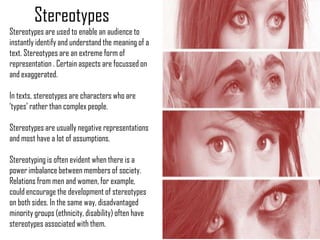
Stereotypes
Stereotypes are used to enable an audience to
instantly identify and understand the meaning of a
text. Stereotypes are an extreme form of
representation . Certain aspects are focussed on
and exaggerated.

In texts, stereotypes are characters who are
‘types’ rather than complex people.

Stereotypes are usually negative representations
and most have a lot of assumptions.

Stereotyping is often evident when there is a
power imbalance between members of society.
Relations from men and women, for example,
could encourage the development of stereotypes
on both sides. In the same way, disadvantaged
minority groups (ethnicity, disability) often have
stereotypes associated with them.
TASK
What stereotypes have you used in your trailer? Why did you
use them? What initial interpretation did you intend your
audience to make? How do stereotypes aid understanding of
the narrative/genre?
Ideology
O’Sullivan States that underpinning most of the media,
various powerful vested interests operate to ensure that
particular representations are manifested.

Noam Chomsky argues that the media serve the
interests of the state and corporate power.

Ideology then is a set of beliefs and ideas that are
presented in a media text. Dominant Ideologies those
which are accepted and understood by the majority of
people as part of our culture and expectations.

What dominant Ideologies govern our society? How do
stereotypes in media texts help to re-affirm and
reinforce these?
Task
Watch these trailers – what ideologies are reinforced? How have stereotypes been
used to portray this?

Ideal 2.4 family set up, living in suburbia. Threat to the family unit
http://www.youtube.com/watch?v=MRJA3lN0xCQ

Threat of otherness (to western society), defining masculinity?
http://www.youtube.com/watch?v=qDMXkPfxjOc#

Working mother – is it manageable? Should women concentrate on either
motherhood or career – can you do both?
http://www.youtube.com/watch?v=Uv1QsQN78Hk


Now watch your trailer – what ideologies are
embedded within your work? Is Chomsky correct?
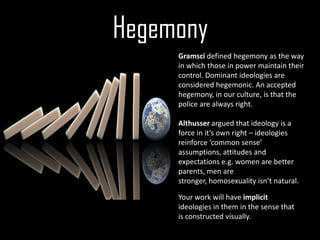
Hegemony
     Gramsci defined hegemony as the way
     in which those in power maintain their
     control. Dominant ideologies are
     considered hegemonic. An accepted
     hegemony, in our culture, is that the
     police are always right.

     Althusser argued that ideology is a
     force in it’s own right – ideologies
     reinforce ‘common sense’
     assumptions, attitudes and
     expectations e.g. women are better
     parents, men are
     stronger, homosexuality isn’t natural.

     Your work will have implicit
     ideologies in them in the sense that
     is constructed visually.

A2 Media Studies: Representation Intro

  • 1.
  • 2.
    What is Representation? •A representation can be a single image, a sequence of images or a whole programme. • The media do not present reality they ‘re-present it’ – they are representing things that have already occurred. How does Representation work? • Representations invite audiences to understand them and agree with them in certain preferred ways. Different interpretations are possible to some extent, depending on the audience.
  • 3.
    The Power of Representations Whatever representations are used, there are ideologies, meanings and values that are implicit in that presentation. Clearly this gives great power and responsibility to media institutions as the representations, to some extent can influence social attitudes to social groups in many ways. In particular some institutions could be accused of starting what Stanley Cohen coins ‘moral panics’.
  • 4.
    Stereotypes Stereotypes are usedto enable an audience to instantly identify and understand the meaning of a text. Stereotypes are an extreme form of representation . Certain aspects are focussed on and exaggerated. In texts, stereotypes are characters who are ‘types’ rather than complex people. Stereotypes are usually negative representations and most have a lot of assumptions. Stereotyping is often evident when there is a power imbalance between members of society. Relations from men and women, for example, could encourage the development of stereotypes on both sides. In the same way, disadvantaged minority groups (ethnicity, disability) often have stereotypes associated with them.
  • 5.
    TASK What stereotypes haveyou used in your trailer? Why did you use them? What initial interpretation did you intend your audience to make? How do stereotypes aid understanding of the narrative/genre?
  • 6.
    Ideology O’Sullivan States thatunderpinning most of the media, various powerful vested interests operate to ensure that particular representations are manifested. Noam Chomsky argues that the media serve the interests of the state and corporate power. Ideology then is a set of beliefs and ideas that are presented in a media text. Dominant Ideologies those which are accepted and understood by the majority of people as part of our culture and expectations. What dominant Ideologies govern our society? How do stereotypes in media texts help to re-affirm and reinforce these?
  • 7.
    Task Watch these trailers– what ideologies are reinforced? How have stereotypes been used to portray this? Ideal 2.4 family set up, living in suburbia. Threat to the family unit http://www.youtube.com/watch?v=MRJA3lN0xCQ Threat of otherness (to western society), defining masculinity? http://www.youtube.com/watch?v=qDMXkPfxjOc# Working mother – is it manageable? Should women concentrate on either motherhood or career – can you do both? http://www.youtube.com/watch?v=Uv1QsQN78Hk Now watch your trailer – what ideologies are embedded within your work? Is Chomsky correct?
  • 8.
    Hegemony Gramsci defined hegemony as the way in which those in power maintain their control. Dominant ideologies are considered hegemonic. An accepted hegemony, in our culture, is that the police are always right. Althusser argued that ideology is a force in it’s own right – ideologies reinforce ‘common sense’ assumptions, attitudes and expectations e.g. women are better parents, men are stronger, homosexuality isn’t natural. Your work will have implicit ideologies in them in the sense that is constructed visually.