AUDIENCE THEORISTS 
Connor Crosby
JEREMY TUNSTALL – PRIMARY, SECONDARY, 
TERTIARY AUDIENCE ENGAGEMENT 
Primary, Secondary, Tertiary Audience Engagement: "Watching films in a cinema 
involve a primary mode of audience engagement as the spectator is immersed with the 
narrative while watching a programme at home on television may involve eating a meal 
at the same time, texting, using social media or other additional activities. Tertiary 
audience engagement is using the text as background media like music radio". 
– Primary (close attention) e.g. cinema, books 
– Secondary (the medium in question is relegated to the background) e.g. Radio, some 
TV, music 
– Tertiary (although medium is present, no conscious monitoring takes place) e.g. 
pictures
BLUMLER AND KATZ – USES AND 
GRATIFICATIONS THEORY 
Uses and Gratifications Theory: "Different audiences gain different pleasures from a 
media text e.g. Gravity can be enjoyed via diversion or escapism, it can use surveillance 
to give information to audiences and can also be discussed on forums and blogs as a 
form of developing personal relationships(common also in video games). Personal 
identity can be developed with audiences who relate to certain characters more than 
others". The Uses and Gratifications Theory follows a basic model. It is an audience-centered 
approach. When an audience actively seeks out media, they are typically 
seeking it in order to gratify a need. For example, in social situations, people may feel 
more confident and knowledgeable when they have specific facts and stories from 
media to add to conversation. By seeking out media, a person fulfils a need to be 
informed.
KATZ AND LARZASFELD – TWO-STEP 
FLOW THEORY 
Two Step Flow Theory: "Jonathan Ross discussed with his guest Steve Coogan the 
recent phone hacking scandal and made it clear he had an opinion on the subject - this 
reflects the Two Step Flow theory where an existing idea or belief is taken on by an 
opinion leader (as in newspapers as the 'Fourth Estate')". This theory asserts that 
information from the media moves in two distinct stages. First, individuals (opinion 
leaders) who pay close attention to the mass media and its messages receive the 
information. Opinion leaders pass on their own interpretations in addition to the 
actual media content.
ADORNO – PASSIVE CONSUMPTION, 
HYPODERMIC MODEL (FRANKFURT 
SCHOOL) 
Passive Consumption, Hypodermic Model (Frankfurt School): "A strong argument 
suggests that audiences may be passively affected by the sexist, violent representations 
in GTAV as it is a more realist text than other shoot em' up action adventure games. 
Young audiences ultimately may begin to view women differently and think that the 
aspirational violence is acceptable as a means to an end". The hypodermic needle 
model (also known as the hypodermic-syringe model, transmission-belt model, 
or magic bullet theory) is a model of communications suggesting that an intended 
message is directly received and wholly accepted by the receiver.
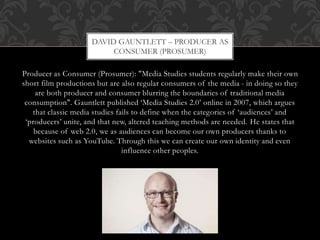
DAVID GAUNTLETT – PRODUCER AS 
CONSUMER (PROSUMER) 
Producer as Consumer (Prosumer): "Media Studies students regularly make their own 
short film productions but are also regular consumers of the media - in doing so they 
are both producer and consumer blurring the boundaries of traditional media 
consumption". Gauntlett published ‘Media Studies 2.0’ online in 2007, which argues 
that classic media studies fails to define when the categories of ‘audiences’ and 
‘producers’ unite, and that new, altered teaching methods are needed. He states that 
because of web 2.0, we as audiences can become our own producers thanks to 
websites such as YouTube. Through this we can create our own identity and even 
influence other peoples.
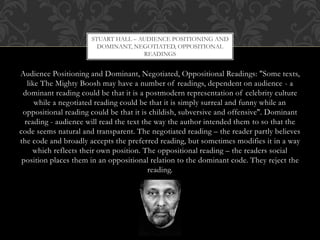
STUART HALL – AUDIENCE POSITIONING AND 
DOMINANT, NEGOTIATED, OPPOSITIONAL 
READINGS 
Audience Positioning and Dominant, Negotiated, Oppositional Readings: "Some texts, 
like The Mighty Boosh may have a number of readings, dependent on audience - a 
dominant reading could be that it is a postmodern representation of celebrity culture 
while a negotiated reading could be that it is simply surreal and funny while an 
oppositional reading could be that it is childish, subversive and offensive". Dominant 
reading - audience will read the text the way the author intended them to so that the 
code seems natural and transparent. The negotiated reading – the reader partly believes 
the code and broadly accepts the preferred reading, but sometimes modifies it in a way 
which reflects their own position. The oppositional reading – the readers social 
position places them in an oppositional relation to the dominant code. They reject the 
reading.
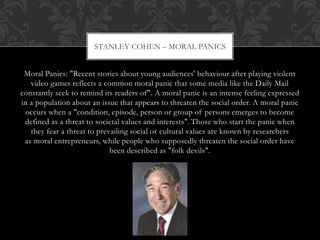
STANLEY COHEN – MORAL PANICS 
Moral Panics: "Recent stories about young audiences' behaviour after playing violent 
video games reflects a common moral panic that some media like the Daily Mail 
constantly seek to remind its readers of". A moral panic is an intense feeling expressed 
in a population about an issue that appears to threaten the social order. A moral panic 
occurs when a "condition, episode, person or group of persons emerges to become 
defined as a threat to societal values and interests". Those who start the panic when 
they fear a threat to prevailing social or cultural values are known by researchers 
as moral entrepreneurs, while people who supposedly threaten the social order have 
been described as "folk devils".
MARTIN BARKER – CHALLENGING 
MORAL PANICS 
Challenging Moral Panics: "Barker suggests once you have entered into a debate about 
violent video games for example you must have already decided about negative media 
effects". Martin Baker said “you can only have a witch-hunt if you believe in the 
existence of witchcraft. You must have already decided in negative media effects if 
your question is “does this product have the potential to deprave its audience ?””
GEORGE GERBNER – CULTIVATION 
THEORY 
Cultivation Theory: "The cultivation theory suggests that the more you look at 
television, the more you are likely to believe in the reality of the representation e.g. 
believing everything you see and hear on BBC News 24 and not challenging the nature 
of a constructed text". Gerbner claimed that because TV contains so much violence, 
“people who spend the most time in front of the tube develop an exaggerated belief in 
a mean and scary world.” He also said “today, the TV set is a key member of the 
household, with virtually unlimited access to every person in the family.”He compared 
the power of television to the power of religion, saying that television was to modern 
society what religion once was in earlier times.

Audience Theorists

  • 1.
  • 2.
    JEREMY TUNSTALL –PRIMARY, SECONDARY, TERTIARY AUDIENCE ENGAGEMENT Primary, Secondary, Tertiary Audience Engagement: "Watching films in a cinema involve a primary mode of audience engagement as the spectator is immersed with the narrative while watching a programme at home on television may involve eating a meal at the same time, texting, using social media or other additional activities. Tertiary audience engagement is using the text as background media like music radio". – Primary (close attention) e.g. cinema, books – Secondary (the medium in question is relegated to the background) e.g. Radio, some TV, music – Tertiary (although medium is present, no conscious monitoring takes place) e.g. pictures
  • 3.
    BLUMLER AND KATZ– USES AND GRATIFICATIONS THEORY Uses and Gratifications Theory: "Different audiences gain different pleasures from a media text e.g. Gravity can be enjoyed via diversion or escapism, it can use surveillance to give information to audiences and can also be discussed on forums and blogs as a form of developing personal relationships(common also in video games). Personal identity can be developed with audiences who relate to certain characters more than others". The Uses and Gratifications Theory follows a basic model. It is an audience-centered approach. When an audience actively seeks out media, they are typically seeking it in order to gratify a need. For example, in social situations, people may feel more confident and knowledgeable when they have specific facts and stories from media to add to conversation. By seeking out media, a person fulfils a need to be informed.
  • 4.
    KATZ AND LARZASFELD– TWO-STEP FLOW THEORY Two Step Flow Theory: "Jonathan Ross discussed with his guest Steve Coogan the recent phone hacking scandal and made it clear he had an opinion on the subject - this reflects the Two Step Flow theory where an existing idea or belief is taken on by an opinion leader (as in newspapers as the 'Fourth Estate')". This theory asserts that information from the media moves in two distinct stages. First, individuals (opinion leaders) who pay close attention to the mass media and its messages receive the information. Opinion leaders pass on their own interpretations in addition to the actual media content.
  • 5.
    ADORNO – PASSIVECONSUMPTION, HYPODERMIC MODEL (FRANKFURT SCHOOL) Passive Consumption, Hypodermic Model (Frankfurt School): "A strong argument suggests that audiences may be passively affected by the sexist, violent representations in GTAV as it is a more realist text than other shoot em' up action adventure games. Young audiences ultimately may begin to view women differently and think that the aspirational violence is acceptable as a means to an end". The hypodermic needle model (also known as the hypodermic-syringe model, transmission-belt model, or magic bullet theory) is a model of communications suggesting that an intended message is directly received and wholly accepted by the receiver.
  • 6.
    DAVID GAUNTLETT –PRODUCER AS CONSUMER (PROSUMER) Producer as Consumer (Prosumer): "Media Studies students regularly make their own short film productions but are also regular consumers of the media - in doing so they are both producer and consumer blurring the boundaries of traditional media consumption". Gauntlett published ‘Media Studies 2.0’ online in 2007, which argues that classic media studies fails to define when the categories of ‘audiences’ and ‘producers’ unite, and that new, altered teaching methods are needed. He states that because of web 2.0, we as audiences can become our own producers thanks to websites such as YouTube. Through this we can create our own identity and even influence other peoples.
  • 7.
    STUART HALL –AUDIENCE POSITIONING AND DOMINANT, NEGOTIATED, OPPOSITIONAL READINGS Audience Positioning and Dominant, Negotiated, Oppositional Readings: "Some texts, like The Mighty Boosh may have a number of readings, dependent on audience - a dominant reading could be that it is a postmodern representation of celebrity culture while a negotiated reading could be that it is simply surreal and funny while an oppositional reading could be that it is childish, subversive and offensive". Dominant reading - audience will read the text the way the author intended them to so that the code seems natural and transparent. The negotiated reading – the reader partly believes the code and broadly accepts the preferred reading, but sometimes modifies it in a way which reflects their own position. The oppositional reading – the readers social position places them in an oppositional relation to the dominant code. They reject the reading.
  • 8.
    STANLEY COHEN –MORAL PANICS Moral Panics: "Recent stories about young audiences' behaviour after playing violent video games reflects a common moral panic that some media like the Daily Mail constantly seek to remind its readers of". A moral panic is an intense feeling expressed in a population about an issue that appears to threaten the social order. A moral panic occurs when a "condition, episode, person or group of persons emerges to become defined as a threat to societal values and interests". Those who start the panic when they fear a threat to prevailing social or cultural values are known by researchers as moral entrepreneurs, while people who supposedly threaten the social order have been described as "folk devils".
  • 9.
    MARTIN BARKER –CHALLENGING MORAL PANICS Challenging Moral Panics: "Barker suggests once you have entered into a debate about violent video games for example you must have already decided about negative media effects". Martin Baker said “you can only have a witch-hunt if you believe in the existence of witchcraft. You must have already decided in negative media effects if your question is “does this product have the potential to deprave its audience ?””
  • 10.
    GEORGE GERBNER –CULTIVATION THEORY Cultivation Theory: "The cultivation theory suggests that the more you look at television, the more you are likely to believe in the reality of the representation e.g. believing everything you see and hear on BBC News 24 and not challenging the nature of a constructed text". Gerbner claimed that because TV contains so much violence, “people who spend the most time in front of the tube develop an exaggerated belief in a mean and scary world.” He also said “today, the TV set is a key member of the household, with virtually unlimited access to every person in the family.”He compared the power of television to the power of religion, saying that television was to modern society what religion once was in earlier times.