Real-time Multimedia Monitoring in
Large-Scale Wireless Multimedia Sensor
    Networks: Research Challenges
    Joint work by:
    M.Cesana, A.Redondi – Politecnico di Milano
    N. Tiglao, A. Grilo – INESC-ID/INOV/IST
    J. M. Barcelo-Ordinas, M. Alaei – Universitat Politecnica de Catalunya
    P. Todorova – Fraunhofer FOKUS
MWMSN Project

   Multi-tier Wireless Multimedia Sensor
  Networks
   Goal: To enable support for enhanced
  monitoring and tracking applications through
  multimedia visual/audio wireless sensor nodes


                  NGI 2012, Karlskrona, Sweden    2
Outline

   Introduction
   Real-time multimedia monitoring applications
   Efficient delivery of visual data in WMSNs
     MAC Layer
     Network Layer
     Transport Layer
   Research challenges and final discussion


                    NGI 2012, Karlskrona, Sweden   3
Introduction
  WSN equipped with multimedia sensors give
 birth to WMSN.

  They enable a new class of monitoring
 applications, but demanding in terms of:
    computational resources
    energy resources

  Need for innovative solutions:
    combination/optimization techniques at
   the different layers of the protocol stack
                     NGI 2012, Karlskrona, Sweden   4
Real-Time Multimedia Monitoring

  Supervised monitoring (Image/Video-based)
    Delivery of compressed image/video flows,
   analyzed by a human operator

    Low bitrate achievable with complex encoders
   (e.g. H.264/AVC), not supported by WMSN

    Suitable solutions: Object-based approaches,
   Distributed Video Coding

    Challenge: Successful implementation of these
   techniques
                    NGI 2012, Karlskrona, Sweden     5
Real-Time Multimedia Monitoring

  Unsupervised monitoring (Feature-based)
    Use visual features to describe the underlying pixel
   content

    Suitable for a broad range of monitoring tasks
   (e.g., object recognition, face detection…)

    Main challenges:
       Coding of visual features
       Low-complexity feature extraction algorithms
       Rate-accuracy models for resources allocation

                     NGI 2012, Karlskrona, Sweden       6
MAC Layer

  Main requirements for video streaming
 over WMSN:
    Steady-flow of information
    Delay-bounded delivery of packets

  As a consequence, the MAC layer has to:
    support reliable communication
    be QoS-aware
    save as much energy as possible


                    NGI 2012, Karlskrona, Sweden   7
MAC Layer – available solutions

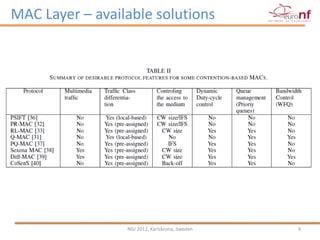
  Available solutions to tune QoS metrics:
    Power control
    Traffic class differentiation (Q-MAC)
    Contention-free vs. contention-based approaches
    Duty-cycling control
    Queuing and scheduling mechanisms
    Error control mechanisms

  For WMSN, most important features are:
    Intra/Inter-node traffic class differentiation
    Node synchronization (duty-cycling control)

                     NGI 2012, Karlskrona, Sweden      8
MAC Layer – available solutions


                 NGI 2012, Karlskrona, Sweden   9
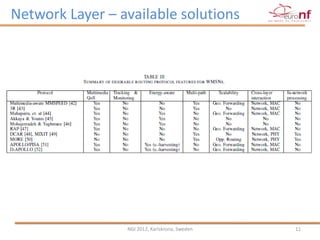
Network Layer: Routing
 Traditional solutions for WSN focused on energy
consumption
 In the WMSN case, need also for real-time
delivery
 Desirable features
    Traffic differentiation and joint-optimization of
   multiple QoS goals
    Resource balancing
    Fast adaptation to change in monitoring conditions
    Support to in-network processing / cross-layer opt.
    Scalability
    Energy-harvesting awareness
                     NGI 2012, Karlskrona, Sweden      10
Network Layer – available solutions


                 NGI 2012, Karlskrona, Sweden   11
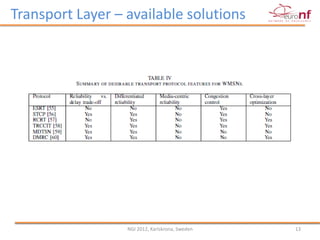
Transport Layer
 Similarly to the network layer case, available
solutions are not suitable for WMSN.

 Design guidelines
    Differentiated reliability
    Trade-off between reliability/timeliness
    Media-centric collaborative reliability
    Congestion control
    Cross-layer optimization


                      NGI 2012, Karlskrona, Sweden   12
Transport Layer – available solutions


                  NGI 2012, Karlskrona, Sweden   13
Collaborative Sensing in WMSN
 Multimedia nodes are characterized by a
directional sensing model (FoV)

 They can be grouped basing on their common
sensing coverage

 Several challenges
    Directional coverage
    Clustering / Scheduling
    Collaboration protocols

                     NGI 2012, Karlskrona, Sweden   14
Conclusions and Research Challenges
 Application Layer (feature-based):
   Novel coding techniques
   Practical implementations
 MAC Layer
   Service differentiation
   Dynamic duty-cycling control
 Network Layer:
   In-network processing
   Energy harvesting
 Transport Layer
   Media-centric reliability
   Cross-layer optimization with routing
                     NGI 2012, Karlskrona, Sweden   15
Thank your for your attention!


          NGI 2012, Karlskrona, Sweden   16
Project Members
   M. Cesana, A. Redondi – {cesana,
  redondi}@elet.polimi.it
      Multimedia coding, Application
   N. Tiglao, A. Grilo – {nestor.tiglao,
  antonio.grilo}@inesc-id.pt
      Routing and Transport
   J. M. Barcelo-Ordinas, M. Alaei –
  {joseb,malaei}@ac.upc.edu
      MAC Layer
   P. Todorova –
  petia.todorova@fokus.fraunhofer.de
      Collaborative Sensing
                     NGI 2012, Karlskrona, Sweden   17

Wireless Multimedia Sensor Networks

  • 1.
    Real-time Multimedia Monitoringin Large-Scale Wireless Multimedia Sensor Networks: Research Challenges Joint work by: M.Cesana, A.Redondi – Politecnico di Milano N. Tiglao, A. Grilo – INESC-ID/INOV/IST J. M. Barcelo-Ordinas, M. Alaei – Universitat Politecnica de Catalunya P. Todorova – Fraunhofer FOKUS
  • 2.
    MWMSN Project  Multi-tier Wireless Multimedia Sensor Networks  Goal: To enable support for enhanced monitoring and tracking applications through multimedia visual/audio wireless sensor nodes NGI 2012, Karlskrona, Sweden 2
  • 3.
    Outline Introduction  Real-time multimedia monitoring applications  Efficient delivery of visual data in WMSNs  MAC Layer  Network Layer  Transport Layer  Research challenges and final discussion NGI 2012, Karlskrona, Sweden 3
  • 4.
    Introduction  WSNequipped with multimedia sensors give birth to WMSN.  They enable a new class of monitoring applications, but demanding in terms of:  computational resources  energy resources  Need for innovative solutions:  combination/optimization techniques at the different layers of the protocol stack NGI 2012, Karlskrona, Sweden 4
  • 5.
    Real-Time Multimedia Monitoring  Supervised monitoring (Image/Video-based)  Delivery of compressed image/video flows, analyzed by a human operator  Low bitrate achievable with complex encoders (e.g. H.264/AVC), not supported by WMSN  Suitable solutions: Object-based approaches, Distributed Video Coding  Challenge: Successful implementation of these techniques NGI 2012, Karlskrona, Sweden 5
  • 6.
    Real-Time Multimedia Monitoring  Unsupervised monitoring (Feature-based)  Use visual features to describe the underlying pixel content  Suitable for a broad range of monitoring tasks (e.g., object recognition, face detection…)  Main challenges:  Coding of visual features  Low-complexity feature extraction algorithms  Rate-accuracy models for resources allocation NGI 2012, Karlskrona, Sweden 6
  • 7.
    MAC Layer Main requirements for video streaming over WMSN:  Steady-flow of information  Delay-bounded delivery of packets  As a consequence, the MAC layer has to:  support reliable communication  be QoS-aware  save as much energy as possible NGI 2012, Karlskrona, Sweden 7
  • 8.
    MAC Layer –available solutions  Available solutions to tune QoS metrics:  Power control  Traffic class differentiation (Q-MAC)  Contention-free vs. contention-based approaches  Duty-cycling control  Queuing and scheduling mechanisms  Error control mechanisms  For WMSN, most important features are:  Intra/Inter-node traffic class differentiation  Node synchronization (duty-cycling control) NGI 2012, Karlskrona, Sweden 8
  • 9.
    MAC Layer –available solutions NGI 2012, Karlskrona, Sweden 9
  • 10.
    Network Layer: Routing Traditional solutions for WSN focused on energy consumption  In the WMSN case, need also for real-time delivery  Desirable features  Traffic differentiation and joint-optimization of multiple QoS goals  Resource balancing  Fast adaptation to change in monitoring conditions  Support to in-network processing / cross-layer opt.  Scalability  Energy-harvesting awareness NGI 2012, Karlskrona, Sweden 10
  • 11.
    Network Layer –available solutions NGI 2012, Karlskrona, Sweden 11
  • 12.
    Transport Layer  Similarlyto the network layer case, available solutions are not suitable for WMSN.  Design guidelines  Differentiated reliability  Trade-off between reliability/timeliness  Media-centric collaborative reliability  Congestion control  Cross-layer optimization NGI 2012, Karlskrona, Sweden 12
  • 13.
    Transport Layer –available solutions NGI 2012, Karlskrona, Sweden 13
  • 14.
    Collaborative Sensing inWMSN  Multimedia nodes are characterized by a directional sensing model (FoV)  They can be grouped basing on their common sensing coverage  Several challenges  Directional coverage  Clustering / Scheduling  Collaboration protocols NGI 2012, Karlskrona, Sweden 14
  • 15.
    Conclusions and ResearchChallenges  Application Layer (feature-based):  Novel coding techniques  Practical implementations  MAC Layer  Service differentiation  Dynamic duty-cycling control  Network Layer:  In-network processing  Energy harvesting  Transport Layer  Media-centric reliability  Cross-layer optimization with routing NGI 2012, Karlskrona, Sweden 15
  • 16.
    Thank your foryour attention! NGI 2012, Karlskrona, Sweden 16
  • 17.
    Project Members  M. Cesana, A. Redondi – {cesana, redondi}@elet.polimi.it  Multimedia coding, Application  N. Tiglao, A. Grilo – {nestor.tiglao, antonio.grilo}@inesc-id.pt  Routing and Transport  J. M. Barcelo-Ordinas, M. Alaei – {joseb,malaei}@ac.upc.edu  MAC Layer  P. Todorova – petia.todorova@fokus.fraunhofer.de  Collaborative Sensing NGI 2012, Karlskrona, Sweden 17