EC FIARCH WORKSHOP
GEORGIOS GARDIKIS, GEORGE XILOURIS, NCSR “DEMOKRITOS”
• Promising aspect within the FI scene
    • On-demand signaling of specific network-layer metrics
      to querying applications aiming in optimization of
      application behavior and performance
    • Within the generic “Resource Awareness” FI design
      principle.


2
• Present model: implicit derivation of network status
      (e.g. TCP)
    • Applications assume network conditions by observing
      their own performance
    • Implicit network awareness has survived during the
      years, and works well for most of the applications
    • It is also scalable


3
• Gradual paradigm shift from host-centric to content-centric
      communication
    • Existing implicit mechanisms may be not as efficient due to new
      communication architectures, beyond the traditional client-server:
        – peer-to-peer
        – CDNs/Content-centric networks
        – in-network clouds etc.
    • Content is distributed into the network, rather than concentrated
      in a single server -> simultaneous communication with
      tens, hundreds, or even thousands of peers.
    • Assessing the communication with each of these peers at
      application level via the usual in-band methods would pose
      significant overhead in the network, besides requiring a
      considerable amount of time.


4
• A scalable and efficient way to provide explicit Network Awareness
    • Offered by Network Operators (or third-parties)
    • “Network Cost” (NC) assessment for any given pair or group of
      network endpoints.
    • NC could be instantly exploited at application level in order to
      optimize operations such as in-network content placement, peer
      selection, prioritization and load balancing.
    • A similar approach is promoted by the Application Layer Traffic
      Optimisation (ALTO) WG of the IETF


5
• peer-to-peer file sharing and streaming - for optimizing p2p
      communication via selection of “best peers” i.e. peers with lower
      NC
    • one-to-one and one-to-many real-time audiovisual communication
      – for a priori optimizing stream format and rate according to NC
    • distributed caching, Content-Delivery Networks (CDN) and
      Information Centric Networking (ICN) – for choosing optimal
      locations for caching content within the network
    • in-network clouds – for efficient load balancing, traffic distribution
      and resource transfer to optimal locations, including Virtual
      Machine (VM) migration.


6
7
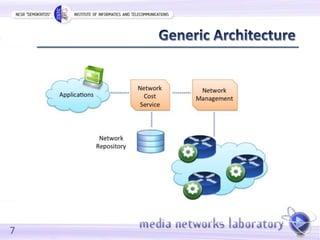
• Network Cost Query: pair or group of endpoints’
      addresses, optionally application type (for application-aware
      networks)
    • Response: Network Cost vector


       where ci(a,b), denotes a certain network metric between
       endpoints a and b (e.g. hop count, one-way delay, average packet
       loss, jitter/delay variation etc.)
    • Can be transformed to a scalar value, taking into account the
      sensitivity wi of the specific application against each of the
      aforementioned metrics.


8
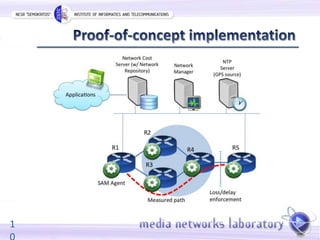
• Customised SNMP agents on Linux-based routers
    • On-demand execution of active end-to-end measurements
      according to the OWAMP protocol (RFC 4656)
    • Configuration of measurements and collection of results over
      SNMP
    • Network Cost provided to applications over SOAP/XML protocol
    • NC elements:
        –   Number of hops traversed
        –   Average One-Way Delay (OWD)
        –   Average packet loss
        –   Average jitter
        –   Percentage of duplicates
    • Also tested on DiffServ-enabled configurations (Network Cost
      varies upon different DSCP values)


9
1
• OpenSource implementation of the SAM framework is available at
                http://medianetlab.gr/opensource

    • Technical information available in the work:

     G. Gardikis, K. Sarsembagieva, G. Xilouris, A. Kourtis, “An SNMP Agent for Active In-
     Network Measurements”, in Proc. ICUMT 2012, October 3-5, 2012, St. Petersburg,
                                      Russia (to appear).


1
• Security and Network Operator Privacy; authentication
      of the querying entity, anti-(D)DoS protection etc.
    • Inter-domain operation – “assembling” NCs across a
      chain of network domains
    • Inclusion of the access network; separate assessment of
      the access link and combining results with edge/core
      network statistics so as to form end-to-end cost in a
      scalable manner


1
www.medianetlab.gr

    xilouris@iit.demokritos.gr


1

Network cost services

  • 1.
    EC FIARCH WORKSHOP GEORGIOSGARDIKIS, GEORGE XILOURIS, NCSR “DEMOKRITOS”
  • 2.
    • Promising aspectwithin the FI scene • On-demand signaling of specific network-layer metrics to querying applications aiming in optimization of application behavior and performance • Within the generic “Resource Awareness” FI design principle. 2
  • 3.
    • Present model:implicit derivation of network status (e.g. TCP) • Applications assume network conditions by observing their own performance • Implicit network awareness has survived during the years, and works well for most of the applications • It is also scalable 3
  • 4.
    • Gradual paradigmshift from host-centric to content-centric communication • Existing implicit mechanisms may be not as efficient due to new communication architectures, beyond the traditional client-server: – peer-to-peer – CDNs/Content-centric networks – in-network clouds etc. • Content is distributed into the network, rather than concentrated in a single server -> simultaneous communication with tens, hundreds, or even thousands of peers. • Assessing the communication with each of these peers at application level via the usual in-band methods would pose significant overhead in the network, besides requiring a considerable amount of time. 4
  • 5.
    • A scalableand efficient way to provide explicit Network Awareness • Offered by Network Operators (or third-parties) • “Network Cost” (NC) assessment for any given pair or group of network endpoints. • NC could be instantly exploited at application level in order to optimize operations such as in-network content placement, peer selection, prioritization and load balancing. • A similar approach is promoted by the Application Layer Traffic Optimisation (ALTO) WG of the IETF 5
  • 6.
    • peer-to-peer filesharing and streaming - for optimizing p2p communication via selection of “best peers” i.e. peers with lower NC • one-to-one and one-to-many real-time audiovisual communication – for a priori optimizing stream format and rate according to NC • distributed caching, Content-Delivery Networks (CDN) and Information Centric Networking (ICN) – for choosing optimal locations for caching content within the network • in-network clouds – for efficient load balancing, traffic distribution and resource transfer to optimal locations, including Virtual Machine (VM) migration. 6
  • 7.
  • 8.
    • Network CostQuery: pair or group of endpoints’ addresses, optionally application type (for application-aware networks) • Response: Network Cost vector where ci(a,b), denotes a certain network metric between endpoints a and b (e.g. hop count, one-way delay, average packet loss, jitter/delay variation etc.) • Can be transformed to a scalar value, taking into account the sensitivity wi of the specific application against each of the aforementioned metrics. 8
  • 9.
    • Customised SNMPagents on Linux-based routers • On-demand execution of active end-to-end measurements according to the OWAMP protocol (RFC 4656) • Configuration of measurements and collection of results over SNMP • Network Cost provided to applications over SOAP/XML protocol • NC elements: – Number of hops traversed – Average One-Way Delay (OWD) – Average packet loss – Average jitter – Percentage of duplicates • Also tested on DiffServ-enabled configurations (Network Cost varies upon different DSCP values) 9
  • 10.
  • 11.
    • OpenSource implementationof the SAM framework is available at http://medianetlab.gr/opensource • Technical information available in the work: G. Gardikis, K. Sarsembagieva, G. Xilouris, A. Kourtis, “An SNMP Agent for Active In- Network Measurements”, in Proc. ICUMT 2012, October 3-5, 2012, St. Petersburg, Russia (to appear). 1
  • 12.
    • Security andNetwork Operator Privacy; authentication of the querying entity, anti-(D)DoS protection etc. • Inter-domain operation – “assembling” NCs across a chain of network domains • Inclusion of the access network; separate assessment of the access link and combining results with edge/core network statistics so as to form end-to-end cost in a scalable manner 1
  • 13.
    www.medianetlab.gr xilouris@iit.demokritos.gr 1