Toyota Production System KAIZEN NAEEM BHAI
Change  Better  Make it better  ( Improvement )
Getting Started What is a Manufacturing Company ? Make  good quality products Selling to Customer Earn Profit Guarantee employee’s better life Bring prosperity to people
Getting Started What is a good Quality product? お客様が満足する製品 我々の給料は、お客様に製品を買ってもらい、その代金の中から支払われる。 すなわち我々の料の源は、お客様である。 従って、続けて給料を貰うには、私達が造った製品をお客様に続けて買ってもらはねばならない。 それには、私達が造った製品にお客様がいつも満足して貰うことが大切である。 Which satisfies the customer Reasonable Price Good Quality On time Delivery After sales service What is Customer Satisfaction?
Cost,Profit & Price Profit Cost Selling Price Selling Price =  Cost + Profit Cost & Profit Profit = Selling Price - Cost Selling Price (Rs) How to earn more profit? Increase the  selling price Reduce the  cost
Cost,Profit & Price Material  cost Purchased Parts cost Other cost Facility cost The expenses depend upon the method of manufacturing Every company is same  (No big difference in a cost components) There is a difference depending on industry Cost Cost (Expense) Based  on TPS Product Manufacturing and the cost KAIZEN Minimum Investment & Maximum Profit
TPS What is MUDA (Waste)? Identified by Tenchi Ohno-Japan Waste is the use of any material or resource beyond what the customer requires and is willing to pay for.
TPS MURI (overburden) MURA (unevenness) MUDA (waste) Value- Added Work   Motions of Worker MUDA= Non Value-Added Work Non Value-Added Work Customer pays money only for  Value-Added Work
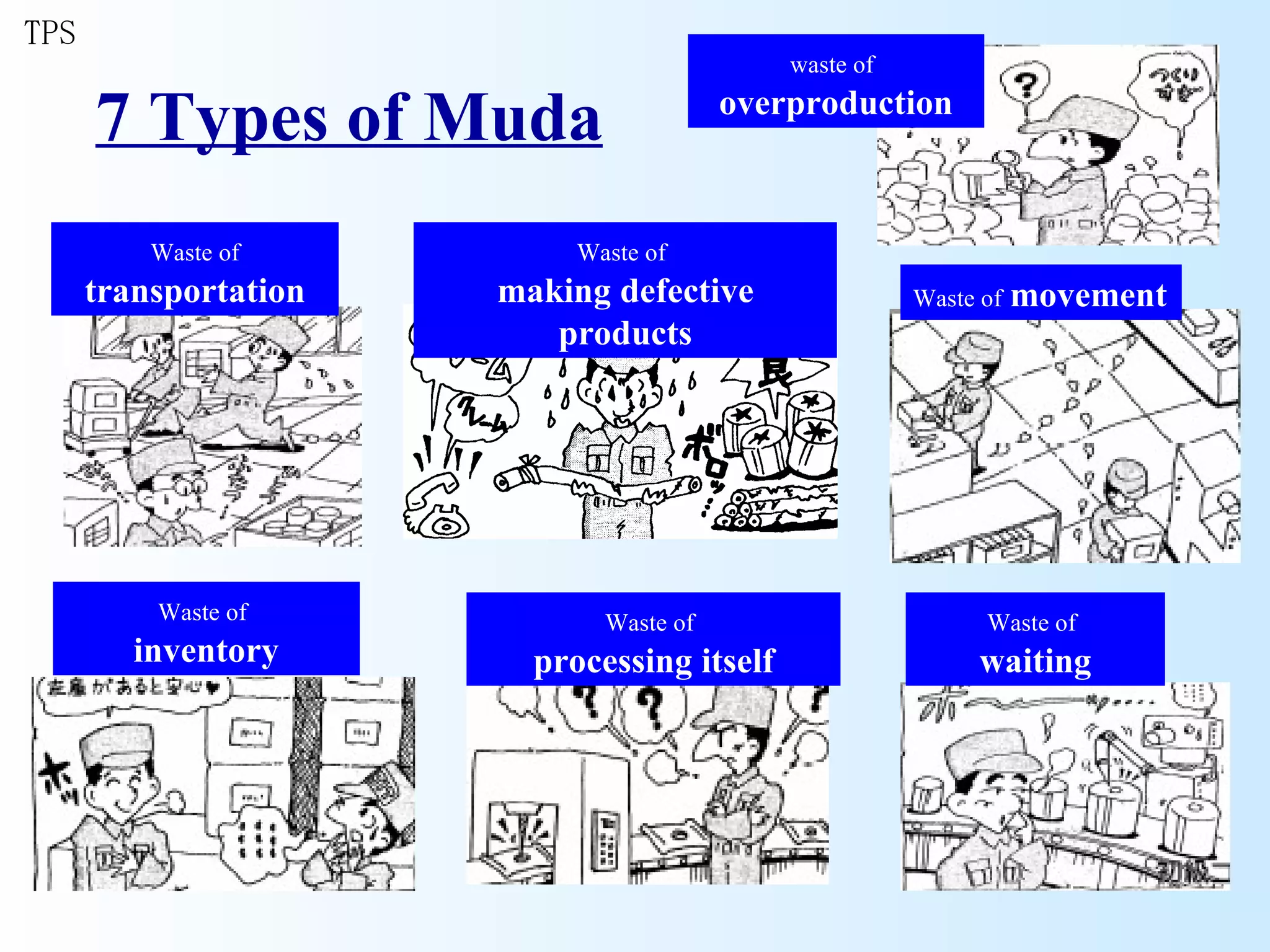
TPS waste of   overproduction Waste of   waiting Waste of   transportation Waste of   processing itself Waste of   inventory Waste of   movement Waste of   making defective products 7 Types of Muda
Inventory Any raw material, work in progress (WIP) or finished goods which are not having value added to them  Caused by:  Production schedule not level  Inaccurate forecasting  Excessive downtime/set up  Push instead of pull  Large batching  Unreliable suppliers  Why one of the 7 Wastes ?:  Adds cost  Extra storage space required  Extra resource to manage  Hides shortages & defects  Can become damaged  Shelf life expires
Over Production To produce sooner, faster or in greater quantities than the absolute customer demand Manufacturing too much, too early or “Just in Case” Overproduction discourages a smooth flow of goods or services Takes the focus away from what the customer really wants Leads to excessive inventory Caused by: MRP push rather than kanban pull Large batch sizes Looks better to be busy! Poor people utilization Lack of customer focus Why one of the 7 wastes ?: Costs money Consumes resource ahead of plan Creates inventory Hides inventory/defect problems Space utilization
Motion Adds cost  Motion is the movement of “man”  Waste motion occurs when individuals move more than is necessary for the process to be completed  Caused by:  No standard operating procedure  Poor housekeeping  Badly designed cell  Inadequate training  Why one of the 7 Wastes ?:  It interrupts production flow  Increases production time  Can cause injury
Waiting People or parts that wait for a work cycle to be completed  Where are the bottlenecks?  What are the major causes of lost machine availability?  What are we doing to improve machine availability?  Do people wait on machinery?  Caused by:  Shortages & unreliable supply chain  Lack of multi-skilling/flexibility  Downtime/Breakdown  Ineffective production planning  Quality, design, engineering Issues  Why one of the 7 Wastes ?:   Stop/start production  Poor workflow continuity  Causes bottlenecks  Long lead times  Failed delivery dates
Transportation Unnecessary movement of parts between processes  Complex material flow paths  Poor close coupling  Wasted floor space  Unnecessary material handling  Potential damage to products  Caused by:  Badly designed process/cell  Poor value stream flow  Complex material flows  Sharing of equipment  Why one of the 7 Wastes ?:  Increases production time  It consumes resource & floorspace  Poor communication  Increases work in progress  Potential damage to products
Over processing Processing beyond the standard required by the customer  By improving processing efficiency we ultimately use less resource to achieve the same customer satisfaction  Caused by:  •  Out of date standards  •  Attitude - ‘Always done it like this’  •  Not understanding the process  •  Lack of innovation & improvement  •  Lack of standard operation procedures  Why one of the 7 Wastes ?:  •  It consumes resource  •  It increases production time  •  It’s work above and beyond specification  •  Can reduce life of component
Non-Right First Time  (Scrap, Rework and Defects) A defect is a component which the customer would deem unacceptable to pass the quality standard  •  Defects reduce or discourage customer satisfaction  •  Defects have to be rectified  •  Rectification costs money with regard to time effort and materials  •  Defects in the field will lose customers  •  Right first time is the key  Caused by:  •  Out of control/Incapable processes  •  Lack of skill,training & on the job support  •  Inaccurate design & engineering  •  Machine inaccuracy  •  Black art processes  Why one of the 7 Wastes ?:  •  Adds costs  •  It interrupts the scheduled • It consumes resources  •  It creates paper work  •  Reduces customer confidence
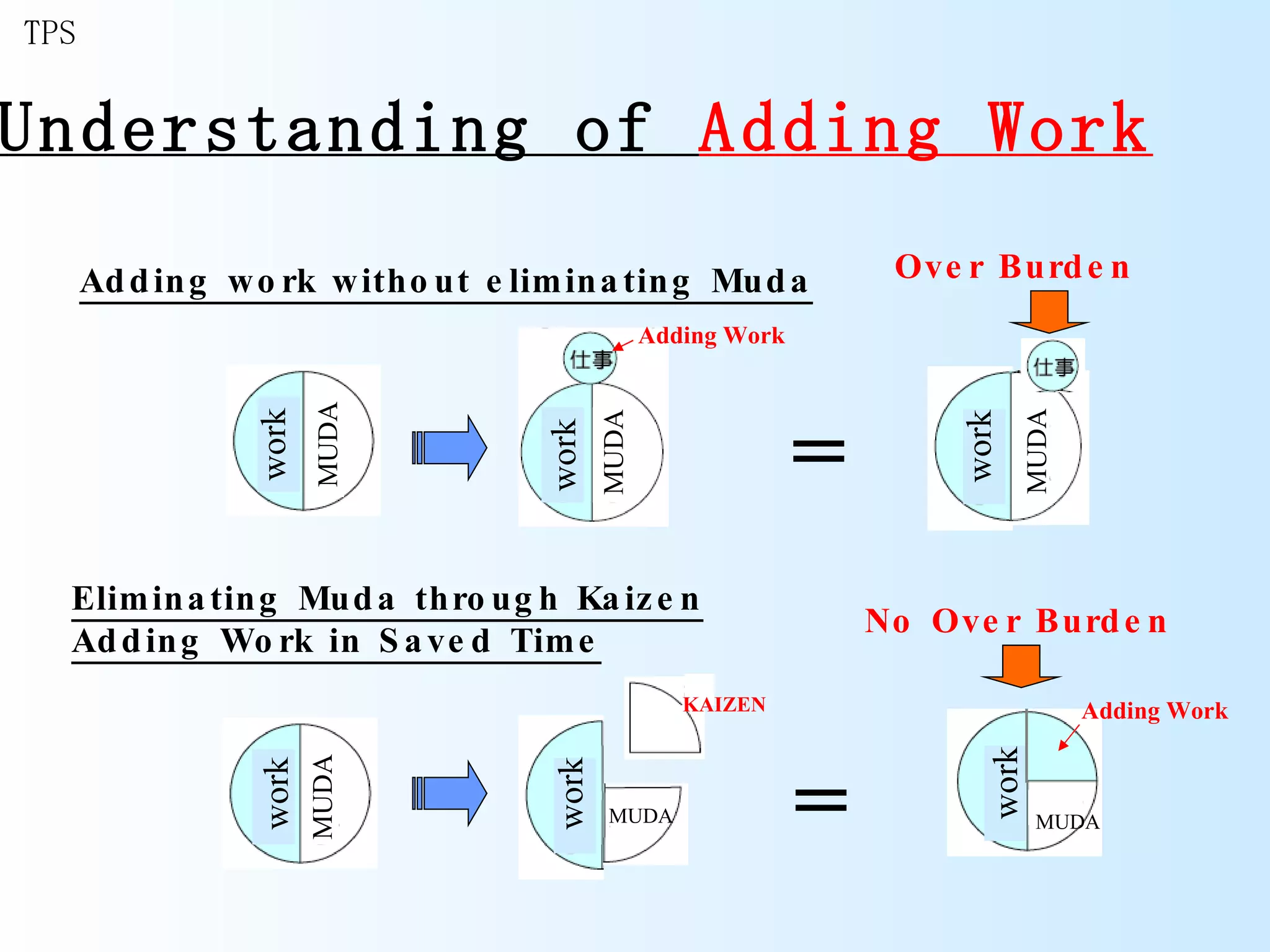
TPS Over Burden Adding work without eliminating Muda Understanding of  Adding Work Eliminating Muda through Kaizen Adding Work in Saved Time = work MUDA work work MUDA MUDA Adding Work No Over Burden work work MUDA KAIZEN MUDA work MUDA = Adding Work
TPS Minimize Lead Time Minimize Non Processing Time Many types of MUDA will be highlighted when we minimize the Non Processing Time Lead Time  =  Processing Time + Non Processing Time = + = LEAD TIME Lead Time : time required to process from start to end (i.e. from raw material processing till packing goods)
Eliminate all MUDA from work site(NO.1) Injection Shop= Ground Floor Assembly Shop=  1 st  Floor Ground Floor Ground Floor+ Use of Trolley [Before] [After]
Eliminate all MUDA from work site(NO.2) ライゼン ビデオ Make Process Flow Video-3 Video-4 punching Jig Assy Jig
Countermeasure (Example-3) サーモソル Waste of   processing itself Waste of   Inventory(W.I.P) Three drill bits for three holes Single tool with three sizes for three holes No need to change tool Achieve Single Piece Flow No WIP 7.0mm 4.0mm 5.5mm
Let’s move  towards continual Kaizen Thank You

Toyota Production System & 7 Muda

  • 1.
    Toyota Production SystemKAIZEN NAEEM BHAI
  • 2.
    Change Better Make it better ( Improvement )
  • 3.
    Getting Started Whatis a Manufacturing Company ? Make good quality products Selling to Customer Earn Profit Guarantee employee’s better life Bring prosperity to people
  • 4.
    Getting Started Whatis a good Quality product? お客様が満足する製品 我々の給料は、お客様に製品を買ってもらい、その代金の中から支払われる。 すなわち我々の料の源は、お客様である。 従って、続けて給料を貰うには、私達が造った製品をお客様に続けて買ってもらはねばならない。 それには、私達が造った製品にお客様がいつも満足して貰うことが大切である。 Which satisfies the customer Reasonable Price Good Quality On time Delivery After sales service What is Customer Satisfaction?
  • 5.
    Cost,Profit & PriceProfit Cost Selling Price Selling Price = Cost + Profit Cost & Profit Profit = Selling Price - Cost Selling Price (Rs) How to earn more profit? Increase the selling price Reduce the cost
  • 6.
    Cost,Profit & PriceMaterial cost Purchased Parts cost Other cost Facility cost The expenses depend upon the method of manufacturing Every company is same (No big difference in a cost components) There is a difference depending on industry Cost Cost (Expense) Based on TPS Product Manufacturing and the cost KAIZEN Minimum Investment & Maximum Profit
  • 7.
    TPS What isMUDA (Waste)? Identified by Tenchi Ohno-Japan Waste is the use of any material or resource beyond what the customer requires and is willing to pay for.
  • 8.
    TPS MURI (overburden)MURA (unevenness) MUDA (waste) Value- Added Work Motions of Worker MUDA= Non Value-Added Work Non Value-Added Work Customer pays money only for Value-Added Work
  • 9.
    TPS waste of overproduction Waste of waiting Waste of transportation Waste of processing itself Waste of inventory Waste of movement Waste of making defective products 7 Types of Muda
  • 10.
    Inventory Any rawmaterial, work in progress (WIP) or finished goods which are not having value added to them Caused by: Production schedule not level Inaccurate forecasting Excessive downtime/set up Push instead of pull Large batching Unreliable suppliers Why one of the 7 Wastes ?: Adds cost Extra storage space required Extra resource to manage Hides shortages & defects Can become damaged Shelf life expires
  • 11.
    Over Production Toproduce sooner, faster or in greater quantities than the absolute customer demand Manufacturing too much, too early or “Just in Case” Overproduction discourages a smooth flow of goods or services Takes the focus away from what the customer really wants Leads to excessive inventory Caused by: MRP push rather than kanban pull Large batch sizes Looks better to be busy! Poor people utilization Lack of customer focus Why one of the 7 wastes ?: Costs money Consumes resource ahead of plan Creates inventory Hides inventory/defect problems Space utilization
  • 12.
    Motion Adds cost Motion is the movement of “man” Waste motion occurs when individuals move more than is necessary for the process to be completed Caused by: No standard operating procedure Poor housekeeping Badly designed cell Inadequate training Why one of the 7 Wastes ?: It interrupts production flow Increases production time Can cause injury
  • 13.
    Waiting People orparts that wait for a work cycle to be completed Where are the bottlenecks? What are the major causes of lost machine availability? What are we doing to improve machine availability? Do people wait on machinery? Caused by: Shortages & unreliable supply chain Lack of multi-skilling/flexibility Downtime/Breakdown Ineffective production planning Quality, design, engineering Issues Why one of the 7 Wastes ?: Stop/start production Poor workflow continuity Causes bottlenecks Long lead times Failed delivery dates
  • 14.
    Transportation Unnecessary movementof parts between processes Complex material flow paths Poor close coupling Wasted floor space Unnecessary material handling Potential damage to products Caused by: Badly designed process/cell Poor value stream flow Complex material flows Sharing of equipment Why one of the 7 Wastes ?: Increases production time It consumes resource & floorspace Poor communication Increases work in progress Potential damage to products
  • 15.
    Over processing Processingbeyond the standard required by the customer By improving processing efficiency we ultimately use less resource to achieve the same customer satisfaction Caused by: • Out of date standards • Attitude - ‘Always done it like this’ • Not understanding the process • Lack of innovation & improvement • Lack of standard operation procedures Why one of the 7 Wastes ?: • It consumes resource • It increases production time • It’s work above and beyond specification • Can reduce life of component
  • 16.
    Non-Right First Time (Scrap, Rework and Defects) A defect is a component which the customer would deem unacceptable to pass the quality standard • Defects reduce or discourage customer satisfaction • Defects have to be rectified • Rectification costs money with regard to time effort and materials • Defects in the field will lose customers • Right first time is the key Caused by: • Out of control/Incapable processes • Lack of skill,training & on the job support • Inaccurate design & engineering • Machine inaccuracy • Black art processes Why one of the 7 Wastes ?: • Adds costs • It interrupts the scheduled • It consumes resources • It creates paper work • Reduces customer confidence
  • 17.
    TPS Over BurdenAdding work without eliminating Muda Understanding of Adding Work Eliminating Muda through Kaizen Adding Work in Saved Time = work MUDA work work MUDA MUDA Adding Work No Over Burden work work MUDA KAIZEN MUDA work MUDA = Adding Work
  • 18.
    TPS Minimize LeadTime Minimize Non Processing Time Many types of MUDA will be highlighted when we minimize the Non Processing Time Lead Time = Processing Time + Non Processing Time = + = LEAD TIME Lead Time : time required to process from start to end (i.e. from raw material processing till packing goods)
  • 19.
    Eliminate all MUDAfrom work site(NO.1) Injection Shop= Ground Floor Assembly Shop= 1 st Floor Ground Floor Ground Floor+ Use of Trolley [Before] [After]
  • 20.
    Eliminate all MUDAfrom work site(NO.2) ライゼン ビデオ Make Process Flow Video-3 Video-4 punching Jig Assy Jig
  • 21.
    Countermeasure (Example-3) サーモソルWaste of processing itself Waste of Inventory(W.I.P) Three drill bits for three holes Single tool with three sizes for three holes No need to change tool Achieve Single Piece Flow No WIP 7.0mm 4.0mm 5.5mm
  • 22.
    Let’s move towards continual Kaizen Thank You