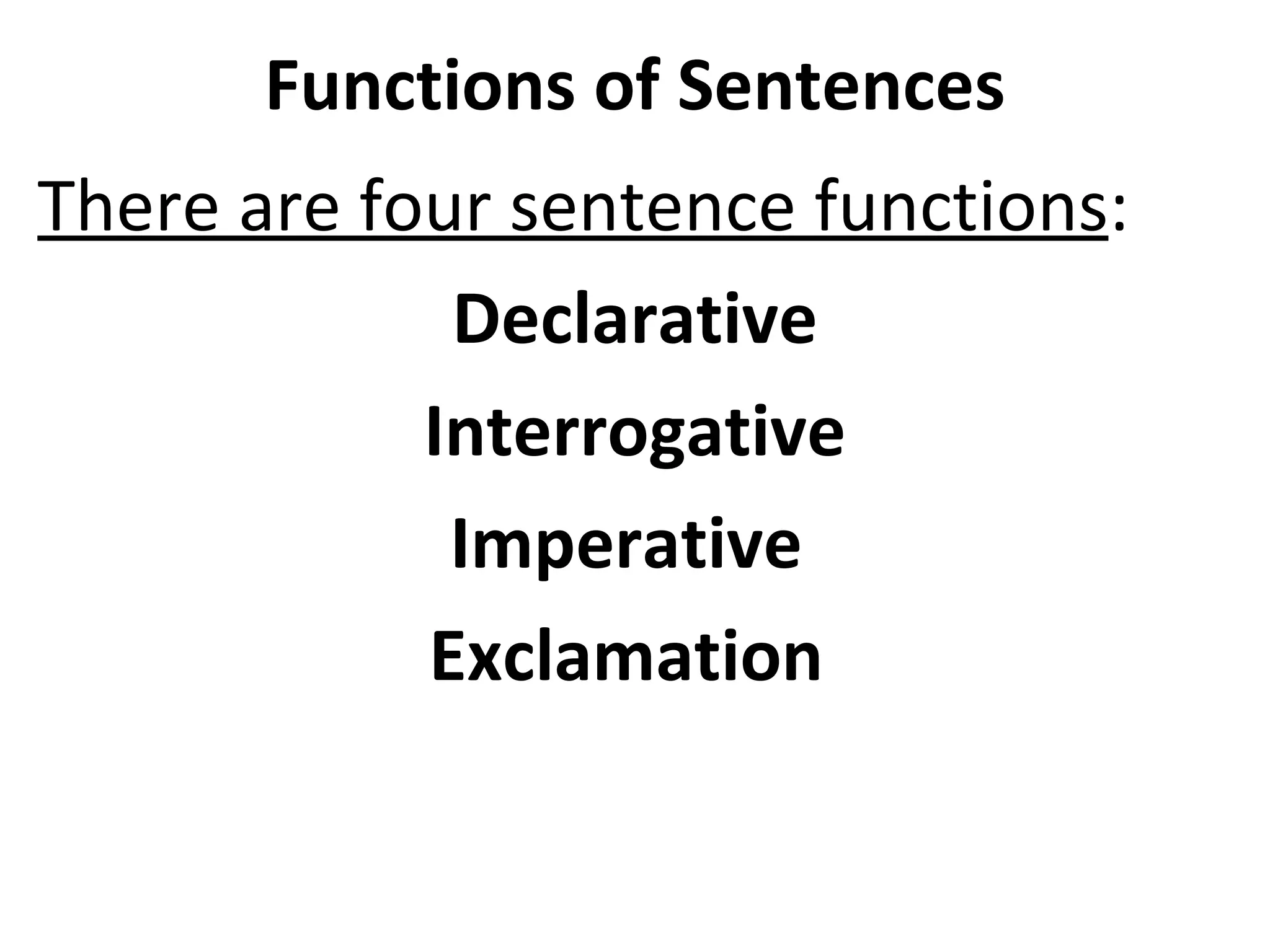
Functions of Sentences There are four sentence functions :  Declarative Interrogative Imperative  Exclamation
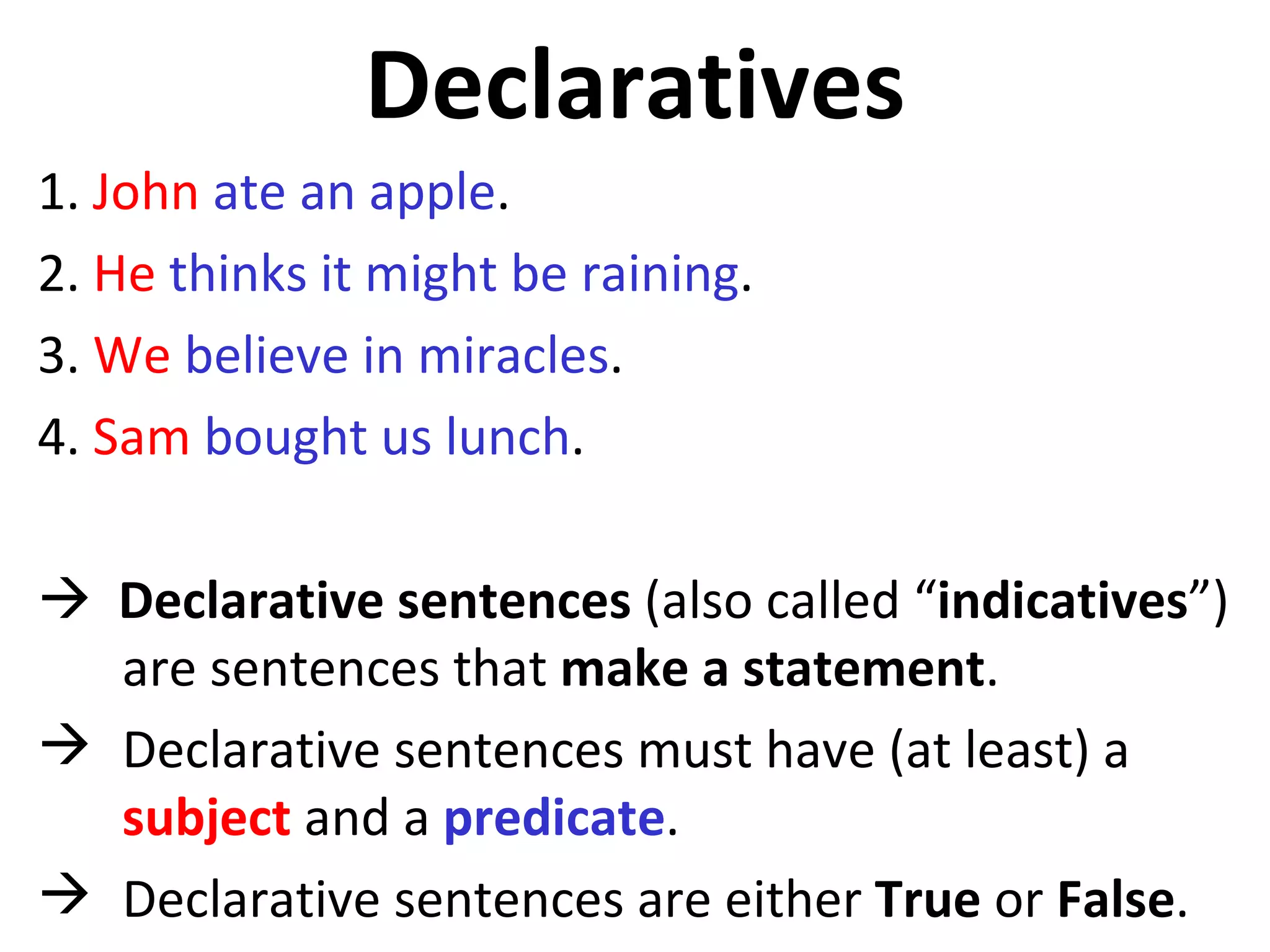
Declaratives 1.  John   ate an apple .  2.  He   thinks it might be raining .  3.  We   believe in miracles .  4.  Sam   bought us lunch .     Declarative sentences  (also called “ indicatives ”) are sentences that  make a statement .  Declarative sentences must have (at least) a  subject  and a  predicate .  Declarative sentences are either  True  or  False .
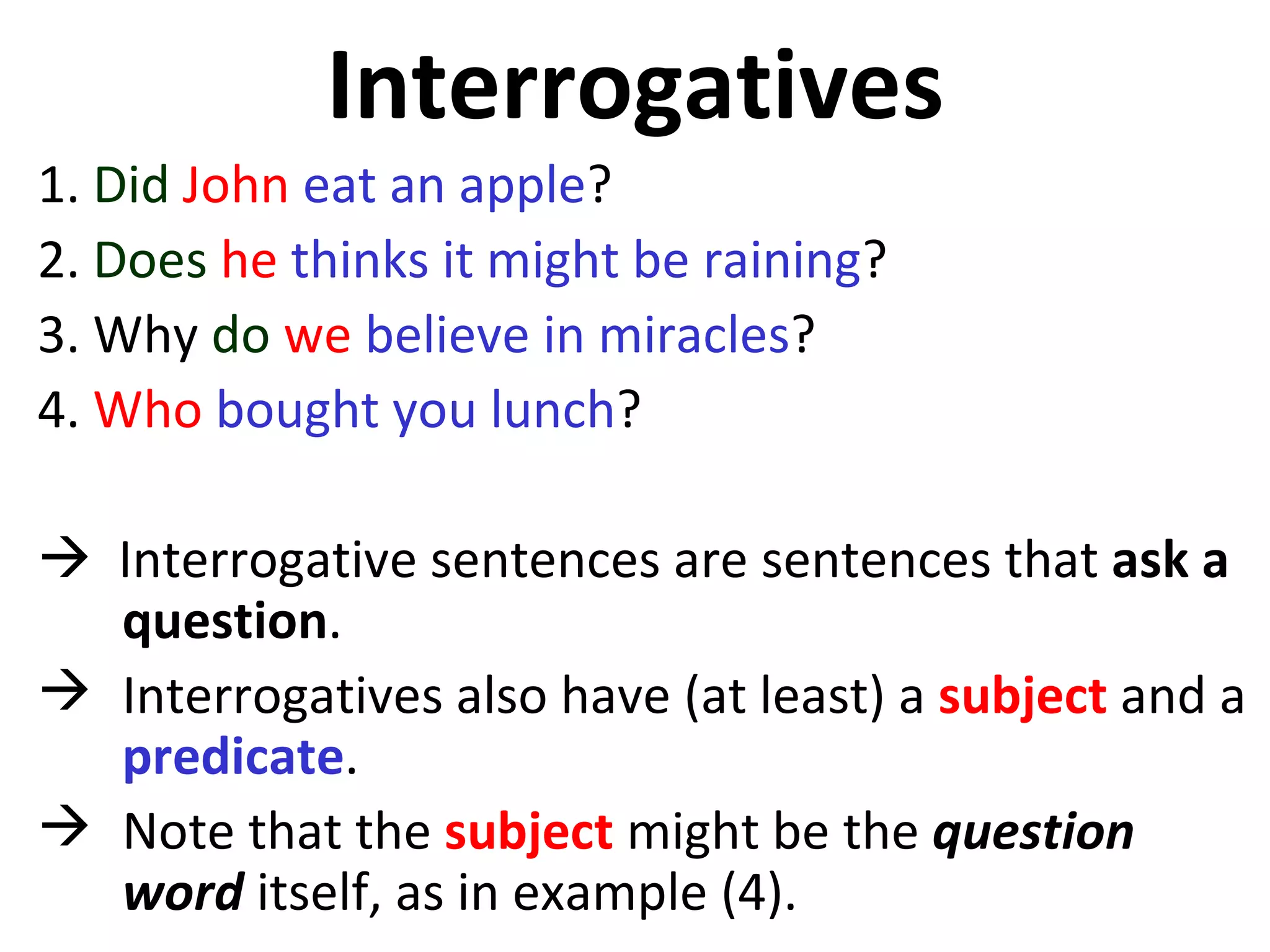
Interrogatives 1.  Did   John   eat an apple ?  2.  Does   he   thinks it might be raining ?  3. Why  do   we   believe in miracles ?  4.  Who   bought you lunch ?     Interrogative sentences are sentences that  ask a question .  Interrogatives also have (at least) a  subject  and a  predicate .  Note that the  subject  might be the  question word  itself, as in example (4).
Interrogatives There are three kinds of Interrogatives:  Yes/No Questions  Wh- Questions Tag Questions
Yes/No Questions 1.  Will   it  snow this year?  2.  Is   she  coming to the party? 3.  Have   you  been here before?  4.  Did   John  eat an apple?  5.   Are   you  at school now?     Yes/No questions are formed by  Subj .- Aux . Inver.  Yes/No questions can start with  any auxiliary  (examples 1-4)  OR  with the  verb  “ be ” (example 5).  The answer to a yes/no question is either “yes” or “no”.
Wh- Questions 1.  Who   ate the apple?  2.  What  movie did you see? 3.  Why  aren’t you coming to the party? 4.  When  have you been here before?  5.  Where  are you now?     Wh-questions may start with  any   interrogative pronoun . The answer to a wh- question is  never  “yes” or “no”.
Tag Questions 1. You  went  to school today,  didn’t  you?  2. It  was  snowing today,  wasn’t  it? 3. You  wouldn’t  eat that,  would  you?  4. She  hasn’t  been here before,  has  she?  Tag questions are made up of a  declarative sentence , followed by a  yes/no question .  If the  verb  in the  declarative sentence  is  positive , the  tag question  is  negative .  If the  verb  in the  declarative sentence  is  negative , the  tag question  is  positive .
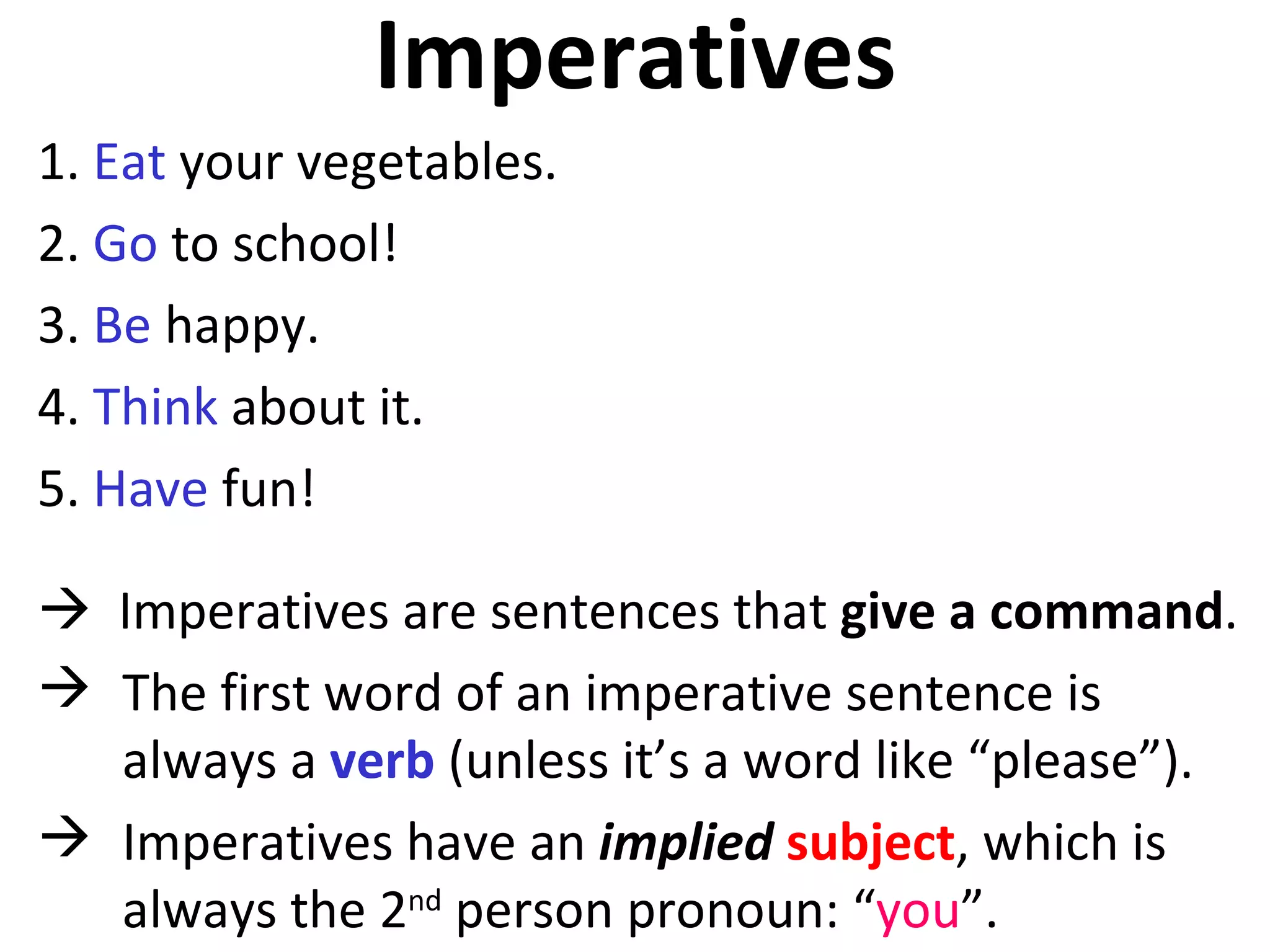
Imperatives 1.  Eat  your vegetables.  2.  Go  to school!  3.  Be  happy.  4.  Think  about it.  5.  Have  fun!    Imperatives are sentences that  give a command .  The first word of an imperative sentence is always a  verb  (unless it’s a word like “please”).  Imperatives have an  implied   subject , which is always the 2 nd  person pronoun: “ you ”.
How can we prove that the subject of imperatives is “you”?  Recall that  reflexive pronouns  require an antecedent  within their clause :  John is proud of himself.  *John is proud of herself.  Now observe the following sentences :  3. Think for  yourself !  4. Do it  yourselves ! These  reflexives  must have an antecedent, which can only be the second person pronoun “ you ”  –  5. *Think for  himself !  6. *Do it  themselves !
Exclamations 1.   That’s great!  2. Wow, it sounds amazing!  3. Boy, this is hard!  4. Man, I can’t believe it!     Exclamations  are sentences that  express strong emotion .  In writing, exclamations end with an “ ! ”.  Exclamations often start with an  Interjection  – These are words like “ wow! ”, “ boy! ”, “ (oh my)   god! ”,  “ouch! ”, etc.
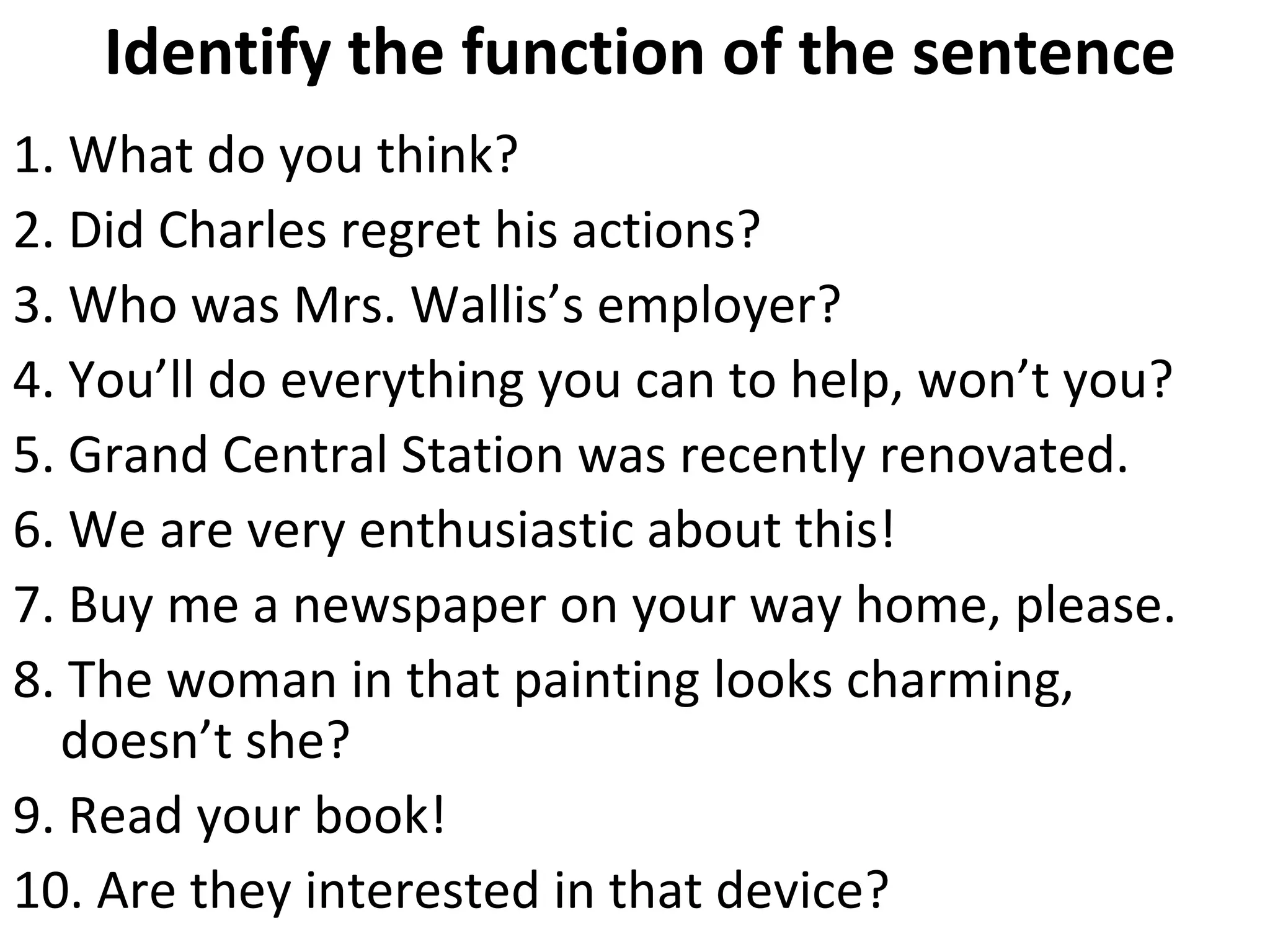
Identify the function of the sentence 1. What do you think? 2. Did Charles regret his actions? 3. Who was Mrs. Wallis’s employer? 4. You’ll do everything you can to help, won’t you? 5. Grand Central Station was recently renovated. 6. We are very enthusiastic about this! 7. Buy me a newspaper on your way home, please.  8. The woman in that painting looks charming, doesn’t she? 9. Read your book! 10. Are they interested in that device?
Homework Read and do all the exercises in lessons 42 and 45

Unit 15 functions of sentences

  • 1.
    Functions of SentencesThere are four sentence functions : Declarative Interrogative Imperative Exclamation
  • 2.
    Declaratives 1. John ate an apple . 2. He thinks it might be raining . 3. We believe in miracles . 4. Sam bought us lunch .  Declarative sentences (also called “ indicatives ”) are sentences that make a statement . Declarative sentences must have (at least) a subject and a predicate . Declarative sentences are either True or False .
  • 3.
    Interrogatives 1. Did John eat an apple ? 2. Does he thinks it might be raining ? 3. Why do we believe in miracles ? 4. Who bought you lunch ?  Interrogative sentences are sentences that ask a question . Interrogatives also have (at least) a subject and a predicate . Note that the subject might be the question word itself, as in example (4).
  • 4.
    Interrogatives There arethree kinds of Interrogatives: Yes/No Questions Wh- Questions Tag Questions
  • 5.
    Yes/No Questions 1. Will it snow this year? 2. Is she coming to the party? 3. Have you been here before? 4. Did John eat an apple? 5. Are you at school now?  Yes/No questions are formed by Subj .- Aux . Inver.  Yes/No questions can start with any auxiliary (examples 1-4) OR with the verb “ be ” (example 5). The answer to a yes/no question is either “yes” or “no”.
  • 6.
    Wh- Questions 1. Who ate the apple? 2. What movie did you see? 3. Why aren’t you coming to the party? 4. When have you been here before? 5. Where are you now?  Wh-questions may start with any interrogative pronoun . The answer to a wh- question is never “yes” or “no”.
  • 7.
    Tag Questions 1.You went to school today, didn’t you? 2. It was snowing today, wasn’t it? 3. You wouldn’t eat that, would you? 4. She hasn’t been here before, has she? Tag questions are made up of a declarative sentence , followed by a yes/no question . If the verb in the declarative sentence is positive , the tag question is negative . If the verb in the declarative sentence is negative , the tag question is positive .
  • 8.
    Imperatives 1. Eat your vegetables. 2. Go to school! 3. Be happy. 4. Think about it. 5. Have fun!  Imperatives are sentences that give a command . The first word of an imperative sentence is always a verb (unless it’s a word like “please”). Imperatives have an implied subject , which is always the 2 nd person pronoun: “ you ”.
  • 9.
    How can weprove that the subject of imperatives is “you”? Recall that reflexive pronouns require an antecedent within their clause : John is proud of himself. *John is proud of herself. Now observe the following sentences : 3. Think for yourself ! 4. Do it yourselves ! These reflexives must have an antecedent, which can only be the second person pronoun “ you ” – 5. *Think for himself ! 6. *Do it themselves !
  • 10.
    Exclamations 1. That’s great! 2. Wow, it sounds amazing! 3. Boy, this is hard! 4. Man, I can’t believe it!  Exclamations are sentences that express strong emotion . In writing, exclamations end with an “ ! ”. Exclamations often start with an Interjection – These are words like “ wow! ”, “ boy! ”, “ (oh my) god! ”, “ouch! ”, etc.
  • 11.
    Identify the functionof the sentence 1. What do you think? 2. Did Charles regret his actions? 3. Who was Mrs. Wallis’s employer? 4. You’ll do everything you can to help, won’t you? 5. Grand Central Station was recently renovated. 6. We are very enthusiastic about this! 7. Buy me a newspaper on your way home, please. 8. The woman in that painting looks charming, doesn’t she? 9. Read your book! 10. Are they interested in that device?
  • 12.
    Homework Read anddo all the exercises in lessons 42 and 45