People and Government
State/Country/Nation
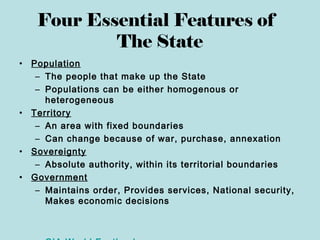
Four Essential Features of
The State
• Population
– The people that make up the State
– Populations can be either homogenous or
heterogeneous
• Territory
– An area with fixed boundaries
– Can change because of war, purchase, annexation
• Sovereignty
– Absolute authority, within its territorial boundaries
• Government
– Maintains order, Provides services, National security,
Makes economic decisions
State vs. Country?
• State and country generally have the
same meaning
– Political community (People)
– definite boundaries (Territory)
– Freedom to make rules and laws without
getting approval from another (Sovereignty)
– independent government
Section –I
Principles of Government
• How many countries are there in the world
today?
• The answer…
• 200 is probably the best current answer to
the question.
Why is there not an exact number?
• There are dozens of territories and
colonies that are sometimes erroneously
called "countries" but don't count at all
– Bermuda
– Puerto Rico
– Greenland
– Northern Ireland
– Scotland
– they're not fully independent countries
So, are PA and NY countries?
• Not exactly
• Political divisions in the United States are
called states because:
• When the colonies banded together to
fight the British, they thought of
themselves as independent countries.
Population
• Race –
• Ethnicity –
• Nationality -
Race
• A group of people identified as distinct
from other groups because of supposed
physical or genetic traits. “The way you
look”
• Some biologists and anthropologists do
not recognize race as a biologically valid
classification. Race is "merely a social
construct.
Race
• It is difficult to say a person belongs to a
specific race because there are so many
variations such as skin color.
Ethnicity
• a socially defined category of people who
identify with each other based on common
ancestral, social, cultural or national
experience
– Physical characteristics
– Linguistics
– Can you ever shed your ethnicity?
Nationality
• is the legal relationship between a person
and a state
DNA Discussion Project
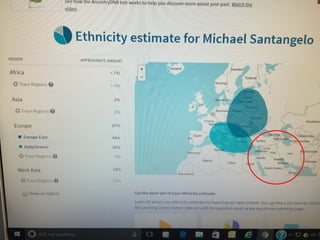
• Have you ever wondered about the origins of your
family? Are you curious about your ethnicity or race?
Have you heard or told stories about your family's past?
Would you like to know the truth behind family secrets?
There happens to be a scientific way to answer all these
questions with a high level of accuracy. It is called DNA.
• DNA Discussion Project
DNA Discussion Project
• In the long run, we hope to expand the project to
include elementary and high school students in
the region. By encouraging greater
understanding of the science of genetics, the
construction of race, and the perception of
ethnicity, we hope to expand the dialogue about
diversity in our community.
Power????
•How do people come to
power???
Theories of the Origin of the
State
Theories of the Origin of the
State
•Evolution
–Evolved from the
family
Theories of the Origin of the
State
•Force
•Submit authority to a
ruling force
Theories of the Origin of the
State
•Divine Right
•Rulers were chosen by
god
Theories of the Origin of the
State
•Social Contract Theory
• People gave Gov't power in return for
safety
• A government of “rules” not “rulers”
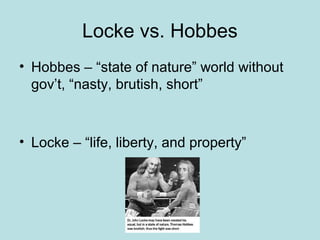
Locke vs. Hobbes
• Hobbes – “state of nature” world without
gov’t, “nasty, brutish, short”
• Locke – “life, liberty, and property”
The Purposes/Role of
Government
• Americans are affected by government in
countless ways every day.
• National, state, and local governments
make decisions and run programs that
impact our daily lives.
• Unfortunately, most Americans give little
to no thought about the extent of the
government’s role.
Actions of Government
Purposes of
Government
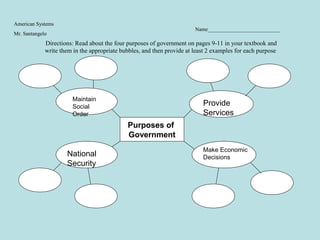
American Systems
Mr. Santangelo
Directions: Read about the four purposes of government on pages 9-11 in your textbook and
write them in the appropriate bubbles, and then provide at least 2 examples for each purpose
Purposes of
Government
Name___________________________
Maintain
Social
Order
Make Economic
Decisions
Provide
Services
National
Security
The Purposes of Government
• Maintain Social Order
– Courts
– Pay Taxes
– Makes laws
– Police
– Traffic signs
The Purposes of Government
• National Security
– Armed Services
– Alliances or Treaties
– United Nations
– CIA
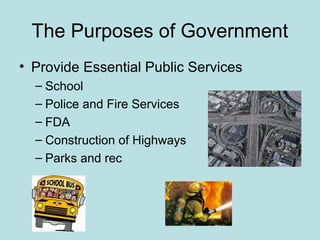
The Purposes of Government
• Provide Essential Public Services
– School
– Police and Fire Services
– FDA
– Construction of Highways
– Parks and rec
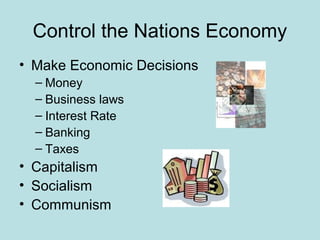
Control the Nations Economy
• Make Economic Decisions
– Money
– Business laws
– Interest Rate
– Banking
– Taxes
• Capitalism
• Socialism
• Communism
American Systems
Mr. Paone
Directions: Read about the four purposes of government on pages 9-11 in your textbook and
write them in the appropriate bubbles, and then provide at least 2 examples for each purpose
Purposes of
Government
Public Services
Safeguard the
Economy
Social Order
National
Security
Alliances and
Foreign Affairs Taxes
Minimum Wage
Collecting
Taxes
Education
Healthcare
WelfareCourt
System
Military:
Army/Navy
Make and
Enforce Laws
Name___________________________
Purposes of the American
Government
• Preamble
Preamble
• Introduction to the US Constitution
• Six Goals of the US Government
• Form a More Perfect Union
– Promote Cooperation between the states
• Establish Justice
– Make fair laws and treat all citizens equally.
• Insure Domestic Tranquility
– Keep communities safe from crime and
disorder
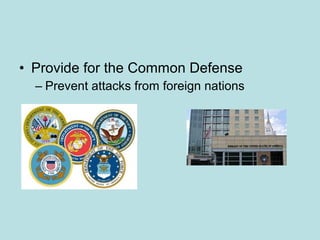
• Provide for the Common Defense
– Prevent attacks from foreign nations
• Promote the General Welfare
– Improve the quality of people’s lives
• Secure the Blessings of Liberty
– Allow people to be free from unnecessary and
unjust laws
• How well is the United States doing in
terms of achieving its goals?
End of Show
•GO
Eagles,
Flyers
and
76ers
T ForTemple U

The State

  • 1.
  • 2.
    Four Essential Featuresof The State • Population – The people that make up the State – Populations can be either homogenous or heterogeneous • Territory – An area with fixed boundaries – Can change because of war, purchase, annexation • Sovereignty – Absolute authority, within its territorial boundaries • Government – Maintains order, Provides services, National security, Makes economic decisions
  • 3.
    State vs. Country? •State and country generally have the same meaning – Political community (People) – definite boundaries (Territory) – Freedom to make rules and laws without getting approval from another (Sovereignty) – independent government
  • 4.
    Section –I Principles ofGovernment • How many countries are there in the world today? • The answer… • 200 is probably the best current answer to the question.
  • 5.
    Why is therenot an exact number? • There are dozens of territories and colonies that are sometimes erroneously called "countries" but don't count at all – Bermuda – Puerto Rico – Greenland – Northern Ireland – Scotland – they're not fully independent countries
  • 6.
    So, are PAand NY countries? • Not exactly • Political divisions in the United States are called states because: • When the colonies banded together to fight the British, they thought of themselves as independent countries.
  • 7.
    Population • Race – •Ethnicity – • Nationality -
  • 8.
    Race • A groupof people identified as distinct from other groups because of supposed physical or genetic traits. “The way you look” • Some biologists and anthropologists do not recognize race as a biologically valid classification. Race is "merely a social construct.
  • 9.
    Race • It isdifficult to say a person belongs to a specific race because there are so many variations such as skin color.
  • 10.
    Ethnicity • a sociallydefined category of people who identify with each other based on common ancestral, social, cultural or national experience – Physical characteristics – Linguistics – Can you ever shed your ethnicity?
  • 11.
    Nationality • is thelegal relationship between a person and a state
  • 12.
    DNA Discussion Project •Have you ever wondered about the origins of your family? Are you curious about your ethnicity or race? Have you heard or told stories about your family's past? Would you like to know the truth behind family secrets? There happens to be a scientific way to answer all these questions with a high level of accuracy. It is called DNA. • DNA Discussion Project
  • 13.
    DNA Discussion Project •In the long run, we hope to expand the project to include elementary and high school students in the region. By encouraging greater understanding of the science of genetics, the construction of race, and the perception of ethnicity, we hope to expand the dialogue about diversity in our community.
  • 15.
  • 16.
    Theories of theOrigin of the State
  • 17.
    Theories of theOrigin of the State •Evolution –Evolved from the family
  • 18.
    Theories of theOrigin of the State •Force •Submit authority to a ruling force
  • 19.
    Theories of theOrigin of the State •Divine Right •Rulers were chosen by god
  • 20.
    Theories of theOrigin of the State •Social Contract Theory • People gave Gov't power in return for safety • A government of “rules” not “rulers”
  • 21.
    Locke vs. Hobbes •Hobbes – “state of nature” world without gov’t, “nasty, brutish, short” • Locke – “life, liberty, and property”
  • 22.
    The Purposes/Role of Government •Americans are affected by government in countless ways every day. • National, state, and local governments make decisions and run programs that impact our daily lives. • Unfortunately, most Americans give little to no thought about the extent of the government’s role.
  • 23.
  • 24.
  • 25.
    American Systems Mr. Santangelo Directions:Read about the four purposes of government on pages 9-11 in your textbook and write them in the appropriate bubbles, and then provide at least 2 examples for each purpose Purposes of Government Name___________________________ Maintain Social Order Make Economic Decisions Provide Services National Security
  • 26.
    The Purposes ofGovernment • Maintain Social Order – Courts – Pay Taxes – Makes laws – Police – Traffic signs
  • 27.
    The Purposes ofGovernment • National Security – Armed Services – Alliances or Treaties – United Nations – CIA
  • 28.
    The Purposes ofGovernment • Provide Essential Public Services – School – Police and Fire Services – FDA – Construction of Highways – Parks and rec
  • 29.
    Control the NationsEconomy • Make Economic Decisions – Money – Business laws – Interest Rate – Banking – Taxes • Capitalism • Socialism • Communism
  • 30.
    American Systems Mr. Paone Directions:Read about the four purposes of government on pages 9-11 in your textbook and write them in the appropriate bubbles, and then provide at least 2 examples for each purpose Purposes of Government Public Services Safeguard the Economy Social Order National Security Alliances and Foreign Affairs Taxes Minimum Wage Collecting Taxes Education Healthcare WelfareCourt System Military: Army/Navy Make and Enforce Laws Name___________________________
  • 31.
    Purposes of theAmerican Government • Preamble
  • 32.
    Preamble • Introduction tothe US Constitution • Six Goals of the US Government
  • 34.
    • Form aMore Perfect Union – Promote Cooperation between the states
  • 35.
    • Establish Justice –Make fair laws and treat all citizens equally.
  • 36.
    • Insure DomesticTranquility – Keep communities safe from crime and disorder
  • 37.
    • Provide forthe Common Defense – Prevent attacks from foreign nations
  • 38.
    • Promote theGeneral Welfare – Improve the quality of people’s lives
  • 39.
    • Secure theBlessings of Liberty – Allow people to be free from unnecessary and unjust laws
  • 40.
    • How wellis the United States doing in terms of achieving its goals?
  • 41.
  • 42.