Chapter Introduction
Section 1: The Diversity of
           Americans
Section 2: Who Are
           America’s
           Citizens?
Section 3: Government and
           the People
Visual Summary
Our Declaration of
Independence proclaims that
“all men are created equal.” This
does not mean that everyone is
born with the same wealth,
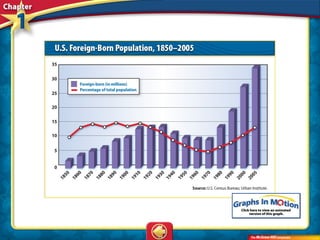
intelligence, strength, or
ambition. Each one of us has a
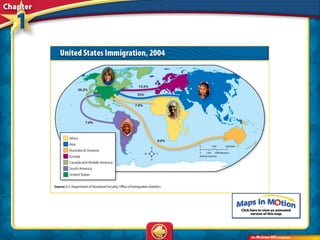
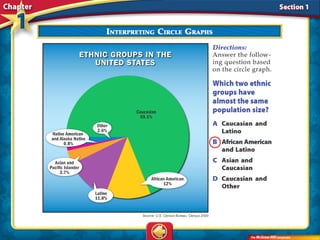
unique combination of qualities
and characteristics. The words
of the Declaration mean that all
people should have equal rights,
which is the cornerstone of the
democratic ideal.
Section 1:
The Diversity of Americans
As American citizens, we
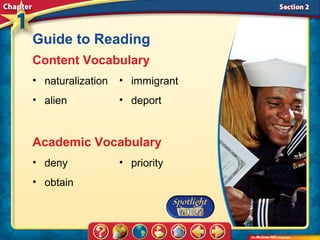
make a commitment to the
nation and to the values
and principles that are part
of United States
democracy. In addition to the
common values and civic
unity, the United States
benefits from its rich diversity.
Section 2: Who Are
America’s Citizens?
Citizens possess certain
rights. With citizenship,
there are also certain
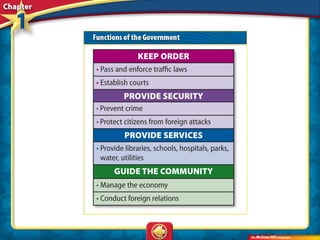
responsibilities expected of
all Americans. In the United
States, there are two ways to
become a citizen: by birth
and by a process called
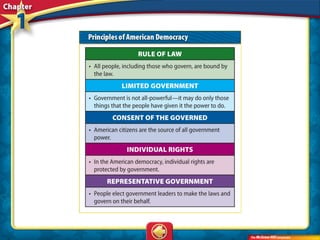
naturalization.
Section 3:
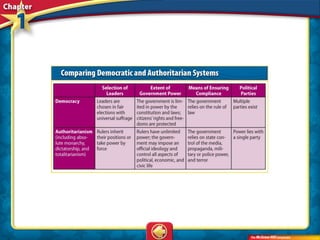
Government and the
People
People form governments
to establish order, provide
security, and accomplish
common goals. Democratic
governments perform
necessary functions so
citizens can live together
peacefully.
Guide to Reading
Big Idea
As American citizens, we make a
commitment to the nation and to the
values and principles that are part of
United States democracy.
Guide to Reading
Content Vocabulary
• civics        • popular
                  sovereignty
• citizenship
                • institution
• citizen
• service
  economy
• value
Guide to Reading
Academic Vocabulary
• diverse
• ethnic
• principle
What is Civics?
        Civics is the study of the rights and
        duties of citizens.
What is Civics? (cont.)
• Civics is the study of the rights and duties
  of citizens.
• Changes in citizenship requirements
What is Civics? (cont.)
• Rights and duties of citizens:
  – Owe loyalty to the government
  – Entitled to protection from the
    government
• Citizens as part of a country
A Changing Society
        American society has undergone many
        changes in the past, and these changes
        continue today.
A Changing Society (cont.)
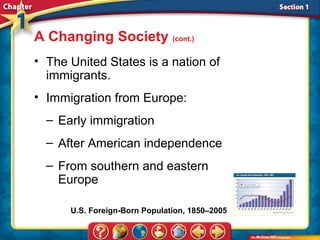
• The United States is a nation of
  immigrants.
• Immigration from Europe:
  – Early immigration
  – After American independence
  – From southern and eastern
    Europe

      U.S. Foreign-Born Population, 1850–2005
A Changing Society (cont.)
• Changes in immigration patterns:
  – Latin America
  – Asia
• African immigrants brought by force
A Changing Society (cont.)
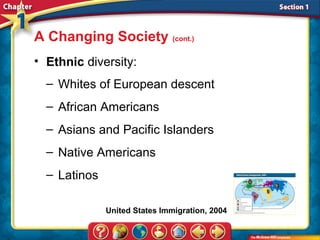
• Ethnic diversity:
  – Whites of European descent
  – African Americans
  – Asians and Pacific Islanders
  – Native Americans
  – Latinos

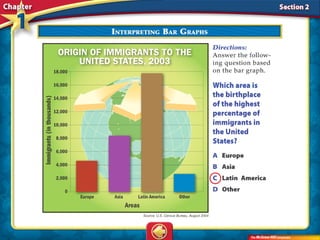
              United States Immigration, 2004
A Changing Society (cont.)
• Religious diversity:
  – Christians
  – Jews
  – Muslims
  – Buddhists
  – Other religious groups
A Changing Society (cont.)
• Population growth and change today:
  – Birthrate
  – Service Economy
  – Increasing population in the South and
    West
A Changing Society (cont.)
 – Rising age of citizens
 – Increasing levels of education
 – Growing Latino population
American Values and Institutions
        Americans share key values, and these
        values are reflected in the important
        institutions of American life.
American Values and Institutions         (cont.)


• Values are broad ideas about what is
  good or desirable that are shared by
  people in a society.
American Values and Institutions          (cont.)


• Basic American values
• Values uniting Americans:
  – The country’s founding documents
  – The English language as a source of
    unity
  – Belief in popular sovereignty
American Values and Institutions         (cont.)


• Role of major American institutions:
  – The family
  – Religious institutions
  – Educational institutions
  – Social institutions
  – Governmental institutions
Guide to Reading
Big Idea
Citizens possess certain rights. With
citizenship, Americans also have
certain responsibilities.
Guide to Reading
Content Vocabulary
• naturalization   • immigrant
• alien            • deport


Academic Vocabulary
• deny             • priority
• obtain
Path to Citizenship
         In the United States, there are two ways
         to become a citizen: by birth and by a
         process called naturalization.
Path to Citizenship (cont.)
• There are two ways to become an
  American citizen:
    – Birth
    – Naturalization
•                                   D
                                    u
                                    a
                                    l
                                    c
                                    it
                                    i
Path to Citizenship (cont.)
• The naturalization process for aliens:
  – Declaration of Intention
  – Living in the United States
  – Interview and citizenship exam
  – Oath of allegiance
• Native Americans as citizens
Path to Citizenship (cont.)
• Denying and losing citizenship:
  – Improperly obtained citizenship
  – Expatriation
  – Federal crimes involving extreme
    disloyalty
Aliens in America
        Even though the United States controls
        the admission of aliens to this country,
        each year millions of people enter
        America illegally.
Aliens in America (cont.)
• There are restrictions on the number of
  immigrants who can enter the United
  States.
• Immigration Act of 1990
Aliens in America (cont.)
• Aliens living in the United States illegally:
  – Temporary visitors
  – Crossing borders
  – Foreigners with expired legal permits
  – Many fear being deported
Aliens in America (cont.)
• The United States Border Patrol:
• Different categories of legal aliens:
  – Resident aliens
  – Nonresident aliens
  – Refugees
• Rights of aliens
Guide to Reading
Big Idea
People form governments to
establish order, provide security, and
accomplish common goals.
Guide to Reading
Content Vocabulary
• government       • republic
• public policy    • monarchy
• budget           • majority rule
• democracy        • authoritarian
• direct           • totalitarian
  democracy
• representative
  democracy
Guide to Reading
Academic Vocabulary
• community
• enforce
• constrain
The Need for Government
        The different levels of government
        provide many different services.
The Need for Government (cont.)
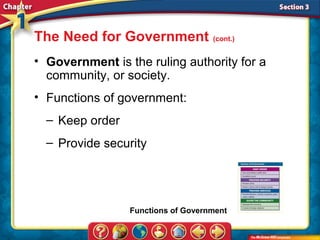
• Government is the ruling authority for a
  community, or society.
• Functions of government:
  – Keep order
  – Provide security


                 Functions of Government
The Need for Government (cont.)
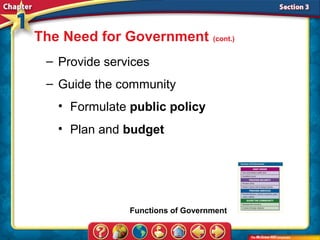
 – Provide services
 – Guide the community
   • Formulate public policy
   • Plan and budget


               Functions of Government
The Need for Government (cont.)
• Levels of government:
  – National
  – State and local
Types of Government
        The people are the ultimate rulers of
        democratic countries, while in
        totalitarian states, a single person or
        small group holds all the power.
Types of Government (cont.)
• Democratic government
• Types of democracy:
 – Direct democracy
 – Representative democracy or republic
 – Constitutional monarchy
Types of Government (cont.)
• Principles of democracy:
  – Rule of law
  – Limited government
  – Consent of the governed


          Principles of American Democracy
Types of Government (cont.)
 – Individual rights
 – Representative government
 – Majority rule


          Principles of American Democracy
Types of Government (cont.)
• Authoritarian government
  – Absolute monarchy
  – Dictatorship
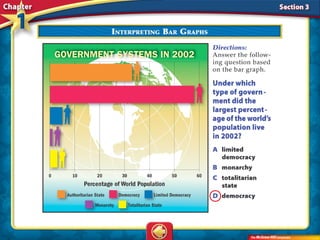
  – Totalitarianism


Comparing Democratic and Authoritarian Systems
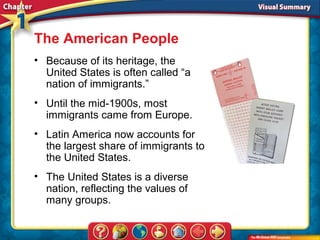
The American People
• Because of its heritage, the
  United States is often called “a
  nation of immigrants.”
• Until the mid-1900s, most
  immigrants came from Europe.
• Latin America now accounts for
  the largest share of immigrants to
  the United States.
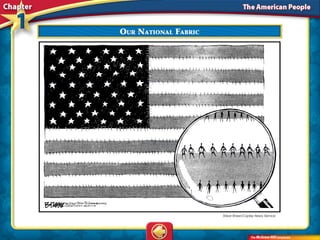
• The United States is a diverse
  nation, reflecting the values of
  many groups.
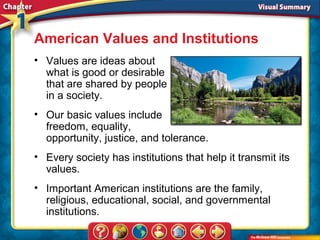
American Values and Institutions
• Values are ideas about
  what is good or desirable
  that are shared by people
  in a society.
• Our basic values include
  freedom, equality,
  opportunity, justice, and tolerance.
• Every society has institutions that help it transmit its
  values.
• Important American institutions are the family,
  religious, educational, social, and governmental
  institutions.
Citizenship
• According to the U.S. Constitution, people can
  become American citizens by birth and through
  naturalization.
• Millions of illegal aliens live in the United States.
  Legal aliens have entered the country lawfully.
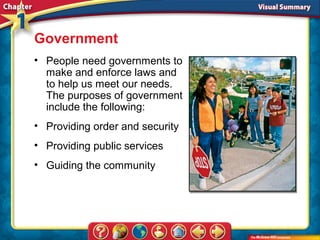
Government
• People need governments to
  make and enforce laws and
  to help us meet our needs.
  The purposes of government
  include the following:
• Providing order and security
• Providing public services
• Guiding the community
Government
• Although all governments carry out the same basic
  functions, there are differences in the ways
  governments can be organized.
• The main types of government are democratic
  government and authoritarian government.
• In a democracy, the supreme political authority rests
  with the people.
civics
the study of the rights and duties of
citizens
citizenship
rights and duties of members of a
state
citizens
community members who owe loyalty
to the government and are entitled to
protection from it
service economy
where the majority of people earn
their living by providing a service
rather than manufacturing a product
value
the general principles of beliefs
people use to make judgments and
decisions
popular sovereignty
the notion that power lies with the
people
institution
sets of ideas that people have about
relationships, obligations, roles and
functions of society
diverse
differing from one another
ethnic
relating to races or groups of people
who share common traits and
customs
principle 
a rule of conduct or belief
naturalization
a legal process to obtain citizenship
alien
a noncitizen
immigrant
a person who moves permanently to
a new country
deport
to send an alien or immigrant back to
his or her own country
deny
refusal to grant, agree, or believe
obtain
to gain or acquire
priority
something that is given more
attention or importance
government
the ruling authority for a community
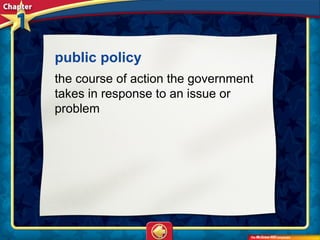
public policy
the course of action the government
takes in response to an issue or
problem
budget
a plan for making and spending
money
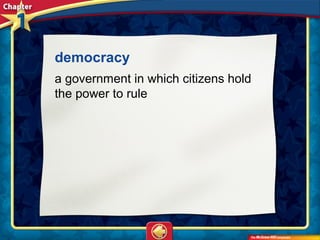
democracy
a government in which citizens hold
the power to rule
direct democracy
a form of democracy in which the
people vote firsthand
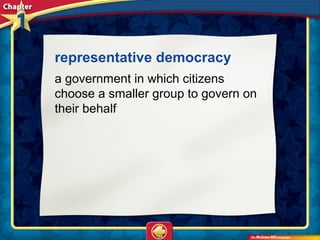
representative democracy
a government in which citizens
choose a smaller group to govern on
their behalf
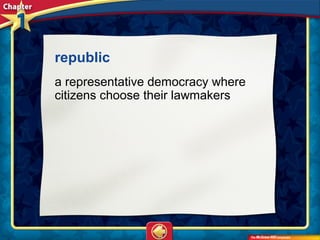
republic
a representative democracy where
citizens choose their lawmakers
monarchy
a government with a hereditary,
single leader
majority rule
political principle providing that a
majority of the members of a
community has the power to make
laws binding upon all the people
authoritarian
a government in which one leader or
group of people holds absolute power
totalitarian
a system in which government control
extends to almost all aspects of
people’s lives
community
a group of people who share the
same interests and concerns
enforce
to carry out by force or ensure
compliance
constrain
to force, limit, or hold back

Chapter 01 power point

  • 2.
    Chapter Introduction Section 1:The Diversity of Americans Section 2: Who Are America’s Citizens? Section 3: Government and the People Visual Summary
  • 3.
    Our Declaration of Independenceproclaims that “all men are created equal.” This does not mean that everyone is born with the same wealth, intelligence, strength, or ambition. Each one of us has a unique combination of qualities and characteristics. The words of the Declaration mean that all people should have equal rights, which is the cornerstone of the democratic ideal.
  • 4.
    Section 1: The Diversityof Americans As American citizens, we make a commitment to the nation and to the values and principles that are part of United States democracy. In addition to the common values and civic unity, the United States benefits from its rich diversity.
  • 5.
    Section 2: WhoAre America’s Citizens? Citizens possess certain rights. With citizenship, there are also certain responsibilities expected of all Americans. In the United States, there are two ways to become a citizen: by birth and by a process called naturalization.
  • 6.
    Section 3: Government andthe People People form governments to establish order, provide security, and accomplish common goals. Democratic governments perform necessary functions so citizens can live together peacefully.
  • 7.
    Guide to Reading BigIdea As American citizens, we make a commitment to the nation and to the values and principles that are part of United States democracy.
  • 8.
    Guide to Reading ContentVocabulary • civics • popular sovereignty • citizenship • institution • citizen • service economy • value
  • 9.
    Guide to Reading AcademicVocabulary • diverse • ethnic • principle
  • 10.
    What is Civics? Civics is the study of the rights and duties of citizens.
  • 11.
    What is Civics?(cont.) • Civics is the study of the rights and duties of citizens. • Changes in citizenship requirements
  • 12.
    What is Civics?(cont.) • Rights and duties of citizens: – Owe loyalty to the government – Entitled to protection from the government • Citizens as part of a country
  • 13.
    A Changing Society American society has undergone many changes in the past, and these changes continue today.
  • 14.
    A Changing Society(cont.) • The United States is a nation of immigrants. • Immigration from Europe: – Early immigration – After American independence – From southern and eastern Europe U.S. Foreign-Born Population, 1850–2005
  • 15.
    A Changing Society(cont.) • Changes in immigration patterns: – Latin America – Asia • African immigrants brought by force
  • 16.
    A Changing Society(cont.) • Ethnic diversity: – Whites of European descent – African Americans – Asians and Pacific Islanders – Native Americans – Latinos United States Immigration, 2004
  • 17.
    A Changing Society(cont.) • Religious diversity: – Christians – Jews – Muslims – Buddhists – Other religious groups
  • 18.
    A Changing Society(cont.) • Population growth and change today: – Birthrate – Service Economy – Increasing population in the South and West
  • 19.
    A Changing Society(cont.) – Rising age of citizens – Increasing levels of education – Growing Latino population
  • 20.
    American Values andInstitutions Americans share key values, and these values are reflected in the important institutions of American life.
  • 21.
    American Values andInstitutions (cont.) • Values are broad ideas about what is good or desirable that are shared by people in a society.
  • 22.
    American Values andInstitutions (cont.) • Basic American values • Values uniting Americans: – The country’s founding documents – The English language as a source of unity – Belief in popular sovereignty
  • 23.
    American Values andInstitutions (cont.) • Role of major American institutions: – The family – Religious institutions – Educational institutions – Social institutions – Governmental institutions
  • 24.
    Guide to Reading BigIdea Citizens possess certain rights. With citizenship, Americans also have certain responsibilities.
  • 25.
    Guide to Reading ContentVocabulary • naturalization • immigrant • alien • deport Academic Vocabulary • deny • priority • obtain
  • 26.
    Path to Citizenship In the United States, there are two ways to become a citizen: by birth and by a process called naturalization.
  • 27.
    Path to Citizenship(cont.) • There are two ways to become an American citizen: – Birth – Naturalization • D u a l c it i
  • 28.
    Path to Citizenship(cont.) • The naturalization process for aliens: – Declaration of Intention – Living in the United States – Interview and citizenship exam – Oath of allegiance • Native Americans as citizens
  • 29.
    Path to Citizenship(cont.) • Denying and losing citizenship: – Improperly obtained citizenship – Expatriation – Federal crimes involving extreme disloyalty
  • 30.
    Aliens in America Even though the United States controls the admission of aliens to this country, each year millions of people enter America illegally.
  • 31.
    Aliens in America(cont.) • There are restrictions on the number of immigrants who can enter the United States. • Immigration Act of 1990
  • 32.
    Aliens in America(cont.) • Aliens living in the United States illegally: – Temporary visitors – Crossing borders – Foreigners with expired legal permits – Many fear being deported
  • 33.
    Aliens in America(cont.) • The United States Border Patrol: • Different categories of legal aliens: – Resident aliens – Nonresident aliens – Refugees • Rights of aliens
  • 34.
    Guide to Reading BigIdea People form governments to establish order, provide security, and accomplish common goals.
  • 35.
    Guide to Reading ContentVocabulary • government • republic • public policy • monarchy • budget • majority rule • democracy • authoritarian • direct • totalitarian democracy • representative democracy
  • 36.
    Guide to Reading AcademicVocabulary • community • enforce • constrain
  • 37.
    The Need forGovernment The different levels of government provide many different services.
  • 38.
    The Need forGovernment (cont.) • Government is the ruling authority for a community, or society. • Functions of government: – Keep order – Provide security Functions of Government
  • 39.
    The Need forGovernment (cont.) – Provide services – Guide the community • Formulate public policy • Plan and budget Functions of Government
  • 40.
    The Need forGovernment (cont.) • Levels of government: – National – State and local
  • 41.
    Types of Government The people are the ultimate rulers of democratic countries, while in totalitarian states, a single person or small group holds all the power.
  • 42.
    Types of Government(cont.) • Democratic government • Types of democracy: – Direct democracy – Representative democracy or republic – Constitutional monarchy
  • 43.
    Types of Government(cont.) • Principles of democracy: – Rule of law – Limited government – Consent of the governed Principles of American Democracy
  • 44.
    Types of Government(cont.) – Individual rights – Representative government – Majority rule Principles of American Democracy
  • 45.
    Types of Government(cont.) • Authoritarian government – Absolute monarchy – Dictatorship – Totalitarianism Comparing Democratic and Authoritarian Systems
  • 46.
    The American People •Because of its heritage, the United States is often called “a nation of immigrants.” • Until the mid-1900s, most immigrants came from Europe. • Latin America now accounts for the largest share of immigrants to the United States. • The United States is a diverse nation, reflecting the values of many groups.
  • 47.
    American Values andInstitutions • Values are ideas about what is good or desirable that are shared by people in a society. • Our basic values include freedom, equality, opportunity, justice, and tolerance. • Every society has institutions that help it transmit its values. • Important American institutions are the family, religious, educational, social, and governmental institutions.
  • 48.
    Citizenship • According tothe U.S. Constitution, people can become American citizens by birth and through naturalization. • Millions of illegal aliens live in the United States. Legal aliens have entered the country lawfully.
  • 49.
    Government • People needgovernments to make and enforce laws and to help us meet our needs. The purposes of government include the following: • Providing order and security • Providing public services • Guiding the community
  • 50.
    Government • Although allgovernments carry out the same basic functions, there are differences in the ways governments can be organized. • The main types of government are democratic government and authoritarian government. • In a democracy, the supreme political authority rests with the people.
  • 60.
    civics the study ofthe rights and duties of citizens
  • 61.
    citizenship rights and dutiesof members of a state
  • 62.
    citizens community members whoowe loyalty to the government and are entitled to protection from it
  • 63.
    service economy where themajority of people earn their living by providing a service rather than manufacturing a product
  • 64.
    value the general principlesof beliefs people use to make judgments and decisions
  • 65.
    popular sovereignty the notionthat power lies with the people
  • 66.
    institution sets of ideasthat people have about relationships, obligations, roles and functions of society
  • 67.
  • 68.
    ethnic relating to racesor groups of people who share common traits and customs
  • 69.
    principle  a rule ofconduct or belief
  • 70.
    naturalization a legal processto obtain citizenship
  • 71.
  • 72.
    immigrant a person whomoves permanently to a new country
  • 73.
    deport to send analien or immigrant back to his or her own country
  • 74.
    deny refusal to grant,agree, or believe
  • 75.
  • 76.
    priority something that isgiven more attention or importance
  • 77.
  • 78.
    public policy the courseof action the government takes in response to an issue or problem
  • 79.
    budget a plan formaking and spending money
  • 80.
    democracy a government inwhich citizens hold the power to rule
  • 81.
    direct democracy a formof democracy in which the people vote firsthand
  • 82.
    representative democracy a governmentin which citizens choose a smaller group to govern on their behalf
  • 83.
    republic a representative democracywhere citizens choose their lawmakers
  • 84.
    monarchy a government witha hereditary, single leader
  • 85.
    majority rule political principleproviding that a majority of the members of a community has the power to make laws binding upon all the people
  • 86.
    authoritarian a government inwhich one leader or group of people holds absolute power
  • 87.
    totalitarian a system inwhich government control extends to almost all aspects of people’s lives
  • 88.
    community a group ofpeople who share the same interests and concerns
  • 89.
    enforce to carry outby force or ensure compliance
  • 90.