Forces
Force
a force is a pushing or pulling action which can
change the shape of an object, make a
stationary object move or make a moving object
change its speed/direction
Measured in Newtons (N)
Moment of a force
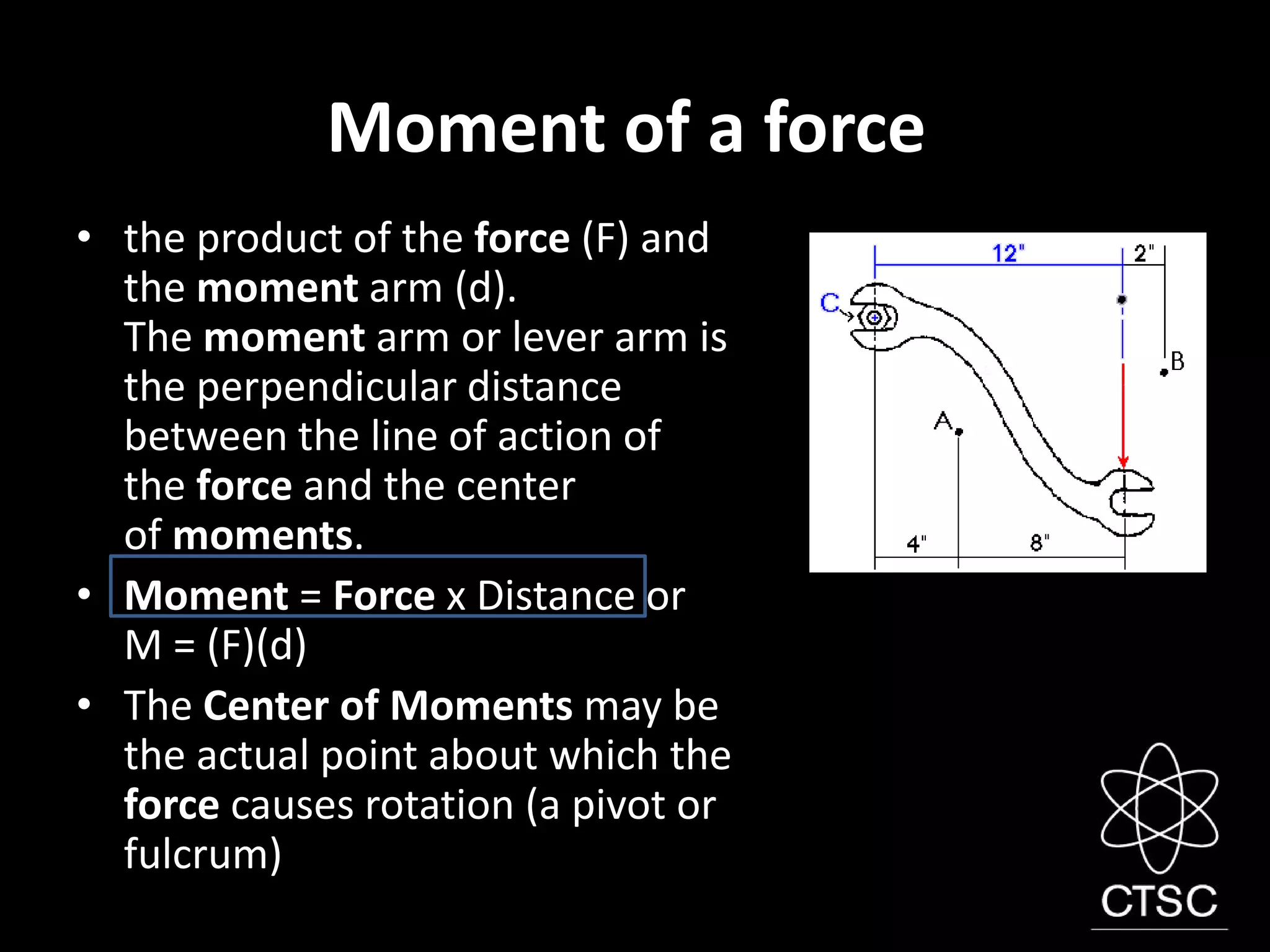
• the product of the force (F) and
the moment arm (d).
The moment arm or lever arm is
the perpendicular distance
between the line of action of
the force and the center
of moments.
• Moment = Force x Distance or
M = (F)(d)
• The Center of Moments may be
the actual point about which the
force causes rotation (a pivot or
fulcrum)
The Law of Moments
When a body is in equilibrium, the sum of the
clockwise moments about any point equals the
sum of the anticlockwise moments about the
same point
Law of Moments
Conditions for Equilibrium
I. The sum of the forces in one directions
equals the sum of the forces in the opposite
direction
II. The law of moments must apply
Levers
• Any device which
can turn about a
pivot/fulcrum
• Moved with a force
called effort
Clockwise moment= anticlockwise moment
Force and Distance Multipliers
• Levers act as force multipliers, making it easier
to move large loads
• Levers have a mechanical advantage (MA) and
a velocity ratio (VR)
• MA =
𝐿𝑜𝑎𝑑
𝐸𝑓𝑓𝑜𝑟𝑡
and VR =
𝑑𝑖𝑠𝑡𝑎𝑛𝑐𝑒 𝑚𝑜𝑣𝑒𝑑 𝑏𝑦 𝑒𝑓𝑓𝑜𝑟𝑡
𝑑𝑖𝑠𝑡𝑎𝑛𝑐𝑒 𝑚𝑜𝑣𝑒𝑑 𝑏𝑦 𝑙𝑜𝑎𝑑
Examples
Centres of Mass
• a point representing the mean position of the
matter in a body or system
• A body behaves as if its whole mass were
concentrated at this point
• The centre of mass of a regularly shaped body
of the same density throughout is at its
centre. In other cases it can be found by
experiment
Toppling
• The position of the
centre of mass of a
body affects whether or
not it topples over
easily
• A body topples when
the verticle line through
its centre of mass falls
outside its base
Centre of
Mass
Base
Stability of a body can be increased by:
i. Lowering its centre of mass (eg: adding more
weight to the bottom of the body)
ii. Increasing the area of its base
Stability
• Stable Equilibrium: if a body is slightly
displaced and released, and it then returns to
its previous position
• Unstable Equilibrium: when a body moves
further away from its previous position when
slightly displaced and released
• Neutral Equilibrium: if a body remains in its
new position when displaced
Adding Forces
• Scalars are values that have magnitude, but no
direction
• Force is a vector: it has both magnitude and
direction. Force can be represented by a straight line
(The size of the line indicates magnitude of force)
with an arrow to indicate direction
Resultant Forces
• It is often useful to
know the value of the
single, resultant force.
• This is the sum of all of
the forces acting on the
object at once.
Parallelogram Law
If two forces acting at a point are represented in
size and direction by the sides of a parallelogram
drawn from the point, their resultant is
represented in size and direction by the diagonal
of the parallelogram drawn from the point
Friction
• The force that opposes one surface moving
over another
• Static friction: the friction that exists between
a stationary object and the surface on which
it's resting
• Dynamic friction: the force that must be
overcome to maintain steady motion of one
body relative to another because they remain
in contact
Static Friction > Dynamic Friction
Pendulums
Simple Pendulum
• A point mass suspended by a massless string
from some point about which is allowed to
swing back and forth in a place
• The motion of a pendulum swinging back and
forth is Periodic: it takes time T to complete
one oscillation
Pendulum Values
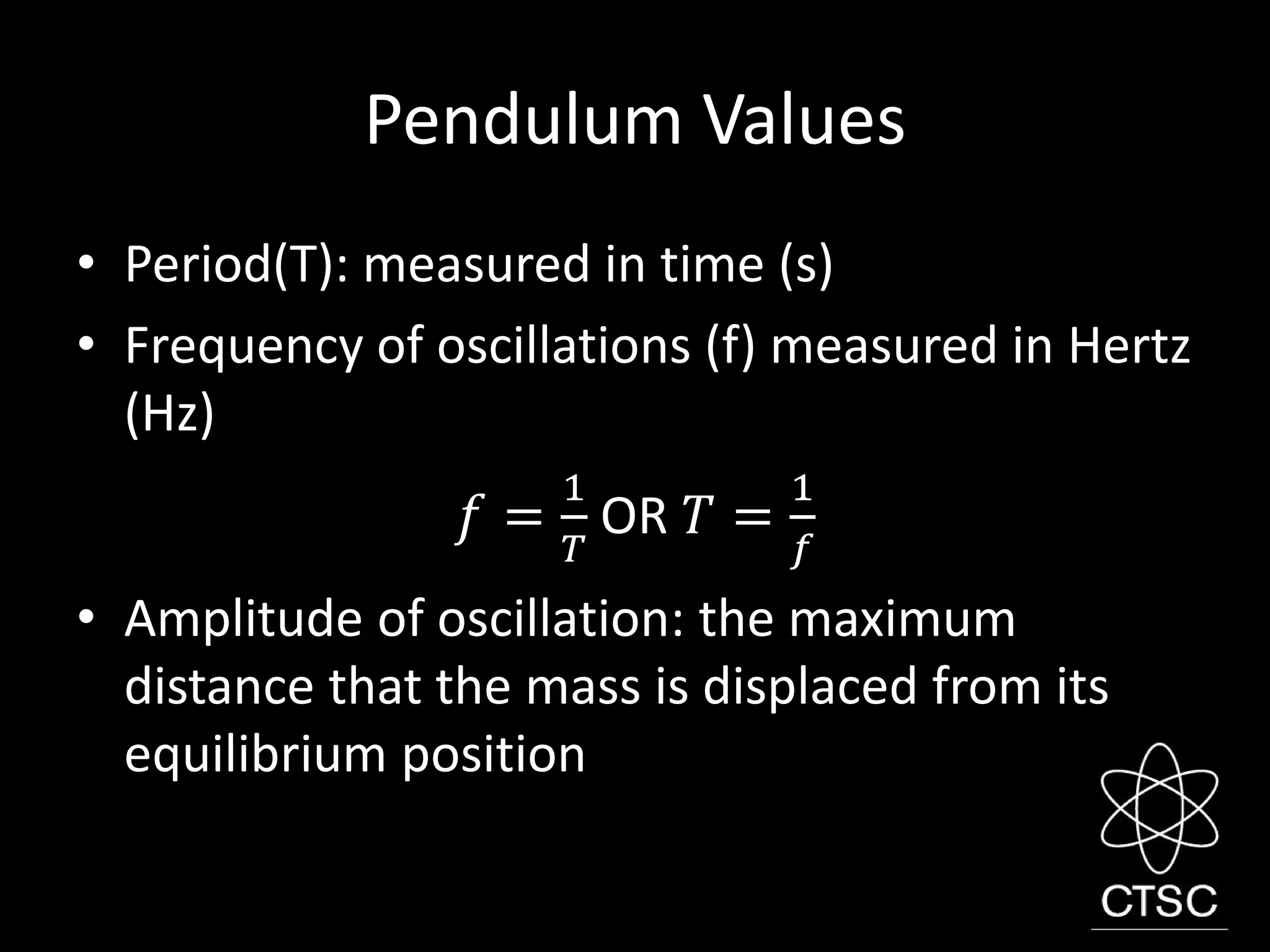
• Period(T): measured in time (s)
• Frequency of oscillations (f) measured in Hertz
(Hz)
𝑓 =
1
𝑇
OR 𝑇 =
1
𝑓
• Amplitude of oscillation: the maximum
distance that the mass is displaced from its
equilibrium position
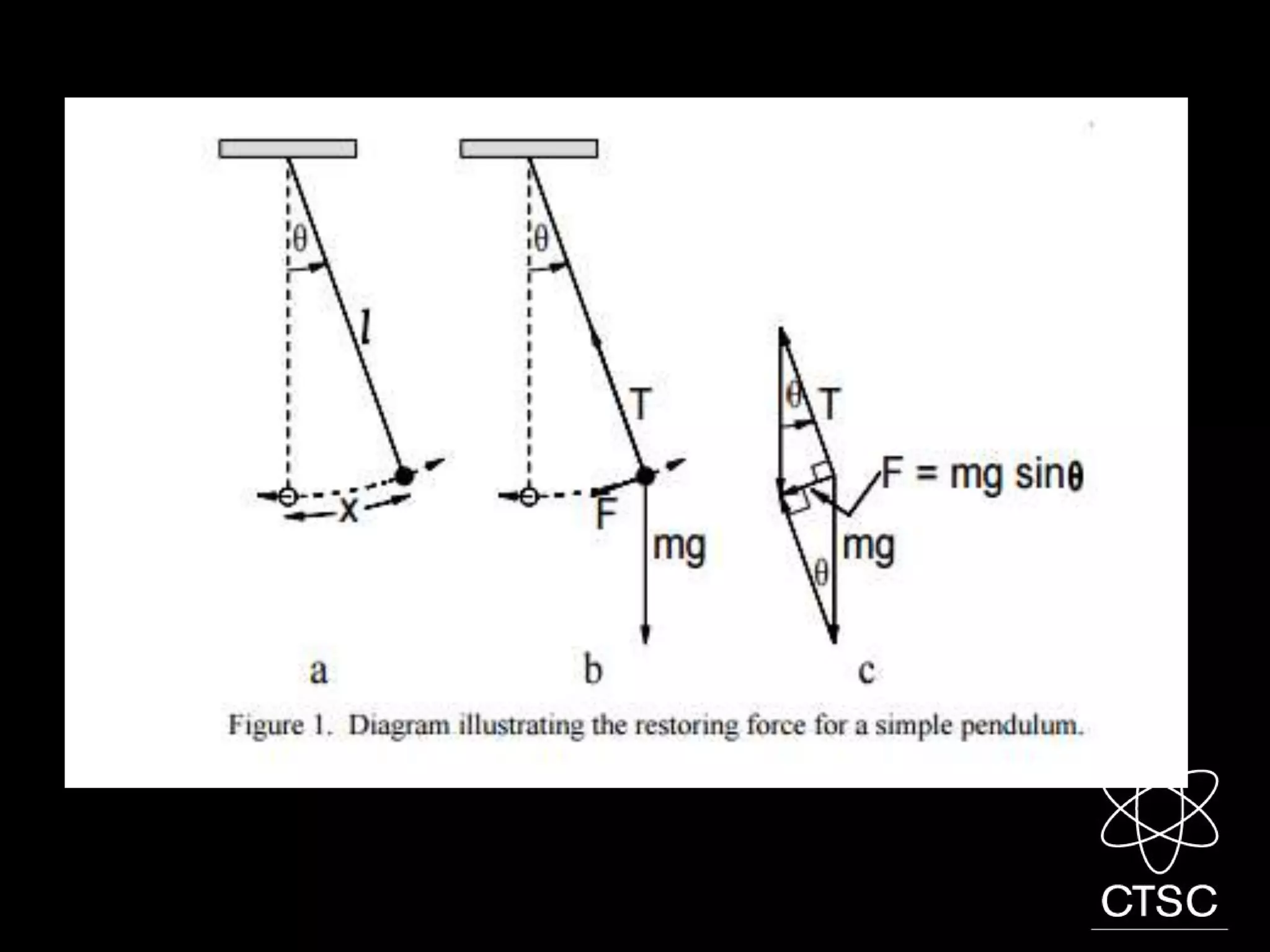
Pendulums and Forces
• When pendulums are displaced from
equilibrium, there is a restoring force (F) that
moves it back.
• The Period can be calculated using an
equation for simple harmonic motion:
𝑇 = 2𝜋
𝑚
𝑘
Radioactivity
Isotopes
• Atoms of the same element with different
numbers of neutrons. (ie. The same atomic
number but a different atomic mass)
• Radioactive Isotopes: unstable isotopes which
emit radiation
• Radioactivity results from unstable nuclei
• Has an ionizing effect: Can knock electrons out of
atoms, turning them in to positively or negatively
charged ions.
• This ionizing effect is used to detect radiation
with a Geiger-Müller Tube
Alpha, beta and gamma rays
• A radioactive substance releases one or more
of three types of radiation: alpha (α), beta (β)
and gamma (γ)
Alpha (α) Rays
• Easily stopped by a thick sheet of paper,
strong electric and magnetic fields
• Short range in air: cause intense ionisation
due to frequent collisions with gas molecules
• Sources: He ions with a double positive
charge, Americium (am-241
Beta (β) Rays
• Streams of high energy electrons
• Stopped by a few millimetres of aluminium.
Deflected by medium strength electric and
magnetic fields
• Range of several metres in air. Lower ionizing
power than alpha rays
• Pure source: Strontium (Sr-90)
Gamma (γ) rays
• Electromagnatic radiation travelling at the
speed of light
• Only stopped by very thick lead sheets, not
defelected by electric and magnetic fields
• Very low ionization of gas
• Source: Cobalt (Co-60)
Particle Tracks
• Detected in a Diffusion Cloud Chamber
Alpha particle tracks
Beta particle tracks
Radioactive Decay
• Because they are unstable, radioactive atoms
‘decay’ in to atoms of different elements with
more stable nuclei
• This decay is not affected by the purity of the
chemical
• Half life: the average time for half of the
atoms in a given sample to decay. Unaffected
by temperature, different for every radioactive
element
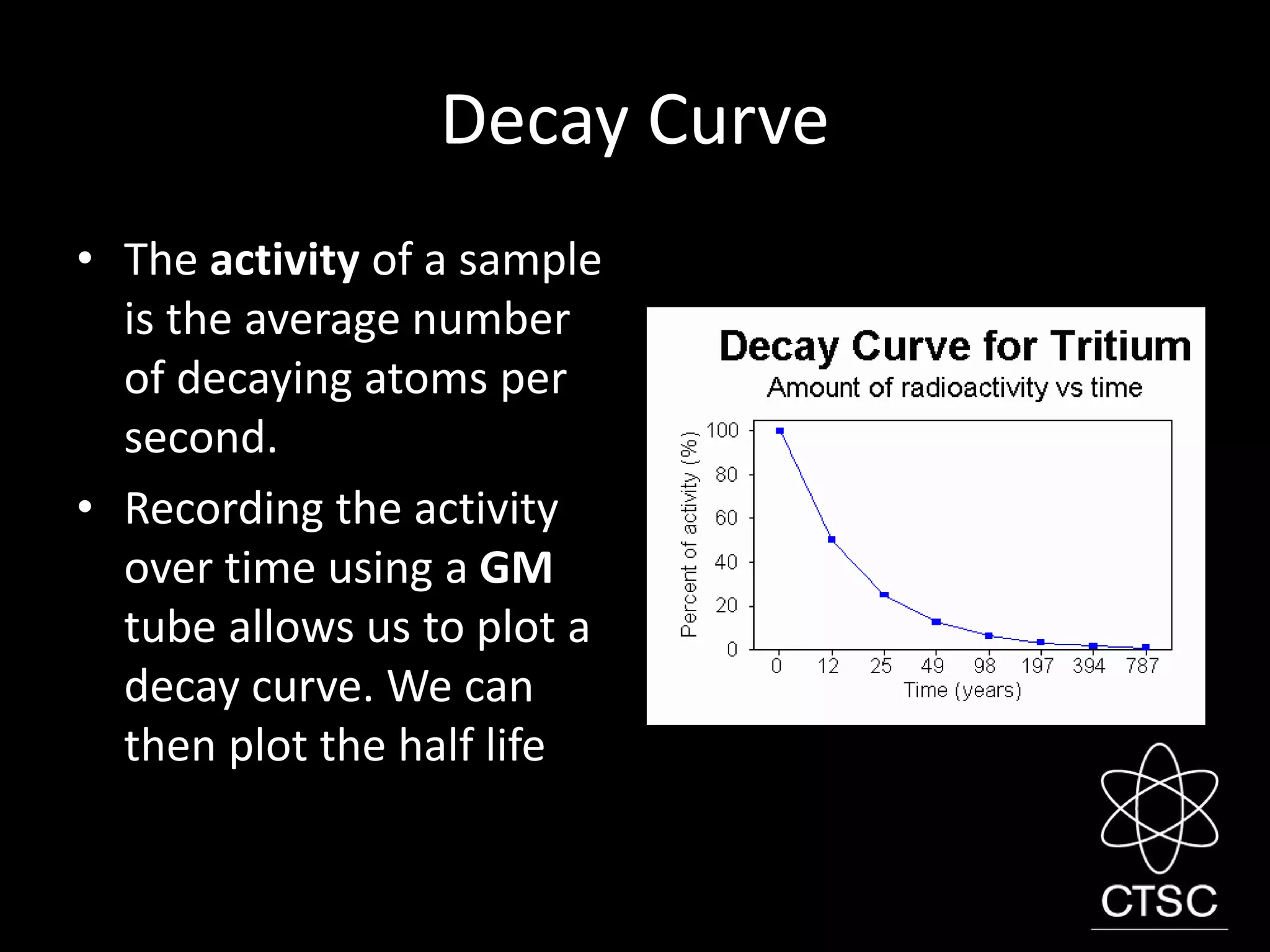
Decay Curve
• The activity of a sample
is the average number
of decaying atoms per
second.
• Recording the activity
over time using a GM
tube allows us to plot a
decay curve. We can
then plot the half life
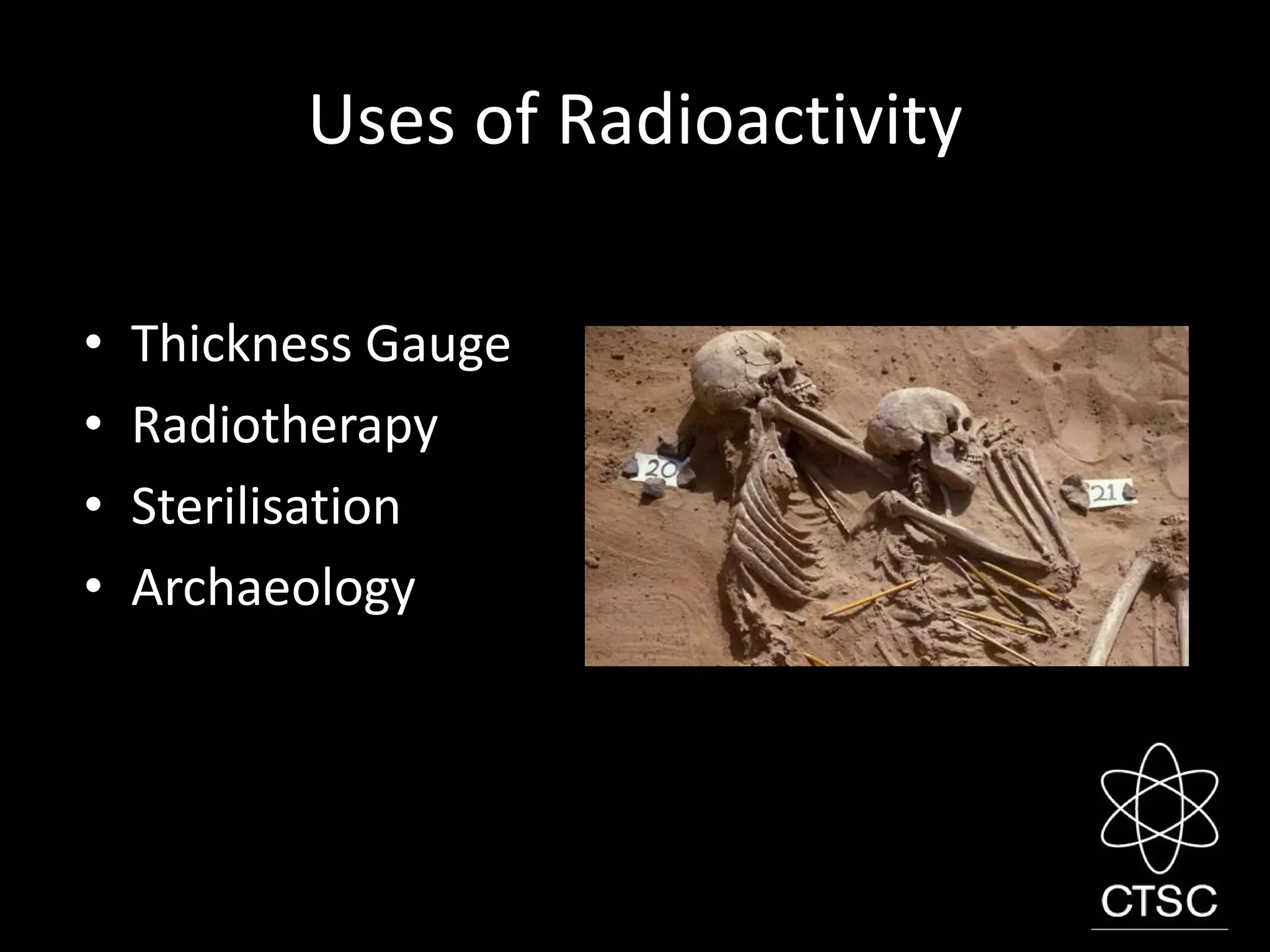
Uses of Radioactivity
• Thickness Gauge
• Radiotherapy
• Sterilisation
• Archaeology
Resources
• http://www.phys.utk.edu/labs/simplependulu
m.pdf

Forces

  • 1.
  • 2.
    Force a force isa pushing or pulling action which can change the shape of an object, make a stationary object move or make a moving object change its speed/direction Measured in Newtons (N)
  • 3.
    Moment of aforce • the product of the force (F) and the moment arm (d). The moment arm or lever arm is the perpendicular distance between the line of action of the force and the center of moments. • Moment = Force x Distance or M = (F)(d) • The Center of Moments may be the actual point about which the force causes rotation (a pivot or fulcrum)
  • 4.
    The Law ofMoments When a body is in equilibrium, the sum of the clockwise moments about any point equals the sum of the anticlockwise moments about the same point
  • 5.
  • 6.
    Conditions for Equilibrium I.The sum of the forces in one directions equals the sum of the forces in the opposite direction II. The law of moments must apply
  • 7.
    Levers • Any devicewhich can turn about a pivot/fulcrum • Moved with a force called effort Clockwise moment= anticlockwise moment
  • 8.
    Force and DistanceMultipliers • Levers act as force multipliers, making it easier to move large loads • Levers have a mechanical advantage (MA) and a velocity ratio (VR) • MA = 𝐿𝑜𝑎𝑑 𝐸𝑓𝑓𝑜𝑟𝑡 and VR = 𝑑𝑖𝑠𝑡𝑎𝑛𝑐𝑒 𝑚𝑜𝑣𝑒𝑑 𝑏𝑦 𝑒𝑓𝑓𝑜𝑟𝑡 𝑑𝑖𝑠𝑡𝑎𝑛𝑐𝑒 𝑚𝑜𝑣𝑒𝑑 𝑏𝑦 𝑙𝑜𝑎𝑑
  • 9.
  • 10.
    Centres of Mass •a point representing the mean position of the matter in a body or system • A body behaves as if its whole mass were concentrated at this point • The centre of mass of a regularly shaped body of the same density throughout is at its centre. In other cases it can be found by experiment
  • 11.
    Toppling • The positionof the centre of mass of a body affects whether or not it topples over easily • A body topples when the verticle line through its centre of mass falls outside its base Centre of Mass Base
  • 12.
    Stability of abody can be increased by: i. Lowering its centre of mass (eg: adding more weight to the bottom of the body) ii. Increasing the area of its base
  • 13.
    Stability • Stable Equilibrium:if a body is slightly displaced and released, and it then returns to its previous position • Unstable Equilibrium: when a body moves further away from its previous position when slightly displaced and released • Neutral Equilibrium: if a body remains in its new position when displaced
  • 14.
    Adding Forces • Scalarsare values that have magnitude, but no direction • Force is a vector: it has both magnitude and direction. Force can be represented by a straight line (The size of the line indicates magnitude of force) with an arrow to indicate direction
  • 15.
    Resultant Forces • Itis often useful to know the value of the single, resultant force. • This is the sum of all of the forces acting on the object at once.
  • 16.
    Parallelogram Law If twoforces acting at a point are represented in size and direction by the sides of a parallelogram drawn from the point, their resultant is represented in size and direction by the diagonal of the parallelogram drawn from the point
  • 18.
    Friction • The forcethat opposes one surface moving over another • Static friction: the friction that exists between a stationary object and the surface on which it's resting • Dynamic friction: the force that must be overcome to maintain steady motion of one body relative to another because they remain in contact Static Friction > Dynamic Friction
  • 19.
  • 20.
    Simple Pendulum • Apoint mass suspended by a massless string from some point about which is allowed to swing back and forth in a place • The motion of a pendulum swinging back and forth is Periodic: it takes time T to complete one oscillation
  • 21.
    Pendulum Values • Period(T):measured in time (s) • Frequency of oscillations (f) measured in Hertz (Hz) 𝑓 = 1 𝑇 OR 𝑇 = 1 𝑓 • Amplitude of oscillation: the maximum distance that the mass is displaced from its equilibrium position
  • 22.
    Pendulums and Forces •When pendulums are displaced from equilibrium, there is a restoring force (F) that moves it back. • The Period can be calculated using an equation for simple harmonic motion: 𝑇 = 2𝜋 𝑚 𝑘
  • 24.
  • 25.
    Isotopes • Atoms ofthe same element with different numbers of neutrons. (ie. The same atomic number but a different atomic mass) • Radioactive Isotopes: unstable isotopes which emit radiation
  • 26.
    • Radioactivity resultsfrom unstable nuclei • Has an ionizing effect: Can knock electrons out of atoms, turning them in to positively or negatively charged ions. • This ionizing effect is used to detect radiation with a Geiger-Müller Tube
  • 27.
    Alpha, beta andgamma rays • A radioactive substance releases one or more of three types of radiation: alpha (α), beta (β) and gamma (γ)
  • 28.
    Alpha (α) Rays •Easily stopped by a thick sheet of paper, strong electric and magnetic fields • Short range in air: cause intense ionisation due to frequent collisions with gas molecules • Sources: He ions with a double positive charge, Americium (am-241
  • 29.
    Beta (β) Rays •Streams of high energy electrons • Stopped by a few millimetres of aluminium. Deflected by medium strength electric and magnetic fields • Range of several metres in air. Lower ionizing power than alpha rays • Pure source: Strontium (Sr-90)
  • 30.
    Gamma (γ) rays •Electromagnatic radiation travelling at the speed of light • Only stopped by very thick lead sheets, not defelected by electric and magnetic fields • Very low ionization of gas • Source: Cobalt (Co-60)
  • 31.
    Particle Tracks • Detectedin a Diffusion Cloud Chamber Alpha particle tracks Beta particle tracks
  • 32.
    Radioactive Decay • Becausethey are unstable, radioactive atoms ‘decay’ in to atoms of different elements with more stable nuclei • This decay is not affected by the purity of the chemical • Half life: the average time for half of the atoms in a given sample to decay. Unaffected by temperature, different for every radioactive element
  • 33.
    Decay Curve • Theactivity of a sample is the average number of decaying atoms per second. • Recording the activity over time using a GM tube allows us to plot a decay curve. We can then plot the half life
  • 34.
    Uses of Radioactivity •Thickness Gauge • Radiotherapy • Sterilisation • Archaeology
  • 35.