
Learner Guide
Cambridge IGCSE
TM
Environmental Management 0680
For examination from 2019
Cambridge O Level
Environmental Management 5014
Interactive
In order to help us develop the highest quality resources, we are undertaking a continuous programme of
review; not only to measure the success of our resources but also to highlight areas for improvement and to
identify new development needs.
We invite you to complete our survey by visiting the website below. Your comments on the quality and
relevance of our resources are very important to us.
www.surveymonkey.co.uk/r/GL6ZNJB
© Cambridge University Press & Assessment 2022 v2
Cambridge Assessment International Education is part of Cambridge University Press & Assessment. Cambridge University
Press & Assessment is a department of the University of Cambridge.
Cambridge University Press & Assessment retains the copyright on all its publications. Registered centres are permitted to
copy material from this booklet for their own internal use. However, we cannot give permission to centres to photocopy
any material that is acknowledged to a third party even for internal use within a centre.
Contents
About this guide 4
Section 1: Syllabus content - what you need to know about 5
Section 2: How you will be assessed 6
Section 3: What skills will be assessed 22
Section 4: Example candidate response 24
Section 5: Revision 29
Section 6: Useful resources 39
Learner Guide
4 Cambridge IGCSE / O Level Environmental Management 0680 / 5014
This guide explains what you need to know about your Cambridge Environmental Management course and examinations. You
should use this guide alongside the support of your teacher. It will help you to:
9
9 understand what skills you should develop by taking this Cambridge IGCSE course
9
9 understand how you will be assessed
9
9 understand what we are looking for in the answers you write
9
9 plan your revision programme
9
9 revise, by providing revision tips and an interactive revision checklist (Section 5).
About this guide
Learner Guide
5
Cambridge IGCSE / O Level Environmental Management 0680 / 5014
This section gives you an outline of the syllabus content for this course. Ask your teacher for more detail about each topic. You
can also find more detail in the Revision checklists of this guide.
The syllabus is divided into nine topic which have been designed to help you develop an understanding of both the natural
and the human environment. The nine topics are:
1. Rocks and minerals and their exploration
2. Energy and the environment
3. Agriculture and the environment
4. Water and its management
5. Oceans and fisherie
6. Managing natural hazards
7. The atmosphere and human activities
8. Human population
9. Natural ecosystems and human activities
Make sure you always check the latest syllabus, which is available at www.cambridgeinternational.org
Section 1: Syllabus content - what you need to know about
Learner Guide
6 Cambridge IGCSE / O Level Environmental Management 0680 / 5014
Section 2: How you will be assessed
You will be assessed at the end of the course using two papers:
• Paper 1 Theory
• Paper 2 Management in context
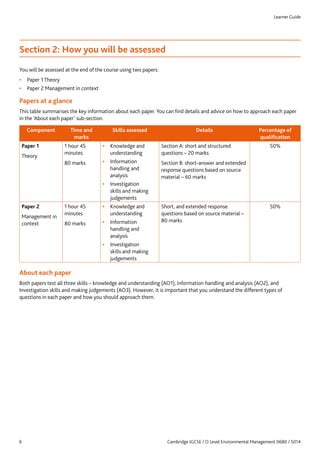
Papers at a glance
This table summarises the key information about each paper. You can find details and advice on how to approach each paper
in the ‘About each paper’ sub-section.
Component Time and
marks
Skills assessed Details Percentage of
qualification
Paper 1
Theory
1 hour 45
minutes
80 marks
• Knowledge and
understanding
• Information
handling and
analysis
• Investigation
skills and making
judgements
Section A: short and structured
questions – 20 marks
Section B: short-answer and extended
response questions based on source
material – 60 marks
50%
Paper 2
Management in
context
1 hour 45
minutes
80 marks
• Knowledge and
understanding
• Information
handling and
analysis
• Investigation
skills and making
judgements
Short, and extended response
questions based on source material –
80 marks
50%
About each paper
Both papers test all three skills – knowledge and understanding (AO1), information handling and analysis (AO2), and
Investigation skills and making judgements (AO3). However, it is important that you understand the different types of
questions in each paper and how you should approach them.
Learner Guide
7
Cambridge IGCSE / O Level Environmental Management 0680 / 5014
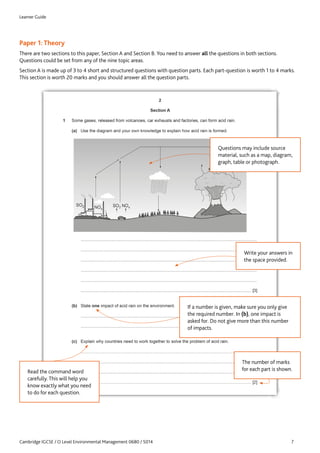
Questions may include source
material, such as a map, diagram,
graph, table or photograph.
Write your answers in
the space provided.
If a number is given, make sure you only give
the required number. In (b), one impact is
asked for. Do not give more than this number
of impacts.
The number of marks
for each part is shown.
Read the command word
carefully. This will help you
know exactly what you need
to do for each question.
Paper 1: Theory
There are two sections to this paper, Section A and Section B. You need to answer all the questions in both sections.
Questions could be set from any of the nine topic areas.
Section A is made up of 3 to 4 short and structured questions with question parts. Each part-question is worth 1 to 4 marks.
This section is worth 20 marks and you should answer all the question parts.
Learner Guide
8 Cambridge IGCSE / O Level Environmental Management 0680 / 5014
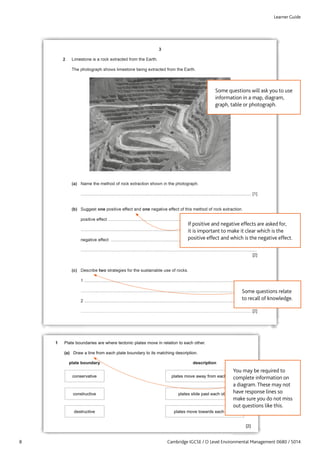
Some questions will ask you to use
information in a map, diagram,
graph, table or photograph.
If positive and negative effects are asked for,
it is important to make it clear which is the
positive effect and which is the negative effect.
Some questions relate
to recall of knowledge.
You may be required to
complete information on
a diagram. These may not
have response lines so
make sure you do not miss
out questions like this.
Learner Guide
9
Cambridge IGCSE / O Level Environmental Management 0680 / 5014
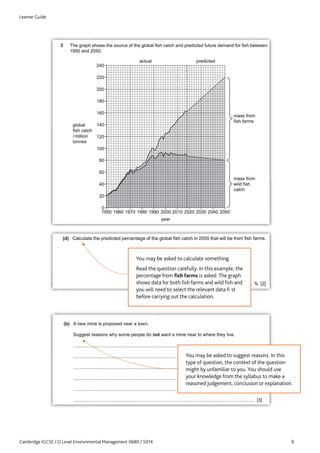
You may be asked to calculate something.
Read the question carefully. In this example, the
percentage from fish farms is asked. The graph
shows data for both fish farms and wild fish and
you will need to select the relevant data fi st
before carrying out the calculation.
You may be asked to suggest reasons. In this
type of question, the context of the question
might by unfamiliar to you. You should use
your knowledge from the syllabus to make a
reasoned judgement, conclusion or explanation.
Learner Guide
10 Cambridge IGCSE / O Level Environmental Management 0680 / 5014
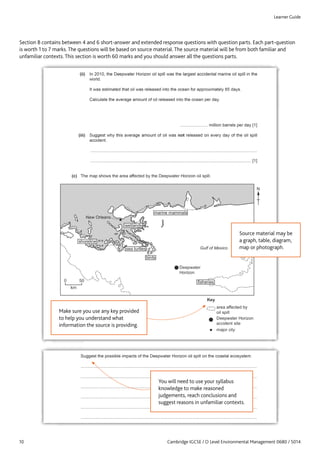
Section B contains between 4 and 6 short-answer and extended response questions with question parts. Each part-question
is worth 1 to 7 marks. The questions will be based on source material. The source material will be from both familiar and
unfamiliar contexts. This section is worth 60 marks and you should answer all the questions parts.
Source material may be
a graph, table, diagram,
map or photograph.
Make sure you use any key provided
to help you understand what
information the source is providing.
You will need to use your syllabus
knowledge to make reasoned
judgements, reach conclusions and
suggest reasons in unfamiliar contexts.
Learner Guide
11
Cambridge IGCSE / O Level Environmental Management 0680 / 5014
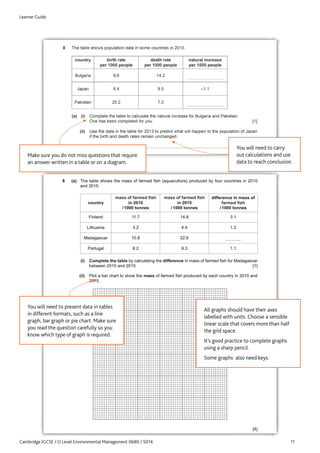
Make sure you do not miss questions that require
an answer written in a table or on a diagram.
You will need to carry
out calculations and use
data to reach conclusion.
You will need to present data in tables
in different formats, such as a line
graph, bar graph or pie chart. Make sure
you read the question carefully so you
know which type of graph is required.
All graphs should have their axes
labelled with units. Choose a sensible
linear scale that covers more than half
the grid space.
It’s good practice to complete graphs
using a sharp pencil.
Some graphs also need keys.
Learner Guide
12 Cambridge IGCSE / O Level Environmental Management 0680 / 5014
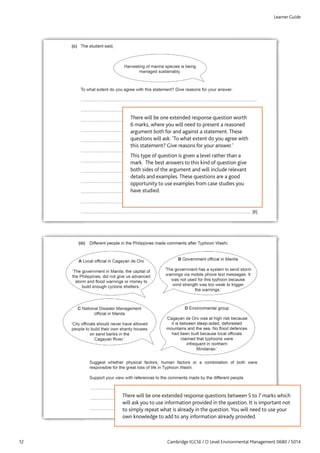
There will be one extended response question worth
6 marks, where you will need to present a reasoned
argument both for and against a statement. These
questions will ask: ‘To what extent do you agree with
this statement? Give reasons for your answer.’
This type of question is given a level rather than a
mark. The best answers to this kind of question give
both sides of the argument and will include relevant
details and examples. These questions are a good
opportunity to use examples from case studies you
have studied.
There will be one extended response questions between 5 to 7 marks which
will ask you to use information provided in the question. It is important not
to simply repeat what is already in the question. You will need to use your
own knowledge to add to any information already provided.
Learner Guide
13
Cambridge IGCSE / O Level Environmental Management 0680 / 5014
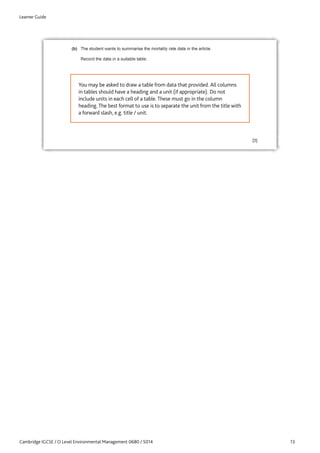
You may be asked to draw a table from data that provided. All columns
in tables should have a heading and a unit (if appropriate). Do not
include units in each cell of a table. These must go in the column
heading. The best format to use is to separate the unit from the title with
a forward slash, e.g. title / unit.
Learner Guide
14 Cambridge IGCSE / O Level Environmental Management 0680 / 5014
Paper 2: Management in context
The paper has between 2 and 5 short and extended response questions with question parts. You need to answer all the
question parts in this paper.
The question paper is based on environmental management issues that relate to one country. Questions could be set from
any of the nine topic areas. This paper is worth 80 marks.
The question paper is made up of short and extended response questions. These questions are based on source material and
are ‘real-life’ management in context issues.
The question paper includes practical based questions that help you demonstrate your fieldwork skills, such as writing a
method for estimating biodiversity and populations using pitfall traps, pooters, quadrats and transects. You will need to
be able to describe random and systematic sampling and apply these sampling techniques to unfamiliar contexts. You will
need to draw tables for data, plot bar charts, line graphs and pie charts and interpret data from maps, diagrams, tables,
photographs and text.
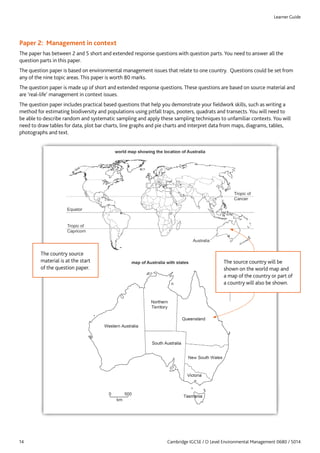
The country source
material is at the start
of the question paper.
The source country will be
shown on the world map and
a map of the country or part of
a country will also be shown.
Learner Guide
15
Cambridge IGCSE / O Level Environmental Management 0680 / 5014
Information about this
country is included. This
source material can be used
throughout the question paper.
You may have to interpret
climate data on temperature,
sunshine hours and
precipitation. The source
material at the start of the
question paper also includes a
summary of the type of climate
a country has.
Learner Guide
16 Cambridge IGCSE / O Level Environmental Management 0680 / 5014
Some questions will be simple recall. Make sure
you only give the required number of answers
if a number is stated. In this example, one
renewable energy resource is asked for. You
should not try to name more than one.
You should be able to
interpret a tally system.
You may have to draw a
table. Remember to include
column headings and units
in the column headings but
not in the cells of the table.
You will need to carry out
calculations from data.
Learner Guide
17
Cambridge IGCSE / O Level Environmental Management 0680 / 5014
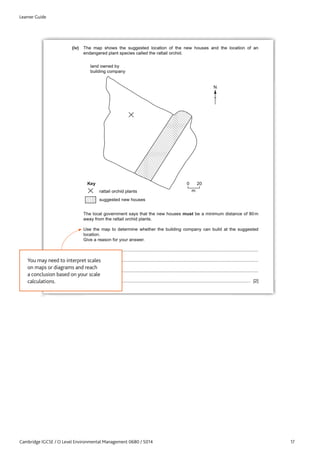
You may need to interpret scales
on maps or diagrams and reach
a conclusion based on your scale
calculations.
Learner Guide
18 Cambridge IGCSE / O Level Environmental Management 0680 / 5014
You should be familiar with sampling techniques
and how to construct questionnaires.
You may have to write a
conclusion based on information
given in a questionnaire or table.
Learner Guide
19
Cambridge IGCSE / O Level Environmental Management 0680 / 5014
You will need to interpret
sampling methods and suggest
improvements. You will also
need to write conclusions
based on data provided.
You will need to write
methods for how to
estimate biodiversity
and populations in
unfamiliar contexts.
Learner Guide
20 Cambridge IGCSE / O Level Environmental Management 0680 / 5014
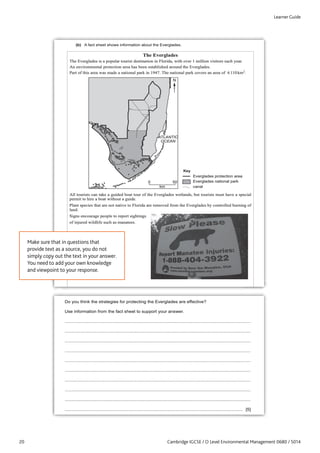
Make sure that in questions that
provide text as a source, you do not
simply copy out the text in your answer.
You need to add your own knowledge
and viewpoint to your response.
Learner Guide
21
Cambridge IGCSE / O Level Environmental Management 0680 / 5014
You may need to describe
trends or patterns in data
or distributions of data.
Learner Guide
22 Cambridge IGCSE / O Level Environmental Management 0680 / 5014
The areas of knowledge, understanding and skills that you will be assessed on are called assessment objectives (AO).
The examiners take account of the following skills areas (assessment objectives) in the examination papers.
• AO1 Knowledge and understanding
• AO2 Information handling and analysis
• AO3 Investigation skills and making judgements
It is important that you know the different weightings (%) of the assessment objectives, as this affects how the examiner will
assess your work.
For example, assessment objective 3 (AO3 Investigation skills and making judgements) is worth 20% of the total marks in
Paper 1 and 30% in Paper 2.
The approximate weightings of the assessment objectives (AOs) are summarised below.
Assessment objectives as a percentage of the qualification
Assessment objective Weighting in IGCSE %
AO1 Knowledge and understanding 40
AO2 Information handling and analysis 35
AO3 Investigation skills and making judgements 25
Total 100
Assessment objectives as a percentage of each component
Assessment objective Weighting in components %
Paper 1 Paper 2
AO1 Knowledge and understanding 40 40
AO2 Information handling and analysis 40 30
AO3 Investigation skills and making judgements 20 30
Total 100 100
Assessment objectives (AO) What does the AO mean? What do you need to be able to do?
AO1
Knowledge and understanding
Remember and understand
facts and information.
You need to show that you can use your knowledge and
understanding of concepts. You can do this by:
• defining key terms
• recalling impacts, effects, factors, methods and
strategies
AO2
Information handling and
analysis
Use facts and information
and be able to explain
information and develop
points.
You need to show that you can use facts and information in
different formats. You can do this by being able to:
• locate, select, organise and present information from
different sources
• use information from different sources e.g. graphs,
maps, tables, diagrams, text, photographs, numbers
• work with numerical data by carrying out calculations
• interpretating and analysing numerical data
• describing trends and patterns and making conclusions
Section 3: What skills will be assessed
Learner Guide
23
Cambridge IGCSE / O Level Environmental Management 0680 / 5014
Assessment objectives (AO) What does the AO mean? What do you need to be able to do?
AO3
Investigation skills and making
judgements
Be familiar with investigation
skills in practical contexts.
Be able to make judgements
based on information.
You need to show that you can analyse different
information and use information to make a decision or
choice. You can do this by:
• planning investigations
• identifying limitations with methods and suggest
improvements
• presenting reasoned explanations for patterns and
relationships
• making reasoned judgements and reaching conclusions
Learner Guide
24 Cambridge IGCSE / O Level Environmental Management 0680 / 5014
All information and advice in this section is specific to the example question and response
being demonstrated. It should give you an idea of how your responses might be viewed by an
examiner but it is not a list of what to do in all questions. In your own examination, you will
need to pay careful attention to what each question is asking you to do.
Question
Command words have been highlighted and their
meaning explained. This will help you to understand
clearly what is required. For more information go to www.
cambridgeinternational.org/exam-administration/what-to-
expect-on-exams-day/command-words/
Example candidate response
This is an answer by a real candidate in exam conditions.
Good points and problems have been highlighted.
Common mistakes
This will help you to avoid common mistakes made by
candidates. So often candidates lose marks in their exams
because they misread or misinterpret the questions.
How the answer could have been improved
This summarises what could be done to gain more marks.
Section 4: Example candidate response
This section takes you through an example question and learner response from a Cambridge 0680 / 5014 past paper. It will
help you to see how to identify command words within questions and to understand what is required in your response. A
command word is the part of the question that tells you what you need to do with your knowledge. For example, you might
need to describe something, explain something, argue a point of view or list what you know.
This section is separated as follows:
Learner Guide
25 Cambridge IGCSE / O Level Environmental Management 0680 / 5014
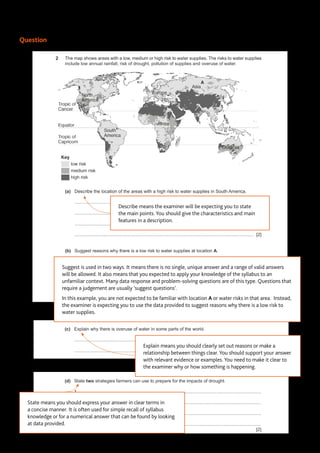
Question
Describe means the examiner will be expecting you to state
the main points. You should give the characteristics and main
features in a description.
Suggest is used in two ways. It means there is no single, unique answer and a range of valid answers
will be allowed. It also means that you expected to apply your knowledge of the syllabus to an
unfamiliar context. Many data response and problem-solving questions are of this type. Questions that
require a judgement are usually ‘suggest questions’.
In this example, you are not expected to be familiar with location A or water risks in that area. Instead,
the examiner is expecting you to use the data provided to suggest reasons why there is a low risk to
water supplies.
Explain means you should clearly set out reasons or make a
relationship between things clear. You should support your answer
with relevant evidence or examples. You need to make it clear to
the examiner why or how something is happening.
State means you should express your answer in clear terms in
a concise manner. It is often used for simple recall of syllabus
knowledge or for a numerical answer that can be found by looking
at data provided.
Learner Guide
26
Cambridge IGCSE / O Level Environmental Management 0680 / 5014
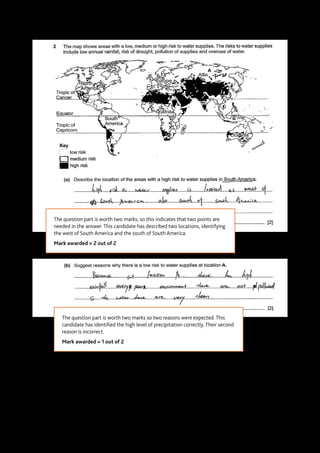
The question part is worth two marks, so this indicates that two points are
needed in the answer. This candidate has described two locations, identifying
the west of South America and the south of South America.
Mark awarded = 2 out of 2
The question part is worth two marks so two reasons were expected. This
candidate has identified the high level of precipitation correctly. Their second
reason is incorrect.
Mark awarded = 1 out of 2
Learner Guide
27 Cambridge IGCSE / O Level Environmental Management 0680 / 5014
The question part is worth two marks so two explanation points were expected. This
candidate has correctly explained that an increase in population is a valid explanation for
overuse of water. Their point about ‘development of countries…for company’ needs further
clarification and explanation to clearly indicate high water use.
Mark awarded = 1 out of 2
Two strategies are asked for and this is indicated by the ‘two’ in the question and the
number of marks. The fi st strategy does not provide enough detail. The second strategy is
not practical.
Mark awarded = 0 out of 2
How the answer could have improved
(a) It helps to use bullet points to structure your responses. This will help you give the sufficient number of answers in your
response. Use the number of marks as a guide to the number of points you need to give.
(b)As a suggest question you are not expected to know the details of the location shown but you should use your syllabus
knowledge to help answer this question. The map shows location A above the Tropic of Cancer, in the northern hemisphere
so this would suggest a colder climate and long periods of cold weather, which would mean there is less likelihood of
drought. Any reasonable reason for a low risk to water supplies would be acceptable, such as a low population, so there is
less use of available water.
(c) If the response explained why the development of countries leads to overuse of water then this would have gained the
second mark. For example, ‘development of countries leads to more industries’ or ‘development of countries leads to more
disposal income so people can use water in swimming pools’.
(d)As a 'state' question, the strategies are in the syllabus and required recall. Some candidates find it useful to write revision
notes using the syllabus as a guide to all the strategies they should be familiar with.
Common mistakes
(a) Take time to make sure you are using the key correctly. In this question, some candidates read the key incorrectly and took
the lighter low risk shading to be the high risk.
(b)The most common mistake in explain questions is to not give enough detail in your response.
(c) Giving more than the number of strategies asked for as an incorrect answer can contradict a previously correct one.
Learner Guide
28
Cambridge IGCSE / O Level Environmental Management 0680 / 5014
General advice
In order to do your best when answering a question, make sure you:
• address the question being asked, stay focused
• think carefully about how to define a given term, ensuring your answer is clear and precise, so that definitions cannot be
confused with other terms
• relate any knowledge to the question being asked, i.e. consider the context of the information you are giving
• are clear and direct in any judgement or conclusions you are making as the examiner cannot make assumptions about
what you mean
• support any conclusions with accurate and relevant information or data from the source context provided
• answer every question, including those where there are no response lines e.g. on a diagram, in a table, or on a grid
• complete diagrams and graphs using a sharp pencil and ruler
• use a calculator to help you with calculations but check your answer makes sense. You should give numerical answers to
an appropriate number of significant figu es or decimal places.
Learner Guide
29 Cambridge IGCSE / O Level Environmental Management 0680 / 5014
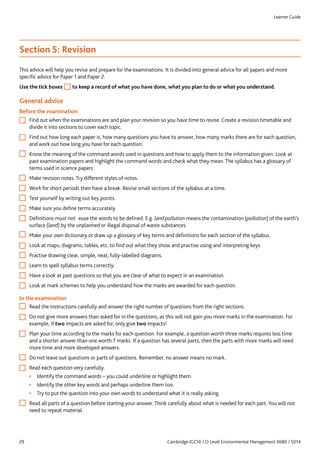
This advice will help you revise and prepare for the examinations. It is divided into general advice for all papers and more
specific advice for Paper 1 and Paper 2.
Use the tick boxes to keep a record of what you have done, what you plan to do or what you understand.
General advice
Before the examination
Find out when the examinations are and plan your revision so you have time to revise. Create a revision timetable and
divide it into sections to cover each topic.
Find out how long each paper is, how many questions you have to answer, how many marks there are for each question,
and work out how long you have for each question.
Know the meaning of the command words used in questions and how to apply them to the information given. Look at
past examination papers and highlight the command words and check what they mean. The syllabus has a glossary of
terms used in science papers.
Make revision notes. Try different styles of notes.
Work for short periods then have a break. Revise small sections of the syllabus at a time.
Test yourself by writing out key points.
Make sure you define terms accurately.
Definitions must not euse the words to be defined. E.g. land pollution means the contamination (pollution) of the earth’s
surface (land) by the unplanned or illegal disposal of waste substances.
Make your own dictionary or draw up a glossary of key terms and definitions for each section of the syllabus.
Look at maps, diagrams, tables, etc. to find out what they show and practise using and interpreting keys.
Practise drawing clear, simple, neat, fully-labelled diagrams.
Learn to spell syllabus terms correctly.
Have a look at past questions so that you are clear of what to expect in an examination.
Look at mark schemes to help you understand how the marks are awarded for each question.
Section 5: Revision
Read the instructions carefully and answer the right number of questions from the right sections.
Do not give more answers than asked for in the questions, as this will not gain you more marks in the examination. For
example, if two impacts are asked for, only give two impacts!
Plan your time according to the marks for each question. For example, a question worth three marks requires less time
and a shorter answer than one worth 7 marks. If a question has several parts, then the parts with more marks will need
more time and more developed answers.
Do not leave out questions or parts of questions. Remember, no answer means no mark.
Read each question very carefully.
• Identify the command words – you could underline or highlight them.
• Identify the other key words and perhaps underline them too.
• Try to put the question into your own words to understand what it is really asking.
Read all parts of a question before starting your answer. Think carefully about what is needed for each part. You will not
need to repeat material.
In the examination
Learner Guide
30
Cambridge IGCSE / O Level Environmental Management 0680 / 5014
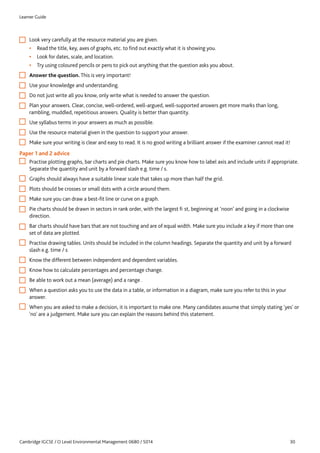
Look very carefully at the resource material you are given.
• Read the title, key, axes of graphs, etc. to find out exactly what it is showing you.
• Look for dates, scale, and location.
• Try using coloured pencils or pens to pick out anything that the question asks you about.
Answer the question. This is very important!
Use your knowledge and understanding.
Do not just write all you know, only write what is needed to answer the question.
Plan your answers. Clear, concise, well-ordered, well-argued, well-supported answers get more marks than long,
rambling, muddled, repetitious answers. Quality is better than quantity.
Use syllabus terms in your answers as much as possible.
Use the resource material given in the question to support your answer.
Make sure your writing is clear and easy to read. It is no good writing a brilliant answer if the examiner cannot read it!
Practise plotting graphs, bar charts and pie charts. Make sure you know how to label axis and include units if appropriate.
Separate the quantity and unit by a forward slash e.g. time / s.
Graphs should always have a suitable linear scale that takes up more than half the grid.
Plots should be crosses or small dots with a circle around them.
Make sure you can draw a best-fit line or curve on a graph.
Pie charts should be drawn in sectors in rank order, with the largest fi st, beginning at ‘noon’ and going in a clockwise
direction.
Bar charts should have bars that are not touching and are of equal width. Make sure you include a key if more than one
set of data are plotted.
Practise drawing tables. Units should be included in the column headings. Separate the quantity and unit by a forward
slash e.g. time / s
Know the different between independent and dependent variables.
Know how to calculate percentages and percentage change.
Be able to work out a mean (average) and a range .
When a question asks you to use the data in a table, or information in a diagram, make sure you refer to this in your
answer.
When you are asked to make a decision, it is important to make one. Many candidates assume that simply stating 'yes' or
'no' are a judgement. Make sure you can explain the reasons behind this statement.
Paper 1 and 2 advice
Learner Guide
31 Cambridge IGCSE / O Level Environmental Management 0680 / 5014
Revision checklists
In the next part of this guide we have provided some revision checklists. These include information from the syllabus that you should revise. They don’t contain all the detailed knowledge
you need to know, just an overview. For more detail see the syllabus and talk to your teacher.
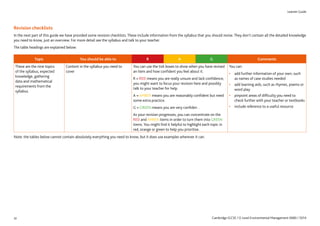
The table headings are explained below:
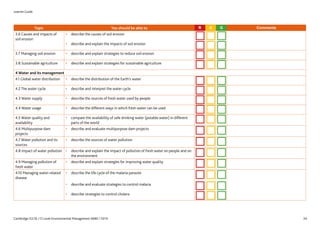
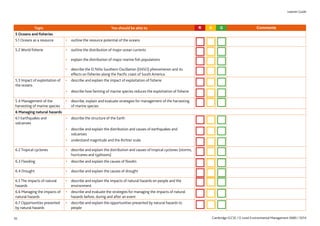
Topic You should be able to R A G Comments
These are the nine topics
of the syllabus, expected
knowledge, gathering
data and mathematical
requirements from the
syllabus.
Content in the syllabus you need to
cover
You can use the tick boxes to show when you have revised
an item and how confident you feel about it.
R = RED means you are really unsure and lack confidence;
you might want to focus your revision here and possibly
talk to your teacher for help.
A = AMBER means you are reasonably confident but need
some extra practice.
G = GREEN means you are very confiden .
As your revision progresses, you can concentrate on the
RED and AMBER items in order to turn them into GREEN
items. You might find it helpful to highlight each topic in
red, orange or green to help you prioritise.
You can:
• add further information of your own, such
as names of case studies needed
• add learning aids, such as rhymes, poems or
word play
• pinpoint areas of difficulty you need to
check further with your teacher or textbooks
• include reference to a useful resource
Note: the tables below cannot contain absolutely everything you need to know, but it does use examples wherever it can.
Learner Guide
32
Cambridge IGCSE / O Level Environmental Management 0680 / 5014
Paper 1 Theory and Paper 2 Management in Context
Topic You should be able to R A G Comments
Expected Knowledge Candidates should be able to identify and name the world’s continents and
oceans:
• Africa, Antarctica, Asia, Europe, North America, Oceania and South America
• Atlantic Ocean, Pacific Ocean, Indian Ocean, Arctic Ocean and Southern
Ocean
1 Rocks and minerals and their exploitation
1.1 Formation of rocks • describe and interpret the rock cycle
• state and explain the formation and characteristics of named igneous,
sedimentary and metamorphic rocks
1.2 Extraction of rocks and
minerals from the Earth
• describe the following methods of extraction of rocks and minerals from the
Earth:
–
– surface mining
–
– subsurface mining
• discuss the factors that affect the decision to extract rocks and minerals
1.3 Impact of rock and
mineral extraction
• describe and explain the environmental, economic and social impacts of rock
and mineral extraction
1.4 Managing the impact of
rock and mineral extraction
• describe and evaluate strategies for restoring landscapes damaged by rock
and mineral extraction
1.5 Sustainable use of rocks
and minerals
• define sustainable esource and sustainable development
• describe and evaluate strategies for the sustainable use of rocks and minerals
2 Energy and the environment
2.1 Fossil fuel formation • describe the formation of the fossil fuels: coal, oil and gas
Learner Guide
33 Cambridge IGCSE / O Level Environmental Management 0680 / 5014
Topic You should be able to R A G Comments
2.2 Energy resources and the
generation of electricity
• classify the following energy resources as nonrenewable or renewable:
fossil fuels, nuclear power, biofuels, geothermal power, hydro-electric power,
tidal power, wave power, solar power, wind power
• describe how each of these energy resources is used to generate electricity
• describe the environmental, economic and social advantages and
disadvantages of each of these energy resources
2.3 Energy demand • describe and explain the factors affecting the demand for energy
2.4 Conservation and
management of energy
resources
• describe and explain strategies for the efficient management of energy
resources
• research and development of new energy resources
2.5 Impact of oil pollution • describe the causes and impacts of oil pollution on marine and coastal
ecosystems
2.6 Management of oil
pollution
• discuss strategies for reducing oil spills in marine and coastal ecosystems
• discuss strategies for minimising the impacts of oil spills on the marine and
coastal ecosystems
3 Agriculture and the environment
3.1 Soil composition • describe and explain the composition of soils
3.2 Soils for plant growth • describe soils as a medium for plant growth
• describe the differences between a sandy and clay soil
3.3 Agriculture types • describe the different types of agriculture
3.4 Increasing agricultural
yields
• describe techniques used to increase agricultural yields
3.5 Impact of agriculture • describe and explain the impact of agricultural practices on the environment
and people
Learner Guide
34
Cambridge IGCSE / O Level Environmental Management 0680 / 5014
Topic You should be able to R A G Comments
3.6 Causes and impacts of
soil erosion
• describe the causes of soil erosion
• describe and explain the impacts of soil erosion
3.7 Managing soil erosion • describe and explain strategies to reduce soil erosion
3.8 Sustainable agriculture • describe and explain strategies for sustainable agriculture
4 Water and its management
4.1 Global water distribution • describe the distribution of the Earth’s water
4.2 The water cycle • describe and interpret the water cycle
4.3 Water supply • describe the sources of fresh water used by people
4.4 Water usage • describe the different ways in which fresh water can be used
4.5 Water quality and
availability
• compare the availability of safe drinking water (potable water) in different
parts of the world
4.6 Multipurpose dam
projects
• describe and evaluate multipurpose dam projects
4.7 Water pollution and its
sources
• describe the sources of water pollution
4.8 Impact of water pollution • describe and explain the impact of pollution of fresh water on people and on
the environment
4.9 Managing pollution of
fresh water
• describe and explain strategies for improving water quality
4.10 Managing water-related
disease
• describe the life cycle of the malaria parasite
• describe and evaluate strategies to control malaria
• describe strategies to control cholera
Learner Guide
35 Cambridge IGCSE / O Level Environmental Management 0680 / 5014
Topic You should be able to R A G Comments
5 Oceans and fisheries
5.1 Oceans as a resource • outline the resource potential of the oceans
5.2 World fisherie • outline the distribution of major ocean currents
• explain the distribution of major marine fish populations
• describe the El Niño Southern Oscillation (ENSO) phenomenon and its
effects on fisheries along the Pacific coast of South America
5.3 Impact of exploitation of
the oceans
• describe and explain the impact of exploitation of fisherie
• describe how farming of marine species reduces the exploitation of fisherie
5.4 Management of the
harvesting of marine species
• describe, explain and evaluate strategies for management of the harvesting
of marine species
6 Managing natural hazards
6.1 Earthquakes and
volcanoes
• describe the structure of the Earth
• describe and explain the distribution and causes of earthquakes and
volcanoes
• understand magnitude and the Richter scale
6.2 Tropical cyclones • describe and explain the distribution and causes of tropical cyclones (storms,
hurricanes and typhoons)
6.3 Flooding • describe and explain the causes of floodin
6.4 Drought • describe and explain the causes of drought
6.5 The impacts of natural
hazards
• describe and explain the impacts of natural hazards on people and the
environment
6.6 Managing the impacts of
natural hazards
• describe and evaluate the strategies for managing the impacts of natural
hazards before, during and after an event
6.7 Opportunities presented
by natural hazards
• describe and explain the opportunities presented by natural hazards to
people
Learner Guide
36
Cambridge IGCSE / O Level Environmental Management 0680 / 5014
Topic You should be able to R A G Comments
7 The atmosphere and human activities
7.1 The atmosphere • describe the structure and composition of the atmosphere
• describe the natural greenhouse effect
7.2 Atmospheric pollution and
its causes
• describe and explain the causes of atmospheric pollution, with reference to:
–
– smog
–
– acid rain
–
– ozone layer depletion
–
– enhanced greenhouse effect
7.3 Impact of atmospheric
pollution
• describe and explain the impact of atmospheric pollution
7.4 Managing atmospheric
pollution
• describe and explain the strategies used by individuals, governments and the
international community to reduce the effects of atmospheric pollution
8 Human population
8.1 Human population
distribution and density
• identify where people live in the world
8.2 Changes in population
size
• describe and explain the growth curve of populations
• describe and explain the changes in human populations
8.3 Population structure • describe population structure in MEDCs and LEDCs
8.4 Managing human
population size
• evaluate strategies for managing human population size
9 Natural ecosystems and human activities
9.1 Ecosystems • define the terms ecosystem, population, community, habitat and niche
• describe the biotic (living) and abiotic (nonliving) components of an
ecosystem
• describe biotic interactions
• describe the process of photosynthesis
Learner Guide
37 Cambridge IGCSE / O Level Environmental Management 0680 / 5014
Topic You should be able to R A G Comments
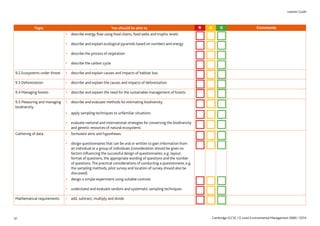
• describe energy flow using food chains, food webs and trophic levels
• describe and explain ecological pyramids based on numbers and energy
• describe the process of respiration
• describe the carbon cycle
9.2 Ecosystems under threat • describe and explain causes and impacts of habitat loss
9.3 Deforestation • describe and explain the causes and impacts of deforestation
9.4 Managing forests • describe and explain the need for the sustainable management of forests
9.5 Measuring and managing
biodiversity
• describe and evaluate methods for estimating biodiversity
• apply sampling techniques to unfamiliar situations
• evaluate national and international strategies for conserving the biodiversity
and genetic resources of natural ecosystems
Gathering of data • formulate aims and hypotheses
• design questionnaires that can be oral or written to gain information from
an individual or a group of individuals (consideration should be given to
factors influencing the successful design of questionnaires, e.g. layout,
format of questions, the appropriate wording of questions and the number
of questions. The practical considerations of conducting a questionnaire, e.g.
the sampling methods, pilot survey and location of survey should also be
discussed)
• design a simple experiment using suitable controls
• understand and evaluate random and systematic sampling techniques.
Mathematical requirements • add, subtract, multiply and divide
Learner Guide
38
Cambridge IGCSE / O Level Environmental Management 0680 / 5014
Topic You should be able to R A G Comments
• use averages, decimals, fractions, percentages, ratios and reciprocals
• understand the terms mean and range
• use standard notation, including both positive and negative indices
• understand significant figu es and use them appropriately
• recognise and use direct and inverse proportion
• draw tables, charts and graphs from given data
• interpret charts and graphs
• determine the gradient and intercept of a graph
• select suitable scales and axes for graphs
• make approximate evaluations of numerical expressions
• understand the meaning of angle, curve, circle, radius, diameter, area,
circumference, square, rectangle and diagonal
• understand map scale and the use of the scale line.
Learner Guide
39 Cambridge IGCSE / O Level Environmental Management 0680 / 5014
Section 6: Useful resources
The resources listed below will help you to revise and study for your Cambridge Environmental Management 0680 course.
These resources have not been through the Cambridge quality assurance process but have been found suitable for use with
various parts of the syllabus. This list includes website links providing direct access to internet resources. Cambridge is not
responsible for the accuracy or content of information contained in these resources. The inclusion of a link to an external
website should not be understood to be an endorsement of that website or the site's owners (or their products/services).
1 Rocks and minerals and their exploitation
https://www.worldatlas.com/articles/what-is-the-environmental-impact-of-the-mining-industry.html
www.learner.org/ – search for ‘rock cycle’.
www.greatmining.com/ – search under ‘Surface mining’ and ‘Underground mining’.
https://www.oxfam.org.au/what-we-do/mining/impacts-of-mining/
https://www.gold.org/about-gold/gold-supply/gold-development/positive-impacts-mining-case-studies
2 Energy and the environment
www.eia.gov – search ‘What is energy? Explained’ for a summary of renewable and non-renewable resources
www.need.org – search ‘Secondary energy infobook’
www.world-nuclear.org – search ‘nuclear power’
www.ufl.edu – search ‘biogas’
www.nrdc.org – search ‘wind power’
www.onpower.is – search ‘geothermal power’
http://nationalgeographic.org – search ‘Education: hydroelectric’
www.need.org – search ‘Secondary solar factsheet’
www.alternative-energy-news.info – search for ‘wind power’, ‘solar power’, ‘wave power’.
http://nationalgeographic.org – search ‘Hydroelectric and geothermal: benefits and drawbacks’
3 Agriculture and the environment
www.rhs.org.uk – search ‘soil types’.
www.bbc.co.uk/education – search for ‘farming in rural environments’
www.fao.org – search for ‘How to feed the world in 2050’.
www.bbc.co.uk/news – search for ‘The disappearing Aral Sea’ and the short clip ‘Aral Sea – Duzbay’s story’.
www.un.org – search for ‘desertification day’
4 Water and its mangement
http://asi.ucdavis.edu/ – search ‘Sustainable agriculture activity guides’.
www.leafuk.org/leaf/home.eb – search ‘Simply sustainable soils’.
www.usgs.gov – search ‘Where is Earth’s water?’
https://thewaterproject.org/ – search ‘create a mini water cycle’.
www.klickitatpud.com/ – search ‘Packwood Lake Hydro Project’.
www.water-pollution.org.uk – search ‘types of water pollution’ and ‘causes of water pollution’.
https://healingearth.ijep.net/water/case-study-river-ganges
http://www.greenpeace.org.uk – search ‘Hidden consequences: The unseen price of water pollution’.
5 Oceans and fisheries
www.climate.gov/ – search ‘El Nino status’.
www.climate.gov/ – search ‘What is El Nino in a nutshell?’
http://wwf.panda.org/ – search ‘unsustainable fishin ’.
Learner Guide
40
Cambridge IGCSE / O Level Environmental Management 0680 / 5014
http://advocacy.britannica.com/blog/advocacy/ – search ‘pros and cons of fish farming’.
6 Managing natural hazards
www.volcanodiscovery.com/ – search ‘live volcano webcams’.
http://earthquake.usgs.gov/ – search ‘Measuring the size of an earthquake’.
www.bbc.co.uk/news – search ’Japan earthquake: tsunami hits north-east’.
http://floodlist.com/
http://earthquake.usgs.gov – search ‘A comparison of two Bay Area earthquakes: 1989 v. 1906’.
www.youtube.com/ – search ‘Fertility of the Nile – Nile – BBC’ (BBC Earth).
7 The atmosphere and human activities
www.haze.gov.sg/
www.esrl.noaa.gov/ – search ‘South Pole ozone hole’
www.theozonehole.com/
https://vimeo.com/104321114 – ‘The Antarctic ozone hole’ video by Patrick Cullis.
https://www.epa.gov/acidrain
https://climate.nasa.gov/effects/
www.metoffice.gov.uk/ – search ‘what is climate change?’ and ‘Impacts of climate change’.
www.globalccsinstitute.com/ – search ‘understanding carbon capture and storage’.
www.gcsescience.com/index.html – search ‘catalytic converters’.
http://powerplantstechnology.blogspot.co.uk/ – search ‘Flue gas desulfurization’.
8 Human population
www.differencebetween.com/difference-between-afforestation-and-reforestation/
www.earthtimes.org/encyclopaedia/environmental-issues/deforestation/
www.s-cool.co.uk/ – search ‘populations’.
www.youtube.com/ – search ‘Human population through time’.
www.youtube.com/ – search ‘[Channel 4 News] Population explosion causes poverty crisis’.
www.worldwatch.org/ – search ‘Nine population strategies’
www.japanfs.org/en/news/archives/news_id034953.html – search ‘depopulation of society in Japan’
www.bbc.co.uk/ – search ‘How Ethiopia slowed its population growth’
http://geography.about.com/ – search ‘China’s one child policy’.
9 Natural ecosystems and human activities
www.bbc.co.uk/education/subjects – search ‘photosynthesis and respiration’.
www.saps.org.uk/ – search ‘Animation – respiration and photosynthesis’.
www.scienceaid.co.uk/biology/ecology/ – search ‘food chains and energy’
www.rspb.org.uk/ – search ‘pyramids of numbers’.
www.nationalgeographic.com/environment/ – search ‘Photo gallery: rain forest deforestation’.
www.shutterstock.com/search/deforestation
Sampling techniques
www.amentsoc.org/ – search ‘Make a pooter activity for kids’.
www.saps.org.uk/ – search ‘Questions about quadrats’.
www.youtube.com/ – search ‘quadrat sampling’.
www.saps.org.uk/ – search ‘Ecology practical 2: The distribution of species across a footpath’.
www.rgs.org/HomePage.htm – search ‘sampling techniques’
Learner Guide
41 Cambridge IGCSE / O Level Environmental Management 0680 / 5014
www.saps.org.uk/ – search ‘Ecology practical 1: Measuring abundance and random sampling’
www.saps.org.uk/ – search ‘Ecology practical 3: abundance and random sampling at Waun Las Nature Reserve, Wales’.
You can find a esource list, including endorsed resources to support Cambridge IGCSE / O Level Environmental Management
on our public website [here]
Endorsed resources have been written to be closely aligned to the syllabus they support, and have been through a detailed
quality assurance process. All textbooks endorsed by Cambridge International for this syllabus are the ideal resource to be
used alongside this Learner Guide.
In addition to reading the syllabus, you should refer to the past and specimen papers.
Cambridge Assessment International Education
The Triangle Building, Shaftesbury Road, Cambridge, CB2 8EA, United Kingdom
t: +44 1223 553554
e: info@cambridgeinternational.org www.cambridgeinternational.org
© Cambridge University Press & Assessment 2022 v2

0680_Learner_Guide_(for_examination_in_2019).pdf

  • 1.
    Learner Guide Cambridge IGCSE TM EnvironmentalManagement 0680 For examination from 2019 Cambridge O Level Environmental Management 5014 Interactive
  • 2.
    In order tohelp us develop the highest quality resources, we are undertaking a continuous programme of review; not only to measure the success of our resources but also to highlight areas for improvement and to identify new development needs. We invite you to complete our survey by visiting the website below. Your comments on the quality and relevance of our resources are very important to us. www.surveymonkey.co.uk/r/GL6ZNJB © Cambridge University Press & Assessment 2022 v2 Cambridge Assessment International Education is part of Cambridge University Press & Assessment. Cambridge University Press & Assessment is a department of the University of Cambridge. Cambridge University Press & Assessment retains the copyright on all its publications. Registered centres are permitted to copy material from this booklet for their own internal use. However, we cannot give permission to centres to photocopy any material that is acknowledged to a third party even for internal use within a centre.
  • 3.
    Contents About this guide4 Section 1: Syllabus content - what you need to know about 5 Section 2: How you will be assessed 6 Section 3: What skills will be assessed 22 Section 4: Example candidate response 24 Section 5: Revision 29 Section 6: Useful resources 39
  • 4.
    Learner Guide 4 CambridgeIGCSE / O Level Environmental Management 0680 / 5014 This guide explains what you need to know about your Cambridge Environmental Management course and examinations. You should use this guide alongside the support of your teacher. It will help you to: 9 9 understand what skills you should develop by taking this Cambridge IGCSE course 9 9 understand how you will be assessed 9 9 understand what we are looking for in the answers you write 9 9 plan your revision programme 9 9 revise, by providing revision tips and an interactive revision checklist (Section 5). About this guide
  • 5.
    Learner Guide 5 Cambridge IGCSE/ O Level Environmental Management 0680 / 5014 This section gives you an outline of the syllabus content for this course. Ask your teacher for more detail about each topic. You can also find more detail in the Revision checklists of this guide. The syllabus is divided into nine topic which have been designed to help you develop an understanding of both the natural and the human environment. The nine topics are: 1. Rocks and minerals and their exploration 2. Energy and the environment 3. Agriculture and the environment 4. Water and its management 5. Oceans and fisherie 6. Managing natural hazards 7. The atmosphere and human activities 8. Human population 9. Natural ecosystems and human activities Make sure you always check the latest syllabus, which is available at www.cambridgeinternational.org Section 1: Syllabus content - what you need to know about
  • 6.
    Learner Guide 6 CambridgeIGCSE / O Level Environmental Management 0680 / 5014 Section 2: How you will be assessed You will be assessed at the end of the course using two papers: • Paper 1 Theory • Paper 2 Management in context Papers at a glance This table summarises the key information about each paper. You can find details and advice on how to approach each paper in the ‘About each paper’ sub-section. Component Time and marks Skills assessed Details Percentage of qualification Paper 1 Theory 1 hour 45 minutes 80 marks • Knowledge and understanding • Information handling and analysis • Investigation skills and making judgements Section A: short and structured questions – 20 marks Section B: short-answer and extended response questions based on source material – 60 marks 50% Paper 2 Management in context 1 hour 45 minutes 80 marks • Knowledge and understanding • Information handling and analysis • Investigation skills and making judgements Short, and extended response questions based on source material – 80 marks 50% About each paper Both papers test all three skills – knowledge and understanding (AO1), information handling and analysis (AO2), and Investigation skills and making judgements (AO3). However, it is important that you understand the different types of questions in each paper and how you should approach them.
  • 7.
    Learner Guide 7 Cambridge IGCSE/ O Level Environmental Management 0680 / 5014 Questions may include source material, such as a map, diagram, graph, table or photograph. Write your answers in the space provided. If a number is given, make sure you only give the required number. In (b), one impact is asked for. Do not give more than this number of impacts. The number of marks for each part is shown. Read the command word carefully. This will help you know exactly what you need to do for each question. Paper 1: Theory There are two sections to this paper, Section A and Section B. You need to answer all the questions in both sections. Questions could be set from any of the nine topic areas. Section A is made up of 3 to 4 short and structured questions with question parts. Each part-question is worth 1 to 4 marks. This section is worth 20 marks and you should answer all the question parts.
  • 8.
    Learner Guide 8 CambridgeIGCSE / O Level Environmental Management 0680 / 5014 Some questions will ask you to use information in a map, diagram, graph, table or photograph. If positive and negative effects are asked for, it is important to make it clear which is the positive effect and which is the negative effect. Some questions relate to recall of knowledge. You may be required to complete information on a diagram. These may not have response lines so make sure you do not miss out questions like this.
  • 9.
    Learner Guide 9 Cambridge IGCSE/ O Level Environmental Management 0680 / 5014 You may be asked to calculate something. Read the question carefully. In this example, the percentage from fish farms is asked. The graph shows data for both fish farms and wild fish and you will need to select the relevant data fi st before carrying out the calculation. You may be asked to suggest reasons. In this type of question, the context of the question might by unfamiliar to you. You should use your knowledge from the syllabus to make a reasoned judgement, conclusion or explanation.
  • 10.
    Learner Guide 10 CambridgeIGCSE / O Level Environmental Management 0680 / 5014 Section B contains between 4 and 6 short-answer and extended response questions with question parts. Each part-question is worth 1 to 7 marks. The questions will be based on source material. The source material will be from both familiar and unfamiliar contexts. This section is worth 60 marks and you should answer all the questions parts. Source material may be a graph, table, diagram, map or photograph. Make sure you use any key provided to help you understand what information the source is providing. You will need to use your syllabus knowledge to make reasoned judgements, reach conclusions and suggest reasons in unfamiliar contexts.
  • 11.
    Learner Guide 11 Cambridge IGCSE/ O Level Environmental Management 0680 / 5014 Make sure you do not miss questions that require an answer written in a table or on a diagram. You will need to carry out calculations and use data to reach conclusion. You will need to present data in tables in different formats, such as a line graph, bar graph or pie chart. Make sure you read the question carefully so you know which type of graph is required. All graphs should have their axes labelled with units. Choose a sensible linear scale that covers more than half the grid space. It’s good practice to complete graphs using a sharp pencil. Some graphs also need keys.
  • 12.
    Learner Guide 12 CambridgeIGCSE / O Level Environmental Management 0680 / 5014 There will be one extended response question worth 6 marks, where you will need to present a reasoned argument both for and against a statement. These questions will ask: ‘To what extent do you agree with this statement? Give reasons for your answer.’ This type of question is given a level rather than a mark. The best answers to this kind of question give both sides of the argument and will include relevant details and examples. These questions are a good opportunity to use examples from case studies you have studied. There will be one extended response questions between 5 to 7 marks which will ask you to use information provided in the question. It is important not to simply repeat what is already in the question. You will need to use your own knowledge to add to any information already provided.
  • 13.
    Learner Guide 13 Cambridge IGCSE/ O Level Environmental Management 0680 / 5014 You may be asked to draw a table from data that provided. All columns in tables should have a heading and a unit (if appropriate). Do not include units in each cell of a table. These must go in the column heading. The best format to use is to separate the unit from the title with a forward slash, e.g. title / unit.
  • 14.
    Learner Guide 14 CambridgeIGCSE / O Level Environmental Management 0680 / 5014 Paper 2: Management in context The paper has between 2 and 5 short and extended response questions with question parts. You need to answer all the question parts in this paper. The question paper is based on environmental management issues that relate to one country. Questions could be set from any of the nine topic areas. This paper is worth 80 marks. The question paper is made up of short and extended response questions. These questions are based on source material and are ‘real-life’ management in context issues. The question paper includes practical based questions that help you demonstrate your fieldwork skills, such as writing a method for estimating biodiversity and populations using pitfall traps, pooters, quadrats and transects. You will need to be able to describe random and systematic sampling and apply these sampling techniques to unfamiliar contexts. You will need to draw tables for data, plot bar charts, line graphs and pie charts and interpret data from maps, diagrams, tables, photographs and text. The country source material is at the start of the question paper. The source country will be shown on the world map and a map of the country or part of a country will also be shown.
  • 15.
    Learner Guide 15 Cambridge IGCSE/ O Level Environmental Management 0680 / 5014 Information about this country is included. This source material can be used throughout the question paper. You may have to interpret climate data on temperature, sunshine hours and precipitation. The source material at the start of the question paper also includes a summary of the type of climate a country has.
  • 16.
    Learner Guide 16 CambridgeIGCSE / O Level Environmental Management 0680 / 5014 Some questions will be simple recall. Make sure you only give the required number of answers if a number is stated. In this example, one renewable energy resource is asked for. You should not try to name more than one. You should be able to interpret a tally system. You may have to draw a table. Remember to include column headings and units in the column headings but not in the cells of the table. You will need to carry out calculations from data.
  • 17.
    Learner Guide 17 Cambridge IGCSE/ O Level Environmental Management 0680 / 5014 You may need to interpret scales on maps or diagrams and reach a conclusion based on your scale calculations.
  • 18.
    Learner Guide 18 CambridgeIGCSE / O Level Environmental Management 0680 / 5014 You should be familiar with sampling techniques and how to construct questionnaires. You may have to write a conclusion based on information given in a questionnaire or table.
  • 19.
    Learner Guide 19 Cambridge IGCSE/ O Level Environmental Management 0680 / 5014 You will need to interpret sampling methods and suggest improvements. You will also need to write conclusions based on data provided. You will need to write methods for how to estimate biodiversity and populations in unfamiliar contexts.
  • 20.
    Learner Guide 20 CambridgeIGCSE / O Level Environmental Management 0680 / 5014 Make sure that in questions that provide text as a source, you do not simply copy out the text in your answer. You need to add your own knowledge and viewpoint to your response.
  • 21.
    Learner Guide 21 Cambridge IGCSE/ O Level Environmental Management 0680 / 5014 You may need to describe trends or patterns in data or distributions of data.
  • 22.
    Learner Guide 22 CambridgeIGCSE / O Level Environmental Management 0680 / 5014 The areas of knowledge, understanding and skills that you will be assessed on are called assessment objectives (AO). The examiners take account of the following skills areas (assessment objectives) in the examination papers. • AO1 Knowledge and understanding • AO2 Information handling and analysis • AO3 Investigation skills and making judgements It is important that you know the different weightings (%) of the assessment objectives, as this affects how the examiner will assess your work. For example, assessment objective 3 (AO3 Investigation skills and making judgements) is worth 20% of the total marks in Paper 1 and 30% in Paper 2. The approximate weightings of the assessment objectives (AOs) are summarised below. Assessment objectives as a percentage of the qualification Assessment objective Weighting in IGCSE % AO1 Knowledge and understanding 40 AO2 Information handling and analysis 35 AO3 Investigation skills and making judgements 25 Total 100 Assessment objectives as a percentage of each component Assessment objective Weighting in components % Paper 1 Paper 2 AO1 Knowledge and understanding 40 40 AO2 Information handling and analysis 40 30 AO3 Investigation skills and making judgements 20 30 Total 100 100 Assessment objectives (AO) What does the AO mean? What do you need to be able to do? AO1 Knowledge and understanding Remember and understand facts and information. You need to show that you can use your knowledge and understanding of concepts. You can do this by: • defining key terms • recalling impacts, effects, factors, methods and strategies AO2 Information handling and analysis Use facts and information and be able to explain information and develop points. You need to show that you can use facts and information in different formats. You can do this by being able to: • locate, select, organise and present information from different sources • use information from different sources e.g. graphs, maps, tables, diagrams, text, photographs, numbers • work with numerical data by carrying out calculations • interpretating and analysing numerical data • describing trends and patterns and making conclusions Section 3: What skills will be assessed
  • 23.
    Learner Guide 23 Cambridge IGCSE/ O Level Environmental Management 0680 / 5014 Assessment objectives (AO) What does the AO mean? What do you need to be able to do? AO3 Investigation skills and making judgements Be familiar with investigation skills in practical contexts. Be able to make judgements based on information. You need to show that you can analyse different information and use information to make a decision or choice. You can do this by: • planning investigations • identifying limitations with methods and suggest improvements • presenting reasoned explanations for patterns and relationships • making reasoned judgements and reaching conclusions
  • 24.
    Learner Guide 24 CambridgeIGCSE / O Level Environmental Management 0680 / 5014 All information and advice in this section is specific to the example question and response being demonstrated. It should give you an idea of how your responses might be viewed by an examiner but it is not a list of what to do in all questions. In your own examination, you will need to pay careful attention to what each question is asking you to do. Question Command words have been highlighted and their meaning explained. This will help you to understand clearly what is required. For more information go to www. cambridgeinternational.org/exam-administration/what-to- expect-on-exams-day/command-words/ Example candidate response This is an answer by a real candidate in exam conditions. Good points and problems have been highlighted. Common mistakes This will help you to avoid common mistakes made by candidates. So often candidates lose marks in their exams because they misread or misinterpret the questions. How the answer could have been improved This summarises what could be done to gain more marks. Section 4: Example candidate response This section takes you through an example question and learner response from a Cambridge 0680 / 5014 past paper. It will help you to see how to identify command words within questions and to understand what is required in your response. A command word is the part of the question that tells you what you need to do with your knowledge. For example, you might need to describe something, explain something, argue a point of view or list what you know. This section is separated as follows:
  • 25.
    Learner Guide 25 CambridgeIGCSE / O Level Environmental Management 0680 / 5014 Question Describe means the examiner will be expecting you to state the main points. You should give the characteristics and main features in a description. Suggest is used in two ways. It means there is no single, unique answer and a range of valid answers will be allowed. It also means that you expected to apply your knowledge of the syllabus to an unfamiliar context. Many data response and problem-solving questions are of this type. Questions that require a judgement are usually ‘suggest questions’. In this example, you are not expected to be familiar with location A or water risks in that area. Instead, the examiner is expecting you to use the data provided to suggest reasons why there is a low risk to water supplies. Explain means you should clearly set out reasons or make a relationship between things clear. You should support your answer with relevant evidence or examples. You need to make it clear to the examiner why or how something is happening. State means you should express your answer in clear terms in a concise manner. It is often used for simple recall of syllabus knowledge or for a numerical answer that can be found by looking at data provided.
  • 26.
    Learner Guide 26 Cambridge IGCSE/ O Level Environmental Management 0680 / 5014 The question part is worth two marks, so this indicates that two points are needed in the answer. This candidate has described two locations, identifying the west of South America and the south of South America. Mark awarded = 2 out of 2 The question part is worth two marks so two reasons were expected. This candidate has identified the high level of precipitation correctly. Their second reason is incorrect. Mark awarded = 1 out of 2
  • 27.
    Learner Guide 27 CambridgeIGCSE / O Level Environmental Management 0680 / 5014 The question part is worth two marks so two explanation points were expected. This candidate has correctly explained that an increase in population is a valid explanation for overuse of water. Their point about ‘development of countries…for company’ needs further clarification and explanation to clearly indicate high water use. Mark awarded = 1 out of 2 Two strategies are asked for and this is indicated by the ‘two’ in the question and the number of marks. The fi st strategy does not provide enough detail. The second strategy is not practical. Mark awarded = 0 out of 2 How the answer could have improved (a) It helps to use bullet points to structure your responses. This will help you give the sufficient number of answers in your response. Use the number of marks as a guide to the number of points you need to give. (b)As a suggest question you are not expected to know the details of the location shown but you should use your syllabus knowledge to help answer this question. The map shows location A above the Tropic of Cancer, in the northern hemisphere so this would suggest a colder climate and long periods of cold weather, which would mean there is less likelihood of drought. Any reasonable reason for a low risk to water supplies would be acceptable, such as a low population, so there is less use of available water. (c) If the response explained why the development of countries leads to overuse of water then this would have gained the second mark. For example, ‘development of countries leads to more industries’ or ‘development of countries leads to more disposal income so people can use water in swimming pools’. (d)As a 'state' question, the strategies are in the syllabus and required recall. Some candidates find it useful to write revision notes using the syllabus as a guide to all the strategies they should be familiar with. Common mistakes (a) Take time to make sure you are using the key correctly. In this question, some candidates read the key incorrectly and took the lighter low risk shading to be the high risk. (b)The most common mistake in explain questions is to not give enough detail in your response. (c) Giving more than the number of strategies asked for as an incorrect answer can contradict a previously correct one.
  • 28.
    Learner Guide 28 Cambridge IGCSE/ O Level Environmental Management 0680 / 5014 General advice In order to do your best when answering a question, make sure you: • address the question being asked, stay focused • think carefully about how to define a given term, ensuring your answer is clear and precise, so that definitions cannot be confused with other terms • relate any knowledge to the question being asked, i.e. consider the context of the information you are giving • are clear and direct in any judgement or conclusions you are making as the examiner cannot make assumptions about what you mean • support any conclusions with accurate and relevant information or data from the source context provided • answer every question, including those where there are no response lines e.g. on a diagram, in a table, or on a grid • complete diagrams and graphs using a sharp pencil and ruler • use a calculator to help you with calculations but check your answer makes sense. You should give numerical answers to an appropriate number of significant figu es or decimal places.
  • 29.
    Learner Guide 29 CambridgeIGCSE / O Level Environmental Management 0680 / 5014 This advice will help you revise and prepare for the examinations. It is divided into general advice for all papers and more specific advice for Paper 1 and Paper 2. Use the tick boxes to keep a record of what you have done, what you plan to do or what you understand. General advice Before the examination Find out when the examinations are and plan your revision so you have time to revise. Create a revision timetable and divide it into sections to cover each topic. Find out how long each paper is, how many questions you have to answer, how many marks there are for each question, and work out how long you have for each question. Know the meaning of the command words used in questions and how to apply them to the information given. Look at past examination papers and highlight the command words and check what they mean. The syllabus has a glossary of terms used in science papers. Make revision notes. Try different styles of notes. Work for short periods then have a break. Revise small sections of the syllabus at a time. Test yourself by writing out key points. Make sure you define terms accurately. Definitions must not euse the words to be defined. E.g. land pollution means the contamination (pollution) of the earth’s surface (land) by the unplanned or illegal disposal of waste substances. Make your own dictionary or draw up a glossary of key terms and definitions for each section of the syllabus. Look at maps, diagrams, tables, etc. to find out what they show and practise using and interpreting keys. Practise drawing clear, simple, neat, fully-labelled diagrams. Learn to spell syllabus terms correctly. Have a look at past questions so that you are clear of what to expect in an examination. Look at mark schemes to help you understand how the marks are awarded for each question. Section 5: Revision Read the instructions carefully and answer the right number of questions from the right sections. Do not give more answers than asked for in the questions, as this will not gain you more marks in the examination. For example, if two impacts are asked for, only give two impacts! Plan your time according to the marks for each question. For example, a question worth three marks requires less time and a shorter answer than one worth 7 marks. If a question has several parts, then the parts with more marks will need more time and more developed answers. Do not leave out questions or parts of questions. Remember, no answer means no mark. Read each question very carefully. • Identify the command words – you could underline or highlight them. • Identify the other key words and perhaps underline them too. • Try to put the question into your own words to understand what it is really asking. Read all parts of a question before starting your answer. Think carefully about what is needed for each part. You will not need to repeat material. In the examination
  • 30.
    Learner Guide 30 Cambridge IGCSE/ O Level Environmental Management 0680 / 5014 Look very carefully at the resource material you are given. • Read the title, key, axes of graphs, etc. to find out exactly what it is showing you. • Look for dates, scale, and location. • Try using coloured pencils or pens to pick out anything that the question asks you about. Answer the question. This is very important! Use your knowledge and understanding. Do not just write all you know, only write what is needed to answer the question. Plan your answers. Clear, concise, well-ordered, well-argued, well-supported answers get more marks than long, rambling, muddled, repetitious answers. Quality is better than quantity. Use syllabus terms in your answers as much as possible. Use the resource material given in the question to support your answer. Make sure your writing is clear and easy to read. It is no good writing a brilliant answer if the examiner cannot read it! Practise plotting graphs, bar charts and pie charts. Make sure you know how to label axis and include units if appropriate. Separate the quantity and unit by a forward slash e.g. time / s. Graphs should always have a suitable linear scale that takes up more than half the grid. Plots should be crosses or small dots with a circle around them. Make sure you can draw a best-fit line or curve on a graph. Pie charts should be drawn in sectors in rank order, with the largest fi st, beginning at ‘noon’ and going in a clockwise direction. Bar charts should have bars that are not touching and are of equal width. Make sure you include a key if more than one set of data are plotted. Practise drawing tables. Units should be included in the column headings. Separate the quantity and unit by a forward slash e.g. time / s Know the different between independent and dependent variables. Know how to calculate percentages and percentage change. Be able to work out a mean (average) and a range . When a question asks you to use the data in a table, or information in a diagram, make sure you refer to this in your answer. When you are asked to make a decision, it is important to make one. Many candidates assume that simply stating 'yes' or 'no' are a judgement. Make sure you can explain the reasons behind this statement. Paper 1 and 2 advice
  • 31.
    Learner Guide 31 CambridgeIGCSE / O Level Environmental Management 0680 / 5014 Revision checklists In the next part of this guide we have provided some revision checklists. These include information from the syllabus that you should revise. They don’t contain all the detailed knowledge you need to know, just an overview. For more detail see the syllabus and talk to your teacher. The table headings are explained below: Topic You should be able to R A G Comments These are the nine topics of the syllabus, expected knowledge, gathering data and mathematical requirements from the syllabus. Content in the syllabus you need to cover You can use the tick boxes to show when you have revised an item and how confident you feel about it. R = RED means you are really unsure and lack confidence; you might want to focus your revision here and possibly talk to your teacher for help. A = AMBER means you are reasonably confident but need some extra practice. G = GREEN means you are very confiden . As your revision progresses, you can concentrate on the RED and AMBER items in order to turn them into GREEN items. You might find it helpful to highlight each topic in red, orange or green to help you prioritise. You can: • add further information of your own, such as names of case studies needed • add learning aids, such as rhymes, poems or word play • pinpoint areas of difficulty you need to check further with your teacher or textbooks • include reference to a useful resource Note: the tables below cannot contain absolutely everything you need to know, but it does use examples wherever it can.
  • 32.
    Learner Guide 32 Cambridge IGCSE/ O Level Environmental Management 0680 / 5014 Paper 1 Theory and Paper 2 Management in Context Topic You should be able to R A G Comments Expected Knowledge Candidates should be able to identify and name the world’s continents and oceans: • Africa, Antarctica, Asia, Europe, North America, Oceania and South America • Atlantic Ocean, Pacific Ocean, Indian Ocean, Arctic Ocean and Southern Ocean 1 Rocks and minerals and their exploitation 1.1 Formation of rocks • describe and interpret the rock cycle • state and explain the formation and characteristics of named igneous, sedimentary and metamorphic rocks 1.2 Extraction of rocks and minerals from the Earth • describe the following methods of extraction of rocks and minerals from the Earth: – – surface mining – – subsurface mining • discuss the factors that affect the decision to extract rocks and minerals 1.3 Impact of rock and mineral extraction • describe and explain the environmental, economic and social impacts of rock and mineral extraction 1.4 Managing the impact of rock and mineral extraction • describe and evaluate strategies for restoring landscapes damaged by rock and mineral extraction 1.5 Sustainable use of rocks and minerals • define sustainable esource and sustainable development • describe and evaluate strategies for the sustainable use of rocks and minerals 2 Energy and the environment 2.1 Fossil fuel formation • describe the formation of the fossil fuels: coal, oil and gas
  • 33.
    Learner Guide 33 CambridgeIGCSE / O Level Environmental Management 0680 / 5014 Topic You should be able to R A G Comments 2.2 Energy resources and the generation of electricity • classify the following energy resources as nonrenewable or renewable: fossil fuels, nuclear power, biofuels, geothermal power, hydro-electric power, tidal power, wave power, solar power, wind power • describe how each of these energy resources is used to generate electricity • describe the environmental, economic and social advantages and disadvantages of each of these energy resources 2.3 Energy demand • describe and explain the factors affecting the demand for energy 2.4 Conservation and management of energy resources • describe and explain strategies for the efficient management of energy resources • research and development of new energy resources 2.5 Impact of oil pollution • describe the causes and impacts of oil pollution on marine and coastal ecosystems 2.6 Management of oil pollution • discuss strategies for reducing oil spills in marine and coastal ecosystems • discuss strategies for minimising the impacts of oil spills on the marine and coastal ecosystems 3 Agriculture and the environment 3.1 Soil composition • describe and explain the composition of soils 3.2 Soils for plant growth • describe soils as a medium for plant growth • describe the differences between a sandy and clay soil 3.3 Agriculture types • describe the different types of agriculture 3.4 Increasing agricultural yields • describe techniques used to increase agricultural yields 3.5 Impact of agriculture • describe and explain the impact of agricultural practices on the environment and people
  • 34.
    Learner Guide 34 Cambridge IGCSE/ O Level Environmental Management 0680 / 5014 Topic You should be able to R A G Comments 3.6 Causes and impacts of soil erosion • describe the causes of soil erosion • describe and explain the impacts of soil erosion 3.7 Managing soil erosion • describe and explain strategies to reduce soil erosion 3.8 Sustainable agriculture • describe and explain strategies for sustainable agriculture 4 Water and its management 4.1 Global water distribution • describe the distribution of the Earth’s water 4.2 The water cycle • describe and interpret the water cycle 4.3 Water supply • describe the sources of fresh water used by people 4.4 Water usage • describe the different ways in which fresh water can be used 4.5 Water quality and availability • compare the availability of safe drinking water (potable water) in different parts of the world 4.6 Multipurpose dam projects • describe and evaluate multipurpose dam projects 4.7 Water pollution and its sources • describe the sources of water pollution 4.8 Impact of water pollution • describe and explain the impact of pollution of fresh water on people and on the environment 4.9 Managing pollution of fresh water • describe and explain strategies for improving water quality 4.10 Managing water-related disease • describe the life cycle of the malaria parasite • describe and evaluate strategies to control malaria • describe strategies to control cholera
  • 35.
    Learner Guide 35 CambridgeIGCSE / O Level Environmental Management 0680 / 5014 Topic You should be able to R A G Comments 5 Oceans and fisheries 5.1 Oceans as a resource • outline the resource potential of the oceans 5.2 World fisherie • outline the distribution of major ocean currents • explain the distribution of major marine fish populations • describe the El Niño Southern Oscillation (ENSO) phenomenon and its effects on fisheries along the Pacific coast of South America 5.3 Impact of exploitation of the oceans • describe and explain the impact of exploitation of fisherie • describe how farming of marine species reduces the exploitation of fisherie 5.4 Management of the harvesting of marine species • describe, explain and evaluate strategies for management of the harvesting of marine species 6 Managing natural hazards 6.1 Earthquakes and volcanoes • describe the structure of the Earth • describe and explain the distribution and causes of earthquakes and volcanoes • understand magnitude and the Richter scale 6.2 Tropical cyclones • describe and explain the distribution and causes of tropical cyclones (storms, hurricanes and typhoons) 6.3 Flooding • describe and explain the causes of floodin 6.4 Drought • describe and explain the causes of drought 6.5 The impacts of natural hazards • describe and explain the impacts of natural hazards on people and the environment 6.6 Managing the impacts of natural hazards • describe and evaluate the strategies for managing the impacts of natural hazards before, during and after an event 6.7 Opportunities presented by natural hazards • describe and explain the opportunities presented by natural hazards to people
  • 36.
    Learner Guide 36 Cambridge IGCSE/ O Level Environmental Management 0680 / 5014 Topic You should be able to R A G Comments 7 The atmosphere and human activities 7.1 The atmosphere • describe the structure and composition of the atmosphere • describe the natural greenhouse effect 7.2 Atmospheric pollution and its causes • describe and explain the causes of atmospheric pollution, with reference to: – – smog – – acid rain – – ozone layer depletion – – enhanced greenhouse effect 7.3 Impact of atmospheric pollution • describe and explain the impact of atmospheric pollution 7.4 Managing atmospheric pollution • describe and explain the strategies used by individuals, governments and the international community to reduce the effects of atmospheric pollution 8 Human population 8.1 Human population distribution and density • identify where people live in the world 8.2 Changes in population size • describe and explain the growth curve of populations • describe and explain the changes in human populations 8.3 Population structure • describe population structure in MEDCs and LEDCs 8.4 Managing human population size • evaluate strategies for managing human population size 9 Natural ecosystems and human activities 9.1 Ecosystems • define the terms ecosystem, population, community, habitat and niche • describe the biotic (living) and abiotic (nonliving) components of an ecosystem • describe biotic interactions • describe the process of photosynthesis
  • 37.
    Learner Guide 37 CambridgeIGCSE / O Level Environmental Management 0680 / 5014 Topic You should be able to R A G Comments • describe energy flow using food chains, food webs and trophic levels • describe and explain ecological pyramids based on numbers and energy • describe the process of respiration • describe the carbon cycle 9.2 Ecosystems under threat • describe and explain causes and impacts of habitat loss 9.3 Deforestation • describe and explain the causes and impacts of deforestation 9.4 Managing forests • describe and explain the need for the sustainable management of forests 9.5 Measuring and managing biodiversity • describe and evaluate methods for estimating biodiversity • apply sampling techniques to unfamiliar situations • evaluate national and international strategies for conserving the biodiversity and genetic resources of natural ecosystems Gathering of data • formulate aims and hypotheses • design questionnaires that can be oral or written to gain information from an individual or a group of individuals (consideration should be given to factors influencing the successful design of questionnaires, e.g. layout, format of questions, the appropriate wording of questions and the number of questions. The practical considerations of conducting a questionnaire, e.g. the sampling methods, pilot survey and location of survey should also be discussed) • design a simple experiment using suitable controls • understand and evaluate random and systematic sampling techniques. Mathematical requirements • add, subtract, multiply and divide
  • 38.
    Learner Guide 38 Cambridge IGCSE/ O Level Environmental Management 0680 / 5014 Topic You should be able to R A G Comments • use averages, decimals, fractions, percentages, ratios and reciprocals • understand the terms mean and range • use standard notation, including both positive and negative indices • understand significant figu es and use them appropriately • recognise and use direct and inverse proportion • draw tables, charts and graphs from given data • interpret charts and graphs • determine the gradient and intercept of a graph • select suitable scales and axes for graphs • make approximate evaluations of numerical expressions • understand the meaning of angle, curve, circle, radius, diameter, area, circumference, square, rectangle and diagonal • understand map scale and the use of the scale line.
  • 39.
    Learner Guide 39 CambridgeIGCSE / O Level Environmental Management 0680 / 5014 Section 6: Useful resources The resources listed below will help you to revise and study for your Cambridge Environmental Management 0680 course. These resources have not been through the Cambridge quality assurance process but have been found suitable for use with various parts of the syllabus. This list includes website links providing direct access to internet resources. Cambridge is not responsible for the accuracy or content of information contained in these resources. The inclusion of a link to an external website should not be understood to be an endorsement of that website or the site's owners (or their products/services). 1 Rocks and minerals and their exploitation https://www.worldatlas.com/articles/what-is-the-environmental-impact-of-the-mining-industry.html www.learner.org/ – search for ‘rock cycle’. www.greatmining.com/ – search under ‘Surface mining’ and ‘Underground mining’. https://www.oxfam.org.au/what-we-do/mining/impacts-of-mining/ https://www.gold.org/about-gold/gold-supply/gold-development/positive-impacts-mining-case-studies 2 Energy and the environment www.eia.gov – search ‘What is energy? Explained’ for a summary of renewable and non-renewable resources www.need.org – search ‘Secondary energy infobook’ www.world-nuclear.org – search ‘nuclear power’ www.ufl.edu – search ‘biogas’ www.nrdc.org – search ‘wind power’ www.onpower.is – search ‘geothermal power’ http://nationalgeographic.org – search ‘Education: hydroelectric’ www.need.org – search ‘Secondary solar factsheet’ www.alternative-energy-news.info – search for ‘wind power’, ‘solar power’, ‘wave power’. http://nationalgeographic.org – search ‘Hydroelectric and geothermal: benefits and drawbacks’ 3 Agriculture and the environment www.rhs.org.uk – search ‘soil types’. www.bbc.co.uk/education – search for ‘farming in rural environments’ www.fao.org – search for ‘How to feed the world in 2050’. www.bbc.co.uk/news – search for ‘The disappearing Aral Sea’ and the short clip ‘Aral Sea – Duzbay’s story’. www.un.org – search for ‘desertification day’ 4 Water and its mangement http://asi.ucdavis.edu/ – search ‘Sustainable agriculture activity guides’. www.leafuk.org/leaf/home.eb – search ‘Simply sustainable soils’. www.usgs.gov – search ‘Where is Earth’s water?’ https://thewaterproject.org/ – search ‘create a mini water cycle’. www.klickitatpud.com/ – search ‘Packwood Lake Hydro Project’. www.water-pollution.org.uk – search ‘types of water pollution’ and ‘causes of water pollution’. https://healingearth.ijep.net/water/case-study-river-ganges http://www.greenpeace.org.uk – search ‘Hidden consequences: The unseen price of water pollution’. 5 Oceans and fisheries www.climate.gov/ – search ‘El Nino status’. www.climate.gov/ – search ‘What is El Nino in a nutshell?’ http://wwf.panda.org/ – search ‘unsustainable fishin ’.
  • 40.
    Learner Guide 40 Cambridge IGCSE/ O Level Environmental Management 0680 / 5014 http://advocacy.britannica.com/blog/advocacy/ – search ‘pros and cons of fish farming’. 6 Managing natural hazards www.volcanodiscovery.com/ – search ‘live volcano webcams’. http://earthquake.usgs.gov/ – search ‘Measuring the size of an earthquake’. www.bbc.co.uk/news – search ’Japan earthquake: tsunami hits north-east’. http://floodlist.com/ http://earthquake.usgs.gov – search ‘A comparison of two Bay Area earthquakes: 1989 v. 1906’. www.youtube.com/ – search ‘Fertility of the Nile – Nile – BBC’ (BBC Earth). 7 The atmosphere and human activities www.haze.gov.sg/ www.esrl.noaa.gov/ – search ‘South Pole ozone hole’ www.theozonehole.com/ https://vimeo.com/104321114 – ‘The Antarctic ozone hole’ video by Patrick Cullis. https://www.epa.gov/acidrain https://climate.nasa.gov/effects/ www.metoffice.gov.uk/ – search ‘what is climate change?’ and ‘Impacts of climate change’. www.globalccsinstitute.com/ – search ‘understanding carbon capture and storage’. www.gcsescience.com/index.html – search ‘catalytic converters’. http://powerplantstechnology.blogspot.co.uk/ – search ‘Flue gas desulfurization’. 8 Human population www.differencebetween.com/difference-between-afforestation-and-reforestation/ www.earthtimes.org/encyclopaedia/environmental-issues/deforestation/ www.s-cool.co.uk/ – search ‘populations’. www.youtube.com/ – search ‘Human population through time’. www.youtube.com/ – search ‘[Channel 4 News] Population explosion causes poverty crisis’. www.worldwatch.org/ – search ‘Nine population strategies’ www.japanfs.org/en/news/archives/news_id034953.html – search ‘depopulation of society in Japan’ www.bbc.co.uk/ – search ‘How Ethiopia slowed its population growth’ http://geography.about.com/ – search ‘China’s one child policy’. 9 Natural ecosystems and human activities www.bbc.co.uk/education/subjects – search ‘photosynthesis and respiration’. www.saps.org.uk/ – search ‘Animation – respiration and photosynthesis’. www.scienceaid.co.uk/biology/ecology/ – search ‘food chains and energy’ www.rspb.org.uk/ – search ‘pyramids of numbers’. www.nationalgeographic.com/environment/ – search ‘Photo gallery: rain forest deforestation’. www.shutterstock.com/search/deforestation Sampling techniques www.amentsoc.org/ – search ‘Make a pooter activity for kids’. www.saps.org.uk/ – search ‘Questions about quadrats’. www.youtube.com/ – search ‘quadrat sampling’. www.saps.org.uk/ – search ‘Ecology practical 2: The distribution of species across a footpath’. www.rgs.org/HomePage.htm – search ‘sampling techniques’
  • 41.
    Learner Guide 41 CambridgeIGCSE / O Level Environmental Management 0680 / 5014 www.saps.org.uk/ – search ‘Ecology practical 1: Measuring abundance and random sampling’ www.saps.org.uk/ – search ‘Ecology practical 3: abundance and random sampling at Waun Las Nature Reserve, Wales’. You can find a esource list, including endorsed resources to support Cambridge IGCSE / O Level Environmental Management on our public website [here] Endorsed resources have been written to be closely aligned to the syllabus they support, and have been through a detailed quality assurance process. All textbooks endorsed by Cambridge International for this syllabus are the ideal resource to be used alongside this Learner Guide. In addition to reading the syllabus, you should refer to the past and specimen papers.
  • 42.
    Cambridge Assessment InternationalEducation The Triangle Building, Shaftesbury Road, Cambridge, CB2 8EA, United Kingdom t: +44 1223 553554 e: info@cambridgeinternational.org www.cambridgeinternational.org © Cambridge University Press & Assessment 2022 v2