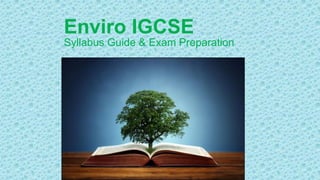
Enviro IGCSE
Syllabus Guide & Exam Preparation
Syllabus overview
Aims
The aims describe the purposes of a course based on this syllabus.
The aims are to enable students to acquire:
• knowledge of natural systems which make life possible on Earth
• an understanding that humans are part of these systems and depend on them
• an appreciation of the diverse influences of human activity on natural systems
• an awareness of the need to manage natural systems
• an understanding of sustainable development to meet the needs of the present, without
compromising the ability of future generations to meet their own needs
• a sense of responsibility and concern for the welfare of the environment and all organisms
• an awareness of their own values concerning environmental issues
• an awareness of the values of others
• a willingness to review their own attitudes in the light of new knowledge and experiences
• a sound basis for further study, personal development and participation in local and global
environmental concerns
Expected knowledge
Candidates should be able to
identify and name the
world’s continents:
• Africa, Antarctica, Asia,
Europe, North America,
Oceania and South America
Oceans:
• Atlantic Ocean, Pacific
Ocean, Indian Ocean, Arctic
Ocean and Southern Ocean.
Content overview
The syllabus is divided into nine topics which have been designed to develop an understanding of both the
natural and the human environment:
Introduction to Key Skills (3 hours)
Chapters:
1. Rocks and minerals and their exploitation (10 hours)
2. Energy and the environment (19 hours)
3. Agriculture and the environment (24 hours)
4. Water and its management (18 hours)
5. Oceans and fisheries (9 hours)
6. Managing natural hazards (29 hours)
7. The atmosphere and human activities (20 hours)
8. Human population (9 hours)
9. Natural ecosystems and human activities (39 hours)
(Number in brackets show suggested study hours in total, additional revision time will vary but 15 to 20% of total study hours depending on
the student is a rough guide if they have a good understanding of content and are using correct terminology, excluding past paper practice.
Please note the Cambridge IGCSE syllabuses based on learners having about 130 guided learning hours for each subject during the course but
this is for guidance only. The number of hours a learner needs to achieve the qualification may vary according to local practice and their
previous experience of the subject. This material will be optimally covered in a total of 180 hours, part guided and partly self study.)
Assessment overview
Candidates write 2 papers:
Paper 1
1 hour 45 minutes
Theory 50%
80 marks
Section A: short and structured questions
– 20 marks
Section B: short-answer and extended
response questions based on source material
– 60 marks
Externally assessed
Paper 2
1 hour 45 minutes
Management in context 50%
80 marks
Short, and extended response
questions based on source
material
Externally assessed
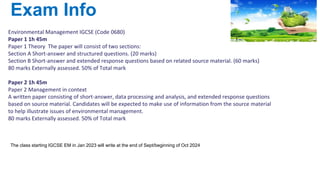
Exam Info
Environmental Management IGCSE (Code 0680)
Paper 1 1h 45m
Paper 1 Theory The paper will consist of two sections:
Section A Short-answer and structured questions. (20 marks)
Section B Short-answer and extended response questions based on related source material. (60 marks)
80 marks Externally assessed. 50% of Total mark
Paper 2 1h 45m
Paper 2 Management in context
A written paper consisting of short-answer, data processing and analysis, and extended response questions
based on source material. Candidates will be expected to make use of information from the source material
to help illustrate issues of environmental management.
80 marks Externally assessed. 50% of Total mark
The class starting IGCSE EM in Jan 2023 will write at the end of Sept/beginning of Oct 2024
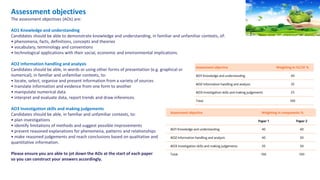
Assessment objectives
The assessment objectives (AOs) are:
AO1 Knowledge and understanding
Candidates should be able to demonstrate knowledge and understanding, in familiar and unfamiliar contexts, of:
• phenomena, facts, definitions, concepts and theories
• vocabulary, terminology and conventions
• technological applications with their social, economic and environmental implications.
AO2 Information handling and analysis
Candidates should be able, in words or using other forms of presentation (e.g. graphical or
numerical), in familiar and unfamiliar contexts, to:
• locate, select, organise and present information from a variety of sources
• translate information and evidence from one form to another
• manipulate numerical data
• interpret and evaluate data, report trends and draw inferences.
AO3 Investigation skills and making judgements
Candidates should be able, in familiar and unfamiliar contexts, to:
• plan investigations
• identify limitations of methods and suggest possible improvements
• present reasoned explanations for phenomena, patterns and relationships
• make reasoned judgements and reach conclusions based on qualitative and
quantitative information.
Please ensure you are able to jot down the AOs at the start of each paper
so you can construct your answers accordingly.
Resources for exam preparation
Overall Revision
Please follow this link for more details:
https://www.cambridgeinternational.org/programmes-and-qualifications/cambridge-igcse-environmental-management-
0680/#:~:text=Environmental%20Management%20(0680)-,Syllabus%20overview,Earth%20science%2C%20geography%20and%20economics.
• Please make use of the past papers, Examiner’s reports and detailed syllabus notes on the above website.
• Ensure you have worked through the sample script examples for both the IGCSE and A level papers uploaded to the Exam
Preparation folder
• It is suggested you complete at least 5 past papers each for papers 1 & 2 achieving above your target mark before the
external assessment.
Please ensure you are working from the following resources:
Syllabus Resources:
1. Official Cambridge Text Book: Cambridge IGCSE and O Level Environmental Management (2017), by Gary Skinner et al;
Cambridge University Press; ISBN 978-1-316-63485-1 (PDF in Class Folder)
2. There are folders on Moodle with a primary PPT/PDF of class notes including links to various extra resources and videos,
these links are mandatory viewing unless clearly specified to be optional extension material.
3. In each folder there are a variety of extra PDFs and supporting documents to be use in conjunction with the class notes.
4. Students need to use their own notes from class lectures and pracs.
5. Practical application and real-world examples shared on Moodle
6. Please note is NOT sufficient to work of summary notes such as Zee Notes etc.
Exam Tips
• Please be sure to revise each section carefully
• Practice past papers for paper 1 and 2
• Read the mark schemes and examiners reports carefully for your practice papers and refine your answers
• Ensure you have revised the key skills in the introduction to the text book and practiced the mathematical and
data type questions.
• Remember to note the AOs before each paper and structure your answers accordingly.
• Read all questions carefully, noting command words and key words. Take special care to note impacts, causes,
etc
• Always refer to the specific context.
• Take care your new points are clearly different to previous points.
• Remember to give “both sides of the story in “discuss” questions.
• Use correct terminology, learn your definitions and be precise.
• Always have a go! Remember your common sense and applied general knowledge can be worth marks if
structured correctly in context.
• Remember some questions will test your ability to solve new problems using learned skills. You will possibly
encounter material you have not seen before, but the same skills and processes will apply.
• Stay healthy, get some rest!
Enviro IGCSE Further general comments and study tips:
Common areas of concern:
∙ READ THE QUESTION CAREFULLY.
Slow down, read it three times and remember:
∙ Everything in the text is there for a reason. For example:
If it talks about silt, you need to mention the relevance, etc
∙ Look at the context: Is it Rural/Urban look at the data WRT population age, no. of children,
life expectancy, income and apply to your answers. Is it near the coast or inland?
∙ Be careful of small details like length / breadth – DOUBLE CHECK you are following the
instructions. Cause, impact or solution?
Exactly which months are they looking for? Assume nothing, check everything.
∙ ON GRAPHS & CALCULATIONS: - Skills PDF
∙ Label axes, REMEMBER TO ADD UNITS OF MEASUREMENT eg CM, ML etc. Time on X axis,
growth/rain/etc on Y axis or as appropriate.
∙ Give it a TITLE, Label your lines or add a KEY
∙ https://www.khanacademy.org/science/biology/intro-to-biology/science-of-biology/a/the-
science-of-biology
Scientific Method
∙ https://math.tutorvista.com/statistics/types-of-graph.html
Graphs
∙ https://www.youtube.com/watch?v=be9e-Q-jC-0
Sampling
∙ Please revise TRENDLINES & TRENDS
∙ SHOW ALL WORKING
∙ ON STRUCTURE & CLARITY
∙ Ensure your points are clearly defined and do not overlap
∙ Have you given both sides / adv & disadv for the AO3 Questions (4+ marks)?
∙ Endure your concepts are ORDERED and COMPLETED…take them to the end outcome,
does the ecosystem flourish or does it result in decline/death? Make sure you give
enough detail, do not be too brief. Do not repeat the question in the answer.
∙ Separate and pay attention to CAUSES, IMPACTS & SOLUTIONS. Ensure you are
answering exactly which is being asked in the context of the question.
∙ Be accurate, check your work and read back carefully checking back to questions.
∙ “POLLUTION” is always qualified: Water/Air/Land etc
∙ WRITE CLEARLY

Enviro IGCSE.pdf

  • 1.
    Enviro IGCSE Syllabus Guide& Exam Preparation
  • 2.
    Syllabus overview Aims The aimsdescribe the purposes of a course based on this syllabus. The aims are to enable students to acquire: • knowledge of natural systems which make life possible on Earth • an understanding that humans are part of these systems and depend on them • an appreciation of the diverse influences of human activity on natural systems • an awareness of the need to manage natural systems • an understanding of sustainable development to meet the needs of the present, without compromising the ability of future generations to meet their own needs • a sense of responsibility and concern for the welfare of the environment and all organisms • an awareness of their own values concerning environmental issues • an awareness of the values of others • a willingness to review their own attitudes in the light of new knowledge and experiences • a sound basis for further study, personal development and participation in local and global environmental concerns Expected knowledge Candidates should be able to identify and name the world’s continents: • Africa, Antarctica, Asia, Europe, North America, Oceania and South America Oceans: • Atlantic Ocean, Pacific Ocean, Indian Ocean, Arctic Ocean and Southern Ocean.
  • 3.
    Content overview The syllabusis divided into nine topics which have been designed to develop an understanding of both the natural and the human environment: Introduction to Key Skills (3 hours) Chapters: 1. Rocks and minerals and their exploitation (10 hours) 2. Energy and the environment (19 hours) 3. Agriculture and the environment (24 hours) 4. Water and its management (18 hours) 5. Oceans and fisheries (9 hours) 6. Managing natural hazards (29 hours) 7. The atmosphere and human activities (20 hours) 8. Human population (9 hours) 9. Natural ecosystems and human activities (39 hours) (Number in brackets show suggested study hours in total, additional revision time will vary but 15 to 20% of total study hours depending on the student is a rough guide if they have a good understanding of content and are using correct terminology, excluding past paper practice. Please note the Cambridge IGCSE syllabuses based on learners having about 130 guided learning hours for each subject during the course but this is for guidance only. The number of hours a learner needs to achieve the qualification may vary according to local practice and their previous experience of the subject. This material will be optimally covered in a total of 180 hours, part guided and partly self study.)
  • 4.
    Assessment overview Candidates write2 papers: Paper 1 1 hour 45 minutes Theory 50% 80 marks Section A: short and structured questions – 20 marks Section B: short-answer and extended response questions based on source material – 60 marks Externally assessed Paper 2 1 hour 45 minutes Management in context 50% 80 marks Short, and extended response questions based on source material Externally assessed
  • 5.
    Exam Info Environmental ManagementIGCSE (Code 0680) Paper 1 1h 45m Paper 1 Theory The paper will consist of two sections: Section A Short-answer and structured questions. (20 marks) Section B Short-answer and extended response questions based on related source material. (60 marks) 80 marks Externally assessed. 50% of Total mark Paper 2 1h 45m Paper 2 Management in context A written paper consisting of short-answer, data processing and analysis, and extended response questions based on source material. Candidates will be expected to make use of information from the source material to help illustrate issues of environmental management. 80 marks Externally assessed. 50% of Total mark The class starting IGCSE EM in Jan 2023 will write at the end of Sept/beginning of Oct 2024
  • 6.
    Assessment objectives The assessmentobjectives (AOs) are: AO1 Knowledge and understanding Candidates should be able to demonstrate knowledge and understanding, in familiar and unfamiliar contexts, of: • phenomena, facts, definitions, concepts and theories • vocabulary, terminology and conventions • technological applications with their social, economic and environmental implications. AO2 Information handling and analysis Candidates should be able, in words or using other forms of presentation (e.g. graphical or numerical), in familiar and unfamiliar contexts, to: • locate, select, organise and present information from a variety of sources • translate information and evidence from one form to another • manipulate numerical data • interpret and evaluate data, report trends and draw inferences. AO3 Investigation skills and making judgements Candidates should be able, in familiar and unfamiliar contexts, to: • plan investigations • identify limitations of methods and suggest possible improvements • present reasoned explanations for phenomena, patterns and relationships • make reasoned judgements and reach conclusions based on qualitative and quantitative information. Please ensure you are able to jot down the AOs at the start of each paper so you can construct your answers accordingly.
  • 7.
    Resources for exampreparation Overall Revision Please follow this link for more details: https://www.cambridgeinternational.org/programmes-and-qualifications/cambridge-igcse-environmental-management- 0680/#:~:text=Environmental%20Management%20(0680)-,Syllabus%20overview,Earth%20science%2C%20geography%20and%20economics. • Please make use of the past papers, Examiner’s reports and detailed syllabus notes on the above website. • Ensure you have worked through the sample script examples for both the IGCSE and A level papers uploaded to the Exam Preparation folder • It is suggested you complete at least 5 past papers each for papers 1 & 2 achieving above your target mark before the external assessment. Please ensure you are working from the following resources: Syllabus Resources: 1. Official Cambridge Text Book: Cambridge IGCSE and O Level Environmental Management (2017), by Gary Skinner et al; Cambridge University Press; ISBN 978-1-316-63485-1 (PDF in Class Folder) 2. There are folders on Moodle with a primary PPT/PDF of class notes including links to various extra resources and videos, these links are mandatory viewing unless clearly specified to be optional extension material. 3. In each folder there are a variety of extra PDFs and supporting documents to be use in conjunction with the class notes. 4. Students need to use their own notes from class lectures and pracs. 5. Practical application and real-world examples shared on Moodle 6. Please note is NOT sufficient to work of summary notes such as Zee Notes etc.
  • 8.
    Exam Tips • Pleasebe sure to revise each section carefully • Practice past papers for paper 1 and 2 • Read the mark schemes and examiners reports carefully for your practice papers and refine your answers • Ensure you have revised the key skills in the introduction to the text book and practiced the mathematical and data type questions. • Remember to note the AOs before each paper and structure your answers accordingly. • Read all questions carefully, noting command words and key words. Take special care to note impacts, causes, etc • Always refer to the specific context. • Take care your new points are clearly different to previous points. • Remember to give “both sides of the story in “discuss” questions. • Use correct terminology, learn your definitions and be precise. • Always have a go! Remember your common sense and applied general knowledge can be worth marks if structured correctly in context. • Remember some questions will test your ability to solve new problems using learned skills. You will possibly encounter material you have not seen before, but the same skills and processes will apply. • Stay healthy, get some rest!
  • 9.
    Enviro IGCSE Furthergeneral comments and study tips: Common areas of concern: ∙ READ THE QUESTION CAREFULLY. Slow down, read it three times and remember: ∙ Everything in the text is there for a reason. For example: If it talks about silt, you need to mention the relevance, etc ∙ Look at the context: Is it Rural/Urban look at the data WRT population age, no. of children, life expectancy, income and apply to your answers. Is it near the coast or inland? ∙ Be careful of small details like length / breadth – DOUBLE CHECK you are following the instructions. Cause, impact or solution? Exactly which months are they looking for? Assume nothing, check everything.
  • 10.
    ∙ ON GRAPHS& CALCULATIONS: - Skills PDF ∙ Label axes, REMEMBER TO ADD UNITS OF MEASUREMENT eg CM, ML etc. Time on X axis, growth/rain/etc on Y axis or as appropriate. ∙ Give it a TITLE, Label your lines or add a KEY ∙ https://www.khanacademy.org/science/biology/intro-to-biology/science-of-biology/a/the- science-of-biology Scientific Method ∙ https://math.tutorvista.com/statistics/types-of-graph.html Graphs ∙ https://www.youtube.com/watch?v=be9e-Q-jC-0 Sampling ∙ Please revise TRENDLINES & TRENDS ∙ SHOW ALL WORKING
  • 11.
    ∙ ON STRUCTURE& CLARITY ∙ Ensure your points are clearly defined and do not overlap ∙ Have you given both sides / adv & disadv for the AO3 Questions (4+ marks)? ∙ Endure your concepts are ORDERED and COMPLETED…take them to the end outcome, does the ecosystem flourish or does it result in decline/death? Make sure you give enough detail, do not be too brief. Do not repeat the question in the answer. ∙ Separate and pay attention to CAUSES, IMPACTS & SOLUTIONS. Ensure you are answering exactly which is being asked in the context of the question. ∙ Be accurate, check your work and read back carefully checking back to questions. ∙ “POLLUTION” is always qualified: Water/Air/Land etc ∙ WRITE CLEARLY