Dr. Mosam Phirke,
Resident, Psychiatry Department,
L.T.M.M.C.& G.H., MUMBAI.
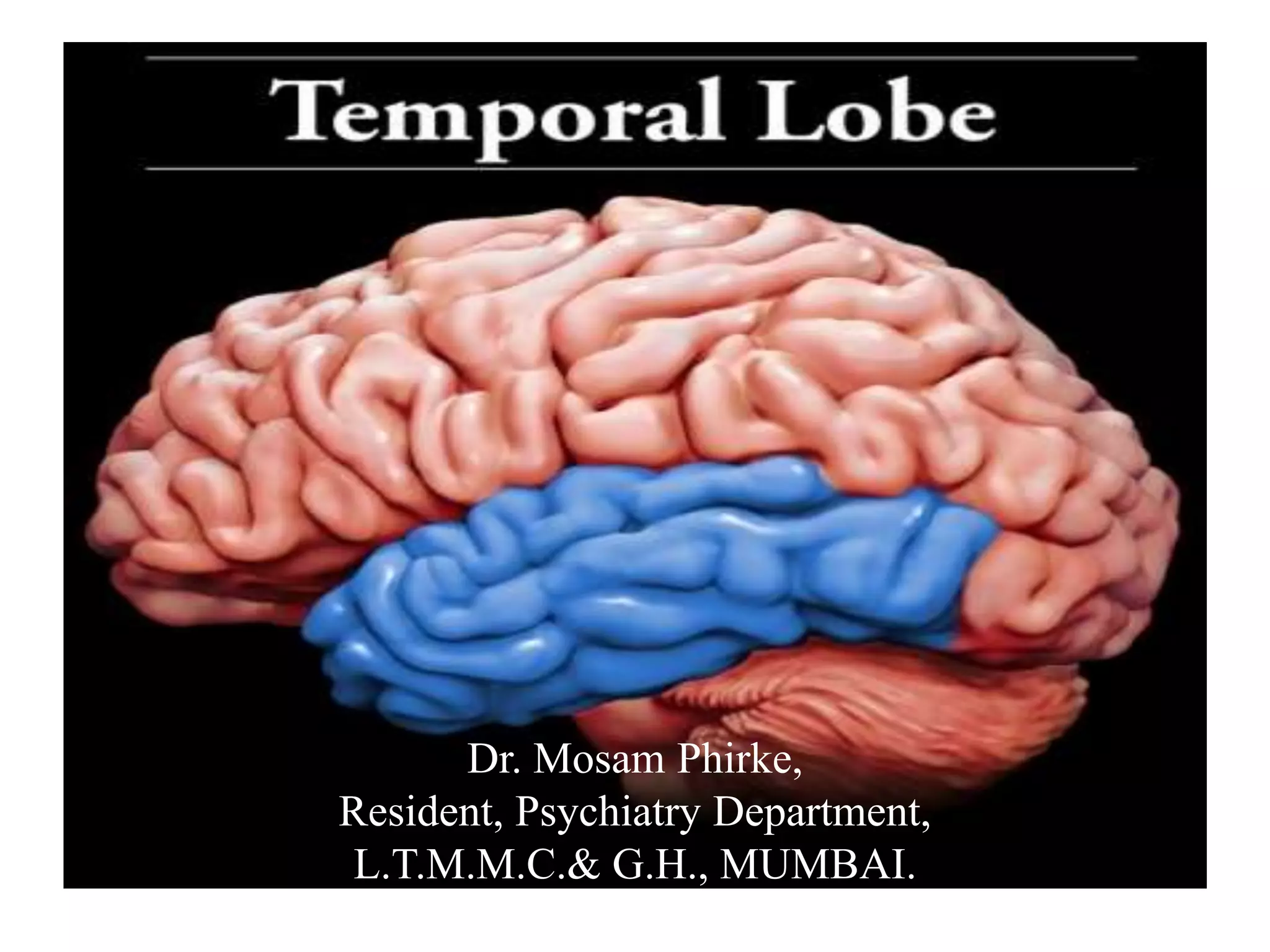
Temporal Lobe
• One of the four major lobes of cerebral cortex.
• Located beneath lateral fissure
• Processing sensory input into derived meaning
• Appropriate retention of visual memory
• Language comprehension
• Emotional association
• Seat of human para-psychological and psychic
abilities
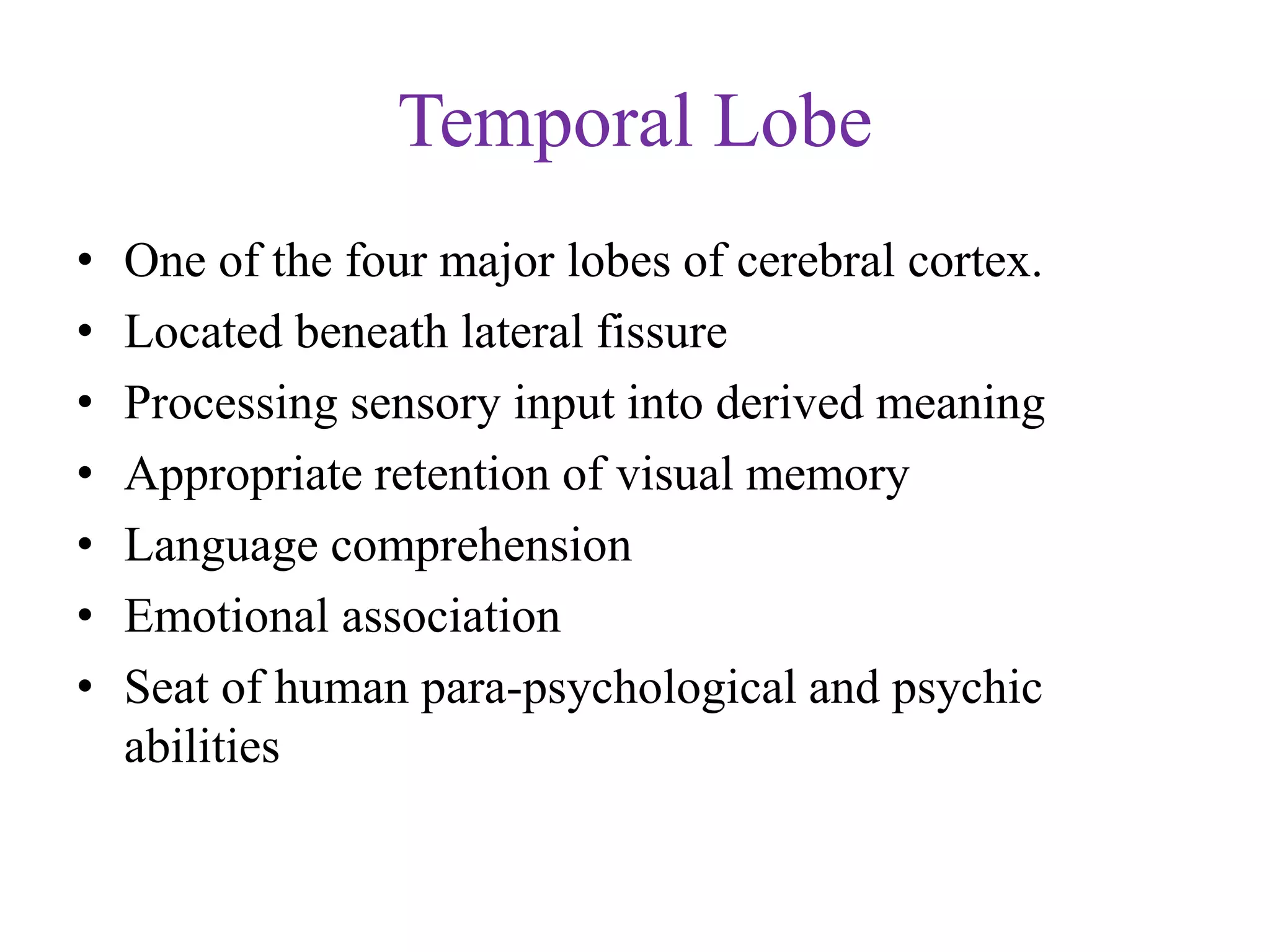
FUNCTIONAL AREAS
Temporal Lobe
• Anatomy & Function
– Lateral Surface
• Heschl’s gyrus (a.k.a. Transverse temporal gyrus)
• Superior temporal gyrus
• Superior temporal sulcus
• Middle temporal gyrus
• Inferior temoral gyrus
FUNCTIONAL AREAS
Temporal Lobe
• Anatomy & Function
– Medial Surface
• Fusiform gyrus
• Hippocampal gyrus
• Amygdala
• Dentate Gyrus
• Inferior temporal sulcus
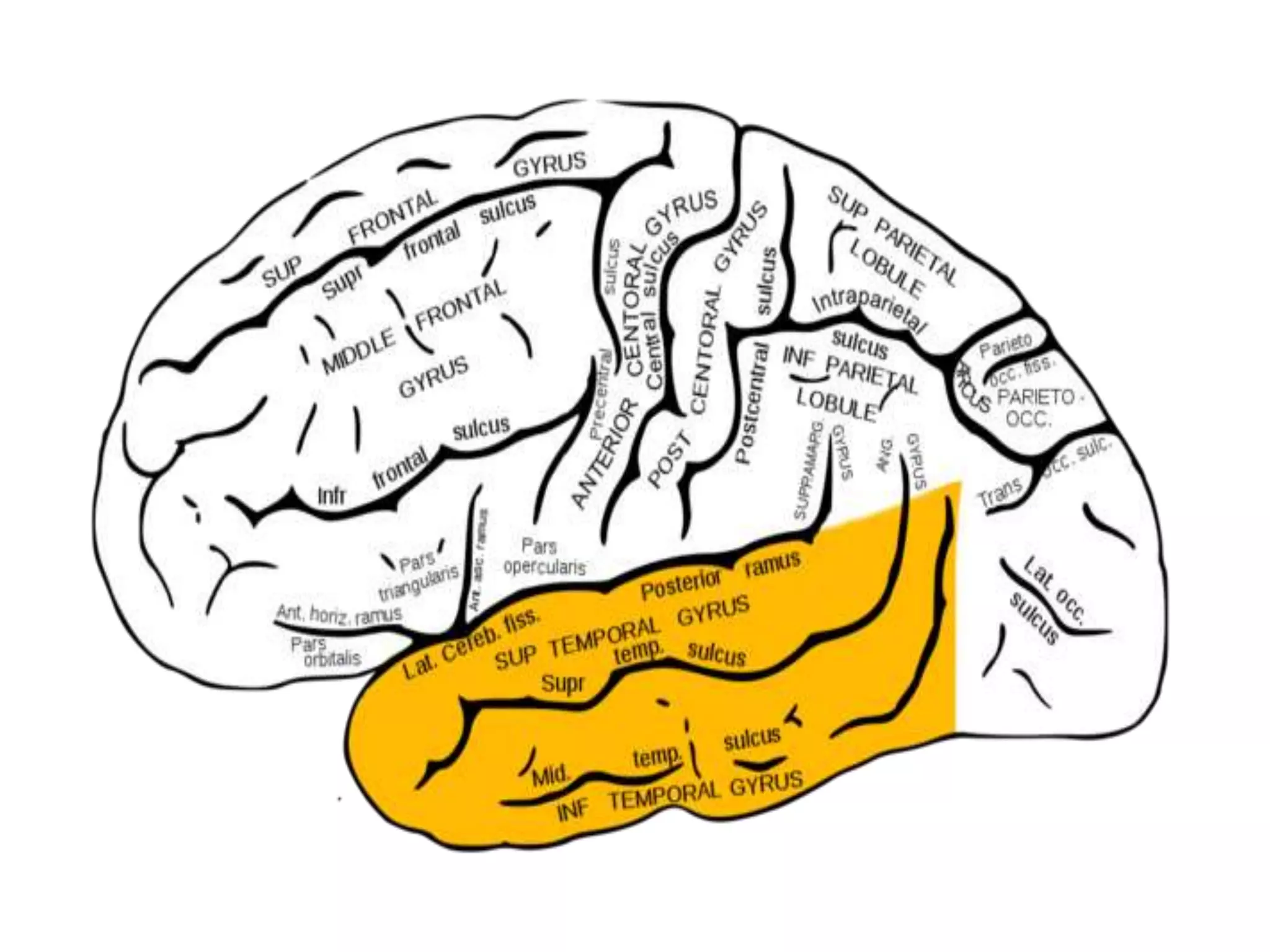
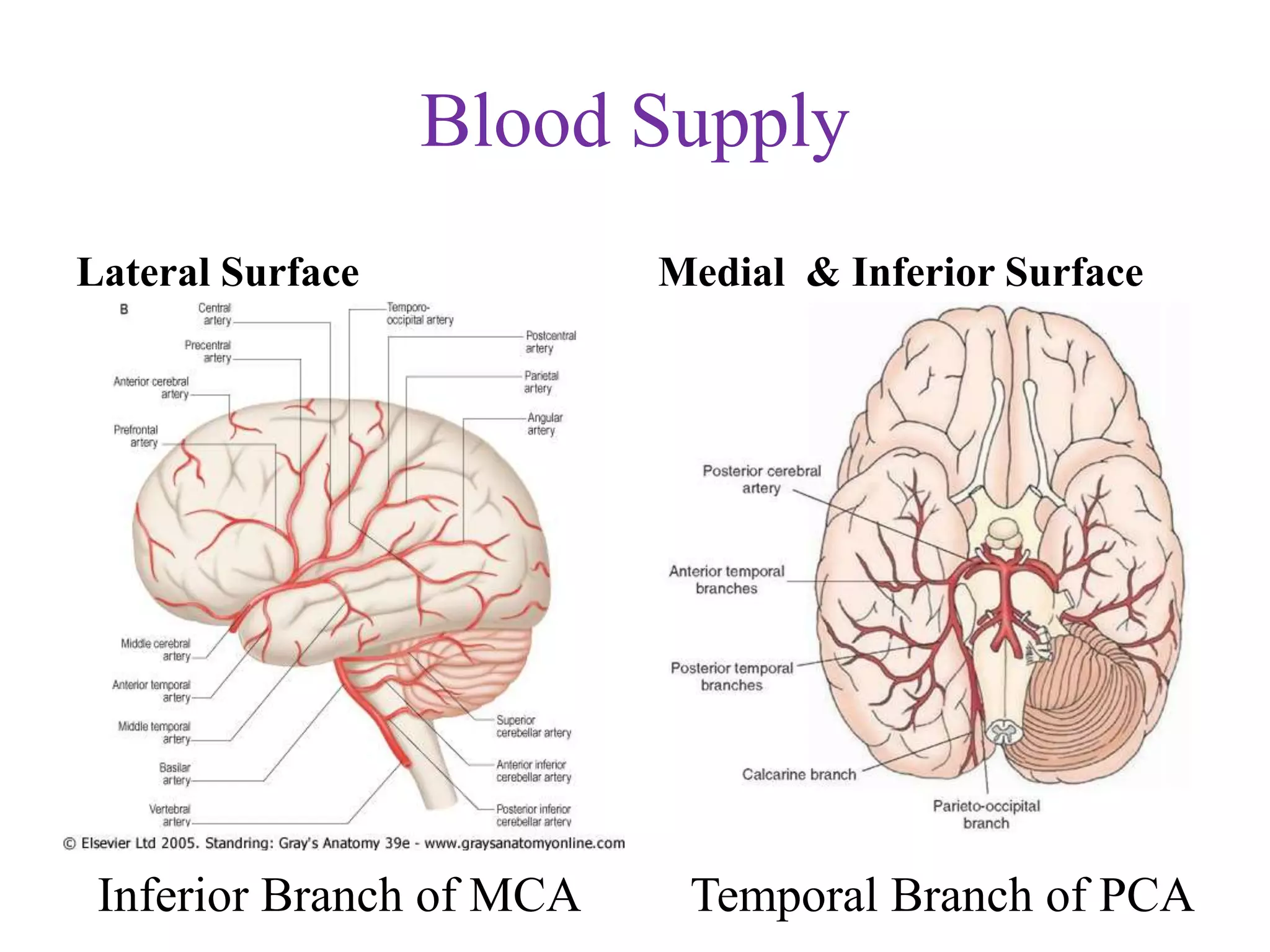
Blood Supply
Lateral Surface Medial & Inferior Surface
Inferior Branch of MCA Temporal Branch of PCA
Connections of Temporal Lobe
1. Hierarchical sensory pathway
2. Dorsal auditory pathway
3. Polymodal pathway
4. Medial (mesial) temporal pathway
5. Frontal lobe projection
Functions of Temporal Lobe
• Visual memory
• Memory formation (long term storage of sensory inputs)
• Processing sensory input
– Auditory (superior temporal gyrus)- processing input
– Visual (fusiform and inferior temporal gyrus)- object recognition
– Olfactory (entorhinal cortex)
– Gustatory (insular cortex)
– Language recognition (Wernicke's area)
– Identification and Categorization of Stimuli
– Emotional response is associated with a particular stimulus
Temporal Lobe Testing
Symptoms of Temporal Lobe Lesions
1. Disturbance of Auditory Sensation and perception
2. Disturbance of selective attention of auditory and visual input
3. Disorders of visual perception
4. Impaired organization and categorization of verbal material
5. Disturbance of language comprehension
6. Impaired long term memory
7. Altered personality and affective behavior
8. Altered sexual behavior
-Kolb & Wishaw (1990)
• Left superior temporal gyrus difficulty in discriminating
speech
• Right superior temporal gyrus inability to discriminate
melodies and produce prosody
• Inferior temporal gyrus inability to recognize objects, called
Visual agnosia
• Fusiform gyrus inability to recognize face, called
Prosopagnosia (face blindness)
Organization & Categorization
• Left temporal lobe lobotomies lead to impairment in the ability to
categorize words or pictures of objects
• Posterior lesions lead to a difficulty in recognizing specific word
categories
Language Comprehension
• Stimuli can be interpreted in different ways depending on the
context
Example: Fall - the season or a tumble
Memory
• Antero-grade Amnesia
– Amnesia for events after bilateral removal of the medial
temporal lobes
• Infero-temporal Cortex
– Conscious recall of information
• Left temporal lobe
– Verbal memory
• Right temporal lobe
– Impaired recall of nonverbal material
Affect
• Stimulation of anterior and medial temporal cortex produces feelings
of fear
Temporal Lobe Personality
(Geschwind syndrome)
– Personality that overemphasizes trivial and petty details of life
– Pedantic speech (an overly formal speaking style inappropriate to
the conversational setting)
– Egocentricity (preoccupation with one’s own internal world)
– Perseveration
– Paranoia
– Preoccupation with religion
– Proneness to aggression
Sexual Behavior
• Severe damage to temporal lobe show increase
sexual behavior
1. Aphasia
Wernicke’s aphasia
• Wernicke’s area affected
• Deficit in comprehension of
spoken speech
• Difficulty in repetition &
responding commands
• Impaired spontaneous
speech, writing & reading
• Para-phasic errors,
neologism & grammatical
mistakes
• Fluent speech with normal
rhythm & inflexion
- Lishman’s Organic Psychiatry
Pure word deafness
• Primary auditory area affected
• Deficit in understanding of
spoken speech
• Difficulty in repetition & cannot
write to dictation
• Normal fluent speech, writing &
reading
• Agnosia for spoken words but
comprehend reading
• Fluent speech with normal
rhythm & inflection
Temporal lobe aphasia
Conduction Aphasia
• Affect Arcuate Fasciculus which connects Wernicke’s &
Broca’s area
• Speech & writing are impaired as in wernicke’s aphasia
• Repetition is severely impaired
• Comprehension of spoken & written material well preserved
- Lishman’s Organic Psychiatry
Conduction Aphasia
2. TEMPORAL LOBE EPILEPSY
• Temporal lobe epilepsy (TLE) was defined in 1985 by the
International League Against Epilepsy (ILAE) as a condition
characterized by recurrent unprovoked seizures originating
from the medial (Hippocampus, Para-hippocampal gyrus,
Amygdala) or lateral temporal lobe (Neocortex)
• Begins in late childhood or early adulthood
• Most common of anatomically defined syndromes (around
60%)
• Most varied and complex auras
• Resembles with symptoms of psychiatric disorder
- Lishman’s Organic Psychiatry
CAUSES
• Hippocampus sclerosis a.k.a. Mesial temporal sclerosis or
Ammon’s horn sclerosis
• Childhood febrile convulsions
• Tumors
• Cortical dysplasia 2ry to encephalitis and meningitis
• Head injury or vessel malformation
• Trauma
• Congenital brain malformations
- Lishman’s Organic Psychiatry
Types- 1. Simple
2. Complex
Auras-
1.Epigastric aura
2.Cephalic aura
3.Affective aura (Anxiety, Fear)
Ictal- Oral automatism
Manual automatism
Speech automatism / Vocalization
Illusions and Hallucinations
Experiential phenomenon
Affective Features
Non convulsive status epilepticus
- Lishman’s Organic Psychiatry
3. Klüver–Bucy syndrome
Klüver–Bucy syndrome is a syndrome resulting from bilateral
lesions of the anterior temporal lobe including amygdaloid nucleus
1. Amnesia
2. Docility
3. Hyperphagia / Dietary changes
4. Hyper-orality
5. Hyper-sexuality
6. Visual agnosia
7. Others- Hyper-metamorphosis, diminished emotional affect
- From Wikipedia, Free encyclopedia
4.Temporal Lobe Infarct
Middle cerebral artery-
• Wernicke’s aphasia
• Conduction aphasia
• With or without sensory-motor deficit
Posterior cerebral artery-
• Recent memory loss
5. Temporal Lobe Tumors
• Patients with temporal lobe tumors experience psychiatric,
behavioral, or personality changes
• Patients with tumors of the temporal lobe who have temporal lobe
seizures often have seizure-associated schizophrenia-like
psychotic symptoms
• Symptoms include-Auditory hallucinations and atypical dream-
like episodes, depersonalization, blanking-out spells
• May present with depression and frontal lobe–like apathy &
irritability or with features suggesting hypomania or mania,
• Personality changes commonly occur and may be one of the
earliest indications of an undiagnosed temporal lobe tumor
THANK YOU

Temporal lobe

  • 1.
    Dr. Mosam Phirke, Resident,Psychiatry Department, L.T.M.M.C.& G.H., MUMBAI.
  • 2.
    Temporal Lobe • Oneof the four major lobes of cerebral cortex. • Located beneath lateral fissure • Processing sensory input into derived meaning • Appropriate retention of visual memory • Language comprehension • Emotional association • Seat of human para-psychological and psychic abilities
  • 4.
  • 5.
    Temporal Lobe • Anatomy& Function – Lateral Surface • Heschl’s gyrus (a.k.a. Transverse temporal gyrus) • Superior temporal gyrus • Superior temporal sulcus • Middle temporal gyrus • Inferior temoral gyrus
  • 7.
  • 8.
    Temporal Lobe • Anatomy& Function – Medial Surface • Fusiform gyrus • Hippocampal gyrus • Amygdala • Dentate Gyrus • Inferior temporal sulcus
  • 9.
    Blood Supply Lateral SurfaceMedial & Inferior Surface Inferior Branch of MCA Temporal Branch of PCA
  • 10.
    Connections of TemporalLobe 1. Hierarchical sensory pathway 2. Dorsal auditory pathway 3. Polymodal pathway 4. Medial (mesial) temporal pathway 5. Frontal lobe projection
  • 11.
    Functions of TemporalLobe • Visual memory • Memory formation (long term storage of sensory inputs) • Processing sensory input – Auditory (superior temporal gyrus)- processing input – Visual (fusiform and inferior temporal gyrus)- object recognition – Olfactory (entorhinal cortex) – Gustatory (insular cortex) – Language recognition (Wernicke's area) – Identification and Categorization of Stimuli – Emotional response is associated with a particular stimulus
  • 12.
  • 13.
    Symptoms of TemporalLobe Lesions 1. Disturbance of Auditory Sensation and perception 2. Disturbance of selective attention of auditory and visual input 3. Disorders of visual perception 4. Impaired organization and categorization of verbal material 5. Disturbance of language comprehension 6. Impaired long term memory 7. Altered personality and affective behavior 8. Altered sexual behavior -Kolb & Wishaw (1990)
  • 14.
    • Left superiortemporal gyrus difficulty in discriminating speech • Right superior temporal gyrus inability to discriminate melodies and produce prosody • Inferior temporal gyrus inability to recognize objects, called Visual agnosia • Fusiform gyrus inability to recognize face, called Prosopagnosia (face blindness)
  • 15.
    Organization & Categorization •Left temporal lobe lobotomies lead to impairment in the ability to categorize words or pictures of objects • Posterior lesions lead to a difficulty in recognizing specific word categories Language Comprehension • Stimuli can be interpreted in different ways depending on the context Example: Fall - the season or a tumble
  • 16.
    Memory • Antero-grade Amnesia –Amnesia for events after bilateral removal of the medial temporal lobes • Infero-temporal Cortex – Conscious recall of information • Left temporal lobe – Verbal memory • Right temporal lobe – Impaired recall of nonverbal material
  • 17.
    Affect • Stimulation ofanterior and medial temporal cortex produces feelings of fear Temporal Lobe Personality (Geschwind syndrome) – Personality that overemphasizes trivial and petty details of life – Pedantic speech (an overly formal speaking style inappropriate to the conversational setting) – Egocentricity (preoccupation with one’s own internal world) – Perseveration – Paranoia – Preoccupation with religion – Proneness to aggression
  • 18.
    Sexual Behavior • Severedamage to temporal lobe show increase sexual behavior
  • 19.
    1. Aphasia Wernicke’s aphasia •Wernicke’s area affected • Deficit in comprehension of spoken speech • Difficulty in repetition & responding commands • Impaired spontaneous speech, writing & reading • Para-phasic errors, neologism & grammatical mistakes • Fluent speech with normal rhythm & inflexion - Lishman’s Organic Psychiatry Pure word deafness • Primary auditory area affected • Deficit in understanding of spoken speech • Difficulty in repetition & cannot write to dictation • Normal fluent speech, writing & reading • Agnosia for spoken words but comprehend reading • Fluent speech with normal rhythm & inflection
  • 20.
  • 21.
    Conduction Aphasia • AffectArcuate Fasciculus which connects Wernicke’s & Broca’s area • Speech & writing are impaired as in wernicke’s aphasia • Repetition is severely impaired • Comprehension of spoken & written material well preserved - Lishman’s Organic Psychiatry
  • 22.
  • 23.
    2. TEMPORAL LOBEEPILEPSY • Temporal lobe epilepsy (TLE) was defined in 1985 by the International League Against Epilepsy (ILAE) as a condition characterized by recurrent unprovoked seizures originating from the medial (Hippocampus, Para-hippocampal gyrus, Amygdala) or lateral temporal lobe (Neocortex) • Begins in late childhood or early adulthood • Most common of anatomically defined syndromes (around 60%) • Most varied and complex auras • Resembles with symptoms of psychiatric disorder - Lishman’s Organic Psychiatry
  • 24.
    CAUSES • Hippocampus sclerosisa.k.a. Mesial temporal sclerosis or Ammon’s horn sclerosis • Childhood febrile convulsions • Tumors • Cortical dysplasia 2ry to encephalitis and meningitis • Head injury or vessel malformation • Trauma • Congenital brain malformations - Lishman’s Organic Psychiatry
  • 25.
    Types- 1. Simple 2.Complex Auras- 1.Epigastric aura 2.Cephalic aura 3.Affective aura (Anxiety, Fear) Ictal- Oral automatism Manual automatism Speech automatism / Vocalization Illusions and Hallucinations Experiential phenomenon Affective Features Non convulsive status epilepticus - Lishman’s Organic Psychiatry
  • 27.
    3. Klüver–Bucy syndrome Klüver–Bucysyndrome is a syndrome resulting from bilateral lesions of the anterior temporal lobe including amygdaloid nucleus 1. Amnesia 2. Docility 3. Hyperphagia / Dietary changes 4. Hyper-orality 5. Hyper-sexuality 6. Visual agnosia 7. Others- Hyper-metamorphosis, diminished emotional affect - From Wikipedia, Free encyclopedia
  • 28.
    4.Temporal Lobe Infarct Middlecerebral artery- • Wernicke’s aphasia • Conduction aphasia • With or without sensory-motor deficit Posterior cerebral artery- • Recent memory loss
  • 29.
    5. Temporal LobeTumors • Patients with temporal lobe tumors experience psychiatric, behavioral, or personality changes • Patients with tumors of the temporal lobe who have temporal lobe seizures often have seizure-associated schizophrenia-like psychotic symptoms • Symptoms include-Auditory hallucinations and atypical dream- like episodes, depersonalization, blanking-out spells • May present with depression and frontal lobe–like apathy & irritability or with features suggesting hypomania or mania, • Personality changes commonly occur and may be one of the earliest indications of an undiagnosed temporal lobe tumor
  • 30.