High Renaissance Portraiture - Here’s lookin’ at you kid!
Just a quick background on portraiture to supplement the notes… There were two camps within portraiture during the Renaissance: The Collective Portrait  - individual portraits as part of a group within a painting, these were often of famous citizens, ordinary people, or the artists themselves could be featured. The Independent Portrait  - within this there were two kinds…the  profile  and the  sculpture . The  profile  was very popular during the early Quatrrocento (1400s) and in the form of a bust. They were a carry-over from Roman medallions and coins --> influence of antiquity.  Popular because it was easy to create a likeness and it was found to be a flattering view. The  sculpture  portrait was derived from Roman art and popular for a time in Florence.
Collective Portraits… Michelangel’s  The Last Judgment  1534-1541 Raphael’s  School of Athens  1510-1511 The some of the figures within these works are thought to be portraits of real people…
St. Bartholomew’s flayed skin has the face of Michelangelo, an allusion to his own anguish at this time as revealed in his letters and poems
JOY MAY KILL   by: Michelangelo Buonarroti (1475-1564)   Too much good luck no less than misery   May kill a man condemned to mortal pain,   If, lost to hope and chilled in every vein,   A sudden pardon comes to set him free.   Thus thy unwonted kindness shown to me   Amid the gloom where only sad thoughts reign,   With too much rapture bringing light again,   Threatens my life more than that agony.   Good news and bad may bear the self-same knife;   And death may follow both upon their flight;   For hearts that shrink or swell, alike will break.   Let then thy beauty, to preserve my life,   Temper the source of this supreme delight,   Lest joy so poignant slay a soul so weak.
La Pietà di Michelangelo dell'Opera del Duomo (Firenze) c.1557 This sculpture is thought to be of the Lamentation of Christ.  The four figures: Jesus, Mary Magdalene, the Virgin Mary and possibly Joseph of Armathea or Nicodemus (who is said to be a self-portrait of Michelangelo).  He did not finish the sculpture himself, as when he discovered a flaw in the marble, and threw a fit on it.
Raphael’s depiction of Plato in the  School of Athens  modeled after Leonardo.
Francesco Maria I della Rovere a.k.a. Raphael's mistress as Hypatia of Alexandria in the  School of Athens .  He also painted the image on the right for her husband.
Portrait of Pope Leo X Raphael, 1518-1519 Oil on wood 154 x 119 cm
Pope Leo X Elected on the death of Julius II and only 38 years of age, Leo X was described a easy-going, luxury-loving, and fat.  He tended to favour Rapheal for church commissions as he was said to have had poor relations with Michelangelo, “He is too violent; one cannot deal with him.” He had shocked many within the church due to his interest in Olympian deities and during religious ceremonies.  His methods of selling indulgences as a manner of fundraising for the building of the new St. Peter’s contributed to Martin Luther’s 95 Theses and the dawn of the Protestant Reformation. He was born Giovanni di Lorenzo de' Medici  and was succeeded by his cousin Ginalia de’Medici (Clement VII)
Raphael’s portrait of Leo X Why is this such an important work?  It was ambitious and innovative and influenced future group portraits of Popes. Interest in his use of diagonal perspective and the ‘X’ shape within the work --> our eyes are drawn up from the table to the illuminated manuscript, a sign of the learned refinement of the near-sighted pope. The two cardinals are Luigi de Rossi (left) and Ginlia de’Medici (right) and were close supporters of the pope.  The deeper tonal shadows on the Cardinals’ faces establish depth within the work and the colour scheme is rich and restrained.  Symbols within the work include the manuscript (Leo’s education), the finely carved bell (Leo’s taste in high culture and the arts),  the ball on top of the Pope's chair evokes (abacus balls of the Medici Family). Leo’s power is expressed in his position and by the deference of his Cardinals and some of his ruthless, plump self-satisfaction.
Piero della Francesca, Battista Sforza and Federigo da Montefeltro, Duke of Urbino, ca. 1465, panel, 47 x 66 cm., Uffizi, Florence.   Independent portraits…
Domenico Ghirlandaio, Giovanna degli Albizzi, 1488, panel, 76 x 50 cm   Renaissance profile portrait type had, as one of its sources, ancient medals that carried portrait heads, in profile, of noted persons - a mark of their stature in life, as well as a means of commemorating them, with dignity, in death.
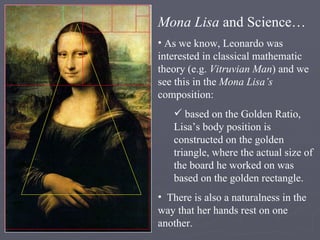
Da Vinci  Mona Lisa, La Gioconda  1503-1505 2’6” x 1’9”
Mona Lisa Undoubtedly one of the world’s most famous portraits, it is largely believed to be the portrait of Lisa de Antonio Maria Gherardini, wife of a wealthy Florentine Francesco del Giocondo Mona was slang for  ma donna …my lady. Leonardo created the work in a relatively new manner in that we get to see the sitter in 1/2 view. Her mysterious smile tends to be of most interest to us --> achieved through Leonardo’s mastery of chiaroscurco and atmospheric perspective. As well, Leonardo employs the technique of sfumato which blurs the background as much as it blurs some of the details in the face (i.e. the facial expression) We are also intrigued with a the ambiguous background which seems to recede to nowhere in particular.
Mona Lisa  and Science… As we know, Leonardo was interested in classical mathematic theory (e.g.  Vitruvian Man ) and we see this in the  Mona Lisa’s  composition: based on the Golden Ratio, Lisa’s body position is constructed on the golden triangle, where the actual size of the board he worked on was based on the golden rectangle. There is also a naturalness in the way that her hands rest on one another.
Mona Lisa and unity… Because of the between the foreground and background the work appears more whole. Leonardo has repeated patterns within the work, for example the way her hair has been painted it echoed in the form of the background rocks and river.  The pathway in the background is continued in the folds of her clothing on the right. Her head almost merges with the landscape behind in the use of the colours used within the work and the use of directional lighting.
“ If one wanted to see how faithfully art can imitate nature, one could readily perceived it from this dead; for here Leonardo subtly reproduced every living detail.  The eyes had their natural lustre and moistness, and around them were the lashes and all those rosy and pearly tints that demand the greatest delicacy of execution.  The eyebrows were completely natural, growing thickly in one place and lightly in another and following the pores of the skin.  The nose was finely painted, with rosy and delicate nostrils as in life.  The mouth, joined to the flesh-tints of the face by the red of the lips, appeared to be living flesh rather than paint.  On looking closely at the pit of her throat on could sear that the pulses were beating.  Altogether this picture was painted in a manner to make the most confident artist -no matter who - despair and lose heart.  Leonardo also made use of this device: while he was painting Mona Lisa, who was a very beautiful woman, he employed singer and musicians or jesters to keep her full of merriment and so chase away the melancholy that painters usually give to portraits.  As a result, in this painting of Leonardo’s there was a smile so pleasing that it seemed diving rather than human; and those who saw it were amazed to find that it was as alive as the original.” --Giorgio Vasari (written 50 years after the painting was completed)
Portrait of Ginevra Benci  1474-1476 Oil on wood 42 x 37 cm
Ginerva de’Benci Ginevera was held in high regards by Florentines of her time due to her sharp intelligence.  The portrait was painted in commemoration of her marriage to Luigi Niccolini, and the painting's imagery and reverse text support this theme.  She was 16-years-old at the time of the painting. The portrait has been admired by many for its portrayal of Ginevra's temperament. She is beautiful but austere; she has no hint of a smile and her gaze, though forward, seems indifferent to the viewer.  A strip from the bottom of the painting was removed in the past, presumably due to damage, and Ginevra's arms and hands were lost. Technically the painting is modeled with gradually deepening veils of smoky shadow—not by line, not by abrupt transitions of color or light. the painting is lit direct and rather harsh, by setting it in open space.
The reverse of the portrait is decorated with a juniper sprig encircled by a wreath of laurel and palm and is memorialized by the phrase VIRTUTEM FORMA DECORAT ("Beauty adorns Virtue"). The Italian word for juniper is "ginepro", which leads many to believe that the juniper motif is a symbolic pun on Ginevra's name. Fittingly, juniper was also a Renaissance symbol for chastity.
Cecilia Gallerani (Lady with an Ermine)  1483-1490 Oil on wood 53.4 x 39.3 cm
Lady with an Ermine Cecilia Gallerani was believed to be the mistress of Lodovico Sforza, Duke of Milan. She was only 17 years old at the time of the work, Cecilia played music and wrote poetry.  Several interpretations of the significance of the ermine in her portrait are  possible .  Pet ermines were associated with the aristocracy and ermines were emblems of purity that would face death rather than soil their pristine coats and a personal device of Sforza, who had been invested with the Order of the Ermine in 1488. As in many of Leonardo's portraits, the composition comprises a pyramidic spiral and the sitter is caught in the motion of turning to her left, reflecting Leonardo's life-long preoccupation with the dynamics of movement. The three-quarter profile portrait was one of his many innovations.
Lady with an Ermine - Style This work shows new approaches to portraiture through its form, style, format.  The painting is lit from above which ,increases the contrast between light and shadow and throws the features into greater relief. Leonard achieved this effect by showing it in restricted space.  Painted with chiaroscuro: the first time in the history of portraiture a sense of the mystery and uniqueness of the human personality.  Cecilia turns and reacts, a gentle smile of welcome sparkling in her eyes and playing across the corners of her mouth as she glances at a companion outside the formal limits of her picture space.  her neck and chin play intricate games with bouncing light; and the ermine's cheek shines softly through its veiling shadow. First painting ever that conveyed such a living sense of the sitter's deportment -- the carriage of the head, the slope of the shoulders, the slim elegance of an aristocratic hand, and the total courtly grace.
Influence of Leonardo on Raphael… Leonardo was, as we know, an important innovator to Renaissance portraiture through is implementation of chiaroscuro and sfumato in his works. Raphael was a keen to study the works of Leonardo and did so with much care and paid very close attention to Leonardo’s understanding of detail in his works. The use of compositional construction, especially the use of the pyramidal structure, 3/4 length pose, employing sfumato in the background were all taken on board by Raphael. Leonardo worked hard to show the ‘motions of the mind’, that is not just showing the passive observations of the sitter, but showing the the soul within the subject.  This idea Raphael adopted and brought into his own corpus of work.
Leonardo,  Mona Lisa  1503-1506 Raphael,  Maddalena Doni  1506
Leonardo,  Mona Lisa  1503-1506 Raphael,  Angolo Doni  c.1506
Mona Lisa and Raphael’s Portraits… Agnolo Doni commissioned Raphael to paint 2 portraits in 1506. Maddalen Doni : Follows the compostion model of  Mona Lisa  without the ‘mystery’(pyramidal format) Landscape differences  M.L.  --> rocky and ‘fantastic’ while  M.D.  is the Tuscan countryside. Differences come in the treatment of the garments,  M.L.  --> unadorned, simple while  M.D.  --> lavish and rich (brocade sleeves, silk bodice, transparent veil) Each portrait show the each woman’s place, ie.  M.L.  bride to be, powerless while  M.D.  wealthy, established
Mona Lisa and Raphael’s Portraits… Agnolo Doni : landscape background continuous, though the pose is mirrored to  Mona Lisa’s Raphael’s treatment of landscape more naturalistic and 3D, especially if compared to  Francesca’s  Battista and Frederico Sforza  -->owed to Leonardo Raphael communicates Agnolo’s personality through his pose and glance. Raphael displays his psychological insight of his subject, but much more formal and less penetrating that Leonardo’s.
Raphael,  Maddalena Doni  1506 Raphael,  Angolo Doni  c.1506
Piero della Francesca, Battista Sforza and Federigo da Montefeltro, Duke of Urbino, ca. 1465, panel, 47 x 66 cm., Uffizi, Florence.

Ren Portrait

  • 1.
    High Renaissance Portraiture- Here’s lookin’ at you kid!
  • 2.
    Just a quickbackground on portraiture to supplement the notes… There were two camps within portraiture during the Renaissance: The Collective Portrait - individual portraits as part of a group within a painting, these were often of famous citizens, ordinary people, or the artists themselves could be featured. The Independent Portrait - within this there were two kinds…the profile and the sculpture . The profile was very popular during the early Quatrrocento (1400s) and in the form of a bust. They were a carry-over from Roman medallions and coins --> influence of antiquity. Popular because it was easy to create a likeness and it was found to be a flattering view. The sculpture portrait was derived from Roman art and popular for a time in Florence.
  • 3.
    Collective Portraits… Michelangel’s The Last Judgment 1534-1541 Raphael’s School of Athens 1510-1511 The some of the figures within these works are thought to be portraits of real people…
  • 4.
    St. Bartholomew’s flayedskin has the face of Michelangelo, an allusion to his own anguish at this time as revealed in his letters and poems
  • 5.
    JOY MAY KILL by: Michelangelo Buonarroti (1475-1564) Too much good luck no less than misery May kill a man condemned to mortal pain, If, lost to hope and chilled in every vein, A sudden pardon comes to set him free. Thus thy unwonted kindness shown to me Amid the gloom where only sad thoughts reign, With too much rapture bringing light again, Threatens my life more than that agony. Good news and bad may bear the self-same knife; And death may follow both upon their flight; For hearts that shrink or swell, alike will break. Let then thy beauty, to preserve my life, Temper the source of this supreme delight, Lest joy so poignant slay a soul so weak.
  • 6.
    La Pietà diMichelangelo dell'Opera del Duomo (Firenze) c.1557 This sculpture is thought to be of the Lamentation of Christ. The four figures: Jesus, Mary Magdalene, the Virgin Mary and possibly Joseph of Armathea or Nicodemus (who is said to be a self-portrait of Michelangelo). He did not finish the sculpture himself, as when he discovered a flaw in the marble, and threw a fit on it.
  • 7.
    Raphael’s depiction ofPlato in the School of Athens modeled after Leonardo.
  • 8.
    Francesco Maria Idella Rovere a.k.a. Raphael's mistress as Hypatia of Alexandria in the School of Athens . He also painted the image on the right for her husband.
  • 9.
    Portrait of PopeLeo X Raphael, 1518-1519 Oil on wood 154 x 119 cm
  • 10.
    Pope Leo XElected on the death of Julius II and only 38 years of age, Leo X was described a easy-going, luxury-loving, and fat. He tended to favour Rapheal for church commissions as he was said to have had poor relations with Michelangelo, “He is too violent; one cannot deal with him.” He had shocked many within the church due to his interest in Olympian deities and during religious ceremonies. His methods of selling indulgences as a manner of fundraising for the building of the new St. Peter’s contributed to Martin Luther’s 95 Theses and the dawn of the Protestant Reformation. He was born Giovanni di Lorenzo de' Medici and was succeeded by his cousin Ginalia de’Medici (Clement VII)
  • 11.
    Raphael’s portrait ofLeo X Why is this such an important work? It was ambitious and innovative and influenced future group portraits of Popes. Interest in his use of diagonal perspective and the ‘X’ shape within the work --> our eyes are drawn up from the table to the illuminated manuscript, a sign of the learned refinement of the near-sighted pope. The two cardinals are Luigi de Rossi (left) and Ginlia de’Medici (right) and were close supporters of the pope. The deeper tonal shadows on the Cardinals’ faces establish depth within the work and the colour scheme is rich and restrained. Symbols within the work include the manuscript (Leo’s education), the finely carved bell (Leo’s taste in high culture and the arts), the ball on top of the Pope's chair evokes (abacus balls of the Medici Family). Leo’s power is expressed in his position and by the deference of his Cardinals and some of his ruthless, plump self-satisfaction.
  • 12.
    Piero della Francesca,Battista Sforza and Federigo da Montefeltro, Duke of Urbino, ca. 1465, panel, 47 x 66 cm., Uffizi, Florence. Independent portraits…
  • 13.
    Domenico Ghirlandaio, Giovannadegli Albizzi, 1488, panel, 76 x 50 cm Renaissance profile portrait type had, as one of its sources, ancient medals that carried portrait heads, in profile, of noted persons - a mark of their stature in life, as well as a means of commemorating them, with dignity, in death.
  • 14.
    Da Vinci Mona Lisa, La Gioconda 1503-1505 2’6” x 1’9”
  • 15.
    Mona Lisa Undoubtedlyone of the world’s most famous portraits, it is largely believed to be the portrait of Lisa de Antonio Maria Gherardini, wife of a wealthy Florentine Francesco del Giocondo Mona was slang for ma donna …my lady. Leonardo created the work in a relatively new manner in that we get to see the sitter in 1/2 view. Her mysterious smile tends to be of most interest to us --> achieved through Leonardo’s mastery of chiaroscurco and atmospheric perspective. As well, Leonardo employs the technique of sfumato which blurs the background as much as it blurs some of the details in the face (i.e. the facial expression) We are also intrigued with a the ambiguous background which seems to recede to nowhere in particular.
  • 16.
    Mona Lisa and Science… As we know, Leonardo was interested in classical mathematic theory (e.g. Vitruvian Man ) and we see this in the Mona Lisa’s composition: based on the Golden Ratio, Lisa’s body position is constructed on the golden triangle, where the actual size of the board he worked on was based on the golden rectangle. There is also a naturalness in the way that her hands rest on one another.
  • 17.
    Mona Lisa andunity… Because of the between the foreground and background the work appears more whole. Leonardo has repeated patterns within the work, for example the way her hair has been painted it echoed in the form of the background rocks and river. The pathway in the background is continued in the folds of her clothing on the right. Her head almost merges with the landscape behind in the use of the colours used within the work and the use of directional lighting.
  • 18.
    “ If onewanted to see how faithfully art can imitate nature, one could readily perceived it from this dead; for here Leonardo subtly reproduced every living detail. The eyes had their natural lustre and moistness, and around them were the lashes and all those rosy and pearly tints that demand the greatest delicacy of execution. The eyebrows were completely natural, growing thickly in one place and lightly in another and following the pores of the skin. The nose was finely painted, with rosy and delicate nostrils as in life. The mouth, joined to the flesh-tints of the face by the red of the lips, appeared to be living flesh rather than paint. On looking closely at the pit of her throat on could sear that the pulses were beating. Altogether this picture was painted in a manner to make the most confident artist -no matter who - despair and lose heart. Leonardo also made use of this device: while he was painting Mona Lisa, who was a very beautiful woman, he employed singer and musicians or jesters to keep her full of merriment and so chase away the melancholy that painters usually give to portraits. As a result, in this painting of Leonardo’s there was a smile so pleasing that it seemed diving rather than human; and those who saw it were amazed to find that it was as alive as the original.” --Giorgio Vasari (written 50 years after the painting was completed)
  • 19.
    Portrait of GinevraBenci 1474-1476 Oil on wood 42 x 37 cm
  • 20.
    Ginerva de’Benci Gineverawas held in high regards by Florentines of her time due to her sharp intelligence. The portrait was painted in commemoration of her marriage to Luigi Niccolini, and the painting's imagery and reverse text support this theme. She was 16-years-old at the time of the painting. The portrait has been admired by many for its portrayal of Ginevra's temperament. She is beautiful but austere; she has no hint of a smile and her gaze, though forward, seems indifferent to the viewer. A strip from the bottom of the painting was removed in the past, presumably due to damage, and Ginevra's arms and hands were lost. Technically the painting is modeled with gradually deepening veils of smoky shadow—not by line, not by abrupt transitions of color or light. the painting is lit direct and rather harsh, by setting it in open space.
  • 21.
    The reverse ofthe portrait is decorated with a juniper sprig encircled by a wreath of laurel and palm and is memorialized by the phrase VIRTUTEM FORMA DECORAT ("Beauty adorns Virtue"). The Italian word for juniper is "ginepro", which leads many to believe that the juniper motif is a symbolic pun on Ginevra's name. Fittingly, juniper was also a Renaissance symbol for chastity.
  • 22.
    Cecilia Gallerani (Ladywith an Ermine) 1483-1490 Oil on wood 53.4 x 39.3 cm
  • 23.
    Lady with anErmine Cecilia Gallerani was believed to be the mistress of Lodovico Sforza, Duke of Milan. She was only 17 years old at the time of the work, Cecilia played music and wrote poetry. Several interpretations of the significance of the ermine in her portrait are possible . Pet ermines were associated with the aristocracy and ermines were emblems of purity that would face death rather than soil their pristine coats and a personal device of Sforza, who had been invested with the Order of the Ermine in 1488. As in many of Leonardo's portraits, the composition comprises a pyramidic spiral and the sitter is caught in the motion of turning to her left, reflecting Leonardo's life-long preoccupation with the dynamics of movement. The three-quarter profile portrait was one of his many innovations.
  • 24.
    Lady with anErmine - Style This work shows new approaches to portraiture through its form, style, format. The painting is lit from above which ,increases the contrast between light and shadow and throws the features into greater relief. Leonard achieved this effect by showing it in restricted space. Painted with chiaroscuro: the first time in the history of portraiture a sense of the mystery and uniqueness of the human personality. Cecilia turns and reacts, a gentle smile of welcome sparkling in her eyes and playing across the corners of her mouth as she glances at a companion outside the formal limits of her picture space. her neck and chin play intricate games with bouncing light; and the ermine's cheek shines softly through its veiling shadow. First painting ever that conveyed such a living sense of the sitter's deportment -- the carriage of the head, the slope of the shoulders, the slim elegance of an aristocratic hand, and the total courtly grace.
  • 25.
    Influence of Leonardoon Raphael… Leonardo was, as we know, an important innovator to Renaissance portraiture through is implementation of chiaroscuro and sfumato in his works. Raphael was a keen to study the works of Leonardo and did so with much care and paid very close attention to Leonardo’s understanding of detail in his works. The use of compositional construction, especially the use of the pyramidal structure, 3/4 length pose, employing sfumato in the background were all taken on board by Raphael. Leonardo worked hard to show the ‘motions of the mind’, that is not just showing the passive observations of the sitter, but showing the the soul within the subject. This idea Raphael adopted and brought into his own corpus of work.
  • 26.
    Leonardo, MonaLisa 1503-1506 Raphael, Maddalena Doni 1506
  • 27.
    Leonardo, MonaLisa 1503-1506 Raphael, Angolo Doni c.1506
  • 28.
    Mona Lisa andRaphael’s Portraits… Agnolo Doni commissioned Raphael to paint 2 portraits in 1506. Maddalen Doni : Follows the compostion model of Mona Lisa without the ‘mystery’(pyramidal format) Landscape differences M.L. --> rocky and ‘fantastic’ while M.D. is the Tuscan countryside. Differences come in the treatment of the garments, M.L. --> unadorned, simple while M.D. --> lavish and rich (brocade sleeves, silk bodice, transparent veil) Each portrait show the each woman’s place, ie. M.L. bride to be, powerless while M.D. wealthy, established
  • 29.
    Mona Lisa andRaphael’s Portraits… Agnolo Doni : landscape background continuous, though the pose is mirrored to Mona Lisa’s Raphael’s treatment of landscape more naturalistic and 3D, especially if compared to Francesca’s Battista and Frederico Sforza -->owed to Leonardo Raphael communicates Agnolo’s personality through his pose and glance. Raphael displays his psychological insight of his subject, but much more formal and less penetrating that Leonardo’s.
  • 30.
    Raphael, MaddalenaDoni 1506 Raphael, Angolo Doni c.1506
  • 31.
    Piero della Francesca,Battista Sforza and Federigo da Montefeltro, Duke of Urbino, ca. 1465, panel, 47 x 66 cm., Uffizi, Florence.