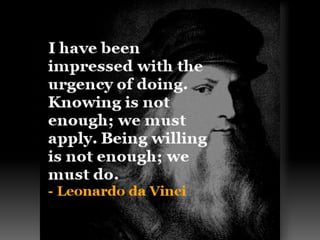
LEONARDO DA VINCI 
Leonardo di ser Piero daVinci (15 April 1452 – 2 May 1519) was 
an Italian polymath, painter, sculptor, architect, musician, mathematician, 
engineer, inventor, anatomist, geologist, cartographer,botanist, and 
writer. He is widely considered to be one of the greatest painters of all time 
and perhaps the most diversely talented person ever to have lived. 
LIFE 
Leonardo was born on 15 April 1452, "at the third hour of the 
night"[nb in theTuscan hill town of Vinci. 
 Leonardo had no surname in the modern sense, "da Vinci" simply 
meaning "of Vinci": his full birth name was "Lionardo di ser Piero da 
Vinci", meaning "Leonardo, (son) of (Mes)ser Piero from Vinci“.
Little is known about Leonardo's early life. He spent his first five 
years in the hamlet of Anchiano in the home of his mother 
then from 1457 he lived in the household of his father, grandparents 
and uncle, Francesco, in the small town of Vinci. His father had married 
a sixteen-year-old girl named Albiera, who loved Leonardo but died 
young.When Leonardo was sixteen his father married again, to 
twenty-year-old Francesca Lanfredini. It was not until his third and 
fourth marriages that Ser Piero produced legitimate heirs. 
Leonardo received an informal education in Latin, geometry and 
mathematics.
 In later life, Leonardo recorded only two childhood incidents. One, which 
he regarded as an omen, was when a kite dropped from the sky and 
hovered over his cradle, its tail feathers brushing his face. The second 
occurred while he was exploring in the mountains: he discovered a cave 
and was both terrified that some great monster might lurk there and 
driven by curiosity to find out what was inside. 
Leonardo was, and is, renowned primarily as a painter. 
Notable work(s): The Mona Lisa 
The Last Supper 
The Lady with an Ermine
MONALISA 
The Mona Lisa is a half-length 
portrait of a woman which has 
been acclaimed as "the best 
known, the most visited, the most 
written about, the most sung 
about, the most parodied work of 
art in the world“. 
The painting, thought to be a 
portrait of Lisa Gherardini, the 
wife of Francesco, is in oil on a 
white Lombardy , and is believed 
to have been painted between 
1503 and 1506, although Leonardo 
may have continued working on it 
as late as 1517. It was acquired by 
King Francis I of France and is now 
the property of the French 
Republic, on permanent display 
at The Louvre museum 
in Paris since 1797.
Value 
It is believed that Francis bought Mona Lisa in 1504 or 1506 for $9,200. Among 
works in the Louvre, in 1852 its market value was 90,000 francs compared to works 
by Raphael valued at up to 600,000 francs. In 1913, it was reported that the English 
government offered $5 million for the painting, the highest estimate of its value at 
that time 
Speculation 
Although the sitter has traditionally been identified as Lisa del Giocondo, a lack of 
definitive evidence has long fueled alternative theories, including Leonardo's 
mother Caterina in a distant memory and the possibility that Leonardo used his 
own likeness. Other aspects of the painting that have been subject to speculation 
are the original size of the painting, whether it is the original, why it was painted, 
and various explanations for how the effect of an enigmatic smile was achieved.
THE LAST SUPPER 
The Last Supper is a late 15th-century fresco painting 
by Leonardo da Vinci in the refectory of the Convent of Santa 
Maria delle Grazie, Milan. It is one of the world's most famous 
paintings, and one of the most studied, scrutinized, and 
satirized
The Last Suppermeasures 460 cm × 880 cm (180 in × 350 in) and covers an end 
wall of the dining hall at the monastery of Santa Maria delle Grazie in Milan, 
Italy. The theme was a traditional one for refectories, although the room was 
not a refectory at the time that Leonardo painted it. 
The Last Supper specifically portrays the reaction given by each apostle when 
Jesus said one of them would betray him. All twelve apostles have different 
reactions to the news, with various degrees of anger and shock. The apostles 
are identified from a manuscript 
Speculations 
The Last Supper has also been the target of much speculation by writers and 
historical revisionists alike, usually centered on purported hidden messages or 
hints found within the painting. 
Some have identified the person to Jesus' right (left of Jesus from the viewer's 
perspective), not as John the Apostle, but a woman, often purported to 
beMary Magdalene. This speculation was the topic of the book The Templar 
Revelation (1997) by Lynn Picknett and Clive Prince, and plays a central role 
in Dan Brown's fiction novel The Da Vinci Code(2003). 
There have also been other popular speculations about the work. It has been 
suggested that there is no cup in the painting, yet Jesus' left hand is pointing 
to the Eucharist and his right to a glass of wine. (There are several glasses on 
the table, but they are difficult to see owing to the work's deterioration and
(There are several glasses on the table, but they are difficult to see owing to the work's 
deterioration and restorations.) This is not the glorified chalice of legend as Leonardo 
insisted on realistic paintings. To add realism, Leonardo copied the style of the plates, 
glasses, utensils and the table cloth from the Dominican friars' refectory.
Lady with an Ermine 
Lady with an Ermine is a painting 
by Leonardo da Vinci from around 
1489–1490. The subject of the 
portrait is Cecilia Gallerani, and 
probably was painted at a time when 
she was the mistress of Duke of 
Milan, and Leonardo was in the 
service of the Duke. The painting is 
one of only four portraits of women 
painted by Leonardo, the others 
being the Mona Lisa, the portrait of 
Benci, and La belle ferronnière. It is 
currently displayed at 
the Czartoryski Museum, Poland.
Subject and symbolism 
The small portrait generally called The Lady with the Ermine was painted in oils on 
wooden panel. At the time of its painting, the medium of oil paint was relatively new 
to Italy, having been introduced in the 1470s. 
Cecilia Gallerani was a member of a large family that was neither wealthy nor noble. 
Her father served for a time at the Duke's court. At the time her portrait was painted, 
she was about 16 years old and was renowned for her beauty, her scholarship, and her 
poetry. She was betrothed at the approximate age of 10 years to a young nobleman 
of the house of Visconti but the marriage was called off. Cecilia became the mistress 
of the Duke and bore him a son, but he chose to marry a woman from a nobler 
family, Beatrice d'EsteThere are several interpretations of the significance of 
the ermine in her portrait. The ermine, a stoat in its winter coat, was a 
traditional symbol of purity because it was believed an ermine would face death 
rather than soil its white coat. 
Her painting shows a half-length figure, the body of the young woman turned at a 
three-quarter angle toward her right, but her face turned toward her left. Her gaze is 
directed neither straight ahead, nor toward the viewer, but toward a "third party" 
beyond the picture's frame. In her arms, Gallerani holds a small white-coated stoat 
known as an ermine.
In his old age, Leonardo compiled a bestiary in which he recorded: 
MODERATION : The ermine out of moderation never eats but once a day, and it 
would rather let itself be captured by hunters than take refuge in a dirty lair, in order 
not to stain its purity. 
ame the mistress of the Duke and bore him a son, but he chose to marry a woman from 
a nobler family.
Thank you…. 
The presentation was given by 
Introduction Siddharth Jain (B.com LLB) 
Monalisa the painting Ria Sharma (BBA LLB) 
The last supper the painting Riya Chatterjee (BA LLB) 
The lady with an ermine the painting Soniya Brar (BA LLB) 
To : MR. MANOJ KUMAR SIR

leonardo d vinci sample2

  • 2.
    LEONARDO DA VINCI Leonardo di ser Piero daVinci (15 April 1452 – 2 May 1519) was an Italian polymath, painter, sculptor, architect, musician, mathematician, engineer, inventor, anatomist, geologist, cartographer,botanist, and writer. He is widely considered to be one of the greatest painters of all time and perhaps the most diversely talented person ever to have lived. LIFE Leonardo was born on 15 April 1452, "at the third hour of the night"[nb in theTuscan hill town of Vinci.  Leonardo had no surname in the modern sense, "da Vinci" simply meaning "of Vinci": his full birth name was "Lionardo di ser Piero da Vinci", meaning "Leonardo, (son) of (Mes)ser Piero from Vinci“.
  • 3.
    Little is knownabout Leonardo's early life. He spent his first five years in the hamlet of Anchiano in the home of his mother then from 1457 he lived in the household of his father, grandparents and uncle, Francesco, in the small town of Vinci. His father had married a sixteen-year-old girl named Albiera, who loved Leonardo but died young.When Leonardo was sixteen his father married again, to twenty-year-old Francesca Lanfredini. It was not until his third and fourth marriages that Ser Piero produced legitimate heirs. Leonardo received an informal education in Latin, geometry and mathematics.
  • 4.
     In laterlife, Leonardo recorded only two childhood incidents. One, which he regarded as an omen, was when a kite dropped from the sky and hovered over his cradle, its tail feathers brushing his face. The second occurred while he was exploring in the mountains: he discovered a cave and was both terrified that some great monster might lurk there and driven by curiosity to find out what was inside. Leonardo was, and is, renowned primarily as a painter. Notable work(s): The Mona Lisa The Last Supper The Lady with an Ermine
  • 5.
    MONALISA The MonaLisa is a half-length portrait of a woman which has been acclaimed as "the best known, the most visited, the most written about, the most sung about, the most parodied work of art in the world“. The painting, thought to be a portrait of Lisa Gherardini, the wife of Francesco, is in oil on a white Lombardy , and is believed to have been painted between 1503 and 1506, although Leonardo may have continued working on it as late as 1517. It was acquired by King Francis I of France and is now the property of the French Republic, on permanent display at The Louvre museum in Paris since 1797.
  • 6.
    Value It isbelieved that Francis bought Mona Lisa in 1504 or 1506 for $9,200. Among works in the Louvre, in 1852 its market value was 90,000 francs compared to works by Raphael valued at up to 600,000 francs. In 1913, it was reported that the English government offered $5 million for the painting, the highest estimate of its value at that time Speculation Although the sitter has traditionally been identified as Lisa del Giocondo, a lack of definitive evidence has long fueled alternative theories, including Leonardo's mother Caterina in a distant memory and the possibility that Leonardo used his own likeness. Other aspects of the painting that have been subject to speculation are the original size of the painting, whether it is the original, why it was painted, and various explanations for how the effect of an enigmatic smile was achieved.
  • 7.
    THE LAST SUPPER The Last Supper is a late 15th-century fresco painting by Leonardo da Vinci in the refectory of the Convent of Santa Maria delle Grazie, Milan. It is one of the world's most famous paintings, and one of the most studied, scrutinized, and satirized
  • 8.
    The Last Suppermeasures460 cm × 880 cm (180 in × 350 in) and covers an end wall of the dining hall at the monastery of Santa Maria delle Grazie in Milan, Italy. The theme was a traditional one for refectories, although the room was not a refectory at the time that Leonardo painted it. The Last Supper specifically portrays the reaction given by each apostle when Jesus said one of them would betray him. All twelve apostles have different reactions to the news, with various degrees of anger and shock. The apostles are identified from a manuscript Speculations The Last Supper has also been the target of much speculation by writers and historical revisionists alike, usually centered on purported hidden messages or hints found within the painting. Some have identified the person to Jesus' right (left of Jesus from the viewer's perspective), not as John the Apostle, but a woman, often purported to beMary Magdalene. This speculation was the topic of the book The Templar Revelation (1997) by Lynn Picknett and Clive Prince, and plays a central role in Dan Brown's fiction novel The Da Vinci Code(2003). There have also been other popular speculations about the work. It has been suggested that there is no cup in the painting, yet Jesus' left hand is pointing to the Eucharist and his right to a glass of wine. (There are several glasses on the table, but they are difficult to see owing to the work's deterioration and
  • 9.
    (There are severalglasses on the table, but they are difficult to see owing to the work's deterioration and restorations.) This is not the glorified chalice of legend as Leonardo insisted on realistic paintings. To add realism, Leonardo copied the style of the plates, glasses, utensils and the table cloth from the Dominican friars' refectory.
  • 10.
    Lady with anErmine Lady with an Ermine is a painting by Leonardo da Vinci from around 1489–1490. The subject of the portrait is Cecilia Gallerani, and probably was painted at a time when she was the mistress of Duke of Milan, and Leonardo was in the service of the Duke. The painting is one of only four portraits of women painted by Leonardo, the others being the Mona Lisa, the portrait of Benci, and La belle ferronnière. It is currently displayed at the Czartoryski Museum, Poland.
  • 11.
    Subject and symbolism The small portrait generally called The Lady with the Ermine was painted in oils on wooden panel. At the time of its painting, the medium of oil paint was relatively new to Italy, having been introduced in the 1470s. Cecilia Gallerani was a member of a large family that was neither wealthy nor noble. Her father served for a time at the Duke's court. At the time her portrait was painted, she was about 16 years old and was renowned for her beauty, her scholarship, and her poetry. She was betrothed at the approximate age of 10 years to a young nobleman of the house of Visconti but the marriage was called off. Cecilia became the mistress of the Duke and bore him a son, but he chose to marry a woman from a nobler family, Beatrice d'EsteThere are several interpretations of the significance of the ermine in her portrait. The ermine, a stoat in its winter coat, was a traditional symbol of purity because it was believed an ermine would face death rather than soil its white coat. Her painting shows a half-length figure, the body of the young woman turned at a three-quarter angle toward her right, but her face turned toward her left. Her gaze is directed neither straight ahead, nor toward the viewer, but toward a "third party" beyond the picture's frame. In her arms, Gallerani holds a small white-coated stoat known as an ermine.
  • 12.
    In his oldage, Leonardo compiled a bestiary in which he recorded: MODERATION : The ermine out of moderation never eats but once a day, and it would rather let itself be captured by hunters than take refuge in a dirty lair, in order not to stain its purity. ame the mistress of the Duke and bore him a son, but he chose to marry a woman from a nobler family.
  • 13.
    Thank you…. Thepresentation was given by Introduction Siddharth Jain (B.com LLB) Monalisa the painting Ria Sharma (BBA LLB) The last supper the painting Riya Chatterjee (BA LLB) The lady with an ermine the painting Soniya Brar (BA LLB) To : MR. MANOJ KUMAR SIR