Radial and angular parts of the
hydrogenic wave functions
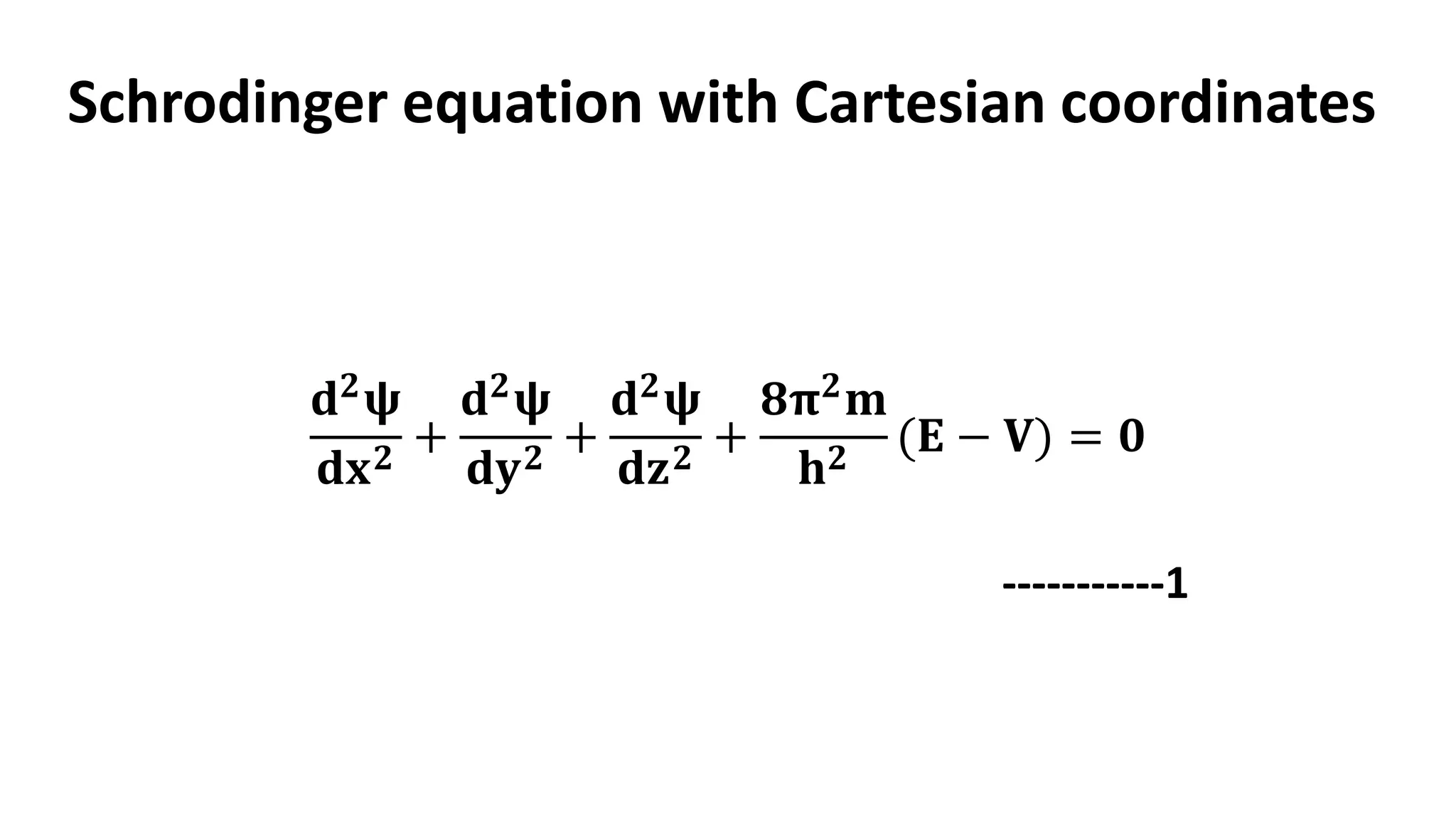
𝐝𝟐𝛙
𝐝𝐱𝟐
+
𝐝𝟐𝛙
𝐝𝐲𝟐
+
𝐝𝟐𝛙
𝐝𝐳𝟐
+
𝟖𝛑𝟐𝐦
𝐡𝟐
(𝐄 − 𝐕) = 𝟎
-----------1
Schrodinger equation with Cartesian coordinates
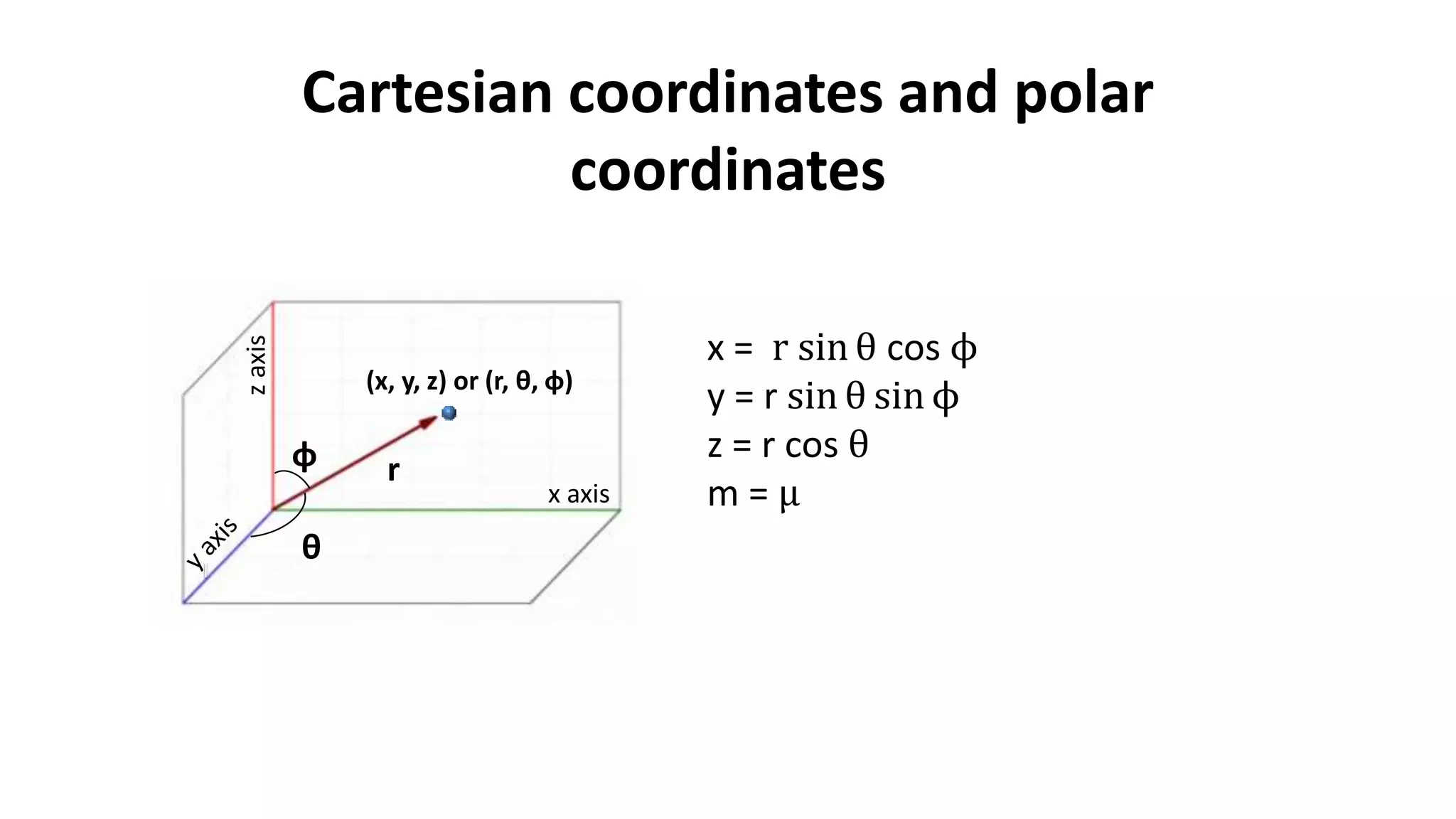
Cartesian coordinates and polar
coordinates
θ
φ r
(x, y, z) or (r, θ, φ)
x axis
z
axis
x = r sin θ cos ϕ
y = r sin θ sin ϕ
z = r cos θ
m = μ
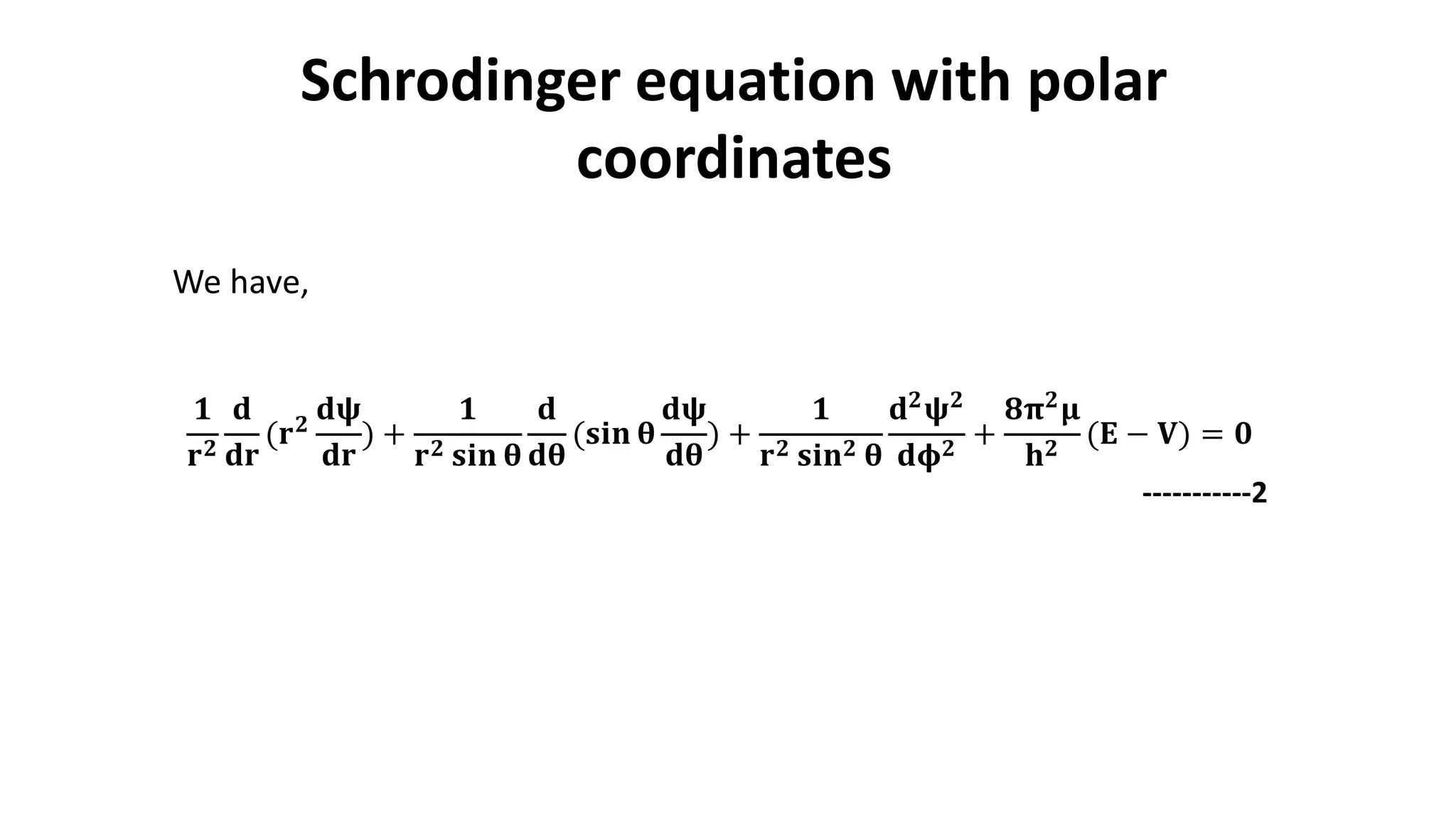
𝟏
𝐫𝟐
𝐝
𝐝𝐫
(𝐫𝟐
𝐝𝛙
𝐝𝐫
) +
𝟏
𝐫𝟐 𝐬𝐢𝐧 𝛉
𝐝
𝐝𝛉
(𝐬𝐢𝐧 𝛉
𝐝𝛙
𝐝𝛉
) +
𝟏
𝐫𝟐 𝐬𝐢𝐧𝟐 𝛉
𝐝𝟐
𝛙𝟐
𝐝𝛟𝟐
+
𝟖𝛑𝟐
𝛍
𝐡𝟐
(𝐄 − 𝐕) = 𝟎
-----------2
Schrodinger equation with polar
coordinates
We have,
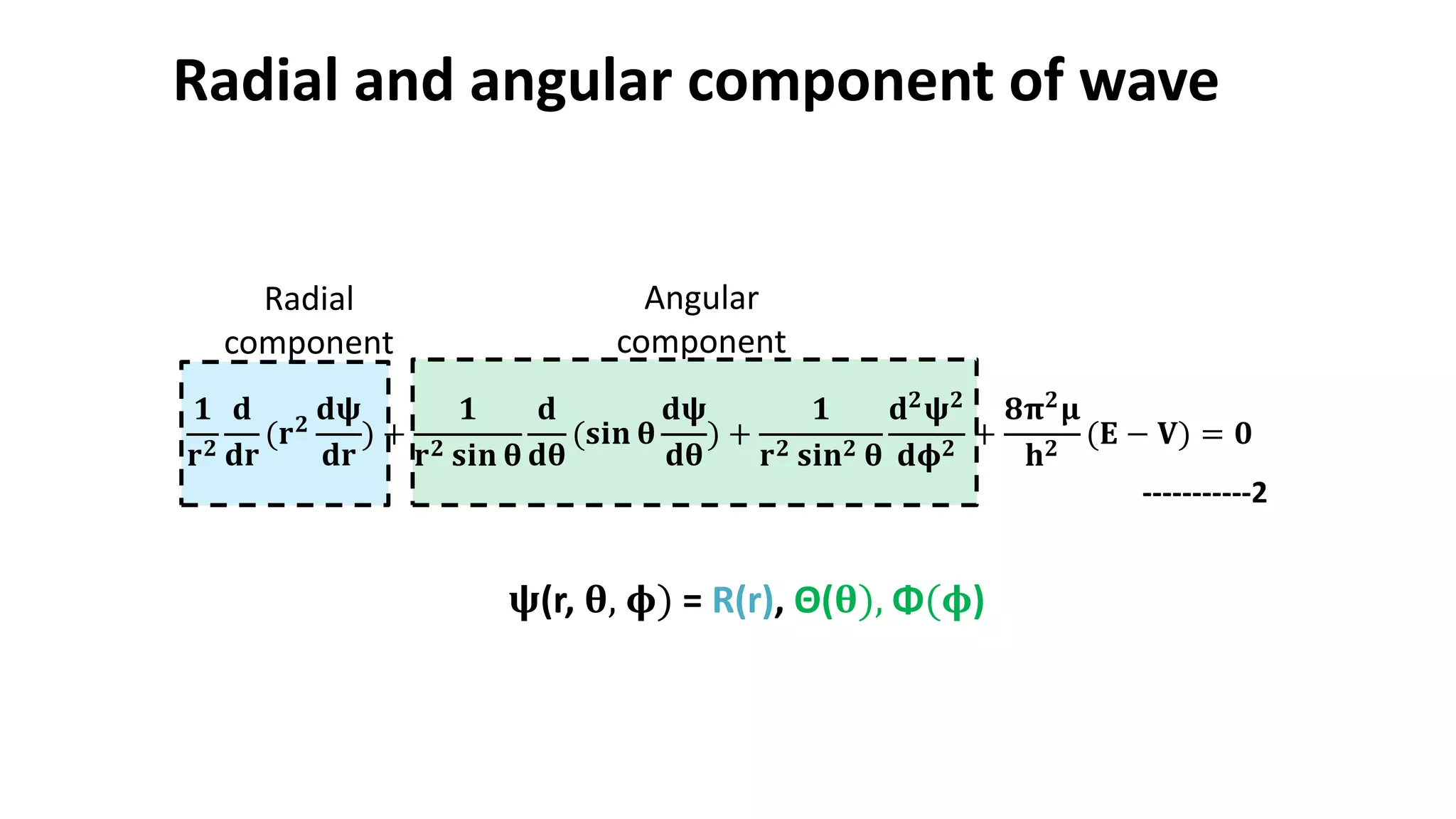
𝟏
𝐫𝟐
𝐝
𝐝𝐫
(𝐫𝟐
𝐝𝛙
𝐝𝐫
) +
𝟏
𝐫𝟐 𝐬𝐢𝐧 𝛉
𝐝
𝐝𝛉
(𝐬𝐢𝐧 𝛉
𝐝𝛙
𝐝𝛉
) +
𝟏
𝐫𝟐 𝐬𝐢𝐧𝟐 𝛉
𝐝𝟐
𝛙𝟐
𝐝𝛟𝟐
+
𝟖𝛑𝟐
𝛍
𝐡𝟐
(𝐄 − 𝐕) = 𝟎
-----------2
𝛙(r, 𝛉, 𝛟) = R(r), Θ(𝛉), Φ(𝛟)
Radial and angular component of wave
Angular
component
Radial
component
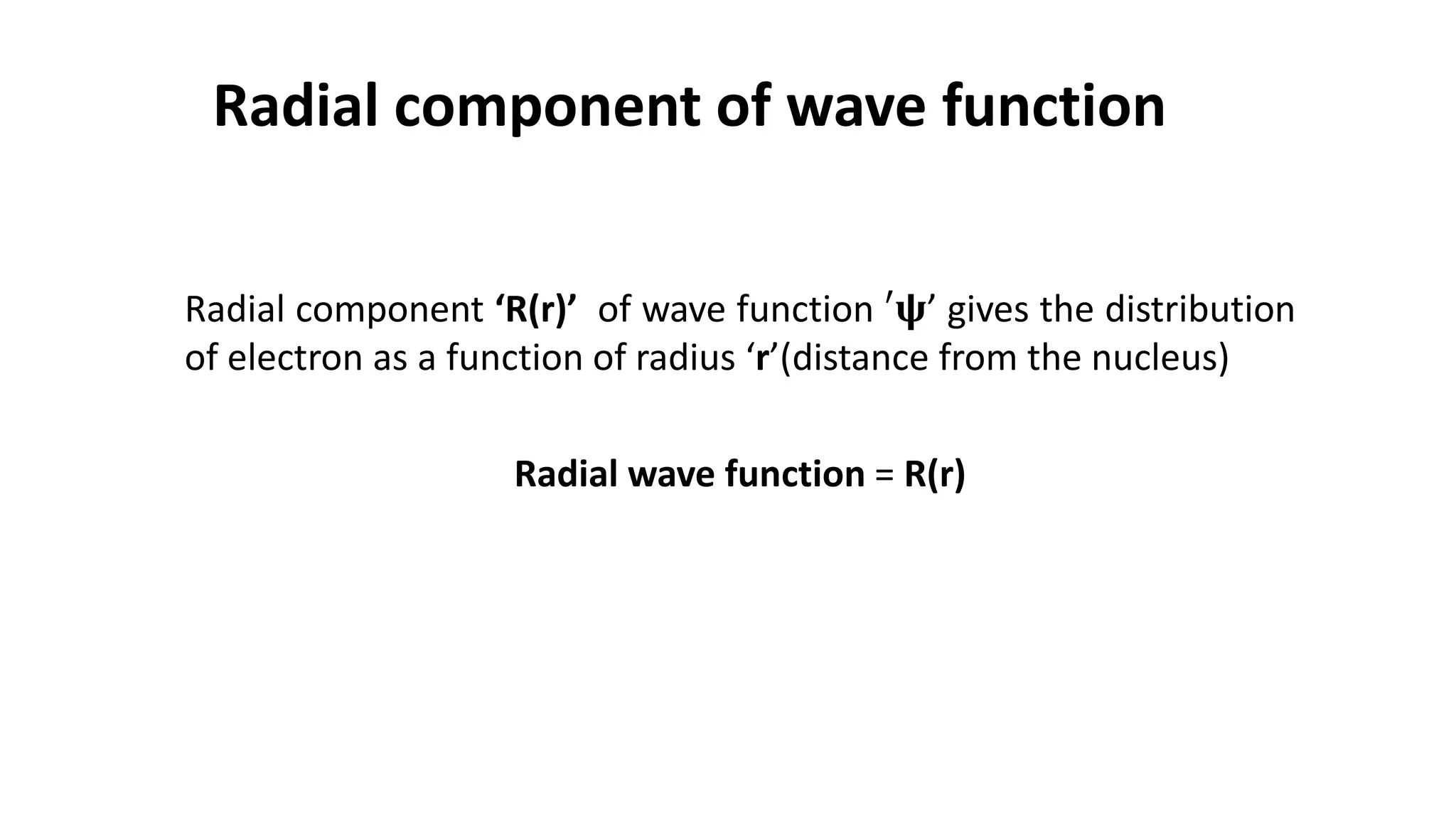
Radial component ‘R(r)’ of wave function ′𝛙’ gives the distribution
of electron as a function of radius ‘r’(distance from the nucleus)
Radial wave function = R(r)
Radial component of wave function
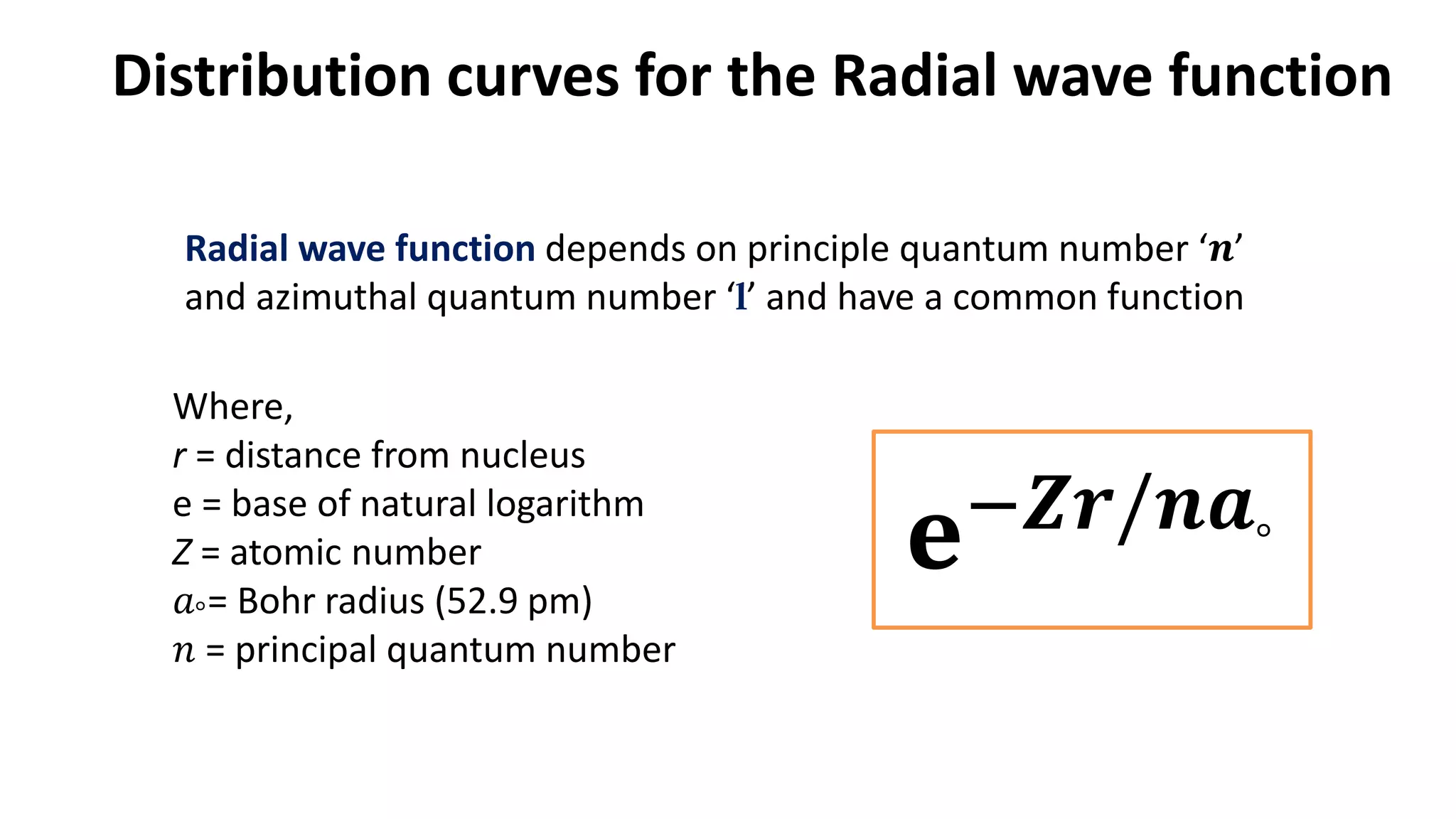
Radial wave function depends on principle quantum number ‘𝒏’
and azimuthal quantum number ‘l’ and have a common function
𝐞−𝒁𝒓/𝒏𝒂°
Where,
r = distance from nucleus
e = base of natural logarithm
Z = atomic number
𝑎°= Bohr radius (52.9 pm)
𝑛 = principal quantum number
Distribution curves for the Radial wave function
Orbital
Quantum
number
Radial component of wave function
‘R(r)’
1s n = 1, l = 0 2(
𝑧
𝑎°
)3/2
𝑒−𝑍𝑟/𝑛𝑎°
2s n = 2, l = 0
1
8
1
2
𝑧
𝑎°
3
2
2 −
2𝑍r
n𝑎°
𝑒−𝑍𝑟/𝑛𝑎°
‘[R(r)]2’ gives the probability of finding electron.
Distribution curves for the Radial wave function
r in pm R(r) [R(r)]2 4πr2 [R(r)]2
0 0.005198122 2.70205E-05 0
52.5 0.001926797 3.71255E-06 0.128522758
52.9 0.001912282 3.65682E-06 0.128530144
53.5 0.001890715 3.5748E-06 0.128513735
224.8 7.41823E-05 5.50301E-09 0.003492872
R(r) =2(
𝑧
𝑎°
)3/2
𝑒−𝑍𝑟/𝑛𝑎°
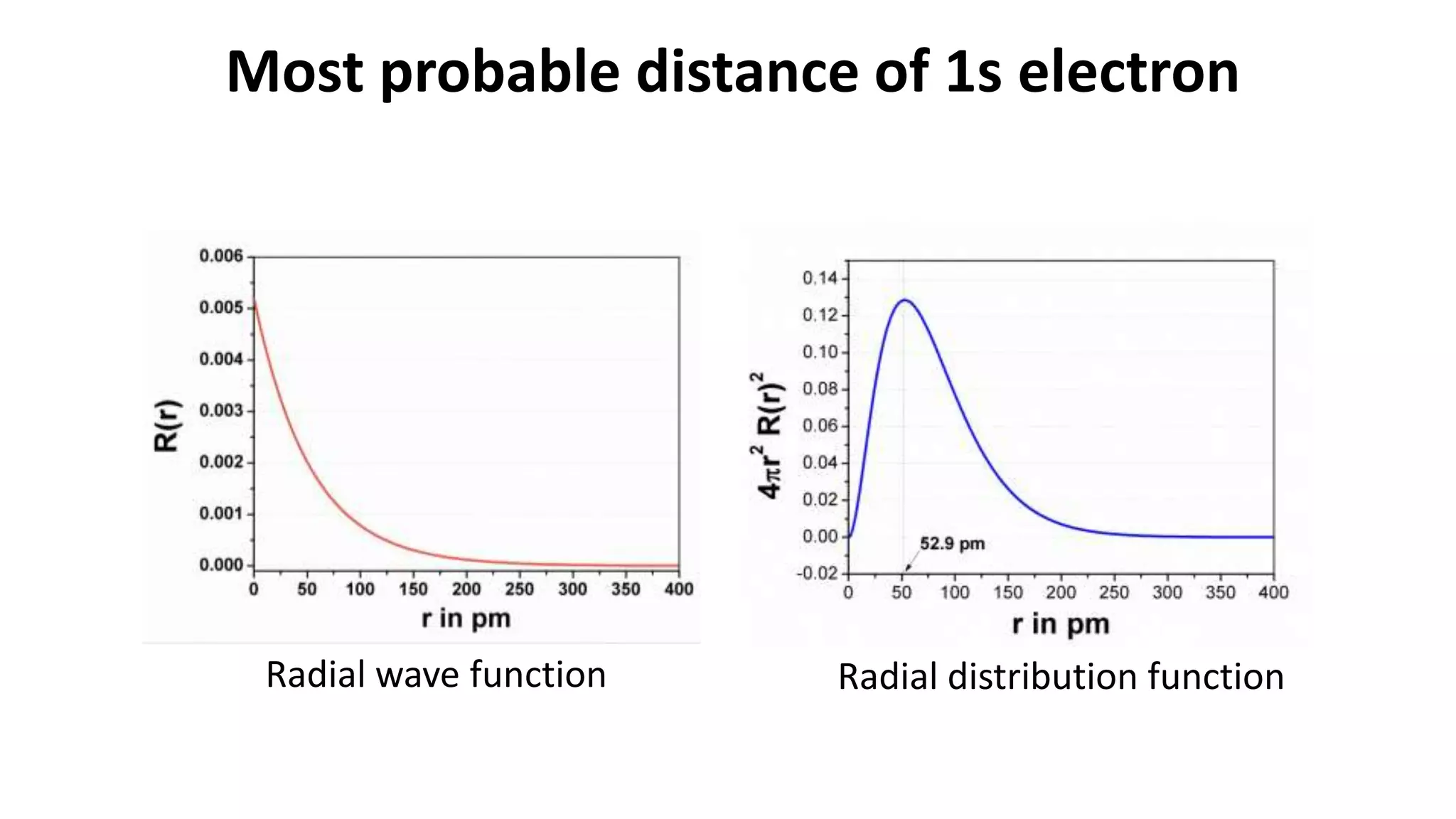
Most probable distance of 1s electron
Radial wave function Radial distribution function
Most probable distance of 1s electron
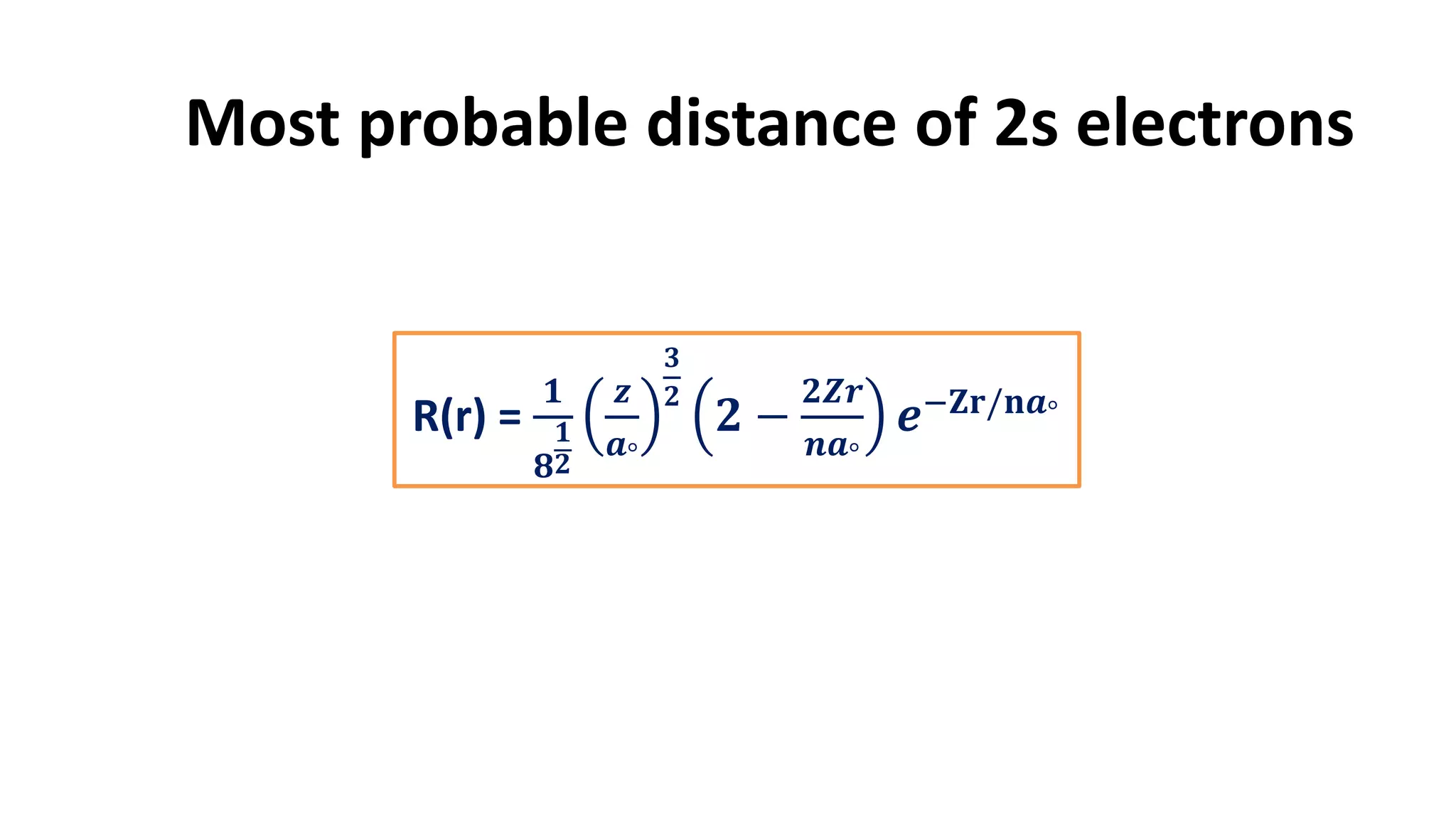
R(r) =
𝟏
𝟖
𝟏
𝟐
𝒛
𝒂°
𝟑
𝟐
𝟐 −
𝟐𝒁𝒓
𝒏𝒂°
𝒆−𝐙𝐫/𝐧𝒂°
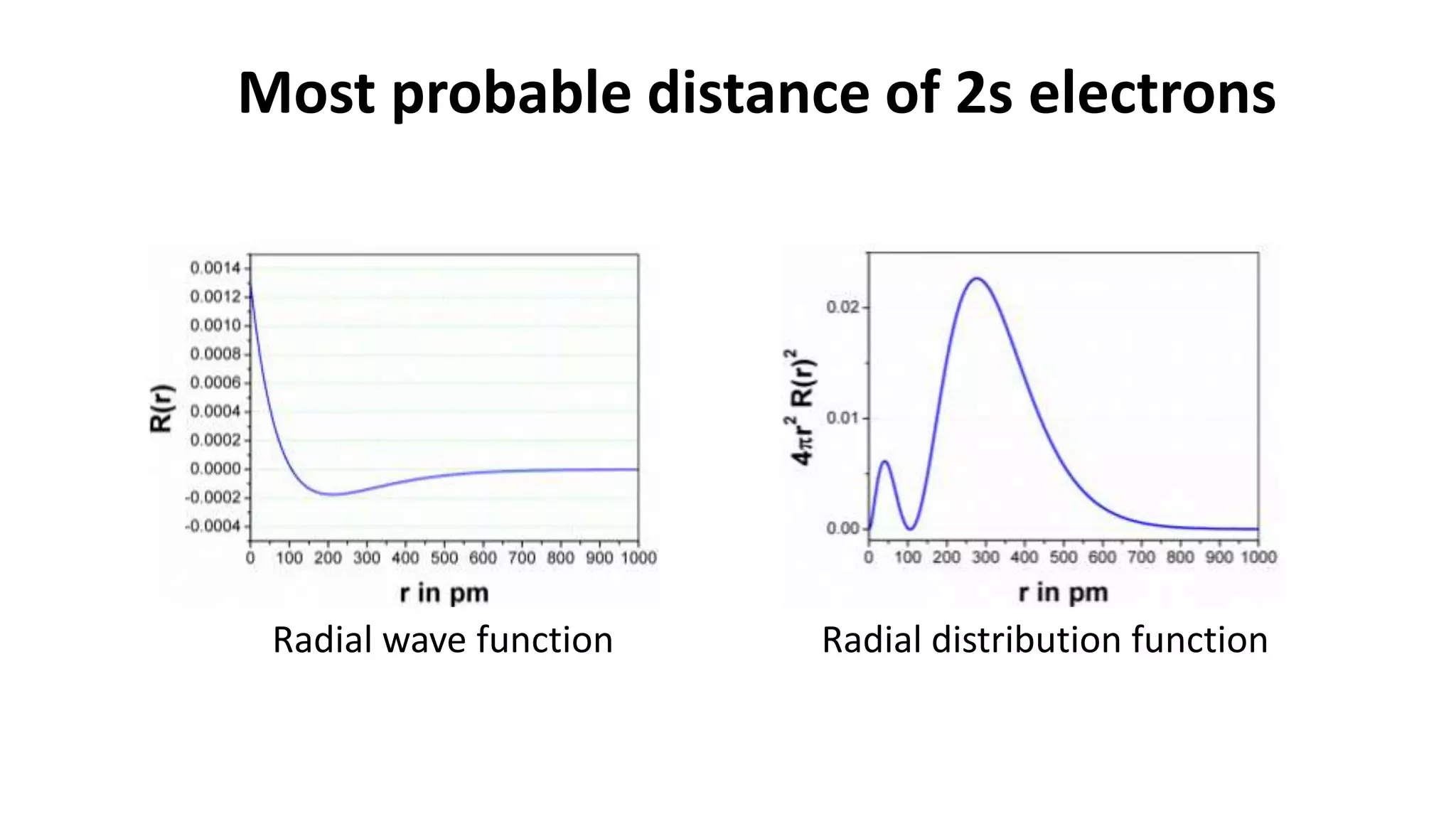
Most probable distance of 2s electrons
Radial distribution function
Radial wave function
Most probable distance of 2s electrons
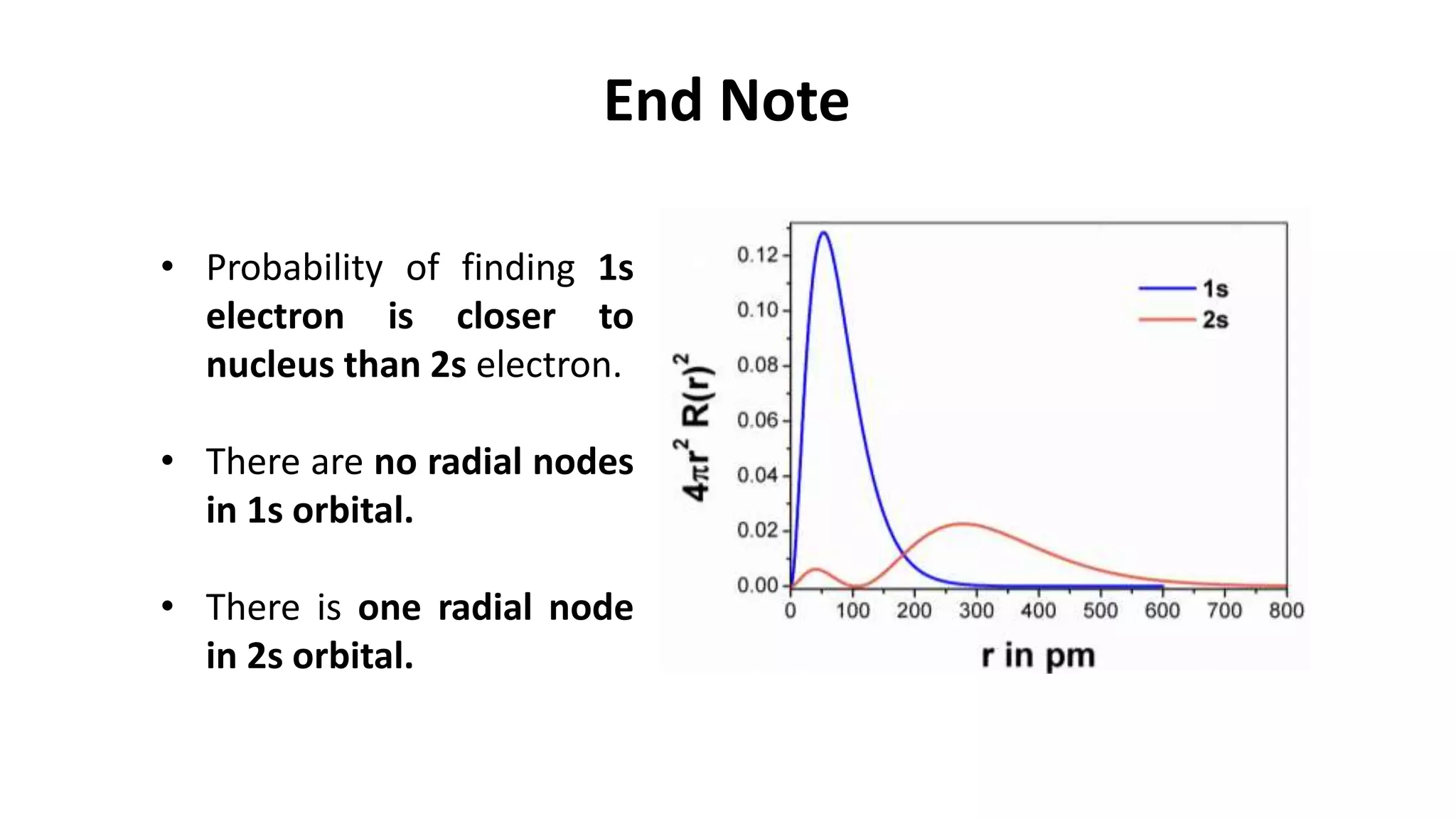
• Probability of finding 1s
electron is closer to
nucleus than 2s electron.
• There are no radial nodes
in 1s orbital.
• There is one radial node
in 2s orbital.
End Note
You can read more always
• Lee, J. D., (2018), Concise Inorganic Chemistry, Fifth Edition, New
Delhi, Wiley India.
• Huheey, J. E., Keiter, E. A., Keiter, R. L., Medhi, O. K., (2019) Inorganic
Chemistry: Principle of structure and reactivity, Fourth Edition, Noida,
Pearson Education India.
• Atkins, P., Overton T., Rourke, J., Weller, M., Armstrong F., (2006)
Shriver and Atkin’s Inorganic Chemistry, Fourth Edition, Great Britain,
Oxford University Press.

Radial distribution function and most probable distance of 1s and 2s electron

  • 1.
    Radial and angularparts of the hydrogenic wave functions
  • 2.
  • 3.
    Cartesian coordinates andpolar coordinates θ φ r (x, y, z) or (r, θ, φ) x axis z axis x = r sin θ cos ϕ y = r sin θ sin ϕ z = r cos θ m = μ
  • 4.
    𝟏 𝐫𝟐 𝐝 𝐝𝐫 (𝐫𝟐 𝐝𝛙 𝐝𝐫 ) + 𝟏 𝐫𝟐 𝐬𝐢𝐧𝛉 𝐝 𝐝𝛉 (𝐬𝐢𝐧 𝛉 𝐝𝛙 𝐝𝛉 ) + 𝟏 𝐫𝟐 𝐬𝐢𝐧𝟐 𝛉 𝐝𝟐 𝛙𝟐 𝐝𝛟𝟐 + 𝟖𝛑𝟐 𝛍 𝐡𝟐 (𝐄 − 𝐕) = 𝟎 -----------2 Schrodinger equation with polar coordinates We have,
  • 5.
    𝟏 𝐫𝟐 𝐝 𝐝𝐫 (𝐫𝟐 𝐝𝛙 𝐝𝐫 ) + 𝟏 𝐫𝟐 𝐬𝐢𝐧𝛉 𝐝 𝐝𝛉 (𝐬𝐢𝐧 𝛉 𝐝𝛙 𝐝𝛉 ) + 𝟏 𝐫𝟐 𝐬𝐢𝐧𝟐 𝛉 𝐝𝟐 𝛙𝟐 𝐝𝛟𝟐 + 𝟖𝛑𝟐 𝛍 𝐡𝟐 (𝐄 − 𝐕) = 𝟎 -----------2 𝛙(r, 𝛉, 𝛟) = R(r), Θ(𝛉), Φ(𝛟) Radial and angular component of wave Angular component Radial component
  • 6.
    Radial component ‘R(r)’of wave function ′𝛙’ gives the distribution of electron as a function of radius ‘r’(distance from the nucleus) Radial wave function = R(r) Radial component of wave function
  • 7.
    Radial wave functiondepends on principle quantum number ‘𝒏’ and azimuthal quantum number ‘l’ and have a common function 𝐞−𝒁𝒓/𝒏𝒂° Where, r = distance from nucleus e = base of natural logarithm Z = atomic number 𝑎°= Bohr radius (52.9 pm) 𝑛 = principal quantum number Distribution curves for the Radial wave function
  • 8.
    Orbital Quantum number Radial component ofwave function ‘R(r)’ 1s n = 1, l = 0 2( 𝑧 𝑎° )3/2 𝑒−𝑍𝑟/𝑛𝑎° 2s n = 2, l = 0 1 8 1 2 𝑧 𝑎° 3 2 2 − 2𝑍r n𝑎° 𝑒−𝑍𝑟/𝑛𝑎° ‘[R(r)]2’ gives the probability of finding electron. Distribution curves for the Radial wave function
  • 9.
    r in pmR(r) [R(r)]2 4πr2 [R(r)]2 0 0.005198122 2.70205E-05 0 52.5 0.001926797 3.71255E-06 0.128522758 52.9 0.001912282 3.65682E-06 0.128530144 53.5 0.001890715 3.5748E-06 0.128513735 224.8 7.41823E-05 5.50301E-09 0.003492872 R(r) =2( 𝑧 𝑎° )3/2 𝑒−𝑍𝑟/𝑛𝑎° Most probable distance of 1s electron
  • 10.
    Radial wave functionRadial distribution function Most probable distance of 1s electron
  • 11.
  • 12.
    Radial distribution function Radialwave function Most probable distance of 2s electrons
  • 13.
    • Probability offinding 1s electron is closer to nucleus than 2s electron. • There are no radial nodes in 1s orbital. • There is one radial node in 2s orbital. End Note
  • 14.
    You can readmore always • Lee, J. D., (2018), Concise Inorganic Chemistry, Fifth Edition, New Delhi, Wiley India. • Huheey, J. E., Keiter, E. A., Keiter, R. L., Medhi, O. K., (2019) Inorganic Chemistry: Principle of structure and reactivity, Fourth Edition, Noida, Pearson Education India. • Atkins, P., Overton T., Rourke, J., Weller, M., Armstrong F., (2006) Shriver and Atkin’s Inorganic Chemistry, Fourth Edition, Great Britain, Oxford University Press.