Radial and angular parts of the hydrogenic wave
functions, variations for 1s, 2s, 2p, 3s, 3p and 3d
orbitals ?
Mr. Mithil Fal Desai, Ph. D.
Assistant Professor in Chemistry
Shree Mallikarjun and Shri Chetan Manju Desai College
Canacona, Goa
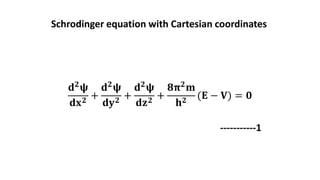
𝐝 𝟐
𝛙
𝐝𝐱 𝟐
+
𝐝 𝟐
𝛙
𝐝𝐲 𝟐
+
𝐝 𝟐
𝛙
𝐝𝐳 𝟐
+
𝟖𝛑 𝟐
𝐦
𝐡 𝟐
(𝐄 − 𝐕) = 𝟎
-----------1
Schrodinger equation with Cartesian coordinates
Cartesian coordinates and Polar coordinates
θ
φ r
(x, y, z) or (r, θ, φ)
x axis
zaxis
x = r sin θ cos ϕ
y = r sin θ sin ϕ
z = r cos θ
m = μ
𝟏
𝐫 𝟐
𝐝
𝐝𝐫
(𝐫 𝟐
𝐝𝛙
𝐝𝐫
) +
𝟏
𝐫 𝟐 𝐬𝐢𝐧 𝛉
𝐝
𝐝𝛉
(𝐬𝐢𝐧 𝛉
𝐝𝛙
𝐝𝛉
) +
𝟏
𝐫 𝟐 𝐬𝐢𝐧 𝟐 𝛉
𝐝 𝟐 𝛙 𝟐
𝐝𝛟 𝟐
+
𝟖𝛑 𝟐 𝛍
𝐡 𝟐
(𝐄 − 𝐕) = 𝟎
-----------2
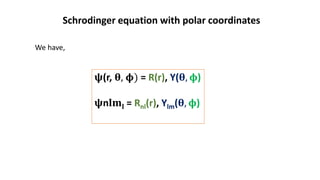
𝛙(r, 𝛉, 𝛟) = R(r), Θ(𝛉), Φ(𝛟)
𝛙(r, 𝛉, 𝛟) = R(r), Y(𝛉, 𝛟)
Schrodinger equation with polar coordinates
We have,
𝛙(r, 𝛉, 𝛟) = R(r), Y(𝛉, 𝛟)
𝛙n𝐥𝐦𝐥 = Rnl(r), Ylm(𝛉, 𝛟)
Schrodinger equation with polar coordinates
We have,
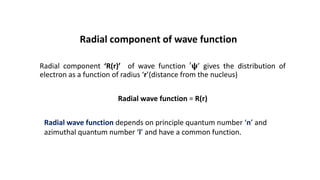
Radial component ‘R(r)’ of wave function ′𝛙’ gives the distribution of
electron as a function of radius ‘r’(distance from the nucleus)
Radial wave function = R(r)
Radial component of wave function
Radial wave function depends on principle quantum number ‘n’ and
azimuthal quantum number ‘l’ and have a common function.
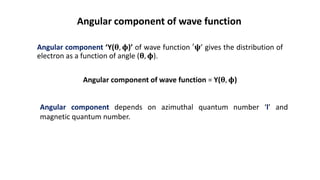
Angular component ‘Y(𝛉, 𝛟)’ of wave function ′𝛙’ gives the distribution of
electron as a function of angle (𝛉, 𝛟).
Angular component of wave function = Y(𝛉, 𝛟)
Angular component of wave function
Angular component depends on azimuthal quantum number ‘l’ and
magnetic quantum number.
8
http://web.pdx.edu/~pmo
eck/lectures/modern/TRM
-7.ppt
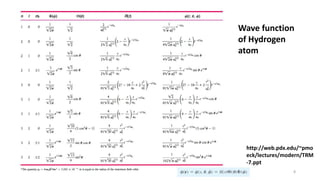
Wave function
of Hydrogen
atom
Radial variation of wave function
Plot the graph of R(r) v/s r for
1s, 2s, 3s, 3p and 3d orbital
Angular variation of atomic orbital

Radial and angular parts wave function

  • 1.
    Radial and angularparts of the hydrogenic wave functions, variations for 1s, 2s, 2p, 3s, 3p and 3d orbitals ? Mr. Mithil Fal Desai, Ph. D. Assistant Professor in Chemistry Shree Mallikarjun and Shri Chetan Manju Desai College Canacona, Goa
  • 2.
    𝐝 𝟐 𝛙 𝐝𝐱 𝟐 + 𝐝𝟐 𝛙 𝐝𝐲 𝟐 + 𝐝 𝟐 𝛙 𝐝𝐳 𝟐 + 𝟖𝛑 𝟐 𝐦 𝐡 𝟐 (𝐄 − 𝐕) = 𝟎 -----------1 Schrodinger equation with Cartesian coordinates
  • 3.
    Cartesian coordinates andPolar coordinates θ φ r (x, y, z) or (r, θ, φ) x axis zaxis x = r sin θ cos ϕ y = r sin θ sin ϕ z = r cos θ m = μ
  • 4.
    𝟏 𝐫 𝟐 𝐝 𝐝𝐫 (𝐫 𝟐 𝐝𝛙 𝐝𝐫 )+ 𝟏 𝐫 𝟐 𝐬𝐢𝐧 𝛉 𝐝 𝐝𝛉 (𝐬𝐢𝐧 𝛉 𝐝𝛙 𝐝𝛉 ) + 𝟏 𝐫 𝟐 𝐬𝐢𝐧 𝟐 𝛉 𝐝 𝟐 𝛙 𝟐 𝐝𝛟 𝟐 + 𝟖𝛑 𝟐 𝛍 𝐡 𝟐 (𝐄 − 𝐕) = 𝟎 -----------2 𝛙(r, 𝛉, 𝛟) = R(r), Θ(𝛉), Φ(𝛟) 𝛙(r, 𝛉, 𝛟) = R(r), Y(𝛉, 𝛟) Schrodinger equation with polar coordinates We have,
  • 5.
    𝛙(r, 𝛉, 𝛟)= R(r), Y(𝛉, 𝛟) 𝛙n𝐥𝐦𝐥 = Rnl(r), Ylm(𝛉, 𝛟) Schrodinger equation with polar coordinates We have,
  • 6.
    Radial component ‘R(r)’of wave function ′𝛙’ gives the distribution of electron as a function of radius ‘r’(distance from the nucleus) Radial wave function = R(r) Radial component of wave function Radial wave function depends on principle quantum number ‘n’ and azimuthal quantum number ‘l’ and have a common function.
  • 7.
    Angular component ‘Y(𝛉,𝛟)’ of wave function ′𝛙’ gives the distribution of electron as a function of angle (𝛉, 𝛟). Angular component of wave function = Y(𝛉, 𝛟) Angular component of wave function Angular component depends on azimuthal quantum number ‘l’ and magnetic quantum number.
  • 8.
  • 9.
    Radial variation ofwave function Plot the graph of R(r) v/s r for 1s, 2s, 3s, 3p and 3d orbital
  • 10.
    Angular variation ofatomic orbital