LESSONS FROM
EDWARD TUFTE
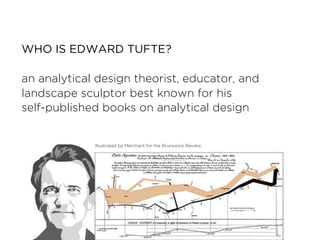
WHO IS EDWARD TUFTE?
an analytical design theorist, educator, and
landscape sculptor best known for his
self-published books on analytical design
Illustrated by Merchant for the Brunswick Review
STRIVE FOR
GRAPHICAL INTEGRITY
1
Visual representations of data
must tell the truth.
GRAPHICAL INTEGRITY1
Calculated by dividing the size of the
effect shown in the graphic by the size
of the effect in the data. 
If the Lie Factor is greater than 1
the graph overstates the effect.
THE LIE FACTOR
According to Tufte the Lie Factor of this
graph is 14.8.  A numerical change of 53%
is represented by a graphical change
(size of horizontal lines) of 783%.
GRAPHICAL INTEGRITY1
The representation of numbers, as physically
measured on the surface of the graph itself,
should be directly proportional to the
numerical quantities represented
1ST PRINCIPLE
GRAPHICAL INTEGRITY1
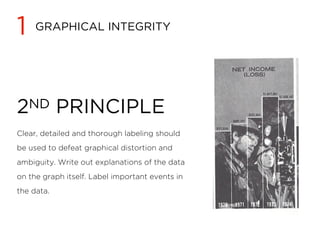
Clear, detailed and thorough labeling should
be used to defeat graphical distortion and
ambiguity. Write out explanations of the data
on the graph itself. Label important events in
the data.
2ND PRINCIPLE
GRAPHICAL INTEGRITY1
Show data variation, not design variation.
3RD PRINCIPLE
GRAPHICAL INTEGRITY1
In time-series displays of money,
deflated and standardized units of
monetary measurement are nearly
always better than nominal units.
4TH PRINCIPLE
GRAPHICAL INTEGRITY1
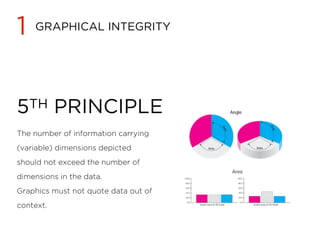
The number of information carrying
(variable) dimensions depicted
should not exceed the number of
dimensions in the data.
Graphics must not quote data out of
context.
5TH PRINCIPLE
MAXIMIZE
DATA INK
2
The ink on a graph that represents data. Good graphical representations
maximize data-ink and erase as much non-data-ink as possible. 
The data-ink ratio is calculated by 1 minus the proportion of the graph
that can be erased without loss of data-information. 
DATA INK2
1. Above all else show data.
2. Maximize the data-ink ratio.
3. Erase non-data-ink.
4. Erase redundant data-ink.
5. Revise and edit
5 PRINCIPLES
It’s an electroencephalogram – a graph
that records the electrical activity from
the brain. This graph would have a very
high data-ink ratio of 1.
DATA INK2
Graph from Carl Sagan’s The Dragons of Eden
DATA INK2
Tufte’s redesign
DATA INK2
Tufte’s redesign from Beautiful Evidence
AVOID
CHART JUNK
3
The excessive and unnecessary use of graphical
effects in graphs used to demonstrate the graphic
ability of the designer rather than display the data.
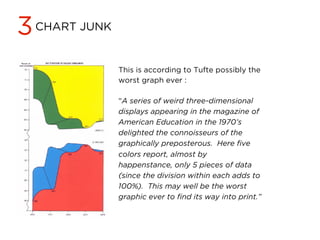
This is according to Tufte possibly the
worst graph ever :
“A series of weird three-dimensional
displays appearing in the magazine of
American Education in the 1970’s
delighted the connoisseurs of the
graphically preposterous.  Here five
colors report, almost by
happenstance, only 5 pieces of data
(since the division within each adds to
100%).  This may well be the worst
graphic ever to find its way into print.”
CHART JUNK3
AIM FOR HIGH
DATA DENSITY
4
The proportion of the total size of the graph that
is dedicated displaying data. 
DATA DENSITY4
Maximize data density and the size of
the data matrix within reason. One
way of achieving this is through the
Shrink Principle.  Most graphs can be
shrunk way down without losing
legibility or information.
SHRINK
PRINCIPLE
USE
CLASSIC DESIGN
SOLUTIONS
5
SMALL
MULTIPLES
5
Series of the same small
graph repeated in one visual.
DESIGN SOLUTIONS
DESIGN SOLUTIONS5
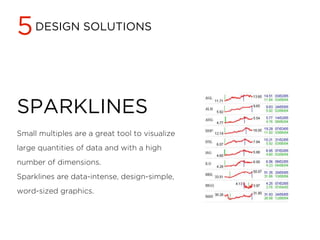
Small multiples are a great tool to visualize
large quantities of data and with a high
number of dimensions. 
Sparklines are data-intense, design-simple,
word-sized graphics. 
SPARKLINES
DESIGN SOLUTIONS5
The most frequently used form of graphic design.
One dimension, usually the horizontal, is time, and the graphics march
along showing variation as time proceeds. Most visualization time-series
works are videos, which show time by changing the picture, requiring
the user to remember what came before.
TIME SERIES
DESIGN SOLUTIONS5
Refers to an approach where a visualization contains enormous detail,
but an overall pattern emerges. Panorama, vista, and prospect deliver to
viewers the freedom of choice that derives from an overview, a capacity
to compare and sift through detail. And that micro-information, like
smaller texture in landscape perception, provides a credible refuge
where the pace of visualization is condensed, slowed, and personalized.
MICRO/MACRO
COMPOSITION
APPLY
AESTHETICS & TECHNIQUE
6
AESTHETICS & TECHNIQUE6
have a properly chosen format and design
use words, numbers, and drawing together
reflect a balance, a proportion, a sense of relevant scale
display an accessible complexity of detail
have a narrative quality, a story to tell about the data
draw elements in a professional manner, with the
technical details of production done with care
avoid content-free decoration, including chartjunk
Juan Velasco
Cornell ornithologist Edwing Scholes and biologist/photographer Tim Laman
Senior Graphics Editor Fernando Baptista, Graphics Specialist Maggie Smith and freelance researcher
Fanna Gebreyesus
National Geographic
If a visualization is too cluttered, don't remove
data, change the design. Credibility comes from
detail and in many cases one can clarify a design
by adding detail.
High-density designs also allow viewers to select,
to narrate, to recast and personalize data for
their own uses.
Data-thin, forgetful displays move viewers
toward ignorance and passivity, and at the same
time diminish the credibility of the source.
CLUTTER
6AESTHETICS & TECHNIQUE
JFlowMap is a research prototype developed at the University of Fribourg that experiments various
visualization techniques for spatial interactions, i.e. interactions between pairs of geographic
locations. These can be migrations, movement of goods and people, network traffic, or any kind of
entities “flowing” between locations.
Hyperakt and Ekene Ijeoma visualized migrations over time and
space in The Refugee Project
http://www.therefugeeproject.org
Empty space may reduce clutter, but it is not
how much empty space there is, but rather how
it is used. It is not how much information there
is, but rather how effectively it is arranged.
Low density computer displays lead to
spreading information out over many screens
or dialog boxes. Place information adjacent in
space, not stacked in time, to avoid the `Where
am I?' problem.
CLUTTER
6AESTHETICS & TECHNIQUE
For a graduate project, Michael Barry and Brian Card explored the Boston subway system through a
set of annotated interactives that show train routes, usage, and scheduling.
http://mbtaviz.github.io/
Implies using color or other differentiation to separate
important classes of information. Consider a colormapped
surface that requires annotation. If the colormap uses all
possible colors, positioning annotation will be difficult
because of color clashes. A better approach might be to
use intensity of a single hue for the colormap, leaving visual
space for addition information; i.e., the annotation.
LAYERING AND
SEPARATION
6AESTHETICS & TECHNIQUE
Muted colors, subtle
shading and thin contour
lines allow multiple types
of data to be layered
together in this 1958
topographic map of
Chattanooga, Tennessee.
Effective layering of information is often
difficult because an omnipresent, yet
subtle, design issue is involved:
the various elements collected together
interact, creating non-information
patterns and texture.
1 + 1 = 3 OR MORE
6AESTHETICS & TECHNIQUE
Chart by Andrew Abela
FOR MORE TIPS
HTTP://WWW.SLIDESHARE.NET/MCGARRAHJESSEE/MCJEDWARD-TUFTENOTES

Lessons From Edward Tufte

  • 1.
  • 2.
    WHO IS EDWARDTUFTE? an analytical design theorist, educator, and landscape sculptor best known for his self-published books on analytical design Illustrated by Merchant for the Brunswick Review
  • 3.
    STRIVE FOR GRAPHICAL INTEGRITY 1 Visualrepresentations of data must tell the truth.
  • 4.
    GRAPHICAL INTEGRITY1 Calculated bydividing the size of the effect shown in the graphic by the size of the effect in the data.  If the Lie Factor is greater than 1 the graph overstates the effect. THE LIE FACTOR According to Tufte the Lie Factor of this graph is 14.8.  A numerical change of 53% is represented by a graphical change (size of horizontal lines) of 783%.
  • 5.
    GRAPHICAL INTEGRITY1 The representationof numbers, as physically measured on the surface of the graph itself, should be directly proportional to the numerical quantities represented 1ST PRINCIPLE
  • 6.
    GRAPHICAL INTEGRITY1 Clear, detailedand thorough labeling should be used to defeat graphical distortion and ambiguity. Write out explanations of the data on the graph itself. Label important events in the data. 2ND PRINCIPLE
  • 7.
    GRAPHICAL INTEGRITY1 Show datavariation, not design variation. 3RD PRINCIPLE
  • 8.
    GRAPHICAL INTEGRITY1 In time-seriesdisplays of money, deflated and standardized units of monetary measurement are nearly always better than nominal units. 4TH PRINCIPLE
  • 9.
    GRAPHICAL INTEGRITY1 The numberof information carrying (variable) dimensions depicted should not exceed the number of dimensions in the data. Graphics must not quote data out of context. 5TH PRINCIPLE
  • 10.
    MAXIMIZE DATA INK 2 The inkon a graph that represents data. Good graphical representations maximize data-ink and erase as much non-data-ink as possible.  The data-ink ratio is calculated by 1 minus the proportion of the graph that can be erased without loss of data-information. 
  • 11.
    DATA INK2 1. Aboveall else show data. 2. Maximize the data-ink ratio. 3. Erase non-data-ink. 4. Erase redundant data-ink. 5. Revise and edit 5 PRINCIPLES It’s an electroencephalogram – a graph that records the electrical activity from the brain. This graph would have a very high data-ink ratio of 1.
  • 12.
    DATA INK2 Graph fromCarl Sagan’s The Dragons of Eden
  • 13.
  • 14.
    DATA INK2 Tufte’s redesignfrom Beautiful Evidence
  • 15.
    AVOID CHART JUNK 3 The excessiveand unnecessary use of graphical effects in graphs used to demonstrate the graphic ability of the designer rather than display the data.
  • 16.
    This is accordingto Tufte possibly the worst graph ever : “A series of weird three-dimensional displays appearing in the magazine of American Education in the 1970’s delighted the connoisseurs of the graphically preposterous.  Here five colors report, almost by happenstance, only 5 pieces of data (since the division within each adds to 100%).  This may well be the worst graphic ever to find its way into print.” CHART JUNK3
  • 17.
    AIM FOR HIGH DATADENSITY 4 The proportion of the total size of the graph that is dedicated displaying data. 
  • 18.
    DATA DENSITY4 Maximize datadensity and the size of the data matrix within reason. One way of achieving this is through the Shrink Principle.  Most graphs can be shrunk way down without losing legibility or information. SHRINK PRINCIPLE
  • 19.
  • 20.
    SMALL MULTIPLES 5 Series of thesame small graph repeated in one visual. DESIGN SOLUTIONS
  • 21.
    DESIGN SOLUTIONS5 Small multiplesare a great tool to visualize large quantities of data and with a high number of dimensions.  Sparklines are data-intense, design-simple, word-sized graphics.  SPARKLINES
  • 22.
    DESIGN SOLUTIONS5 The mostfrequently used form of graphic design. One dimension, usually the horizontal, is time, and the graphics march along showing variation as time proceeds. Most visualization time-series works are videos, which show time by changing the picture, requiring the user to remember what came before. TIME SERIES
  • 23.
    DESIGN SOLUTIONS5 Refers toan approach where a visualization contains enormous detail, but an overall pattern emerges. Panorama, vista, and prospect deliver to viewers the freedom of choice that derives from an overview, a capacity to compare and sift through detail. And that micro-information, like smaller texture in landscape perception, provides a credible refuge where the pace of visualization is condensed, slowed, and personalized. MICRO/MACRO COMPOSITION
  • 25.
  • 26.
    AESTHETICS & TECHNIQUE6 havea properly chosen format and design use words, numbers, and drawing together reflect a balance, a proportion, a sense of relevant scale display an accessible complexity of detail have a narrative quality, a story to tell about the data draw elements in a professional manner, with the technical details of production done with care avoid content-free decoration, including chartjunk
  • 27.
    Juan Velasco Cornell ornithologistEdwing Scholes and biologist/photographer Tim Laman Senior Graphics Editor Fernando Baptista, Graphics Specialist Maggie Smith and freelance researcher Fanna Gebreyesus National Geographic
  • 28.
    If a visualizationis too cluttered, don't remove data, change the design. Credibility comes from detail and in many cases one can clarify a design by adding detail. High-density designs also allow viewers to select, to narrate, to recast and personalize data for their own uses. Data-thin, forgetful displays move viewers toward ignorance and passivity, and at the same time diminish the credibility of the source. CLUTTER 6AESTHETICS & TECHNIQUE
  • 29.
    JFlowMap is aresearch prototype developed at the University of Fribourg that experiments various visualization techniques for spatial interactions, i.e. interactions between pairs of geographic locations. These can be migrations, movement of goods and people, network traffic, or any kind of entities “flowing” between locations.
  • 30.
    Hyperakt and EkeneIjeoma visualized migrations over time and space in The Refugee Project http://www.therefugeeproject.org
  • 31.
    Empty space mayreduce clutter, but it is not how much empty space there is, but rather how it is used. It is not how much information there is, but rather how effectively it is arranged. Low density computer displays lead to spreading information out over many screens or dialog boxes. Place information adjacent in space, not stacked in time, to avoid the `Where am I?' problem. CLUTTER 6AESTHETICS & TECHNIQUE
  • 32.
    For a graduateproject, Michael Barry and Brian Card explored the Boston subway system through a set of annotated interactives that show train routes, usage, and scheduling. http://mbtaviz.github.io/
  • 33.
    Implies using coloror other differentiation to separate important classes of information. Consider a colormapped surface that requires annotation. If the colormap uses all possible colors, positioning annotation will be difficult because of color clashes. A better approach might be to use intensity of a single hue for the colormap, leaving visual space for addition information; i.e., the annotation. LAYERING AND SEPARATION 6AESTHETICS & TECHNIQUE
  • 34.
    Muted colors, subtle shadingand thin contour lines allow multiple types of data to be layered together in this 1958 topographic map of Chattanooga, Tennessee.
  • 35.
    Effective layering ofinformation is often difficult because an omnipresent, yet subtle, design issue is involved: the various elements collected together interact, creating non-information patterns and texture. 1 + 1 = 3 OR MORE 6AESTHETICS & TECHNIQUE
  • 36.
  • 37.