DISCUSSION 
ISSUES ON 
ASSESEMENT 
GROUP NAME : 
FATIN AMIRA BINTI YUNUS 
NUR SHUHADA SURIA BINTI SHA’ARI 
ATINA HASANAH BINTI MOHD RAZALI
NATURE AND PURPOSE 
OF ASSESSMENT 
 Assessment shall be holistic, with emphasis on 
the formative or developmental purpose of quality 
assuring student learning. 
 It also standards-based as it seeks to ensure that 
teachers will teach to the standards and students 
will aim to meet or even exceed the standards. 
 The students’ attainment of standards in terms of 
content and performance is, therefore, a critical 
evidence of learning.
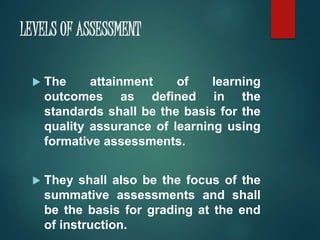
LEVELS OF ASSESSMENT 
 The attainment of learning 
outcomes as defined in the 
standards shall be the basis for the 
quality assurance of learning using 
formative assessments. 
 They shall also be the focus of the 
summative assessments and shall 
be the basis for grading at the end 
of instruction.
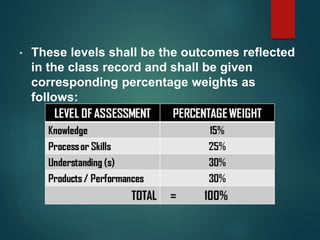
• These levels shall be the outcomes reflected 
in the class record and shall be given 
corresponding percentage weights as 
follows:
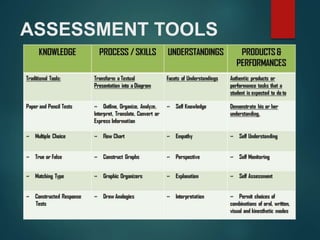
ASSESSMENT TOOLS
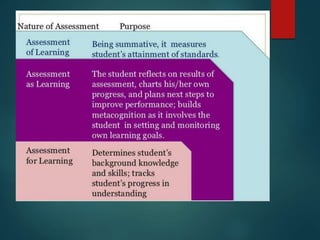
TYPE OF ASSESSMENT 
Two type of assessment : 
Formative assessment 
(Assessment for learning) 
Summative assessment 
(Assessment of learning)
FORMATIVE 
ASSESSMENT 
 Is a process used by teachers and 
students during instruction that 
provides explicit feedback to adjust 
on-going teaching and learning in 
order to improve student 
achievement. 
 There is also a diagnostic test 
which identifies a student area of 
achievement and weakness in a 
particular subject, which can give 
an idea of difficulty the student is
EXAMPLE 
draw a concept map in class to 
represent their understanding of 
a topic 
submit one or two sentences 
identifying the main point of a 
lecture 
turn in a research proposal for 
early feedback
SUMMATIVE ASSESSMENT 
 Are cumulative evaluation used to 
measure growth after instruction and are 
generally given at the end of a course in 
order to determine whether long term 
goals have been met 
 Summative assessment focus on what the 
student has learned at the end of a unit of 
instruction or at the end of a grade level 
 Summative assessment purpose is to let 
the teachers and students know the level 
of accomplishment attained.
EXAMPLE 
a midterm exam 
a final project 
a paper 
a senior recital
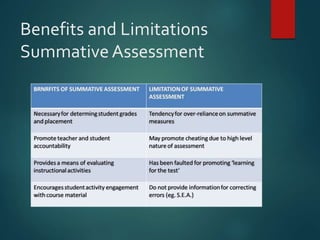
Benefits and Limitations 
Summative Assessment
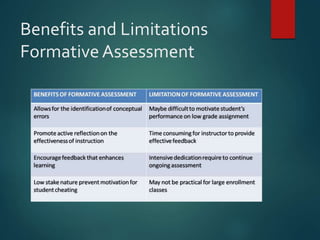
Benefits and Limitations 
Formative Assessment

Assesement

  • 1.
    DISCUSSION ISSUES ON ASSESEMENT GROUP NAME : FATIN AMIRA BINTI YUNUS NUR SHUHADA SURIA BINTI SHA’ARI ATINA HASANAH BINTI MOHD RAZALI
  • 2.
    NATURE AND PURPOSE OF ASSESSMENT  Assessment shall be holistic, with emphasis on the formative or developmental purpose of quality assuring student learning.  It also standards-based as it seeks to ensure that teachers will teach to the standards and students will aim to meet or even exceed the standards.  The students’ attainment of standards in terms of content and performance is, therefore, a critical evidence of learning.
  • 4.
    LEVELS OF ASSESSMENT  The attainment of learning outcomes as defined in the standards shall be the basis for the quality assurance of learning using formative assessments.  They shall also be the focus of the summative assessments and shall be the basis for grading at the end of instruction.
  • 5.
    • These levelsshall be the outcomes reflected in the class record and shall be given corresponding percentage weights as follows:
  • 6.
  • 7.
    TYPE OF ASSESSMENT Two type of assessment : Formative assessment (Assessment for learning) Summative assessment (Assessment of learning)
  • 8.
    FORMATIVE ASSESSMENT Is a process used by teachers and students during instruction that provides explicit feedback to adjust on-going teaching and learning in order to improve student achievement.  There is also a diagnostic test which identifies a student area of achievement and weakness in a particular subject, which can give an idea of difficulty the student is
  • 9.
    EXAMPLE draw aconcept map in class to represent their understanding of a topic submit one or two sentences identifying the main point of a lecture turn in a research proposal for early feedback
  • 10.
    SUMMATIVE ASSESSMENT Are cumulative evaluation used to measure growth after instruction and are generally given at the end of a course in order to determine whether long term goals have been met  Summative assessment focus on what the student has learned at the end of a unit of instruction or at the end of a grade level  Summative assessment purpose is to let the teachers and students know the level of accomplishment attained.
  • 11.
    EXAMPLE a midtermexam a final project a paper a senior recital
  • 12.
    Benefits and Limitations Summative Assessment
  • 13.
    Benefits and Limitations Formative Assessment