0
Syllabus for Two-year
Bachelor of Education
B. Ed.
Department of Education
Aliah University, Kolkata-16
1
Two-Year B. Ed Syllabus
Department of Education
Aliah University
In pursuance with the Gazette Notification (Extraordinary, Part III-Sec 4) on 20th
November,
2014 (Appendix 4), NCTE (Recognition Norms and Procedure) Regulations, 2014 and according
to the norms and standards of Aliah University, the B.Ed. curriculum has been framed. The
B.Ed. syllabus includes 7 courses on Perspectives in Education, 5 courses on Curriculum and
Pedagogic studies (including two pedagogy courses on any of the school subject areas), school
internship and 4 courses on enhancing professional capabilities. The optional courses of 2 credits
weightage in the area of educational significance have been covered in the syllabus. The B.Ed.
syllabus covers 18 courses along with internship in four semester duration. A total of 80 credits,
that is, 2000 marks, are covered in four semesters (500 Marks each). It covers teaching of theory
courses of 40 credits, Practicum and Field work 28 credits and internship of 12 credits
respectively. Theory course teaching will include classroom based teaching learning activities
like lecture, discussion, dialogue, small group session, workshop, presentation, etc.
The Practicum and Field works will include hands on experiences in real school situations as
well as in simulated forms. Observations, interviews, focused group discussions, anecdotes,
dairy, maintenance, collection of audio visual data, reflective dairy writing, development of
teaching learning materials, exhibitions, debates, role play, cooperative learning exercises,
demonstration, case studies, action research, projects, etc.
The internship will include fulltime engagement in real school situations for a prolonged period
of 16 weeks duration. This will cover observation, instructional design, planning, intervention
practices, classroom teaching, record keeping, co-curricular activities, formative evaluation
practices and interpretation, and community projects under the supervision of teacher educators
and mentors from the concerned schools.
The B.Ed. programme includes theory based teaching learning activities and Practicum
(including Internship) on 50:50 bases. Total numbers of credits allotted to theory related teaching
are 40 credits (1000 Marks) and Practicum plus internship 40 credits (1000 Marks) out of a total
of 80 credits, that is, 2000 Marks.
 Semester means effective teaching work of 16 weeks excluding admission and
semester end examination period.
 One credit of teaching activities means one hour effective teaching of theory course
in each week for 16 weeks: Total 16 hours teaching per credit.
 One credit for Practicum / Field work / Internship means two hour effective work in
each week for 16 weeks. Total 32 hours of practicum per credit.
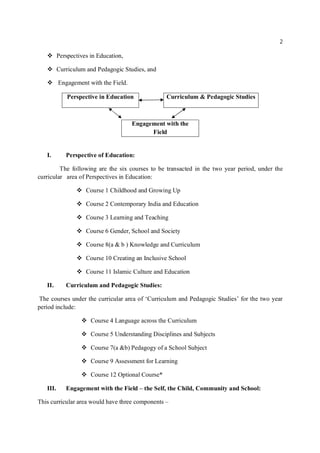
The programme has three broad curricular areas –
2
 Perspectives in Education,
 Curriculum and Pedagogic Studies, and
 Engagement with the Field.
Perspective in Education Curriculum & Pedagogic Studies
I. Perspective of Education:
The following are the six courses to be transacted in the two year period, under the
curricular area of Perspectives in Education:
 Course 1 Childhood and Growing Up
 Course 2 Contemporary India and Education
 Course 3 Learning and Teaching
 Course 6 Gender, School and Society
 Course 8(a & b ) Knowledge and Curriculum
 Course 10 Creating an Inclusive School
 Course 11 Islamic Culture and Education
II. Curriculum and Pedagogic Studies:
The courses under the curricular area of ‘Curriculum and Pedagogic Studies’ for the two year
period include:
 Course 4 Language across the Curriculum
 Course 5 Understanding Disciplines and Subjects
 Course 7(a &b) Pedagogy of a School Subject
 Course 9 Assessment for Learning
 Course 12 Optional Course*
III. Engagement with the Field – the Self, the Child, Community and School:
This curricular area would have three components –
Engagement with the
Field
3
 Tasks and Assignments that run through all the courses as indicated in the year wise
distribution of the syllabus
 School Internship
 Courses on Enhancing Professional Capacities (EPC):
 Course EPC 1: Reading and Reflecting on Texts
 Course EPC 2: Drama and Art in Education
 Course EPC 3: Critical Understanding of ICT
 Course EPC 4: Understanding the Self
4
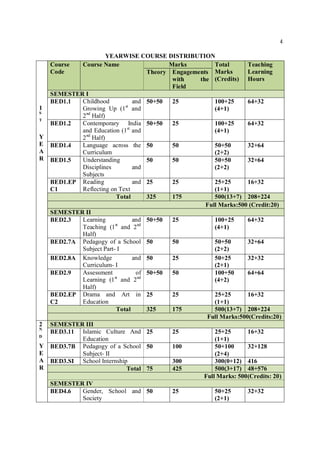
YEARWISE COURSE DISTRIBUTION
1
S
T
Y
E
A
R
Course
Code
Course Name Marks Total
Marks
(Credits)
Teaching
Learning
Hours
Theory Engagements
with the
Field
SEMESTER I
BED1.1 Childhood and
Growing Up (1st
and
2nd
Half)
50+50 25 100+25
(4+1)
64+32
BED1.2 Contemporary India
and Education (1st
and
2nd
Half)
50+50 25 100+25
(4+1)
64+32
BED1.4 Language across the
Curriculum
50 50 50+50
(2+2)
32+64
BED1.5 Understanding
Disciplines and
Subjects
50 50 50+50
(2+2)
32+64
BED1.EP
C1
Reading and
Reflecting on Text
25 25 25+25
(1+1)
16+32
Total 325 175 500(13+7) 208+224
Full Marks:500 (Credit:20)
SEMESTER II
BED2.3 Learning and
Teaching (1st
and 2nd
Half)
50+50 25 100+25
(4+1)
64+32
BED2.7A Pedagogy of a School
Subject Part- I
50 50 50+50
(2+2)
32+64
BED2.8A Knowledge and
Curriculum- I
50 25 50+25
(2+1)
32+32
BED2.9 Assessment of
Learning (1st
and 2nd
Half)
50+50 50 100+50
(4+2)
64+64
BED2.EP
C2
Drama and Art in
Education
25 25 25+25
(1+1)
16+32
Total 325 175 500(13+7) 208+224
Full Marks:500(Credits:20)
2
N
D
Y
E
A
R
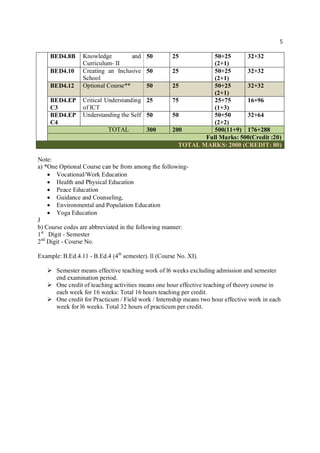
SEMESTER III
BED3.11 Islamic Culture And
Education
25 25 25+25
(1+1)
16+32
BED3.7B Pedagogy of a School
Subject- II
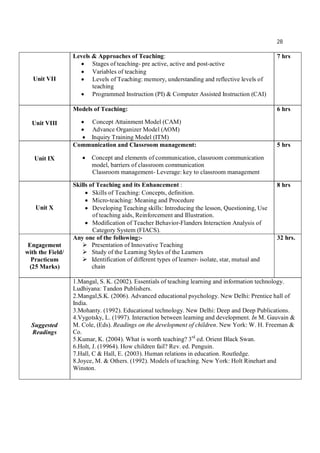
50 100 50+100
(2+4)
32+128
BED3.SI School Internship 300 300(0+12) 416
Total 75 425 500(3+17) 48+576
Full Marks: 500(Credits: 20)
SEMESTER IV
BED4.6 Gender, School and
Society
50 25 50+25
(2+1)
32+32
5
BED4.8B Knowledge and
Curriculum- II
50 25 50+25
(2+1)
32+32
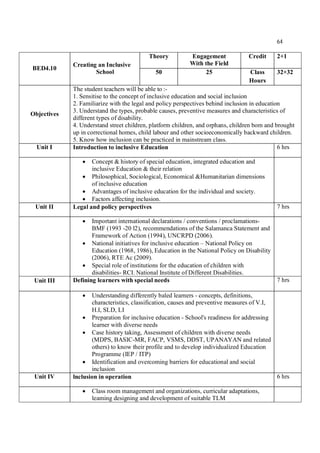
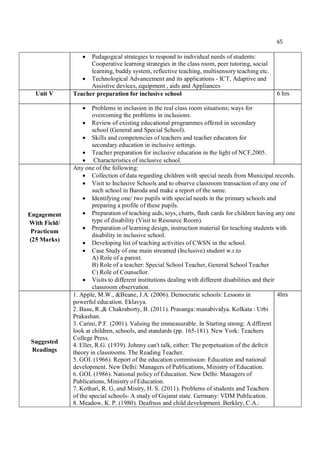
BED4.10 Creating an Inclusive
School
50 25 50+25
(2+1)
32+32
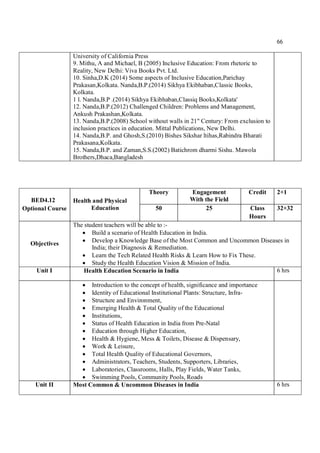
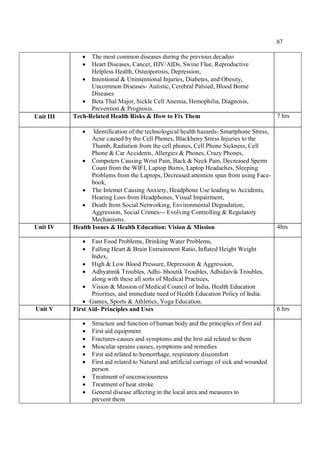
BED4.12 Optional Course** 50 25 50+25
(2+1)
32+32
BED4.EP
C3
Critical Understanding
of ICT
25 75 25+75
(1+3)
16+96
BED4.EP
C4
Understanding the Self 50 50 50+50
(2+2)
32+64
TOTAL 300 200 500(11+9) 176+288
Full Marks: 500(Credit :20)
TOTAL MARKS: 2000 (CREDIT: 80)
Note:
a) *One Optional Course can be from among the following-
 Vocational/Work Education
 Health and Physical Education
 Peace Education
 Guidance and Counseling,
 Environmental and Population Education
 Yoga Education
J
b) Course codes are abbreviated in the following manner:
1st
Digit - Semester
2nd
Digit - Course No.
Example: B.Ed.4.11 - B.Ed.4 (4th
semester). ll (Course No. XI).
 Semester means effective teaching work of l6 weeks excluding admission and semester
end examination period.
 One credit of teaching activities means one hour effective teaching of theory course in
each week for 16 weeks: Total 16 hours teaching per credit.
 One credit for Practicum / Field work / Internship means two hour effective work in each
week for l6 weeks. Total 32 hours of practicum per credit.
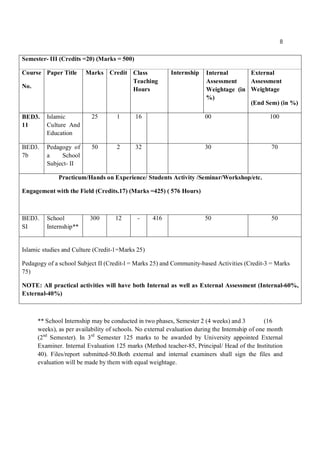
6
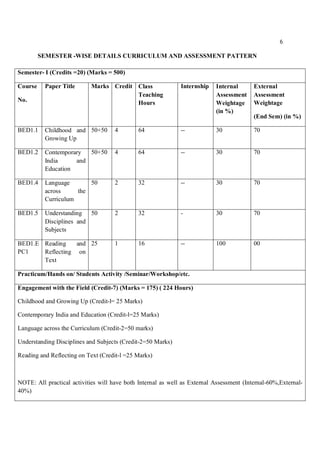
SEMESTER -WISE DETAILS CURRICULUM AND ASSESSMENT PATTERN
Semester- I (Credits =20) (Marks = 500)
Course
No.
Paper Title Marks Credit Class
Teaching
Hours
Internship Internal
Assessment
Weightage
(in %)
External
Assessment
Weightage
(End Sem) (in %)
BED1.1 Childhood and
Growing Up
50+50 4 64 -- 30 70
BED1.2 Contemporary
India and
Education
50+50 4 64 -- 30 70
BED1.4 Language
across the
Curriculum
50 2 32 -- 30 70
BED1.5 Understanding
Disciplines and
Subjects
50 2 32 - 30 70
BED1.E
PC1
Reading and
Reflecting on
Text
25 1 16 -- 100 00
Practicum/Hands on/ Students Activity /Seminar/Workshop/etc.
Engagement with the Field (Credit-7) (Marks = 175) ( 224 Hours)
Childhood and Growing Up (Credit-l= 25 Marks)
Contemporary India and Education (Credit-l=25 Marks)
Language across the Curriculum (Credit-2=50 marks)
Understanding Disciplines and Subjects (Credit-2=50 Marks)
Reading and Reflecting on Text (Credit-l =25 Marks)
NOTE: All practical activities will have both Internal as well as External Assessment (Internal-60%,External-
40%)
7
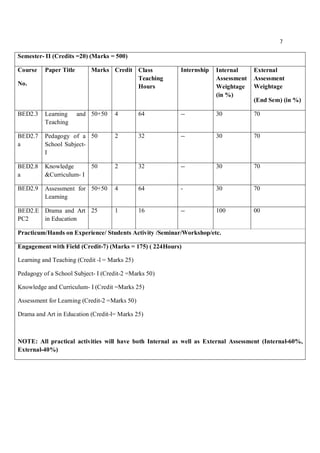
Semester- II (Credits =20) (Marks = 500)
Course
No.
Paper Title Marks Credit Class
Teaching
Hours
Internship Internal
Assessment
Weightage
(in %)
External
Assessment
Weightage
(End Sem) (in %)
BED2.3 Learning and
Teaching
50+50 4 64 -- 30 70
BED2.7
a
Pedagogy of a
School Subject-
I
50 2 32 -- 30 70
BED2.8
a
Knowledge
&Curriculum- I
50 2 32 -- 30 70
BED2.9 Assessment for
Learning
50+50 4 64 - 30 70
BED2.E
PC2
Drama and Art
in Education
25 1 16 -- 100 00
Practicum/Hands on Experience/ Students Activity /Seminar/Workshop/etc.
Engagement with Field (Credit-7) (Marks = 175) ( 224Hours)
Learning and Teaching (Credit -l = Marks 25)
Pedagogy of a School Subject- I (Credit-2 =Marks 50)
Knowledge and Curriculum- I (Credit =Marks 25)
Assessment for Learning (Credit-2 =Marks 50)
Drama and Art in Education (Credit-l= Marks 25)
NOTE: All practical activities will have both Internal as well as External Assessment (Internal-60%,
External-40%)
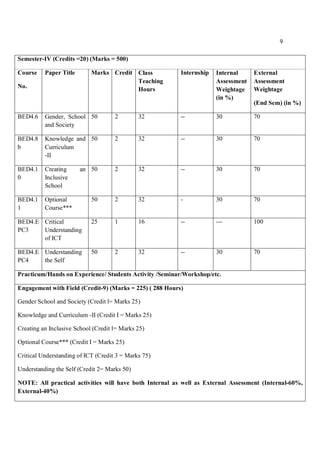
8
** School Internship may be conducted in two phases, Semester 2 (4 weeks) and 3 (16
weeks), as per availability of schools. No external evaluation during the Internship of one month
(2nd
Semester). In 3rd
Semester 125 marks to be awarded by University appointed External
Examiner. Internal Evaluation 125 marks (Method teacher-85, Principal/ Head of the Institution
40). Files/report submitted-50.Both external and internal examiners shall sign the files and
evaluation will be made by them with equal weightage.
Semester- III (Credits =20) (Marks = 500)
Course
No.
Paper Title Marks Credit Class
Teaching
Hours
Internship Internal
Assessment
Weightage (in
%)
External
Assessment
Weightage
(End Sem) (in %)
BED3.
11
Islamic
Culture And
Education
25 1 16 00 100
BED3.
7b
Pedagogy of
a School
Subject- II
50 2 32 30 70
Practicum/Hands on Experience/ Students Activity /Seminar/Workshop/etc.
Engagement with the Field (Credits.17) (Marks =425) ( 576 Hours)
BED3.
SI
School
Internship**
300 12 - 416 50 50
Islamic studies and Culture (Credit-1=Marks 25)
Pedagogy of a school Subject II (Credit-l = Marks 25) and Community-based Activities (Credit-3 = Marks
75)
NOTE: All practical activities will have both Internal as well as External Assessment (Internal-60%,
External-40%)
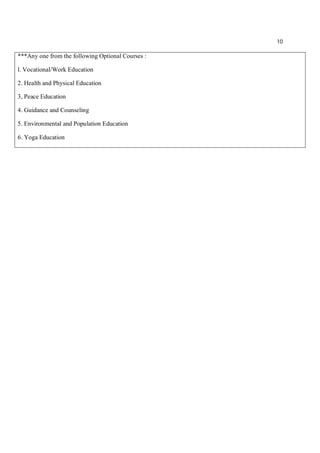
9
Semester-IV (Credits =20) (Marks = 500)
Course
No.
Paper Title Marks Credit Class
Teaching
Hours
Internship Internal
Assessment
Weightage
(in %)
External
Assessment
Weightage
(End Sem) (in %)
BED4.6 Gender, School
and Society
50 2 32 -- 30 70
BED4.8
b
Knowledge and
Curriculum
-II
50 2 32 -- 30 70
BED4.1
0
Creating an
Inclusive
School
50 2 32 -- 30 70
BED4.1
1
Optional
Course***
50 2 32 - 30 70
BED4.E
PC3
Critical
Understanding
of ICT
25 1 16 -- --- 100
BED4.E
PC4
Understanding
the Self
50 2 32 -- 30 70
Practicum/Hands on Experience/ Students Activity /Seminar/Workshop/etc.
Engagement with Field (Credit-9) (Marks = 225) ( 288 Hours)
Gender School and Society (Credit l= Marks 25)
Knowledge and Curriculum -II (Credit I = Marks 25)
Creating an Inclusive School (Credit l= Marks 25)
Optional Course*** (Credit I = Marks 25)
Critical Understanding of ICT (Credit 3 = Marks 75)
Understanding the Self (Credit 2= Marks 50)
NOTE: All practical activities will have both Internal as well as External Assessment (Internal-60%,
External-40%)
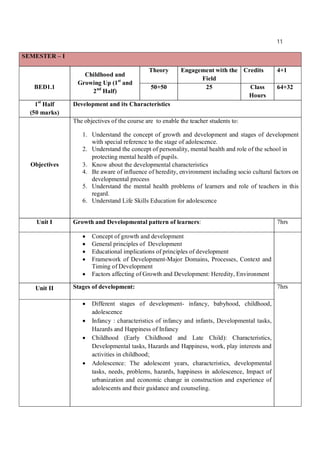
10
***Any one from the following Optional Courses :
l. Vocational/Work Education
2. Health and Physical Education
3, Peace Education
4. Guidance and Counseling
5. Environmental and Population Education
6. Yoga Education
11
SEMESTER – I
BED1.1
Childhood and
Growing Up (1st
and
2nd
Half)
Theory Engagement with the
Field
Credits 4+1
50+50 25 Class
Hours
64+32
1st
Half
(50 marks)
Development and its Characteristics
Objectives
The objectives of the course are to enable the teacher students to:
1. Understand the concept of growth and development and stages of development
with special reference to the stage of adolescence.
2. Understand the concept of personality, mental health and role of the school in
protecting mental health of pupils.
3. Know about the developmental characteristics
4. Be aware of influence of heredity, environment including socio cultural factors on
developmental process
5. Understand the mental health problems of learners and role of teachers in this
regard.
6. Understand Life Skills Education for adolescence
Unit I Growth and Developmental pattern of learners: 7hrs
 Concept of growth and development
 General principles of Development
 Educational implications of principles of development
 Framework of Development-Major Domains, Processes, Context and
Timing of Development
 Factors affecting of Growth and Development: Heredity, Environment
Unit II Stages of development: 7hrs
 Different stages of development- infancy, babyhood, childhood,
adolescence
 Infancy : characteristics of infancy and infants, Developmental tasks,
Hazards and Happiness of Infancy
 Childhood (Early Childhood and Late Child): Characteristics,
Developmental tasks, Hazards and Happiness, work, play interests and
activities in childhood;
 Adolescence: The adolescent years, characteristics, developmental
tasks, needs, problems, hazards, happiness in adolescence, Impact of
urbanization and economic change in construction and experience of
adolescents and their guidance and counseling.
12
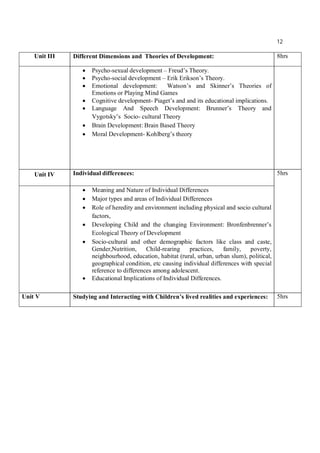
Unit III Different Dimensions and Theories of Development: 8hrs
 Psycho-sexual development – Freud’s Theory.
 Psycho-social development – Erik Erikson’s Theory.
 Emotional development: Watson’s and Skinner’s Theories of
Emotions or Playing Mind Games
 Cognitive development- Piaget’s and and its educational implications.
 Language And Speech Development: Brunner’s Theory and
Vygotsky’s Socio- cultural Theory
 Brain Development: Brain Based Theory
 Moral Development- Kohlberg’s theory
Unit IV Individual differences: 5hrs
 Meaning and Nature of Individual Differences
 Major types and areas of Individual Differences
 Role of heredity and environment including physical and socio cultural
factors,
 Developing Child and the changing Environment: Bronfenbrenner’s
Ecological Theory of Development
 Socio-cultural and other demographic factors like class and caste,
Gender,Nutrition, Child-rearing practices, family, poverty,
neighbourhood, education, habitat (rural, urban, urban slum), political,
geographical condition, etc causing individual differences with special
reference to differences among adolescent.
 Educational Implications of Individual Differences.
Unit V Studying and Interacting with Children’s lived realities and experiences: 5hrs
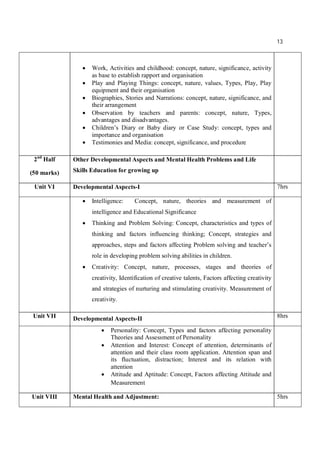
13
 Work, Activities and childhood: concept, nature, significance, activity
as base to establish rapport and organisation
 Play and Playing Things: concept, nature, values, Types, Play, Play
equipment and their organisation
 Biographies, Stories and Narrations: concept, nature, significance, and
their arrangement
 Observation by teachers and parents: concept, nature, Types,
advantages and disadvantages.
 Children’s Diary or Baby diary or Case Study: concept, types and
importance and organisation
 Testimonies and Media: concept, significance, and procedure
2nd
Half
(50 marks)
Other Developmental Aspects and Mental Health Problems and Life
Skills Education for growing up
Unit VI Developmental Aspects-I 7hrs
 Intelligence: Concept, nature, theories and measurement of
intelligence and Educational Significance
 Thinking and Problem Solving: Concept, characteristics and types of
thinking and factors influencing thinking; Concept, strategies and
approaches, steps and factors affecting Problem solving and teacher’s
role in developing problem solving abilities in children.
 Creativity: Concept, nature, processes, stages and theories of
creativity, Identification of creative talents, Factors affecting creativity
and strategies of nurturing and stimulating creativity. Measurement of
creativity.
Unit VII Developmental Aspects-II 8hrs
 Personality: Concept, Types and factors affecting personality
Theories and Assessment of Personality
 Attention and Interest: Concept of attention, determinants of
attention and their class room application. Attention span and
its fluctuation, distraction; Interest and its relation with
attention
 Attitude and Aptitude: Concept, Factors affecting Attitude and
Measurement
Unit VIII Mental Health and Adjustment: 5hrs
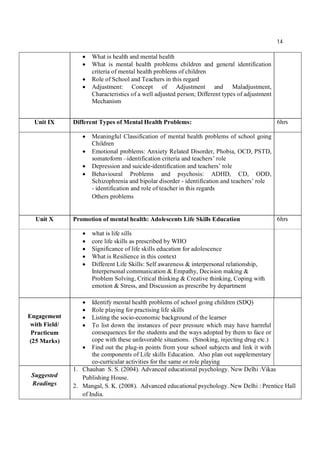
14
 What is health and mental health
 What is mental health problems children and general identification
criteria of mental health problems of children
 Role of School and Teachers in this regard
 Adjustment: Concept of Adjustment and Maladjustment,
Characteristics of a well adjusted person; Different types of adjustment
Mechanism
Unit IX Different Types of Mental Health Problems: 6hrs
 Meaningful Classification of mental health problems of school going
Children
 Emotional problems: Anxiety Related Disorder, Phobia, OCD, PSTD,
somatoform –identification criteria and teachers’ role
 Depression and suicide-identification and teachers’ role
 Behavioural Problems and psychosis: ADHD, CD, ODD,
Schizophrenia and bipolar disorder - identification and teachers’ role
- identification and role of teacher in this regards
Others problems
Unit X Promotion of mental health: Adolescents Life Skills Education 6hrs
 what is life sills
 core life skills as prescribed by WHO
 Significance of life skills education for adolescence
 What is Resilience in this context
 Different Life Skills: Self awareness & interpersonal relationship,
Interpersonal communication & Empathy, Decision making &
Problem Solving, Critical thinking & Creative thinking, Coping with
emotion & Stress, and Discussion as prescribe by department
Engagement
with Field/
Practicum
(25 Marks)
 Identify mental health problems of school going children (SDQ)
 Role playing for practising life skills
 Listing the socio-economic background of the learner
 To list down the instances of peer pressure which may have harmful
consequences for the students and the ways adopted by them to face or
cope with these unfavorable situations. (Smoking, injecting drug etc.)
 Find out the plug-in points from your school subjects and link it with
the components of Life skills Education. Also plan out supplementary
co-curricular activities for the same or role playing
Suggested
Readings
1. Chauhan S. S. (2004). Advanced educational psychology. New Delhi :Vikas
Publishing House.
2. Mangal, S. K. (2008). Advanced educational psychology. New Delhi : Prentice Hall
of India.
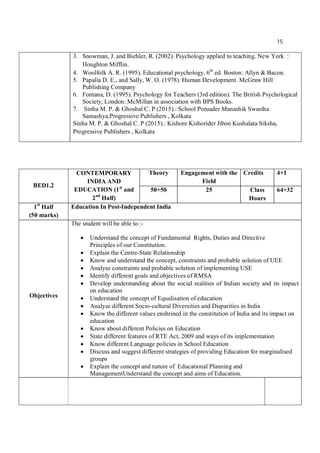
15
3. Snowman, J. and Biehler, R. (2002). Psychology applied to teaching. New York :
Houghton Mifflin.
4. Woolfolk A. R. (1995). Educational psychology. 6th
ed. Boston: Allyn & Bacon.
5. Papalia D. E., and Sally, W. O. (1978). Human Development. McGraw Hill
Publishing Company
6. Fontana, D. (1995). Psychology for Teachers (3rd edition). The British Psychological
Society, London: McMillan in association with BPS Books.
7. Sinha M. P. & Ghoshal C. P (2015).: School Poruader Manashik Swastha
Samashya,Progressive Publishers , Kolkata
Sinha M. P. & Ghoshal C. P (2015).: Kishore Kishorider Jibon Kushalata Siksha,
Progressive Publishers , Kolkata
BED1.2
CONTEMPORARY
INDIA AND
EDUCATION (1st
and
2nd
Half)
Theory Engagement with the
Field
Credits 4+1
50+50 25 Class
Hours
64+32
1st
Half
(50 marks)
Education In Post-Independent India
Objectives
The student will be able to :-
 Understand the concept of Fundamental Rights, Duties and Directive
Principles of our Constitution.
 Explain the Centre-State Relationship
 Know and understand the concept, constraints and probable solution of UEE
 Analyse constraints and probable solution of implementing USE
 Identify different goals and objectives of RMSA
 Develop understanding about the social realities of Indian society and its impact
on education
 Understand the concept of Equalisation of education
 Analyse different Socio-cultural Diversities and Disparities in India
 Know the different values enshrined in the constitution of India and its impact on
education
 Know about different Policies on Education
 State different features of RTE Act, 2009 and ways of its implementation
 Know different Language policies in School Education
 Discuss and suggest different strategies of providing Education for marginalised
groups
 Explain the concept and nature of Educational Planning and
ManagementUnderstand the concept and aims of Education.
16
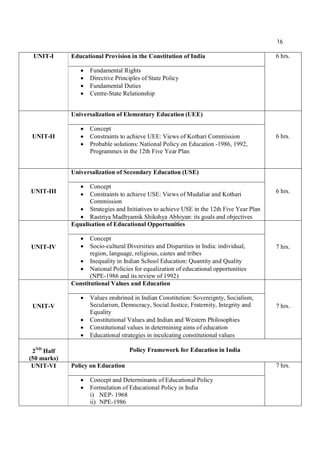
UNIT-I Educational Provision in the Constitution of India 6 hrs.
 Fundamental Rights
 Directive Principles of State Policy
 Fundamental Duties
 Centre-State Relationship
UNIT-II
Universalization of Elementary Education (UEE)
6 hrs.
 Concept
 Constraints to achieve UEE: Views of Kothari Commission
 Probable solutions: National Policy on Education -1986, 1992,
Programmes in the 12th Five Year Plan
UNIT-III
Universalization of Secondary Education (USE)
6 hrs.
 Concept
 Constraints to achieve USE: Views of Mudaliar and Kothari
Commission
 Strategies and Initiatives to achieve USE in the 12th Five Year Plan
 Rastriya Madhyamik Shikshya Abhiyan: its goals and objectives
UNIT-IV
Equalisation of Educational Opportunities
7 hrs.
 Concept
 Socio-cultural Diversities and Disparities in India: individual,
region, language, religious, castes and tribes
 Inequality in Indian School Education: Quantity and Quality
 National Policies for equalization of educational opportunities
(NPE-1986 and its review of 1992)
UNIT-V
Constitutional Values and Education
7 hrs.
 Values enshrined in Indian Constitution: Sovereignty, Socialism,
Secularism, Democracy, Social Justice, Fraternity, Integrity and
Equality
 Constitutional Values and Indian and Western Philosophies
 Constitutional values in determining aims of education
 Educational strategies in inculcating constitutional values
2ND
Half
(50 marks)
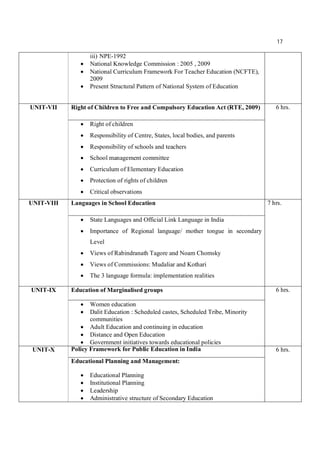
Policy Framework for Education in India
UNIT-VI Policy on Education 7 hrs.
 Concept and Determinants of Educational Policy
 Formulation of Educational Policy in India
i) NEP- 1968
ii) NPE-1986
17
iii) NPE-1992
 National Knowledge Commission : 2005 , 2009
 National Curriculum Framework For Teacher Education (NCFTE),
2009
 Present Structural Pattern of National System of Education
UNIT-VII Right of Children to Free and Compulsory Education Act (RTE, 2009) 6 hrs.
 Right of children
 Responsibility of Centre, States, local bodies, and parents
 Responsibility of schools and teachers
 School management committee
 Curriculum of Elementary Education
 Protection of rights of children
 Critical observations
UNIT-VIII Languages in School Education 7 hrs.
 State Languages and Official Link Language in India
 Importance of Regional language/ mother tongue in secondary
Level
 Views of Rabindranath Tagore and Noam Chomsky
 Views of Commissions: Mudaliar and Kothari
 The 3 language formula: implementation realities
UNIT-IX Education of Marginalised groups 6 hrs.
 Women education
 Dalit Education : Scheduled castes, Scheduled Tribe, Minority
communities
 Adult Education and continuing in education
 Distance and Open Education
 Government initiatives towards educational policies
UNIT-X Policy Framework for Public Education in India 6 hrs.
Educational Planning and Management:
 Educational Planning
 Institutional Planning
 Leadership
 Administrative structure of Secondary Education
18
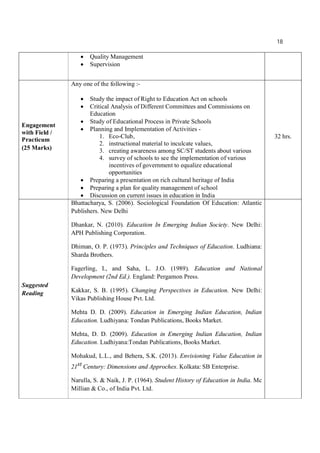
 Quality Management
 Supervision
Engagement
with Field /
Practicum
(25 Marks)
Any one of the following :-
 Study the impact of Right to Education Act on schools
 Critical Analysis of Different Committees and Commissions on
Education
 Study of Educational Process in Private Schools
 Planning and Implementation of Activities -
1. Eco-Club,
2. instructional material to inculcate values,
3. creating awareness among SC/ST students about various
4. survey of schools to see the implementation of various
incentives of government to equalize educational
opportunities
 Preparing a presentation on rich cultural heritage of India
 Preparing a plan for quality management of school
 Discussion on current issues in education in India
32 hrs.
Suggested
Reading
Bhattacharya, S. (2006). Sociological Foundation Of Education: Atlantic
Publishers. New Delhi
Dhankar, N. (2010). Education In Emerging Indian Society. New Delhi:
APH Publishing Corporation.
Dhiman, O. P. (1973). Principles and Techniques of Education. Ludhiana:
Sharda Brothers.
Fagerling, I., and Saha, L. J.O. (1989). Education and National
Development (2nd Ed.). England: Pergamon Press.
Kakkar, S. B. (1995). Changing Perspectives in Education. New Delhi:
Vikas Publishing House Pvt. Ltd.
Mehta D. D. (2009). Education in Emerging Indian Education, Indian
Education. Ludhiyana: Tondan Publications, Books Market.
Mehta, D. D. (2009). Education in Emerging Indian Education, Indian
Education. Ludhiyana:Tondan Publications, Books Market.
Mohakud, L.L., and Behera, S.K. (2013). Envisioning Value Education in
21st Century: Dimensions and Approches. Kolkata: SB Enterprise.
Narulla, S. & Naik, J. P. (1964). Student History of Education in India. Mc
Millian & Co., of India Pvt. Ltd.
19
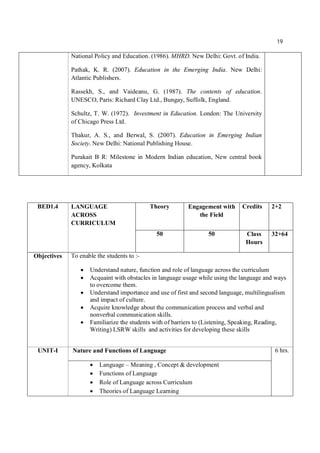
National Policy and Education. (1986). MHRD. New Delhi: Govt. of India.
Pathak, K. R. (2007). Education in the Emerging India. New Delhi:
Atlantic Publishers.
Rassekh, S., and Vaideanu, G. (1987). The contents of education.
UNESCO, Paris: Richard Clay Ltd., Bungay, Suffolk, England.
Schultz, T. W. (1972). Investment in Education. London: The University
of Chicago Press Ltd.
Thakur, A. S., and Berwal, S. (2007). Education in Emerging Indian
Society. New Delhi: National Publishing House.
Purakait B R: Milestone in Modern Indian education, New central book
agency, Kolkata
BED1.4 LANGUAGE
ACROSS
CURRICULUM
Theory Engagement with
the Field
Credits 2+2
50 50 Class
Hours
32+64
Objectives To enable the students to :-
 Understand nature, function and role of language across the curriculum
 Acquaint with obstacles in language usage while using the language and ways
to overcome them.
 Understand importance and use of first and second language, multilingualism
and impact of culture.
 Acquire knowledge about the communication process and verbal and
nonverbal communication skills.
 Familiarize the students with of barriers to (Listening, Speaking, Reading,
Writing) LSRW skills and activities for developing these skills
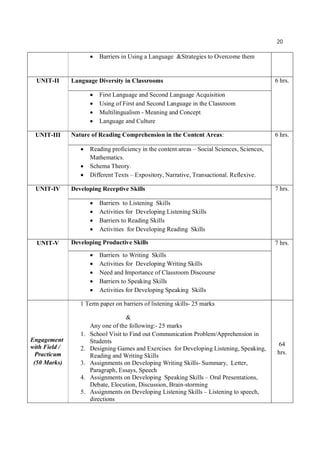
UNIT-I Nature and Functions of Language 6 hrs.
 Language – Meaning , Concept & development
 Functions of Language
 Role of Language across Curriculum
 Theories of Language Learning
20
 Barriers in Using a Language &Strategies to Overcome them
UNIT-II Language Diversity in Classrooms 6 hrs.
 First Language and Second Language Acquisition
 Using of First and Second Language in the Classroom
 Multilingualism - Meaning and Concept
 Language and Culture
UNIT-III Nature of Reading Comprehension in the Content Areas: 6 hrs.
 Reading proficiency in the content areas – Social Sciences, Sciences,
Mathematics.
 Schema Theory.
 Different Texts – Expository, Narrative, Transactional. Reflexive.
UNIT-IV Developing Receptive Skills 7 hrs.
 Barriers to Listening Skills
 Activities for Developing Listening Skills
 Barriers to Reading Skills
 Activities for Developing Reading Skills
UNIT-V Developing Productive Skills 7 hrs.
 Barriers to Writing Skills
 Activities for Developing Writing Skills
 Need and Importance of Classroom Discourse
 Barriers to Speaking Skills
 Activities for Developing Speaking Skills
Engagement
with Field /
Practicum
(50 Marks)
1 Term paper on barriers of listening skills- 25 marks
&
Any one of the following:- 25 marks
1. School Visit to Find out Communication Problem/Apprehension in
Students
2. Designing Games and Exercises for Developing Listening, Speaking,
Reading and Writing Skills
3. Assignments on Developing Writing Skills- Summary, Letter,
Paragraph, Essays, Speech
4. Assignments on Developing Speaking Skills – Oral Presentations,
Debate, Elocution, Discussion, Brain-storming
5. Assignments on Developing Listening Skills – Listening to speech,
directions
64
hrs.
21
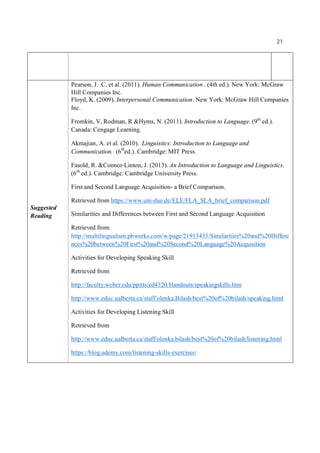
Suggested
Reading
Pearson, J. .C. et al. (2011). Human Communication . (4th ed.). New York: McGraw
Hill Companies Inc.
Floyd, K. (2009). Interpersonal Communication. New York: McGraw Hill Companies
Inc.
Fromkin, V, Rodman, R &Hyms, N. (2011). Introduction to Language. (9th
ed.).
Canada: Cengage Learning.
Akmajian, A. et al. (2010). Linguistics: Introduction to Language and
Communication. (6th
ed.). Cambridge: MIT Press.
Fasold, R. &Connor-Linton, J. (2013). An Introduction to Language and Linguistics.
(6th
ed.). Cambridge: Cambridge University Press.
First and Second Language Acquisition- a Brief Comparison.
Retrieved from https://www.uni-due.de/ELE/FLA_SLA_brief_comparison.pdf
Similarities and Differences between First and Second Language Acquisition
Retrieved from
http://multilingualism.pbworks.com/w/page/21913433/Similarities%20and%20Differe
nces%20between%20First%20and%20Second%20Language%20Acquisition
Activities for Developing Speaking Skill
Retrieved from
http://faculty.weber.edu/ppitts/ed4320/Handouts/speakingskills.htm
http://www.educ.ualberta.ca/staff/olenka.Bilash/best%20of%20bilash/speaking.html
Activities for Developing Listening Skill
Retrieved from
http://www.educ.ualberta.ca/staff/olenka.bilash/best%20of%20bilash/listening.html
https://blog.udemy.com/listening-skills-exercises/
22
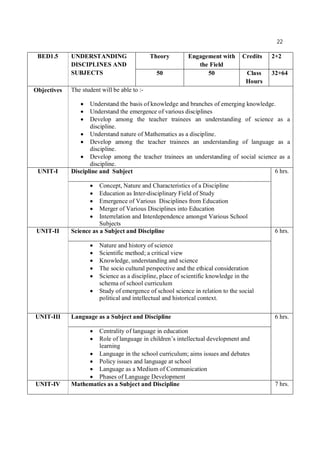
BED1.5 UNDERSTANDING
DISCIPLINES AND
SUBJECTS
Theory Engagement with
the Field
Credits 2+2
50 50 Class
Hours
32+64
Objectives The student will be able to :-
 Understand the basis of knowledge and branches of emerging knowledge.
 Understand the emergence of various disciplines
 Develop among the teacher trainees an understanding of science as a
discipline.
 Understand nature of Mathematics as a discipline.
 Develop among the teacher trainees an understanding of language as a
discipline.
 Develop among the teacher trainees an understanding of social science as a
discipline.
UNIT-I Discipline and Subject 6 hrs.
 Concept, Nature and Characteristics of a Discipline
 Education as Inter-disciplinary Field of Study
 Emergence of Various Disciplines from Education
 Merger of Various Disciplines into Education
 Interrelation and Interdependence amongst Various School
Subjects
UNIT-II Science as a Subject and Discipline 6 hrs.
 Nature and history of science
 Scientific method; a critical view
 Knowledge, understanding and science
 The socio cultural perspective and the ethical consideration
 Science as a discipline, place of scientific knowledge in the
schema of school curriculum
 Study of emergence of school science in relation to the social
political and intellectual and historical context.
UNIT-III Language as a Subject and Discipline 6 hrs.
 Centrality of language in education
 Role of language in children’s intellectual development and
learning
 Language in the school curriculum; aims issues and debates
 Policy issues and language at school
 Language as a Medium of Communication
 Phases of Language Development
UNIT-IV Mathematics as a Subject and Discipline 7 hrs.
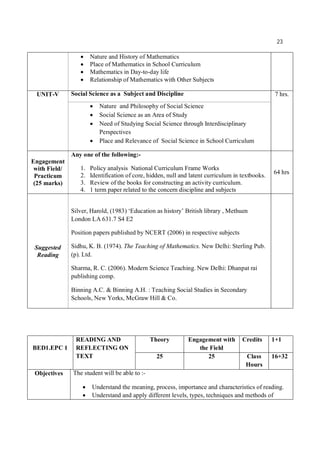
23
 Nature and History of Mathematics
 Place of Mathematics in School Curriculum
 Mathematics in Day-to-day life
 Relationship of Mathematics with Other Subjects
UNIT-V Social Science as a Subject and Discipline 7 hrs.
 Nature and Philosophy of Social Science
 Social Science as an Area of Study
 Need of Studying Social Science through Interdisciplinary
Perspectives
 Place and Relevance of Social Science in School Curriculum
Engagement
with Field/
Practicum
(25 marks)
Any one of the following:-
1. Policy analysis National Curriculum Frame Works
2. Identification of core, hidden, null and latent curriculum in textbooks.
3. Review of the books for constructing an activity curriculum.
4. 1 term paper related to the concern discipline and subjects
64 hrs
Suggested
Reading
Silver, Harold, (1983) ‘Education as history’ British library , Methuen
London LA 631.7 S4 E2
Position papers published by NCERT (2006) in respective subjects
Sidhu, K. B. (1974). The Teaching of Mathematics. New Delhi: Sterling Pub.
(p). Ltd.
Sharma, R. C. (2006). Modern Science Teaching. New Delhi: Dhanpat rai
publishing comp.
Binning A.C. & Binning A.H. : Teaching Social Studies in Secondary
Schools, New Yorks, McGraw Hill & Co.
BED1.EPC 1
READING AND
REFLECTING ON
TEXT
Theory Engagement with
the Field
Credits 1+1
25 25 Class
Hours
16+32
Objectives The student will be able to :-
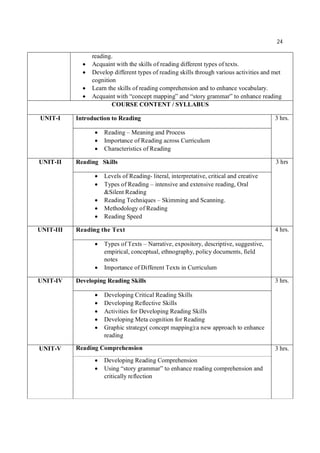
 Understand the meaning, process, importance and characteristics of reading.
 Understand and apply different levels, types, techniques and methods of
24
reading.
 Acquaint with the skills of reading different types of texts.
 Develop different types of reading skills through various activities and met
cognition
 Learn the skills of reading comprehension and to enhance vocabulary.
 Acquaint with “concept mapping” and “story grammar” to enhance reading
COURSE CONTENT / SYLLABUS
UNIT-I Introduction to Reading 3 hrs.
 Reading – Meaning and Process
 Importance of Reading across Curriculum
 Characteristics of Reading
UNIT-II Reading Skills 3 hrs
 Levels of Reading- literal, interpretative, critical and creative
 Types of Reading – intensive and extensive reading, Oral
&Silent Reading
 Reading Techniques – Skimming and Scanning.
 Methodology of Reading
 Reading Speed
UNIT-III Reading the Text 4 hrs.
 Types of Texts – Narrative, expository, descriptive, suggestive,
empirical, conceptual, ethnography, policy documents, field
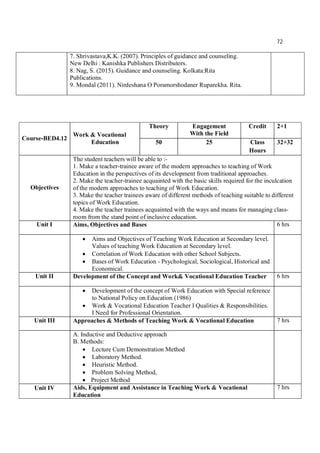
notes
 Importance of Different Texts in Curriculum
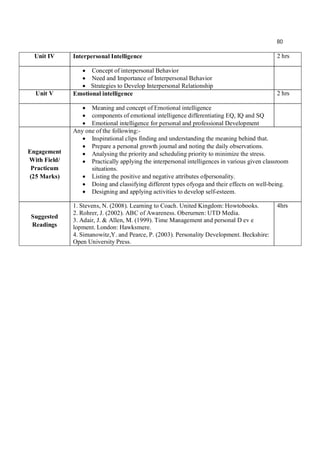
UNIT-IV Developing Reading Skills 3 hrs.
 Developing Critical Reading Skills
 Developing Reflective Skills
 Activities for Developing Reading Skills
 Developing Meta cognition for Reading
 Graphic strategy( concept mapping):a new approach to enhance
reading
UNIT-V Reading Comprehension 3 hrs.
 Developing Reading Comprehension
 Using “story grammar” to enhance reading comprehension and
critically reflection
25
Engagement
with Field/
Practicum (25
Marks)
(no end
semester
examination)
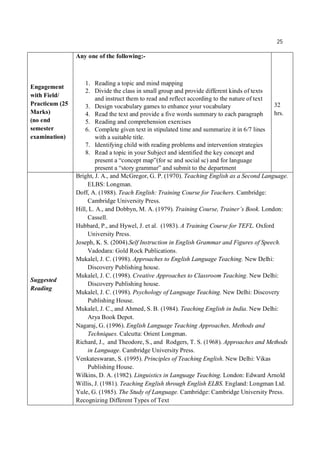
Any one of the following:-
1. Reading a topic and mind mapping
2. Divide the class in small group and provide different kinds of texts
and instruct them to read and reflect according to the nature of text
3. Design vocabulary games to enhance your vocabulary
4. Read the text and provide a five words summary to each paragraph
5. Reading and comprehension exercises
6. Complete given text in stipulated time and summarize it in 6/7 lines
with a suitable title.
7. Identifying child with reading problems and intervention strategies
8. Read a topic in your Subject and identified the key concept and
present a “concept map”(for sc and social sc) and for language
present a “story grammar” and submit to the department
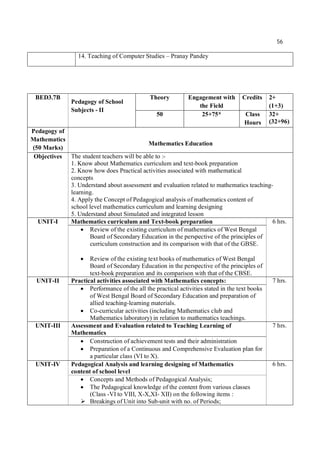
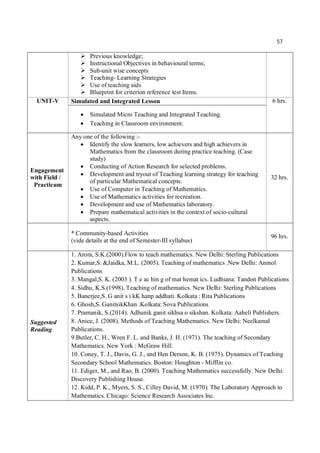
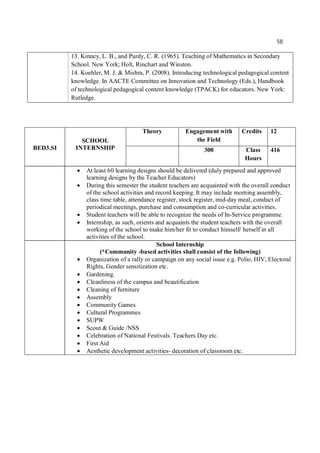
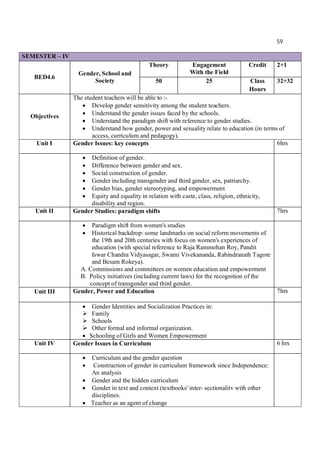
32
hrs.
Suggested
Reading
Bright, J. A., and McGregor, G. P. (1970). Teaching English as a Second Language.
ELBS: Longman.
Doff, A. (1988). Teach English: Training Course for Teachers. Cambridge:
Cambridge University Press.
Hill, L. A., and Dobbyn, M. A. (1979). Training Course, Trainer’s Book. London:
Cassell.
Hubbard, P., and Hywel, J. et al. (1983). A Training Course for TEFL. Oxford
University Press.
Joseph, K. S. (2004).Self Instruction in English Grammar and Figures of Speech.
Vadodara: Gold Rock Publications.
Mukalel, J. C. (1998). Approaches to English Language Teaching. New Delhi:
Discovery Publishing house.
Mukalel, J. C. (1998). Creative Approaches to Classroom Teaching. New Delhi:
Discovery Publishing house.
Mukalel, J. C. (1998). Psychology of Language Teaching. New Delhi: Discovery
Publishing House.
Mukalel, J. C., and Ahmed, S. B. (1984). Teaching English in India. New Delhi:
Arya Book Depot.
Nagaraj, G. (1996). English Language Teaching Approaches, Methods and
Techniques. Calcutta: Orient Longman.
Richard, J., and Theodore, S., and Rodgers, T. S. (1968). Approaches and Methods
in Language. Cambridge University Press.
Venkateswaran, S. (1995). Principles of Teaching English. New Delhi: Vikas
Publishing House.
Wilkins, D. A. (1982). Linguistics in Language Teaching. London: Edward Arnold
Willis, J. (1981). Teaching English through English ELBS. England: Longman Ltd.
Yule, G. (1985). The Study of Language. Cambridge: Cambridge University Press.
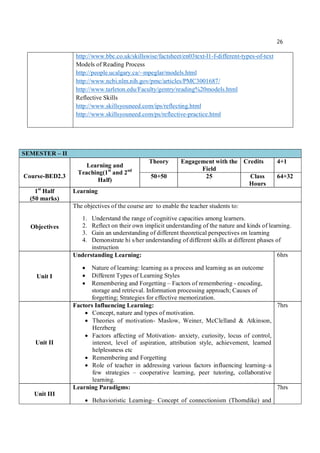
Recognizing Different Types of Text
26
http://www.bbc.co.uk/skillswise/factsheet/en03text-l1-f-different-types-of-text
Models of Reading Process
http://people.ucalgary.ca/~mpeglar/models.html
http://www.ncbi.nlm.nih.gov/pmc/articles/PMC3001687/
http://www.tarleton.edu/Faculty/gentry/reading%20models.html
Reflective Skills
http://www.skillsyouneed.com/ips/reflecting.html
http://www.skillsyouneed.com/ps/reflective-practice.html
SEMESTER – II
Course-BED2.3
Learning and
Teaching(1st
and 2nd
Half)
Theory Engagement with the
Field
Credits 4+1
50+50 25 Class
Hours
64+32
1st
Half
(50 marks)
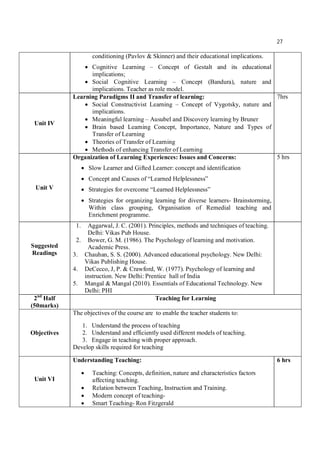
Learning
Objectives
The objectives of the course are to enable the teacher students to:
1. Understand the range of cognitive capacities among learners.
2. Reflect on their own implicit understanding of the nature and kinds of learning.
3. Gain an understanding of different theoretical perspectives on learning
4. Demonstrate hi s/her understanding of different skills at different phases of
instruction
Unit I
Understanding Learning:
 Nature of learning: learning as a process and learning as an outcome
 Different Types of Learning Styles
 Remembering and Forgetting – Factors of remembering - encoding,
storage and retrieval. Information processing approach; Causes of
forgetting; Strategies for effective memorization.
6hrs
Unit II
Factors Influencing Learning:
 Concept, nature and types of motivation.
 Theories of motivation- Maslow, Weiner, McClelland & Atkinson,
Herzberg
 Factors affecting of Motivation- anxiety, curiosity, locus of control,
interest, level of aspiration, attribution style, achievement, learned
helplessness etc
 Remembering and Forgetting
 Role of teacher in addressing various factors influencing learning–a
few strategies – cooperative learning, peer tutoring, collaborative
learning.
7hrs
Unit III
Learning Paradigms:
 Behavioristic Learning– Concept of connectionism (Thorndike) and
7hrs
27
conditioning (Pavlov & Skinner) and their educational implications.
 Cognitive Learning – Concept of Gestalt and its educational
implications;
 Social Cognitive Learning – Concept (Bandura), nature and
implications. Teacher as role model.
Unit IV
Learning Paradigms II and Transfer of learning:
 Social Constructivist Learning – Concept of Vygotsky, nature and
implications.
 Meaningful learning – Ausubel and Discovery learning by Bruner
 Brain based Learning Concept, Importance, Nature and Types of
Transfer of Learning
 Theories of Transfer of Learning
 Methods of enhancing Transfer of Learning
7hrs
Unit V
Organization of Learning Experiences: Issues and Concerns:
 Slow Learner and Gifted Learner: concept and identification
 Concept and Causes of “Learned Helplessness”
 Strategies for overcome “Learned Helplessness”
 Strategies for organizing learning for diverse learners- Brainstorming,
Within class grouping, Organisation of Remedial teaching and
Enrichment programme.
5 hrs
Suggested
Readings
1. Aggarwal, J. C. (2001). Principles, methods and techniques of teaching.
Delhi: Vikas Pub House.
2. Bower, G. M. (1986). The Psychology of learning and motivation.
Academic Press.
3. Chauhan, S. S. (2000). Advanced educational psychology. New Delhi:
Vikas Publishing House.
4. DeCecco, J, P. & Crawford, W. (1977). Psychology of learning and
instruction. New Delhi: Prentice hall of India
5. Mangal & Mangal (2010). Essentials of Educational Technology. New
Delhi: PHI
2nd
Half
(50marks)
Teaching for Learning
Objectives
The objectives of the course are to enable the teacher students to:
1. Understand the process of teaching
2. Understand and efficiently used different models of teaching.
3. Engage in teaching with proper approach.
Develop skills required for teaching
Unit VI
Understanding Teaching:
 Teaching: Concepts, definition, nature and characteristics factors
affecting teaching.
 Relation between Teaching, Instruction and Training.
 Modern concept of teaching-
 Smart Teaching- Ron Fitzgerald
6 hrs
28
Unit VII
Levels & Approaches of Teaching:
 Stages of teaching- pre active, active and post-active
 Variables of teaching
 Levels of Teaching: memory, understanding and reflective levels of
teaching
 Programmed Instruction (PI) & Computer Assisted Instruction (CAI)
7 hrs
Unit VIII
Models of Teaching:
 Concept Attainment Model (CAM)
 Advance Organizer Model (AOM)
 Inquiry Training Model (ITM)
6 hrs
Unit IX
Communication and Classroom management:
 Concept and elements of communication, classroom communication
model, barriers of classroom communication
Classroom management- Leverage: key to classroom management
5 hrs
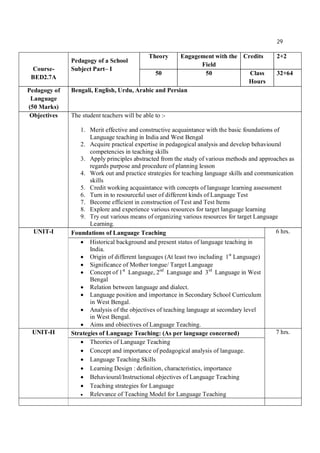
Unit X
Skills of Teaching and its Enhancement :
 Skills of Teaching: Concepts, definition.
 Micro-teaching: Meaning and Procedure
 Developing Teaching skills: Introducing the lesson, Questioning, Use
of teaching aids, Reinforcement and Illustration.
 Modification of Teacher Behavior-Flanders Interaction Analysis of
Category System (FIACS).
8 hrs
Engagement
with the Field/
Practicum
(25 Marks)
Any one of the following:-
 Presentation of Innovative Teaching
 Study of the Learning Styles of the Learners
 Identification of different types of learner- isolate, star, mutual and
chain
32 hrs.
Suggested
Readings
1.Mangal, S. K. (2002). Essentials of teaching learning and information technology.
Ludhiyana: Tandon Publishers.
2.Mangal,S.K. (2006). Advanced educational psychology. New Delhi: Prentice hall of
India.
3.Mohanty. (1992). Educational technology. New Delhi: Deep and Deep Publications.
4.Vygotsky, L. (1997). Interaction between learning and development. In M. Gauvain &
M. Cole, (Eds). Readings on the development of children. New York: W. H. Freeman &
Co.
5.Kumar, K. (2004). What is worth teaching? 3rd
ed. Orient Black Swan.
6.Holt, J. (19964). How children fail? Rev. ed. Penguin.
7.Hall, C & Hall, E. (2003). Human relations in education. Routledge.
8.Joyce, M. & Others. (1992). Models of teaching. New York: Holt Rinehart and
Winston.
29
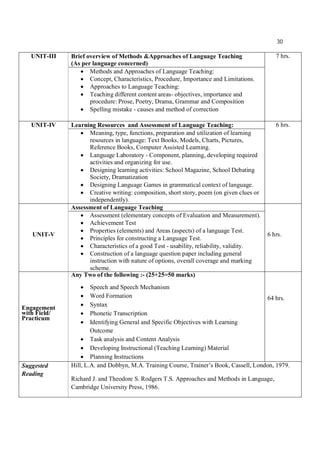
Course-
BED2.7A
Pedagogy of a School
Subject Part– I
Theory Engagement with the
Field
Credits 2+2
50 50 Class
Hours
32+64
Pedagogy of
Language
(50 Marks)
Bengali, English, Urdu, Arabic and Persian
Objectives The student teachers will be able to :-
1. Merit effective and constructive acquaintance with the basic foundations of
Language teaching in India and West Bengal
2. Acquire practical expertise in pedagogical analysis and develop behavioural
competencies in teaching skills
3. Apply principles abstracted from the study of various methods and approaches as
regards purpose and procedure of planning lesson
4. Work out and practice strategies for teaching language skills and communication
skills
5. Credit working acquaintance with concepts of language learning assessment
6. Turn in to resourceful user of different kinds of Language Test
7. Become efficient in construction of Test and Test Items
8. Explore and experience various resources for target language learning
9. Try out various means of organizing various resources for target Language
Learning.
UNIT-I Foundations of Language Teaching 6 hrs.
 Historical background and present status of language teaching in
India.
 Origin of different languages (At least two including 1st
Language)
 Significance of Mother tongue/ Target Language
 Concept of 1st
Language, 2nd
Language and 3rd
Language in West
Bengal
 Relation between language and dialect.
 Language position and importance in Secondary School Curriculum
in West Bengal.
 Analysis of the objectives of teaching language at secondary level
in West Bengal.
 Aims and obiectives of Language Teaching.
UNIT-II Strategies of Language Teaching: (As per language concerned) 7 hrs.
 Theories of Language Teaching
 Concept and importance of pedagogical analysis of language.
 Language Teaching Skills
 Learning Design : definition, characteristics, importance
 Behavioural/Instructional objectives of Language Teaching
 Teaching strategies for Language
 Relevance of Teaching Model for Language Teaching
30
UNIT-III Brief overview of Methods &Approaches of Language Teaching
(As per language concerned)
7 hrs.
 Methods and Approaches of Language Teaching:
 Concept, Characteristics, Procedure, Importance and Limitations.
 Approaches to Language Teaching:
 Teaching different content areas- objectives, importance and
procedure: Prose, Poetry, Drama, Grammar and Composition
 Spelling mistake - causes and method of correction
UNIT-IV Learning Resources and Assessment of Language Teaching: 6 hrs.
 Meaning, type, functions, preparation and utilization of learning
resources in language: Text Books, Models, Charts, Pictures,
Reference Books, Computer Assisted Learning.
 Language Laboratory - Component, planning, developing required
activities and organizing for use.
 Designing learning activities: School Magazine, School Debating
Society, Dramatization
 Designing Language Games in grammatical context of language.
 Creative writing: composition, short story, poem (on given clues or
independently).
UNIT-V
Assessment of Language Teaching
6 hrs.
 Assessment (elementary concepts of Evaluation and Measurement).
 Achievement Test
 Properties (elements) and Areas (aspects) of a language Test.
 Principles for constructing a Language Test.
 Characteristics of a good Test - usability, reliability, validity.
 Construction of a language question paper including general
instruction with nature of options, overall coverage and marking
scheme.
Engagement
with Field/
Practicum
Any Two of the following :- (25+25=50 marks)
 Speech and Speech Mechanism
 Word Formation
 Syntax
 Phonetic Transcription
 Identifying General and Specific Objectives with Learning
Outcome
 Task analysis and Content Analysis
 Developing Instructional (Teaching Learning) Material
 Planning Instructions
64 hrs.
Suggested
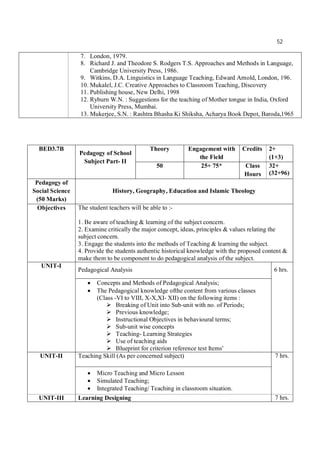
Reading
Hill, L.A. and Dobbyn, M.A. Training Course, Trainer’s Book, Cassell, London, 1979.
Richard J. and Theodore S. Rodgers T.S. Approaches and Methods in Language,
Cambridge University Press, 1986.
31
Wilkins, D.A. Linguistics in Language Teaching, Edward Arnold, London, 1982.
Mukalel, J.C. Creative Approaches to Classroom Teaching, Discovery Publishing house,
New Delhi, 1998
Ryburn W.N. : Suggestions for the teaching of Mother tongue in India, Oxford University
Press, Mumbai.
Mukerjee, S.N. : Rashtra Bhasha Ki Shiksha, Acharya Book Depot, Baroda, 1965.
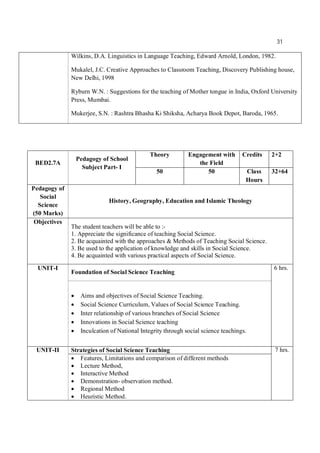
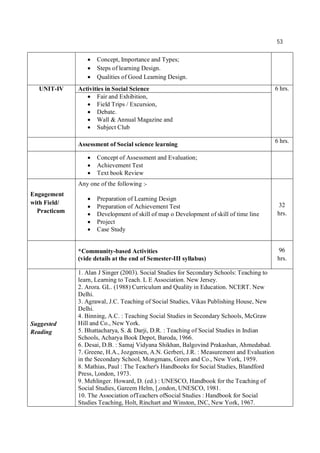
BED2.7A
Pedagogy of School
Subject Part- I
Theory Engagement with
the Field
Credits 2+2
50 50 Class
Hours
32+64
Pedagogy of
Social
Science
(50 Marks)
History, Geography, Education and Islamic Theology
Objectives
The student teachers will be able to :-
1. Appreciate the significance of teaching Social Science.
2. Be acquainted with the approaches & Methods of Teaching Social Science.
3. Be used to the application of knowledge and skills in Social Science.
4. Be acquainted with various practical aspects of Social Science.
UNIT-I
Foundation of Social Science Teaching
6 hrs.
 Aims and objectives of Social Science Teaching.
 Social Science Curriculum, Values of Social Science Teaching.
 Inter relationship of various branches of Social Science
 Innovations in Social Science teaching
 Inculcation of National Integrity through social science teachings.
UNIT-II Strategies of Social Science Teaching 7 hrs.
 Features, Limitations and comparison of different methods
 Lecture Method,
 Interactive Method
 Demonstration- observation method.
 Regional Method
 Heuristic Method.
32
 Project Method
 CA
UNIT-III Learning Resource in Social Science Teaching 6 hrs.
 Meaning, type and importance of Learning Resources.
 Quality of good social science text book.
 Teaching aids in Social Science.
 Improvisation of Teaching Aids.
 Planning and organization of Social Science Laboratory
UNIT-IV Social Science Teacher 6 hrs.
 Qualifications and qualities of social science Teachers.
 Professional growth of Social Science Teacher.
Evaluation in Social Science Education
7 hrs.
 Evaluation devices, evaluation programme in social studies
 Competency based evaluation, continuous and comprehensive evaluation;
formative and summative evaluation, diagnose and remediation;
construction of assessment tools like achievement test.
Engagement
with Field/
Practicum
Presentation of a topic related to the field- 25 marks
&
Any one of the following (25marks):-
 Visit to
 Historical Places
 Ecological Places
 Commercial Places
 Political Places
 Organization of Programmes
 Environment Awareness
 Social Awareness
 Election Awareness
 Exhibition
 School
64
hrs.
Suggested
Reading
Agrawal, J.C. : Teaching of Social Studies, Vikas Publishing House, New Delhi.
Binning, A.C. : Teaching Social Studies in Secondary Schools, McGraw Hill and Co.,
New York.
33
Bhattacharya, S. & Darji, D.R. : Teaching of Social Studies in Indian Schools,
Acharya Book Depot, Baroda, 1966.
Desai, D.B. : Samaj Vidyana Shikhan, Balgovind Prakashan, Ahmedabad.
Greene, H.A., Jozgensen, A.N. Gerberi, J.R. : Measurement and Evaluation in the
Secondary School, Mongmans, Green and Co., New York, 1959.
Mathias, Paul : The Teacher’s Handbooks for Social Studies, Blandford Press,
London, 1973.
Mehlinger. Howard, D. (ed.) : UNESCO, Handbook for the Teaching of Social
Studies, Gareem Helm, London, UNESCO, 1981.
The Association of Teachers of Social Studies : Handbook for Social Studies
Teaching, Holt, Rinchart and Winston, INC, New York, 1967.
Konli, A.S. (1996). Teaching of Social Studies, Anmol Publications Pvt. Ltd., New
Delhi.
BED2.7A
Pedagogy of School
Subjects - I
Theory Engagement with
the Field
Credits 2+2
50 50 Class
Hours
32+64
Pedagogy of
Mathematics
(50 Marks)
Mathematics
Objectives Student teacher will be able to:
1. Understand the nature of mathematics and mathematics education
2. Know the Objectives of teaching mathematics and the principles of the
preparation of relevant curriculum and text books.
3. Understand Teaching methodologies in mathematics education.
4. Apply Mathematics education in cross-cultural perspectives.
5. Understand the Assessment and evaluation in the teaching learning of
mathematics.
UNIT-I Nature and Theoretical aspects of Mathematics Education: 7 hrs.
 The nature of mathematics
 Correlation of mathematics with other disciplines
 Scope of mathematics education
 Values of teaching mathematics
 History of Mathematics in India
 Teaching-learning of Mathematics from the view point of Skinner,
34
Piaget, Bruner, Vygotsky & Dienes
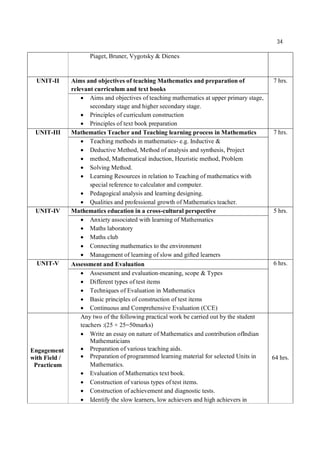
UNIT-II Aims and objectives of teaching Mathematics and preparation of
relevant curriculum and text books
7 hrs.
 Aims and objectives of teaching mathematics at upper primary stage,
secondary stage and higher secondary stage.
 Principles of curriculum construction
 Principles of text book preparation
UNIT-III Mathematics Teacher and Teaching learning process in Mathematics 7 hrs.
 Teaching methods in mathematics- e.g. Inductive &
 Deductive Method, Method of analysis and synthesis, Project
 method, Mathematical induction, Heuristic method, Problem
 Solving Method.
 Learning Resources in relation to Teaching of mathematics with
special reference to calculator and computer.
 Pedagogical analysis and learning designing.
 Qualities and professional growth of Mathematics teacher.
UNIT-IV Mathematics education in a cross-cultural perspective 5 hrs.
 Anxiety associated with learning of Mathematics
 Maths laboratory
 Maths club
 Connecting mathematics to the environment
 Management of learning of slow and gifted learners
UNIT-V Assessment and Evaluation 6 hrs.
 Assessment and evaluation-meaning, scope & Types
 Different types of test items
 Techniques of Evaluation in Mathematics
 Basic principles of construction of test items
 Continuous and Comprehensive Evaluation (CCE)
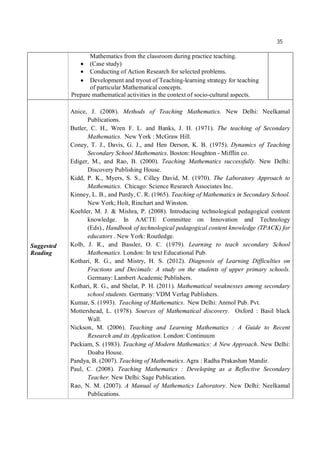
Engagement
with Field /
Practicum
Any two of the following practical work be carried out by the student
teachers :(25 + 25=50marks)
 Write an essay on nature of Mathematics and contribution ofIndian
Mathematicians
 Preparation of various teaching aids.
 Preparation of programmed learning material for selected Units in
Mathematics.
 Evaluation of Mathematics text book.
 Construction of various types of test items.
 Construction of achievement and diagnostic tests.
 Identify the slow learners, low achievers and high achievers in
64 hrs.
35
Mathematics from the classroom during practice teaching.
 (Case study)
 Conducting of Action Research for selected problems.
 Development and tryout of Teaching-learning strategy for teaching
of particular Mathematical concepts.
Prepare mathematical activities in the context of socio-cultural aspects.
Suggested
Reading
Anice, J. (2008). Methods of Teaching Mathematics. New Delhi: Neelkamal
Publications.
Butler, C. H., Wren F. L. and Banks, J. H. (1971). The teaching of Secondary
Mathematics. New York : McGraw Hill.
Coney, T. J., Davis, G. J., and Hen Derson, K. B. (1975). Dynamics of Teaching
Secondary School Mathematics. Boston: Houghton - Mifflin co.
Ediger, M., and Rao, B. (2000). Teaching Mathematics successfully. New Delhi:
Discovery Publishing House.
Kidd, P. K., Myers, S. S., Cilley David, M. (1970). The Laboratory Approach to
Mathematics. Chicago: Science Research Associates Inc.
Kinney, L. B., and Purdy, C. R. (1965). Teaching of Mathematics in Secondary School.
New York; Holt, Rinchart and Winston.
Koehler, M. J. & Mishra, P. (2008). Introducing technological pedagogical content
knowledge. In AACTE Committee on Innovation and Technology
(Eds)., Handbook of technological pedagogical content knowledge (TPACK) for
educators . New York: Routledge.
Kolb, J. R., and Bassler, O. C. (1979). Learning to teach secondary School
Mathematics. London: In text Educational Pub.
Kothari, R. G., and Mistry, H. S. (2012). Diagnosis of Learning Difficulties on
Fractions and Decimals: A study on the students of upper primary schools.
Germany: Lambert Academic Publishers.
Kothari, R. G., and Shelat, P. H. (2011). Mathematical weaknesses among secondary
school students. Germany: VDM Verlag Publishers.
Kumar, S. (1993). Teaching of Mathematics. New Delhi: Anmol Pub. Pvt.
Mottershead, L. (1978). Sources of Mathematical discovery. Oxford : Basil black
Wall.
Nickson, M. (2006). Teaching and Learning Mathematics : A Guide to Recent
Research and its Application. London: Continuum
Packiam, S. (1983). Teaching of Modern Mathematics: A New Approach. New Delhi:
Doaba House.
Pandya, B. (2007). Teaching of Mathematics. Agra : Radha Prakashan Mandir.
Paul, C. (2008). Teaching Mathematics : Developing as a Reflective Secondary
Teacher. New Delhi: Sage Publication.
Rao, N. M. (2007). A Manual of Mathematics Laboratory. New Delhi: Neelkamal
Publications.
36
Reeve, W. D. (1954). Mathematics for the Secondary School. New York: Holt,
Rinehart and Winston, Inc.
Servais, W., and Varga, T. (Ed.) (1971). Teaching School Mathematics. A UNESCO
Source Book. UNESCO, Penguin books.
Shah G. B. (1964). New Dimensions in teaching of Mathematics. Baroda : CASE.
Sidhu, K. B. (1974). The Teaching of Mathematics. New Delhi: Sterling Pub. (p). Ltd.
(LB 1646 14 54)
Singh, H., Avtar, R., and Singh, V. P. (2008). A Handbook for Designing Mathematics
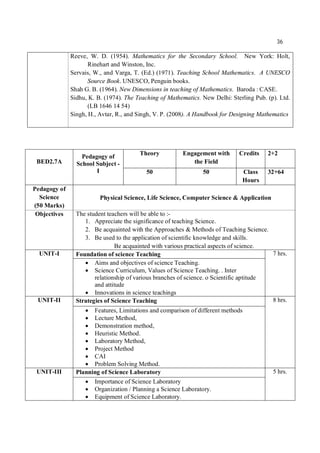
BED2.7A
Pedagogy of
School Subject -
I
Theory Engagement with
the Field
Credits 2+2
50 50 Class
Hours
32+64
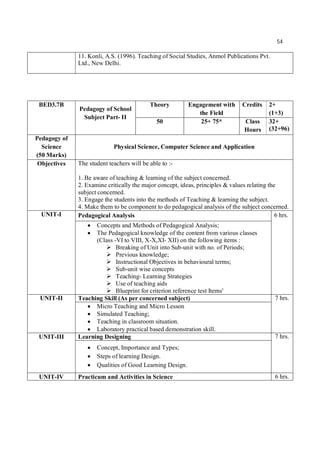
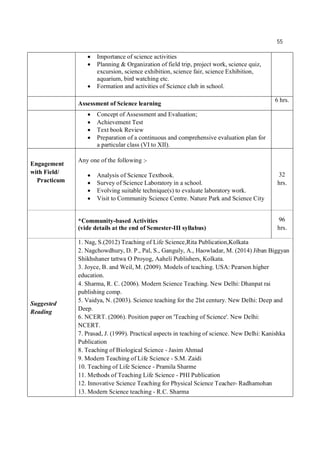
Pedagogy of
Science
(50 Marks)
Physical Science, Life Science, Computer Science & Application
Objectives The student teachers will be able to :-
1. Appreciate the significance of teaching Science.
2. Be acquainted with the Approaches & Methods of Teaching Science.
3. Be used to the application of scientific knowledge and skills.
Be acquainted with various practical aspects of science.
UNIT-I Foundation of science Teaching 7 hrs.
 Aims and objectives of science Teaching.
 Science Curriculum, Values of Science Teaching. . Inter
relationship of various branches of science. o Scientific aptitude
and attitude
 Innovations in science teachings
UNIT-II Strategies of Science Teaching 8 hrs.
 Features, Limitations and comparison of different methods
 Lecture Method,
 Demonstration method,
 Heuristic Method.
 Laboratory Method,
 Project Method
 CAI
 Problem Solving Method.
UNIT-III Planning of Science Laboratory 5 hrs.
 Importance of Science Laboratory
 Organization / Planning a Science Laboratory.
 Equipment of Science Laboratory.
37
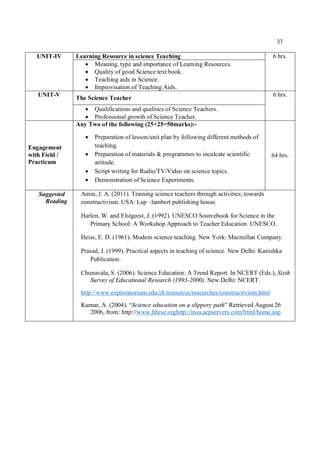
UNIT-IV Learning Resource in science Teaching 6 hrs.
 Meaning, type and importance of Learning Resources.
 Quality of good Science text book.
 Teaching aids in Science.
 Improvisation of Teaching Aids.
UNIT-V
The Science Teacher
6 hrs.
 Qualifications and qualities of Science Teachers.
 Professional growth of Science Teacher.
Engagement
with Field /
Practicum
Any Two of the following (25+25=50marks):-
 Preparation of lesson/unit plan by following different methods of
teaching.
 Preparation of materials & programmes to inculcate scientific
attitude.
 Script writing for Radio/TV/Video on science topics.
 Demonstration of Science Experiments.
64 hrs.
Suggested
Reading
Amin, J. A. (2011). Training science teachers through activities; towards
constructivism. USA: Lap –lambert publishing house.
Harlen, W. and Elstgeest, J. (1992). UNESCO Sourcebook for Science in the
Primary School: A Workshop Approach to Teacher Education. UNESCO.
Heiss, E. D. (1961). Modern science teaching. New York: Macmillan Company.
Prasad, J. (1999). Practical aspects in teaching of science. New Delhi: Kanishka
Publication.
Chunavala, S. (2006). Science Education: A Trend Report. In NCERT (Eds.), Sixth
Survey of Educational Research (1993-2000). New Delhi: NCERT.
http://www.exploratorium.edu/ifi/resources/researches/constructivism.html
Kumar, A. (2004). “Science education on a slippery path” Retrieved August 26
2006, from: http://www.hbcse.orghttp://insa.acpservers.com/html/home.asp
38
Course-
BED2.8a KNOWLEDGE
AND
CURRICULUM- I
Theory Engagement with
the Field
Credits 2+1
50 25 Class
Hours
32+32
Objectives To enable the students to :-
 Learn about epistemological bases of knowledge
 Understand the various concepts and maxims of education.
 Understand the concepts and approaches of curriculum development.
 Understand the bases and determinants of curriculum.
 Acquaint with the curriculum reform in the Indian context.
UNIT-I Epistemological bases of Education 7 hrs.
 Meaning of epistemology with reference to the process of
knowledge building and generation.
 Conditions, structure and forms of knowledge
 Distinction and relationship between: Knowledge and skill;
Teaching and training; Knowledge and information; and
Reason and belief.
 Activity, Discovery and Dialogue as knowledge getting strategies
to form the basis of child centred education with reference to
Gandhi, Tagore, Plato and Freire.
UNIT- II Sociological bases of Education 7 hrs.
 Society and Culture: Meaning and Nature
 Social Change in the light of Industrialization, Democracy and
Individual Autonomy
 Society and Modern Values: Equity, Equality, Individual
Opportunity, Social Justice and Dignity with special reference to
Ambedkar
 Multiculuralism and Democratic Education
 Nationalism, Universalism and Secularism and their
interrelationship with Education with special reference to Tagore
and Krishnamurti
UNIT- III Aims and Objectives of Education
7 hrs
 Introduction to Aims, Goals and Objectives of Education
 Aims of Education and Sources of Aims
 Goals of Education: Levels of Goals and Formulating Goals
 Educational Objectives: Types of Educational Objectives
 Guidelines for Formulating Educational Objectives
 Taxonomic Levels: Cognitive, Affective and Psychomotor
Domains and Approaches to Educational Objectives
39
UNIT- IV Concept of Curriculum 5 hrs.
Meaning, Evolution and modern concept and scope of curriculum
Curriculum as a process and praxis
Curriculum, Curriculum framework, Syllabus , Textbook: Concept,
Differences and their significance in school education
Different Facets and Types of curriculum with special emphasis on
Hidden Curriculum
UNIT- V Foundations of Curriculum 6 hrs.
 Philosophical Foundations and Curriculum: Philosophy and
Curriculum, Major Philosophies and Curriculum, Modern Indian
Educators and their Contribution to Curriculum
 Sociological Foundations of Curriculum: Society, Education and
Schooling, Social Change and the Curriculum, Planning for Curriculum
Change
 Psychological Foundations of Curriculum: Learning Theories and
Curriculum, Transfer of Learning, Basic Human Needs and Curriculum
Engagement
with Field /
Practicum
(25 marks)
 Knowledge getting process
 Formulation of objectives
 Designing activity or child centred design of curriculum
 Ambedkar and Modern Values
 Identification of core, hidden, null and latent curriculum in
textbooks.
 Critically Analysis of School Curriculum at different stages
 Discussion/debate on curriculum issues
32 hrs.
Suggested
Readings
Aggrawal, J. C., & Gupta, S. (2005). Curriculum Development. New Delhi: Shipra
Publisher.
Alaxander, W. M., & Saylor, J. G. (1966). Curriculum Planning for modern schools.
New York: Holt, Rinhart and Winston Inc.
Balrara, M. (1999). Principles of Curriculum Renewal. New Delhi: Kanishka
Publishers.
Candra, A. (1977). Curriculum Development and Evaluation in education. New Delhi:
Sterling Publishers.
Darji, D. R., & Lulla, B. P. (1967). Curriculum development in secondary schools of
Baroda. Baroda: Sadhana Press.
Erickson, H.L.(2007) concept based curriculum and instruction for the thinking
classroom California; corwin press
Hassrin, M. (2004). Curriculum Planning for elementary education. New Delhi: Anmol
Publishers.
Herbert, J. W. & Geneva, D. H. (1990). International Encyclopedia of Education
40
Evaluation. New York: Pergamon Press Oxford House.
Jenkins, D., & Shifrnan, D. M. (1976). Curriculum an introduction. London: Pitman
Publishing House.
Jhompson, K., and White, J. C. (1975). Curriculum development. London: Pitman
Publishing
Khan.M.I. and Nigam,B.K.(2007).Curriculum reform change and continuity. New Delhi;
kanishka publication
Kumari, S., and Srivastava, D. S. (2005). Curriculum and Instruction. New Delhi: Shipra
Publishers.
Macdonald, B., & Walker, R. (1976). Changing the Curriculum. Britain: Pitman Press.
Musgrave, P. W. (1974). Contemporary studies in the Curriculum. Australia: Angus and
Roberston Publishers.
Nigam, B. K., & Khan, I. M. (1993). Evaluation and research in Curriculum
Construction. New Delhi: Kaniska Publishers.
Ornsttein, A. C. & Hunkins, F.P. (1988). Curriculum foundations, Principles and issues
New jersey prentice hall
Panday, M. (2007). Principles of Curriculum Development. New Delhi; Rajat
publications
Rajput, J. S. (2004). Encyclopedia of Indian Education. New Delhi: NCERT.
Satyanarayan, P.V. (2004). Curriculum development and management. New Delhi: DPH.
Sharma, R. (2002). Modern methods of Curriculum Organisation. Jaipur: Book Enclave.
Sharma, S. R. (1999). Issues in Curriculum Administration. New Delhi: Pearl Publishing
House.
Sockett, H. (1976). Designing the Curriculum. Britain: Pitman Press.
Srivastava, H. S. (2006). Curriculum and methods of teaching. New Delhi: Shipra
Publishers.
Tata, H. (1962). Curriculum development theory & practice. New York: Harcourt, Brace
& World Inc.
Yadav, Y.P. (2006). Fundamentals of Curriculum design. New Delhi; Shri Sai
Printographers
41
Course-
BED2.9
ASSESSMENT FOR
LEARNING (1st
and
2nd
Half)
Theory Engagement
with the Field
Credits 4+2
50+50 50 Class
Hours
64+64
1 ST
HALF
(50marks)
ASSESSMENT FOR LEARNING
Objectives To enable the students to :-
 Get basic knowledge of assessment for learning.
 Familiar with different Concepts like assessment, evaluation, test,
examination, measurement.
 Know different tools and techniques of assessment.
 Know different characteristics of instruments of Assessment.
 Know different types of teacher made tests and will construct them.
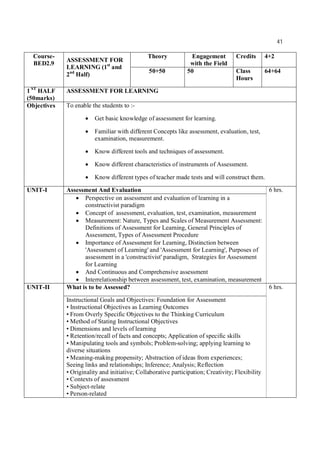
UNIT-I Assessment And Evaluation 6 hrs.
 Perspective on assessment and evaluation of learning in a
constructivist paradigm
 Concept of assessment, evaluation, test, examination, measurement
 Measurement: Nature, Types and Scales of Measurement Assessment:
Definitions of Assessment for Learning, General Principles of
Assessment, Types of Assessment Procedure
 Importance of Assessment for Learning, Distinction between
'Assessment of Learning' and 'Assessment for Learning', Purposes of
assessment in a 'constructivist' paradigm, Strategies for Assessment
for Learning
 And Continuous and Comprehensive assessment
 Interrelationship between assessment, test, examination, measurement
UNIT-II What is to be Assessed? 6 hrs.
Instructional Goals and Objectives: Foundation for Assessment
• Instructional Objectives as Learning Outcomes
• From Overly Specific Objectives to the Thinking Curriculum
• Method of Stating Instructional Objectives
• Dimensions and levels of learning
• Retention/recall of facts and concepts; Application of specific skills
• Manipulating tools and symbols; Problem-solving; applying learning to
diverse situations
• Meaning-making propensity; Abstraction of ideas from experiences;
Seeing links and relationships; Inference; Analysis; Reflection
• Originality and initiative; Collaborative participation; Creativity; Flexibility
• Contexts of assessment
• Subject-relate
• Person-related
42
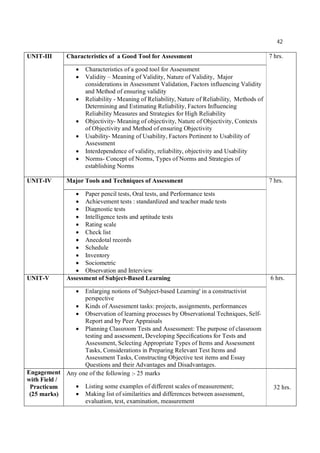
UNIT-III Characteristics of a Good Tool for Assessment 7 hrs.
 Characteristics of a good tool for Assessment
 Validity – Meaning of Validity, Nature of Validity, Major
considerations in Assessment Validation, Factors influencing Validity
and Method of ensuring validity
 Reliability - Meaning of Reliability, Nature of Reliability, Methods of
Determining and Estimating Reliability, Factors Influencing
Reliability Measures and Strategies for High Reliability
 Objectivity- Meaning of objectivity, Nature of Objectivity, Contexts
of Objectivity and Method of ensuring Objectivity
 Usability- Meaning of Usability, Factors Pertinent to Usability of
Assessment
 Interdependence of validity, reliability, objectivity and Usability
 Norms- Concept of Norms, Types of Norms and Strategies of
establishing Norms
UNIT-IV Major Tools and Techniques of Assessment 7 hrs.
 Paper pencil tests, Oral tests, and Performance tests
 Achievement tests : standardized and teacher made tests
 Diagnostic tests
 Intelligence tests and aptitude tests
 Rating scale
 Check list
 Anecdotal records
 Schedule
 Inventory
 Sociometric
 Observation and Interview
UNIT-V Assessment of Subject-Based Learning 6 hrs.
 Enlarging notions of 'Subject-based Learning' in a constructivist
perspective
 Kinds of Assessment tasks: projects, assignments, performances
 Observation of learning processes by Observational Techniques, Self-
Report and by Peer Appraisals
 Planning Classroom Tests and Assessment: The purpose of classroom
testing and assessment, Developing Specifications for Tests and
Assessment, Selecting Appropriate Types of Items and Assessment
Tasks, Considerations in Preparing Relevant Test Items and
Assessment Tasks, Constructing Objective test items and Essay
Questions and their Advantages and Disadvantages.
Engagement
with Field /
Practicum
(25 marks)
Any one of the following :- 25 marks
 Listing some examples of different scales of measurement;
 Making list of similarities and differences between assessment,
evaluation, test, examination, measurement
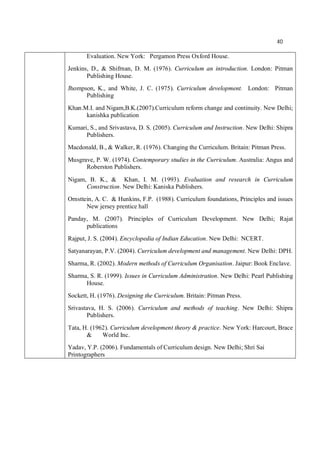
32 hrs.
43
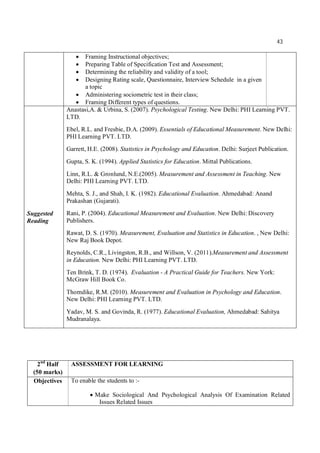
 Framing Instructional objectives;
 Preparing Table of Specification Test and Assessment;
 Determining the reliability and validity of a tool;
 Designing Rating scale, Questionnaire, Interview Schedule in a given
a topic
 Administering sociometric test in their class;
 Framing Different types of questions.
Suggested
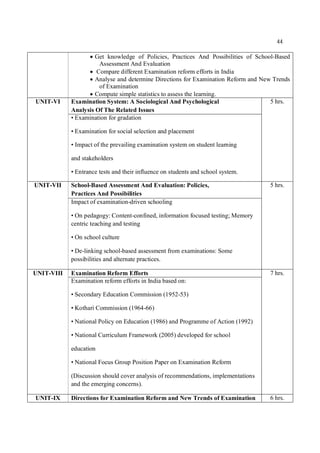
Reading
Anastasi,A. & Urbina, S. (2007). Psychological Testing. New Delhi: PHI Learning PVT.
LTD.
Ebel, R.L. and Fresbie, D.A. (2009). Essentials of Educational Measurement. New Delhi:
PHI Learning PVT. LTD.
Garrett, H.E. (2008). Statistics in Psychology and Education. Delhi: Surjeet Publication.
Gupta, S. K. (1994). Applied Statistics for Education. Mittal Publications.
Linn, R.L. & Gronlund, N.E.(2005). Measurement and Assessment in Teaching. New
Delhi: PHI Learning PVT. LTD.
Mehta, S. J., and Shah, I. K. (1982). Educational Evaluation. Ahmedabad: Anand
Prakashan (Gujarati).
Rani, P. (2004). Educational Measurement and Evaluation. New Delhi: Discovery
Publishers.
Rawat, D. S. (1970). Measurement, Evaluation and Statistics in Education. , New Delhi:
New Raj Book Depot.
Reynolds, C.R., Livingston, R.B., and Willson, V. (2011).Measurement and Assessment
in Education. New Delhi: PHI Learning PVT. LTD.
Ten Brink, T. D. (1974). Evaluation - A Practical Guide for Teachers. New York:
McGraw Hill Book Co.
Thorndike, R.M. (2010). Measurement and Evaluation in Psychology and Education.
New Delhi: PHI Learning PVT. LTD.
Yadav, M. S. and Govinda, R. (1977). Educational Evaluation, Ahmedabad: Sahitya
Mudranalaya.
2nd
Half
(50 marks)
ASSESSMENT FOR LEARNING
Objectives To enable the students to :-
 Make Sociological And Psychological Analysis Of Examination Related
Issues Related Issues
44
 Get knowledge of Policies, Practices And Possibilities of School-Based
Assessment And Evaluation
 Compare different Examination reform efforts in India
 Analyse and determine Directions for Examination Reform and New Trends
of Examination
 Compute simple statistics to assess the learning.
UNIT-VI Examination System: A Sociological And Psychological
Analysis Of The Related Issues
5 hrs.
• Examination for gradation
• Examination for social selection and placement
• Impact of the prevailing examination system on student learning
and stakeholders
• Entrance tests and their influence on students and school system.
UNIT-VII School-Based Assessment And Evaluation: Policies,
Practices And Possibilities
5 hrs.
Impact of examination-driven schooling
• On pedagogy: Content-confined, information focused testing; Memory
centric teaching and testing
• On school culture
• De-linking school-based assessment from examinations: Some
possibilities and alternate practices.
UNIT-VIII Examination Reform Efforts 7 hrs.
Examination reform efforts in India based on:
• Secondary Education Commission (1952-53)
• Kothari Commission (1964-66)
• National Policy on Education (1986) and Programme of Action (1992)
• National Curriculum Framework (2005) developed for school
education
• National Focus Group Position Paper on Examination Reform
(Discussion should cover analysis of recommendations, implementations
and the emerging concerns).
UNIT-IX Directions for Examination Reform and New Trends of Examination 6 hrs.
45
 Introducing flexibility in examination-taking requirements
 Improving quality and range of questions in exam papers
 Question bank
 Semester system
 Including school-based credits
 Examination management
 Role of ICT in examination
UNIT-X Statistical Tools for Data Analysis, Feedback And Reporting 9 hrs.
Statistical tools—Percentage, graphical representation, frequency
distribution, central tendency, variation, normal distribution, percentile
rank, correlation, Score transformation and their interpretation
Feedback as an essential component of formative assessment, Use of
assessment for feedback; Types of teacher feedback (written comments,
oral); Peer feedback
• Place of marks, grades and qualitative descriptions
• Developing and maintaining a comprehensive learner profile
• Purposes of reporting
Engagement
with Field
/Practicum
Any one of the following :- 25 marks
 Organising debate on current examination practices;
 Preparing portfolio, report card regarding progress of learner;
 Framing Question Bank on different pedagogical subjects;
 Preparing article on Impact of the prevailing examination system
on student learning and stakeholders;
 Listing strategies for management of examination in school;
 Preparing computer generated examination related records and
registers;
 Prepare graphs and use statistics for analysis of test result;
 Transferring test scores into norms and interpreting it; and
 Making visit different schools and preparing report on learning
output of certain class.
32 hrs.
Suggested
Reading
Anastasi,A. & Urbina, S. (2007). Psychological Testing. New Delhi: PHI Learning
PVT. LTD.
Ebel, R.L. and Fresbie, D.A. (2009). Essentials of Educational Measurement. New
Delhi: PHI Learning PVT. LTD.
Garrett, H.E. (2008). Statistics in Psychology and Education. Delhi: Surjeet
Publication.
Gupta, S. K. (1994). Applied Statistics for Education. Mittal Publications.
Linn, R.L. & Gronlund, N.E.(2005). Measurement and Assessment in Teaching. New
46
Delhi: PHI Learning PVT. LTD.
Mehta, S. J., and Shah, I. K. (1982). Educational Evaluation. Ahmedabad: Anand
Prakashan (Gujarati).
Rani, P. (2004). Educational Measurement and Evaluation. New Delhi: Discovery
Publishers.
Rawat, D. S. (1970). Measurement, Evaluation and Statistics in Education. , New
Delhi: New Raj Book Depot.
Reynolds, C.R., Livingston, R.B., and Willson, V. (2011).Measurement and
Assessment in Education. New Delhi: PHI Learning PVT. LTD.
Ten Brink, T. D. (1974). Evaluation - A Practical Guide for Teachers. New York:
McGraw Hill Book Co.
Thorndike, R.M. (2010). Measurement and Evaluation in Psychology and Education.
New Delhi: PHI Learning PVT. LTD.
Yadav, M. S. and Govinda, R. (1977). Educational Evaluation, Ahmedabad: Sahitya
Mudranalaya.
BED2.EPC 2
DRAMA AND ART
IN EDUCATION
Theory Engagement
with the Field
Credits 1+1
25 25 Class
Hours
16+32
Objectives To enable the students to :-
 Understand the use of ‘Drama’ as a Pedagogy.
 Use ‘Role play’ technique in the teaching learning process.
 Understand the importance of dramatic way of presentation.
 Integrate singing method in teaching learning process.
 Understand various ‘Dance forms’ and their integration in educational practices.
 Use art of drawing and painting in teaching learning process.
 Develop creativity through different creative art forms.
 Understand the efficacy of different art forms in education.
UNIT-I Drama and its Fundamentals 3hrs.
47
Drama as a tool of learning
Different Forms of Drama
Role play and Simulation
Use of Drama for Educational and social change (Street play,
Dramatization of a lesson) with spl reference to Utpal Dutta
Use of Drama Techniques in the Classroom: voice and speech, mime and
movements, improvisation, skills of observation, imitation and
presentation
UNIT-II Music ( Gayan and Vadan ) 3 hrs.
Sur, Taal and Laya (Sargam)
Vocal - Folk songs, Poems, Prayers
Singing along with “Karaoke”
Composition of Songs, Poems, Prayers
Integration of Gayan and Vadan in Educational practices
UNIT-III The Art of Dance 3 hrs.
Various Dance Forms - Bharat Natyam, Kathakali, Folk dance : Garba,
Bhavai, Bhangada, Bihu and various other dances
Integration of Dance in educational practices
(Action songs, Nritya Natika )
UNIT-IV Drawing and Painting 3 hrs.
Colours, Strokes and Sketching- understanding of various means and
perspectives
Different forms of painting- Worli art, Madhubani art, Glass painting,
Fabric painting and various forms of painting
Use of Drawing and Painting in Education -Chart making, Poster
making, match-stick drawing and other forms
UNIT-V Creative Art 4 hrs.
Creative writing -Story writing, Poetry writing
Model making - Clay modeling, Origami, Puppet making
Decorative Art - Rangoli, Ekebana, Wall painting (Mural)
Designing - Computer graphics, CD Cover, Book cover, Collage work
The use of different art forms in Education
Engagement
with Field /
Practicum
(25marks)
(No end
semester
exam)
Any two of the following :-
 Develop a script of any lesson in any subject of your choice to
perform a Play / Drama.
 Develop a script for the street play focusing on “Girl’s education and
Women empowerment”.
 Prepare a script of Bhavai based on some Socio-political issues.
 Prepare a pictorial monograph on “Various folk dance of Gujarat”.
 Prepare a pictorial monograph on “Various Dance forms in India”.
 Prepare a calendar chart on “Various Musical Instruments in India”.
 Develop an Audio CD based on newly composed Poems of Gujarati /
Hindi language.
 Prepare some useful, productive and decorative models out of the
32 hrs.
48
west materials.
 Visit the Faculty of Performing Arts in your city and prepare a
detailed report on its multifarious functioning.
 Organize a competition on some Decorative / Performing Art forms
in the school during your School Internship programme and prepare a
report on it.
 Organize a workshop on some selected Creative Art forms in the
school during your School Internship programme and prepare a report
on it.
 Develop a creative design based on your choice for CD Cover or
Book cover.
 Develop a design or picture based on collage work.
Suggested
Reading
1) Theory of Drama by A.Nicoll
2) Natya Kala by Dhirubhai Thakar
3) Natya lekhan by Dhananjay Thakar
4) Natak desh videsman by Hasmukh Baradi
5) Gujarati theatre no Itihas by Baradi Hasmukh
6) Acting is Believing by Charls McGaw
7) Art of Speech by Kethlin Rich
8) Natya Sahity na swaroopo by Nanda kumar pathak
9) Bhavai by Sudahaben Desai
10) Bhavai by Krishnakant Kadkiya
11) Natya Manjari saurabh by G.K.Bhatt
12) Bharat aur Bhartiya Natya Kala by Surendra nath Dixit
13) Ekanki nu swarup ane Gujarati Ekanki by Jayant Kothari.
14) The History of Gujrati Theatre- vinod Meghani.
15) Japan ni Rangbhumi by C.C.Mehta.
16) Nakrani, H. (1988). Gamta Gaao Geet. Rajkot, Pravin Prakashan.
17) Deva, B.C.(1981). An Introduction to Indian Music. Publication Division, Ministry
of Information and Broadcasting, Government of India.
18) Abhinav Raga Manjari by Pt. Bhatkhande
19) Kramik Pustak Malika by Pt. Bhatkhande
20) Abhinav Geet Manjari by Ratanjankar
21) NCERT, (2006). Position Paper by National Focus Group on Arts, Music, Dance
and Theatre
49
SEMESTER – III
Course-BED3.11
Islamic Culture and
Education
Theory Engagement with the
Field
Full
Marks
1+1
25 25 50 16+32
Objectives
The objectives of the course are to enable the teacher students to:
7. Identify Arabia before Islam with reference to Political, Economic, Cultural,
Religious and Social scenario
8. Know about and Analyse the life of Prophet Mohammed and his contribution
9. Analyse Status of Women in Islam
10. Realise the importance of Education in Islam
Unit I Arabia before Islam 4hrs
 Political scenario
 Economic scenario
 Cultural scenario
 Religious scenario
 Social scenario
Unit II The Prophet of Islam 4hrs
 Early Life of Prophet Mohammed (pbuh): - Birth, Marriage,
Revelation, Hostility of the Quraish, Hijrat.
 The Prophet at Madinah: Battle of Badr, Uhud, Ditch, Treaty of
Hudaibiah, Battle of Mutah.
 The Conquest of Makkah, Battle of Hunayn, Tabuk, The
Farewell Pilgrimage.
 The Prophet as a Reformer and as a Nation Builder.
Unit III Islam and its teachings 12hrs
 Meaning of Islam – Ideologies (Social, Moral, Religious,
Intellectual, Cultural, Political and International )
 Quran: Social Values.
 Hadith/ Sunnah: Social Values, Classification of Hadith.
 Pilars of Islam: Tauheed, Namaz, Roza, Hajj and Zakat.
Unit IV Women in Islam 4hrs
 Status of Women in Islam As
 A Female child,
 wife,
 Mother,
 Widow, Divorce,
 Inheritance and Education.
Unit V Education in Islam 8hrs
 Importance of Education in Islam
 Muslims’ contribution to Education:
 Mathematics,
50
 Medicine,
 Geography and
 History
Engagement
With Field/
Practicum
(25 Marks)
Any one of the following:
 Visit to any Islamic Educational Institute and prepare report
 Making Documentary study on The Prophet of Islam and reporting
 Preparation of paper on Status of Women in Islam
 Debate on various issues of Islam and Education
Any other activities related to the subject as instructed by subject teachers
Suggested
Readings
1. A Study of Islamic History : K. Ali.
2. History of the Arabs : P.K. Hitti.
3. The Caliphate: Its Rise, Decline and Fall : Sir William Muir
4. History of Islam : Prof. Masudul Hasan
5. The Spirit of Islam : Syed Ameer Ali
6. Towards Understanding Islam : Maulana Maududi
7. The Preaching of Islam : T.W. Arnold
8. The Preaching of Islam : Reynold Nicolson
4hrs
BED3.7B
Pedagogy of a School
Subject Part-II
Theory Engagement with the
Field
Credits 2+(1+3)
50 25+75* Class
Hours
32+(32
+96)
Pedagogy of
Language
(50 marks)
Bengali, English, Urdu, Arabic and Persian
Objectives
The student will be able to :-
Design appropriate teaching - learning strategy/approach suited to particular content.
Be at home with the principles of constructing content analysis of school curriculum.
Use ICT and various teaching aids in teaching ofLanguages.
Understand the historical development of Language Teaching.
Develop various skills related to language leaming.
Prepare a blueprint before entering into a class.
51
UNIT-I Pedagogical Analysis 6 hrs.
 Concepts and Methods of Pedagogical Analysis;
 The Pedagogical knowledge of the content from various classes
(Class -VI to VIII, X-X,XI- XII) on the following items:
 Breaking of Unit into Sub-unit with no. of Periods;
 Previous knowledge;
 Instructional Objectives in behavioural terms;
 Sub-unit wise concepts
 Teaching- learning Strategies
 Use of teaching aids
 Blueprint for criterion reference test Items.
UNIT-II
Teaching Skill (As per concerned subject)
7 hrs. Micro Teaching and Micro Lesson
 Simulated Teaching
 Integrated Teaching/ Teaching in classroom situation.
UNIT-III
Learning Designing
7 hrs.
 Concept, Importance and Types
 Steps of Learning Design
 Qualities of Good Learning Design
UNIT-IV
Activities in Language
6 hrs.
 Fair and Exhibition,
 Field Trips / Excursion,
 Debate,
 Wall & Annual Magazine
 Sahitya Sabha
 Use of ICT
 Use of Dictionary, Encyclopaedia and Thesaurus
UNIT-V
Assessment of Teaching-Learning Material on Language
6 hrs.
 Text book review and analysis / e-book Review
 Teaching learning material on Language learning
Engagement
With Field/
Practicum
Any one of the following :-
 Identify the slow learners, low achievers and high achievers in
Language from the classroom during practice teaching. (Case study)
 Conducting of Action Research for selected problems.
 Development and tryout of Teaching learning strategy for teaching
of particular Language concepts.
 Development and use of Language laboratory.
96 hrs.
* Community-based Activities
(vide details at the end of Semester-III syllabus)
96 hrs.
Suggested
Readings
1. Bennett, W. A. (1969). Aspects of Language and Language Teaching.
2. Cambridge: Cambridge University Press.
3. Braden K (2006). Task Based Language Education: From Theory to
4. Practice. Cambridge: Cambridge University Press.
5. Britton James (1973). Language and Learning. London: Penguine Books.
6. Hill, L.A. and Dobbyn, M.A. Training Course, Trainer's Booh Cassell,
52
7. London, 1979.
8. Richard J. and Theodore S. Rodgers T.S. Approaches and Methods in Language,
Cambridge University Press, 1986.
9. Witkins, D.A. Linguistics in Language Teaching, Edward Arnold, London, 196.
10. Mukalel, J.C. Creative Approaches to Classroom Teaching, Discovery
11. Publishing house, New Delhi, 1998
12. Ryburn W.N. : Suggestions for the teaching of Mother tongue in India, Oxford
University Press, Mumbai.
13. Mukerjee, S.N. : Rashtra Bhasha Ki Shiksha, Acharya Book Depot, Baroda,1965
BED3.7B
Pedagogy of School
Subject Part- II
Theory Engagement with
the Field
Credits 2+
(1+3)
50 25+ 75* Class
Hours
32+
(32+96)
Pedagogy of
Social Science
(50 Marks)
History, Geography, Education and Islamic Theology
Objectives The student teachers will be able to :-
1. Be aware of teaching & learning of the subject concern.
2. Examine critically the major concept, ideas, principles & values relating the
subject concern.
3. Engage the students into the methods of Teaching & learning the subject.
4. Provide the students authentic historical knowledge with the proposed content &
make them to be component to do pedagogical analysis of the subject.
UNIT-I
Pedagogical Analysis 6 hrs.
 Concepts and Methods of Pedagogical Analysis;
 The Pedagogical knowledge ofthe content from various classes
(Class -VI to VIII, X-X,XI- XII) on the following items :
 Breaking of Unit into Sub-unit with no. of Periods;
 Previous knowledge;
 Instructional Objectives in behavioural terms;
 Sub-unit wise concepts
 Teaching- Learning Strategies
 Use of teaching aids
 Blueprint for criterion reference test Items'
UNIT-II Teaching Skill (As per concerned subject) 7 hrs.
 Micro Teaching and Micro Lesson
 Simulated Teaching;
 Integrated Teaching/ Teaching in classroom situation.
UNIT-III Learning Designing 7 hrs.
53
 Concept, Importance and Types;
 Steps of learning Design.
 Qualities of Good Learning Design.
UNIT-IV Activities in Social Science 6 hrs.
 Fair and Exhibition,
 Field Trips / Excursion,
 Debate.
 Wall & Annual Magazine and
 Subject Club
Assessment of Social science learning
6 hrs.
 Concept of Assessment and Evaluation;
 Achievement Test
 Text book Review
Engagement
with Field/
Practicum
Any one of the following :-
 Preparation of Learning Design
 Preparation of Achievement Test
 Development of skill of map o Development of skill of time line
 Project
 Case Study
32
hrs.
*Community-based Activities
(vide details at the end of Semester-III syllabus)
96
hrs.
Suggested
Reading
1. Alan J Singer (2003). Social Studies for Secondary Schools: Teaching to
learn, Learning to Teach. L E Association. New Jersey.
2. Arora. GL. (1988) Curriculum and Quality in Education. NCERT. New
Delhi.
3. Agrawal, J.C. Teaching of Social Studies, Vikas Publishing House, New
Delhi.
4. Binning, A.C. : Teaching Social Studies in Secondary Schools, McGraw
Hill and Co., New York.
5. Bhattacharya, S. & Darji, D.R. : Teaching of Social Studies in Indian
Schools, Acharya Book Depot, Baroda, 1966.
6. Desai, D.B. : Samaj Vidyana Shikhan, Balgovind Prakashan, Ahmedabad.
7. Greene, H.A., Jozgensen, A.N. Gerberi, J.R. : Measurement and Evaluation
in the Secondary School, Mongmans, Green and Co., New York, 1959.
8. Mathias, Paul : The Teacher's Handbooks for Social Studies, Blandford
Press, l,ondon, 1973.
9. Mehlinger. Howard, D. (ed.) : UNESCO, Handbook for the Teaching of
Social Studies, Gareem Helm, [,ondon, UNESCO, 1981.
10. The Association ofTeachers ofSocial Studies : Handbook for Social
Studies Teaching, Holt, Rinchart and Winston, INC, New York, 1967.
54
11. Konli, A.S. (1996). Teaching of Social Studies, Anmol Publications Pvt.
Ltd., New Delhi.
BED3.7B
Pedagogy of School
Subject Part- II
Theory Engagement with
the Field
Credits 2+
(1+3)
50 25+ 75* Class
Hours
32+
(32+96)
Pedagogy of
Science
(50 Marks)
Physical Science, Computer Science and Application
Objectives The student teachers will be able to :-
1. Be aware of teaching & learning of the subject concerned.
2. Examine critically the major concept, ideas, principles & values relating the
subject concerned.
3. Engage the students into the methods of Teaching & learning the subject.
4. Make them to be component to do pedagogical analysis of the subject concerned.
UNIT-I Pedagogical Analysis 6 hrs.
 Concepts and Methods of Pedagogical Analysis;
 The Pedagogical knowledge of the content from various classes
(Class -VI to VIII, X-X,XI- XII) on the following items :
 Breaking of Unit into Sub-unit with no. of Periods;
 Previous knowledge;
 Instructional Objectives in behavioural terms;
 Sub-unit wise concepts
 Teaching- Learning Strategies
 Use of teaching aids
 Blueprint for criterion reference test Items'
UNIT-II Teaching Skill (As per concerned subject) 7 hrs.
 Micro Teaching and Micro Lesson
 Simulated Teaching;
 Teaching in classroom situation.
 Laboratory practical based demonstration skill.
UNIT-III Learning Designing 7 hrs.
 Concept, Importance and Types;
 Steps of learning Design.
 Qualities of Good Learning Design.
UNIT-IV Practicum and Activities in Science 6 hrs.
55
 Importance of science activities
 Planning & Organization of field trip, project work, science quiz,
excursion, science exhibition, science fair, science Exhibition,
aquarium, bird watching etc.
 Formation and activities of Science club in school.
Assessment of Science learning
6 hrs.
 Concept of Assessment and Evaluation;
 Achievement Test
 Text book Review
 Preparation of a continuous and comprehensive evaluation plan for
a particular class (VI to XII).
Engagement
with Field/
Practicum
Any one of the following :-
 Analysis of Science Textbook.
 Survey of Science Laboratory in a school.
 Evolving suitable technique(s) to evaluate laboratory work.
 Visit to Community Science Centre. Nature Park and Science City
32
hrs.
*Community-based Activities
(vide details at the end of Semester-III syllabus)
96
hrs.
Suggested
Reading
1. Nag, S.(2012) Teaching of Life Science,Rita Publication,Kolkata
2. Nagchowdhury, D. P., Pal, S., Ganguly, A., Haowladar, M. (2014) Jiban Biggyan
Shikhshaner tattwa O Proyog, Aaheli Publishers, Kolkata.
3. Joyce, B. and Weil, M. (2009). Models of teaching. USA: Pearson higher
education.
4. Sharma, R. C. (2006). Modern Science Teaching. New Delhi: Dhanpat rai
publishing comp.
5. Vaidya, N. (2003). Science teaching for the 2lst century. New Delhi: Deep and
Deep.
6. NCERT. (2006). Position paper on 'Teaching of Science'. New Delhi:
NCERT.
7. Prasad, J. (1999). Practical aspects in teaching of science. New Delhi: Kanishka
Publication
8. Teaching of Biological Science - Jasim Ahmad
9. Modern Teaching of Life Science - S.M. Zaidi
10. Teaching of Life Science - Pramila Sharme
11. Methods of Teaching Life Science - PHI Publication
12. Innovative Science Teaching for Physical Science Teacher- Radhamohan
13. Modern Science teaching - R.C. Sharma
56
14. Teaching of Computer Studies – Pranay Pandey
BED3.7B
Pedagogy of School
Subjects - II
Theory Engagement with
the Field
Credits 2+
(1+3)
50 25+75* Class
Hours
32+
(32+96)
Pedagogy of
Mathematics
(50 Marks)
Mathematics Education
Objectives The student teachers will be able to :-
1. Know about Mathematics curriculum and text-book preparation
2. Know how does Practical activities associated with mathematical
concepts
3. Understand about assessment and evaluation related to mathematics teaching-
learning.
4. Apply the Concept of Pedagogical analysis of mathematics content of
school level mathematics curriculum and learning designing
5. Understand about Simulated and integrated lesson
UNIT-I Mathematics curriculum and Text-book preparation 6 hrs.
 Review of the existing curriculum of mathematics of West Bengal
Board of Secondary Education in the perspective of the principles of
curriculum construction and its comparison with that of the GBSE.
 Review of the existing text books of mathematics of West Bengal
Board of Secondary Education in the perspective of the principles of
text-book preparation and its comparison with that of the CBSE.
UNIT-II Practical activities associated with Mathematics concepts: 7 hrs.
 Performance of the all the practical activities stated in the text books
of West Bengal Board of Secondary Education and preparation of
allied teaching-learning materials.
 Co-curricular activities (including Mathematics club and
Mathematics laboratory) in relation to mathematics teachings.
UNIT-III Assessment and Evaluation related to Teaching Learning of
Mathematics
7 hrs.
 Construction of achievement tests and their administration
 Preparation of a Continuous and Comprehensive Evaluation plan for
a particular class (VI to X).
UNIT-IV Pedagogical Analysis and learning designing of Mathematics
content of school level
6 hrs.
 Concepts and Methods of Pedagogical Analysis;
 The Pedagogical knowledge of the content from various classes
(Class -VI to VIII, X-X,XI- XII) on the following items :
 Breakings of Unit into Sub-unit with no. of Periods;
57
 Previous knowledge;
 Instructional Objectives in behavioural terms;
 Sub-unit wise concepts
 Teaching- Learning Strategies
 Use of teaching aids
 Blueprint for criterion reference test Items.
UNIT-V Simulated and Integrated Lesson 6 hrs.
 Simulated Micro Teaching and Integrated Teaching.
 Teaching in Classroom environment.
Engagement
with Field /
Practicum
Any one of the following :-
 Identify the slow learners, low achievers and high achievers in
Mathematics from the classroom during practice teaching. (Case
study)
 Conducting of Action Research for selected problems.
 Development and tryout of Teaching learning strategy for teaching
of particular Mathematical concepts.
 Use of Computer in Teaching of Mathematics.
 Use of Mathematics activities for recreation.
 Development and use of Mathematics laboratory.
 Prepare mathematical activities in the context of socio-cultural
aspects.
32 hrs.
* Community-based Activities
(vide details at the end of Semester-III syllabus)
96 hrs.
Suggested
Reading
1. Arora, S.K.(2000).Flow to teach mathematics. New Delhi: Sterling Publications
2. Kumar,S. &Jaidka, M.L. (2005). Teaching of mathematics .New Delhi: Anmol
Publications
3. Mangal,S. K. (2003 ). T e ac hin g of mat hemat ics. Ludhiana: Tandon Publications
4. Sidhu, K.S.(1998). Teaching of mathematics. New Delhi: Sterling Publications
5. Banerjee,S. G anit s i kK hanp addhati. Kolkata : Rita Publications
6. Ghosh,S. GanitsikKhan .Kolkata: Sova Publications
7. Pramanik, S.(2014). Adhunik ganit sikhsa o sikshan. Kolkata: Aaheli Publishers.
8. Anice, J. (2008). Methods of Teaching Mathematics. New Delhi: Neelkamal
Publications.
9.Butler, C. H., Wren F. L. and Banks, J. H. (1971). The teaching of Secondary
Mathematics. New York : McGraw Hill.
10. Coney, T. J., Davis, G. J., and Hen Derson, K. B. (1975). Dynamics of Teaching
Secondary School Mathematics. Boston: Houghton - Mifflin co.
11. Ediger, M., and Rao, B. (2000). Teaching Mathematics successfully. New Delhi:
Discovery Publishing House.
12. Kidd, P. K., Myers, S. S., Cilley David, M. (1970). The Laboratory Approach to
Mathematics. Chicago: Science Research Associates Inc.
58
13. Kinney, L. B., and Purdy, C. R. (1965). Teaching of Mathematics in Secondary
School. New York; Holt, Rinchart and Winston.
14. Koehler, M. J. & Mishra, P. (2008). Introducing technological pedagogical content
knowledge. In AACTE Committee on Innovation and Technology (Eds.), Handbook
of technological pedagogical content knowledge (TPACK) for educators. New York:
Rutledge.
BED3.SI
SCHOOL
INTERNSHIP
Theory Engagement with
the Field
Credits 12
300 Class
Hours
416
 At least 60 learning designs should be delivered (duly prepared and approved
learning designs by the Teacher Educators)
 During this semester the student teachers are acquainted with the overall conduct
of the school activities and record keeping. It may include morning assembly,
class time table, attendance register, stock register, mid-day meal, conduct of
periodical meetings, purchase and consumption and co-curricular activities.
 Student teachers will be able to recognize the needs of In-Service programme.
 Internship, as such, orients and acquaints the student teachers with the overall
working of the school to make him/her fit to conduct himself/ herself in all
activities of the school.
School Internship
(*Community -based activities shall consist of the following)
 Organization of a rally or campaign on any social issue e.g. Polio, HIV, Electoral
Rights, Gender sensitization etc.
 Gardening.
 Cleanliness of the campus and beautification
 Cleaning of furniture
 Assembly
 Community Games
 Cultural Programmes
 SUPW
 Scout & Guide /NSS
 Celebration of National Festivals. Teachers Day etc.
 First Aid
 Aesthetic development activities- decoration of classroom etc.
59
SEMESTER – IV
BED4.6
Gender, School and
Society
Theory Engagement
With the Field
Credit 2+1
50 25 Class
Hours
32+32
Objectives
The student teachers will be able to :-
 Develop gender sensitivity among the student teachers.
 Understand the gender issues faced by the schools.
 Understand the paradigm shift with reference to gender studies.
 Understand how gender, power and sexuality relate to education (in terms of
access, curriculum and pedagogy).
Unit I Gender Issues: key concepts 6hrs
 Definition of gender.
 Difference between gender and sex.
 Social construction of gender.
 Gender including transgender and third gender, sex, patriarchy.
 Gender bias, gender stereotyping, and empowerment
 Equity and equality in relation with caste, class, religion, ethnicity,
disability and region.
Unit II Gender Studies: paradigm shifts 7hrs
 Paradigm shift from women's studies
 Historical backdrop: some landmarks on social reform movements of
the 19th and 20th centuries with focus on women's experiences of
education (with special reference to Raja Rammohan Roy, Pandit
Iswar Chandra Vidyasagar, Swami Vivekananda, Rabindranath Tagore
and Besam Rokeya).
A. Commissions and committees on women education and empowerment
B. Policy initiatives (including current laws) for the recognition of the
concept of transgender and third gender.
Unit III Gender, Power and Education 7hrs
 Gender Identities and Socialization Practices in:
 Family
 Schools
 Other formal and informal organization.
 Schooling of Girls and Women Empowerment
Unit IV Gender Issues in Curriculum 6 hrs
 Curriculum and the gender question
 Construction of gender in curriculum framework since Independence:
An analysis
 Gender and the hidden curriculum
 Gender in text and context (textbooks' inter- sectionalitv with other
disciplines.
 Teacher as an agent of change
60
Unit V Gender, Sexuality, Sexual Harassment and Abuse 6 hrs
 Development of sexuality, including primary influences in the lives of
children ( such as gender, body image, role models)
 Sites of conflict: Social and emotional
 Understanding the importance of addressing sexual harassment in
family, neighborhood and other formal and informal institutions
 Agencies perpetuating violence: Family, school, work place and media
(print and electronic)
 Institutions redressing sexual harassment and abuse.
Engagement
with the Field /
Practicum
Any one of the following:
 Visit schools and study the sexual abuse and sexual harassment cases.
 Textbook analysis for identifying gender issues, gender biases
reflected in it.
 To undertake study ofsex ratio and analysis ofit state-wise.
 Develop an awareness programme for female infanticide and
foeticide, child maniages, dowry. Sexual abuse, work place
harassment in terms of drama, street play, poster,
documentary, power point presentation.
 Prepare presentation on laws related to rape, dowry, remarriage,
divorce, property inheritance, trafhcking etc.
 Debate on women reservation bill.
 Group activities on domestic violence and other personal
issues and its remedies.
 Visits to institutions like WSRC, dowry prohibition cell,
 women help line, NGO working for women etc.
32 hrs.
Suggested
Readings
l. Basu,R.&Chakraborty, B. (201 I). Prasanga: Manabividya. Kolkata : Urbi Prakashan.
2. Bandarage, A. (1997). Women Population and Global Crisis: A Political Economic
Analysis. London : Zed Books.
3. Nanda,B.P.(2014) Sikhya Ekibhaban,Classiq Books,Kolkata.
4. Boserup, E. (1970). Women's Role in Economic Development. New York : St. Martins
Press.
5. Brock-Utne, B. (1985). Educating for peace: A Feminist Perspective, New York.
6. Ruddick, S. (1989). Maternal Thinkine: Towards a Politics of Peace, London.
7.Di Stefano, C. (1983). 'Masculinity as ideology in political theory: Hobbesian man
considered', Women's Studies International Forum, Vol.6.
8.Elshtain, J.B. (1981). Public man, private woman: woman in social and political
thought, princeton.
9.Grant, R. & Newland, K. (Eds.). (1991). Gender and International Relations. London.
10.Viswanathan, Nalini. (I99'l). Women, Gender and Development Reader, London: Zed
Publication.
11. India's Children: Essays on Social Policy lst Edition( 2015), by A. K. Shiva Kumar
(Editor), Preet Rustagi (Editor), Ramya Subrahmanian (Editor), OUP, Delhi.
12. Child Rights in India: Law, Policy, and Practice( 2013), by Asha Bajpai, OUP
13. Child Sexual Abuse in India and the law (2000), by Maharukh Adenwalla. India
Centre for Rishts and Law, Delhi
61
BED4.8
Knowledge and
Curriculum- Part-II
Theory Engagement
With the Field
Credit 2+1
50 25 Class
Hours
32+32
Objectives
To enable the students to :-
 Understand the concept of curriculum planning and design
 Acquaint with different operational principles of curriculum construction
 Acquaint with different models and process of curriculum development
 Analyse the role of state in the process of curriculum development
 Identify the role of power and ideology as major determinants of curriculum
 Understand the strategies of curriculum implementation
 Understand the ways of curriculum evaluation
 Analyse text books of various stages
 Examine issues in curriculum development
Unit I Curriculum Planning and Designing 7 hrs
 Meaning, Levels and participants of Curriculum Planning,
Improvement of Curriculum Planning
 Concept of Curriculum Design and organization
 Components and Sources of Curriculum Design
 Dimension considerations of Curriculum Design
 Operational Principles of Curriculum Construction
 Curriculum support materials – Roles and Types
 Representation and non-representation of various social groups in
curriculum framing.
Unit II
Curriculum Development: Processes and Determinants
7 hrs
 Concept, Need and Importance of Curriculum development
 Determinants of Curriculum Development: Power, Structure of
Society, knowledge and Ideology; Meritocracy versus elitism in
curriculum
 Role of State in Curriculum Development
 Curriculum reforms in India ; National Curriculum Frameworks (2005)
 Stage Specific Curriculum-Pre-primary, Primary, Secondary, Higher
Secondary
 Process of translating syllabus into text books of different stage
Unit III
Models of Curriculum Development
6 hrs
 Theories of curriculum development –Inductive and Deductive
 Basic Tasks of Curriculum Development
 Approaches of Curriculum Development
 Models of Curriculum Development: Administrative model, Grass-root
Model, Demonstration model, System Analysis model.
Unit IV
Implementation of Curriculum
6 hrs
 Meaning and Nature of Curriculum Implementation
62
 Significance of Curriculum Implementation
 Models of Curriculum Implementation
 Curricular team and its functions at local, state and national levels.
 Tools of implementation. Hand-books, Manuals, Textbooks, Modules,
Instructional Materials
 Training teachers for curriculum implementation
Unit V
Curriculum Evaluation, Issues and Trends
6 hrs
 Nature and Purpose of Curriculum Evaluation.
 Approaches of Curriculum Evaluation – Scientific and Humanistic
Approaches, Intrinsic and Pay-off Evaluation, Formative and
Summative Evaluation and Systems Approach.
 Phases and Participants of Curriculum Evaluation
 Trends and Issues in Curriculum: Irrelevant Curriculum and Emerging
Curriculum, Future Trends in Curriculum
 Understanding National and State Curricula
 Critical Analysis of text books, teachers' handbooks. children's
literature
Engagement
With Field/
Practicum
(25 Marks)
Any one of the following:
 Preparing design and model of curriculum
 Policy analysis National Curriculum Frame works.
 Textbook analysis
 Visit to DEO. DIET. Schools to find out the role of different personnel
in curriculum development process
 Evaluation and preparation of a report of existing GSHSEB, IB and
CBSC curriculum at different level
 Critically Analysis of School Curriculum at different stages
Discussion/debate on curriculum issues
32 hrs.
Suggested
Reading
Aggrawal, J. C., & Gupta, S. (2005). Curriculum Development. New Delhi: Shipra
Publisher.
Alaxander, W. M., & Saylor, J. G. (1966). Curriculum Planning for modern schools.
New York: Holt, Rinhart and Winston Inc.
Balrara, M. (1999). Principles of Curriculum Renewal. New Delhi: Kanishka Publishers.
Candra, A. (1977). Curriculum Development and Evaluation in education. New Delhi:
Sterling Publishers.
Darji, D. R., & Lulla, B. P. (1967). Curriculum development in secondary schools of
Baroda. Baroda: Sadhana Press.
Erickson, H.L.(2007) concept based curriculum and instruction for the thinking
classroom California; corwin press
Hassrin, M. (2004). Curriculum Planning for elementary education. New Delhi: Anmol
63
Publishers.
Herbert, J. W. & Geneva, D. H. (1990). International Encyclopedia of Education
Evaluation. New York: Pergamon Press Oxford House.
Jenkins, D., & Shifrnan, D. M. (1976). Curriculum an introduction. London: Pitman
Publishing House.
Jhompson, K., and White, J. C. (1975). Curriculum development. London: Pitman
Publishing
Khan.M.I. and Nigam,B.K.(2007).Curriculum reform change and continuity. New Delhi;
kanishka publication
Kumari, S., and Srivastava, D. S. (2005). Curriculum and Instruction. New Delhi: Shipra
Publishers.
Macdonald, B., & Walker, R. (1976). Changing the Curriculum. Britain: Pitman Press.
Musgrave, P. W. (1974). Contemporary studies in the Curriculum. Australia: Angus and
Roberston Publishers.
Nigam, B. K., & Khan, I. M. (1993). Evaluation and research in Curriculum
Construction. New Delhi: Kaniska Publishers.
Ornsttein, A. C. & Hunkins, F.P. (1988). Curriculum foundations, Principles and issues
New jersey prentice hall
Panday, M. (2007). Principles of Curriculum Development. New Delhi; Rajat
publications
Rajput, J. S. (2004). Encyclopedia of Indian Education. New Delhi: NCERT.
Satyanarayan, P.V. (2004). Curriculum development and management. New Delhi: DPH.
Sharma, R. (2002). Modern methods of Curriculum Organisation. Jaipur: Book Enclave.
Sharma, S. R. (1999). Issues in Curriculum Administration. New Delhi: Pearl Publishing
House.
Sockett, H. (1976). Designing the Curriculum. Britain: Pitman Press.
Srivastava, H. S. (2006). Curriculum and methods of teaching. New Delhi: Shipra
Publishers.
Tata, H. (1962). Curriculum development theory & practice. New York: Harcourt, Brace
& World Inc.
Yadav, Y.P. (2006). Fundamentals of Curriculum design. New Delhi; Shri Sai
Printographers
64
BED4.10
Creating an Inclusive
School
Theory Engagement
With the Field
Credit 2+1
50 25 Class
Hours
32+32
Objectives
The student teachers will be able to :-
1. Sensitise to the concept of inclusive education and social inclusion
2. Familiarize with the legal and policy perspectives behind inclusion in education
3. Understand the types, probable causes, preventive measures and characteristics of
different types of disability.
4. Understand street children, platform children, and orphans, children bom and brought
up in correctional homes, child labour and other socioeconomically backward children.
5. Know how inclusion can be practiced in mainstream class.
Unit I Introduction to inclusive Education 6 hrs
 Concept & history of special education, integrated education and
inclusive Education & their relation
 Philosophical, Sociological, Economical &Humanitarian dimensions
of inclusive education
 Advantages of inclusive education for the individual and society.
 Factors affecting inclusion.
Unit II Legal and policy perspectives 7 hrs
 Important international declarations / conventions / proclamations-
BMF (1993 -20 l2), recommendations of the Salamanca Statement and
Framework of Action (1994), UNCRPD (2006).
 National initiatives for inclusive education – National Policy on
Education (1968, 1986), Education in the National Policy on Disability
(2006), RTE Ac (2009).
 Special role of institutions for the education of children with
disabilities- RCI. National Institute of Different Disabilities.
Unit III Defining learners with special needs 7 hrs
 Understanding differently baled learners - concepts, definitions,
characteristics, classification, causes and preventive measures of V.I,
H.I, SLD, LI
 Preparation for inclusive education - School's readiness for addressing
learner with diverse needs
 Case history taking, Assessment of children with diverse needs
(MDPS, BASIC-MR, FACP, VSMS, DDST, UPANAYAN and related
others) to know their profile and to develop individualized Education
Programme (IEP / ITP)
 Identification and overcoming barriers for educational and social
inclusion
Unit IV lnclusion in operation 6 hrs
 Class room management and organizations, curricular adaptations,
leaming designing and development of suitable TLM
65
 Pedagogical strategies to respond to individual needs of students:
Cooperative learning strategies in the class room, peer tutoring, social
learning, buddy system, reflective teaching, multisensory teaching etc.
 Technological Advancement and its applications - ICT, Adaptive and
Assistive devices, equipment , aids and Appliances
Unit V Teacher preparation for inclusive school 6 hrs
 Problems in inclusion in the real class room situations; ways for
overcoming the problems in inclusions.
 Review of existing educational programmes offered in secondary
school (General and Special School).
 Skills and competencies of teachers and teacher educators for
secondary education in inclusive settings.
 Teacher preparation for inclusive education in the light of NCF,2005.
 Characteristics of inclusive school.
Engagement
With Field/
Practicum
(25 Marks)
Any one of the following:
 Collection of data regarding children with special needs from Municipal records.
 Visit to Inclusive Schools and to observe classroom transaction of any one of
such school in Baroda and make a report of the same.
 Identifying one/ two pupils with special needs in the primary schools and
preparing a profile of these pupils.
 Preparation of teaching aids, toys, charts, flash cards for children having any one
type of disability (Visit to Resource Room).
 Preparation of learning design, instruction material for teaching students with
disability in inclusive school.
 Developing list of teaching activities of CWSN in the school.
 Case Study of one main streamed (Inclusive) student w.r.to
A) Role of a parent.
B) Role of a teacher: Special School Teacher, General School Teacher
C) Role of Counsellor.
 Visits to different institutions dealing with different disabilities and their
classroom observation.
Suggested
Readings
1. Apple, M.W., &Beane, J.A. (2006). Democratic schools: Lessons in
powerful education. Eklavya.
2. Basu, R.,& Chakraborty, B. (2011). Prasanga: manabividya. Kolkata : Urbi
Prakashan.
3. Carini, P.F. (2001). Valuing the immeasurable. In Starting strong: A dffirent
look at children, schools, and standards (pp. 165-181). New York: Teachers
College Press.
4. Eller, R.G. (1939). Johnny can't talk, either: The perpetuation of the defrcit
theory in classrooms. The Reading Teacher.
5. GOI. (1966). Report of the education commission: Education and national
development. New Delhi: Managers of Publications, Ministry of Education.
6. GOI. (1986). National policy of Education. New Delhi: Managers of
Publications, Ministry of Education.
7. Kothari, R. G, and Mistry, H. S. (2011). Problems of students and Teachers
of the special schools- A study of Gujarat state. Germany: VDM Publication.
8. Meadow, K. P. (1980). Deafruss and child development. Berkley, C.A.:
4hrs
66
University of California Press
9. Mithu, A and Michael, B (2005) Inclusive Education: From rhetoric to
Reality, New Delhi: Viva Books Pvt. Ltd.
10. Sinha,D.K (2014) Some aspects of Inclusive Education,Parichay
Prakasan,Kolkata. Nanda,B.P.(2014) Sikhya Ekibhaban,Classic Books,
Kolkata.
1 l. Nanda,B.P .(2014) Sikhya Ekibhaban,Classiq Books,Kolkata'
12. Nanda,B.P.(2012) Challenged Children: Problems and Management,
Ankush Prakashan,Kolkata.
13. Nanda,B.P.(2008) School without walls in 21" Century: From exclusion to
inclusion practices in education. Mittal Publications, New Delhi.
14. Nanda,B.P. and Ghosh,S.(2010) Bishes Sikshar ltihas,Rabindra Bharati
Prakasana,Kolkata.
15. Nanda,B.P. and Zaman,S.S.(2002) Batichrom dharmi Sishu. Mawola
Brothers,Dhaca,Bangladesh
BED4.12
Optional Course
Health and Physical
Education
Theory Engagement
With the Field
Credit 2+1
50 25 Class
Hours
32+32
Objectives
The student teachers will be able to :-
 Build a scenario of Health Education in India.
 Develop a Knowledge Base of the Most Common and Uncommon Diseases in
India; their Diagnosis & Remediation.
 Learn the Tech Related Health Risks & Learn How to Fix These.
 Study the Health Education Vision & Mission of India.
Unit I Health Education Scenario in India 6 hrs
 Introduction to the concept of health, significance and importance
 Identity of Educational Institutional Plants: Structure, Infra-
 Structure and Environment,
 Emerging Health & Total Quality of the Educational
 Institutions,
 Status of Health Education in India from Pre-Natal
 Education through Higher Education,
 Health & Hygiene, Mess & Toilets, Disease & Dispensary,
 Work & Leisure,
 Total Health Quality of Educational Governors,
 Administrators, Teachers, Students, Supporters, Libraries,
 Laboratories, Classrooms, Halls, Play Fields, Water Tanks,
 Swimming Pools, Community Pools, Roads
Unit II Most Common & Uncommon Diseases in India 6 hrs
67
 The most common diseases during the previous decadeo
 Heart Diseases, Cancer, HIV/AIDs, Swine Flue, Reproductive
Helpless Health, Osteoporosis, Depression,
 Intentional & Unintentional Injuries, Diabetes, and Obesity,
Uncommon Diseases- Autistic, Cerebral Palsied, Blood Borne
Diseases
 Beta Thal Major, Sickle Cell Anemia, Hemophilia, Diagnosis,
Prevention & Prognosis.
Unit III Tech-Related Health Risks & How to Fix Them 7 hrs
 Identification of the technological health hazards- Smartphone Stress,
Acne caused by the Cell Phones, Blackbeny Stress Injuries to the
Thumb, Radiation from the cell phones, Cell Phone Sickness, Cell
Phone & Car Accidents, Allergies & Phones, Crazy Phones,
 Computers Causing Wrist Pain, Back & Neck Pain, Decreased Sperm
Count from the WIFI, Laptop Burns, Laptop Headaches, Sleeping
Problems from the Laptops, Decreased attention span from using Face-
book,
 The Intemet Causing Anxiety, Headphone Use leading to Accidents,
Hearing Loss from Headphones, Visual Impairment,
 Death from Social Networking, Environmental Degradation,
Aggression, Social Crimes--- Evolving Controlling & Regulatory
Mechanisms.
Unit IV Health Issues & Health Education: Vision & Mission 4hrs
 Fast Food Problems, Drinking Water Problems,
 Falling Heart & Brain Entrainment Ratio, Inflated Height Weight
Index,
 High & Low Blood Pressure, Depression & Aggression,
 Adhyatmik Troubles, Adhi- bhoutik Troubles, Adhidaivik Troubles,
along with these all sorts of Medical Practices,
 Vision & Mission of Medical Council of India, Health Education
Priorities, and immediate need of Health Education Policy of India.
 Games, Sports & Athletics, Yoga Education.
Unit V First Aid- Principles and Uses 6 hrs
 Structure and function of human body and the principles of first aid
 First aid equipment
 Fractures-causes and symptoms and the hrst aid related to them
 Muscular sprains causes, symptoms and remedies
 First aid related to hemorrhage, respiratory discomfort
 First aid related to Natural and artificial carriage of sick and wounded
person
 Treatment of unconsciousness
 Treatment of heat stroke
 General disease affecting in the local area and measures to
prevent them
68
Engagement
With Field/
Practicum
(25 Marks)
Any two of the following :-
 Surfing to know the diseases in India.
 Preventive & Ameliorative measures for health hazards.
 Playing Games
 Athletics
 Yoga
 Reflective Dialogues on Serials, such as, Satyamev Jayate on Health of the
People.
 Preparation of inventories on myths on exercises and different type of food
 Make an inventory of energy rich food and nutritious food(locally available)
indicating its health value
 Make an inventory of artificial food and provide critical observations from health
point of view
 Home remedies as health care
 Role of biopolymers(DNA) in health of child
 Medicinal plants and child health
 Strategies for positive thinking and motivation
 Preparation of first aid kit
Suggested
Readings
1. Bhattacharyya, A.K.(2010).Dimensions of Physical Education Principles,
Foundation & I nterpretation. Kolkata:Classique Books.
2. Bucher. C.A. Foundation of Physical Education St. Louis: The C.V. J.
Mosby Co.
3. Bhattacharyya, A.K. &Bhowmick, S. Sarirsitsha. Kolkata: Paschimbanga
Rajya Pustak Parshad.
4. Bandyopadhyay,K. Sarir siksha parichay. Kolkata :Classique Books
5. Kar, Subhabrata& Mandal, Indranil. (2009). Uchhatara sarir siksha.
Lalkuthipara, Suri, Birbhum :Sarir Siksha Prakashani.
6. Gharote, M.L. Applied Yoga Kaivalyadhama, S.M.Y.M. Samiti, Lonavla
7. Dasgupta, Rameswar, Yoga Rashmi. Kaivalyadhama, Lonava, Maharashtra.
8. Kuvalananda, S AsanasKaivalyadhama, Kaivalyadhama, [onava,
Maharashtra.
4hrs
BED4.12
Optional Course
Peace & Value
Education
Theory Engagement
With the Field
Credit 2+1
50 25 Class
Hours
32+32
Objectives
The student teachers will be able to :-
l. Understand the meaning and role of peace education and value education in present
context.
2. Understand the components of peace education.
3. Understand different perspectives of peace education.
4. Be acquainted with methods and evaluation of value education.
69
Unit I Peace Education 6 hrs
 Peace Education - Meaning, Concept, Aims, Objectives, Nature,
Scope and Importance.
 Barriers of Peace Education - Psychological, Cultural, Political.
 Factors responsible for disturbing Peace: Unemployment, terrorism,
Exploitation, suppression of Individuality, complexes.
 Violence in School, home and society.
 Role of Peace Education in present context.
Unit II Social Perspective of Peace Education 6 hrs
 Justice - Social economics, Cultural and religions
 Equality - Egalitarianism, Education for all, equal opportunity
 Critical thinking: Reasoning and applying wisdom cooperation
 Learning to be and learning to live together
 Peace Education in Secondary Education curriculum.
Unit III Value Education 7 hrs
 Meaning, Concept, Nature and Sources of values.
 Meaning, Concept, Nature and scope of Value Education.
 Philosophical perspective, psychological perspective and sociological
perspectives of Value Education.
 Values in Indian Constitution and Fundamental Duties of cltlzens.
Unit IV Women in Islam 7 hrs
General Idea about values o Classification of Values Personal and social
values
a) Intrinsic and extrinsic values on the basis of personal interest & social sood.
b) Social, moral, spiritual and democratic values on the basis ofexpectation
ofsociety & one's selfinspiration o Identihcation of Analysis of emerging
issues involving value conflicts o Design and develop of instructional material
for nurluring values
 o Characteristics of Instructional material for values.
Unit V Methods & evaluation of value Education 8hrs
 Methods & Evaluation of Value Education
a. Traditional Methods: Story Telling, Ramleela, Tamasha street
play & folk songs.
b. Practical Methods: Survey, role play, value clarifi cation,
Intellectual discussions
 Causes of value crisis : material, social, economic, religion evils and
their peaceful solution
 Role of School Every teacher as teacher of values, School curriculum
as value laden
 Moral Dilemma (Dharmsankat) and one's duty towards self and
societv
70
Engagement
With Field/
Practicum
(25 Marks)
Any one of the followings:
 Develop / compile stories with values from different sources and cultures,
 Organize value based co-curricular activities in the classroom and outside the
classroom,
 Develop value based learning designing s,
 Integrating values in school subjects.
Suggested
Readings
1. Nel Noddings. Peace Education: How we come to love and hate war
2. J. Delors. (2001). Learning the treasure within.
3. Page, James, Page, James Smith. Peace Education: Exploring ethical and
philosophical foundations.
4. R. P. Shukla. (2010). Value education and human rights.
5. Bemard Jessie.,The Sociological study of conflict" International
sociological Association, The Nature of conflict, UNESCO Paris (195',7
6. Barash, P. David Approaches to Peace, Oxford University Press, New York
(2000)
7. Galtung, Johan, Peace by Peaceful Means: Peace and conflict,
Development and civilization.
8. Sage Publications, New Delhi, 1996
9. Galtung, Johan,The Struggle for Peace Gujarat Vidyapith' Ahmedabad,
1984
10. Gandhi, M.k., Non-Violence in Peace and War Navajivan Publishing
House, Ahmedabad, 1944
11. Galtung, J., Searching for Peace- The road to TRANSCEND' sterling
Virginia (2003)
12. Hanis Ian. M, : "Peace Education" Mc Farland & company, Inc Publisher
London, 1998
13. Howlett, Charles F., John Dewey and Peace Education, Encyclopedia of
Peace Education , Teacher college, Columbia University 2008.
4hrs
BED4.12
Optional Course
Guidance and
Counselling
Theory Engagement
With the Field
Credit 2+1
50 25 Class
Hours
32+32
Objectives
The student teachers will be able to :-
1. Understand guidance and counselling in details
2. Understand the mental health
3. Develop the knowledge about adjustment and maladjustment.
4. Acquire skill to develop tools and techniques.
5. Understand the idea about Abnormal Behaviour and Mental illness.
Unit I Overview of Guidance and Counselling 6 hrs
 Definition & Functions
 Nature & Scope of Guidance and Counselling
 Difference between Guidance & Counselling
71
 Types of guidance and counselling
 Career& Vocational guidance
 Quality of a good counsellor
Unit II Mental Health 6 hrs
 Concept
 Characteristics
 Role of home & School
 Mental health of a teacher
Unit III Adjustment & Maladjustment 7 hrs
 Concept
 Purpose
 Techniques
 Criteria of good adjustment
 Causes, Prevention &Remedies of Maladjustment
 Maladjustedbehaviours
'Truancy,Lying,Timidity,Stealing,Anxiety,Phobia,Hysteria,
OCD,Depression,Suicidal tendency, Substance Abuse Disorder, Anti-
social Behaviour.
Unit IV Tools &Techniques 7 hrs
 Concept of Testing & Non-testing tools
 Tests to measure-Personality, Attitude, Aptitude,
 Interest, Intelligence, Case study, Questionnaire,
 Opinionnaire, Interview, Observation, ARC & CRC.
Unit V Abnormal Behavior and Mental illness 6 hrs
 Meaning & Concept of normality and abnormality
 Casual factors of Abnormal Behaviour – Biological & Psychological.
Classification of mental illness(DSM-IV)
Engagement
With Field/
Practicum
(25 Marks)
Project on: Maladjusted behaviour (any one; on the basis of case study)
Truancy,Lying,Timidity,Stealin g,Anxiety,Phobia,Hysteria,OCD, Depression,Suicidal
tendency, Substance Abuse Disorder, Antisocial Behaviour.
Suggested
Readings
I Agrawal,R.(2010). Guidance and counselling. New Delhi : Shipra
Publications.
2.Ghosh,S.K. (2012). Sikshay sangati apasangati o nirdesana. Kolkata :
Classique Books.
3. Gibson,R.L&Mitchel, M. H. (2006). Introduction to counselling and
guidance. New Delhi: Pearson,PrenticeHall.
4. Nag,S&Dutt,G. (2014).Sangatibidhane paramarshadan onirdashana.
Kolkata : Rita Book Agency.
5. Pa1,A.K.(2013). Guidance and counseling. New Delhi :
Abhij eetPublication s.
6. Pal,D. (2014). Sikshay-brittite nirdeshana o paramarshadan.
Kolkata: RitaPublications.
4hrs
72
7. Shrivastava,K.K. (2007). Principles of guidance and counseling.
New Delhi : Kanishka Publishers Distributors.
8. Nag, S. (2015). Guidance and counseling. Kolkata:Rita
Publications.
9. Mondal (2011). Nirdeshana O Poramorshodaner Ruparekha. Rita.
Course-BED4.12
Work & Vocational
Education
Theory Engagement
With the Field
Credit 2+1
50 25 Class
Hours
32+32
Objectives
The student teachers will be able to :-
1. Make a teacher-trainee aware of the modern approaches to teaching of Work
Education in the perspectives of its development from traditional approaches.
2. Make the teacher-trainee acquainted with the basic skills required for the inculcation
of the modern approaches to teaching of Work Education.
3. Make the teacher trainees aware of different methods of teaching suitable to different
topics of Work Education.
4. Make the teacher trainees acquainted with the ways and means for managing class-
room from the stand point of inclusive education.
Unit I Aims, Objectives and Bases 6 hrs
 Aims and Objectives of Teaching Work Education at Secondary level.
Values of teaching Work Education at Secondary level.
 Correlation of Work Education with other School Subjects.
 Bases of Work Education - Psychological, Sociological, Historical and
Economical.
Unit II Development of the Concept and Work& Vocational Education Teacher 6 hrs
 Development of the concept of Work Education with Special reference
to National Policy on Education (1986)
 Work & Vocational Education Teacher I Qualities & Responsibilities.
I Need for Professional Orientation.
Unit III Approaches & Methods of Teaching Work & Vocational Education 7 hrs
A. Inductive and Deductive approach
B. Methods:
 Lecture Cum Demonstration Method
 Laboratory Method.
 Heuristic Method.
 Problem Solving Method,
 Project Method
Unit IV Aids, Equipment and Assistance in Teaching Work & Vocational
Education
7 hrs
73
i. Work Education Laboratory
ii. Management of Work Units: -
a) Selection of Work prqects
b)Budgeting and planning
c)Time allocation
d)Materials and Equipment
e) Disposal of finished products
f) Organizational co-ordination of different agencies monitoring
Network through Resource Centers - problems thereof.
iii. Excursion.
Unit V Aspects of Teaching work Education 6 hrs
 A critical evaluation of work education syllabus prescribed by the
WBBSE in (a) the exposure stage and (b) the Involvement stage.
 Concept of improvisation; its use in the teaching of Work Education.
 Ares of work education, viz. socially useful productive work (as
designed by I.B. committee),
 Occupational explorations and Innovative practices.
 Removal of social distances through Work Education.
Engagement
With Field/
Practicum
(25 Marks)
Project on any one:
 Growing of Vegetables/ Fruit / Flower
 Household wiring and Electrical gadgets repairing
 Tailoring and Needle Work
 Bamboo Work and Wood craft
 Tie-Dye and Butik Printing
 Clay Modelling
 Fruit preservation
 Cardboard Work and Book Binding
 Soap, Phenyl and Detergent making
 Wallet mast making
 Paper making and paper cutting work
 Bicycle repairing
Suggested
Readings
1. Choudhury,J.,Deb,N.and Samanta,A.(2014) Karmashiksha Shikhsan
Bigyan Kala O Prajukti ,Aaheli Publishers, Kolkata.
2. Achilles, C. M.; Lintz, M.N.; and Wayson, W.W. "Observations on
Building Public Confidence in Education." EDUCATIONAL EVALUATION
AND POUCY ANALYSIS 11 no. 3 (1989).
3. Banach, Banach, and Cassidy. THE ABC COMPLETE BOOK OF
SCHOOL MARKETING. Ray Township, MI: Author, 1996.
4. Brodhead, C. W. "Image 2000: A Vision for Vocational Education."
VOCATIONAL EDUCATION JOURNAL 66, no. I (January 1991).
5. Buzzell, C.H. "Let Our Image Reflect Our Pride." VOCATIONAL
EDUCATION JOURNAL 62. no. 8 (November-December 1987).
6. Kincheloe, Joe L. Toil and Trouble: Good Work, Smart Workers, and
the Integration of Academic and Vocational Education. New York: Peter Lang
Publishing. (1995)
7. Kincheloe, Joe L. How Do We Tell the Workers? The Socio-Economic
4hrs
74
Foundations of Work and Vocational Education. Boulder, CO Westview
Press. (1999)
8. Lauglo, Jon; Maclean, Rupert (Eds.) "Vocationalisation of Secondary
Education Revisited". Series: Technical and Vocational Education and
Training: Issues, Concerns and Prospects , Vol. 1. Springer. (2005)
9. O'Connor, P.J., and Trussell, S.T. "The Marketing of Vocational
Education." VOCATIONAL EDUCATION JOURNAL 62. no. 8 (November-
December 1 987).
10. Ries, E. "To 'V'or Not to 'V': for Many the Word 'Vocational'Doesn't
Work." TECHNIQUES 72, no. 8 (November-December 1997).
Course-BED4.12 Yoga Education
Theory Engagement
With the Field
Credit 2+1
50 25 Class
Hours
32+32
Objectives
The student teachers will be able to :-
1. Understand the concept and principles of Yoga
2. Understand the ancient system of yoga
3. Develop awareness about the historical aspects of Yoga
4. Learn some meditational practices and techniques
5. Learn to maintain a healthy condition of body and mind
6. Learn the utility of yoga in modern life
Unit I Introduction to Yoga and Yogic Practices 6 hrs
 Introduction to yoga: concept & principles
 Classical approach to yoga practices viz. Kriyas, Yama, Niyama
Asana, Pranayama,
 Bandha, Mudra & dhyana as per yogic texts and research based
principles of Yoga,
 General guidelines for performing Yoga Practices.
Unit II Ancient Systems of Indian Philosophy and Yoga System 6 hrs
 Ancient systems of Indian Philosophy
 Yoga & Sankhya philosophy & their relationship
Unit III Historical aspects of Yoga 6 hrs
 Historical aspect of the Yoga Philosophy
 Yoga as reflected in Bhagwat Gita
Unit IV Introduction to Yogic texts 7 hrs
 Significance to Yogic texts in the context of schools of yoga
 Pantanjala Yoga Shastra: ashtanga yoga and kriya yoga in sadhna pada
 Hathyogic texts (hatha pradaspika and ghera and sahita)
 Complementarities between patanjala yoga and hathyoga
75
 Meditational Procesess in Patanjala yoga sutras
 Hathyogi practices : a List of selected Asana, Pranayama, Bandha,
Mudra from Hathyogi texts for practical yoga sessions for advanced
yoga practitioners
Unit V Yoga and Health 7 hrs
 Need of yoga for a positive health for the modern man
 Concept of health and disease: medical & Yogic perspectives
 Concept ofPanch Kosa for an Integrated & positive health
 Utilitarian Value of Yoga in Modem Age
Engagement
With Field/
Practicum
(25 Marks)
Any one of the following :-
 Preparation of Teaching Aids on Yoga
 Practical Asanas and Pranayam
 Visit to Yoga Ashramas and Centres
Suggested
Readings
1. Swami Shivananda Yoqa Asanas : Divine Life Societv, 1972.
2. Hatha Yoga Pradipika
3. Jha Vinay Kant (2015), Patanjalis Yoga Sutras - Commentary By Swami
Vivekananda, Solar Books, Dariya Ganj, New Delhi
4. NCERT Yoga Syllabus
5. Raja Yoga-Vivekananda Swami-Adyar Publication, Madras
6. Universe of Swami Vivekanand & Complete Wholistic Social
Development, www.icorecase.org
7. Yoga Education - Bachelor of Education Programme (2015), NCTE
Publication, St. Joseph Press, New Delhi
8. Yoga Education - Master of Education Programme (2015), NCTE
Publication, St. Joseph Press, New Delhi.
4hrs
Course-BED2.3
Environmental &
Population Education
Theory Engagement
With the Field
Credit 2+1
50 25 Class
Hours
32+32
Objectives
The student teachers will be able to :-
1. Understand the concept of population and environmental education
2. Know the objectives and methods of teaching environmental and population
3. Be aware of population and environmental education policies
4. Help teachers students analyse the various issues related to population and
environmental education.
Unit I Concept of population education 6 hrs
 The characteristics and scope,
 Methodology of population education and
76
 Its importance
Unit II Concept of environmental education 6 hrs
 Its objectives and importance,
 Developing environmental awareness,
 Environmental attitude, values & pro-environmental behavior.
Unit III Population education policies 7 hrs
 Population policy of the govemment of India (2000),
 Implementation programmes, population control,
 population dynamics in the context of India,
 Population distribution, urbanization and migration.
Unit IV Sustainable development 6 hrs
 Concept of sustainable development and education for sustainable
development
 agenda 2l,
 United Nations Decade of education for sustainable development,
programmes on environmental management
Unit V Issues related to population and environmental education 7 hrs
 Quality of life,
 Sustainable life style,
 Ecofeminism,
 Empowerment of women,
 Environmental and social pollution,
 Effect of population explosion on environment,
 Adolescent reproductive health.
Engagement
With Field/
Practicum
(25 Marks)
Any one of the following:-
 Visits to polluted sites and preparation of repon.
 Interviewing people and reporting the inconveniences due to any of the
Environmental problems.
 To study innovations done by any organization to improve the local Environment.
 To study the implementation of Environmental Education
Programmes.
 To prepare models and exhibits for general awareness of public regarding
environmental hazards.
 To prepare a programme for environmental awareness and to conduct the same,
with school children.
 To visit industries and study alternative strategies of Environmental management.
 To prepare a resource material on any of the environmental problems along with
a suitable evaluation strategy.
 To prepare quizzes and games on environmental issues.
 To study the contribution of NGOs in improving the
 environment of the city.
77
Suggested
Readings
1. Kumar, A. (2009). A text book of environmental science. New Delhi: APH
Publishing Corporation.
2. Singh,Y. K. (2009). Teaching of environmental science New Delhi: APH
Publishing Corporation.
3. Sharma, R. A. (2008). Environmental Education. Meerut: R.Lall Books
Depot.
4. Sharma, B. L., &Maheswari, B. K. (2008). Education for Environmental
and Human value Meerut: R.Lall Books Depot.
5. Sharma, V. S. (2005). Environmental education. New Delhi, Anmol
publication.
6. Pal,S. And Deb,N.(2014) Paribesh Siksha,Aaheli Publishers ,Kolkata
7. YadavSaroj (1988) "Population Education", Shree Publishing House, New
Delhi.
8. Bhenda, A.A. &KavitkarTava (1985), "Principles of Population Studies"
Himalaya Publishing House, Bombay.
9. Kuppuswamy B. (1975), "Population and Society in India", Popular
Prakashan, Bombay.
4hrs
BED4.EPC3 Critical Understanding
of ICT
Theory Engagement
With the Field
Credit 1+3
25 75 Class
Hours
16+96
Objectives
The student teachers will be able to :
1. Understand the social, economic, security and ethical issues associated with the use of
ICT
2. Identify the policy concerns for ICT
3. Describe a computer system;
4. Operate the Windows and/or Linux operating systems;
5. Use Word processing, Spread sheets and Presentation software;
6. Acquire the skill of maintaining the computer system and the skill of trouble shooting
with the help of Anti-Virus and Other tools.
7. Operate on Internet with safety
8. Elucidate the application of ICT for Teaching Learning
9. Develop various skills to use computer technology for sharing the information and
ideas through the Blogs and Chatting groups
Unit I Digital Technology and Socio-economic Context 4hrs
 Concepts of information and communication technology; Universal
access VS Digital Divide – issues and initiatives;
 Challenges of Integration of ICT in School; Aims and objectives of
National Policy on Information and
 Communication Technology (ICT) in School Education in India; IT@
School Project;
 Components and Objectives of National Mission on Education through
78
ICT (NMEICT), Spoken Tutorials, Gyan Darshan, Gyanvani, Sakshat
Portal, e Gyan Kosh; Virtual laboratory and Haptic technology.
Unit II MS office 4hrs
 MS Word
 MS Power Point
 MS Excel
 MS Access
 MS Publisher
Unit III Internet and Educational Resources 4 hrs
 Introduction to Internet
 E-mail, Search Engines, Info-Savvy Skills; Digital Age
 Skills, safe surfing mode;
 Internet resources for different disciplines like natural Sciences, social
sciences, Humanities and Mathematics.
 General Introduction to E-learning, Mobile earning'
distance learning, On-line learning,
 Virtual University, Wikipedia, Massive Open Online Courses
(MOOCs);
 Social networking
Unit IV Techno-Pedagogic Skills 4hrs
 Media Message Compatibility
 Contiguity of Various Message Forms
 Message Credibility & Media Fidelity
 Message Currency , Communication Speed & Control
 Sender-Message-Medium-Receiver Conespondence
Engagement
With Field/
Practicum
(25 Marks)
Any three of the following :-
 Term paper on theoretical aspect of ICT as assigned by subject teacher;
 Installation of Operating systems, Windows, installation of essential
Software and Utilities;
 Projects that may involve the hardware like LCD Projector, digital
camera, camcorder, scanner, Printer' interactive white board and
software like word processors (MS Word/Libre Office), spread sheet
and Slide Presentation (PPT/impress); and/or Creating and using Blogs
and Google Groups, Google Docs.
 Develop a report on preparing a learning designing on any topic from
your methods while using internet resources. They report should
mention the details of navigating, searching, selecting, saving and
evaluating the authenticity of the material and also mention how it
adds or justify the facts, _figures(data), graphics, explanation and logic
ofthe topic.
 Teaching with a multimedia e-content developed by the student.
96 hrs.
Suggested 1. Benkler, Y. (2006). The wealth of networks: How social production
transforms markets and freedom. Yale University Press.
79
Readings 2. Brian K. Williams, Stacey Sawyer (2005)Using Information Technology,
6th Edition Tata Macgrow hill _ Curtin, Dennis, Sen, Kunal, Foley, Kim,
Morin, Cathy(1997)
3. Informa tion Technology: The Breaking Wave, Tata Macgrow hill
http://en.wikibooks.org/wiki/Computers_for_Beginners. An exhaustive source
for beginners.
4. Douglas Comer(2007) The Internet Book: Everything You Need to Know
about Computer Networking and How the IntemetWorks, Prentice Hall,
5. DSERT Kamataka. (2012). Position paper on ICT mediation in education.
DSERT.
BED4.EPC4 Understanding the Self
Theory Engagement
With the Field
Credit 20+2
50 50 Class
Hours
32+64
Objectives
The student teachers will be able to :-
 Understand the meaning and importance of self-concept and self esteem.
 Be aware of different factors related to self-concepts and self-esteem.
 Understand the concept and importance of yoga and well-being.
 Be sensitized about the interrelationships of yoga and well-being.
 Know and develop their personality through various practices.
 Develop interpersonal intelligence.
Unit I Self-concept 4hrs
 Meaning and Definition of self-concept
 Importance of self-concept
 Components of self-concept
 Factors influencing self-concept
 Development of self-concept
 Impact ofPositive and negative self-concept
Unit II Self-esteem 4hrs
 Meaning and concept of self esteem
 Importance of self-esteem
 Types of self esteem
 Strategies for positive behavior
 Kevs to Increasing Self-Esteem
Unit III Personality Development 4 hrs
 Meaning and Types of Personality
 Factors Affecting Personality
 Attributes of good personality
 Strategies for personality development
80
Unit IV Interpersonal Intelligence 2 hrs
 Concept of interpersonal Behavior
 Need and Importance of Interpersonal Behavior
 Strategies to Develop Interpersonal Relationship
Unit V Emotional intelligence 2 hrs
 Meaning and concept of Emotional intelligence
 components of emotional intelligence differentiating EQ, IQ and SQ
 Emotional intelligence for personal and professional Development
Engagement
With Field/
Practicum
(25 Marks)
Any one of the following:-
 Inspirational clips finding and understanding the meaning behind that.
 Prepare a personal growth joumal and noting the daily observations.
 Analysing the priority and scheduling priority to minimize the stress.
 Practically applying the interpersonal intelligences in various given classroom
situations.
 Listing the positive and negative attributes ofpersonality.
 Doing and classifying different types ofyoga and their effects on well-being.
 Designing and applying activities to develop self-esteem.
Suggested
Readings
1. Stevens, N. (2008). Learning to Coach. United Kingdom: Howtobooks.
2. Rohrer, J. (2002). ABC of Awareness. Oberurnen: UTD Media.
3. Adair, J. & Allen, M. (1999). Time Management and personal D ev e
lopment. London: Hawksmere.
4. Simanowitz,Y. and Pearce, P. (2003). Personality Development. Beckshire:
Open University Press.
4hrs

B. ed. syllabus Aliah University

  • 1.
    0 Syllabus for Two-year Bachelorof Education B. Ed. Department of Education Aliah University, Kolkata-16
  • 2.
    1 Two-Year B. EdSyllabus Department of Education Aliah University In pursuance with the Gazette Notification (Extraordinary, Part III-Sec 4) on 20th November, 2014 (Appendix 4), NCTE (Recognition Norms and Procedure) Regulations, 2014 and according to the norms and standards of Aliah University, the B.Ed. curriculum has been framed. The B.Ed. syllabus includes 7 courses on Perspectives in Education, 5 courses on Curriculum and Pedagogic studies (including two pedagogy courses on any of the school subject areas), school internship and 4 courses on enhancing professional capabilities. The optional courses of 2 credits weightage in the area of educational significance have been covered in the syllabus. The B.Ed. syllabus covers 18 courses along with internship in four semester duration. A total of 80 credits, that is, 2000 marks, are covered in four semesters (500 Marks each). It covers teaching of theory courses of 40 credits, Practicum and Field work 28 credits and internship of 12 credits respectively. Theory course teaching will include classroom based teaching learning activities like lecture, discussion, dialogue, small group session, workshop, presentation, etc. The Practicum and Field works will include hands on experiences in real school situations as well as in simulated forms. Observations, interviews, focused group discussions, anecdotes, dairy, maintenance, collection of audio visual data, reflective dairy writing, development of teaching learning materials, exhibitions, debates, role play, cooperative learning exercises, demonstration, case studies, action research, projects, etc. The internship will include fulltime engagement in real school situations for a prolonged period of 16 weeks duration. This will cover observation, instructional design, planning, intervention practices, classroom teaching, record keeping, co-curricular activities, formative evaluation practices and interpretation, and community projects under the supervision of teacher educators and mentors from the concerned schools. The B.Ed. programme includes theory based teaching learning activities and Practicum (including Internship) on 50:50 bases. Total numbers of credits allotted to theory related teaching are 40 credits (1000 Marks) and Practicum plus internship 40 credits (1000 Marks) out of a total of 80 credits, that is, 2000 Marks.  Semester means effective teaching work of 16 weeks excluding admission and semester end examination period.  One credit of teaching activities means one hour effective teaching of theory course in each week for 16 weeks: Total 16 hours teaching per credit.  One credit for Practicum / Field work / Internship means two hour effective work in each week for 16 weeks. Total 32 hours of practicum per credit. The programme has three broad curricular areas –
  • 3.
    2  Perspectives inEducation,  Curriculum and Pedagogic Studies, and  Engagement with the Field. Perspective in Education Curriculum & Pedagogic Studies I. Perspective of Education: The following are the six courses to be transacted in the two year period, under the curricular area of Perspectives in Education:  Course 1 Childhood and Growing Up  Course 2 Contemporary India and Education  Course 3 Learning and Teaching  Course 6 Gender, School and Society  Course 8(a & b ) Knowledge and Curriculum  Course 10 Creating an Inclusive School  Course 11 Islamic Culture and Education II. Curriculum and Pedagogic Studies: The courses under the curricular area of ‘Curriculum and Pedagogic Studies’ for the two year period include:  Course 4 Language across the Curriculum  Course 5 Understanding Disciplines and Subjects  Course 7(a &b) Pedagogy of a School Subject  Course 9 Assessment for Learning  Course 12 Optional Course* III. Engagement with the Field – the Self, the Child, Community and School: This curricular area would have three components – Engagement with the Field
  • 4.
    3  Tasks andAssignments that run through all the courses as indicated in the year wise distribution of the syllabus  School Internship  Courses on Enhancing Professional Capacities (EPC):  Course EPC 1: Reading and Reflecting on Texts  Course EPC 2: Drama and Art in Education  Course EPC 3: Critical Understanding of ICT  Course EPC 4: Understanding the Self
  • 5.
    4 YEARWISE COURSE DISTRIBUTION 1 S T Y E A R Course Code CourseName Marks Total Marks (Credits) Teaching Learning Hours Theory Engagements with the Field SEMESTER I BED1.1 Childhood and Growing Up (1st and 2nd Half) 50+50 25 100+25 (4+1) 64+32 BED1.2 Contemporary India and Education (1st and 2nd Half) 50+50 25 100+25 (4+1) 64+32 BED1.4 Language across the Curriculum 50 50 50+50 (2+2) 32+64 BED1.5 Understanding Disciplines and Subjects 50 50 50+50 (2+2) 32+64 BED1.EP C1 Reading and Reflecting on Text 25 25 25+25 (1+1) 16+32 Total 325 175 500(13+7) 208+224 Full Marks:500 (Credit:20) SEMESTER II BED2.3 Learning and Teaching (1st and 2nd Half) 50+50 25 100+25 (4+1) 64+32 BED2.7A Pedagogy of a School Subject Part- I 50 50 50+50 (2+2) 32+64 BED2.8A Knowledge and Curriculum- I 50 25 50+25 (2+1) 32+32 BED2.9 Assessment of Learning (1st and 2nd Half) 50+50 50 100+50 (4+2) 64+64 BED2.EP C2 Drama and Art in Education 25 25 25+25 (1+1) 16+32 Total 325 175 500(13+7) 208+224 Full Marks:500(Credits:20) 2 N D Y E A R SEMESTER III BED3.11 Islamic Culture And Education 25 25 25+25 (1+1) 16+32 BED3.7B Pedagogy of a School Subject- II 50 100 50+100 (2+4) 32+128 BED3.SI School Internship 300 300(0+12) 416 Total 75 425 500(3+17) 48+576 Full Marks: 500(Credits: 20) SEMESTER IV BED4.6 Gender, School and Society 50 25 50+25 (2+1) 32+32
  • 6.
    5 BED4.8B Knowledge and Curriculum-II 50 25 50+25 (2+1) 32+32 BED4.10 Creating an Inclusive School 50 25 50+25 (2+1) 32+32 BED4.12 Optional Course** 50 25 50+25 (2+1) 32+32 BED4.EP C3 Critical Understanding of ICT 25 75 25+75 (1+3) 16+96 BED4.EP C4 Understanding the Self 50 50 50+50 (2+2) 32+64 TOTAL 300 200 500(11+9) 176+288 Full Marks: 500(Credit :20) TOTAL MARKS: 2000 (CREDIT: 80) Note: a) *One Optional Course can be from among the following-  Vocational/Work Education  Health and Physical Education  Peace Education  Guidance and Counseling,  Environmental and Population Education  Yoga Education J b) Course codes are abbreviated in the following manner: 1st Digit - Semester 2nd Digit - Course No. Example: B.Ed.4.11 - B.Ed.4 (4th semester). ll (Course No. XI).  Semester means effective teaching work of l6 weeks excluding admission and semester end examination period.  One credit of teaching activities means one hour effective teaching of theory course in each week for 16 weeks: Total 16 hours teaching per credit.  One credit for Practicum / Field work / Internship means two hour effective work in each week for l6 weeks. Total 32 hours of practicum per credit.
  • 7.
    6 SEMESTER -WISE DETAILSCURRICULUM AND ASSESSMENT PATTERN Semester- I (Credits =20) (Marks = 500) Course No. Paper Title Marks Credit Class Teaching Hours Internship Internal Assessment Weightage (in %) External Assessment Weightage (End Sem) (in %) BED1.1 Childhood and Growing Up 50+50 4 64 -- 30 70 BED1.2 Contemporary India and Education 50+50 4 64 -- 30 70 BED1.4 Language across the Curriculum 50 2 32 -- 30 70 BED1.5 Understanding Disciplines and Subjects 50 2 32 - 30 70 BED1.E PC1 Reading and Reflecting on Text 25 1 16 -- 100 00 Practicum/Hands on/ Students Activity /Seminar/Workshop/etc. Engagement with the Field (Credit-7) (Marks = 175) ( 224 Hours) Childhood and Growing Up (Credit-l= 25 Marks) Contemporary India and Education (Credit-l=25 Marks) Language across the Curriculum (Credit-2=50 marks) Understanding Disciplines and Subjects (Credit-2=50 Marks) Reading and Reflecting on Text (Credit-l =25 Marks) NOTE: All practical activities will have both Internal as well as External Assessment (Internal-60%,External- 40%)
  • 8.
    7 Semester- II (Credits=20) (Marks = 500) Course No. Paper Title Marks Credit Class Teaching Hours Internship Internal Assessment Weightage (in %) External Assessment Weightage (End Sem) (in %) BED2.3 Learning and Teaching 50+50 4 64 -- 30 70 BED2.7 a Pedagogy of a School Subject- I 50 2 32 -- 30 70 BED2.8 a Knowledge &Curriculum- I 50 2 32 -- 30 70 BED2.9 Assessment for Learning 50+50 4 64 - 30 70 BED2.E PC2 Drama and Art in Education 25 1 16 -- 100 00 Practicum/Hands on Experience/ Students Activity /Seminar/Workshop/etc. Engagement with Field (Credit-7) (Marks = 175) ( 224Hours) Learning and Teaching (Credit -l = Marks 25) Pedagogy of a School Subject- I (Credit-2 =Marks 50) Knowledge and Curriculum- I (Credit =Marks 25) Assessment for Learning (Credit-2 =Marks 50) Drama and Art in Education (Credit-l= Marks 25) NOTE: All practical activities will have both Internal as well as External Assessment (Internal-60%, External-40%)
  • 9.
    8 ** School Internshipmay be conducted in two phases, Semester 2 (4 weeks) and 3 (16 weeks), as per availability of schools. No external evaluation during the Internship of one month (2nd Semester). In 3rd Semester 125 marks to be awarded by University appointed External Examiner. Internal Evaluation 125 marks (Method teacher-85, Principal/ Head of the Institution 40). Files/report submitted-50.Both external and internal examiners shall sign the files and evaluation will be made by them with equal weightage. Semester- III (Credits =20) (Marks = 500) Course No. Paper Title Marks Credit Class Teaching Hours Internship Internal Assessment Weightage (in %) External Assessment Weightage (End Sem) (in %) BED3. 11 Islamic Culture And Education 25 1 16 00 100 BED3. 7b Pedagogy of a School Subject- II 50 2 32 30 70 Practicum/Hands on Experience/ Students Activity /Seminar/Workshop/etc. Engagement with the Field (Credits.17) (Marks =425) ( 576 Hours) BED3. SI School Internship** 300 12 - 416 50 50 Islamic studies and Culture (Credit-1=Marks 25) Pedagogy of a school Subject II (Credit-l = Marks 25) and Community-based Activities (Credit-3 = Marks 75) NOTE: All practical activities will have both Internal as well as External Assessment (Internal-60%, External-40%)
  • 10.
    9 Semester-IV (Credits =20)(Marks = 500) Course No. Paper Title Marks Credit Class Teaching Hours Internship Internal Assessment Weightage (in %) External Assessment Weightage (End Sem) (in %) BED4.6 Gender, School and Society 50 2 32 -- 30 70 BED4.8 b Knowledge and Curriculum -II 50 2 32 -- 30 70 BED4.1 0 Creating an Inclusive School 50 2 32 -- 30 70 BED4.1 1 Optional Course*** 50 2 32 - 30 70 BED4.E PC3 Critical Understanding of ICT 25 1 16 -- --- 100 BED4.E PC4 Understanding the Self 50 2 32 -- 30 70 Practicum/Hands on Experience/ Students Activity /Seminar/Workshop/etc. Engagement with Field (Credit-9) (Marks = 225) ( 288 Hours) Gender School and Society (Credit l= Marks 25) Knowledge and Curriculum -II (Credit I = Marks 25) Creating an Inclusive School (Credit l= Marks 25) Optional Course*** (Credit I = Marks 25) Critical Understanding of ICT (Credit 3 = Marks 75) Understanding the Self (Credit 2= Marks 50) NOTE: All practical activities will have both Internal as well as External Assessment (Internal-60%, External-40%)
  • 11.
    10 ***Any one fromthe following Optional Courses : l. Vocational/Work Education 2. Health and Physical Education 3, Peace Education 4. Guidance and Counseling 5. Environmental and Population Education 6. Yoga Education
  • 12.
    11 SEMESTER – I BED1.1 Childhoodand Growing Up (1st and 2nd Half) Theory Engagement with the Field Credits 4+1 50+50 25 Class Hours 64+32 1st Half (50 marks) Development and its Characteristics Objectives The objectives of the course are to enable the teacher students to: 1. Understand the concept of growth and development and stages of development with special reference to the stage of adolescence. 2. Understand the concept of personality, mental health and role of the school in protecting mental health of pupils. 3. Know about the developmental characteristics 4. Be aware of influence of heredity, environment including socio cultural factors on developmental process 5. Understand the mental health problems of learners and role of teachers in this regard. 6. Understand Life Skills Education for adolescence Unit I Growth and Developmental pattern of learners: 7hrs  Concept of growth and development  General principles of Development  Educational implications of principles of development  Framework of Development-Major Domains, Processes, Context and Timing of Development  Factors affecting of Growth and Development: Heredity, Environment Unit II Stages of development: 7hrs  Different stages of development- infancy, babyhood, childhood, adolescence  Infancy : characteristics of infancy and infants, Developmental tasks, Hazards and Happiness of Infancy  Childhood (Early Childhood and Late Child): Characteristics, Developmental tasks, Hazards and Happiness, work, play interests and activities in childhood;  Adolescence: The adolescent years, characteristics, developmental tasks, needs, problems, hazards, happiness in adolescence, Impact of urbanization and economic change in construction and experience of adolescents and their guidance and counseling.
  • 13.
    12 Unit III DifferentDimensions and Theories of Development: 8hrs  Psycho-sexual development – Freud’s Theory.  Psycho-social development – Erik Erikson’s Theory.  Emotional development: Watson’s and Skinner’s Theories of Emotions or Playing Mind Games  Cognitive development- Piaget’s and and its educational implications.  Language And Speech Development: Brunner’s Theory and Vygotsky’s Socio- cultural Theory  Brain Development: Brain Based Theory  Moral Development- Kohlberg’s theory Unit IV Individual differences: 5hrs  Meaning and Nature of Individual Differences  Major types and areas of Individual Differences  Role of heredity and environment including physical and socio cultural factors,  Developing Child and the changing Environment: Bronfenbrenner’s Ecological Theory of Development  Socio-cultural and other demographic factors like class and caste, Gender,Nutrition, Child-rearing practices, family, poverty, neighbourhood, education, habitat (rural, urban, urban slum), political, geographical condition, etc causing individual differences with special reference to differences among adolescent.  Educational Implications of Individual Differences. Unit V Studying and Interacting with Children’s lived realities and experiences: 5hrs
  • 14.
    13  Work, Activitiesand childhood: concept, nature, significance, activity as base to establish rapport and organisation  Play and Playing Things: concept, nature, values, Types, Play, Play equipment and their organisation  Biographies, Stories and Narrations: concept, nature, significance, and their arrangement  Observation by teachers and parents: concept, nature, Types, advantages and disadvantages.  Children’s Diary or Baby diary or Case Study: concept, types and importance and organisation  Testimonies and Media: concept, significance, and procedure 2nd Half (50 marks) Other Developmental Aspects and Mental Health Problems and Life Skills Education for growing up Unit VI Developmental Aspects-I 7hrs  Intelligence: Concept, nature, theories and measurement of intelligence and Educational Significance  Thinking and Problem Solving: Concept, characteristics and types of thinking and factors influencing thinking; Concept, strategies and approaches, steps and factors affecting Problem solving and teacher’s role in developing problem solving abilities in children.  Creativity: Concept, nature, processes, stages and theories of creativity, Identification of creative talents, Factors affecting creativity and strategies of nurturing and stimulating creativity. Measurement of creativity. Unit VII Developmental Aspects-II 8hrs  Personality: Concept, Types and factors affecting personality Theories and Assessment of Personality  Attention and Interest: Concept of attention, determinants of attention and their class room application. Attention span and its fluctuation, distraction; Interest and its relation with attention  Attitude and Aptitude: Concept, Factors affecting Attitude and Measurement Unit VIII Mental Health and Adjustment: 5hrs
  • 15.
    14  What ishealth and mental health  What is mental health problems children and general identification criteria of mental health problems of children  Role of School and Teachers in this regard  Adjustment: Concept of Adjustment and Maladjustment, Characteristics of a well adjusted person; Different types of adjustment Mechanism Unit IX Different Types of Mental Health Problems: 6hrs  Meaningful Classification of mental health problems of school going Children  Emotional problems: Anxiety Related Disorder, Phobia, OCD, PSTD, somatoform –identification criteria and teachers’ role  Depression and suicide-identification and teachers’ role  Behavioural Problems and psychosis: ADHD, CD, ODD, Schizophrenia and bipolar disorder - identification and teachers’ role - identification and role of teacher in this regards Others problems Unit X Promotion of mental health: Adolescents Life Skills Education 6hrs  what is life sills  core life skills as prescribed by WHO  Significance of life skills education for adolescence  What is Resilience in this context  Different Life Skills: Self awareness & interpersonal relationship, Interpersonal communication & Empathy, Decision making & Problem Solving, Critical thinking & Creative thinking, Coping with emotion & Stress, and Discussion as prescribe by department Engagement with Field/ Practicum (25 Marks)  Identify mental health problems of school going children (SDQ)  Role playing for practising life skills  Listing the socio-economic background of the learner  To list down the instances of peer pressure which may have harmful consequences for the students and the ways adopted by them to face or cope with these unfavorable situations. (Smoking, injecting drug etc.)  Find out the plug-in points from your school subjects and link it with the components of Life skills Education. Also plan out supplementary co-curricular activities for the same or role playing Suggested Readings 1. Chauhan S. S. (2004). Advanced educational psychology. New Delhi :Vikas Publishing House. 2. Mangal, S. K. (2008). Advanced educational psychology. New Delhi : Prentice Hall of India.
  • 16.
    15 3. Snowman, J.and Biehler, R. (2002). Psychology applied to teaching. New York : Houghton Mifflin. 4. Woolfolk A. R. (1995). Educational psychology. 6th ed. Boston: Allyn & Bacon. 5. Papalia D. E., and Sally, W. O. (1978). Human Development. McGraw Hill Publishing Company 6. Fontana, D. (1995). Psychology for Teachers (3rd edition). The British Psychological Society, London: McMillan in association with BPS Books. 7. Sinha M. P. & Ghoshal C. P (2015).: School Poruader Manashik Swastha Samashya,Progressive Publishers , Kolkata Sinha M. P. & Ghoshal C. P (2015).: Kishore Kishorider Jibon Kushalata Siksha, Progressive Publishers , Kolkata BED1.2 CONTEMPORARY INDIA AND EDUCATION (1st and 2nd Half) Theory Engagement with the Field Credits 4+1 50+50 25 Class Hours 64+32 1st Half (50 marks) Education In Post-Independent India Objectives The student will be able to :-  Understand the concept of Fundamental Rights, Duties and Directive Principles of our Constitution.  Explain the Centre-State Relationship  Know and understand the concept, constraints and probable solution of UEE  Analyse constraints and probable solution of implementing USE  Identify different goals and objectives of RMSA  Develop understanding about the social realities of Indian society and its impact on education  Understand the concept of Equalisation of education  Analyse different Socio-cultural Diversities and Disparities in India  Know the different values enshrined in the constitution of India and its impact on education  Know about different Policies on Education  State different features of RTE Act, 2009 and ways of its implementation  Know different Language policies in School Education  Discuss and suggest different strategies of providing Education for marginalised groups  Explain the concept and nature of Educational Planning and ManagementUnderstand the concept and aims of Education.
  • 17.
    16 UNIT-I Educational Provisionin the Constitution of India 6 hrs.  Fundamental Rights  Directive Principles of State Policy  Fundamental Duties  Centre-State Relationship UNIT-II Universalization of Elementary Education (UEE) 6 hrs.  Concept  Constraints to achieve UEE: Views of Kothari Commission  Probable solutions: National Policy on Education -1986, 1992, Programmes in the 12th Five Year Plan UNIT-III Universalization of Secondary Education (USE) 6 hrs.  Concept  Constraints to achieve USE: Views of Mudaliar and Kothari Commission  Strategies and Initiatives to achieve USE in the 12th Five Year Plan  Rastriya Madhyamik Shikshya Abhiyan: its goals and objectives UNIT-IV Equalisation of Educational Opportunities 7 hrs.  Concept  Socio-cultural Diversities and Disparities in India: individual, region, language, religious, castes and tribes  Inequality in Indian School Education: Quantity and Quality  National Policies for equalization of educational opportunities (NPE-1986 and its review of 1992) UNIT-V Constitutional Values and Education 7 hrs.  Values enshrined in Indian Constitution: Sovereignty, Socialism, Secularism, Democracy, Social Justice, Fraternity, Integrity and Equality  Constitutional Values and Indian and Western Philosophies  Constitutional values in determining aims of education  Educational strategies in inculcating constitutional values 2ND Half (50 marks) Policy Framework for Education in India UNIT-VI Policy on Education 7 hrs.  Concept and Determinants of Educational Policy  Formulation of Educational Policy in India i) NEP- 1968 ii) NPE-1986
  • 18.
    17 iii) NPE-1992  NationalKnowledge Commission : 2005 , 2009  National Curriculum Framework For Teacher Education (NCFTE), 2009  Present Structural Pattern of National System of Education UNIT-VII Right of Children to Free and Compulsory Education Act (RTE, 2009) 6 hrs.  Right of children  Responsibility of Centre, States, local bodies, and parents  Responsibility of schools and teachers  School management committee  Curriculum of Elementary Education  Protection of rights of children  Critical observations UNIT-VIII Languages in School Education 7 hrs.  State Languages and Official Link Language in India  Importance of Regional language/ mother tongue in secondary Level  Views of Rabindranath Tagore and Noam Chomsky  Views of Commissions: Mudaliar and Kothari  The 3 language formula: implementation realities UNIT-IX Education of Marginalised groups 6 hrs.  Women education  Dalit Education : Scheduled castes, Scheduled Tribe, Minority communities  Adult Education and continuing in education  Distance and Open Education  Government initiatives towards educational policies UNIT-X Policy Framework for Public Education in India 6 hrs. Educational Planning and Management:  Educational Planning  Institutional Planning  Leadership  Administrative structure of Secondary Education
  • 19.
    18  Quality Management Supervision Engagement with Field / Practicum (25 Marks) Any one of the following :-  Study the impact of Right to Education Act on schools  Critical Analysis of Different Committees and Commissions on Education  Study of Educational Process in Private Schools  Planning and Implementation of Activities - 1. Eco-Club, 2. instructional material to inculcate values, 3. creating awareness among SC/ST students about various 4. survey of schools to see the implementation of various incentives of government to equalize educational opportunities  Preparing a presentation on rich cultural heritage of India  Preparing a plan for quality management of school  Discussion on current issues in education in India 32 hrs. Suggested Reading Bhattacharya, S. (2006). Sociological Foundation Of Education: Atlantic Publishers. New Delhi Dhankar, N. (2010). Education In Emerging Indian Society. New Delhi: APH Publishing Corporation. Dhiman, O. P. (1973). Principles and Techniques of Education. Ludhiana: Sharda Brothers. Fagerling, I., and Saha, L. J.O. (1989). Education and National Development (2nd Ed.). England: Pergamon Press. Kakkar, S. B. (1995). Changing Perspectives in Education. New Delhi: Vikas Publishing House Pvt. Ltd. Mehta D. D. (2009). Education in Emerging Indian Education, Indian Education. Ludhiyana: Tondan Publications, Books Market. Mehta, D. D. (2009). Education in Emerging Indian Education, Indian Education. Ludhiyana:Tondan Publications, Books Market. Mohakud, L.L., and Behera, S.K. (2013). Envisioning Value Education in 21st Century: Dimensions and Approches. Kolkata: SB Enterprise. Narulla, S. & Naik, J. P. (1964). Student History of Education in India. Mc Millian & Co., of India Pvt. Ltd.
  • 20.
    19 National Policy andEducation. (1986). MHRD. New Delhi: Govt. of India. Pathak, K. R. (2007). Education in the Emerging India. New Delhi: Atlantic Publishers. Rassekh, S., and Vaideanu, G. (1987). The contents of education. UNESCO, Paris: Richard Clay Ltd., Bungay, Suffolk, England. Schultz, T. W. (1972). Investment in Education. London: The University of Chicago Press Ltd. Thakur, A. S., and Berwal, S. (2007). Education in Emerging Indian Society. New Delhi: National Publishing House. Purakait B R: Milestone in Modern Indian education, New central book agency, Kolkata BED1.4 LANGUAGE ACROSS CURRICULUM Theory Engagement with the Field Credits 2+2 50 50 Class Hours 32+64 Objectives To enable the students to :-  Understand nature, function and role of language across the curriculum  Acquaint with obstacles in language usage while using the language and ways to overcome them.  Understand importance and use of first and second language, multilingualism and impact of culture.  Acquire knowledge about the communication process and verbal and nonverbal communication skills.  Familiarize the students with of barriers to (Listening, Speaking, Reading, Writing) LSRW skills and activities for developing these skills UNIT-I Nature and Functions of Language 6 hrs.  Language – Meaning , Concept & development  Functions of Language  Role of Language across Curriculum  Theories of Language Learning
  • 21.
    20  Barriers inUsing a Language &Strategies to Overcome them UNIT-II Language Diversity in Classrooms 6 hrs.  First Language and Second Language Acquisition  Using of First and Second Language in the Classroom  Multilingualism - Meaning and Concept  Language and Culture UNIT-III Nature of Reading Comprehension in the Content Areas: 6 hrs.  Reading proficiency in the content areas – Social Sciences, Sciences, Mathematics.  Schema Theory.  Different Texts – Expository, Narrative, Transactional. Reflexive. UNIT-IV Developing Receptive Skills 7 hrs.  Barriers to Listening Skills  Activities for Developing Listening Skills  Barriers to Reading Skills  Activities for Developing Reading Skills UNIT-V Developing Productive Skills 7 hrs.  Barriers to Writing Skills  Activities for Developing Writing Skills  Need and Importance of Classroom Discourse  Barriers to Speaking Skills  Activities for Developing Speaking Skills Engagement with Field / Practicum (50 Marks) 1 Term paper on barriers of listening skills- 25 marks & Any one of the following:- 25 marks 1. School Visit to Find out Communication Problem/Apprehension in Students 2. Designing Games and Exercises for Developing Listening, Speaking, Reading and Writing Skills 3. Assignments on Developing Writing Skills- Summary, Letter, Paragraph, Essays, Speech 4. Assignments on Developing Speaking Skills – Oral Presentations, Debate, Elocution, Discussion, Brain-storming 5. Assignments on Developing Listening Skills – Listening to speech, directions 64 hrs.
  • 22.
    21 Suggested Reading Pearson, J. .C.et al. (2011). Human Communication . (4th ed.). New York: McGraw Hill Companies Inc. Floyd, K. (2009). Interpersonal Communication. New York: McGraw Hill Companies Inc. Fromkin, V, Rodman, R &Hyms, N. (2011). Introduction to Language. (9th ed.). Canada: Cengage Learning. Akmajian, A. et al. (2010). Linguistics: Introduction to Language and Communication. (6th ed.). Cambridge: MIT Press. Fasold, R. &Connor-Linton, J. (2013). An Introduction to Language and Linguistics. (6th ed.). Cambridge: Cambridge University Press. First and Second Language Acquisition- a Brief Comparison. Retrieved from https://www.uni-due.de/ELE/FLA_SLA_brief_comparison.pdf Similarities and Differences between First and Second Language Acquisition Retrieved from http://multilingualism.pbworks.com/w/page/21913433/Similarities%20and%20Differe nces%20between%20First%20and%20Second%20Language%20Acquisition Activities for Developing Speaking Skill Retrieved from http://faculty.weber.edu/ppitts/ed4320/Handouts/speakingskills.htm http://www.educ.ualberta.ca/staff/olenka.Bilash/best%20of%20bilash/speaking.html Activities for Developing Listening Skill Retrieved from http://www.educ.ualberta.ca/staff/olenka.bilash/best%20of%20bilash/listening.html https://blog.udemy.com/listening-skills-exercises/
  • 23.
    22 BED1.5 UNDERSTANDING DISCIPLINES AND SUBJECTS TheoryEngagement with the Field Credits 2+2 50 50 Class Hours 32+64 Objectives The student will be able to :-  Understand the basis of knowledge and branches of emerging knowledge.  Understand the emergence of various disciplines  Develop among the teacher trainees an understanding of science as a discipline.  Understand nature of Mathematics as a discipline.  Develop among the teacher trainees an understanding of language as a discipline.  Develop among the teacher trainees an understanding of social science as a discipline. UNIT-I Discipline and Subject 6 hrs.  Concept, Nature and Characteristics of a Discipline  Education as Inter-disciplinary Field of Study  Emergence of Various Disciplines from Education  Merger of Various Disciplines into Education  Interrelation and Interdependence amongst Various School Subjects UNIT-II Science as a Subject and Discipline 6 hrs.  Nature and history of science  Scientific method; a critical view  Knowledge, understanding and science  The socio cultural perspective and the ethical consideration  Science as a discipline, place of scientific knowledge in the schema of school curriculum  Study of emergence of school science in relation to the social political and intellectual and historical context. UNIT-III Language as a Subject and Discipline 6 hrs.  Centrality of language in education  Role of language in children’s intellectual development and learning  Language in the school curriculum; aims issues and debates  Policy issues and language at school  Language as a Medium of Communication  Phases of Language Development UNIT-IV Mathematics as a Subject and Discipline 7 hrs.
  • 24.
    23  Nature andHistory of Mathematics  Place of Mathematics in School Curriculum  Mathematics in Day-to-day life  Relationship of Mathematics with Other Subjects UNIT-V Social Science as a Subject and Discipline 7 hrs.  Nature and Philosophy of Social Science  Social Science as an Area of Study  Need of Studying Social Science through Interdisciplinary Perspectives  Place and Relevance of Social Science in School Curriculum Engagement with Field/ Practicum (25 marks) Any one of the following:- 1. Policy analysis National Curriculum Frame Works 2. Identification of core, hidden, null and latent curriculum in textbooks. 3. Review of the books for constructing an activity curriculum. 4. 1 term paper related to the concern discipline and subjects 64 hrs Suggested Reading Silver, Harold, (1983) ‘Education as history’ British library , Methuen London LA 631.7 S4 E2 Position papers published by NCERT (2006) in respective subjects Sidhu, K. B. (1974). The Teaching of Mathematics. New Delhi: Sterling Pub. (p). Ltd. Sharma, R. C. (2006). Modern Science Teaching. New Delhi: Dhanpat rai publishing comp. Binning A.C. & Binning A.H. : Teaching Social Studies in Secondary Schools, New Yorks, McGraw Hill & Co. BED1.EPC 1 READING AND REFLECTING ON TEXT Theory Engagement with the Field Credits 1+1 25 25 Class Hours 16+32 Objectives The student will be able to :-  Understand the meaning, process, importance and characteristics of reading.  Understand and apply different levels, types, techniques and methods of
  • 25.
    24 reading.  Acquaint withthe skills of reading different types of texts.  Develop different types of reading skills through various activities and met cognition  Learn the skills of reading comprehension and to enhance vocabulary.  Acquaint with “concept mapping” and “story grammar” to enhance reading COURSE CONTENT / SYLLABUS UNIT-I Introduction to Reading 3 hrs.  Reading – Meaning and Process  Importance of Reading across Curriculum  Characteristics of Reading UNIT-II Reading Skills 3 hrs  Levels of Reading- literal, interpretative, critical and creative  Types of Reading – intensive and extensive reading, Oral &Silent Reading  Reading Techniques – Skimming and Scanning.  Methodology of Reading  Reading Speed UNIT-III Reading the Text 4 hrs.  Types of Texts – Narrative, expository, descriptive, suggestive, empirical, conceptual, ethnography, policy documents, field notes  Importance of Different Texts in Curriculum UNIT-IV Developing Reading Skills 3 hrs.  Developing Critical Reading Skills  Developing Reflective Skills  Activities for Developing Reading Skills  Developing Meta cognition for Reading  Graphic strategy( concept mapping):a new approach to enhance reading UNIT-V Reading Comprehension 3 hrs.  Developing Reading Comprehension  Using “story grammar” to enhance reading comprehension and critically reflection
  • 26.
    25 Engagement with Field/ Practicum (25 Marks) (noend semester examination) Any one of the following:- 1. Reading a topic and mind mapping 2. Divide the class in small group and provide different kinds of texts and instruct them to read and reflect according to the nature of text 3. Design vocabulary games to enhance your vocabulary 4. Read the text and provide a five words summary to each paragraph 5. Reading and comprehension exercises 6. Complete given text in stipulated time and summarize it in 6/7 lines with a suitable title. 7. Identifying child with reading problems and intervention strategies 8. Read a topic in your Subject and identified the key concept and present a “concept map”(for sc and social sc) and for language present a “story grammar” and submit to the department 32 hrs. Suggested Reading Bright, J. A., and McGregor, G. P. (1970). Teaching English as a Second Language. ELBS: Longman. Doff, A. (1988). Teach English: Training Course for Teachers. Cambridge: Cambridge University Press. Hill, L. A., and Dobbyn, M. A. (1979). Training Course, Trainer’s Book. London: Cassell. Hubbard, P., and Hywel, J. et al. (1983). A Training Course for TEFL. Oxford University Press. Joseph, K. S. (2004).Self Instruction in English Grammar and Figures of Speech. Vadodara: Gold Rock Publications. Mukalel, J. C. (1998). Approaches to English Language Teaching. New Delhi: Discovery Publishing house. Mukalel, J. C. (1998). Creative Approaches to Classroom Teaching. New Delhi: Discovery Publishing house. Mukalel, J. C. (1998). Psychology of Language Teaching. New Delhi: Discovery Publishing House. Mukalel, J. C., and Ahmed, S. B. (1984). Teaching English in India. New Delhi: Arya Book Depot. Nagaraj, G. (1996). English Language Teaching Approaches, Methods and Techniques. Calcutta: Orient Longman. Richard, J., and Theodore, S., and Rodgers, T. S. (1968). Approaches and Methods in Language. Cambridge University Press. Venkateswaran, S. (1995). Principles of Teaching English. New Delhi: Vikas Publishing House. Wilkins, D. A. (1982). Linguistics in Language Teaching. London: Edward Arnold Willis, J. (1981). Teaching English through English ELBS. England: Longman Ltd. Yule, G. (1985). The Study of Language. Cambridge: Cambridge University Press. Recognizing Different Types of Text
  • 27.
    26 http://www.bbc.co.uk/skillswise/factsheet/en03text-l1-f-different-types-of-text Models of ReadingProcess http://people.ucalgary.ca/~mpeglar/models.html http://www.ncbi.nlm.nih.gov/pmc/articles/PMC3001687/ http://www.tarleton.edu/Faculty/gentry/reading%20models.html Reflective Skills http://www.skillsyouneed.com/ips/reflecting.html http://www.skillsyouneed.com/ps/reflective-practice.html SEMESTER – II Course-BED2.3 Learning and Teaching(1st and 2nd Half) Theory Engagement with the Field Credits 4+1 50+50 25 Class Hours 64+32 1st Half (50 marks) Learning Objectives The objectives of the course are to enable the teacher students to: 1. Understand the range of cognitive capacities among learners. 2. Reflect on their own implicit understanding of the nature and kinds of learning. 3. Gain an understanding of different theoretical perspectives on learning 4. Demonstrate hi s/her understanding of different skills at different phases of instruction Unit I Understanding Learning:  Nature of learning: learning as a process and learning as an outcome  Different Types of Learning Styles  Remembering and Forgetting – Factors of remembering - encoding, storage and retrieval. Information processing approach; Causes of forgetting; Strategies for effective memorization. 6hrs Unit II Factors Influencing Learning:  Concept, nature and types of motivation.  Theories of motivation- Maslow, Weiner, McClelland & Atkinson, Herzberg  Factors affecting of Motivation- anxiety, curiosity, locus of control, interest, level of aspiration, attribution style, achievement, learned helplessness etc  Remembering and Forgetting  Role of teacher in addressing various factors influencing learning–a few strategies – cooperative learning, peer tutoring, collaborative learning. 7hrs Unit III Learning Paradigms:  Behavioristic Learning– Concept of connectionism (Thorndike) and 7hrs
  • 28.
    27 conditioning (Pavlov &Skinner) and their educational implications.  Cognitive Learning – Concept of Gestalt and its educational implications;  Social Cognitive Learning – Concept (Bandura), nature and implications. Teacher as role model. Unit IV Learning Paradigms II and Transfer of learning:  Social Constructivist Learning – Concept of Vygotsky, nature and implications.  Meaningful learning – Ausubel and Discovery learning by Bruner  Brain based Learning Concept, Importance, Nature and Types of Transfer of Learning  Theories of Transfer of Learning  Methods of enhancing Transfer of Learning 7hrs Unit V Organization of Learning Experiences: Issues and Concerns:  Slow Learner and Gifted Learner: concept and identification  Concept and Causes of “Learned Helplessness”  Strategies for overcome “Learned Helplessness”  Strategies for organizing learning for diverse learners- Brainstorming, Within class grouping, Organisation of Remedial teaching and Enrichment programme. 5 hrs Suggested Readings 1. Aggarwal, J. C. (2001). Principles, methods and techniques of teaching. Delhi: Vikas Pub House. 2. Bower, G. M. (1986). The Psychology of learning and motivation. Academic Press. 3. Chauhan, S. S. (2000). Advanced educational psychology. New Delhi: Vikas Publishing House. 4. DeCecco, J, P. & Crawford, W. (1977). Psychology of learning and instruction. New Delhi: Prentice hall of India 5. Mangal & Mangal (2010). Essentials of Educational Technology. New Delhi: PHI 2nd Half (50marks) Teaching for Learning Objectives The objectives of the course are to enable the teacher students to: 1. Understand the process of teaching 2. Understand and efficiently used different models of teaching. 3. Engage in teaching with proper approach. Develop skills required for teaching Unit VI Understanding Teaching:  Teaching: Concepts, definition, nature and characteristics factors affecting teaching.  Relation between Teaching, Instruction and Training.  Modern concept of teaching-  Smart Teaching- Ron Fitzgerald 6 hrs
  • 29.
    28 Unit VII Levels &Approaches of Teaching:  Stages of teaching- pre active, active and post-active  Variables of teaching  Levels of Teaching: memory, understanding and reflective levels of teaching  Programmed Instruction (PI) & Computer Assisted Instruction (CAI) 7 hrs Unit VIII Models of Teaching:  Concept Attainment Model (CAM)  Advance Organizer Model (AOM)  Inquiry Training Model (ITM) 6 hrs Unit IX Communication and Classroom management:  Concept and elements of communication, classroom communication model, barriers of classroom communication Classroom management- Leverage: key to classroom management 5 hrs Unit X Skills of Teaching and its Enhancement :  Skills of Teaching: Concepts, definition.  Micro-teaching: Meaning and Procedure  Developing Teaching skills: Introducing the lesson, Questioning, Use of teaching aids, Reinforcement and Illustration.  Modification of Teacher Behavior-Flanders Interaction Analysis of Category System (FIACS). 8 hrs Engagement with the Field/ Practicum (25 Marks) Any one of the following:-  Presentation of Innovative Teaching  Study of the Learning Styles of the Learners  Identification of different types of learner- isolate, star, mutual and chain 32 hrs. Suggested Readings 1.Mangal, S. K. (2002). Essentials of teaching learning and information technology. Ludhiyana: Tandon Publishers. 2.Mangal,S.K. (2006). Advanced educational psychology. New Delhi: Prentice hall of India. 3.Mohanty. (1992). Educational technology. New Delhi: Deep and Deep Publications. 4.Vygotsky, L. (1997). Interaction between learning and development. In M. Gauvain & M. Cole, (Eds). Readings on the development of children. New York: W. H. Freeman & Co. 5.Kumar, K. (2004). What is worth teaching? 3rd ed. Orient Black Swan. 6.Holt, J. (19964). How children fail? Rev. ed. Penguin. 7.Hall, C & Hall, E. (2003). Human relations in education. Routledge. 8.Joyce, M. & Others. (1992). Models of teaching. New York: Holt Rinehart and Winston.
  • 30.
    29 Course- BED2.7A Pedagogy of aSchool Subject Part– I Theory Engagement with the Field Credits 2+2 50 50 Class Hours 32+64 Pedagogy of Language (50 Marks) Bengali, English, Urdu, Arabic and Persian Objectives The student teachers will be able to :- 1. Merit effective and constructive acquaintance with the basic foundations of Language teaching in India and West Bengal 2. Acquire practical expertise in pedagogical analysis and develop behavioural competencies in teaching skills 3. Apply principles abstracted from the study of various methods and approaches as regards purpose and procedure of planning lesson 4. Work out and practice strategies for teaching language skills and communication skills 5. Credit working acquaintance with concepts of language learning assessment 6. Turn in to resourceful user of different kinds of Language Test 7. Become efficient in construction of Test and Test Items 8. Explore and experience various resources for target language learning 9. Try out various means of organizing various resources for target Language Learning. UNIT-I Foundations of Language Teaching 6 hrs.  Historical background and present status of language teaching in India.  Origin of different languages (At least two including 1st Language)  Significance of Mother tongue/ Target Language  Concept of 1st Language, 2nd Language and 3rd Language in West Bengal  Relation between language and dialect.  Language position and importance in Secondary School Curriculum in West Bengal.  Analysis of the objectives of teaching language at secondary level in West Bengal.  Aims and obiectives of Language Teaching. UNIT-II Strategies of Language Teaching: (As per language concerned) 7 hrs.  Theories of Language Teaching  Concept and importance of pedagogical analysis of language.  Language Teaching Skills  Learning Design : definition, characteristics, importance  Behavioural/Instructional objectives of Language Teaching  Teaching strategies for Language  Relevance of Teaching Model for Language Teaching
  • 31.
    30 UNIT-III Brief overviewof Methods &Approaches of Language Teaching (As per language concerned) 7 hrs.  Methods and Approaches of Language Teaching:  Concept, Characteristics, Procedure, Importance and Limitations.  Approaches to Language Teaching:  Teaching different content areas- objectives, importance and procedure: Prose, Poetry, Drama, Grammar and Composition  Spelling mistake - causes and method of correction UNIT-IV Learning Resources and Assessment of Language Teaching: 6 hrs.  Meaning, type, functions, preparation and utilization of learning resources in language: Text Books, Models, Charts, Pictures, Reference Books, Computer Assisted Learning.  Language Laboratory - Component, planning, developing required activities and organizing for use.  Designing learning activities: School Magazine, School Debating Society, Dramatization  Designing Language Games in grammatical context of language.  Creative writing: composition, short story, poem (on given clues or independently). UNIT-V Assessment of Language Teaching 6 hrs.  Assessment (elementary concepts of Evaluation and Measurement).  Achievement Test  Properties (elements) and Areas (aspects) of a language Test.  Principles for constructing a Language Test.  Characteristics of a good Test - usability, reliability, validity.  Construction of a language question paper including general instruction with nature of options, overall coverage and marking scheme. Engagement with Field/ Practicum Any Two of the following :- (25+25=50 marks)  Speech and Speech Mechanism  Word Formation  Syntax  Phonetic Transcription  Identifying General and Specific Objectives with Learning Outcome  Task analysis and Content Analysis  Developing Instructional (Teaching Learning) Material  Planning Instructions 64 hrs. Suggested Reading Hill, L.A. and Dobbyn, M.A. Training Course, Trainer’s Book, Cassell, London, 1979. Richard J. and Theodore S. Rodgers T.S. Approaches and Methods in Language, Cambridge University Press, 1986.
  • 32.
    31 Wilkins, D.A. Linguisticsin Language Teaching, Edward Arnold, London, 1982. Mukalel, J.C. Creative Approaches to Classroom Teaching, Discovery Publishing house, New Delhi, 1998 Ryburn W.N. : Suggestions for the teaching of Mother tongue in India, Oxford University Press, Mumbai. Mukerjee, S.N. : Rashtra Bhasha Ki Shiksha, Acharya Book Depot, Baroda, 1965. BED2.7A Pedagogy of School Subject Part- I Theory Engagement with the Field Credits 2+2 50 50 Class Hours 32+64 Pedagogy of Social Science (50 Marks) History, Geography, Education and Islamic Theology Objectives The student teachers will be able to :- 1. Appreciate the significance of teaching Social Science. 2. Be acquainted with the approaches & Methods of Teaching Social Science. 3. Be used to the application of knowledge and skills in Social Science. 4. Be acquainted with various practical aspects of Social Science. UNIT-I Foundation of Social Science Teaching 6 hrs.  Aims and objectives of Social Science Teaching.  Social Science Curriculum, Values of Social Science Teaching.  Inter relationship of various branches of Social Science  Innovations in Social Science teaching  Inculcation of National Integrity through social science teachings. UNIT-II Strategies of Social Science Teaching 7 hrs.  Features, Limitations and comparison of different methods  Lecture Method,  Interactive Method  Demonstration- observation method.  Regional Method  Heuristic Method.
  • 33.
    32  Project Method CA UNIT-III Learning Resource in Social Science Teaching 6 hrs.  Meaning, type and importance of Learning Resources.  Quality of good social science text book.  Teaching aids in Social Science.  Improvisation of Teaching Aids.  Planning and organization of Social Science Laboratory UNIT-IV Social Science Teacher 6 hrs.  Qualifications and qualities of social science Teachers.  Professional growth of Social Science Teacher. Evaluation in Social Science Education 7 hrs.  Evaluation devices, evaluation programme in social studies  Competency based evaluation, continuous and comprehensive evaluation; formative and summative evaluation, diagnose and remediation; construction of assessment tools like achievement test. Engagement with Field/ Practicum Presentation of a topic related to the field- 25 marks & Any one of the following (25marks):-  Visit to  Historical Places  Ecological Places  Commercial Places  Political Places  Organization of Programmes  Environment Awareness  Social Awareness  Election Awareness  Exhibition  School 64 hrs. Suggested Reading Agrawal, J.C. : Teaching of Social Studies, Vikas Publishing House, New Delhi. Binning, A.C. : Teaching Social Studies in Secondary Schools, McGraw Hill and Co., New York.
  • 34.
    33 Bhattacharya, S. &Darji, D.R. : Teaching of Social Studies in Indian Schools, Acharya Book Depot, Baroda, 1966. Desai, D.B. : Samaj Vidyana Shikhan, Balgovind Prakashan, Ahmedabad. Greene, H.A., Jozgensen, A.N. Gerberi, J.R. : Measurement and Evaluation in the Secondary School, Mongmans, Green and Co., New York, 1959. Mathias, Paul : The Teacher’s Handbooks for Social Studies, Blandford Press, London, 1973. Mehlinger. Howard, D. (ed.) : UNESCO, Handbook for the Teaching of Social Studies, Gareem Helm, London, UNESCO, 1981. The Association of Teachers of Social Studies : Handbook for Social Studies Teaching, Holt, Rinchart and Winston, INC, New York, 1967. Konli, A.S. (1996). Teaching of Social Studies, Anmol Publications Pvt. Ltd., New Delhi. BED2.7A Pedagogy of School Subjects - I Theory Engagement with the Field Credits 2+2 50 50 Class Hours 32+64 Pedagogy of Mathematics (50 Marks) Mathematics Objectives Student teacher will be able to: 1. Understand the nature of mathematics and mathematics education 2. Know the Objectives of teaching mathematics and the principles of the preparation of relevant curriculum and text books. 3. Understand Teaching methodologies in mathematics education. 4. Apply Mathematics education in cross-cultural perspectives. 5. Understand the Assessment and evaluation in the teaching learning of mathematics. UNIT-I Nature and Theoretical aspects of Mathematics Education: 7 hrs.  The nature of mathematics  Correlation of mathematics with other disciplines  Scope of mathematics education  Values of teaching mathematics  History of Mathematics in India  Teaching-learning of Mathematics from the view point of Skinner,
  • 35.
    34 Piaget, Bruner, Vygotsky& Dienes UNIT-II Aims and objectives of teaching Mathematics and preparation of relevant curriculum and text books 7 hrs.  Aims and objectives of teaching mathematics at upper primary stage, secondary stage and higher secondary stage.  Principles of curriculum construction  Principles of text book preparation UNIT-III Mathematics Teacher and Teaching learning process in Mathematics 7 hrs.  Teaching methods in mathematics- e.g. Inductive &  Deductive Method, Method of analysis and synthesis, Project  method, Mathematical induction, Heuristic method, Problem  Solving Method.  Learning Resources in relation to Teaching of mathematics with special reference to calculator and computer.  Pedagogical analysis and learning designing.  Qualities and professional growth of Mathematics teacher. UNIT-IV Mathematics education in a cross-cultural perspective 5 hrs.  Anxiety associated with learning of Mathematics  Maths laboratory  Maths club  Connecting mathematics to the environment  Management of learning of slow and gifted learners UNIT-V Assessment and Evaluation 6 hrs.  Assessment and evaluation-meaning, scope & Types  Different types of test items  Techniques of Evaluation in Mathematics  Basic principles of construction of test items  Continuous and Comprehensive Evaluation (CCE) Engagement with Field / Practicum Any two of the following practical work be carried out by the student teachers :(25 + 25=50marks)  Write an essay on nature of Mathematics and contribution ofIndian Mathematicians  Preparation of various teaching aids.  Preparation of programmed learning material for selected Units in Mathematics.  Evaluation of Mathematics text book.  Construction of various types of test items.  Construction of achievement and diagnostic tests.  Identify the slow learners, low achievers and high achievers in 64 hrs.
  • 36.
    35 Mathematics from theclassroom during practice teaching.  (Case study)  Conducting of Action Research for selected problems.  Development and tryout of Teaching-learning strategy for teaching of particular Mathematical concepts. Prepare mathematical activities in the context of socio-cultural aspects. Suggested Reading Anice, J. (2008). Methods of Teaching Mathematics. New Delhi: Neelkamal Publications. Butler, C. H., Wren F. L. and Banks, J. H. (1971). The teaching of Secondary Mathematics. New York : McGraw Hill. Coney, T. J., Davis, G. J., and Hen Derson, K. B. (1975). Dynamics of Teaching Secondary School Mathematics. Boston: Houghton - Mifflin co. Ediger, M., and Rao, B. (2000). Teaching Mathematics successfully. New Delhi: Discovery Publishing House. Kidd, P. K., Myers, S. S., Cilley David, M. (1970). The Laboratory Approach to Mathematics. Chicago: Science Research Associates Inc. Kinney, L. B., and Purdy, C. R. (1965). Teaching of Mathematics in Secondary School. New York; Holt, Rinchart and Winston. Koehler, M. J. & Mishra, P. (2008). Introducing technological pedagogical content knowledge. In AACTE Committee on Innovation and Technology (Eds)., Handbook of technological pedagogical content knowledge (TPACK) for educators . New York: Routledge. Kolb, J. R., and Bassler, O. C. (1979). Learning to teach secondary School Mathematics. London: In text Educational Pub. Kothari, R. G., and Mistry, H. S. (2012). Diagnosis of Learning Difficulties on Fractions and Decimals: A study on the students of upper primary schools. Germany: Lambert Academic Publishers. Kothari, R. G., and Shelat, P. H. (2011). Mathematical weaknesses among secondary school students. Germany: VDM Verlag Publishers. Kumar, S. (1993). Teaching of Mathematics. New Delhi: Anmol Pub. Pvt. Mottershead, L. (1978). Sources of Mathematical discovery. Oxford : Basil black Wall. Nickson, M. (2006). Teaching and Learning Mathematics : A Guide to Recent Research and its Application. London: Continuum Packiam, S. (1983). Teaching of Modern Mathematics: A New Approach. New Delhi: Doaba House. Pandya, B. (2007). Teaching of Mathematics. Agra : Radha Prakashan Mandir. Paul, C. (2008). Teaching Mathematics : Developing as a Reflective Secondary Teacher. New Delhi: Sage Publication. Rao, N. M. (2007). A Manual of Mathematics Laboratory. New Delhi: Neelkamal Publications.
  • 37.
    36 Reeve, W. D.(1954). Mathematics for the Secondary School. New York: Holt, Rinehart and Winston, Inc. Servais, W., and Varga, T. (Ed.) (1971). Teaching School Mathematics. A UNESCO Source Book. UNESCO, Penguin books. Shah G. B. (1964). New Dimensions in teaching of Mathematics. Baroda : CASE. Sidhu, K. B. (1974). The Teaching of Mathematics. New Delhi: Sterling Pub. (p). Ltd. (LB 1646 14 54) Singh, H., Avtar, R., and Singh, V. P. (2008). A Handbook for Designing Mathematics BED2.7A Pedagogy of School Subject - I Theory Engagement with the Field Credits 2+2 50 50 Class Hours 32+64 Pedagogy of Science (50 Marks) Physical Science, Life Science, Computer Science & Application Objectives The student teachers will be able to :- 1. Appreciate the significance of teaching Science. 2. Be acquainted with the Approaches & Methods of Teaching Science. 3. Be used to the application of scientific knowledge and skills. Be acquainted with various practical aspects of science. UNIT-I Foundation of science Teaching 7 hrs.  Aims and objectives of science Teaching.  Science Curriculum, Values of Science Teaching. . Inter relationship of various branches of science. o Scientific aptitude and attitude  Innovations in science teachings UNIT-II Strategies of Science Teaching 8 hrs.  Features, Limitations and comparison of different methods  Lecture Method,  Demonstration method,  Heuristic Method.  Laboratory Method,  Project Method  CAI  Problem Solving Method. UNIT-III Planning of Science Laboratory 5 hrs.  Importance of Science Laboratory  Organization / Planning a Science Laboratory.  Equipment of Science Laboratory.
  • 38.
    37 UNIT-IV Learning Resourcein science Teaching 6 hrs.  Meaning, type and importance of Learning Resources.  Quality of good Science text book.  Teaching aids in Science.  Improvisation of Teaching Aids. UNIT-V The Science Teacher 6 hrs.  Qualifications and qualities of Science Teachers.  Professional growth of Science Teacher. Engagement with Field / Practicum Any Two of the following (25+25=50marks):-  Preparation of lesson/unit plan by following different methods of teaching.  Preparation of materials & programmes to inculcate scientific attitude.  Script writing for Radio/TV/Video on science topics.  Demonstration of Science Experiments. 64 hrs. Suggested Reading Amin, J. A. (2011). Training science teachers through activities; towards constructivism. USA: Lap –lambert publishing house. Harlen, W. and Elstgeest, J. (1992). UNESCO Sourcebook for Science in the Primary School: A Workshop Approach to Teacher Education. UNESCO. Heiss, E. D. (1961). Modern science teaching. New York: Macmillan Company. Prasad, J. (1999). Practical aspects in teaching of science. New Delhi: Kanishka Publication. Chunavala, S. (2006). Science Education: A Trend Report. In NCERT (Eds.), Sixth Survey of Educational Research (1993-2000). New Delhi: NCERT. http://www.exploratorium.edu/ifi/resources/researches/constructivism.html Kumar, A. (2004). “Science education on a slippery path” Retrieved August 26 2006, from: http://www.hbcse.orghttp://insa.acpservers.com/html/home.asp
  • 39.
    38 Course- BED2.8a KNOWLEDGE AND CURRICULUM- I TheoryEngagement with the Field Credits 2+1 50 25 Class Hours 32+32 Objectives To enable the students to :-  Learn about epistemological bases of knowledge  Understand the various concepts and maxims of education.  Understand the concepts and approaches of curriculum development.  Understand the bases and determinants of curriculum.  Acquaint with the curriculum reform in the Indian context. UNIT-I Epistemological bases of Education 7 hrs.  Meaning of epistemology with reference to the process of knowledge building and generation.  Conditions, structure and forms of knowledge  Distinction and relationship between: Knowledge and skill; Teaching and training; Knowledge and information; and Reason and belief.  Activity, Discovery and Dialogue as knowledge getting strategies to form the basis of child centred education with reference to Gandhi, Tagore, Plato and Freire. UNIT- II Sociological bases of Education 7 hrs.  Society and Culture: Meaning and Nature  Social Change in the light of Industrialization, Democracy and Individual Autonomy  Society and Modern Values: Equity, Equality, Individual Opportunity, Social Justice and Dignity with special reference to Ambedkar  Multiculuralism and Democratic Education  Nationalism, Universalism and Secularism and their interrelationship with Education with special reference to Tagore and Krishnamurti UNIT- III Aims and Objectives of Education 7 hrs  Introduction to Aims, Goals and Objectives of Education  Aims of Education and Sources of Aims  Goals of Education: Levels of Goals and Formulating Goals  Educational Objectives: Types of Educational Objectives  Guidelines for Formulating Educational Objectives  Taxonomic Levels: Cognitive, Affective and Psychomotor Domains and Approaches to Educational Objectives
  • 40.
    39 UNIT- IV Conceptof Curriculum 5 hrs. Meaning, Evolution and modern concept and scope of curriculum Curriculum as a process and praxis Curriculum, Curriculum framework, Syllabus , Textbook: Concept, Differences and their significance in school education Different Facets and Types of curriculum with special emphasis on Hidden Curriculum UNIT- V Foundations of Curriculum 6 hrs.  Philosophical Foundations and Curriculum: Philosophy and Curriculum, Major Philosophies and Curriculum, Modern Indian Educators and their Contribution to Curriculum  Sociological Foundations of Curriculum: Society, Education and Schooling, Social Change and the Curriculum, Planning for Curriculum Change  Psychological Foundations of Curriculum: Learning Theories and Curriculum, Transfer of Learning, Basic Human Needs and Curriculum Engagement with Field / Practicum (25 marks)  Knowledge getting process  Formulation of objectives  Designing activity or child centred design of curriculum  Ambedkar and Modern Values  Identification of core, hidden, null and latent curriculum in textbooks.  Critically Analysis of School Curriculum at different stages  Discussion/debate on curriculum issues 32 hrs. Suggested Readings Aggrawal, J. C., & Gupta, S. (2005). Curriculum Development. New Delhi: Shipra Publisher. Alaxander, W. M., & Saylor, J. G. (1966). Curriculum Planning for modern schools. New York: Holt, Rinhart and Winston Inc. Balrara, M. (1999). Principles of Curriculum Renewal. New Delhi: Kanishka Publishers. Candra, A. (1977). Curriculum Development and Evaluation in education. New Delhi: Sterling Publishers. Darji, D. R., & Lulla, B. P. (1967). Curriculum development in secondary schools of Baroda. Baroda: Sadhana Press. Erickson, H.L.(2007) concept based curriculum and instruction for the thinking classroom California; corwin press Hassrin, M. (2004). Curriculum Planning for elementary education. New Delhi: Anmol Publishers. Herbert, J. W. & Geneva, D. H. (1990). International Encyclopedia of Education
  • 41.
    40 Evaluation. New York:Pergamon Press Oxford House. Jenkins, D., & Shifrnan, D. M. (1976). Curriculum an introduction. London: Pitman Publishing House. Jhompson, K., and White, J. C. (1975). Curriculum development. London: Pitman Publishing Khan.M.I. and Nigam,B.K.(2007).Curriculum reform change and continuity. New Delhi; kanishka publication Kumari, S., and Srivastava, D. S. (2005). Curriculum and Instruction. New Delhi: Shipra Publishers. Macdonald, B., & Walker, R. (1976). Changing the Curriculum. Britain: Pitman Press. Musgrave, P. W. (1974). Contemporary studies in the Curriculum. Australia: Angus and Roberston Publishers. Nigam, B. K., & Khan, I. M. (1993). Evaluation and research in Curriculum Construction. New Delhi: Kaniska Publishers. Ornsttein, A. C. & Hunkins, F.P. (1988). Curriculum foundations, Principles and issues New jersey prentice hall Panday, M. (2007). Principles of Curriculum Development. New Delhi; Rajat publications Rajput, J. S. (2004). Encyclopedia of Indian Education. New Delhi: NCERT. Satyanarayan, P.V. (2004). Curriculum development and management. New Delhi: DPH. Sharma, R. (2002). Modern methods of Curriculum Organisation. Jaipur: Book Enclave. Sharma, S. R. (1999). Issues in Curriculum Administration. New Delhi: Pearl Publishing House. Sockett, H. (1976). Designing the Curriculum. Britain: Pitman Press. Srivastava, H. S. (2006). Curriculum and methods of teaching. New Delhi: Shipra Publishers. Tata, H. (1962). Curriculum development theory & practice. New York: Harcourt, Brace & World Inc. Yadav, Y.P. (2006). Fundamentals of Curriculum design. New Delhi; Shri Sai Printographers
  • 42.
    41 Course- BED2.9 ASSESSMENT FOR LEARNING (1st and 2nd Half) TheoryEngagement with the Field Credits 4+2 50+50 50 Class Hours 64+64 1 ST HALF (50marks) ASSESSMENT FOR LEARNING Objectives To enable the students to :-  Get basic knowledge of assessment for learning.  Familiar with different Concepts like assessment, evaluation, test, examination, measurement.  Know different tools and techniques of assessment.  Know different characteristics of instruments of Assessment.  Know different types of teacher made tests and will construct them. UNIT-I Assessment And Evaluation 6 hrs.  Perspective on assessment and evaluation of learning in a constructivist paradigm  Concept of assessment, evaluation, test, examination, measurement  Measurement: Nature, Types and Scales of Measurement Assessment: Definitions of Assessment for Learning, General Principles of Assessment, Types of Assessment Procedure  Importance of Assessment for Learning, Distinction between 'Assessment of Learning' and 'Assessment for Learning', Purposes of assessment in a 'constructivist' paradigm, Strategies for Assessment for Learning  And Continuous and Comprehensive assessment  Interrelationship between assessment, test, examination, measurement UNIT-II What is to be Assessed? 6 hrs. Instructional Goals and Objectives: Foundation for Assessment • Instructional Objectives as Learning Outcomes • From Overly Specific Objectives to the Thinking Curriculum • Method of Stating Instructional Objectives • Dimensions and levels of learning • Retention/recall of facts and concepts; Application of specific skills • Manipulating tools and symbols; Problem-solving; applying learning to diverse situations • Meaning-making propensity; Abstraction of ideas from experiences; Seeing links and relationships; Inference; Analysis; Reflection • Originality and initiative; Collaborative participation; Creativity; Flexibility • Contexts of assessment • Subject-relate • Person-related
  • 43.
    42 UNIT-III Characteristics ofa Good Tool for Assessment 7 hrs.  Characteristics of a good tool for Assessment  Validity – Meaning of Validity, Nature of Validity, Major considerations in Assessment Validation, Factors influencing Validity and Method of ensuring validity  Reliability - Meaning of Reliability, Nature of Reliability, Methods of Determining and Estimating Reliability, Factors Influencing Reliability Measures and Strategies for High Reliability  Objectivity- Meaning of objectivity, Nature of Objectivity, Contexts of Objectivity and Method of ensuring Objectivity  Usability- Meaning of Usability, Factors Pertinent to Usability of Assessment  Interdependence of validity, reliability, objectivity and Usability  Norms- Concept of Norms, Types of Norms and Strategies of establishing Norms UNIT-IV Major Tools and Techniques of Assessment 7 hrs.  Paper pencil tests, Oral tests, and Performance tests  Achievement tests : standardized and teacher made tests  Diagnostic tests  Intelligence tests and aptitude tests  Rating scale  Check list  Anecdotal records  Schedule  Inventory  Sociometric  Observation and Interview UNIT-V Assessment of Subject-Based Learning 6 hrs.  Enlarging notions of 'Subject-based Learning' in a constructivist perspective  Kinds of Assessment tasks: projects, assignments, performances  Observation of learning processes by Observational Techniques, Self- Report and by Peer Appraisals  Planning Classroom Tests and Assessment: The purpose of classroom testing and assessment, Developing Specifications for Tests and Assessment, Selecting Appropriate Types of Items and Assessment Tasks, Considerations in Preparing Relevant Test Items and Assessment Tasks, Constructing Objective test items and Essay Questions and their Advantages and Disadvantages. Engagement with Field / Practicum (25 marks) Any one of the following :- 25 marks  Listing some examples of different scales of measurement;  Making list of similarities and differences between assessment, evaluation, test, examination, measurement 32 hrs.
  • 44.
    43  Framing Instructionalobjectives;  Preparing Table of Specification Test and Assessment;  Determining the reliability and validity of a tool;  Designing Rating scale, Questionnaire, Interview Schedule in a given a topic  Administering sociometric test in their class;  Framing Different types of questions. Suggested Reading Anastasi,A. & Urbina, S. (2007). Psychological Testing. New Delhi: PHI Learning PVT. LTD. Ebel, R.L. and Fresbie, D.A. (2009). Essentials of Educational Measurement. New Delhi: PHI Learning PVT. LTD. Garrett, H.E. (2008). Statistics in Psychology and Education. Delhi: Surjeet Publication. Gupta, S. K. (1994). Applied Statistics for Education. Mittal Publications. Linn, R.L. & Gronlund, N.E.(2005). Measurement and Assessment in Teaching. New Delhi: PHI Learning PVT. LTD. Mehta, S. J., and Shah, I. K. (1982). Educational Evaluation. Ahmedabad: Anand Prakashan (Gujarati). Rani, P. (2004). Educational Measurement and Evaluation. New Delhi: Discovery Publishers. Rawat, D. S. (1970). Measurement, Evaluation and Statistics in Education. , New Delhi: New Raj Book Depot. Reynolds, C.R., Livingston, R.B., and Willson, V. (2011).Measurement and Assessment in Education. New Delhi: PHI Learning PVT. LTD. Ten Brink, T. D. (1974). Evaluation - A Practical Guide for Teachers. New York: McGraw Hill Book Co. Thorndike, R.M. (2010). Measurement and Evaluation in Psychology and Education. New Delhi: PHI Learning PVT. LTD. Yadav, M. S. and Govinda, R. (1977). Educational Evaluation, Ahmedabad: Sahitya Mudranalaya. 2nd Half (50 marks) ASSESSMENT FOR LEARNING Objectives To enable the students to :-  Make Sociological And Psychological Analysis Of Examination Related Issues Related Issues
  • 45.
    44  Get knowledgeof Policies, Practices And Possibilities of School-Based Assessment And Evaluation  Compare different Examination reform efforts in India  Analyse and determine Directions for Examination Reform and New Trends of Examination  Compute simple statistics to assess the learning. UNIT-VI Examination System: A Sociological And Psychological Analysis Of The Related Issues 5 hrs. • Examination for gradation • Examination for social selection and placement • Impact of the prevailing examination system on student learning and stakeholders • Entrance tests and their influence on students and school system. UNIT-VII School-Based Assessment And Evaluation: Policies, Practices And Possibilities 5 hrs. Impact of examination-driven schooling • On pedagogy: Content-confined, information focused testing; Memory centric teaching and testing • On school culture • De-linking school-based assessment from examinations: Some possibilities and alternate practices. UNIT-VIII Examination Reform Efforts 7 hrs. Examination reform efforts in India based on: • Secondary Education Commission (1952-53) • Kothari Commission (1964-66) • National Policy on Education (1986) and Programme of Action (1992) • National Curriculum Framework (2005) developed for school education • National Focus Group Position Paper on Examination Reform (Discussion should cover analysis of recommendations, implementations and the emerging concerns). UNIT-IX Directions for Examination Reform and New Trends of Examination 6 hrs.
  • 46.
    45  Introducing flexibilityin examination-taking requirements  Improving quality and range of questions in exam papers  Question bank  Semester system  Including school-based credits  Examination management  Role of ICT in examination UNIT-X Statistical Tools for Data Analysis, Feedback And Reporting 9 hrs. Statistical tools—Percentage, graphical representation, frequency distribution, central tendency, variation, normal distribution, percentile rank, correlation, Score transformation and their interpretation Feedback as an essential component of formative assessment, Use of assessment for feedback; Types of teacher feedback (written comments, oral); Peer feedback • Place of marks, grades and qualitative descriptions • Developing and maintaining a comprehensive learner profile • Purposes of reporting Engagement with Field /Practicum Any one of the following :- 25 marks  Organising debate on current examination practices;  Preparing portfolio, report card regarding progress of learner;  Framing Question Bank on different pedagogical subjects;  Preparing article on Impact of the prevailing examination system on student learning and stakeholders;  Listing strategies for management of examination in school;  Preparing computer generated examination related records and registers;  Prepare graphs and use statistics for analysis of test result;  Transferring test scores into norms and interpreting it; and  Making visit different schools and preparing report on learning output of certain class. 32 hrs. Suggested Reading Anastasi,A. & Urbina, S. (2007). Psychological Testing. New Delhi: PHI Learning PVT. LTD. Ebel, R.L. and Fresbie, D.A. (2009). Essentials of Educational Measurement. New Delhi: PHI Learning PVT. LTD. Garrett, H.E. (2008). Statistics in Psychology and Education. Delhi: Surjeet Publication. Gupta, S. K. (1994). Applied Statistics for Education. Mittal Publications. Linn, R.L. & Gronlund, N.E.(2005). Measurement and Assessment in Teaching. New
  • 47.
    46 Delhi: PHI LearningPVT. LTD. Mehta, S. J., and Shah, I. K. (1982). Educational Evaluation. Ahmedabad: Anand Prakashan (Gujarati). Rani, P. (2004). Educational Measurement and Evaluation. New Delhi: Discovery Publishers. Rawat, D. S. (1970). Measurement, Evaluation and Statistics in Education. , New Delhi: New Raj Book Depot. Reynolds, C.R., Livingston, R.B., and Willson, V. (2011).Measurement and Assessment in Education. New Delhi: PHI Learning PVT. LTD. Ten Brink, T. D. (1974). Evaluation - A Practical Guide for Teachers. New York: McGraw Hill Book Co. Thorndike, R.M. (2010). Measurement and Evaluation in Psychology and Education. New Delhi: PHI Learning PVT. LTD. Yadav, M. S. and Govinda, R. (1977). Educational Evaluation, Ahmedabad: Sahitya Mudranalaya. BED2.EPC 2 DRAMA AND ART IN EDUCATION Theory Engagement with the Field Credits 1+1 25 25 Class Hours 16+32 Objectives To enable the students to :-  Understand the use of ‘Drama’ as a Pedagogy.  Use ‘Role play’ technique in the teaching learning process.  Understand the importance of dramatic way of presentation.  Integrate singing method in teaching learning process.  Understand various ‘Dance forms’ and their integration in educational practices.  Use art of drawing and painting in teaching learning process.  Develop creativity through different creative art forms.  Understand the efficacy of different art forms in education. UNIT-I Drama and its Fundamentals 3hrs.
  • 48.
    47 Drama as atool of learning Different Forms of Drama Role play and Simulation Use of Drama for Educational and social change (Street play, Dramatization of a lesson) with spl reference to Utpal Dutta Use of Drama Techniques in the Classroom: voice and speech, mime and movements, improvisation, skills of observation, imitation and presentation UNIT-II Music ( Gayan and Vadan ) 3 hrs. Sur, Taal and Laya (Sargam) Vocal - Folk songs, Poems, Prayers Singing along with “Karaoke” Composition of Songs, Poems, Prayers Integration of Gayan and Vadan in Educational practices UNIT-III The Art of Dance 3 hrs. Various Dance Forms - Bharat Natyam, Kathakali, Folk dance : Garba, Bhavai, Bhangada, Bihu and various other dances Integration of Dance in educational practices (Action songs, Nritya Natika ) UNIT-IV Drawing and Painting 3 hrs. Colours, Strokes and Sketching- understanding of various means and perspectives Different forms of painting- Worli art, Madhubani art, Glass painting, Fabric painting and various forms of painting Use of Drawing and Painting in Education -Chart making, Poster making, match-stick drawing and other forms UNIT-V Creative Art 4 hrs. Creative writing -Story writing, Poetry writing Model making - Clay modeling, Origami, Puppet making Decorative Art - Rangoli, Ekebana, Wall painting (Mural) Designing - Computer graphics, CD Cover, Book cover, Collage work The use of different art forms in Education Engagement with Field / Practicum (25marks) (No end semester exam) Any two of the following :-  Develop a script of any lesson in any subject of your choice to perform a Play / Drama.  Develop a script for the street play focusing on “Girl’s education and Women empowerment”.  Prepare a script of Bhavai based on some Socio-political issues.  Prepare a pictorial monograph on “Various folk dance of Gujarat”.  Prepare a pictorial monograph on “Various Dance forms in India”.  Prepare a calendar chart on “Various Musical Instruments in India”.  Develop an Audio CD based on newly composed Poems of Gujarati / Hindi language.  Prepare some useful, productive and decorative models out of the 32 hrs.
  • 49.
    48 west materials.  Visitthe Faculty of Performing Arts in your city and prepare a detailed report on its multifarious functioning.  Organize a competition on some Decorative / Performing Art forms in the school during your School Internship programme and prepare a report on it.  Organize a workshop on some selected Creative Art forms in the school during your School Internship programme and prepare a report on it.  Develop a creative design based on your choice for CD Cover or Book cover.  Develop a design or picture based on collage work. Suggested Reading 1) Theory of Drama by A.Nicoll 2) Natya Kala by Dhirubhai Thakar 3) Natya lekhan by Dhananjay Thakar 4) Natak desh videsman by Hasmukh Baradi 5) Gujarati theatre no Itihas by Baradi Hasmukh 6) Acting is Believing by Charls McGaw 7) Art of Speech by Kethlin Rich 8) Natya Sahity na swaroopo by Nanda kumar pathak 9) Bhavai by Sudahaben Desai 10) Bhavai by Krishnakant Kadkiya 11) Natya Manjari saurabh by G.K.Bhatt 12) Bharat aur Bhartiya Natya Kala by Surendra nath Dixit 13) Ekanki nu swarup ane Gujarati Ekanki by Jayant Kothari. 14) The History of Gujrati Theatre- vinod Meghani. 15) Japan ni Rangbhumi by C.C.Mehta. 16) Nakrani, H. (1988). Gamta Gaao Geet. Rajkot, Pravin Prakashan. 17) Deva, B.C.(1981). An Introduction to Indian Music. Publication Division, Ministry of Information and Broadcasting, Government of India. 18) Abhinav Raga Manjari by Pt. Bhatkhande 19) Kramik Pustak Malika by Pt. Bhatkhande 20) Abhinav Geet Manjari by Ratanjankar 21) NCERT, (2006). Position Paper by National Focus Group on Arts, Music, Dance and Theatre
  • 50.
    49 SEMESTER – III Course-BED3.11 IslamicCulture and Education Theory Engagement with the Field Full Marks 1+1 25 25 50 16+32 Objectives The objectives of the course are to enable the teacher students to: 7. Identify Arabia before Islam with reference to Political, Economic, Cultural, Religious and Social scenario 8. Know about and Analyse the life of Prophet Mohammed and his contribution 9. Analyse Status of Women in Islam 10. Realise the importance of Education in Islam Unit I Arabia before Islam 4hrs  Political scenario  Economic scenario  Cultural scenario  Religious scenario  Social scenario Unit II The Prophet of Islam 4hrs  Early Life of Prophet Mohammed (pbuh): - Birth, Marriage, Revelation, Hostility of the Quraish, Hijrat.  The Prophet at Madinah: Battle of Badr, Uhud, Ditch, Treaty of Hudaibiah, Battle of Mutah.  The Conquest of Makkah, Battle of Hunayn, Tabuk, The Farewell Pilgrimage.  The Prophet as a Reformer and as a Nation Builder. Unit III Islam and its teachings 12hrs  Meaning of Islam – Ideologies (Social, Moral, Religious, Intellectual, Cultural, Political and International )  Quran: Social Values.  Hadith/ Sunnah: Social Values, Classification of Hadith.  Pilars of Islam: Tauheed, Namaz, Roza, Hajj and Zakat. Unit IV Women in Islam 4hrs  Status of Women in Islam As  A Female child,  wife,  Mother,  Widow, Divorce,  Inheritance and Education. Unit V Education in Islam 8hrs  Importance of Education in Islam  Muslims’ contribution to Education:  Mathematics,
  • 51.
    50  Medicine,  Geographyand  History Engagement With Field/ Practicum (25 Marks) Any one of the following:  Visit to any Islamic Educational Institute and prepare report  Making Documentary study on The Prophet of Islam and reporting  Preparation of paper on Status of Women in Islam  Debate on various issues of Islam and Education Any other activities related to the subject as instructed by subject teachers Suggested Readings 1. A Study of Islamic History : K. Ali. 2. History of the Arabs : P.K. Hitti. 3. The Caliphate: Its Rise, Decline and Fall : Sir William Muir 4. History of Islam : Prof. Masudul Hasan 5. The Spirit of Islam : Syed Ameer Ali 6. Towards Understanding Islam : Maulana Maududi 7. The Preaching of Islam : T.W. Arnold 8. The Preaching of Islam : Reynold Nicolson 4hrs BED3.7B Pedagogy of a School Subject Part-II Theory Engagement with the Field Credits 2+(1+3) 50 25+75* Class Hours 32+(32 +96) Pedagogy of Language (50 marks) Bengali, English, Urdu, Arabic and Persian Objectives The student will be able to :- Design appropriate teaching - learning strategy/approach suited to particular content. Be at home with the principles of constructing content analysis of school curriculum. Use ICT and various teaching aids in teaching ofLanguages. Understand the historical development of Language Teaching. Develop various skills related to language leaming. Prepare a blueprint before entering into a class.
  • 52.
    51 UNIT-I Pedagogical Analysis6 hrs.  Concepts and Methods of Pedagogical Analysis;  The Pedagogical knowledge of the content from various classes (Class -VI to VIII, X-X,XI- XII) on the following items:  Breaking of Unit into Sub-unit with no. of Periods;  Previous knowledge;  Instructional Objectives in behavioural terms;  Sub-unit wise concepts  Teaching- learning Strategies  Use of teaching aids  Blueprint for criterion reference test Items. UNIT-II Teaching Skill (As per concerned subject) 7 hrs. Micro Teaching and Micro Lesson  Simulated Teaching  Integrated Teaching/ Teaching in classroom situation. UNIT-III Learning Designing 7 hrs.  Concept, Importance and Types  Steps of Learning Design  Qualities of Good Learning Design UNIT-IV Activities in Language 6 hrs.  Fair and Exhibition,  Field Trips / Excursion,  Debate,  Wall & Annual Magazine  Sahitya Sabha  Use of ICT  Use of Dictionary, Encyclopaedia and Thesaurus UNIT-V Assessment of Teaching-Learning Material on Language 6 hrs.  Text book review and analysis / e-book Review  Teaching learning material on Language learning Engagement With Field/ Practicum Any one of the following :-  Identify the slow learners, low achievers and high achievers in Language from the classroom during practice teaching. (Case study)  Conducting of Action Research for selected problems.  Development and tryout of Teaching learning strategy for teaching of particular Language concepts.  Development and use of Language laboratory. 96 hrs. * Community-based Activities (vide details at the end of Semester-III syllabus) 96 hrs. Suggested Readings 1. Bennett, W. A. (1969). Aspects of Language and Language Teaching. 2. Cambridge: Cambridge University Press. 3. Braden K (2006). Task Based Language Education: From Theory to 4. Practice. Cambridge: Cambridge University Press. 5. Britton James (1973). Language and Learning. London: Penguine Books. 6. Hill, L.A. and Dobbyn, M.A. Training Course, Trainer's Booh Cassell,
  • 53.
    52 7. London, 1979. 8.Richard J. and Theodore S. Rodgers T.S. Approaches and Methods in Language, Cambridge University Press, 1986. 9. Witkins, D.A. Linguistics in Language Teaching, Edward Arnold, London, 196. 10. Mukalel, J.C. Creative Approaches to Classroom Teaching, Discovery 11. Publishing house, New Delhi, 1998 12. Ryburn W.N. : Suggestions for the teaching of Mother tongue in India, Oxford University Press, Mumbai. 13. Mukerjee, S.N. : Rashtra Bhasha Ki Shiksha, Acharya Book Depot, Baroda,1965 BED3.7B Pedagogy of School Subject Part- II Theory Engagement with the Field Credits 2+ (1+3) 50 25+ 75* Class Hours 32+ (32+96) Pedagogy of Social Science (50 Marks) History, Geography, Education and Islamic Theology Objectives The student teachers will be able to :- 1. Be aware of teaching & learning of the subject concern. 2. Examine critically the major concept, ideas, principles & values relating the subject concern. 3. Engage the students into the methods of Teaching & learning the subject. 4. Provide the students authentic historical knowledge with the proposed content & make them to be component to do pedagogical analysis of the subject. UNIT-I Pedagogical Analysis 6 hrs.  Concepts and Methods of Pedagogical Analysis;  The Pedagogical knowledge ofthe content from various classes (Class -VI to VIII, X-X,XI- XII) on the following items :  Breaking of Unit into Sub-unit with no. of Periods;  Previous knowledge;  Instructional Objectives in behavioural terms;  Sub-unit wise concepts  Teaching- Learning Strategies  Use of teaching aids  Blueprint for criterion reference test Items' UNIT-II Teaching Skill (As per concerned subject) 7 hrs.  Micro Teaching and Micro Lesson  Simulated Teaching;  Integrated Teaching/ Teaching in classroom situation. UNIT-III Learning Designing 7 hrs.
  • 54.
    53  Concept, Importanceand Types;  Steps of learning Design.  Qualities of Good Learning Design. UNIT-IV Activities in Social Science 6 hrs.  Fair and Exhibition,  Field Trips / Excursion,  Debate.  Wall & Annual Magazine and  Subject Club Assessment of Social science learning 6 hrs.  Concept of Assessment and Evaluation;  Achievement Test  Text book Review Engagement with Field/ Practicum Any one of the following :-  Preparation of Learning Design  Preparation of Achievement Test  Development of skill of map o Development of skill of time line  Project  Case Study 32 hrs. *Community-based Activities (vide details at the end of Semester-III syllabus) 96 hrs. Suggested Reading 1. Alan J Singer (2003). Social Studies for Secondary Schools: Teaching to learn, Learning to Teach. L E Association. New Jersey. 2. Arora. GL. (1988) Curriculum and Quality in Education. NCERT. New Delhi. 3. Agrawal, J.C. Teaching of Social Studies, Vikas Publishing House, New Delhi. 4. Binning, A.C. : Teaching Social Studies in Secondary Schools, McGraw Hill and Co., New York. 5. Bhattacharya, S. & Darji, D.R. : Teaching of Social Studies in Indian Schools, Acharya Book Depot, Baroda, 1966. 6. Desai, D.B. : Samaj Vidyana Shikhan, Balgovind Prakashan, Ahmedabad. 7. Greene, H.A., Jozgensen, A.N. Gerberi, J.R. : Measurement and Evaluation in the Secondary School, Mongmans, Green and Co., New York, 1959. 8. Mathias, Paul : The Teacher's Handbooks for Social Studies, Blandford Press, l,ondon, 1973. 9. Mehlinger. Howard, D. (ed.) : UNESCO, Handbook for the Teaching of Social Studies, Gareem Helm, [,ondon, UNESCO, 1981. 10. The Association ofTeachers ofSocial Studies : Handbook for Social Studies Teaching, Holt, Rinchart and Winston, INC, New York, 1967.
  • 55.
    54 11. Konli, A.S.(1996). Teaching of Social Studies, Anmol Publications Pvt. Ltd., New Delhi. BED3.7B Pedagogy of School Subject Part- II Theory Engagement with the Field Credits 2+ (1+3) 50 25+ 75* Class Hours 32+ (32+96) Pedagogy of Science (50 Marks) Physical Science, Computer Science and Application Objectives The student teachers will be able to :- 1. Be aware of teaching & learning of the subject concerned. 2. Examine critically the major concept, ideas, principles & values relating the subject concerned. 3. Engage the students into the methods of Teaching & learning the subject. 4. Make them to be component to do pedagogical analysis of the subject concerned. UNIT-I Pedagogical Analysis 6 hrs.  Concepts and Methods of Pedagogical Analysis;  The Pedagogical knowledge of the content from various classes (Class -VI to VIII, X-X,XI- XII) on the following items :  Breaking of Unit into Sub-unit with no. of Periods;  Previous knowledge;  Instructional Objectives in behavioural terms;  Sub-unit wise concepts  Teaching- Learning Strategies  Use of teaching aids  Blueprint for criterion reference test Items' UNIT-II Teaching Skill (As per concerned subject) 7 hrs.  Micro Teaching and Micro Lesson  Simulated Teaching;  Teaching in classroom situation.  Laboratory practical based demonstration skill. UNIT-III Learning Designing 7 hrs.  Concept, Importance and Types;  Steps of learning Design.  Qualities of Good Learning Design. UNIT-IV Practicum and Activities in Science 6 hrs.
  • 56.
    55  Importance ofscience activities  Planning & Organization of field trip, project work, science quiz, excursion, science exhibition, science fair, science Exhibition, aquarium, bird watching etc.  Formation and activities of Science club in school. Assessment of Science learning 6 hrs.  Concept of Assessment and Evaluation;  Achievement Test  Text book Review  Preparation of a continuous and comprehensive evaluation plan for a particular class (VI to XII). Engagement with Field/ Practicum Any one of the following :-  Analysis of Science Textbook.  Survey of Science Laboratory in a school.  Evolving suitable technique(s) to evaluate laboratory work.  Visit to Community Science Centre. Nature Park and Science City 32 hrs. *Community-based Activities (vide details at the end of Semester-III syllabus) 96 hrs. Suggested Reading 1. Nag, S.(2012) Teaching of Life Science,Rita Publication,Kolkata 2. Nagchowdhury, D. P., Pal, S., Ganguly, A., Haowladar, M. (2014) Jiban Biggyan Shikhshaner tattwa O Proyog, Aaheli Publishers, Kolkata. 3. Joyce, B. and Weil, M. (2009). Models of teaching. USA: Pearson higher education. 4. Sharma, R. C. (2006). Modern Science Teaching. New Delhi: Dhanpat rai publishing comp. 5. Vaidya, N. (2003). Science teaching for the 2lst century. New Delhi: Deep and Deep. 6. NCERT. (2006). Position paper on 'Teaching of Science'. New Delhi: NCERT. 7. Prasad, J. (1999). Practical aspects in teaching of science. New Delhi: Kanishka Publication 8. Teaching of Biological Science - Jasim Ahmad 9. Modern Teaching of Life Science - S.M. Zaidi 10. Teaching of Life Science - Pramila Sharme 11. Methods of Teaching Life Science - PHI Publication 12. Innovative Science Teaching for Physical Science Teacher- Radhamohan 13. Modern Science teaching - R.C. Sharma
  • 57.
    56 14. Teaching ofComputer Studies – Pranay Pandey BED3.7B Pedagogy of School Subjects - II Theory Engagement with the Field Credits 2+ (1+3) 50 25+75* Class Hours 32+ (32+96) Pedagogy of Mathematics (50 Marks) Mathematics Education Objectives The student teachers will be able to :- 1. Know about Mathematics curriculum and text-book preparation 2. Know how does Practical activities associated with mathematical concepts 3. Understand about assessment and evaluation related to mathematics teaching- learning. 4. Apply the Concept of Pedagogical analysis of mathematics content of school level mathematics curriculum and learning designing 5. Understand about Simulated and integrated lesson UNIT-I Mathematics curriculum and Text-book preparation 6 hrs.  Review of the existing curriculum of mathematics of West Bengal Board of Secondary Education in the perspective of the principles of curriculum construction and its comparison with that of the GBSE.  Review of the existing text books of mathematics of West Bengal Board of Secondary Education in the perspective of the principles of text-book preparation and its comparison with that of the CBSE. UNIT-II Practical activities associated with Mathematics concepts: 7 hrs.  Performance of the all the practical activities stated in the text books of West Bengal Board of Secondary Education and preparation of allied teaching-learning materials.  Co-curricular activities (including Mathematics club and Mathematics laboratory) in relation to mathematics teachings. UNIT-III Assessment and Evaluation related to Teaching Learning of Mathematics 7 hrs.  Construction of achievement tests and their administration  Preparation of a Continuous and Comprehensive Evaluation plan for a particular class (VI to X). UNIT-IV Pedagogical Analysis and learning designing of Mathematics content of school level 6 hrs.  Concepts and Methods of Pedagogical Analysis;  The Pedagogical knowledge of the content from various classes (Class -VI to VIII, X-X,XI- XII) on the following items :  Breakings of Unit into Sub-unit with no. of Periods;
  • 58.
    57  Previous knowledge; Instructional Objectives in behavioural terms;  Sub-unit wise concepts  Teaching- Learning Strategies  Use of teaching aids  Blueprint for criterion reference test Items. UNIT-V Simulated and Integrated Lesson 6 hrs.  Simulated Micro Teaching and Integrated Teaching.  Teaching in Classroom environment. Engagement with Field / Practicum Any one of the following :-  Identify the slow learners, low achievers and high achievers in Mathematics from the classroom during practice teaching. (Case study)  Conducting of Action Research for selected problems.  Development and tryout of Teaching learning strategy for teaching of particular Mathematical concepts.  Use of Computer in Teaching of Mathematics.  Use of Mathematics activities for recreation.  Development and use of Mathematics laboratory.  Prepare mathematical activities in the context of socio-cultural aspects. 32 hrs. * Community-based Activities (vide details at the end of Semester-III syllabus) 96 hrs. Suggested Reading 1. Arora, S.K.(2000).Flow to teach mathematics. New Delhi: Sterling Publications 2. Kumar,S. &Jaidka, M.L. (2005). Teaching of mathematics .New Delhi: Anmol Publications 3. Mangal,S. K. (2003 ). T e ac hin g of mat hemat ics. Ludhiana: Tandon Publications 4. Sidhu, K.S.(1998). Teaching of mathematics. New Delhi: Sterling Publications 5. Banerjee,S. G anit s i kK hanp addhati. Kolkata : Rita Publications 6. Ghosh,S. GanitsikKhan .Kolkata: Sova Publications 7. Pramanik, S.(2014). Adhunik ganit sikhsa o sikshan. Kolkata: Aaheli Publishers. 8. Anice, J. (2008). Methods of Teaching Mathematics. New Delhi: Neelkamal Publications. 9.Butler, C. H., Wren F. L. and Banks, J. H. (1971). The teaching of Secondary Mathematics. New York : McGraw Hill. 10. Coney, T. J., Davis, G. J., and Hen Derson, K. B. (1975). Dynamics of Teaching Secondary School Mathematics. Boston: Houghton - Mifflin co. 11. Ediger, M., and Rao, B. (2000). Teaching Mathematics successfully. New Delhi: Discovery Publishing House. 12. Kidd, P. K., Myers, S. S., Cilley David, M. (1970). The Laboratory Approach to Mathematics. Chicago: Science Research Associates Inc.
  • 59.
    58 13. Kinney, L.B., and Purdy, C. R. (1965). Teaching of Mathematics in Secondary School. New York; Holt, Rinchart and Winston. 14. Koehler, M. J. & Mishra, P. (2008). Introducing technological pedagogical content knowledge. In AACTE Committee on Innovation and Technology (Eds.), Handbook of technological pedagogical content knowledge (TPACK) for educators. New York: Rutledge. BED3.SI SCHOOL INTERNSHIP Theory Engagement with the Field Credits 12 300 Class Hours 416  At least 60 learning designs should be delivered (duly prepared and approved learning designs by the Teacher Educators)  During this semester the student teachers are acquainted with the overall conduct of the school activities and record keeping. It may include morning assembly, class time table, attendance register, stock register, mid-day meal, conduct of periodical meetings, purchase and consumption and co-curricular activities.  Student teachers will be able to recognize the needs of In-Service programme.  Internship, as such, orients and acquaints the student teachers with the overall working of the school to make him/her fit to conduct himself/ herself in all activities of the school. School Internship (*Community -based activities shall consist of the following)  Organization of a rally or campaign on any social issue e.g. Polio, HIV, Electoral Rights, Gender sensitization etc.  Gardening.  Cleanliness of the campus and beautification  Cleaning of furniture  Assembly  Community Games  Cultural Programmes  SUPW  Scout & Guide /NSS  Celebration of National Festivals. Teachers Day etc.  First Aid  Aesthetic development activities- decoration of classroom etc.
  • 60.
    59 SEMESTER – IV BED4.6 Gender,School and Society Theory Engagement With the Field Credit 2+1 50 25 Class Hours 32+32 Objectives The student teachers will be able to :-  Develop gender sensitivity among the student teachers.  Understand the gender issues faced by the schools.  Understand the paradigm shift with reference to gender studies.  Understand how gender, power and sexuality relate to education (in terms of access, curriculum and pedagogy). Unit I Gender Issues: key concepts 6hrs  Definition of gender.  Difference between gender and sex.  Social construction of gender.  Gender including transgender and third gender, sex, patriarchy.  Gender bias, gender stereotyping, and empowerment  Equity and equality in relation with caste, class, religion, ethnicity, disability and region. Unit II Gender Studies: paradigm shifts 7hrs  Paradigm shift from women's studies  Historical backdrop: some landmarks on social reform movements of the 19th and 20th centuries with focus on women's experiences of education (with special reference to Raja Rammohan Roy, Pandit Iswar Chandra Vidyasagar, Swami Vivekananda, Rabindranath Tagore and Besam Rokeya). A. Commissions and committees on women education and empowerment B. Policy initiatives (including current laws) for the recognition of the concept of transgender and third gender. Unit III Gender, Power and Education 7hrs  Gender Identities and Socialization Practices in:  Family  Schools  Other formal and informal organization.  Schooling of Girls and Women Empowerment Unit IV Gender Issues in Curriculum 6 hrs  Curriculum and the gender question  Construction of gender in curriculum framework since Independence: An analysis  Gender and the hidden curriculum  Gender in text and context (textbooks' inter- sectionalitv with other disciplines.  Teacher as an agent of change
  • 61.
    60 Unit V Gender,Sexuality, Sexual Harassment and Abuse 6 hrs  Development of sexuality, including primary influences in the lives of children ( such as gender, body image, role models)  Sites of conflict: Social and emotional  Understanding the importance of addressing sexual harassment in family, neighborhood and other formal and informal institutions  Agencies perpetuating violence: Family, school, work place and media (print and electronic)  Institutions redressing sexual harassment and abuse. Engagement with the Field / Practicum Any one of the following:  Visit schools and study the sexual abuse and sexual harassment cases.  Textbook analysis for identifying gender issues, gender biases reflected in it.  To undertake study ofsex ratio and analysis ofit state-wise.  Develop an awareness programme for female infanticide and foeticide, child maniages, dowry. Sexual abuse, work place harassment in terms of drama, street play, poster, documentary, power point presentation.  Prepare presentation on laws related to rape, dowry, remarriage, divorce, property inheritance, trafhcking etc.  Debate on women reservation bill.  Group activities on domestic violence and other personal issues and its remedies.  Visits to institutions like WSRC, dowry prohibition cell,  women help line, NGO working for women etc. 32 hrs. Suggested Readings l. Basu,R.&Chakraborty, B. (201 I). Prasanga: Manabividya. Kolkata : Urbi Prakashan. 2. Bandarage, A. (1997). Women Population and Global Crisis: A Political Economic Analysis. London : Zed Books. 3. Nanda,B.P.(2014) Sikhya Ekibhaban,Classiq Books,Kolkata. 4. Boserup, E. (1970). Women's Role in Economic Development. New York : St. Martins Press. 5. Brock-Utne, B. (1985). Educating for peace: A Feminist Perspective, New York. 6. Ruddick, S. (1989). Maternal Thinkine: Towards a Politics of Peace, London. 7.Di Stefano, C. (1983). 'Masculinity as ideology in political theory: Hobbesian man considered', Women's Studies International Forum, Vol.6. 8.Elshtain, J.B. (1981). Public man, private woman: woman in social and political thought, princeton. 9.Grant, R. & Newland, K. (Eds.). (1991). Gender and International Relations. London. 10.Viswanathan, Nalini. (I99'l). Women, Gender and Development Reader, London: Zed Publication. 11. India's Children: Essays on Social Policy lst Edition( 2015), by A. K. Shiva Kumar (Editor), Preet Rustagi (Editor), Ramya Subrahmanian (Editor), OUP, Delhi. 12. Child Rights in India: Law, Policy, and Practice( 2013), by Asha Bajpai, OUP 13. Child Sexual Abuse in India and the law (2000), by Maharukh Adenwalla. India Centre for Rishts and Law, Delhi
  • 62.
    61 BED4.8 Knowledge and Curriculum- Part-II TheoryEngagement With the Field Credit 2+1 50 25 Class Hours 32+32 Objectives To enable the students to :-  Understand the concept of curriculum planning and design  Acquaint with different operational principles of curriculum construction  Acquaint with different models and process of curriculum development  Analyse the role of state in the process of curriculum development  Identify the role of power and ideology as major determinants of curriculum  Understand the strategies of curriculum implementation  Understand the ways of curriculum evaluation  Analyse text books of various stages  Examine issues in curriculum development Unit I Curriculum Planning and Designing 7 hrs  Meaning, Levels and participants of Curriculum Planning, Improvement of Curriculum Planning  Concept of Curriculum Design and organization  Components and Sources of Curriculum Design  Dimension considerations of Curriculum Design  Operational Principles of Curriculum Construction  Curriculum support materials – Roles and Types  Representation and non-representation of various social groups in curriculum framing. Unit II Curriculum Development: Processes and Determinants 7 hrs  Concept, Need and Importance of Curriculum development  Determinants of Curriculum Development: Power, Structure of Society, knowledge and Ideology; Meritocracy versus elitism in curriculum  Role of State in Curriculum Development  Curriculum reforms in India ; National Curriculum Frameworks (2005)  Stage Specific Curriculum-Pre-primary, Primary, Secondary, Higher Secondary  Process of translating syllabus into text books of different stage Unit III Models of Curriculum Development 6 hrs  Theories of curriculum development –Inductive and Deductive  Basic Tasks of Curriculum Development  Approaches of Curriculum Development  Models of Curriculum Development: Administrative model, Grass-root Model, Demonstration model, System Analysis model. Unit IV Implementation of Curriculum 6 hrs  Meaning and Nature of Curriculum Implementation
  • 63.
    62  Significance ofCurriculum Implementation  Models of Curriculum Implementation  Curricular team and its functions at local, state and national levels.  Tools of implementation. Hand-books, Manuals, Textbooks, Modules, Instructional Materials  Training teachers for curriculum implementation Unit V Curriculum Evaluation, Issues and Trends 6 hrs  Nature and Purpose of Curriculum Evaluation.  Approaches of Curriculum Evaluation – Scientific and Humanistic Approaches, Intrinsic and Pay-off Evaluation, Formative and Summative Evaluation and Systems Approach.  Phases and Participants of Curriculum Evaluation  Trends and Issues in Curriculum: Irrelevant Curriculum and Emerging Curriculum, Future Trends in Curriculum  Understanding National and State Curricula  Critical Analysis of text books, teachers' handbooks. children's literature Engagement With Field/ Practicum (25 Marks) Any one of the following:  Preparing design and model of curriculum  Policy analysis National Curriculum Frame works.  Textbook analysis  Visit to DEO. DIET. Schools to find out the role of different personnel in curriculum development process  Evaluation and preparation of a report of existing GSHSEB, IB and CBSC curriculum at different level  Critically Analysis of School Curriculum at different stages Discussion/debate on curriculum issues 32 hrs. Suggested Reading Aggrawal, J. C., & Gupta, S. (2005). Curriculum Development. New Delhi: Shipra Publisher. Alaxander, W. M., & Saylor, J. G. (1966). Curriculum Planning for modern schools. New York: Holt, Rinhart and Winston Inc. Balrara, M. (1999). Principles of Curriculum Renewal. New Delhi: Kanishka Publishers. Candra, A. (1977). Curriculum Development and Evaluation in education. New Delhi: Sterling Publishers. Darji, D. R., & Lulla, B. P. (1967). Curriculum development in secondary schools of Baroda. Baroda: Sadhana Press. Erickson, H.L.(2007) concept based curriculum and instruction for the thinking classroom California; corwin press Hassrin, M. (2004). Curriculum Planning for elementary education. New Delhi: Anmol
  • 64.
    63 Publishers. Herbert, J. W.& Geneva, D. H. (1990). International Encyclopedia of Education Evaluation. New York: Pergamon Press Oxford House. Jenkins, D., & Shifrnan, D. M. (1976). Curriculum an introduction. London: Pitman Publishing House. Jhompson, K., and White, J. C. (1975). Curriculum development. London: Pitman Publishing Khan.M.I. and Nigam,B.K.(2007).Curriculum reform change and continuity. New Delhi; kanishka publication Kumari, S., and Srivastava, D. S. (2005). Curriculum and Instruction. New Delhi: Shipra Publishers. Macdonald, B., & Walker, R. (1976). Changing the Curriculum. Britain: Pitman Press. Musgrave, P. W. (1974). Contemporary studies in the Curriculum. Australia: Angus and Roberston Publishers. Nigam, B. K., & Khan, I. M. (1993). Evaluation and research in Curriculum Construction. New Delhi: Kaniska Publishers. Ornsttein, A. C. & Hunkins, F.P. (1988). Curriculum foundations, Principles and issues New jersey prentice hall Panday, M. (2007). Principles of Curriculum Development. New Delhi; Rajat publications Rajput, J. S. (2004). Encyclopedia of Indian Education. New Delhi: NCERT. Satyanarayan, P.V. (2004). Curriculum development and management. New Delhi: DPH. Sharma, R. (2002). Modern methods of Curriculum Organisation. Jaipur: Book Enclave. Sharma, S. R. (1999). Issues in Curriculum Administration. New Delhi: Pearl Publishing House. Sockett, H. (1976). Designing the Curriculum. Britain: Pitman Press. Srivastava, H. S. (2006). Curriculum and methods of teaching. New Delhi: Shipra Publishers. Tata, H. (1962). Curriculum development theory & practice. New York: Harcourt, Brace & World Inc. Yadav, Y.P. (2006). Fundamentals of Curriculum design. New Delhi; Shri Sai Printographers
  • 65.
    64 BED4.10 Creating an Inclusive School TheoryEngagement With the Field Credit 2+1 50 25 Class Hours 32+32 Objectives The student teachers will be able to :- 1. Sensitise to the concept of inclusive education and social inclusion 2. Familiarize with the legal and policy perspectives behind inclusion in education 3. Understand the types, probable causes, preventive measures and characteristics of different types of disability. 4. Understand street children, platform children, and orphans, children bom and brought up in correctional homes, child labour and other socioeconomically backward children. 5. Know how inclusion can be practiced in mainstream class. Unit I Introduction to inclusive Education 6 hrs  Concept & history of special education, integrated education and inclusive Education & their relation  Philosophical, Sociological, Economical &Humanitarian dimensions of inclusive education  Advantages of inclusive education for the individual and society.  Factors affecting inclusion. Unit II Legal and policy perspectives 7 hrs  Important international declarations / conventions / proclamations- BMF (1993 -20 l2), recommendations of the Salamanca Statement and Framework of Action (1994), UNCRPD (2006).  National initiatives for inclusive education – National Policy on Education (1968, 1986), Education in the National Policy on Disability (2006), RTE Ac (2009).  Special role of institutions for the education of children with disabilities- RCI. National Institute of Different Disabilities. Unit III Defining learners with special needs 7 hrs  Understanding differently baled learners - concepts, definitions, characteristics, classification, causes and preventive measures of V.I, H.I, SLD, LI  Preparation for inclusive education - School's readiness for addressing learner with diverse needs  Case history taking, Assessment of children with diverse needs (MDPS, BASIC-MR, FACP, VSMS, DDST, UPANAYAN and related others) to know their profile and to develop individualized Education Programme (IEP / ITP)  Identification and overcoming barriers for educational and social inclusion Unit IV lnclusion in operation 6 hrs  Class room management and organizations, curricular adaptations, leaming designing and development of suitable TLM
  • 66.
    65  Pedagogical strategiesto respond to individual needs of students: Cooperative learning strategies in the class room, peer tutoring, social learning, buddy system, reflective teaching, multisensory teaching etc.  Technological Advancement and its applications - ICT, Adaptive and Assistive devices, equipment , aids and Appliances Unit V Teacher preparation for inclusive school 6 hrs  Problems in inclusion in the real class room situations; ways for overcoming the problems in inclusions.  Review of existing educational programmes offered in secondary school (General and Special School).  Skills and competencies of teachers and teacher educators for secondary education in inclusive settings.  Teacher preparation for inclusive education in the light of NCF,2005.  Characteristics of inclusive school. Engagement With Field/ Practicum (25 Marks) Any one of the following:  Collection of data regarding children with special needs from Municipal records.  Visit to Inclusive Schools and to observe classroom transaction of any one of such school in Baroda and make a report of the same.  Identifying one/ two pupils with special needs in the primary schools and preparing a profile of these pupils.  Preparation of teaching aids, toys, charts, flash cards for children having any one type of disability (Visit to Resource Room).  Preparation of learning design, instruction material for teaching students with disability in inclusive school.  Developing list of teaching activities of CWSN in the school.  Case Study of one main streamed (Inclusive) student w.r.to A) Role of a parent. B) Role of a teacher: Special School Teacher, General School Teacher C) Role of Counsellor.  Visits to different institutions dealing with different disabilities and their classroom observation. Suggested Readings 1. Apple, M.W., &Beane, J.A. (2006). Democratic schools: Lessons in powerful education. Eklavya. 2. Basu, R.,& Chakraborty, B. (2011). Prasanga: manabividya. Kolkata : Urbi Prakashan. 3. Carini, P.F. (2001). Valuing the immeasurable. In Starting strong: A dffirent look at children, schools, and standards (pp. 165-181). New York: Teachers College Press. 4. Eller, R.G. (1939). Johnny can't talk, either: The perpetuation of the defrcit theory in classrooms. The Reading Teacher. 5. GOI. (1966). Report of the education commission: Education and national development. New Delhi: Managers of Publications, Ministry of Education. 6. GOI. (1986). National policy of Education. New Delhi: Managers of Publications, Ministry of Education. 7. Kothari, R. G, and Mistry, H. S. (2011). Problems of students and Teachers of the special schools- A study of Gujarat state. Germany: VDM Publication. 8. Meadow, K. P. (1980). Deafruss and child development. Berkley, C.A.: 4hrs
  • 67.
    66 University of CaliforniaPress 9. Mithu, A and Michael, B (2005) Inclusive Education: From rhetoric to Reality, New Delhi: Viva Books Pvt. Ltd. 10. Sinha,D.K (2014) Some aspects of Inclusive Education,Parichay Prakasan,Kolkata. Nanda,B.P.(2014) Sikhya Ekibhaban,Classic Books, Kolkata. 1 l. Nanda,B.P .(2014) Sikhya Ekibhaban,Classiq Books,Kolkata' 12. Nanda,B.P.(2012) Challenged Children: Problems and Management, Ankush Prakashan,Kolkata. 13. Nanda,B.P.(2008) School without walls in 21" Century: From exclusion to inclusion practices in education. Mittal Publications, New Delhi. 14. Nanda,B.P. and Ghosh,S.(2010) Bishes Sikshar ltihas,Rabindra Bharati Prakasana,Kolkata. 15. Nanda,B.P. and Zaman,S.S.(2002) Batichrom dharmi Sishu. Mawola Brothers,Dhaca,Bangladesh BED4.12 Optional Course Health and Physical Education Theory Engagement With the Field Credit 2+1 50 25 Class Hours 32+32 Objectives The student teachers will be able to :-  Build a scenario of Health Education in India.  Develop a Knowledge Base of the Most Common and Uncommon Diseases in India; their Diagnosis & Remediation.  Learn the Tech Related Health Risks & Learn How to Fix These.  Study the Health Education Vision & Mission of India. Unit I Health Education Scenario in India 6 hrs  Introduction to the concept of health, significance and importance  Identity of Educational Institutional Plants: Structure, Infra-  Structure and Environment,  Emerging Health & Total Quality of the Educational  Institutions,  Status of Health Education in India from Pre-Natal  Education through Higher Education,  Health & Hygiene, Mess & Toilets, Disease & Dispensary,  Work & Leisure,  Total Health Quality of Educational Governors,  Administrators, Teachers, Students, Supporters, Libraries,  Laboratories, Classrooms, Halls, Play Fields, Water Tanks,  Swimming Pools, Community Pools, Roads Unit II Most Common & Uncommon Diseases in India 6 hrs
  • 68.
    67  The mostcommon diseases during the previous decadeo  Heart Diseases, Cancer, HIV/AIDs, Swine Flue, Reproductive Helpless Health, Osteoporosis, Depression,  Intentional & Unintentional Injuries, Diabetes, and Obesity, Uncommon Diseases- Autistic, Cerebral Palsied, Blood Borne Diseases  Beta Thal Major, Sickle Cell Anemia, Hemophilia, Diagnosis, Prevention & Prognosis. Unit III Tech-Related Health Risks & How to Fix Them 7 hrs  Identification of the technological health hazards- Smartphone Stress, Acne caused by the Cell Phones, Blackbeny Stress Injuries to the Thumb, Radiation from the cell phones, Cell Phone Sickness, Cell Phone & Car Accidents, Allergies & Phones, Crazy Phones,  Computers Causing Wrist Pain, Back & Neck Pain, Decreased Sperm Count from the WIFI, Laptop Burns, Laptop Headaches, Sleeping Problems from the Laptops, Decreased attention span from using Face- book,  The Intemet Causing Anxiety, Headphone Use leading to Accidents, Hearing Loss from Headphones, Visual Impairment,  Death from Social Networking, Environmental Degradation, Aggression, Social Crimes--- Evolving Controlling & Regulatory Mechanisms. Unit IV Health Issues & Health Education: Vision & Mission 4hrs  Fast Food Problems, Drinking Water Problems,  Falling Heart & Brain Entrainment Ratio, Inflated Height Weight Index,  High & Low Blood Pressure, Depression & Aggression,  Adhyatmik Troubles, Adhi- bhoutik Troubles, Adhidaivik Troubles, along with these all sorts of Medical Practices,  Vision & Mission of Medical Council of India, Health Education Priorities, and immediate need of Health Education Policy of India.  Games, Sports & Athletics, Yoga Education. Unit V First Aid- Principles and Uses 6 hrs  Structure and function of human body and the principles of first aid  First aid equipment  Fractures-causes and symptoms and the hrst aid related to them  Muscular sprains causes, symptoms and remedies  First aid related to hemorrhage, respiratory discomfort  First aid related to Natural and artificial carriage of sick and wounded person  Treatment of unconsciousness  Treatment of heat stroke  General disease affecting in the local area and measures to prevent them
  • 69.
    68 Engagement With Field/ Practicum (25 Marks) Anytwo of the following :-  Surfing to know the diseases in India.  Preventive & Ameliorative measures for health hazards.  Playing Games  Athletics  Yoga  Reflective Dialogues on Serials, such as, Satyamev Jayate on Health of the People.  Preparation of inventories on myths on exercises and different type of food  Make an inventory of energy rich food and nutritious food(locally available) indicating its health value  Make an inventory of artificial food and provide critical observations from health point of view  Home remedies as health care  Role of biopolymers(DNA) in health of child  Medicinal plants and child health  Strategies for positive thinking and motivation  Preparation of first aid kit Suggested Readings 1. Bhattacharyya, A.K.(2010).Dimensions of Physical Education Principles, Foundation & I nterpretation. Kolkata:Classique Books. 2. Bucher. C.A. Foundation of Physical Education St. Louis: The C.V. J. Mosby Co. 3. Bhattacharyya, A.K. &Bhowmick, S. Sarirsitsha. Kolkata: Paschimbanga Rajya Pustak Parshad. 4. Bandyopadhyay,K. Sarir siksha parichay. Kolkata :Classique Books 5. Kar, Subhabrata& Mandal, Indranil. (2009). Uchhatara sarir siksha. Lalkuthipara, Suri, Birbhum :Sarir Siksha Prakashani. 6. Gharote, M.L. Applied Yoga Kaivalyadhama, S.M.Y.M. Samiti, Lonavla 7. Dasgupta, Rameswar, Yoga Rashmi. Kaivalyadhama, Lonava, Maharashtra. 8. Kuvalananda, S AsanasKaivalyadhama, Kaivalyadhama, [onava, Maharashtra. 4hrs BED4.12 Optional Course Peace & Value Education Theory Engagement With the Field Credit 2+1 50 25 Class Hours 32+32 Objectives The student teachers will be able to :- l. Understand the meaning and role of peace education and value education in present context. 2. Understand the components of peace education. 3. Understand different perspectives of peace education. 4. Be acquainted with methods and evaluation of value education.
  • 70.
    69 Unit I PeaceEducation 6 hrs  Peace Education - Meaning, Concept, Aims, Objectives, Nature, Scope and Importance.  Barriers of Peace Education - Psychological, Cultural, Political.  Factors responsible for disturbing Peace: Unemployment, terrorism, Exploitation, suppression of Individuality, complexes.  Violence in School, home and society.  Role of Peace Education in present context. Unit II Social Perspective of Peace Education 6 hrs  Justice - Social economics, Cultural and religions  Equality - Egalitarianism, Education for all, equal opportunity  Critical thinking: Reasoning and applying wisdom cooperation  Learning to be and learning to live together  Peace Education in Secondary Education curriculum. Unit III Value Education 7 hrs  Meaning, Concept, Nature and Sources of values.  Meaning, Concept, Nature and scope of Value Education.  Philosophical perspective, psychological perspective and sociological perspectives of Value Education.  Values in Indian Constitution and Fundamental Duties of cltlzens. Unit IV Women in Islam 7 hrs General Idea about values o Classification of Values Personal and social values a) Intrinsic and extrinsic values on the basis of personal interest & social sood. b) Social, moral, spiritual and democratic values on the basis ofexpectation ofsociety & one's selfinspiration o Identihcation of Analysis of emerging issues involving value conflicts o Design and develop of instructional material for nurluring values  o Characteristics of Instructional material for values. Unit V Methods & evaluation of value Education 8hrs  Methods & Evaluation of Value Education a. Traditional Methods: Story Telling, Ramleela, Tamasha street play & folk songs. b. Practical Methods: Survey, role play, value clarifi cation, Intellectual discussions  Causes of value crisis : material, social, economic, religion evils and their peaceful solution  Role of School Every teacher as teacher of values, School curriculum as value laden  Moral Dilemma (Dharmsankat) and one's duty towards self and societv
  • 71.
    70 Engagement With Field/ Practicum (25 Marks) Anyone of the followings:  Develop / compile stories with values from different sources and cultures,  Organize value based co-curricular activities in the classroom and outside the classroom,  Develop value based learning designing s,  Integrating values in school subjects. Suggested Readings 1. Nel Noddings. Peace Education: How we come to love and hate war 2. J. Delors. (2001). Learning the treasure within. 3. Page, James, Page, James Smith. Peace Education: Exploring ethical and philosophical foundations. 4. R. P. Shukla. (2010). Value education and human rights. 5. Bemard Jessie.,The Sociological study of conflict" International sociological Association, The Nature of conflict, UNESCO Paris (195',7 6. Barash, P. David Approaches to Peace, Oxford University Press, New York (2000) 7. Galtung, Johan, Peace by Peaceful Means: Peace and conflict, Development and civilization. 8. Sage Publications, New Delhi, 1996 9. Galtung, Johan,The Struggle for Peace Gujarat Vidyapith' Ahmedabad, 1984 10. Gandhi, M.k., Non-Violence in Peace and War Navajivan Publishing House, Ahmedabad, 1944 11. Galtung, J., Searching for Peace- The road to TRANSCEND' sterling Virginia (2003) 12. Hanis Ian. M, : "Peace Education" Mc Farland & company, Inc Publisher London, 1998 13. Howlett, Charles F., John Dewey and Peace Education, Encyclopedia of Peace Education , Teacher college, Columbia University 2008. 4hrs BED4.12 Optional Course Guidance and Counselling Theory Engagement With the Field Credit 2+1 50 25 Class Hours 32+32 Objectives The student teachers will be able to :- 1. Understand guidance and counselling in details 2. Understand the mental health 3. Develop the knowledge about adjustment and maladjustment. 4. Acquire skill to develop tools and techniques. 5. Understand the idea about Abnormal Behaviour and Mental illness. Unit I Overview of Guidance and Counselling 6 hrs  Definition & Functions  Nature & Scope of Guidance and Counselling  Difference between Guidance & Counselling
  • 72.
    71  Types ofguidance and counselling  Career& Vocational guidance  Quality of a good counsellor Unit II Mental Health 6 hrs  Concept  Characteristics  Role of home & School  Mental health of a teacher Unit III Adjustment & Maladjustment 7 hrs  Concept  Purpose  Techniques  Criteria of good adjustment  Causes, Prevention &Remedies of Maladjustment  Maladjustedbehaviours 'Truancy,Lying,Timidity,Stealing,Anxiety,Phobia,Hysteria, OCD,Depression,Suicidal tendency, Substance Abuse Disorder, Anti- social Behaviour. Unit IV Tools &Techniques 7 hrs  Concept of Testing & Non-testing tools  Tests to measure-Personality, Attitude, Aptitude,  Interest, Intelligence, Case study, Questionnaire,  Opinionnaire, Interview, Observation, ARC & CRC. Unit V Abnormal Behavior and Mental illness 6 hrs  Meaning & Concept of normality and abnormality  Casual factors of Abnormal Behaviour – Biological & Psychological. Classification of mental illness(DSM-IV) Engagement With Field/ Practicum (25 Marks) Project on: Maladjusted behaviour (any one; on the basis of case study) Truancy,Lying,Timidity,Stealin g,Anxiety,Phobia,Hysteria,OCD, Depression,Suicidal tendency, Substance Abuse Disorder, Antisocial Behaviour. Suggested Readings I Agrawal,R.(2010). Guidance and counselling. New Delhi : Shipra Publications. 2.Ghosh,S.K. (2012). Sikshay sangati apasangati o nirdesana. Kolkata : Classique Books. 3. Gibson,R.L&Mitchel, M. H. (2006). Introduction to counselling and guidance. New Delhi: Pearson,PrenticeHall. 4. Nag,S&Dutt,G. (2014).Sangatibidhane paramarshadan onirdashana. Kolkata : Rita Book Agency. 5. Pa1,A.K.(2013). Guidance and counseling. New Delhi : Abhij eetPublication s. 6. Pal,D. (2014). Sikshay-brittite nirdeshana o paramarshadan. Kolkata: RitaPublications. 4hrs
  • 73.
    72 7. Shrivastava,K.K. (2007).Principles of guidance and counseling. New Delhi : Kanishka Publishers Distributors. 8. Nag, S. (2015). Guidance and counseling. Kolkata:Rita Publications. 9. Mondal (2011). Nirdeshana O Poramorshodaner Ruparekha. Rita. Course-BED4.12 Work & Vocational Education Theory Engagement With the Field Credit 2+1 50 25 Class Hours 32+32 Objectives The student teachers will be able to :- 1. Make a teacher-trainee aware of the modern approaches to teaching of Work Education in the perspectives of its development from traditional approaches. 2. Make the teacher-trainee acquainted with the basic skills required for the inculcation of the modern approaches to teaching of Work Education. 3. Make the teacher trainees aware of different methods of teaching suitable to different topics of Work Education. 4. Make the teacher trainees acquainted with the ways and means for managing class- room from the stand point of inclusive education. Unit I Aims, Objectives and Bases 6 hrs  Aims and Objectives of Teaching Work Education at Secondary level. Values of teaching Work Education at Secondary level.  Correlation of Work Education with other School Subjects.  Bases of Work Education - Psychological, Sociological, Historical and Economical. Unit II Development of the Concept and Work& Vocational Education Teacher 6 hrs  Development of the concept of Work Education with Special reference to National Policy on Education (1986)  Work & Vocational Education Teacher I Qualities & Responsibilities. I Need for Professional Orientation. Unit III Approaches & Methods of Teaching Work & Vocational Education 7 hrs A. Inductive and Deductive approach B. Methods:  Lecture Cum Demonstration Method  Laboratory Method.  Heuristic Method.  Problem Solving Method,  Project Method Unit IV Aids, Equipment and Assistance in Teaching Work & Vocational Education 7 hrs
  • 74.
    73 i. Work EducationLaboratory ii. Management of Work Units: - a) Selection of Work prqects b)Budgeting and planning c)Time allocation d)Materials and Equipment e) Disposal of finished products f) Organizational co-ordination of different agencies monitoring Network through Resource Centers - problems thereof. iii. Excursion. Unit V Aspects of Teaching work Education 6 hrs  A critical evaluation of work education syllabus prescribed by the WBBSE in (a) the exposure stage and (b) the Involvement stage.  Concept of improvisation; its use in the teaching of Work Education.  Ares of work education, viz. socially useful productive work (as designed by I.B. committee),  Occupational explorations and Innovative practices.  Removal of social distances through Work Education. Engagement With Field/ Practicum (25 Marks) Project on any one:  Growing of Vegetables/ Fruit / Flower  Household wiring and Electrical gadgets repairing  Tailoring and Needle Work  Bamboo Work and Wood craft  Tie-Dye and Butik Printing  Clay Modelling  Fruit preservation  Cardboard Work and Book Binding  Soap, Phenyl and Detergent making  Wallet mast making  Paper making and paper cutting work  Bicycle repairing Suggested Readings 1. Choudhury,J.,Deb,N.and Samanta,A.(2014) Karmashiksha Shikhsan Bigyan Kala O Prajukti ,Aaheli Publishers, Kolkata. 2. Achilles, C. M.; Lintz, M.N.; and Wayson, W.W. "Observations on Building Public Confidence in Education." EDUCATIONAL EVALUATION AND POUCY ANALYSIS 11 no. 3 (1989). 3. Banach, Banach, and Cassidy. THE ABC COMPLETE BOOK OF SCHOOL MARKETING. Ray Township, MI: Author, 1996. 4. Brodhead, C. W. "Image 2000: A Vision for Vocational Education." VOCATIONAL EDUCATION JOURNAL 66, no. I (January 1991). 5. Buzzell, C.H. "Let Our Image Reflect Our Pride." VOCATIONAL EDUCATION JOURNAL 62. no. 8 (November-December 1987). 6. Kincheloe, Joe L. Toil and Trouble: Good Work, Smart Workers, and the Integration of Academic and Vocational Education. New York: Peter Lang Publishing. (1995) 7. Kincheloe, Joe L. How Do We Tell the Workers? The Socio-Economic 4hrs
  • 75.
    74 Foundations of Workand Vocational Education. Boulder, CO Westview Press. (1999) 8. Lauglo, Jon; Maclean, Rupert (Eds.) "Vocationalisation of Secondary Education Revisited". Series: Technical and Vocational Education and Training: Issues, Concerns and Prospects , Vol. 1. Springer. (2005) 9. O'Connor, P.J., and Trussell, S.T. "The Marketing of Vocational Education." VOCATIONAL EDUCATION JOURNAL 62. no. 8 (November- December 1 987). 10. Ries, E. "To 'V'or Not to 'V': for Many the Word 'Vocational'Doesn't Work." TECHNIQUES 72, no. 8 (November-December 1997). Course-BED4.12 Yoga Education Theory Engagement With the Field Credit 2+1 50 25 Class Hours 32+32 Objectives The student teachers will be able to :- 1. Understand the concept and principles of Yoga 2. Understand the ancient system of yoga 3. Develop awareness about the historical aspects of Yoga 4. Learn some meditational practices and techniques 5. Learn to maintain a healthy condition of body and mind 6. Learn the utility of yoga in modern life Unit I Introduction to Yoga and Yogic Practices 6 hrs  Introduction to yoga: concept & principles  Classical approach to yoga practices viz. Kriyas, Yama, Niyama Asana, Pranayama,  Bandha, Mudra & dhyana as per yogic texts and research based principles of Yoga,  General guidelines for performing Yoga Practices. Unit II Ancient Systems of Indian Philosophy and Yoga System 6 hrs  Ancient systems of Indian Philosophy  Yoga & Sankhya philosophy & their relationship Unit III Historical aspects of Yoga 6 hrs  Historical aspect of the Yoga Philosophy  Yoga as reflected in Bhagwat Gita Unit IV Introduction to Yogic texts 7 hrs  Significance to Yogic texts in the context of schools of yoga  Pantanjala Yoga Shastra: ashtanga yoga and kriya yoga in sadhna pada  Hathyogic texts (hatha pradaspika and ghera and sahita)  Complementarities between patanjala yoga and hathyoga
  • 76.
    75  Meditational Procesessin Patanjala yoga sutras  Hathyogi practices : a List of selected Asana, Pranayama, Bandha, Mudra from Hathyogi texts for practical yoga sessions for advanced yoga practitioners Unit V Yoga and Health 7 hrs  Need of yoga for a positive health for the modern man  Concept of health and disease: medical & Yogic perspectives  Concept ofPanch Kosa for an Integrated & positive health  Utilitarian Value of Yoga in Modem Age Engagement With Field/ Practicum (25 Marks) Any one of the following :-  Preparation of Teaching Aids on Yoga  Practical Asanas and Pranayam  Visit to Yoga Ashramas and Centres Suggested Readings 1. Swami Shivananda Yoqa Asanas : Divine Life Societv, 1972. 2. Hatha Yoga Pradipika 3. Jha Vinay Kant (2015), Patanjalis Yoga Sutras - Commentary By Swami Vivekananda, Solar Books, Dariya Ganj, New Delhi 4. NCERT Yoga Syllabus 5. Raja Yoga-Vivekananda Swami-Adyar Publication, Madras 6. Universe of Swami Vivekanand & Complete Wholistic Social Development, www.icorecase.org 7. Yoga Education - Bachelor of Education Programme (2015), NCTE Publication, St. Joseph Press, New Delhi 8. Yoga Education - Master of Education Programme (2015), NCTE Publication, St. Joseph Press, New Delhi. 4hrs Course-BED2.3 Environmental & Population Education Theory Engagement With the Field Credit 2+1 50 25 Class Hours 32+32 Objectives The student teachers will be able to :- 1. Understand the concept of population and environmental education 2. Know the objectives and methods of teaching environmental and population 3. Be aware of population and environmental education policies 4. Help teachers students analyse the various issues related to population and environmental education. Unit I Concept of population education 6 hrs  The characteristics and scope,  Methodology of population education and
  • 77.
    76  Its importance UnitII Concept of environmental education 6 hrs  Its objectives and importance,  Developing environmental awareness,  Environmental attitude, values & pro-environmental behavior. Unit III Population education policies 7 hrs  Population policy of the govemment of India (2000),  Implementation programmes, population control,  population dynamics in the context of India,  Population distribution, urbanization and migration. Unit IV Sustainable development 6 hrs  Concept of sustainable development and education for sustainable development  agenda 2l,  United Nations Decade of education for sustainable development, programmes on environmental management Unit V Issues related to population and environmental education 7 hrs  Quality of life,  Sustainable life style,  Ecofeminism,  Empowerment of women,  Environmental and social pollution,  Effect of population explosion on environment,  Adolescent reproductive health. Engagement With Field/ Practicum (25 Marks) Any one of the following:-  Visits to polluted sites and preparation of repon.  Interviewing people and reporting the inconveniences due to any of the Environmental problems.  To study innovations done by any organization to improve the local Environment.  To study the implementation of Environmental Education Programmes.  To prepare models and exhibits for general awareness of public regarding environmental hazards.  To prepare a programme for environmental awareness and to conduct the same, with school children.  To visit industries and study alternative strategies of Environmental management.  To prepare a resource material on any of the environmental problems along with a suitable evaluation strategy.  To prepare quizzes and games on environmental issues.  To study the contribution of NGOs in improving the  environment of the city.
  • 78.
    77 Suggested Readings 1. Kumar, A.(2009). A text book of environmental science. New Delhi: APH Publishing Corporation. 2. Singh,Y. K. (2009). Teaching of environmental science New Delhi: APH Publishing Corporation. 3. Sharma, R. A. (2008). Environmental Education. Meerut: R.Lall Books Depot. 4. Sharma, B. L., &Maheswari, B. K. (2008). Education for Environmental and Human value Meerut: R.Lall Books Depot. 5. Sharma, V. S. (2005). Environmental education. New Delhi, Anmol publication. 6. Pal,S. And Deb,N.(2014) Paribesh Siksha,Aaheli Publishers ,Kolkata 7. YadavSaroj (1988) "Population Education", Shree Publishing House, New Delhi. 8. Bhenda, A.A. &KavitkarTava (1985), "Principles of Population Studies" Himalaya Publishing House, Bombay. 9. Kuppuswamy B. (1975), "Population and Society in India", Popular Prakashan, Bombay. 4hrs BED4.EPC3 Critical Understanding of ICT Theory Engagement With the Field Credit 1+3 25 75 Class Hours 16+96 Objectives The student teachers will be able to : 1. Understand the social, economic, security and ethical issues associated with the use of ICT 2. Identify the policy concerns for ICT 3. Describe a computer system; 4. Operate the Windows and/or Linux operating systems; 5. Use Word processing, Spread sheets and Presentation software; 6. Acquire the skill of maintaining the computer system and the skill of trouble shooting with the help of Anti-Virus and Other tools. 7. Operate on Internet with safety 8. Elucidate the application of ICT for Teaching Learning 9. Develop various skills to use computer technology for sharing the information and ideas through the Blogs and Chatting groups Unit I Digital Technology and Socio-economic Context 4hrs  Concepts of information and communication technology; Universal access VS Digital Divide – issues and initiatives;  Challenges of Integration of ICT in School; Aims and objectives of National Policy on Information and  Communication Technology (ICT) in School Education in India; IT@ School Project;  Components and Objectives of National Mission on Education through
  • 79.
    78 ICT (NMEICT), SpokenTutorials, Gyan Darshan, Gyanvani, Sakshat Portal, e Gyan Kosh; Virtual laboratory and Haptic technology. Unit II MS office 4hrs  MS Word  MS Power Point  MS Excel  MS Access  MS Publisher Unit III Internet and Educational Resources 4 hrs  Introduction to Internet  E-mail, Search Engines, Info-Savvy Skills; Digital Age  Skills, safe surfing mode;  Internet resources for different disciplines like natural Sciences, social sciences, Humanities and Mathematics.  General Introduction to E-learning, Mobile earning' distance learning, On-line learning,  Virtual University, Wikipedia, Massive Open Online Courses (MOOCs);  Social networking Unit IV Techno-Pedagogic Skills 4hrs  Media Message Compatibility  Contiguity of Various Message Forms  Message Credibility & Media Fidelity  Message Currency , Communication Speed & Control  Sender-Message-Medium-Receiver Conespondence Engagement With Field/ Practicum (25 Marks) Any three of the following :-  Term paper on theoretical aspect of ICT as assigned by subject teacher;  Installation of Operating systems, Windows, installation of essential Software and Utilities;  Projects that may involve the hardware like LCD Projector, digital camera, camcorder, scanner, Printer' interactive white board and software like word processors (MS Word/Libre Office), spread sheet and Slide Presentation (PPT/impress); and/or Creating and using Blogs and Google Groups, Google Docs.  Develop a report on preparing a learning designing on any topic from your methods while using internet resources. They report should mention the details of navigating, searching, selecting, saving and evaluating the authenticity of the material and also mention how it adds or justify the facts, _figures(data), graphics, explanation and logic ofthe topic.  Teaching with a multimedia e-content developed by the student. 96 hrs. Suggested 1. Benkler, Y. (2006). The wealth of networks: How social production transforms markets and freedom. Yale University Press.
  • 80.
    79 Readings 2. BrianK. Williams, Stacey Sawyer (2005)Using Information Technology, 6th Edition Tata Macgrow hill _ Curtin, Dennis, Sen, Kunal, Foley, Kim, Morin, Cathy(1997) 3. Informa tion Technology: The Breaking Wave, Tata Macgrow hill http://en.wikibooks.org/wiki/Computers_for_Beginners. An exhaustive source for beginners. 4. Douglas Comer(2007) The Internet Book: Everything You Need to Know about Computer Networking and How the IntemetWorks, Prentice Hall, 5. DSERT Kamataka. (2012). Position paper on ICT mediation in education. DSERT. BED4.EPC4 Understanding the Self Theory Engagement With the Field Credit 20+2 50 50 Class Hours 32+64 Objectives The student teachers will be able to :-  Understand the meaning and importance of self-concept and self esteem.  Be aware of different factors related to self-concepts and self-esteem.  Understand the concept and importance of yoga and well-being.  Be sensitized about the interrelationships of yoga and well-being.  Know and develop their personality through various practices.  Develop interpersonal intelligence. Unit I Self-concept 4hrs  Meaning and Definition of self-concept  Importance of self-concept  Components of self-concept  Factors influencing self-concept  Development of self-concept  Impact ofPositive and negative self-concept Unit II Self-esteem 4hrs  Meaning and concept of self esteem  Importance of self-esteem  Types of self esteem  Strategies for positive behavior  Kevs to Increasing Self-Esteem Unit III Personality Development 4 hrs  Meaning and Types of Personality  Factors Affecting Personality  Attributes of good personality  Strategies for personality development
  • 81.
    80 Unit IV InterpersonalIntelligence 2 hrs  Concept of interpersonal Behavior  Need and Importance of Interpersonal Behavior  Strategies to Develop Interpersonal Relationship Unit V Emotional intelligence 2 hrs  Meaning and concept of Emotional intelligence  components of emotional intelligence differentiating EQ, IQ and SQ  Emotional intelligence for personal and professional Development Engagement With Field/ Practicum (25 Marks) Any one of the following:-  Inspirational clips finding and understanding the meaning behind that.  Prepare a personal growth joumal and noting the daily observations.  Analysing the priority and scheduling priority to minimize the stress.  Practically applying the interpersonal intelligences in various given classroom situations.  Listing the positive and negative attributes ofpersonality.  Doing and classifying different types ofyoga and their effects on well-being.  Designing and applying activities to develop self-esteem. Suggested Readings 1. Stevens, N. (2008). Learning to Coach. United Kingdom: Howtobooks. 2. Rohrer, J. (2002). ABC of Awareness. Oberurnen: UTD Media. 3. Adair, J. & Allen, M. (1999). Time Management and personal D ev e lopment. London: Hawksmere. 4. Simanowitz,Y. and Pearce, P. (2003). Personality Development. Beckshire: Open University Press. 4hrs