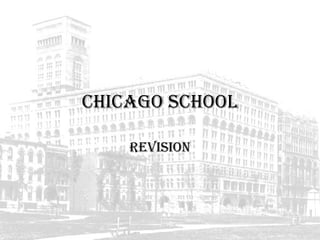
Chicago School Revision
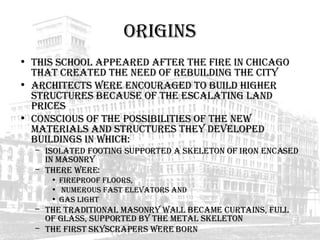
Origins This school appeared after the fire in Chicago that created the need of rebuilding the city Architects were encouraged to build higher structures because of the escalating land prices Conscious of the possibilities of the new materials and structures they developed buildings in which: Isolated footing supported a skeleton of iron encased in masonry There were: fireproof floors, numerous fast elevators and  gas light The traditional masonry wall became curtains, full of glass, supported by the metal skeleton The first skyscrapers were born
Sources of the style The Louisiana-born architect Henry Hobson Richardson. Although he was trained at the École des Beaux-Arts in Paris, Richardson rejected the  école 's dictum that the Greek and Roman classical style was the ultimate standard of design. Instead, his ideal was the rugged Romanesque of the South of France.   The second source of style for the architects of the First Chicago School derived from the very nature of the material they so wholeheartedly adopted: steel.
Sullivan Sullivan was the main architect of this style Sullivan provided his building with a firm visual base, treated the intermediate office floors as a unit, and crowned the whole with a bold cornice   The decorative ornamentation devised by Sullivan and used on some of his office buildings is based on floral motifs but organized in a manner closely resembling the Irish interlace of the early Middle Ages Sullivan designed with the principles of reconciling the world of nature with science and technology
Sullivan His buildings were detailed with lush, yet tastefully subdued organic ornamentation.  His attempt to balance ornamentation into the whole of building design inspired a generation of American and European architects;  the idea that ornamentation be integral to the building itself, rather than merely applied. He created a personal style that had few imitators or followers   Sullivan is one of the few human beings to whom Frank Lloyd Wright publicly acknowledged a debt of influence in his career.
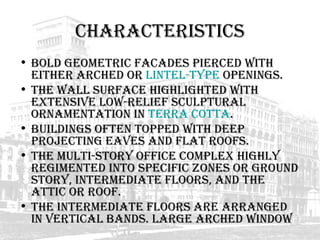
Characteristics Bold geometric facades pierced with either arched or  lintel-type  openings.  The wall surface highlighted with extensive low-relief sculptural ornamentation in  terra cotta .  Buildings often topped with deep projecting eaves and flat roofs.  The multi-story office complex highly regimented into specific zones or ground story, intermediate floors, and the attic or roof.  The intermediate floors are arranged in vertical bands. Large arched window
Characteristics Large arched window Decorative  terra cotta  panel  Decorative band  Vertical strips of windows  Pilaster-like   mullions   Projecting eaves (the under part of a sloping roof overhanging a wall)
Characteristics Highly decorated  frieze   Enriched foliated rinceau (an ornamental motif of scrolls of foliage, usually vine)  Porthole windows  Decorated  terra cotta   spandrels   Capital  of  pilaster  strips
Characteristics Guilloche (a pattern of interlacing bands forming a plait and used as an enrichment on a moulding) enrichment  Foliated and linear enrichments along jambs or entry
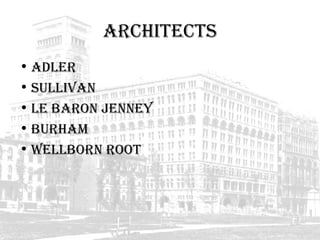
Architects Adler Sullivan Le Baron Jenney Burham Wellborn Root
Buildings Chicago’s Auditorium Montauk blok Chicago Stock Exchange Home Insurance Building Carson Store
Influences The First Chicago School was an astonishing and a profoundly important achievement. Its matchless tradition of technical prowess and aesthetic boldness would surface again in Chicago  in the 1930s with the arrival of the Bauhaus, and  in the following decades in the work of Ludwig Mies van der Rohe and his disciples.

Chicago School

  • 1.
  • 2.
    Origins This schoolappeared after the fire in Chicago that created the need of rebuilding the city Architects were encouraged to build higher structures because of the escalating land prices Conscious of the possibilities of the new materials and structures they developed buildings in which: Isolated footing supported a skeleton of iron encased in masonry There were: fireproof floors, numerous fast elevators and gas light The traditional masonry wall became curtains, full of glass, supported by the metal skeleton The first skyscrapers were born
  • 3.
    Sources of thestyle The Louisiana-born architect Henry Hobson Richardson. Although he was trained at the École des Beaux-Arts in Paris, Richardson rejected the école 's dictum that the Greek and Roman classical style was the ultimate standard of design. Instead, his ideal was the rugged Romanesque of the South of France. The second source of style for the architects of the First Chicago School derived from the very nature of the material they so wholeheartedly adopted: steel.
  • 4.
    Sullivan Sullivan wasthe main architect of this style Sullivan provided his building with a firm visual base, treated the intermediate office floors as a unit, and crowned the whole with a bold cornice The decorative ornamentation devised by Sullivan and used on some of his office buildings is based on floral motifs but organized in a manner closely resembling the Irish interlace of the early Middle Ages Sullivan designed with the principles of reconciling the world of nature with science and technology
  • 5.
    Sullivan His buildingswere detailed with lush, yet tastefully subdued organic ornamentation. His attempt to balance ornamentation into the whole of building design inspired a generation of American and European architects; the idea that ornamentation be integral to the building itself, rather than merely applied. He created a personal style that had few imitators or followers Sullivan is one of the few human beings to whom Frank Lloyd Wright publicly acknowledged a debt of influence in his career.
  • 6.
    Characteristics Bold geometricfacades pierced with either arched or lintel-type openings. The wall surface highlighted with extensive low-relief sculptural ornamentation in terra cotta . Buildings often topped with deep projecting eaves and flat roofs. The multi-story office complex highly regimented into specific zones or ground story, intermediate floors, and the attic or roof. The intermediate floors are arranged in vertical bands. Large arched window
  • 7.
    Characteristics Large archedwindow Decorative terra cotta panel Decorative band Vertical strips of windows Pilaster-like mullions Projecting eaves (the under part of a sloping roof overhanging a wall)
  • 8.
    Characteristics Highly decorated frieze Enriched foliated rinceau (an ornamental motif of scrolls of foliage, usually vine) Porthole windows Decorated terra cotta spandrels Capital of pilaster strips
  • 9.
    Characteristics Guilloche (apattern of interlacing bands forming a plait and used as an enrichment on a moulding) enrichment Foliated and linear enrichments along jambs or entry
  • 10.
    Architects Adler SullivanLe Baron Jenney Burham Wellborn Root
  • 11.
    Buildings Chicago’s AuditoriumMontauk blok Chicago Stock Exchange Home Insurance Building Carson Store
  • 12.
    Influences The FirstChicago School was an astonishing and a profoundly important achievement. Its matchless tradition of technical prowess and aesthetic boldness would surface again in Chicago in the 1930s with the arrival of the Bauhaus, and in the following decades in the work of Ludwig Mies van der Rohe and his disciples.