UNIVERSAL GRAMMAR (UG)
AND SECOND LANGUAGE ACQUISITION


             Guillermo Cid
             Sandra Leiva
           Patricia Retamales
   How do people learn a language?

   Do we learn language the way we learn everything?

   Or is there some special way our brains learns a
    language?
HISTORY
  HISTORY


UNIVERSAL
 UNIVERSAL
GRAMMAR
 GRAMMAR


 SECOND
  SECOND
LANGUAGE
 LANGUAGE
ACQUISITION
 ACQUISITION
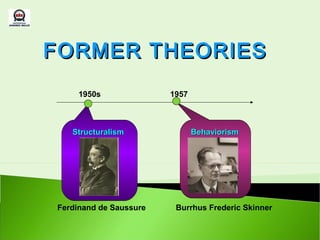
FORMER THEORIES
     1950s              1957


   Structuralism               Behaviorism


Ferdinand de Saussure    Burrhus Frederic Skinner
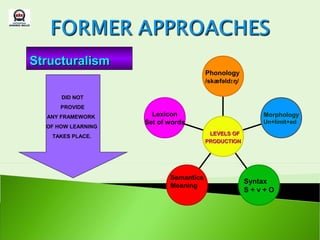
Structuralism
                                       Phonology
                                       /skæfəldɪ ŋ/

      DID NOT
      PROVIDE
  ANY FRAMEWORK       Lexicon                            Morphology
                    Set of words                         Un+limit+ed
  OF HOW LEARNING
                                        LEVELS OF
   TAKES PLACE.
                                       PRODUCTION


                           Semantics
                                                      Syntax
                           Meaning
                                                      S+v+O
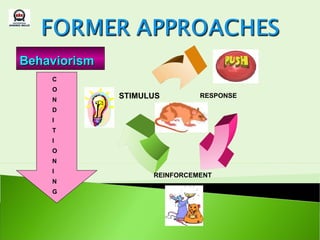
Behaviorism
    C
    O
    N
              STIMULUS         RESPONSE

    D
                     process
    I
    T
    I
    O
    N
    I
                    REINFORCEMENT
    N
    G
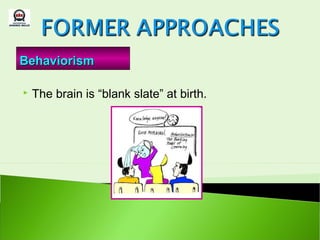
Behaviorism

   The brain is “blank slate” at birth.
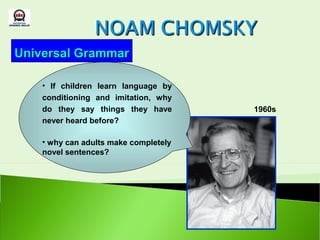
Universal Grammar

    • If children learn language by
    conditioning and imitation, why
    do they say things they have       1960s
    never heard before?

    • why can adults make completely
    novel sentences?
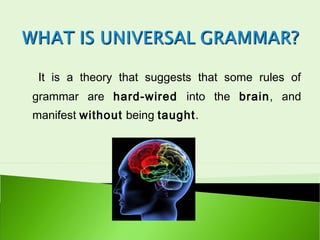
It is a theory that suggests that some rules of
grammar are hard-wired into the brain, and
manifest without being taught.
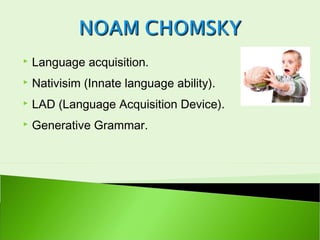
   Language acquisition.
   Nativisim (Innate language ability).
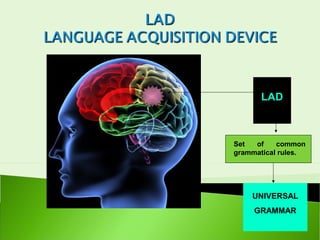
   LAD (Language Acquisition Device).
   Generative Grammar.
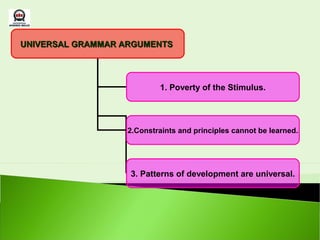
UNIVERSAL GRAMMAR ARGUMENTS


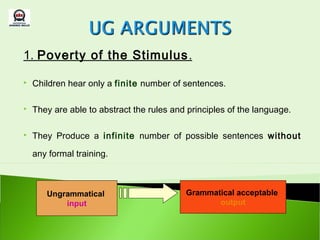
                          1. Poverty of the Stimulus.


                  2.Constraints and principles cannot be learned.


                   3. Patterns of development are universal.
1. Poverty of the Stimulus .

   Children hear only a finite number of sentences.

   They are able to abstract the rules and principles of the language.

   They Produce a infinite number of possible sentences without

    any formal training.


       Ungrammatical                       Grammatical acceptable
           input                                  output
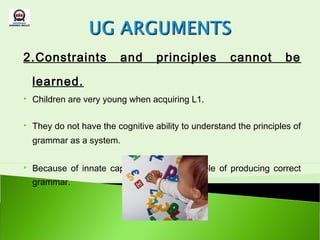
2.Constraints             and       principles         cannot         be

    learned.
   Children are very young when acquiring L1.

   They do not have the cognitive ability to understand the principles of
    grammar as a system.

   Because of innate capacity they are capable of producing correct
    grammar.
3. Patterns of development are universal

   Children learn the various aspects of a language in a
    very similar order.
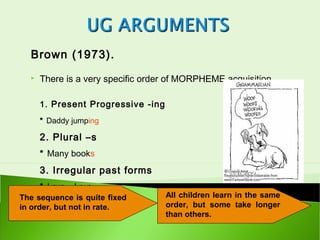
Brown (1973).
     There is a very specific order of MORPHEME acquisition.

      1. Present Progressive -ing
      * Daddy jumping

      2. Plural –s
      * Many books
      3. Irregular past forms
      * I run – I ran
The sequence is quite fixed         All children learn in the same
in order, but not in rate.          order, but some take longer
                                    than others.
LAD


Set  of    common
grammatical rules.


    UNIVERSAL
     GRAMMAR
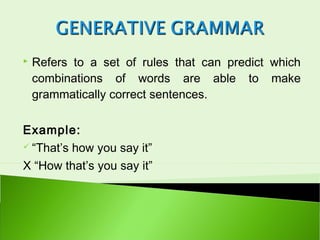
   Refers to a set of rules that can predict which
    combinations of words are able to make
    grammatically correct sentences.

Example:
 “That’s how you say it”

X “How that’s you say it”
Chomsky added two concepts later:

-Principles
          and parameters
-The minimalist program


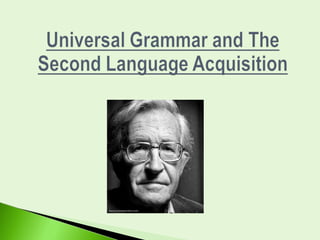
                                  Noam Chomsky
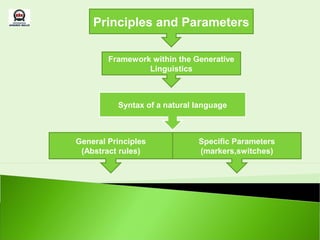
Principles and Parameters

        Framework within the Generative
                 Linguistics


          Syntax of a natural language


General Principles            Specific Parameters
 (Abstract rules)             (markers,switches)
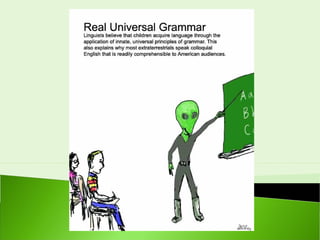
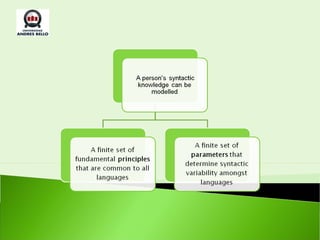
We all have a built in language acquisition device.
(same across languages).
Principles are built in rules for grammar.
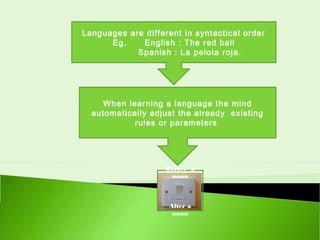
Languages are different in syntactical order
      Eg.    English : The red ball
            Spanish : La pelota roja.


     When learning a language the mind
  automatically adjust the already existing
            rules or parameters


                    Before a
                     noun


                    After a
                     noun
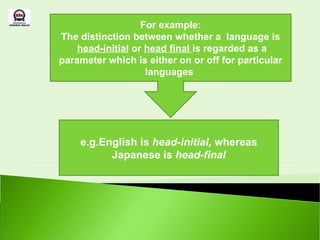
For example:
The distinction between whether a language is
    head-initial or head final is regarded as a
parameter which is either on or off for particular
                    languages


    e.g.English is head-initial, whereas
          Japanese is head-final
The goal of linguistics is to identify all of the
principles and parameters that are universal to
human language (called: Universal Grammar).
The Minimalist Program (MP) is a major line of
inquiry that has been developing inside Generative
Grammar since the early nineties.


Chomsky presents MP as a program, not as a theory.
 Conceptual framework to guide the developmental
               grammatical theory
The Minimalist Program (MP) is a major line of
inquiry that has been developing inside Generative
Grammar since the early nineties.


Chomsky presents MP as a program, not as a theory.
 Conceptual framework to guide the developmental
               grammatical theory
For Chomsky there are minimalist questions but the
answers can be framed in any theory
Why language has the properties it has?
MP explains the specific view of syntactic grammar
•Distinction   between   lexical   and   functional

category

•Chomsky basically found that learners need to

learn only the lexical information of the words

•Syntactic function develops automatically
Researchers have tried to find out
whether L2 learners have access to
            UG or not.
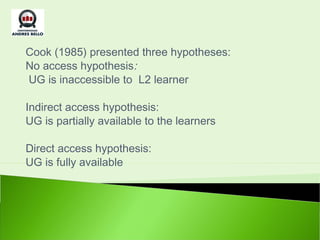
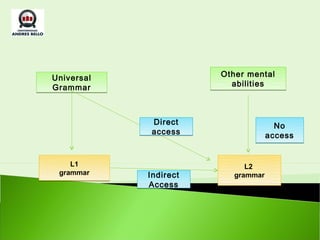
Cook (1985) presented three hypotheses:
No access hypothesis:
  UG is inaccessible to L2 learner
 
Indirect access hypothesis:
UG is partially available to the learners

Direct access hypothesis:
UG is fully available
Universal              Other mental
Grammar                  abilities


            Direct                   No
            access                 access


    L1                      L2
 grammar    Indirect     grammar
            Access
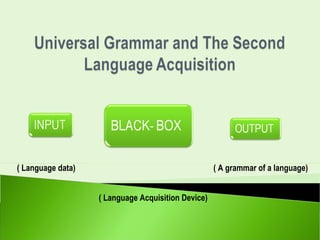
( Language data)                                    ( A grammar of a language)


                   ( Language Acquisition Device)
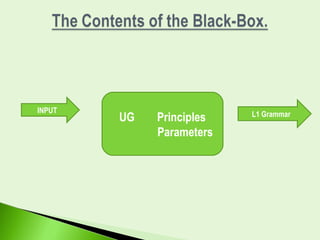
INPUT                     L1 Grammar
        UG   Principles
             Parameters

Universal grammar

  • 1.
    UNIVERSAL GRAMMAR (UG) ANDSECOND LANGUAGE ACQUISITION Guillermo Cid Sandra Leiva Patricia Retamales
  • 2.
    How do people learn a language?  Do we learn language the way we learn everything?  Or is there some special way our brains learns a language?
  • 3.
    HISTORY HISTORY UNIVERSAL UNIVERSAL GRAMMAR GRAMMAR SECOND SECOND LANGUAGE LANGUAGE ACQUISITION ACQUISITION
  • 4.
    FORMER THEORIES 1950s 1957 Structuralism Behaviorism Ferdinand de Saussure Burrhus Frederic Skinner
  • 5.
    Structuralism Phonology /skæfəldɪ ŋ/ DID NOT PROVIDE ANY FRAMEWORK Lexicon Morphology Set of words Un+limit+ed OF HOW LEARNING LEVELS OF TAKES PLACE. PRODUCTION Semantics Syntax Meaning S+v+O
  • 6.
    Behaviorism C O N STIMULUS RESPONSE D process I T I O N I REINFORCEMENT N G
  • 7.
    Behaviorism  The brain is “blank slate” at birth.
  • 8.
    Universal Grammar • If children learn language by conditioning and imitation, why do they say things they have 1960s never heard before? • why can adults make completely novel sentences?
  • 9.
    It is atheory that suggests that some rules of grammar are hard-wired into the brain, and manifest without being taught.
  • 10.
    Language acquisition.  Nativisim (Innate language ability).  LAD (Language Acquisition Device).  Generative Grammar.
  • 11.
    UNIVERSAL GRAMMAR ARGUMENTS 1. Poverty of the Stimulus. 2.Constraints and principles cannot be learned. 3. Patterns of development are universal.
  • 12.
    1. Poverty ofthe Stimulus .  Children hear only a finite number of sentences.  They are able to abstract the rules and principles of the language.  They Produce a infinite number of possible sentences without any formal training. Ungrammatical Grammatical acceptable input output
  • 13.
    2.Constraints and principles cannot be learned.  Children are very young when acquiring L1.  They do not have the cognitive ability to understand the principles of grammar as a system.  Because of innate capacity they are capable of producing correct grammar.
  • 14.
    3. Patterns ofdevelopment are universal  Children learn the various aspects of a language in a very similar order.
  • 15.
    Brown (1973).  There is a very specific order of MORPHEME acquisition. 1. Present Progressive -ing * Daddy jumping 2. Plural –s * Many books 3. Irregular past forms * I run – I ran The sequence is quite fixed All children learn in the same in order, but not in rate. order, but some take longer than others.
  • 16.
    LAD Set of common grammatical rules. UNIVERSAL GRAMMAR
  • 17.
    Refers to a set of rules that can predict which combinations of words are able to make grammatically correct sentences. Example:  “That’s how you say it” X “How that’s you say it”
  • 19.
    Chomsky added twoconcepts later: -Principles and parameters -The minimalist program Noam Chomsky
  • 20.
    Principles and Parameters Framework within the Generative Linguistics Syntax of a natural language General Principles Specific Parameters (Abstract rules) (markers,switches)
  • 21.
    We all havea built in language acquisition device. (same across languages). Principles are built in rules for grammar.
  • 22.
    Languages are differentin syntactical order Eg. English : The red ball Spanish : La pelota roja. When learning a language the mind automatically adjust the already existing rules or parameters Before a noun After a noun
  • 23.
    For example: The distinctionbetween whether a language is head-initial or head final is regarded as a parameter which is either on or off for particular languages e.g.English is head-initial, whereas Japanese is head-final
  • 25.
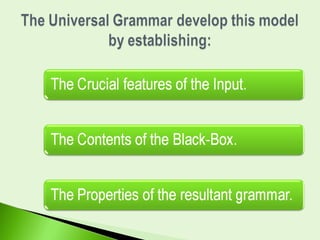
    The goal oflinguistics is to identify all of the principles and parameters that are universal to human language (called: Universal Grammar).
  • 26.
    The Minimalist Program(MP) is a major line of inquiry that has been developing inside Generative Grammar since the early nineties. Chomsky presents MP as a program, not as a theory. Conceptual framework to guide the developmental grammatical theory
  • 27.
    The Minimalist Program(MP) is a major line of inquiry that has been developing inside Generative Grammar since the early nineties. Chomsky presents MP as a program, not as a theory. Conceptual framework to guide the developmental grammatical theory
  • 28.
    For Chomsky thereare minimalist questions but the answers can be framed in any theory Why language has the properties it has? MP explains the specific view of syntactic grammar
  • 29.
    •Distinction between lexical and functional category •Chomsky basically found that learners need to learn only the lexical information of the words •Syntactic function develops automatically
  • 30.
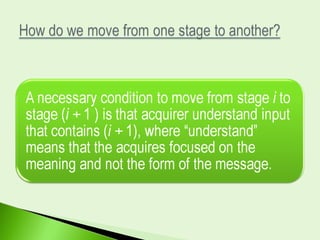
    Researchers have triedto find out whether L2 learners have access to UG or not.
  • 31.
    Cook (1985) presentedthree hypotheses: No access hypothesis: UG is inaccessible to L2 learner   Indirect access hypothesis: UG is partially available to the learners Direct access hypothesis: UG is fully available
  • 32.
    Universal Other mental Grammar abilities Direct No access access L1 L2 grammar Indirect grammar Access
  • 36.
    ( Language data) ( A grammar of a language) ( Language Acquisition Device)
  • 41.
    INPUT L1 Grammar UG Principles Parameters