Soil Respiration Responds to Nutrient Addition
in Northern Hardwood Forests
Tim Fahey, Cornell University
Components of Soil Respiration
• Heterotrophic respiration by microbial decomposers
• Root-associated respiration (supplied by belowground C
allocation)
- respiration of fine roots
- respiration of mycorrhizal fungi
- respiration of other rhizosphere microbes
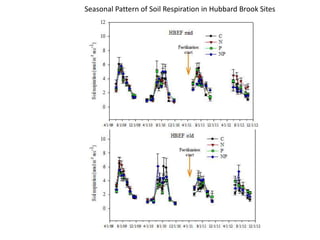
Seasonal Pattern of Soil Respiration in Hubbard Brook Sites
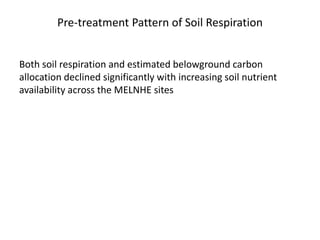
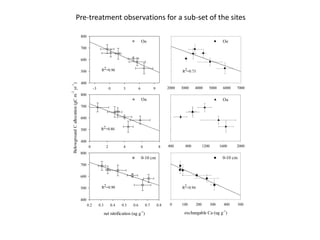
Pre-treatment Pattern of Soil Respiration
Both soil respiration and estimated belowground carbon
allocation declined significantly with increasing soil nutrient
availability across the MELNHE sites
-3 0 3 6 9
400
500
600
700
800
Oe
0 2 4 6 8
BelowgroundCallocation(gCm
-2
yr
-1
)
400
500
600
700
800
Oa
net nitrification (ug g-1
)
0.2 0.3 0.4 0.5 0.6 0.7 0.8
400
500
600
700
800
0-10 cm
2000 3000 4000 5000 6000 7000
Oe
400 800 1200 1600 2000
Oa
exchangable Ca (ug g-1
)
0 100 200 300 400 500
0-10 cm
R2=0.96
R2=0.80
R2=0.90
R2=0.73
R2=0.94
Pre-treatment observations for a sub-set of the sites
Hypotheses
1. Addition of a tree growth-limiting nutrient will reduce
belowground carbon allocation resulting in lower root-associated
respiration
1a. Colimitation would be indicated by strong response of soil
respiration to addition of N + P
2. Reduction of soil respiration will be greatest in most infertile
sites
3. Nitrogen addition might suppress activity of microbial
decomposers thereby complicating interpretation of respiration
response
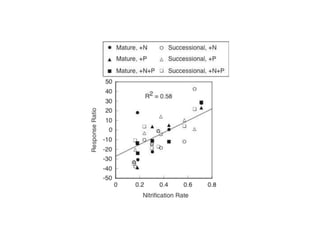
Response ratio of soil respiration to nutrient additions
We express the treatment effect on soil respiration as the ratio:
% response ratio= ((fertilized – control)/control) * 100
Thus a negative response ratio indicates a reduction of soil
respiration in the treated plots
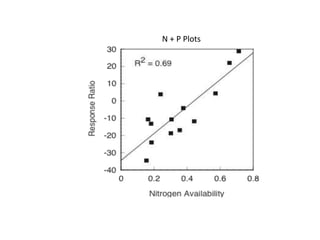
N + P Plots
Note: no clear evidence of a decline of heterotrophic
respiration in response to nutrient addition (next talk)
Conclusions
• Response of soil respiration to nutrient addition varies linearly
with pre-treatment site fertility
• Belowground carbon allocation in infertile sites decreases
significantly in response to nutrient additions (resulting in tree
aboveground growth increase?)
• Some indication of possible co-limitation by N and P on
infertile sites
Acknowledgements
Kikang, Hongzhang, Melany, Ruth and a cast of thousands
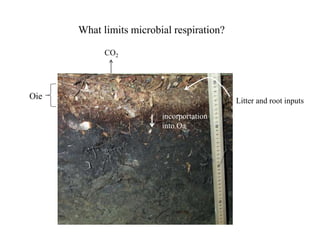
What limits microbial respiration?
Oie
CO2
incorportation
into Oa
Litter and root inputs
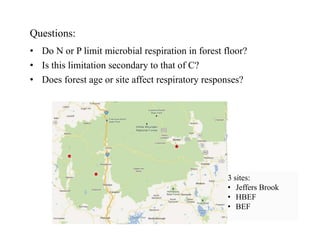
Questions:
• Do N or P limit microbial respiration in forest floor?
• Is this limitation secondary to that of C?
• Does forest age or site affect respiratory responses?
3 sites:
• Jeffers Brook
• HBEF
• BEF
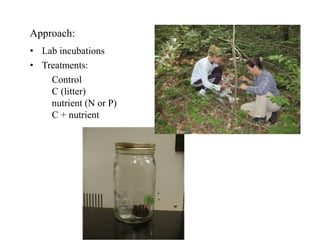
Approach:
• Lab incubations
• Treatments:
Control
C (litter)
nutrient (N or P)
C + nutrient
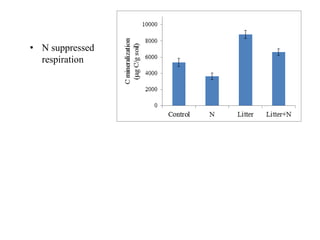
• N suppressed
respiration
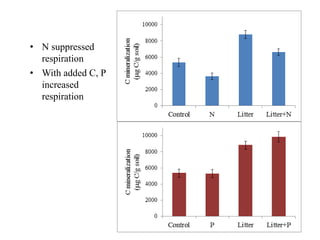
• N suppressed
respiration
• With added C, P
increased
respiration
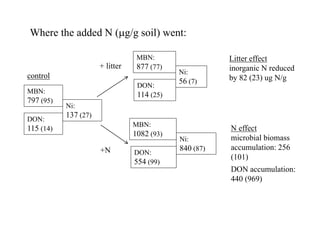
N effect
microbial biomass
accumulation: 256
(101)
DON accumulation:
440 (969)
Litter effect
inorganic N reduced
by 82 (23) ug N/g
Where the added N (mg/g soil) went:
Ni:
137 (27)
DON:
115 (14)
MBN:
797 (95)
Ni:
56 (7)
DON:
114 (25)
MBN:
877 (77)
Ni:
840 (87)
DON:
554 (99)
MBN:
1082 (93)
control
+ litter
+N
cellulases
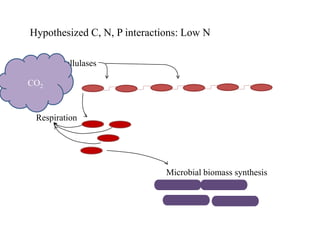
Hypothesized C, N, P interactions: Low N
Microbial biomass synthesis
CO2
Respiration
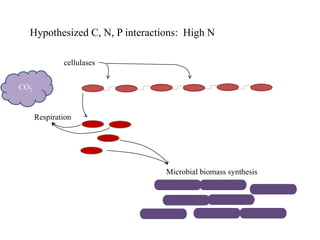
cellulases
Hypothesized C, N, P interactions: High N
Microbial biomass synthesis
Respiration
CO2
Why would P limitation be
induced by added C?
Hypothesized C, N, P interactions:
N may also limit enzyme production, C availability.
We predict that adding N and P together should increase microbial
respiration

Shoestring2014 6-respiration

  • 1.
    Soil Respiration Respondsto Nutrient Addition in Northern Hardwood Forests Tim Fahey, Cornell University
  • 3.
    Components of SoilRespiration • Heterotrophic respiration by microbial decomposers • Root-associated respiration (supplied by belowground C allocation) - respiration of fine roots - respiration of mycorrhizal fungi - respiration of other rhizosphere microbes
  • 4.
    Seasonal Pattern ofSoil Respiration in Hubbard Brook Sites
  • 5.
    Pre-treatment Pattern ofSoil Respiration Both soil respiration and estimated belowground carbon allocation declined significantly with increasing soil nutrient availability across the MELNHE sites
  • 6.
    -3 0 36 9 400 500 600 700 800 Oe 0 2 4 6 8 BelowgroundCallocation(gCm -2 yr -1 ) 400 500 600 700 800 Oa net nitrification (ug g-1 ) 0.2 0.3 0.4 0.5 0.6 0.7 0.8 400 500 600 700 800 0-10 cm 2000 3000 4000 5000 6000 7000 Oe 400 800 1200 1600 2000 Oa exchangable Ca (ug g-1 ) 0 100 200 300 400 500 0-10 cm R2=0.96 R2=0.80 R2=0.90 R2=0.73 R2=0.94 Pre-treatment observations for a sub-set of the sites
  • 7.
    Hypotheses 1. Addition ofa tree growth-limiting nutrient will reduce belowground carbon allocation resulting in lower root-associated respiration 1a. Colimitation would be indicated by strong response of soil respiration to addition of N + P 2. Reduction of soil respiration will be greatest in most infertile sites 3. Nitrogen addition might suppress activity of microbial decomposers thereby complicating interpretation of respiration response
  • 8.
    Response ratio ofsoil respiration to nutrient additions We express the treatment effect on soil respiration as the ratio: % response ratio= ((fertilized – control)/control) * 100 Thus a negative response ratio indicates a reduction of soil respiration in the treated plots
  • 10.
    N + PPlots
  • 11.
    Note: no clearevidence of a decline of heterotrophic respiration in response to nutrient addition (next talk)
  • 12.
    Conclusions • Response ofsoil respiration to nutrient addition varies linearly with pre-treatment site fertility • Belowground carbon allocation in infertile sites decreases significantly in response to nutrient additions (resulting in tree aboveground growth increase?) • Some indication of possible co-limitation by N and P on infertile sites
  • 13.
    Acknowledgements Kikang, Hongzhang, Melany,Ruth and a cast of thousands
  • 14.
    What limits microbialrespiration? Oie CO2 incorportation into Oa Litter and root inputs
  • 15.
    Questions: • Do Nor P limit microbial respiration in forest floor? • Is this limitation secondary to that of C? • Does forest age or site affect respiratory responses? 3 sites: • Jeffers Brook • HBEF • BEF
  • 16.
    Approach: • Lab incubations •Treatments: Control C (litter) nutrient (N or P) C + nutrient
  • 17.
  • 18.
    • N suppressed respiration •With added C, P increased respiration
  • 19.
    N effect microbial biomass accumulation:256 (101) DON accumulation: 440 (969) Litter effect inorganic N reduced by 82 (23) ug N/g Where the added N (mg/g soil) went: Ni: 137 (27) DON: 115 (14) MBN: 797 (95) Ni: 56 (7) DON: 114 (25) MBN: 877 (77) Ni: 840 (87) DON: 554 (99) MBN: 1082 (93) control + litter +N
  • 20.
    cellulases Hypothesized C, N,P interactions: Low N Microbial biomass synthesis CO2 Respiration
  • 21.
    cellulases Hypothesized C, N,P interactions: High N Microbial biomass synthesis Respiration CO2
  • 22.
    Why would Plimitation be induced by added C? Hypothesized C, N, P interactions: N may also limit enzyme production, C availability. We predict that adding N and P together should increase microbial respiration