Multiple Element Limitation
in Northern Hardwood Ecosystems
(MELNHE)
MENTORS
Tim Fahey
Melany Fisk
Mariann Johnston
Matt Vadeboncoeur
Ruth Yanai
GRAD STUDENTS
Daniel Hong
Gretchen Lasser
Alexandrea Rice
Adam Wild
Alexander Young
And all who went before!
UNDERGRADS
Kate Bazany
Marissa Gabriel
Arianna Libenson
Chase Macpherson
Donna Riner
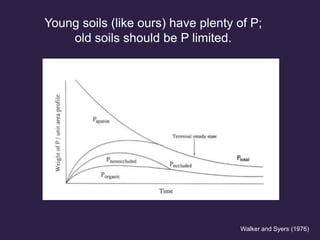
Young soils (like ours) have plenty of P;
old soils should be P limited.
Walker and Syers (1976)
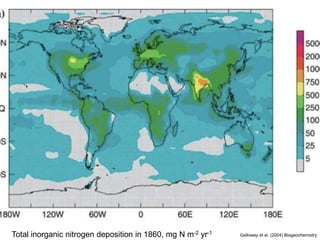
Total inorganic nitrogen deposition in 1860, mg N m-2 yr-1 Galloway et al. (2004) Biogeochemistry
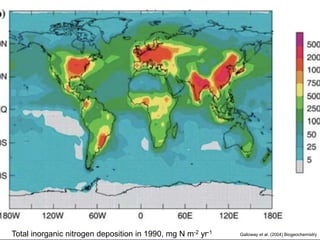
Total inorganic nitrogen deposition in 1990, mg N m-2 yr-1 Galloway et al. (2004) Biogeochemistry
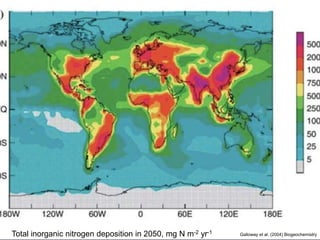
Total inorganic nitrogen deposition in 2050, mg N m-2 yr-1 Galloway et al. (2004) Biogeochemistry
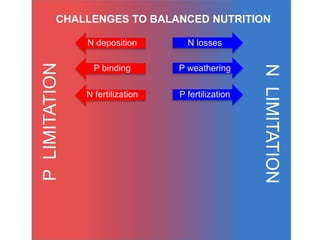
NLIMITATION
PLIMITATION
CHALLENGES TO BALANCED NUTRITION
P binding
N deposition
P weathering
P fertilization
N losses
N fertilization
NLIMITATION
PLIMITATION
CHALLENGES TO BALANCED NUTRITION
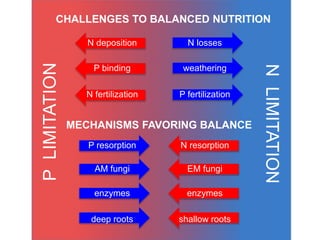
MECHANISMS FAVORING BALANCE
P binding
N deposition
EM fungi
enzymes
shallow roots
N resorption
weathering
P fertilization
N losses
AM fungi
enzymes
deep roots
P resorption
N fertilization
NLIMITATION
PLIMITATION
CHALLENGES TO BALANCED NUTRITION
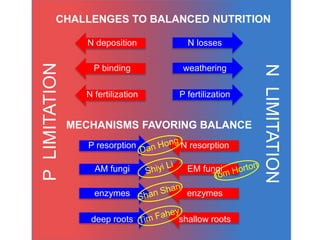
MECHANISMS FAVORING BALANCE
P binding
N deposition
EM fungi
enzymes
shallow roots
N resorption
weathering
P fertilization
N losses
AM fungi
enzymes
deep roots
P resorption
N fertilization
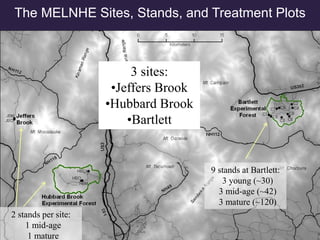
3 sites:
•Jeffers Brook
•Hubbard Brook
•Bartlett
2 stands per site:
1 mid-age
1 mature
9 stands at Bartlett:
3 young (~30)
3 mid-age (~42)
3 mature (~120)
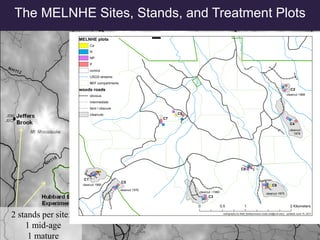
The MELNHE Sites, Stands, and Treatment Plots
3 sites:
•Jeffers Brook
•Hubbard Brook
•Bartlett
2 stands per site:
1 mid-age
1 mature
9 stands at Bartlett:
3 young (~30)
3 mid-age (~42)
3 mature (~120)
The MELNHE Sites, Stands, and Treatment Plots
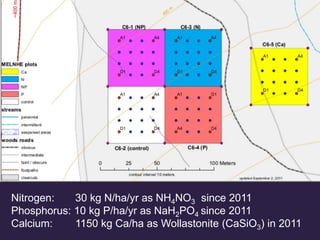
Nitrogen: 30 kg N/ha/yr as NH4NO3 since 2011
Phosphorus: 10 kg P/ha/yr as NaH2PO4 since 2011
Calcium: 1150 kg Ca/ha as Wollastonite (CaSiO3) in 2011
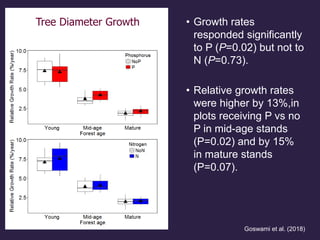
• Growth rates
responded significantly
to P (P=0.02) but not to
N (P=0.73).
• Relative growth rates
were higher by 13%,in
plots receiving P vs no
P in mid-age stands
(P=0.02) and by 15%
in mature stands
(P=0.07).
Tree Diameter Growth
Goswami et al. (2018)
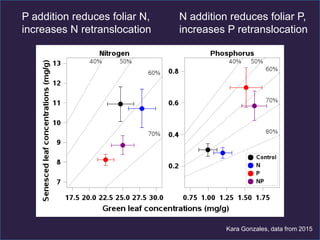
N addition reduces foliar P,
increases P retranslocation
P addition reduces foliar N,
increases N retranslocation
Kara Gonzales, data from 2015
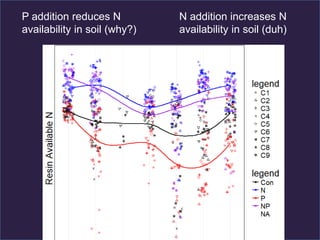
N addition increases N
availability in soil (duh)
P addition reduces N
availability in soil (why?)
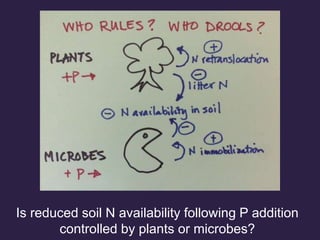
Is reduced soil N availability following P addition
controlled by plants or microbes?
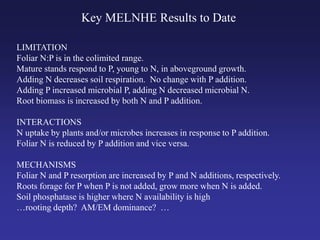
Key MELNHE Results to Date
LIMITATION
Foliar N:P is in the colimited range.
Mature stands respond to P, young to N, in aboveground growth.
Adding N decreases soil respiration. No change with P addition.
Adding P increased microbial P, adding N decreased microbial N.
Root biomass is increased by both N and P addition.
INTERACTIONS
N uptake by plants and/or microbes increases in response to P addition.
Foliar N is reduced by P addition and vice versa.
MECHANISMS
Foliar N and P resorption are increased by P and N additions, respectively.
Roots forage for P when P is not added, grow more when N is added.
Soil phosphatase is higher where N availability is high
…rooting depth? AM/EM dominance? …

HB 2018- Back on a shoestring

  • 1.
    Multiple Element Limitation inNorthern Hardwood Ecosystems (MELNHE) MENTORS Tim Fahey Melany Fisk Mariann Johnston Matt Vadeboncoeur Ruth Yanai GRAD STUDENTS Daniel Hong Gretchen Lasser Alexandrea Rice Adam Wild Alexander Young And all who went before! UNDERGRADS Kate Bazany Marissa Gabriel Arianna Libenson Chase Macpherson Donna Riner
  • 2.
    Young soils (likeours) have plenty of P; old soils should be P limited. Walker and Syers (1976)
  • 3.
    Total inorganic nitrogendeposition in 1860, mg N m-2 yr-1 Galloway et al. (2004) Biogeochemistry
  • 4.
    Total inorganic nitrogendeposition in 1990, mg N m-2 yr-1 Galloway et al. (2004) Biogeochemistry
  • 5.
    Total inorganic nitrogendeposition in 2050, mg N m-2 yr-1 Galloway et al. (2004) Biogeochemistry
  • 6.
    NLIMITATION PLIMITATION CHALLENGES TO BALANCEDNUTRITION P binding N deposition P weathering P fertilization N losses N fertilization
  • 7.
    NLIMITATION PLIMITATION CHALLENGES TO BALANCEDNUTRITION MECHANISMS FAVORING BALANCE P binding N deposition EM fungi enzymes shallow roots N resorption weathering P fertilization N losses AM fungi enzymes deep roots P resorption N fertilization
  • 8.
    NLIMITATION PLIMITATION CHALLENGES TO BALANCEDNUTRITION MECHANISMS FAVORING BALANCE P binding N deposition EM fungi enzymes shallow roots N resorption weathering P fertilization N losses AM fungi enzymes deep roots P resorption N fertilization
  • 9.
    3 sites: •Jeffers Brook •HubbardBrook •Bartlett 2 stands per site: 1 mid-age 1 mature 9 stands at Bartlett: 3 young (~30) 3 mid-age (~42) 3 mature (~120) The MELNHE Sites, Stands, and Treatment Plots
  • 10.
    3 sites: •Jeffers Brook •HubbardBrook •Bartlett 2 stands per site: 1 mid-age 1 mature 9 stands at Bartlett: 3 young (~30) 3 mid-age (~42) 3 mature (~120) The MELNHE Sites, Stands, and Treatment Plots
  • 11.
    Nitrogen: 30 kgN/ha/yr as NH4NO3 since 2011 Phosphorus: 10 kg P/ha/yr as NaH2PO4 since 2011 Calcium: 1150 kg Ca/ha as Wollastonite (CaSiO3) in 2011
  • 12.
    • Growth rates respondedsignificantly to P (P=0.02) but not to N (P=0.73). • Relative growth rates were higher by 13%,in plots receiving P vs no P in mid-age stands (P=0.02) and by 15% in mature stands (P=0.07). Tree Diameter Growth Goswami et al. (2018)
  • 13.
    N addition reducesfoliar P, increases P retranslocation P addition reduces foliar N, increases N retranslocation Kara Gonzales, data from 2015
  • 14.
    N addition increasesN availability in soil (duh) P addition reduces N availability in soil (why?)
  • 15.
    Is reduced soilN availability following P addition controlled by plants or microbes?
  • 16.
    Key MELNHE Resultsto Date LIMITATION Foliar N:P is in the colimited range. Mature stands respond to P, young to N, in aboveground growth. Adding N decreases soil respiration. No change with P addition. Adding P increased microbial P, adding N decreased microbial N. Root biomass is increased by both N and P addition. INTERACTIONS N uptake by plants and/or microbes increases in response to P addition. Foliar N is reduced by P addition and vice versa. MECHANISMS Foliar N and P resorption are increased by P and N additions, respectively. Roots forage for P when P is not added, grow more when N is added. Soil phosphatase is higher where N availability is high …rooting depth? AM/EM dominance? …

Editor's Notes

  • #2 Welcome to the Shoestring Session, otherwise known as MELNHE. I want to take this opportunity to thank our undergraduate interns, the grad students currently active in the project, and the mentors who bring in the big ideas and the funding. [We were called the Shoestring project during a gap between funded projects, and we're now out of money and seeking funding again, so let us know if you have transformative ideas.]
  • #3  long-term soil development, P is most available early in primary succession, but becomes less available in old soils due to weathering losses and occlusion in unavailable forms. So we expect temperate forests on glaciated soils to be N limited, not P limited.
  • #4 Ecosystems may have evolved under conditions of low N deposition,
  • #5 But we are increasingly adding N to forests from air pollution.
  • #6 So at some point, P should become more limiting.
  • #7 Ideally, plants and ecosystems have balanced nutrition, in the perfect purple zone in the middle. Throughout our talks, you are going to see red for P, blue for N, and purple for both. Factors that challenge balanced nutrition include natural processes like P weathering and occlusion, anthropogenic N deposition, and we can experimentally induce them with our fertilization experiment.
  • #8 We are interested in studying the mechanisms for restoring balance. All of these are things that we are working on:
  • #9 Dan Hong will be giving the very next talk on foliar nutrient resorption. Tim’s student Shiyi is working on fungal colonization of roots. Tom Horton is analyzing fungal DNA from ingrowth cores. Shan Shan, Melany’s student, presented work on enzymes last year, and Tim presented on roots last year and will be collecting roots in ingrowth cores this year.
  • #10 I’m going to give you the overall experimental design: Pay attention now, because you’re not going to see this again, it will be constantly referred to and you’re going to say, “Jeffers Brook?”
  • #11 Our treatment plots, to scale, ¼ hectare each. I’ll zoom in on C6:
  • #12 We have stands at 3 sites, all in the WM of NH. At JB and HB, we have 2 stands, one mid-aged and one old. The treatment plots include Control, N, P, N+P, and sometimes, where we had room, a Ca treatment plot. Most of the plots are 50x50 m, except in some of the young stands, 30x30.
  • #13 Key result, presented last year by Melany Fisk on behalf of Shinjini Goswami: Trees grew more in response to P addition.
  • #14 Kara Gonzales presented her thesis results 2 years ago, this is an improved figure, showing on the left that P addition reduces foliar N, which is on the x axis, and increases foliar retranlocation—Dan will tell you more about retranslocation in the next talk. I think this makes total sense from the plant’s point of view, but…
  • #15 Melany Fisk takes the soil microbe’s point of view. Her resin strips, which she has presented before, show that adding P reduces available nitrate and ammonium. Credit to Alex Young for making this graph this morning. So,
  • #16 From the soil point of view, if adding P increases N immobilization, it reduces N available for plant uptake, and that explains reduced foliar N and increased retranslocation. From the plant point of view, trees have a greater demand for N when you add P, they increase N retranslocation, which reduces litter quality, and microbes drool. I’ll stop here, because I want your insight on whether we can distinguish who rules and how this would inform management to make our forests great again.