
Gedanken zu
Learning Analytics
      Martin Ebner
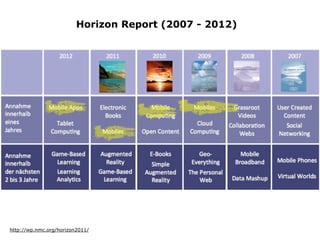
Horizon Report (2007 - 2012)


http://wp.nmc.org/horizon2011/
Educational Data Mining


           Educationa data mining (EDM) is a field
          that exploits statistical, machine-learning,
            and data-mining (DM) algorithms over
          the different types of educational data. Its
           main objective is to analyze these types
            of data in order to resolve educational
                        research issues.


Romero, C. (2010) Educational Data Mining: A Review of the State of the Art - in:
Systems, Man, and Cybernetics, Part C: Applications and Reviews, IEEE
Transactions on, 40, p. 601 - 618
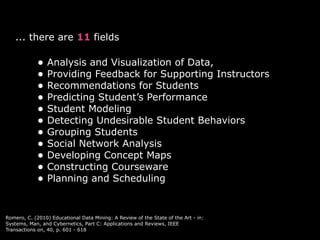
... there are 11 fields

            • Analysis and Visualization of Data,
            • Providing Feedback for Supporting Instructors
            • Recommendations for Students
            • Predicting Student’s Performance
            • Student Modeling
            • Detecting Undesirable Student Behaviors
            • Grouping Students
            • Social Network Analysis
            • Developing Concept Maps
            • Constructing Courseware
            • Planning and Scheduling


Romero, C. (2010) Educational Data Mining: A Review of the State of the Art - in:
Systems, Man, and Cybernetics, Part C: Applications and Reviews, IEEE
Transactions on, 40, p. 601 - 618
Learning Analytics


          Learning Analytics is the use of intelligent
          data, learner-produced data, and analysis
          models to discover information and social
          connections, and to predict and advise on
                           learning.


George Siemens (2010) http://www.elearnspace.org/blog/2010/08/25/what-are-
learning-analytics
Learning Analytics


               Learning Analytics is about collecting
               traces that learners leave behind and
              using those traces to improve learning.


Erik Duval (2012) http://www.slideshare.net/erik.duval/learning-
analytics-13050389
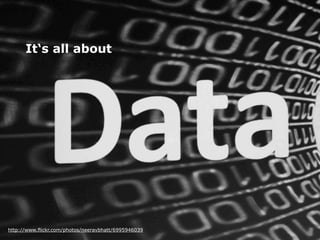
It‘s all about


http://www.flickr.com/photos/neeravbhatt/6995946039
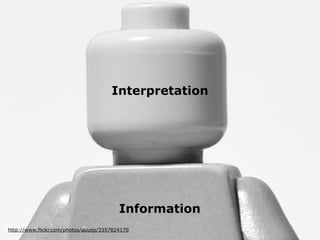
Interpretation


                                         Information
http://www.flickr.com/photos/auuep/3357824170
Beispiel


    ... ein scheinbar simples Problem ...
Beispiel


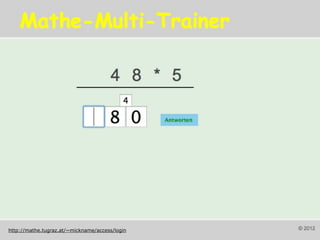
           ... das kleine EinmalEins für
                Volksschulkinder ...
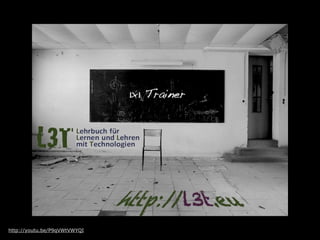
http://youtu.be/P9qVWtVWYQI
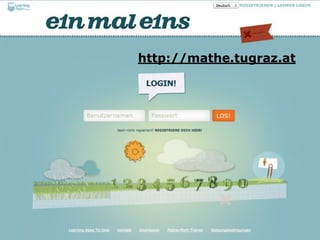
http://mathe.tugraz.at
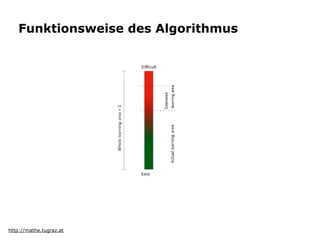
Funktionsweise des Algorithmus


                         !


http://mathe.tugraz.at
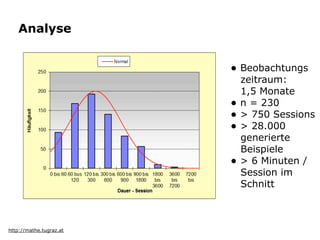
Analyse


                         • Beobachtungs
                             zeitraum:
                             1,5 Monate
                         •   n = 230
                         •   > 750 Sessions
                         •   > 28.000
                             generierte
                             Beispiele
                         •   > 6 Minuten /
                             Session im
                             Schnitt

     !

http://mathe.tugraz.at
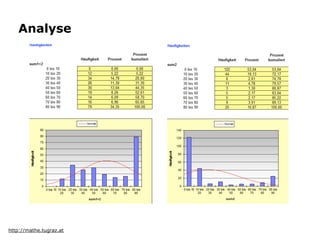
Analyse


                         !   !


http://mathe.tugraz.at
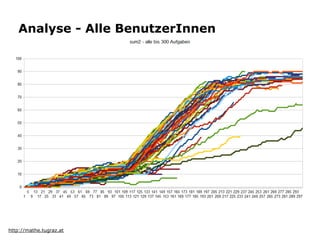
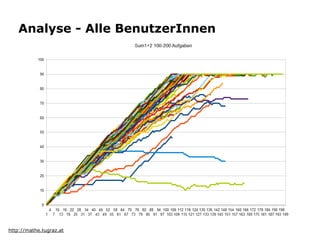
Analyse - Alle BenutzerInnen


                                  !


http://mathe.tugraz.at
Analyse - Alle BenutzerInnen


                                  !
http://mathe.tugraz.at
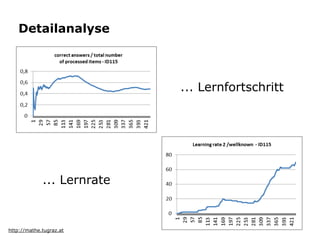
Detailanalyse


                                ... Lernfortschritt


   !
                            !


             ... Lernrate


http://mathe.tugraz.at
http://mathe.tugraz.at/~mickname/access/login
Learning Analytics ist die Interpretation
              von lernerspezifischen Daten um den
               individuellen Lernprozess gezielt zu
                           verbessern.


Martin Ebner & Martin Schön (2012)
Potenzial ist heute noch schwer
               abschätzbar, da mit zunehmender
             Datenmenge gänzlich neue Sichtweisen
                  gewonnen werden können.


                                         ABER ...

Martin Ebner & Martin Schön (2012)
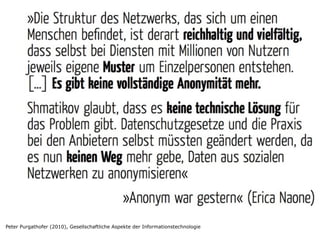
Peter Purgathofer (2010), Gesellschaftliche Aspekte der Informationstechnologie
Slides available at:   http://elearningblog.tugraz.at


                          SOCIAL LEARNING
                       Computer and Information Services
                         Graz University of Technology


                                      Graz University of Technology


                                Martin Ebner
                             martin.ebner@tugraz.at
  mebner                    http://elearning.tugraz.at

Gedanken zu Learning Analytics

  • 1.
  • 2.
    Horizon Report (2007- 2012) http://wp.nmc.org/horizon2011/
  • 3.
    Educational Data Mining Educationa data mining (EDM) is a field that exploits statistical, machine-learning, and data-mining (DM) algorithms over the different types of educational data. Its main objective is to analyze these types of data in order to resolve educational research issues. Romero, C. (2010) Educational Data Mining: A Review of the State of the Art - in: Systems, Man, and Cybernetics, Part C: Applications and Reviews, IEEE Transactions on, 40, p. 601 - 618
  • 4.
    ... there are11 fields • Analysis and Visualization of Data, • Providing Feedback for Supporting Instructors • Recommendations for Students • Predicting Student’s Performance • Student Modeling • Detecting Undesirable Student Behaviors • Grouping Students • Social Network Analysis • Developing Concept Maps • Constructing Courseware • Planning and Scheduling Romero, C. (2010) Educational Data Mining: A Review of the State of the Art - in: Systems, Man, and Cybernetics, Part C: Applications and Reviews, IEEE Transactions on, 40, p. 601 - 618
  • 5.
    Learning Analytics Learning Analytics is the use of intelligent data, learner-produced data, and analysis models to discover information and social connections, and to predict and advise on learning. George Siemens (2010) http://www.elearnspace.org/blog/2010/08/25/what-are- learning-analytics
  • 6.
    Learning Analytics Learning Analytics is about collecting traces that learners leave behind and using those traces to improve learning. Erik Duval (2012) http://www.slideshare.net/erik.duval/learning- analytics-13050389
  • 7.
  • 8.
    Interpretation Information http://www.flickr.com/photos/auuep/3357824170
  • 9.
    Beispiel ... ein scheinbar simples Problem ...
  • 10.
    Beispiel ... das kleine EinmalEins für Volksschulkinder ...
  • 11.
  • 12.
  • 13.
  • 14.
    Funktionsweise des Algorithmus ! http://mathe.tugraz.at
  • 15.
    Analyse • Beobachtungs zeitraum: 1,5 Monate • n = 230 • > 750 Sessions • > 28.000 generierte Beispiele • > 6 Minuten / Session im Schnitt ! http://mathe.tugraz.at
  • 16.
    Analyse ! ! http://mathe.tugraz.at
  • 17.
    Analyse - AlleBenutzerInnen ! http://mathe.tugraz.at
  • 18.
    Analyse - AlleBenutzerInnen ! http://mathe.tugraz.at
  • 19.
    Detailanalyse ... Lernfortschritt ! ! ... Lernrate http://mathe.tugraz.at
  • 20.
  • 21.
    Learning Analytics istdie Interpretation von lernerspezifischen Daten um den individuellen Lernprozess gezielt zu verbessern. Martin Ebner & Martin Schön (2012)
  • 22.
    Potenzial ist heutenoch schwer abschätzbar, da mit zunehmender Datenmenge gänzlich neue Sichtweisen gewonnen werden können. ABER ... Martin Ebner & Martin Schön (2012)
  • 23.
    Peter Purgathofer (2010),Gesellschaftliche Aspekte der Informationstechnologie
  • 24.
    Peter Purgathofer (2010),Gesellschaftliche Aspekte der Informationstechnologie
  • 25.
    Slides available at: http://elearningblog.tugraz.at SOCIAL LEARNING Computer and Information Services Graz University of Technology Graz University of Technology Martin Ebner martin.ebner@tugraz.at mebner http://elearning.tugraz.at