Graph Databases Use Cases
What’s a Graph?
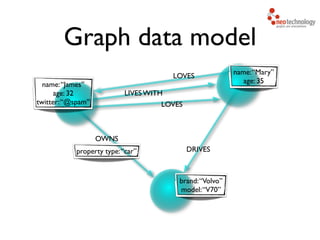
LIVES WITH
LOVES
OWNS
DRIVES
LOVES
name:“James”	

age: 32	

twitter:“@spam”
name:“Mary”	

age: 35
property type:“car”
brand:“Volvo”	

model:“V70”
Graph data model
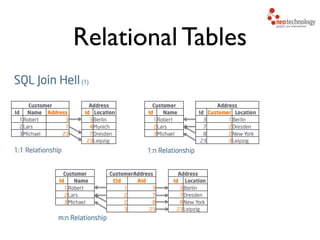
Relational Tables
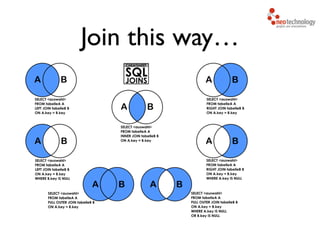
Join this way…
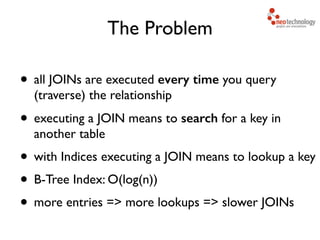
• all JOINs are executed every time you query
(traverse) the relationship 	

•  executing a JOIN means to search for a key in
another table 	

•  with Indices executing a JOIN means to lookup a key 	

•  B-Tree Index: O(log(n)) 	

•  more entries => more lookups => slower JOINs
The Problem
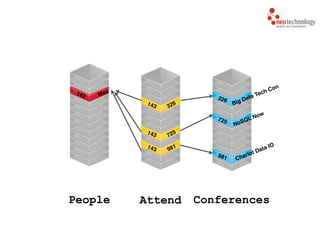
People ConferencesAttend
143 Max
326
Big Data Tech Con
725
NoSQL Now
981 Chariot Data IO143 981
143 725
143 326
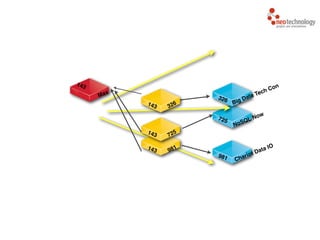
Max
Big Data Tech Con
NoSQL Now
Chariot Data IO
143
326
725
981
143 981
143 725
143 326
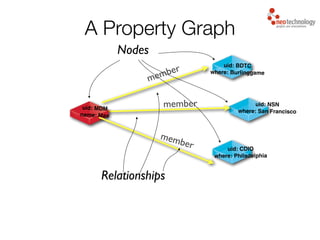
uid: MDM!
name: Max
uid: BDTC!
where: Burlinggame
uid: NSN!
where: San Francisco
uid: CDIO!
where: Philadelphia
Nodes
Relationships
member
member
member
A Property Graph
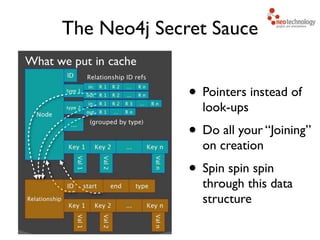
The Neo4j Secret Sauce
• Pointers instead of
look-ups	

• Do all your “Joining”
on creation	

• Spin spin spin
through this data
structure
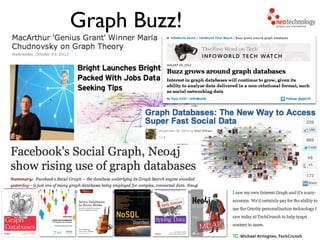
Graph Buzz!
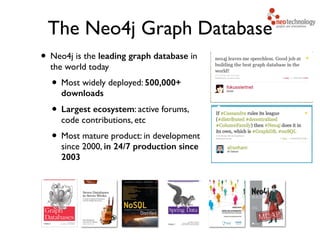
• Neo4j is the leading graph database in
the world today	

• Most widely deployed: 500,000+
downloads	

• Largest ecosystem: active forums,
code contributions, etc	

• Most mature product: in development
since 2000, in 24/7 production since
2003
The Neo4j Graph Database
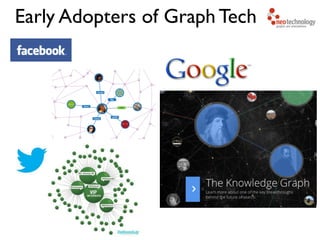
Early Adopters of Graph Tech
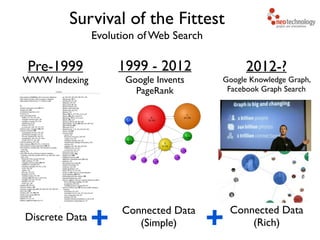
Evolution of Web Search
Survival of the Fittest
Pre-1999	

WWW Indexing
Discrete Data
1999 - 2012	

Google Invents
PageRank
Connected Data	

(Simple)
2012-?	

Google Knowledge Graph,
Facebook Graph Search
Connected Data	

(Rich)
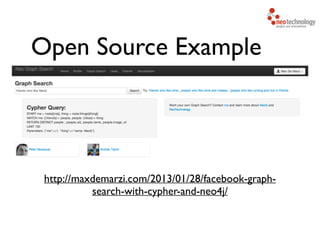
Open Source Example
http://maxdemarzi.com/2013/01/28/facebook-graph-
search-with-cypher-and-neo4j/
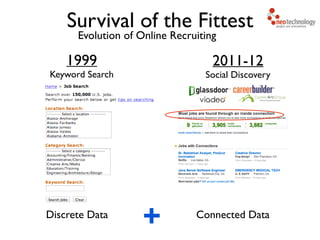
Evolution of Online Recruiting
1999	

Keyword Search
Discrete Data
Survival of the Fittest
2011-12	

Social Discovery
Connected Data
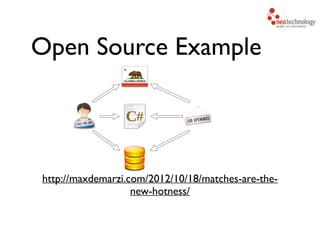
Open Source Example
http://maxdemarzi.com/2012/10/18/matches-are-the-
new-hotness/
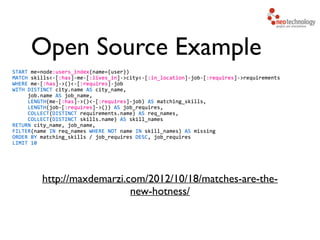
Open Source Example
http://maxdemarzi.com/2012/10/18/matches-are-the-
new-hotness/
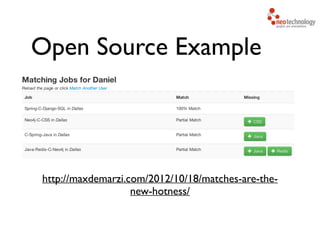
Open Source Example
http://maxdemarzi.com/2012/10/18/matches-are-the-
new-hotness/
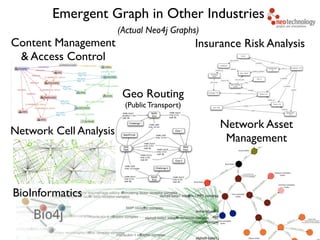
Content Management
& Access Control
Network Asset
Management
Network Cell Analysis
Geo Routing	

(Public Transport)
BioInformatics
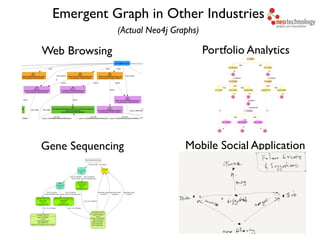
Emergent Graph in Other Industries
(Actual Neo4j Graphs)
Insurance Risk Analysis
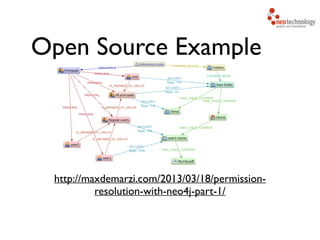
Open Source Example
http://maxdemarzi.com/2013/03/18/permission-
resolution-with-neo4j-part-1/
Web Browsing Portfolio Analytics
Mobile Social ApplicationGene Sequencing
Emergent Graph in Other Industries
(Actual Neo4j Graphs)
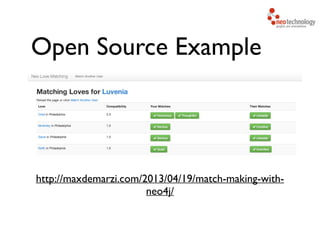
Open Source Example
http://maxdemarzi.com/2013/04/19/match-making-with-
neo4j/
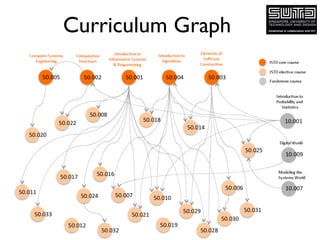
Curriculum Graph
Core Industries
& Use Cases:
Web / ISV
Finance &
Insurance
Datacom /
Telecom
Network & Data Center
Management
MDM
Social
Geo
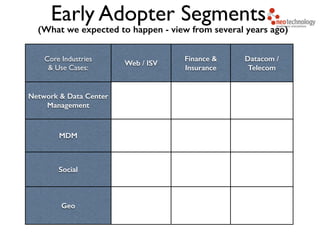
Early Adopter Segments
(What we expected to happen - view from several years ago)
Core Industries
& Use Cases:
Web / ISV
Finance &
Insurance
Telecomm-
unications
Network & Data Center
Management
MDM
Social
Geo
Core Industries
& Use Cases:
Software
Financial
Services
Telecommu
nications
Web Social, HR &
Recruiting
Health Care &
Life Sciences
Media &
Publishing
Energy, Services,
Automotive, Gov’t,
Logistics, Education,
Gaming, Other
Network & Data
Center Management
MDM / System of
Record
Social
Geo
Identity & Access
Mgmt
Content
Management
Recommend-ations
BI, CRM, Impact Analysis,
Fraud Detection, Resource
Optimization, etc.
Accenture
Finance
Energy Aerospace
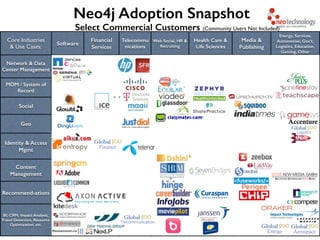
Neo4j Adoption Snapshot
Select Commercial Customers (Community Users Not Included)
What CanYou Do With
Graphs?
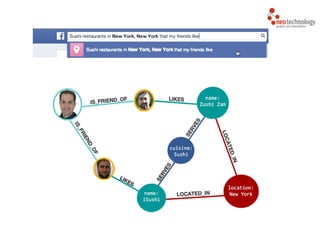
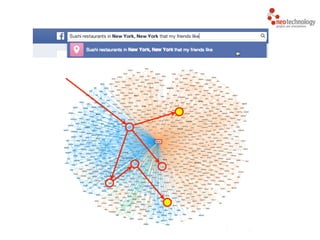
MATCH (me:Person)-[:IS_FRIEND_OF]->(friend),
(friend)-[:LIKES]->(restaurant),
(restaurant)-[:LOCATED_IN]->(city:Location),
(restaurant)-[:SERVES]->(cuisine:Cuisine)
!
WHERE me.name = 'Philip' AND city.location='New York' AND
cuisine.cuisine='Sushi'
!
RETURN restaurant.name
* Cypher query language examplehttp://maxdemarzi.com/?s=facebook
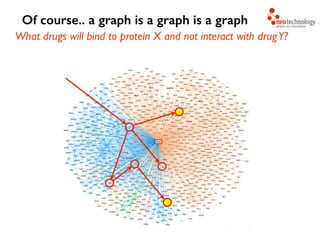
What drugs will bind to protein X and not interact with drugY?
Of course.. a graph is a graph is a graph
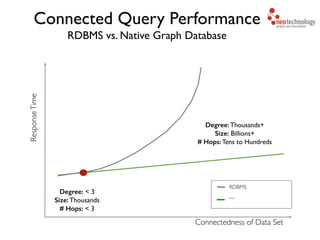
Connected Query
Performance
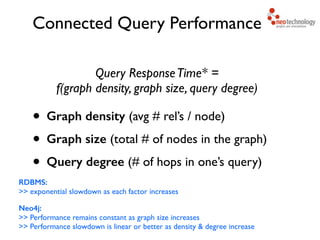
Query ResponseTime* = 	

f(graph density, graph size, query degree)
RDBMS:

>> exponential slowdown as each factor increases	

Neo4j:

>> Performance remains constant as graph size increases

>> Performance slowdown is linear or better as density & degree increase
• Graph density (avg # rel’s / node)	

• Graph size (total # of nodes in the graph)	

• Query degree (# of hops in one’s query)
Connected Query Performance
RDBMS vs. Native Graph Database
Connected Query Performance
Connectedness of Data Set
ResponseTime
RDBMS	

Degree: < 3	

Size: Thousands	

# Hops: < 3
Neo4j	

Degree: Thousands+	

Size: Billions+	

# Hops: Tens to Hundreds
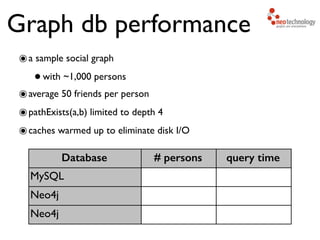
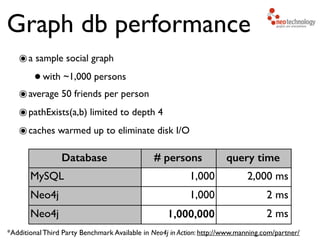
Database # persons query time
MySQL
Neo4j
Neo4j
๏a sample social graph 	

•with ~1,000 persons	

๏average 50 friends per person	

๏pathExists(a,b) limited to depth 4	

๏caches warmed up to eliminate disk I/O
Graph db performance
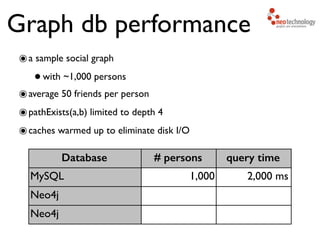
Database # persons query time
MySQL 1,000 2,000 ms
Neo4j
Neo4j
๏a sample social graph 	

•with ~1,000 persons	

๏average 50 friends per person	

๏pathExists(a,b) limited to depth 4	

๏caches warmed up to eliminate disk I/O
Graph db performance
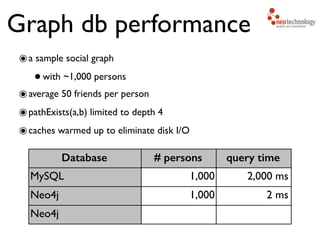
Database # persons query time
MySQL 1,000 2,000 ms
Neo4j 1,000 2 ms
Neo4j
๏a sample social graph 	

•with ~1,000 persons	

๏average 50 friends per person	

๏pathExists(a,b) limited to depth 4	

๏caches warmed up to eliminate disk I/O
Graph db performance
Database # persons query time
MySQL 1,000 2,000 ms
Neo4j 1,000 2 ms
Neo4j 1,000,000 2 ms
๏a sample social graph 	

•with ~1,000 persons	

๏average 50 friends per person	

๏pathExists(a,b) limited to depth 4	

๏caches warmed up to eliminate disk I/O
Graph db performance
*Additional Third Party Benchmark Available in Neo4j in Action: http://www.manning.com/partner/
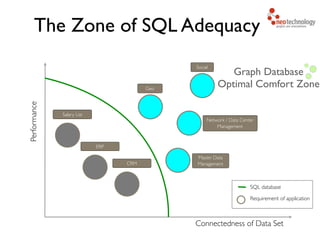
The Zone of SQL Adequacy
Connectedness of Data Set
Performance
SQL database	

Requirement of application
Salary List
ERP
CRM
Network / Data Center	

Management
Social
Master Data	

Management
Geo
Graph Database	

Optimal Comfort Zone
Graph Technology
Ecosystem
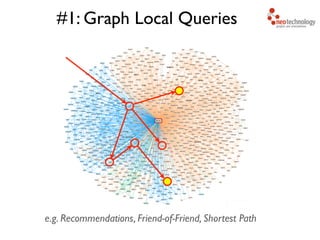
#1: Graph Local Queries
e.g. Recommendations, Friend-of-Friend, Shortest Path
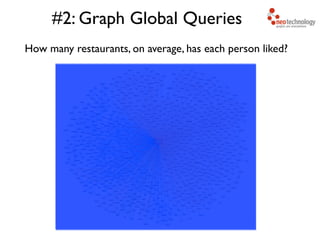
How many restaurants, on average, has each person liked?
#2: Graph Global Queries
What is a
Graph Database
“A graph database... is an online database
management system with CRUD methods
that expose a graph data model”1	

• Two important properties:	

• Native graph storage engine: written
from the ground up to manage graph data	

• Native graph processing, including

index-free adjacency to facilitate traversals
1] Robinson,Webber, Eifrem. Graph Databases. O’Reilly, 2013. p. 5. ISBN-10: 1449356265
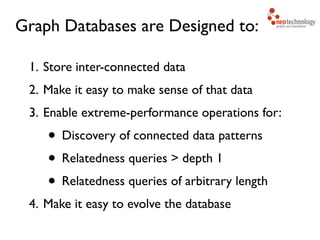
Graph Databases are Designed to:
1. Store inter-connected data	

2. Make it easy to make sense of that data	

3. Enable extreme-performance operations for:	

• Discovery of connected data patterns	

• Relatedness queries > depth 1	

• Relatedness queries of arbitrary length	

4. Make it easy to evolve the database
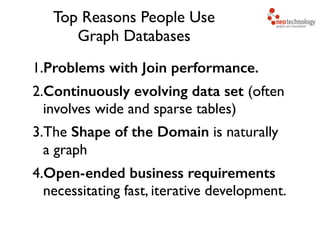
Top Reasons People Use 

Graph Databases
1.Problems with Join performance.	

2.Continuously evolving data set (often
involves wide and sparse tables)	

3.The Shape of the Domain is naturally
a graph	

4.Open-ended business requirements
necessitating fast, iterative development.
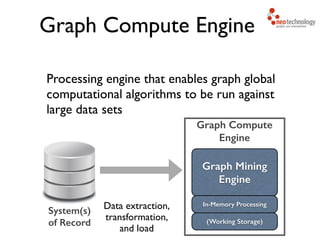
Graph Compute Engine
Processing engine that enables graph global
computational algorithms to be run against
large data sets
Graph Mining
Engine
(Working Storage)
In-Memory Processing
System(s)
of Record
Graph Compute
Engine
Data extraction,	

transformation,	

and load
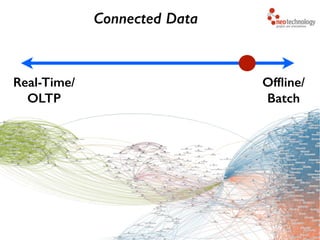
Real-Time/
OLTP
Offline/
Batch
Connected Data
Wait what?
New Users?
Real Time Updates?
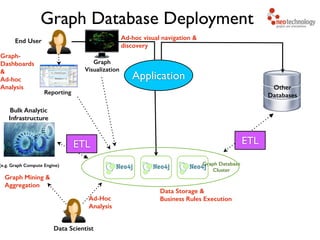
Graph Database Deployment
Application
Other
Databases
ETL
Graph Database
Cluster
Data Storage &

Business Rules Execution
Reporting
Graph-

Dashboards

&

Ad-hoc

Analysis

Graph
Visualization
End User Ad-hoc visual navigation &
discovery
Bulk Analytic
Infrastructure
(e.g. Graph Compute Engine)
ETL
Graph Mining &
Aggregation
Data Scientist
Ad-Hoc

Analysis
Graph Dashboards
The Power ofVisualization
Fraud Detection & Money Laundering
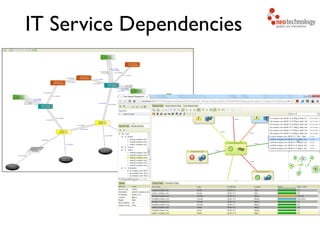
IT Service Dependencies
Working with Graphs
Case Studies &Working Examples
Cypher
LOVESA B
Graph PatternsASCII art
MATCH (A) -[:LOVES]-> (B)	
WHERE A.name = "A"	
RETURN B as lover
Social Example
Social Graph - Create
Practical Cypher
CREATE !
! (joe:Person {name:"Joe"}),!
! (bob:Person {name:"Bob"}),!
! (sally:Person {name:"Sally"}),!
! (anna:Person {name:"Anna"}),!
! (jim:Person {name:"Jim"}),!
! (mike:Person {name:"Mike"}),!
! (billy:Person {name:"Billy"}),!
! !
! (joe)-[:KNOWS]->(bob),!
! (joe)-[:KNOWS]->(sally),!
! (bob)-[:KNOWS]->(sally),!
! (sally)-[:KNOWS]->(anna),!
! (anna)-[:KNOWS]->(jim),!
! (anna)-[:KNOWS]->(mike),!
! (jim)-[:KNOWS]->(mike),!
! (jim)-[:KNOWS]->(billy)
Social Graph - Friends of Joe's Friends
MATCH (person)-[:KNOWS]-(friend),!
(friend)-[:KNOWS]-(foaf) !
WHERE person.name = "Joe"!
AND NOT(person-[:KNOWS]-foaf)!
RETURN foaf !
Practical Cypher
foaf
{name:"Anna"}
Social Graph - Common Friends
MATCH (person1)-[:KNOWS]-(friend),!
(person2)-[:KNOWS]-(friend)!
WHERE person1.name = "Joe" !
AND person2.name = "Sally"!
RETURN friend!
!
!
Practical Cypher
friend
{name:"Bob"}
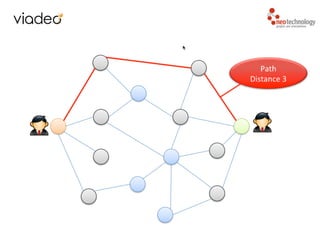
Social Graph - Shortest Path
MATCH path = shortestPath(!
(person1)-[:KNOWS*..6]-(person2)!
)!
WHERE person1.name = "Joe" !
! AND person2.name = "Billy"!
RETURN path!
!
Practical Cypher
path
{start:"13759", !
nodes:["13759","13757","13756","13755","13753"],!
length:4,!
relationships:["101407","101409","101410","101413"],!
end:"13753"}
Network Management
Example
Network Management - Create
CREATE !
! (crm {name:"CRM"}),!
! (dbvm {name:"Database VM"}),!
! (www {name:"Public Website"}),!
! (wwwvm {name:"Webserver VM"}),!
! (srv1 {name:"Server 1"}),!
! (san {name:"SAN"}),!
! (srv2 {name:"Server 2"}),!
!
! (crm)-[:DEPENDS_ON]->(dbvm),!
! (dbvm)-[:DEPENDS_ON]->(srv2),!
! (srv2)-[:DEPENDS_ON]->(san),!
! (www)-[:DEPENDS_ON]->(dbvm),!
! (www)-[:DEPENDS_ON]->(wwwvm),!
! (wwwvm)-[:DEPENDS_ON]->(srv1),!
! (srv1)-[:DEPENDS_ON]->(san)!
Practical Cypher
Network Management - Impact Analysis
// Server 1 Outage!
MATCH (n)<-[:DEPENDS_ON*]-(upstream)!
WHERE n.name = "Server 1"!
RETURN upstream!
Practical Cypher
upstream
{name:"Webserver VM"}
{name:"Public Website"}
Network Management - Dependency Analysis
// Public website dependencies!
MATCH (n)-[:DEPENDS_ON*]->(downstream)!
WHERE n.name = "Public Website"!
RETURN downstream!
!
Practical Cypher
downstream
{name:"Database VM"}
{name:"Server 2"}
{name:"SAN"}
{name:"Webserver VM"}
{name:"Server 1"}
Network Management - Statistics
// Most depended on component!
MATCH (n)<-[:DEPENDS_ON*]-(dependent)!
RETURN n, !
count(DISTINCT dependent) !
AS dependents!
ORDER BY dependents DESC!
LIMIT 1
Practical Cypher
n dependents
{name:"SAN"} 6
Questions ?

Graph database Use Cases

  • 1.
  • 2.
  • 3.
    LIVES WITH LOVES OWNS DRIVES LOVES name:“James” age: 32 twitter:“@spam” name:“Mary” age:35 property type:“car” brand:“Volvo” model:“V70” Graph data model
  • 4.
  • 5.
  • 6.
    • all JOINsare executed every time you query (traverse) the relationship •  executing a JOIN means to search for a key in another table •  with Indices executing a JOIN means to lookup a key •  B-Tree Index: O(log(n)) •  more entries => more lookups => slower JOINs The Problem
  • 7.
    People ConferencesAttend 143 Max 326 BigData Tech Con 725 NoSQL Now 981 Chariot Data IO143 981 143 725 143 326
  • 8.
    Max Big Data TechCon NoSQL Now Chariot Data IO 143 326 725 981 143 981 143 725 143 326
  • 9.
    uid: MDM! name: Max uid:BDTC! where: Burlinggame uid: NSN! where: San Francisco uid: CDIO! where: Philadelphia Nodes Relationships member member member A Property Graph
  • 10.
    The Neo4j SecretSauce • Pointers instead of look-ups • Do all your “Joining” on creation • Spin spin spin through this data structure
  • 11.
  • 12.
    • Neo4j isthe leading graph database in the world today • Most widely deployed: 500,000+ downloads • Largest ecosystem: active forums, code contributions, etc • Most mature product: in development since 2000, in 24/7 production since 2003 The Neo4j Graph Database
  • 13.
  • 14.
    Evolution of WebSearch Survival of the Fittest Pre-1999 WWW Indexing Discrete Data 1999 - 2012 Google Invents PageRank Connected Data (Simple) 2012-? Google Knowledge Graph, Facebook Graph Search Connected Data (Rich)
  • 15.
  • 16.
    Evolution of OnlineRecruiting 1999 Keyword Search Discrete Data Survival of the Fittest 2011-12 Social Discovery Connected Data
  • 17.
  • 18.
  • 19.
  • 20.
    Content Management & AccessControl Network Asset Management Network Cell Analysis Geo Routing (Public Transport) BioInformatics Emergent Graph in Other Industries (Actual Neo4j Graphs) Insurance Risk Analysis
  • 21.
  • 22.
    Web Browsing PortfolioAnalytics Mobile Social ApplicationGene Sequencing Emergent Graph in Other Industries (Actual Neo4j Graphs)
  • 23.
  • 24.
  • 25.
    Core Industries & UseCases: Web / ISV Finance & Insurance Datacom / Telecom Network & Data Center Management MDM Social Geo Early Adopter Segments (What we expected to happen - view from several years ago)
  • 26.
    Core Industries & UseCases: Web / ISV Finance & Insurance Telecomm- unications Network & Data Center Management MDM Social Geo Core Industries & Use Cases: Software Financial Services Telecommu nications Web Social, HR & Recruiting Health Care & Life Sciences Media & Publishing Energy, Services, Automotive, Gov’t, Logistics, Education, Gaming, Other Network & Data Center Management MDM / System of Record Social Geo Identity & Access Mgmt Content Management Recommend-ations BI, CRM, Impact Analysis, Fraud Detection, Resource Optimization, etc. Accenture Finance Energy Aerospace Neo4j Adoption Snapshot Select Commercial Customers (Community Users Not Included)
  • 27.
    What CanYou DoWith Graphs?
  • 29.
    MATCH (me:Person)-[:IS_FRIEND_OF]->(friend), (friend)-[:LIKES]->(restaurant), (restaurant)-[:LOCATED_IN]->(city:Location), (restaurant)-[:SERVES]->(cuisine:Cuisine) ! WHERE me.name= 'Philip' AND city.location='New York' AND cuisine.cuisine='Sushi' ! RETURN restaurant.name * Cypher query language examplehttp://maxdemarzi.com/?s=facebook
  • 31.
    What drugs willbind to protein X and not interact with drugY? Of course.. a graph is a graph is a graph
  • 32.
  • 33.
    Query ResponseTime* = f(graph density, graph size, query degree) RDBMS:
 >> exponential slowdown as each factor increases Neo4j:
 >> Performance remains constant as graph size increases
 >> Performance slowdown is linear or better as density & degree increase • Graph density (avg # rel’s / node) • Graph size (total # of nodes in the graph) • Query degree (# of hops in one’s query) Connected Query Performance
  • 34.
    RDBMS vs. NativeGraph Database Connected Query Performance Connectedness of Data Set ResponseTime RDBMS Degree: < 3 Size: Thousands # Hops: < 3 Neo4j Degree: Thousands+ Size: Billions+ # Hops: Tens to Hundreds
  • 35.
    Database # personsquery time MySQL Neo4j Neo4j ๏a sample social graph •with ~1,000 persons ๏average 50 friends per person ๏pathExists(a,b) limited to depth 4 ๏caches warmed up to eliminate disk I/O Graph db performance
  • 36.
    Database # personsquery time MySQL 1,000 2,000 ms Neo4j Neo4j ๏a sample social graph •with ~1,000 persons ๏average 50 friends per person ๏pathExists(a,b) limited to depth 4 ๏caches warmed up to eliminate disk I/O Graph db performance
  • 37.
    Database # personsquery time MySQL 1,000 2,000 ms Neo4j 1,000 2 ms Neo4j ๏a sample social graph •with ~1,000 persons ๏average 50 friends per person ๏pathExists(a,b) limited to depth 4 ๏caches warmed up to eliminate disk I/O Graph db performance
  • 38.
    Database # personsquery time MySQL 1,000 2,000 ms Neo4j 1,000 2 ms Neo4j 1,000,000 2 ms ๏a sample social graph •with ~1,000 persons ๏average 50 friends per person ๏pathExists(a,b) limited to depth 4 ๏caches warmed up to eliminate disk I/O Graph db performance *Additional Third Party Benchmark Available in Neo4j in Action: http://www.manning.com/partner/
  • 39.
    The Zone ofSQL Adequacy Connectedness of Data Set Performance SQL database Requirement of application Salary List ERP CRM Network / Data Center Management Social Master Data Management Geo Graph Database Optimal Comfort Zone
  • 40.
  • 41.
    #1: Graph LocalQueries e.g. Recommendations, Friend-of-Friend, Shortest Path
  • 42.
    How many restaurants,on average, has each person liked? #2: Graph Global Queries
  • 43.
    What is a GraphDatabase “A graph database... is an online database management system with CRUD methods that expose a graph data model”1 • Two important properties: • Native graph storage engine: written from the ground up to manage graph data • Native graph processing, including
 index-free adjacency to facilitate traversals 1] Robinson,Webber, Eifrem. Graph Databases. O’Reilly, 2013. p. 5. ISBN-10: 1449356265
  • 44.
    Graph Databases areDesigned to: 1. Store inter-connected data 2. Make it easy to make sense of that data 3. Enable extreme-performance operations for: • Discovery of connected data patterns • Relatedness queries > depth 1 • Relatedness queries of arbitrary length 4. Make it easy to evolve the database
  • 45.
    Top Reasons PeopleUse 
 Graph Databases 1.Problems with Join performance. 2.Continuously evolving data set (often involves wide and sparse tables) 3.The Shape of the Domain is naturally a graph 4.Open-ended business requirements necessitating fast, iterative development.
  • 46.
    Graph Compute Engine Processingengine that enables graph global computational algorithms to be run against large data sets Graph Mining Engine (Working Storage) In-Memory Processing System(s) of Record Graph Compute Engine Data extraction, transformation, and load
  • 47.
  • 55.
  • 56.
  • 58.
    Graph Database Deployment Application Other Databases ETL GraphDatabase Cluster Data Storage &
 Business Rules Execution Reporting Graph-
 Dashboards
 &
 Ad-hoc
 Analysis
 Graph Visualization End User Ad-hoc visual navigation & discovery Bulk Analytic Infrastructure (e.g. Graph Compute Engine) ETL Graph Mining & Aggregation Data Scientist Ad-Hoc
 Analysis
  • 59.
  • 60.
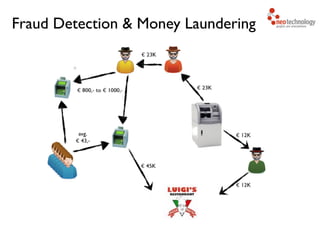
    Fraud Detection &Money Laundering
  • 61.
  • 62.
    Working with Graphs CaseStudies &Working Examples
  • 63.
    Cypher LOVESA B Graph PatternsASCIIart MATCH (A) -[:LOVES]-> (B) WHERE A.name = "A" RETURN B as lover
  • 64.
  • 65.
    Social Graph -Create Practical Cypher CREATE ! ! (joe:Person {name:"Joe"}),! ! (bob:Person {name:"Bob"}),! ! (sally:Person {name:"Sally"}),! ! (anna:Person {name:"Anna"}),! ! (jim:Person {name:"Jim"}),! ! (mike:Person {name:"Mike"}),! ! (billy:Person {name:"Billy"}),! ! ! ! (joe)-[:KNOWS]->(bob),! ! (joe)-[:KNOWS]->(sally),! ! (bob)-[:KNOWS]->(sally),! ! (sally)-[:KNOWS]->(anna),! ! (anna)-[:KNOWS]->(jim),! ! (anna)-[:KNOWS]->(mike),! ! (jim)-[:KNOWS]->(mike),! ! (jim)-[:KNOWS]->(billy)
  • 66.
    Social Graph -Friends of Joe's Friends MATCH (person)-[:KNOWS]-(friend),! (friend)-[:KNOWS]-(foaf) ! WHERE person.name = "Joe"! AND NOT(person-[:KNOWS]-foaf)! RETURN foaf ! Practical Cypher foaf {name:"Anna"}
  • 67.
    Social Graph -Common Friends MATCH (person1)-[:KNOWS]-(friend),! (person2)-[:KNOWS]-(friend)! WHERE person1.name = "Joe" ! AND person2.name = "Sally"! RETURN friend! ! ! Practical Cypher friend {name:"Bob"}
  • 68.
    Social Graph -Shortest Path MATCH path = shortestPath(! (person1)-[:KNOWS*..6]-(person2)! )! WHERE person1.name = "Joe" ! ! AND person2.name = "Billy"! RETURN path! ! Practical Cypher path {start:"13759", ! nodes:["13759","13757","13756","13755","13753"],! length:4,! relationships:["101407","101409","101410","101413"],! end:"13753"}
  • 69.
  • 70.
    Network Management -Create CREATE ! ! (crm {name:"CRM"}),! ! (dbvm {name:"Database VM"}),! ! (www {name:"Public Website"}),! ! (wwwvm {name:"Webserver VM"}),! ! (srv1 {name:"Server 1"}),! ! (san {name:"SAN"}),! ! (srv2 {name:"Server 2"}),! ! ! (crm)-[:DEPENDS_ON]->(dbvm),! ! (dbvm)-[:DEPENDS_ON]->(srv2),! ! (srv2)-[:DEPENDS_ON]->(san),! ! (www)-[:DEPENDS_ON]->(dbvm),! ! (www)-[:DEPENDS_ON]->(wwwvm),! ! (wwwvm)-[:DEPENDS_ON]->(srv1),! ! (srv1)-[:DEPENDS_ON]->(san)! Practical Cypher
  • 71.
    Network Management -Impact Analysis // Server 1 Outage! MATCH (n)<-[:DEPENDS_ON*]-(upstream)! WHERE n.name = "Server 1"! RETURN upstream! Practical Cypher upstream {name:"Webserver VM"} {name:"Public Website"}
  • 72.
    Network Management -Dependency Analysis // Public website dependencies! MATCH (n)-[:DEPENDS_ON*]->(downstream)! WHERE n.name = "Public Website"! RETURN downstream! ! Practical Cypher downstream {name:"Database VM"} {name:"Server 2"} {name:"SAN"} {name:"Webserver VM"} {name:"Server 1"}
  • 73.
    Network Management -Statistics // Most depended on component! MATCH (n)<-[:DEPENDS_ON*]-(dependent)! RETURN n, ! count(DISTINCT dependent) ! AS dependents! ORDER BY dependents DESC! LIMIT 1 Practical Cypher n dependents {name:"SAN"} 6
  • 74.