GRAPH DATABASE
SDIA/M1
Zakaria Benmounah
Constantine 2 University
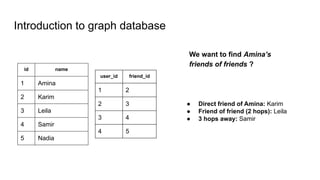
Introduction to graph database
id name
1 Amina
2 Karim
3 Leila
4 Samir
5 Nadia
user_id friend_id
1 2
2 3
3 4
4 5
We want to find Amina’s
friends of friends ?
● Direct friend of Amina: Karim
● Friend of friend (2 hops): Leila
● 3 hops away: Samir
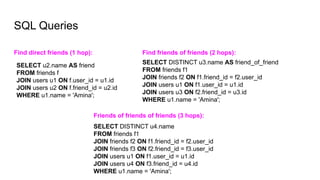
SQL Queries
SELECT u2.name AS friend
FROM friends f
JOIN users u1 ON f.user_id = u1.id
JOIN users u2 ON f.friend_id = u2.id
WHERE u1.name = 'Amina';
SELECT DISTINCT u3.name AS friend_of_friend
FROM friends f1
JOIN friends f2 ON f1.friend_id = f2.user_id
JOIN users u1 ON f1.user_id = u1.id
JOIN users u3 ON f2.friend_id = u3.id
WHERE u1.name = 'Amina';
SELECT DISTINCT u4.name
FROM friends f1
JOIN friends f2 ON f1.friend_id = f2.user_id
JOIN friends f3 ON f2.friend_id = f3.user_id
JOIN users u1 ON f1.user_id = u1.id
JOIN users u4 ON f3.friend_id = u4.id
WHERE u1.name = 'Amina';
Find direct friends (1 hop): Find friends of friends (2 hops):
Friends of friends of friends (3 hops):
Neo4 Queries
Find direct friends (1 hop):
Find friends of friends (2 hops):
friends of friends of friends (3 hops):
MATCH (a:Person {name:'Amina'})-[:FRIEND_WITH]->(f)
RETURN f.name;
MATCH (a:Person {name:'Amina'})-[:FRIEND_WITH*2]->(fof)
RETURN DISTINCT fof.name;
MATCH (a:Person {name:'Amina'})-[:FRIEND_WITH*1..3]->(other)
RETURN DISTINCT other.name;
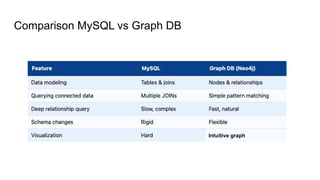
Comparison MySQL vs Graph DB
Intuitive graph
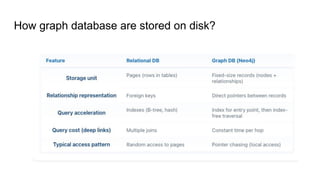
How graph database are stored on disk?
When Graph Databases Are Better?
Scenario A: Social Network Connections
● Goal: Find “friends of friends” or mutual friends.
● Data nature: Highly connected, many relationships per entity.
● Relational Problem: Requires multiple self-joins (slow as data grows).
● Graph Advantage: Simple pattern query, constant traversal time.
Use cases:
● Social networks (Facebook, LinkedIn)
● Professional networking platforms
● Influencer discovery
When Graph Databases Are Better?
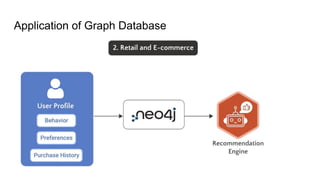
Scenario B: Recommendation Systems
● Goal: “People who like this product also liked…”
● Data nature: Complex relationships between users, products, categories.
● Relational Problem: Many-to-many joins between large tables.
● Graph Advantage: Relationships are direct, easy to traverse.
Use cases:
● Amazon, Netflix, Spotify recommendation engines
● Product or movie similarity detection
When Graph Databases Are Better?
Scenario C: Fraud Detection / Pattern Recognition
● Goal: Detect suspicious account networks or hidden connections.
● Data nature: Many indirect relationships, often unknown in advance.
● Relational Problem: Hard to query unknown relationship depth (needs recursive SQL).
● Graph Advantage: Pattern matching easily reveals complex hidden paths.
Use cases:
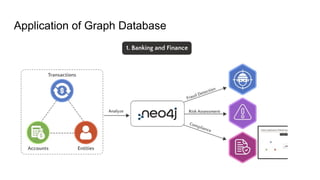
● Banking & financial monitoring
● Cybersecurity
● Telecom fraud
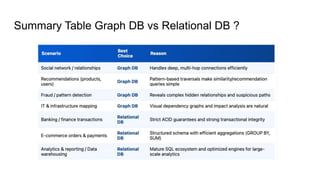
Summary Table Graph DB vs Relational DB ?
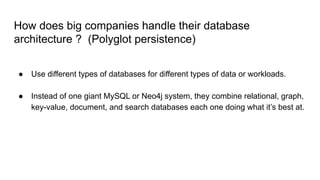
How does big companies handle their database
architecture ? (Polyglot persistence)
● Use different types of databases for different types of data or workloads.
● Instead of one giant MySQL or Neo4j system, they combine relational, graph,
key-value, document, and search databases each one doing what it’s best at.
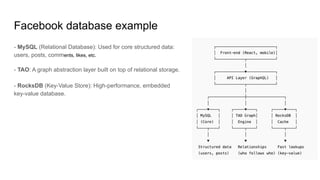
Facebook database example
- MySQL (Relational Database): Used for core structured data:
users, posts, comments, likes, etc.
- TAO: A graph abstraction layer built on top of relational storage.
- RocksDB (Key-Value Store): High-performance, embedded
key-value database.
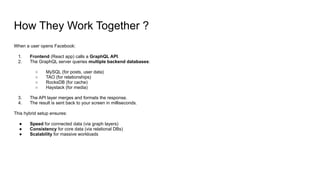
How They Work Together ?
When a user opens Facebook:
1. Frontend (React app) calls a GraphQL API.
2. The GraphQL server queries multiple backend databases:
○ MySQL (for posts, user data)
○ TAO (for relationships)
○ RocksDB (for cache)
○ Haystack (for media)
3. The API layer merges and formats the response.
4. The result is sent back to your screen in milliseconds.
This hybrid setup ensures:
● Speed for connected data (via graph layers)
● Consistency for core data (via relational DBs)
● Scalability for massive workloads
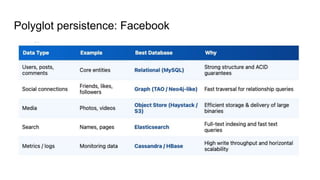
Polyglot persistence: Facebook
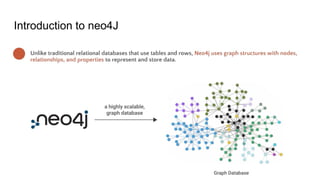
Introduction to neo4J
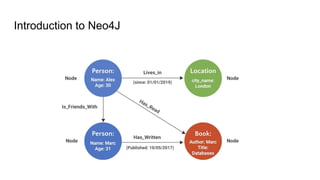
Introduction to Neo4J
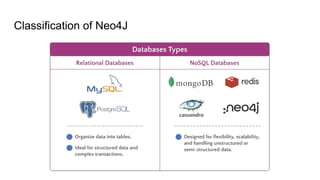
Classification of Neo4J
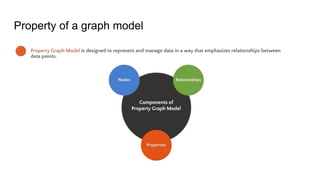
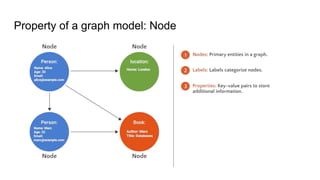
Property of a graph model
Property of a graph model: Node
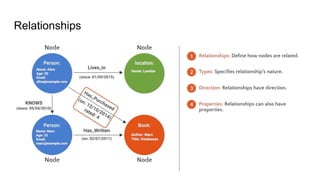
Relationships
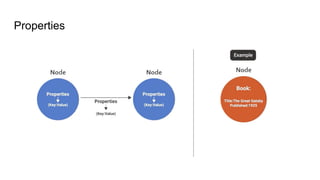
Properties
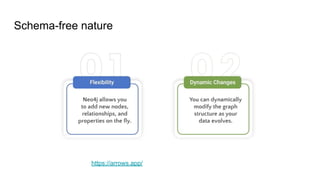
Schema-free nature
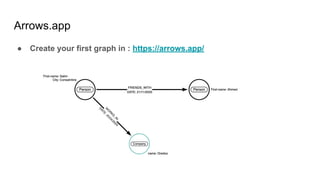
https://arrows.app/
Arrows.app
● Create your first graph in : https://arrows.app/
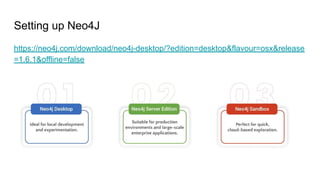
Setting up Neo4J
https://neo4j.com/download/neo4j-desktop/?edition=desktop&flavour=osx&release
=1.6.1&offline=false
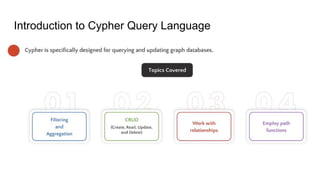
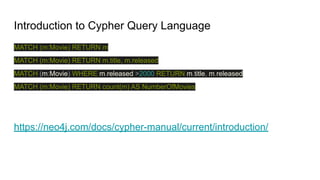
Introduction to Cypher Query Language
MATCH (m:Movie) RETURN m
MATCH (m:Movie) RETURN m.title, m.released
MATCH (m:Movie) WHERE m.released >2000 RETURN m.title, m.released
MATCH (m:Movie) RETURN count(m) AS NumberOfMovies
https://neo4j.com/docs/cypher-manual/current/introduction/
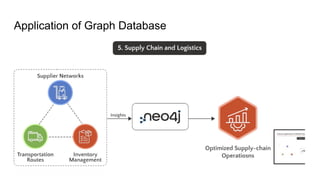
Application of Graph Database
Neo4J
● Download: Downlaod 4J from :
https://neo4j.com/deployment-center/
● Demo

Graph-database_10.ppt etty rty Graph-database_10.ppt etty rtyGraph-database_10.ppt etty rty

  • 1.
  • 2.
    Introduction to graphdatabase id name 1 Amina 2 Karim 3 Leila 4 Samir 5 Nadia user_id friend_id 1 2 2 3 3 4 4 5 We want to find Amina’s friends of friends ? ● Direct friend of Amina: Karim ● Friend of friend (2 hops): Leila ● 3 hops away: Samir
  • 3.
    SQL Queries SELECT u2.nameAS friend FROM friends f JOIN users u1 ON f.user_id = u1.id JOIN users u2 ON f.friend_id = u2.id WHERE u1.name = 'Amina'; SELECT DISTINCT u3.name AS friend_of_friend FROM friends f1 JOIN friends f2 ON f1.friend_id = f2.user_id JOIN users u1 ON f1.user_id = u1.id JOIN users u3 ON f2.friend_id = u3.id WHERE u1.name = 'Amina'; SELECT DISTINCT u4.name FROM friends f1 JOIN friends f2 ON f1.friend_id = f2.user_id JOIN friends f3 ON f2.friend_id = f3.user_id JOIN users u1 ON f1.user_id = u1.id JOIN users u4 ON f3.friend_id = u4.id WHERE u1.name = 'Amina'; Find direct friends (1 hop): Find friends of friends (2 hops): Friends of friends of friends (3 hops):
  • 4.
    Neo4 Queries Find directfriends (1 hop): Find friends of friends (2 hops): friends of friends of friends (3 hops): MATCH (a:Person {name:'Amina'})-[:FRIEND_WITH]->(f) RETURN f.name; MATCH (a:Person {name:'Amina'})-[:FRIEND_WITH*2]->(fof) RETURN DISTINCT fof.name; MATCH (a:Person {name:'Amina'})-[:FRIEND_WITH*1..3]->(other) RETURN DISTINCT other.name;
  • 5.
    Comparison MySQL vsGraph DB Intuitive graph
  • 6.
    How graph databaseare stored on disk?
  • 7.
    When Graph DatabasesAre Better? Scenario A: Social Network Connections ● Goal: Find “friends of friends” or mutual friends. ● Data nature: Highly connected, many relationships per entity. ● Relational Problem: Requires multiple self-joins (slow as data grows). ● Graph Advantage: Simple pattern query, constant traversal time. Use cases: ● Social networks (Facebook, LinkedIn) ● Professional networking platforms ● Influencer discovery
  • 8.
    When Graph DatabasesAre Better? Scenario B: Recommendation Systems ● Goal: “People who like this product also liked…” ● Data nature: Complex relationships between users, products, categories. ● Relational Problem: Many-to-many joins between large tables. ● Graph Advantage: Relationships are direct, easy to traverse. Use cases: ● Amazon, Netflix, Spotify recommendation engines ● Product or movie similarity detection
  • 9.
    When Graph DatabasesAre Better? Scenario C: Fraud Detection / Pattern Recognition ● Goal: Detect suspicious account networks or hidden connections. ● Data nature: Many indirect relationships, often unknown in advance. ● Relational Problem: Hard to query unknown relationship depth (needs recursive SQL). ● Graph Advantage: Pattern matching easily reveals complex hidden paths. Use cases: ● Banking & financial monitoring ● Cybersecurity ● Telecom fraud
  • 10.
    Summary Table GraphDB vs Relational DB ?
  • 11.
    How does bigcompanies handle their database architecture ? (Polyglot persistence) ● Use different types of databases for different types of data or workloads. ● Instead of one giant MySQL or Neo4j system, they combine relational, graph, key-value, document, and search databases each one doing what it’s best at.
  • 12.
    Facebook database example -MySQL (Relational Database): Used for core structured data: users, posts, comments, likes, etc. - TAO: A graph abstraction layer built on top of relational storage. - RocksDB (Key-Value Store): High-performance, embedded key-value database.
  • 13.
    How They WorkTogether ? When a user opens Facebook: 1. Frontend (React app) calls a GraphQL API. 2. The GraphQL server queries multiple backend databases: ○ MySQL (for posts, user data) ○ TAO (for relationships) ○ RocksDB (for cache) ○ Haystack (for media) 3. The API layer merges and formats the response. 4. The result is sent back to your screen in milliseconds. This hybrid setup ensures: ● Speed for connected data (via graph layers) ● Consistency for core data (via relational DBs) ● Scalability for massive workloads
  • 14.
  • 15.
  • 16.
  • 17.
  • 18.
    Property of agraph model
  • 19.
    Property of agraph model: Node
  • 20.
  • 21.
  • 22.
  • 23.
    Arrows.app ● Create yourfirst graph in : https://arrows.app/
  • 24.
  • 25.
    Introduction to CypherQuery Language
  • 26.
    Introduction to CypherQuery Language MATCH (m:Movie) RETURN m MATCH (m:Movie) RETURN m.title, m.released MATCH (m:Movie) WHERE m.released >2000 RETURN m.title, m.released MATCH (m:Movie) RETURN count(m) AS NumberOfMovies https://neo4j.com/docs/cypher-manual/current/introduction/
  • 27.
  • 28.
  • 29.
  • 30.
  • 31.
  • 32.
    Neo4J ● Download: Downlaod4J from : https://neo4j.com/deployment-center/ ● Demo