1. Indices, also known as exponents, are used to succinctly represent extremely large or small numbers. They allow writing numbers like 1.44 x 10⁸ km instead of 144,000,000 km.
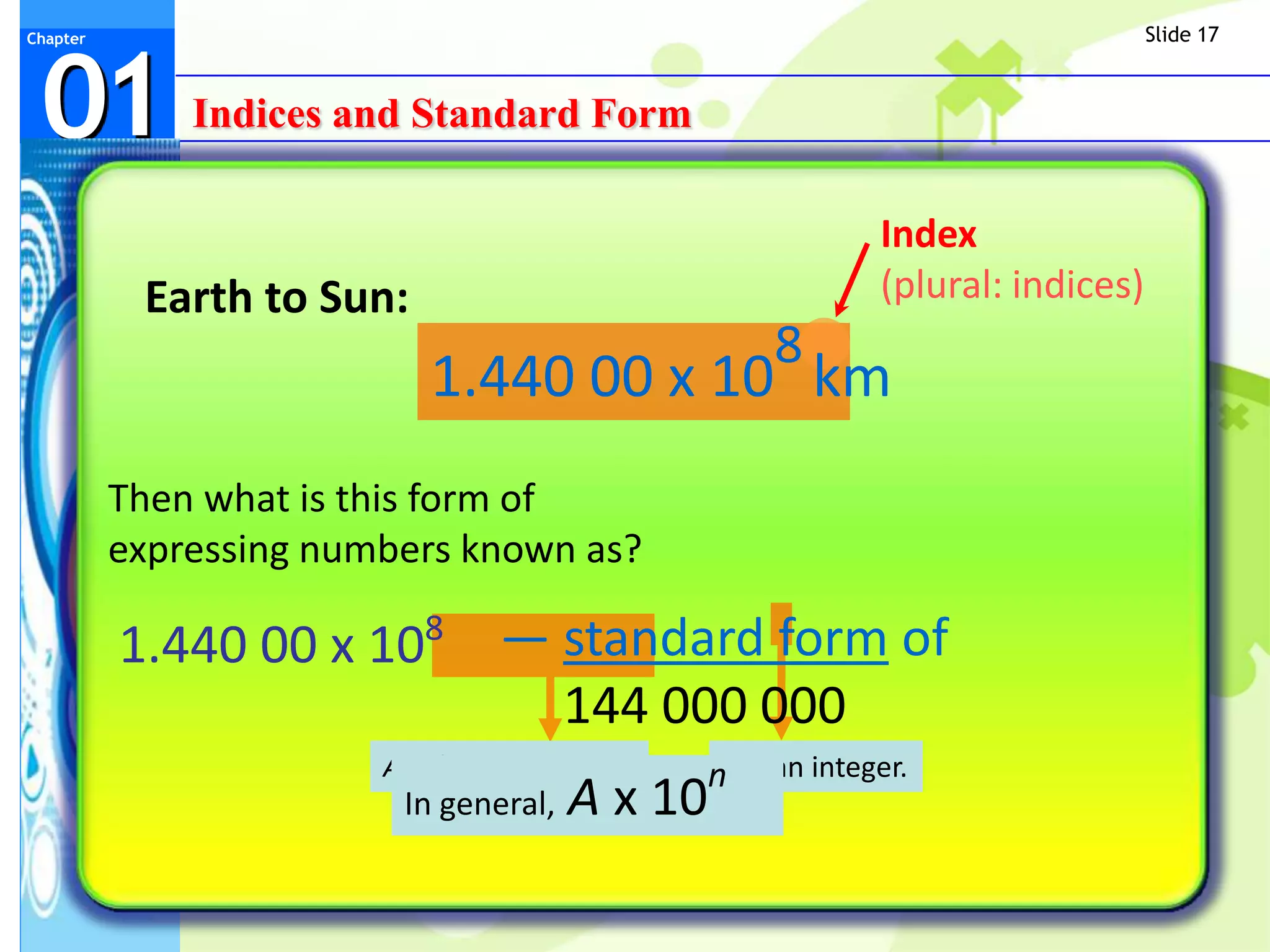
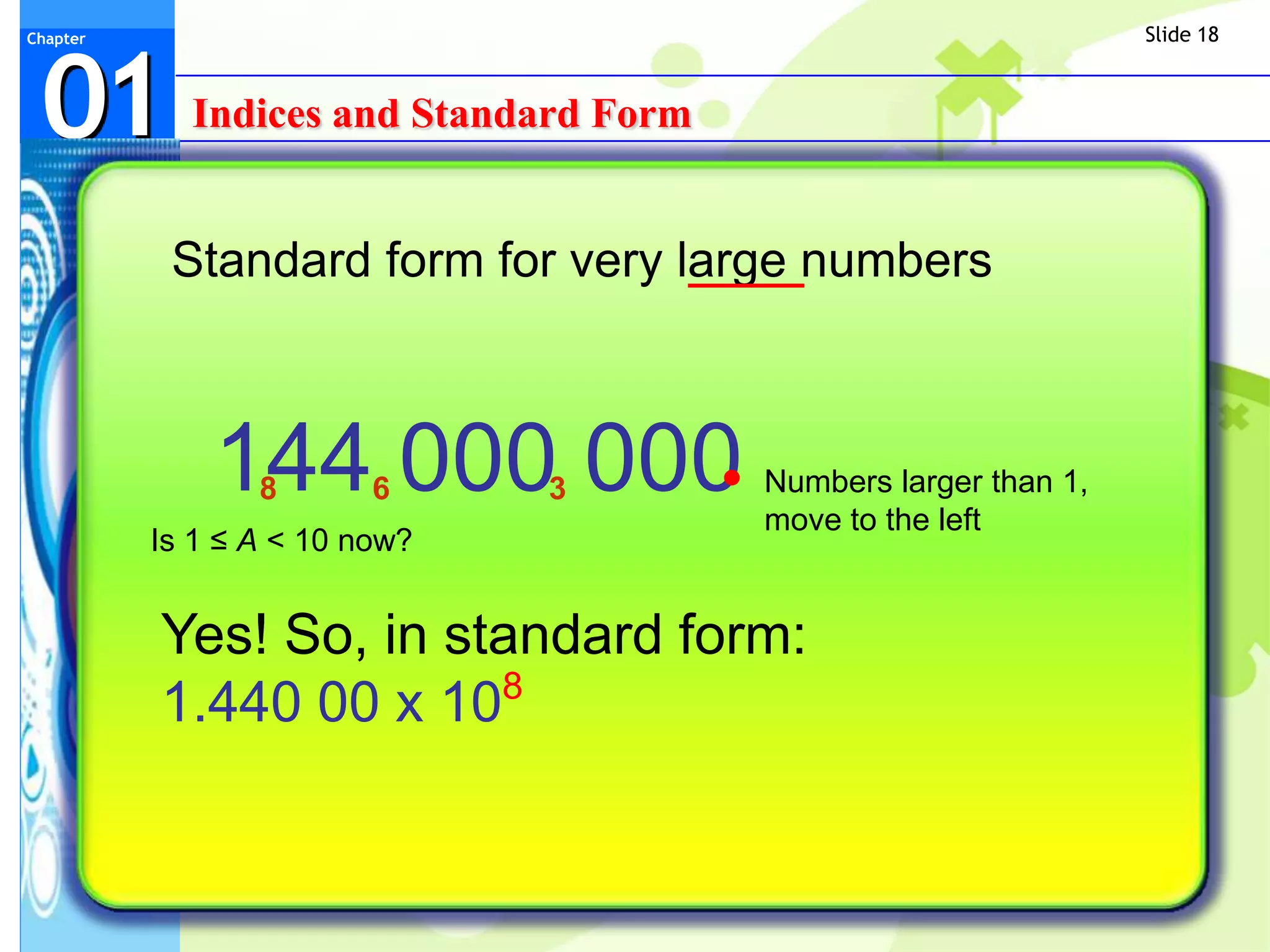
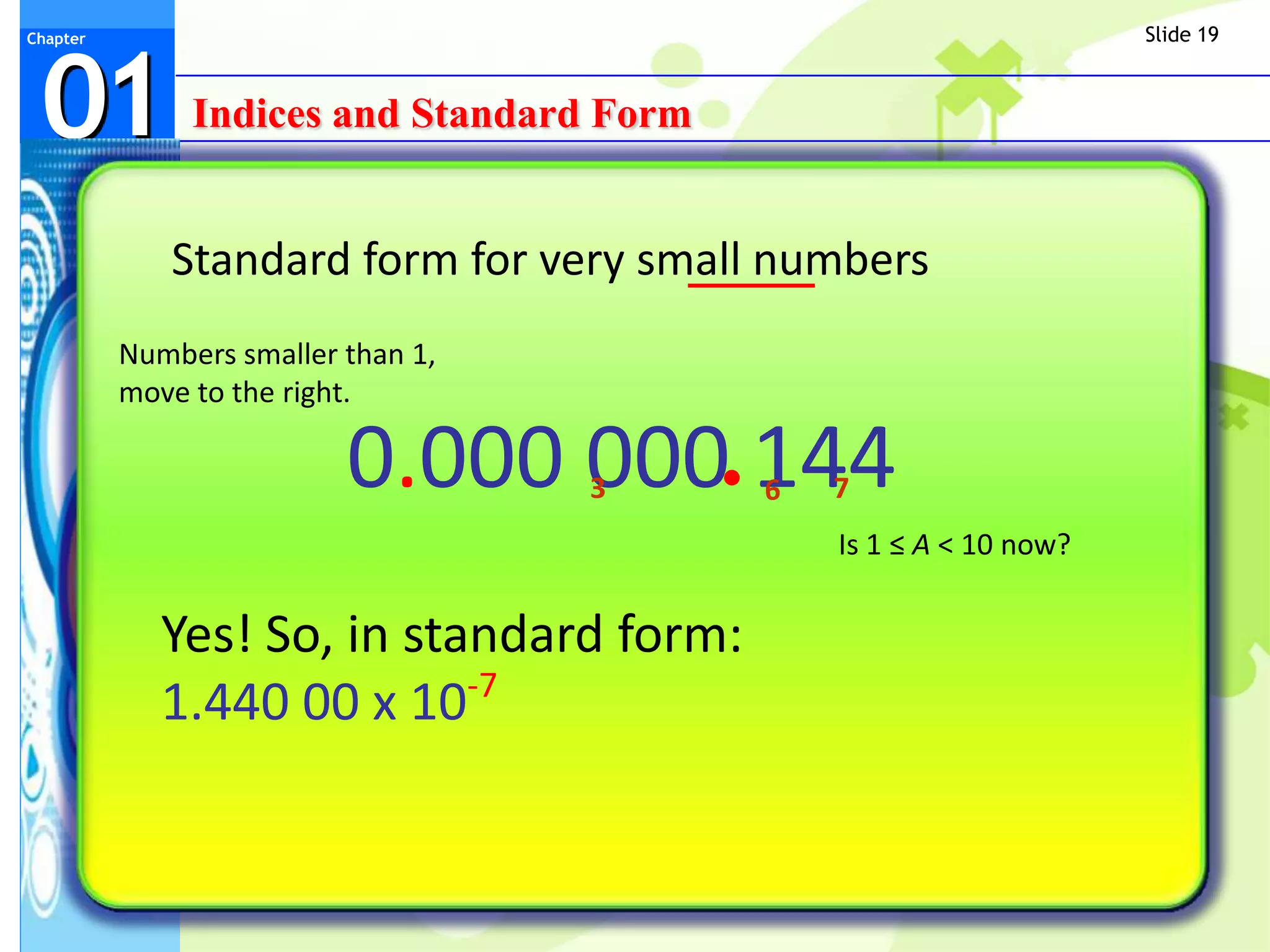
2. Standard form is a notation where a number is written as A x 10n, where 1 ≤ A < 10 and n is an integer. This puts all numbers in a normalized form and makes them easier to comprehend.
3. Laws of indices allow mathematical operations like multiplication and division to be performed on expressions with common bases or exponents.
Slide 1
01
Chapter
Indices and Standard Form
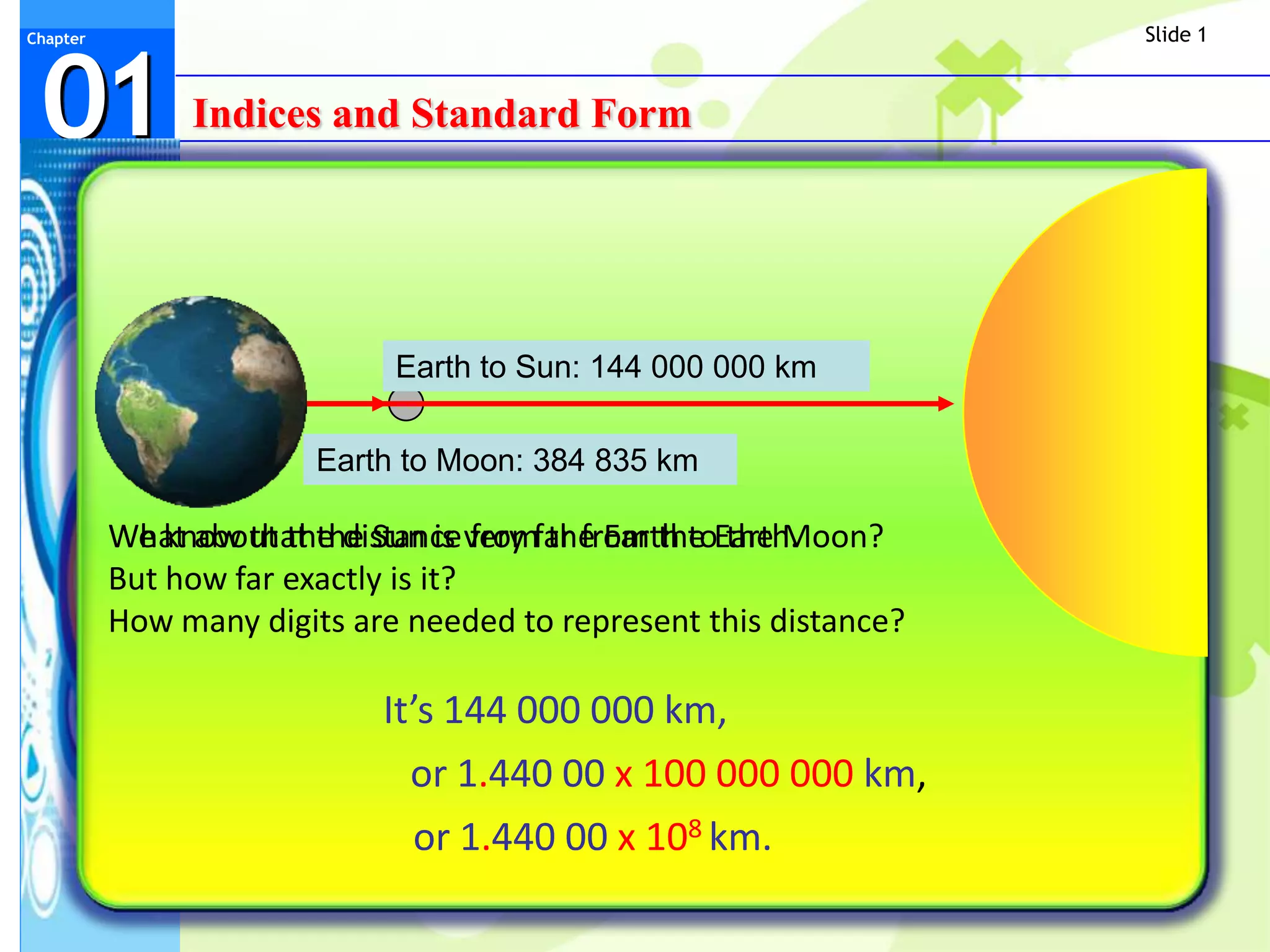
Earth to Sun: 144 000 000 km
Earth to Moon: 384 835 km
What about the distance from the Earth to the Moon?
We know that the Sun is very far from the Earth.
But how far exactly is it?
How many digits are needed to represent this distance?
It’s 144 000 000 km,
or 1.440 00 x 100 000 000 km,
or 1.440 00 x 108 km.
2.
Slide 2
01
Chapter
Indices and Standard Form
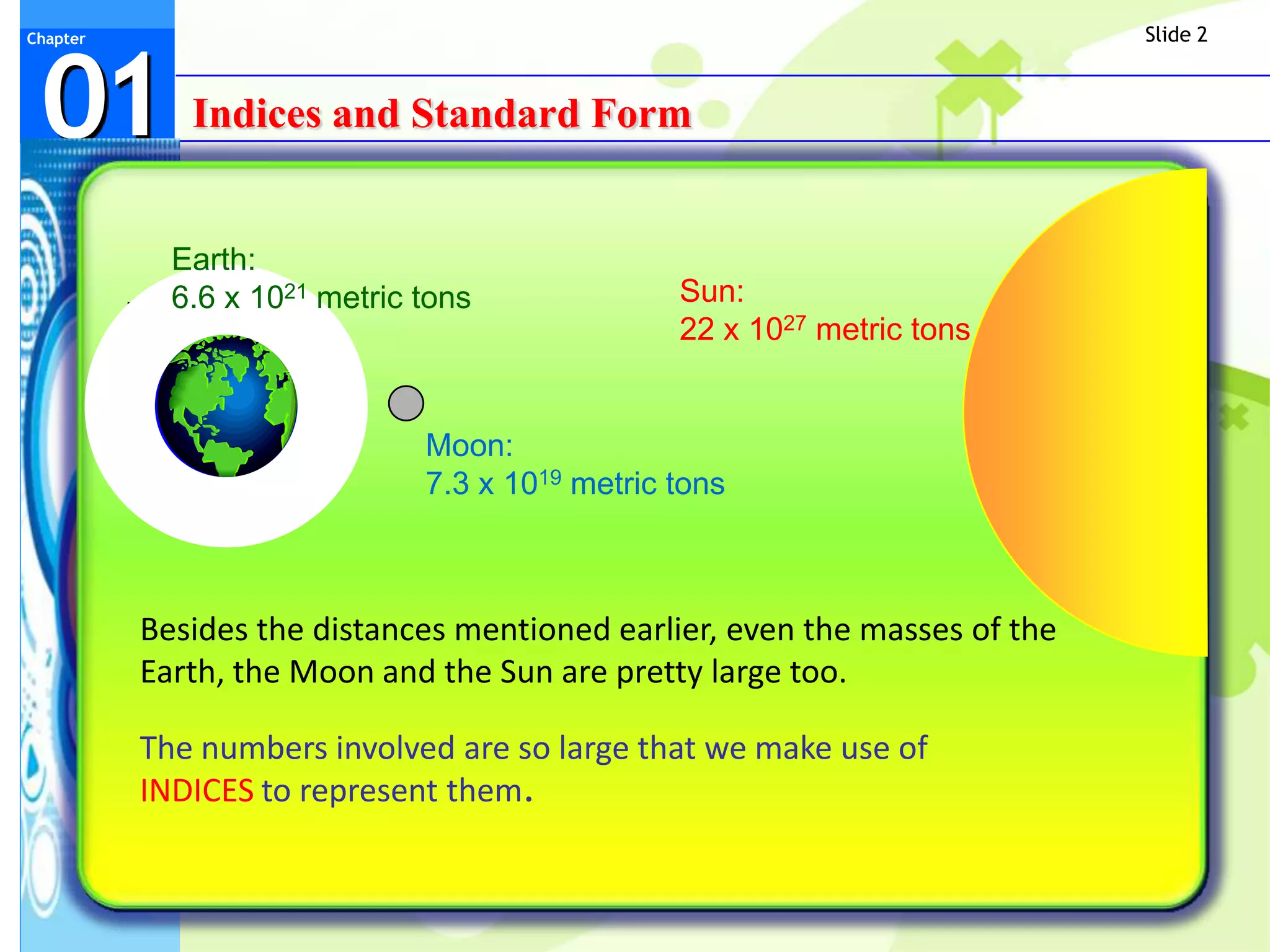
Earth:
6.6 x 10²¹ metric tons Sun:
22 x 1027 metric tons
Moon:
7.3 x 10¹⁹ metric tons
Besides the distances mentioned earlier, even the masses of the
Earth, the Moon and the Sun are pretty large too.
The numbers involved are so large that we make use of
INDICES to represent them.
3.
Slide 3
01
Chapter
Indices and Standard Form
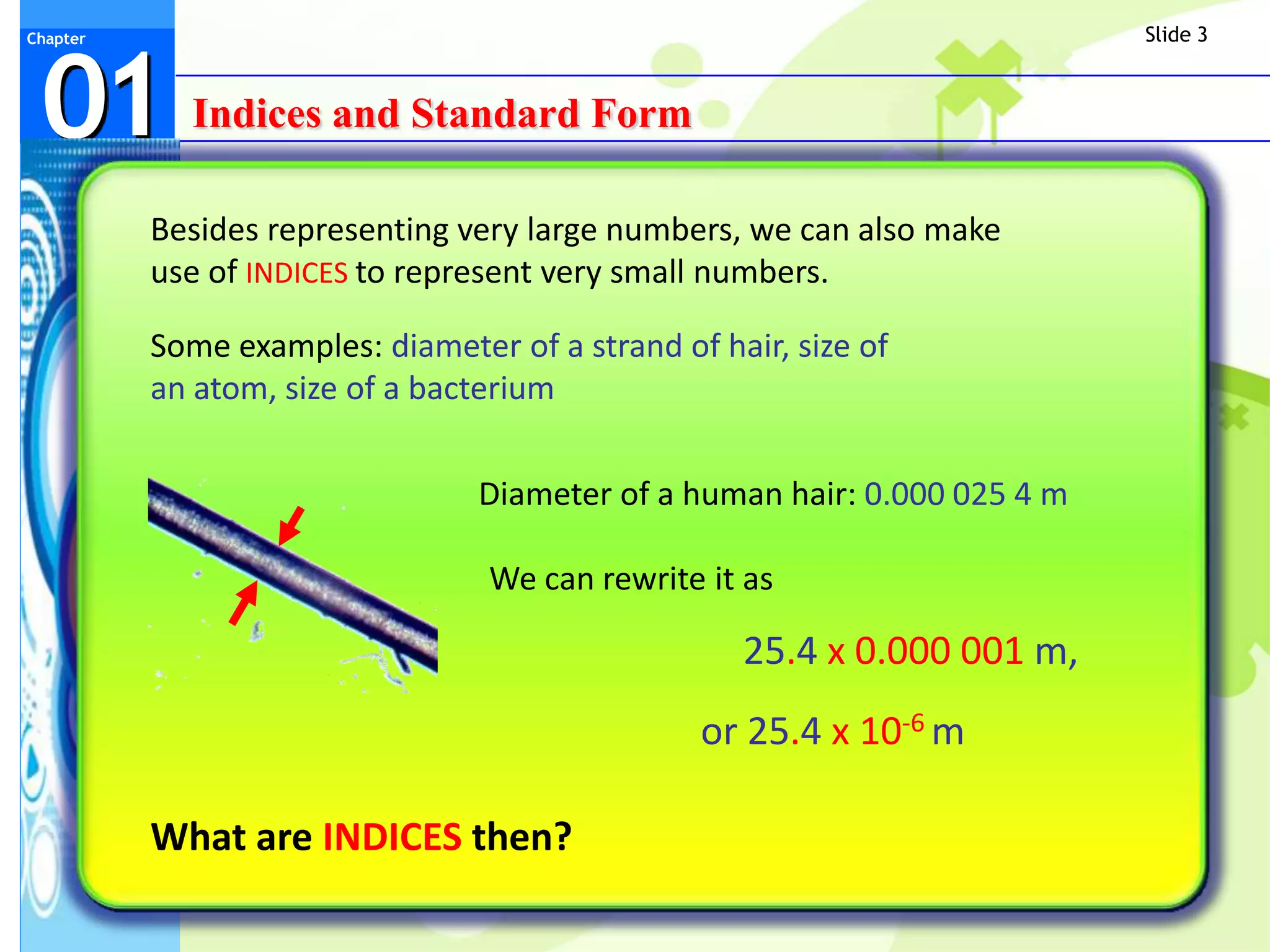
Besides representing very large numbers, we can also make
use of INDICES to represent very small numbers.
Some examples: diameter of a strand of hair, size of
an atom, size of a bacterium
Diameter of a human hair: 0.000 025 4 m
We can rewrite it as
25.4 x 0.000 001 m,
or 25.4 x 10⁻⁶ m
What are INDICES then?
4.
Slide 4
01
Chapter
Indices and Standard Form
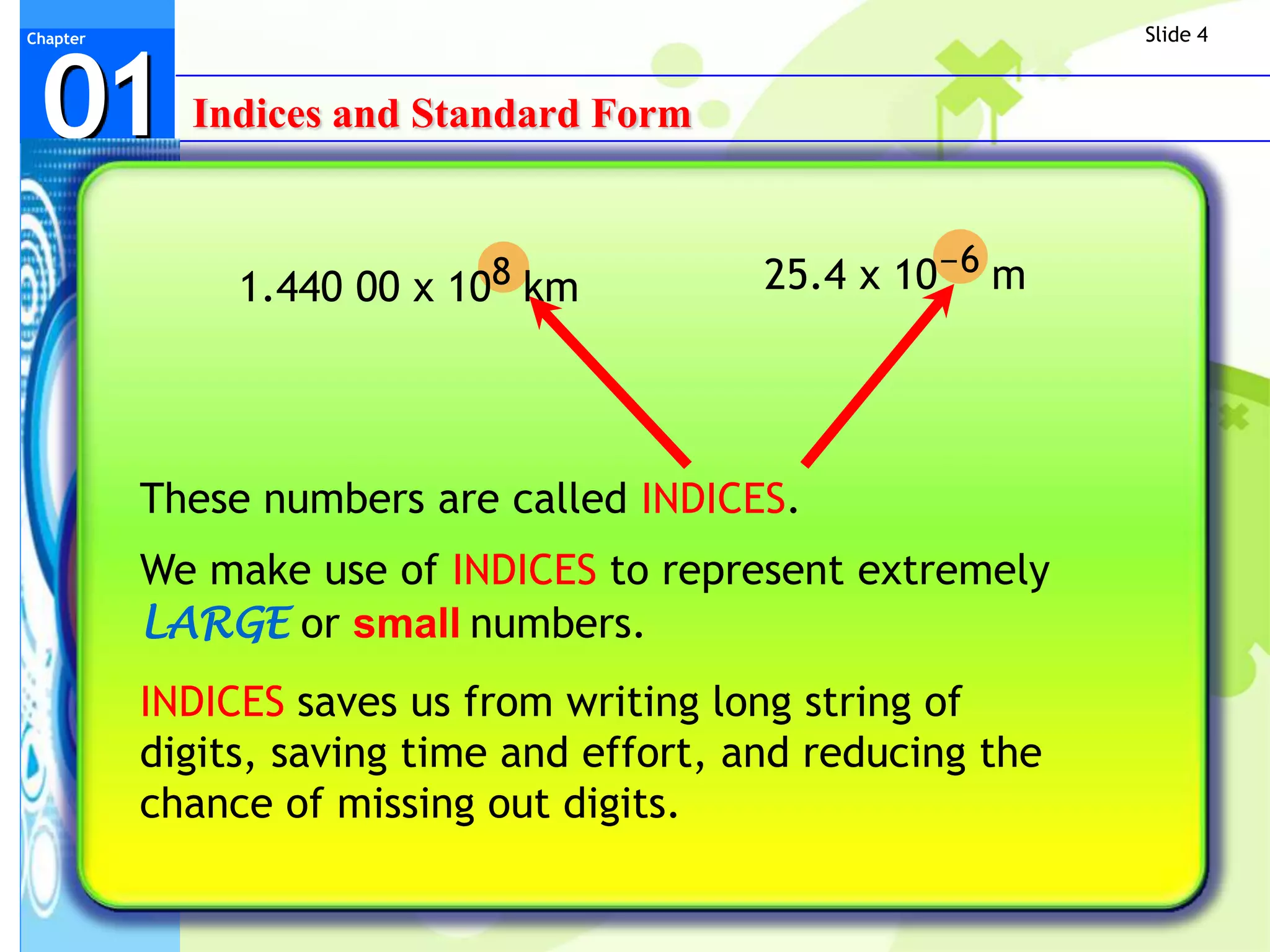
1.440 00 x 108 km 25.4 x 10⁻⁶ m
These numbers are called INDICES.
We make use of INDICES to represent extremely
LARGE or small numbers.
INDICES saves us from writing long string of
digits, saving time and effort, and reducing the
chance of missing out digits.
5.
Slide 5
01
Chapter
Indices and Standard Form
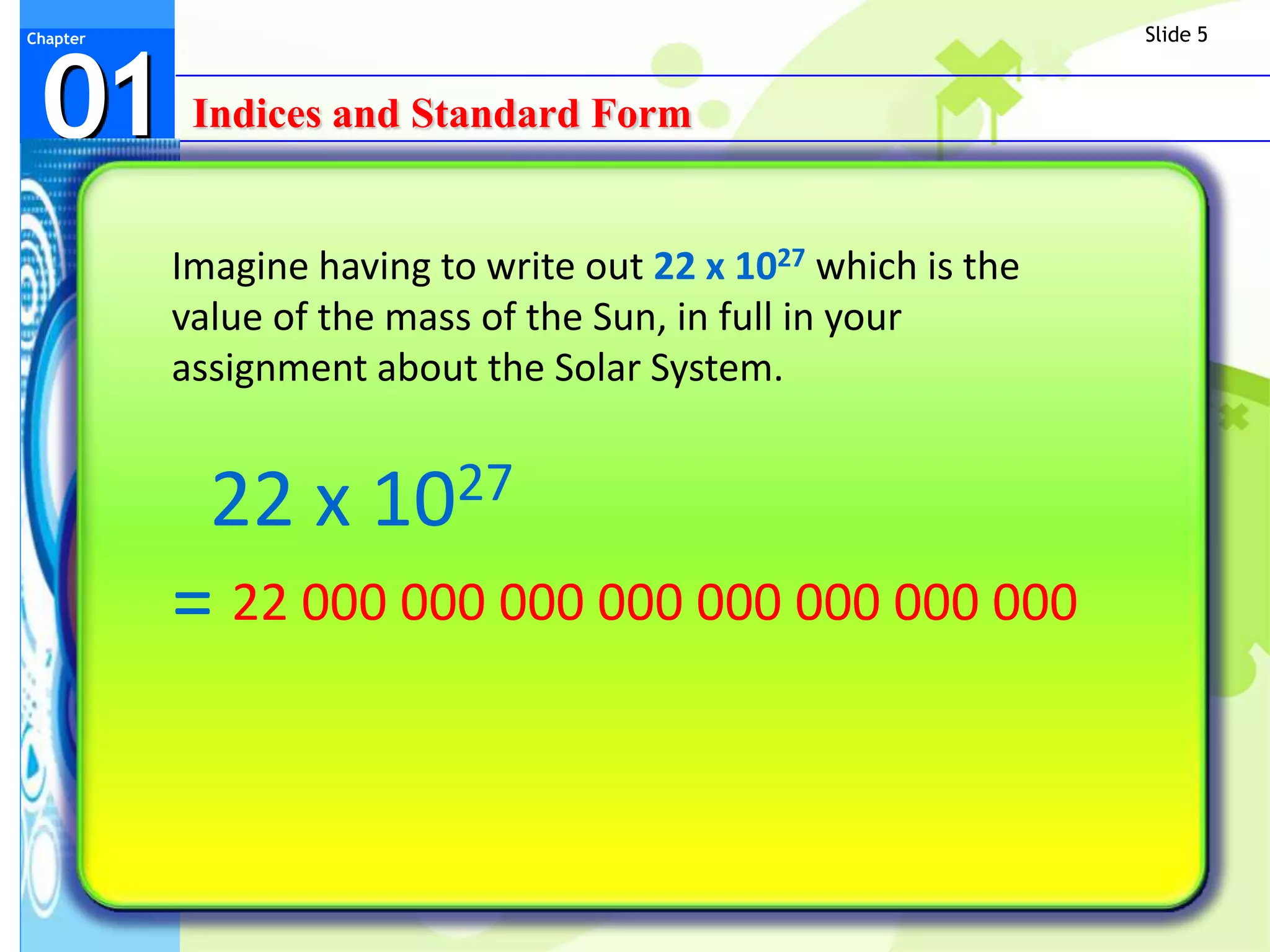
Imagine having to write out 22 x 1027 which is the
value of the mass of the Sun, in full in your
assignment about the Solar System.
22 x 10 27
= 22 000 000 000 000 000 000 000 000
6.
Slide 6
01
Chapter
Indices and Standard Form
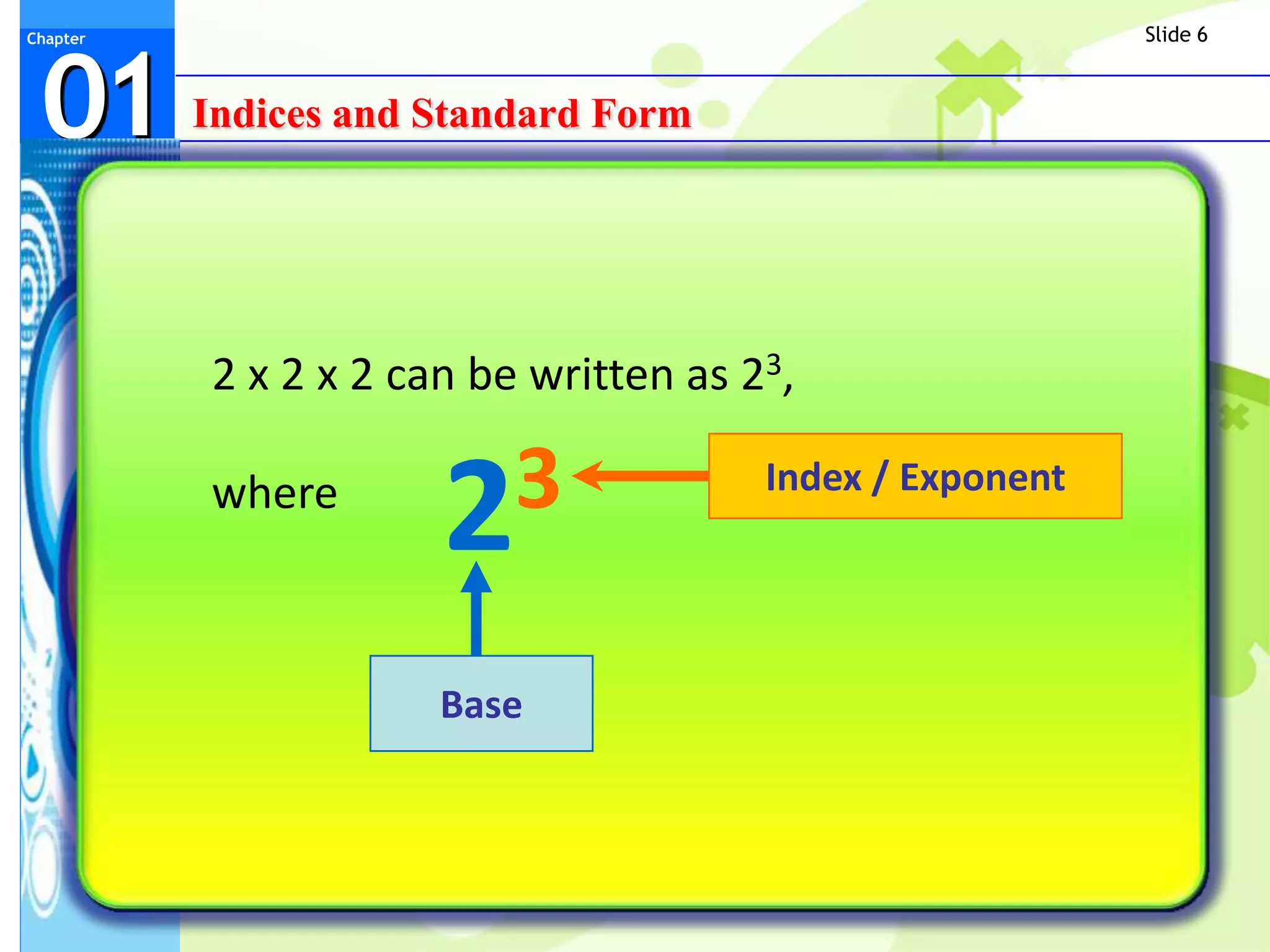
2 x 2 x 2 can be written as 23,
where
23 Index / Exponent
Base
7.
Slide 7
01
Chapter
Indices and Standard Form
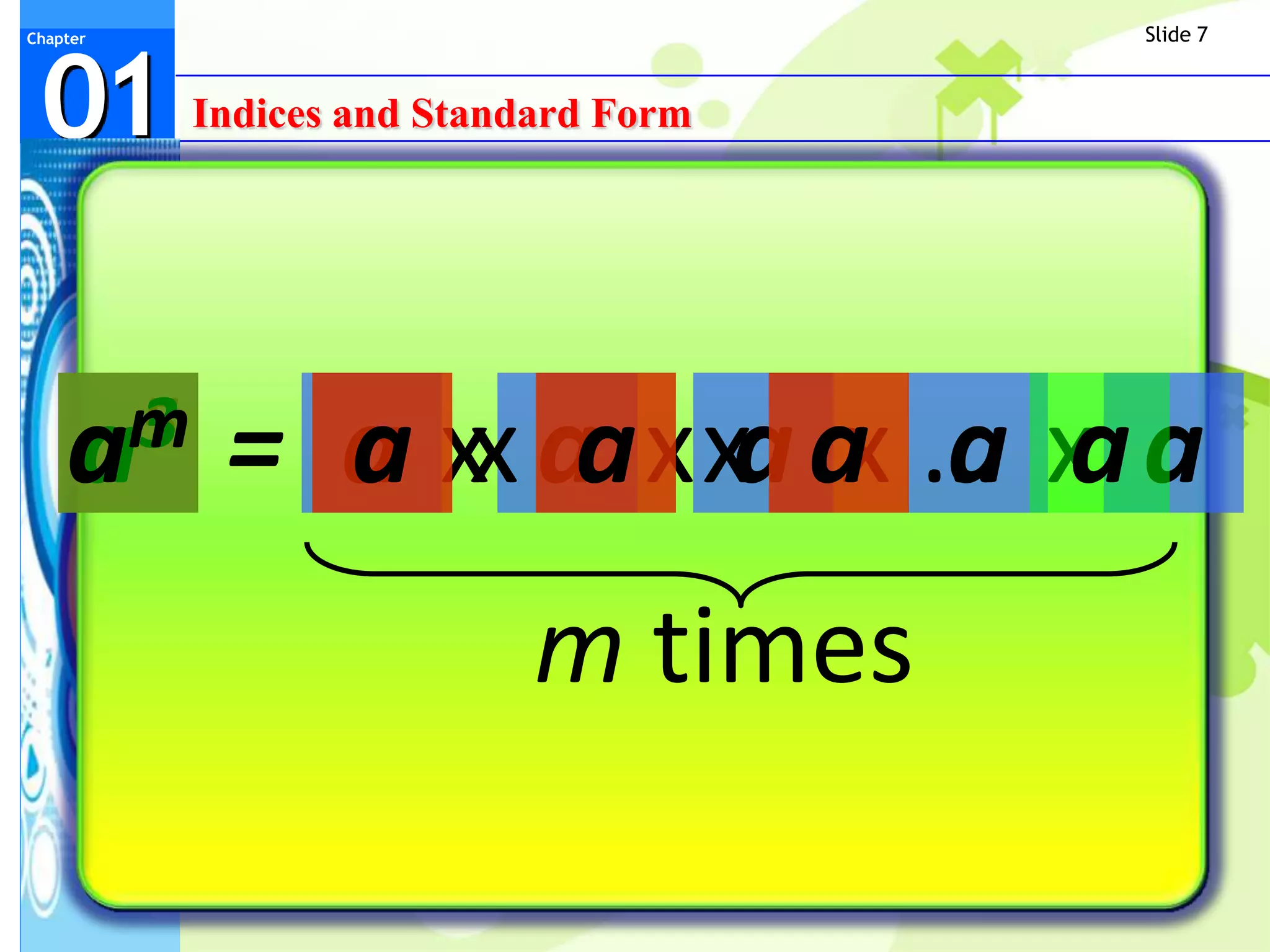
am3
5 = a xx aa x xa a … x a
x a a
m times
8.
Slide 8
01
Chapter
Indices and Standard Form
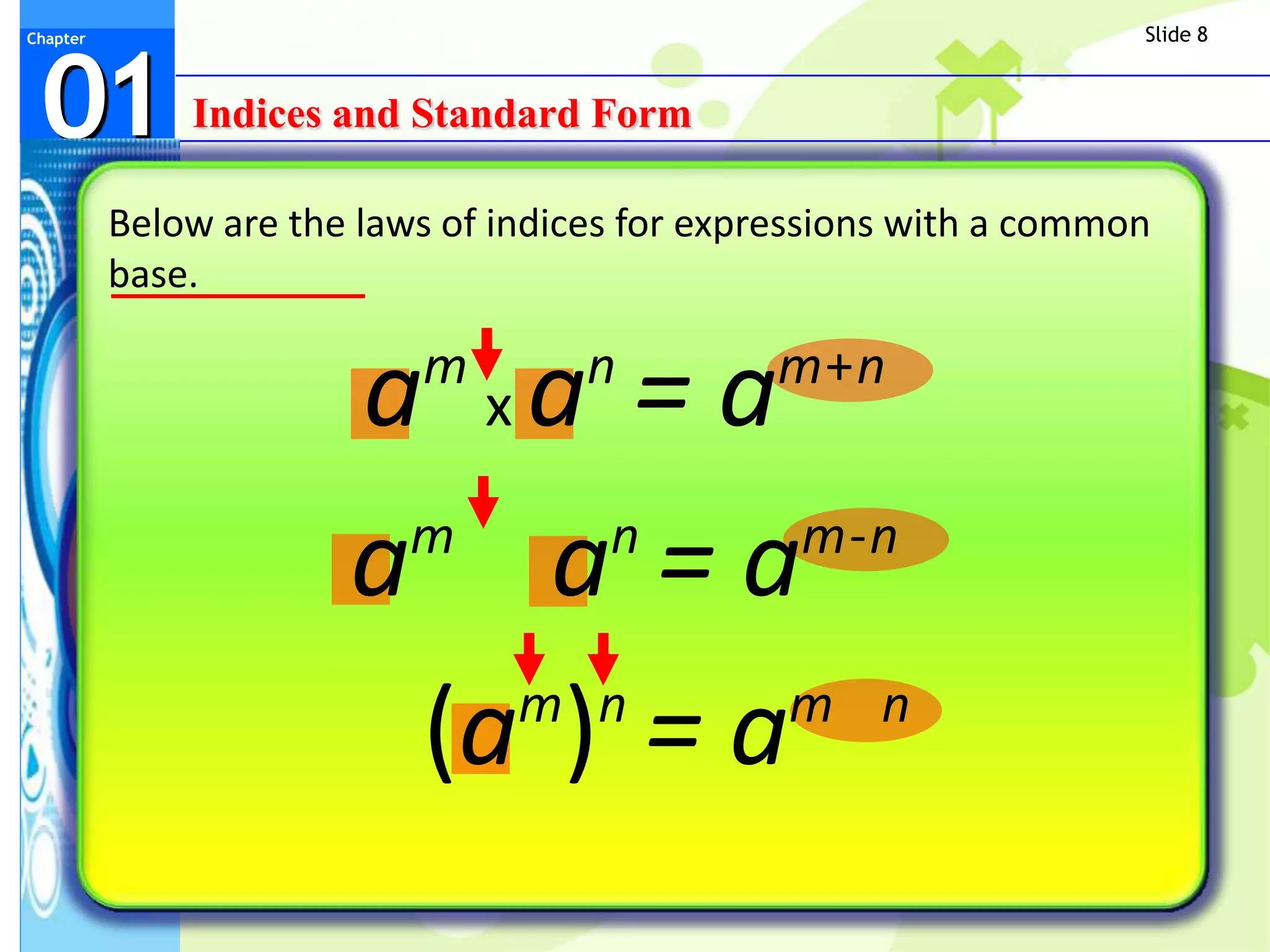
Below are the laws of indices for expressions with a common
base.
a xa = a
m n m+n
a a =a
m n m-n
(a ) = a
m n m n
9.
Slide 9
01
Chapter
Indices and Standard Form
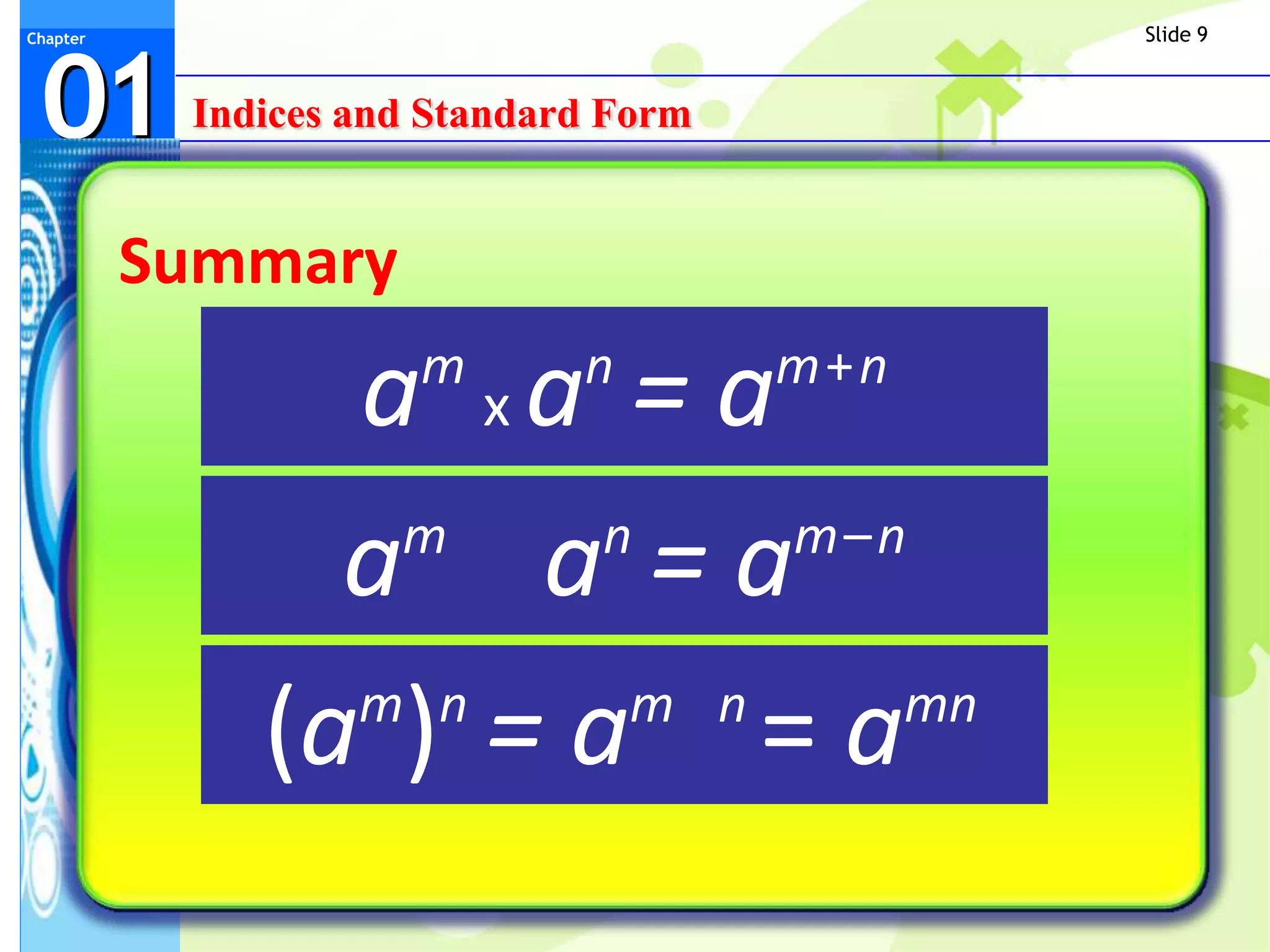
Summary
a xa = a
m n m+n
a a =a
m n m–n
(a ) = a = a
m n m n mn
10.
Slide 10
01
Chapter
Indices and Standard Form
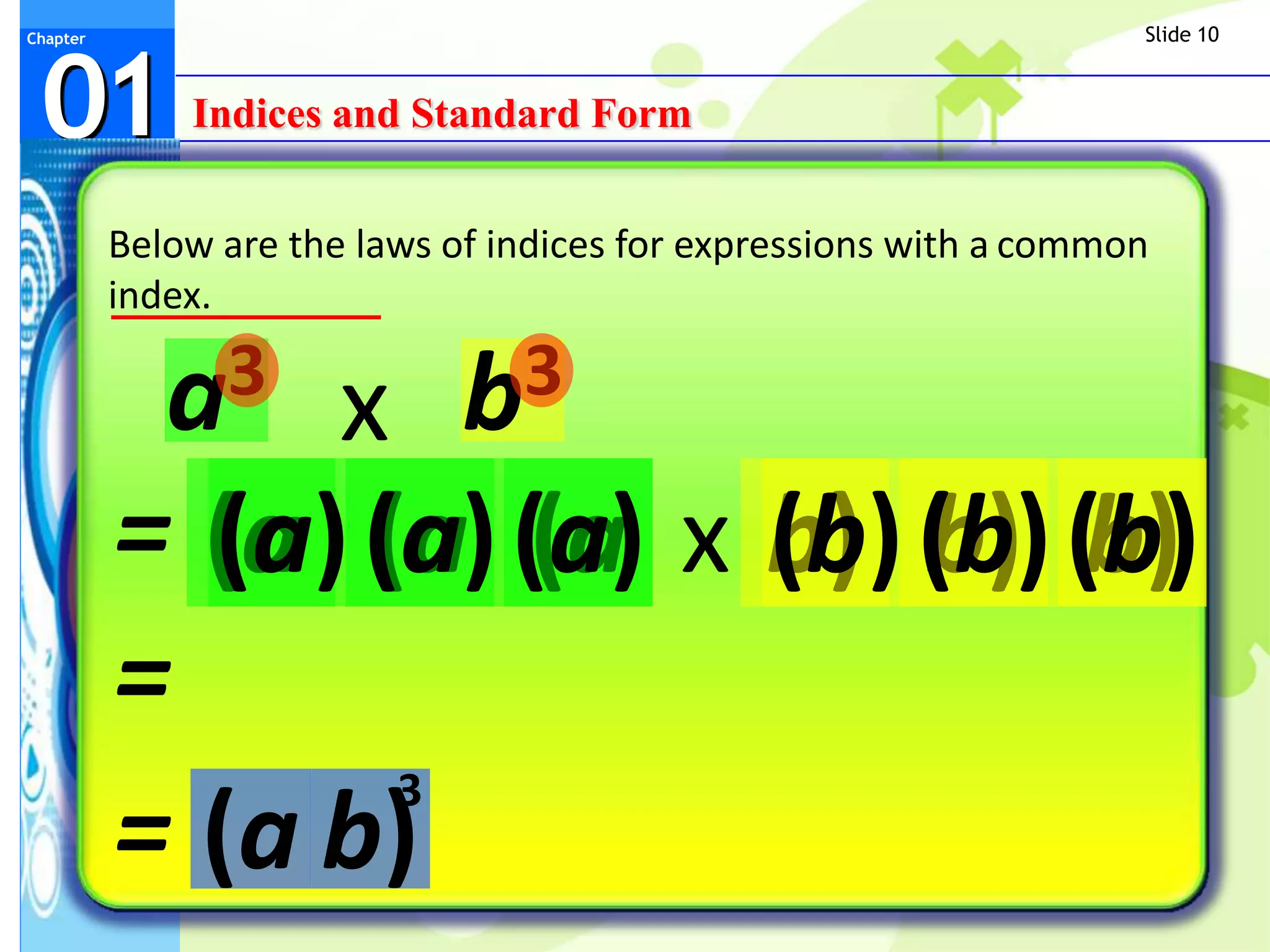
Below are the laws of indices for expressions with a common
index.
a3 b3
x
= (a (a) (a) x b) (b) (b)
(a) (a (a (b) b) b)
=
3
= (a b)
11.
Slide 11
01
Chapter
Indices and Standard Form
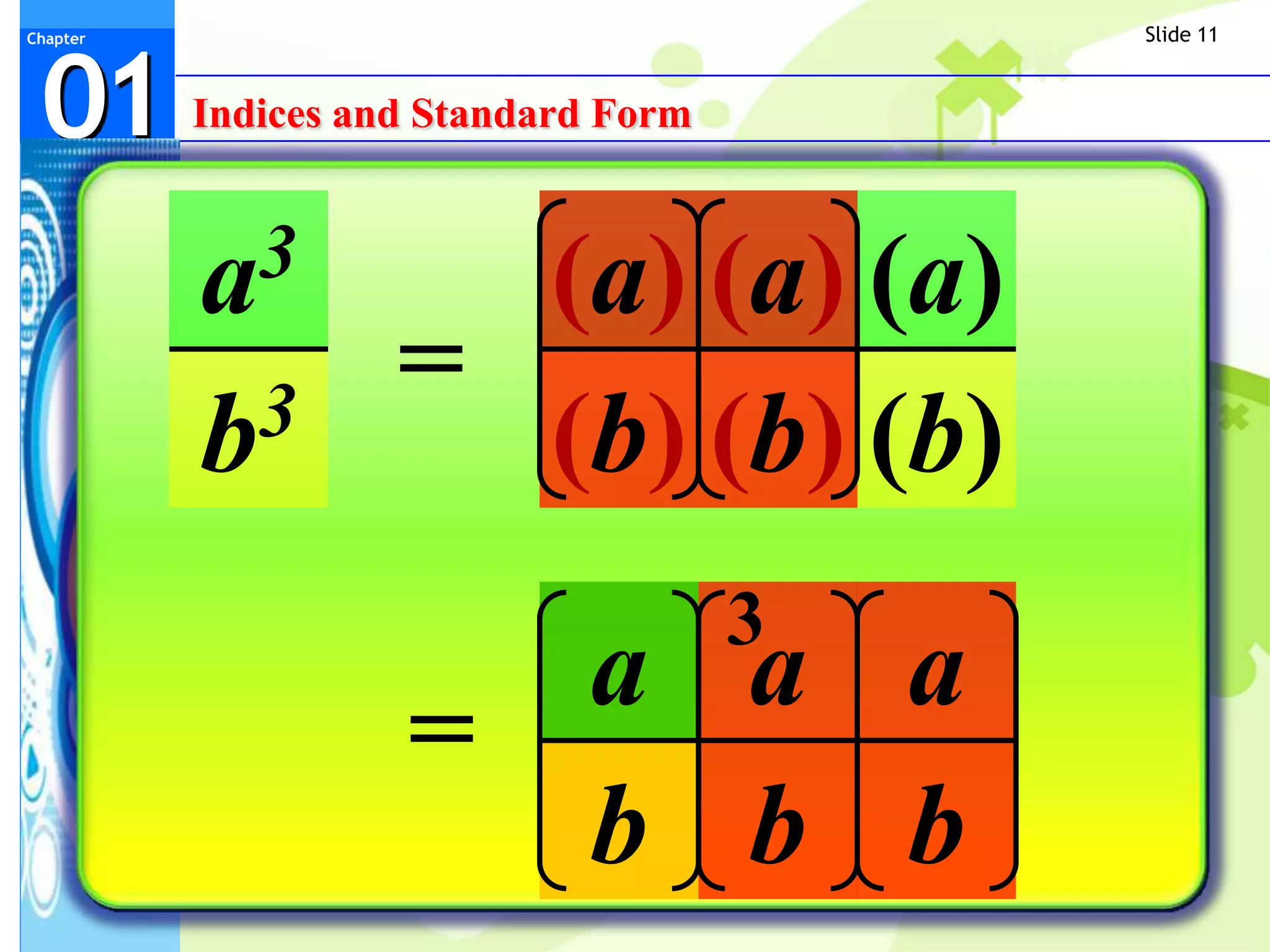
a 3 (a) (a) (a)
a a
3
=
b (b) (b) (b)
b b
3
a a a
=
b b b
12.
Slide 12
01
Chapter
Indices and Standard Form
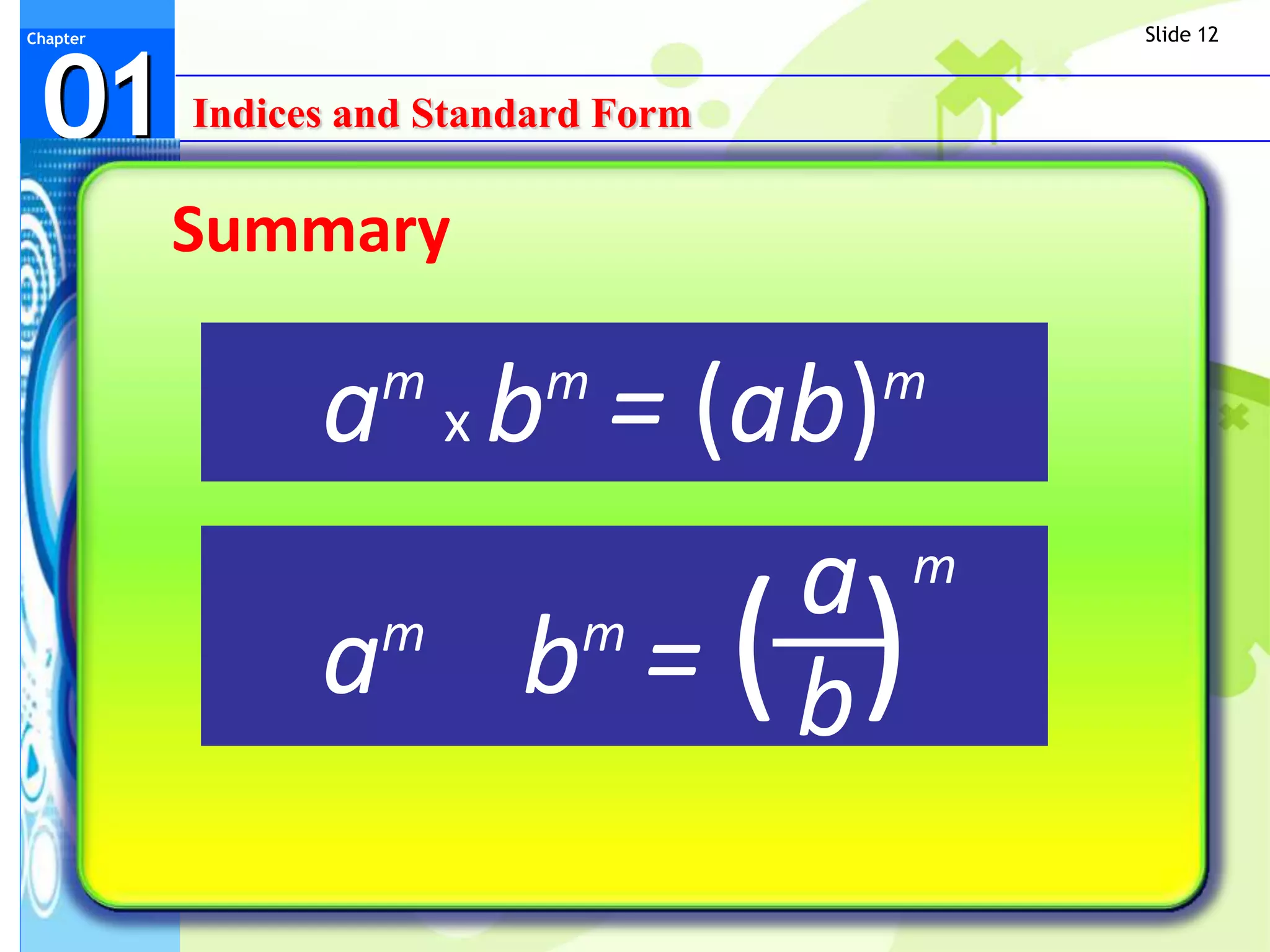
Summary
a x b = (ab)
m m m
a m
a b = ( b)
m m
13.
Slide 13
01
Chapter
Indices and Standard Form
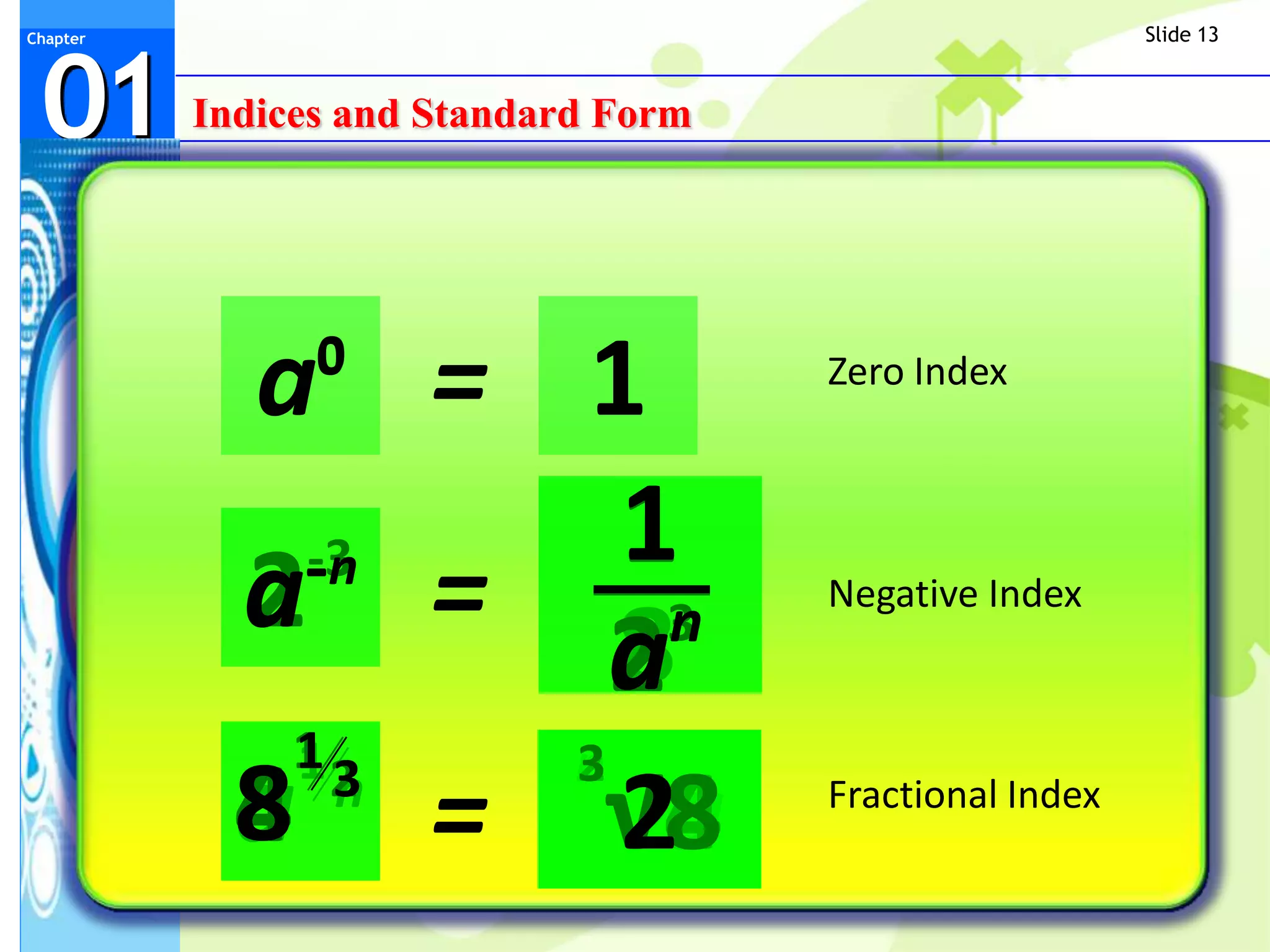
a = 1
0 Zero Index
- =
-3 1
a
2 n
8 n
3
Negative Index
a
2
12 n
3
2
8
4
a = √a
3
n
√8
√4
2 Fractional Index
14.
Slide 14
01
Chapter
Indices and Standard Form
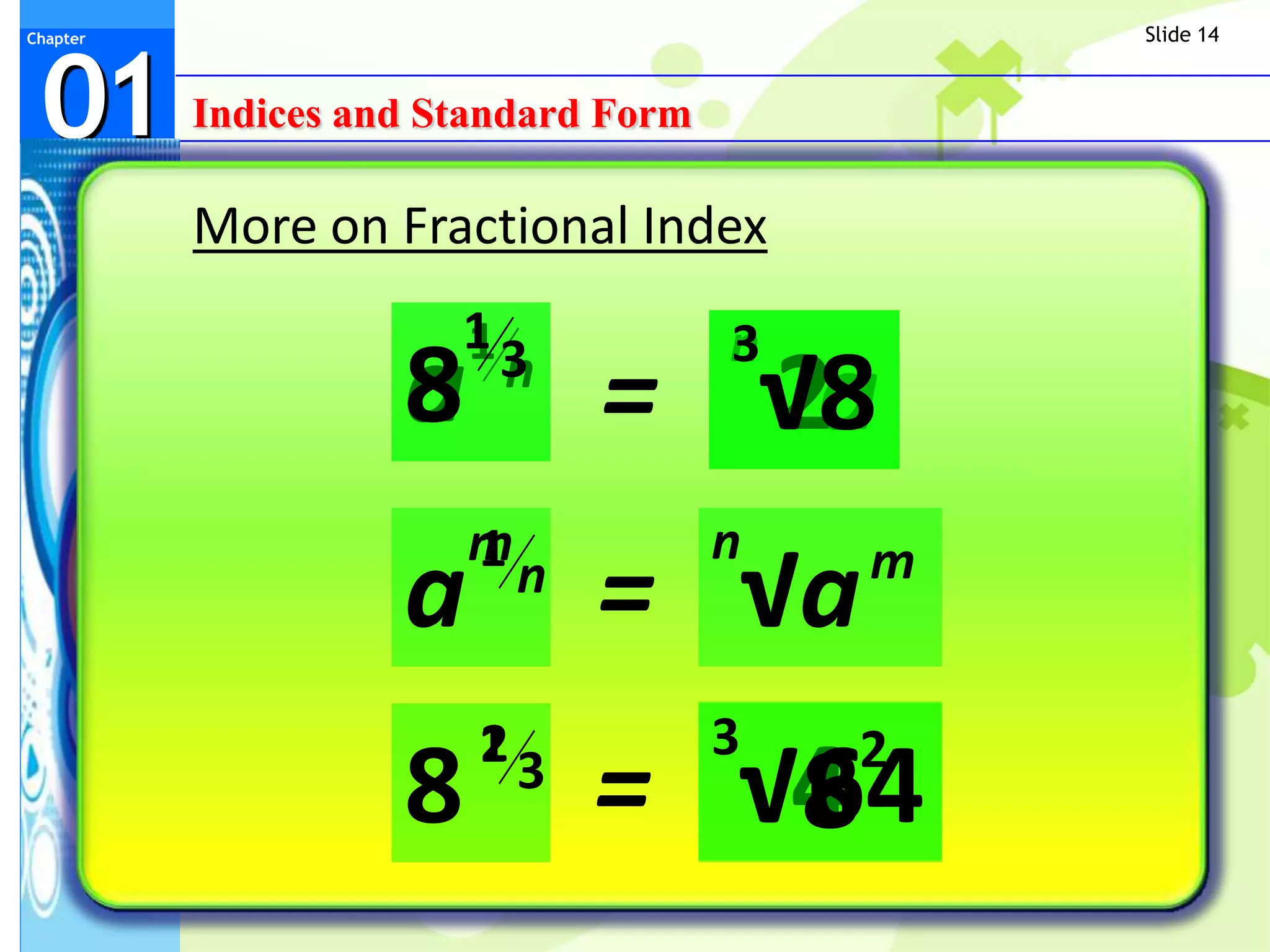
More on Fractional Index
13 n
3
8
a n
= √a
√8
2
m
1n n m
a = √a
2
13 3 2
8 = √4
64
8
15.
Slide 15
01
Chapter
Indices and Standard Form
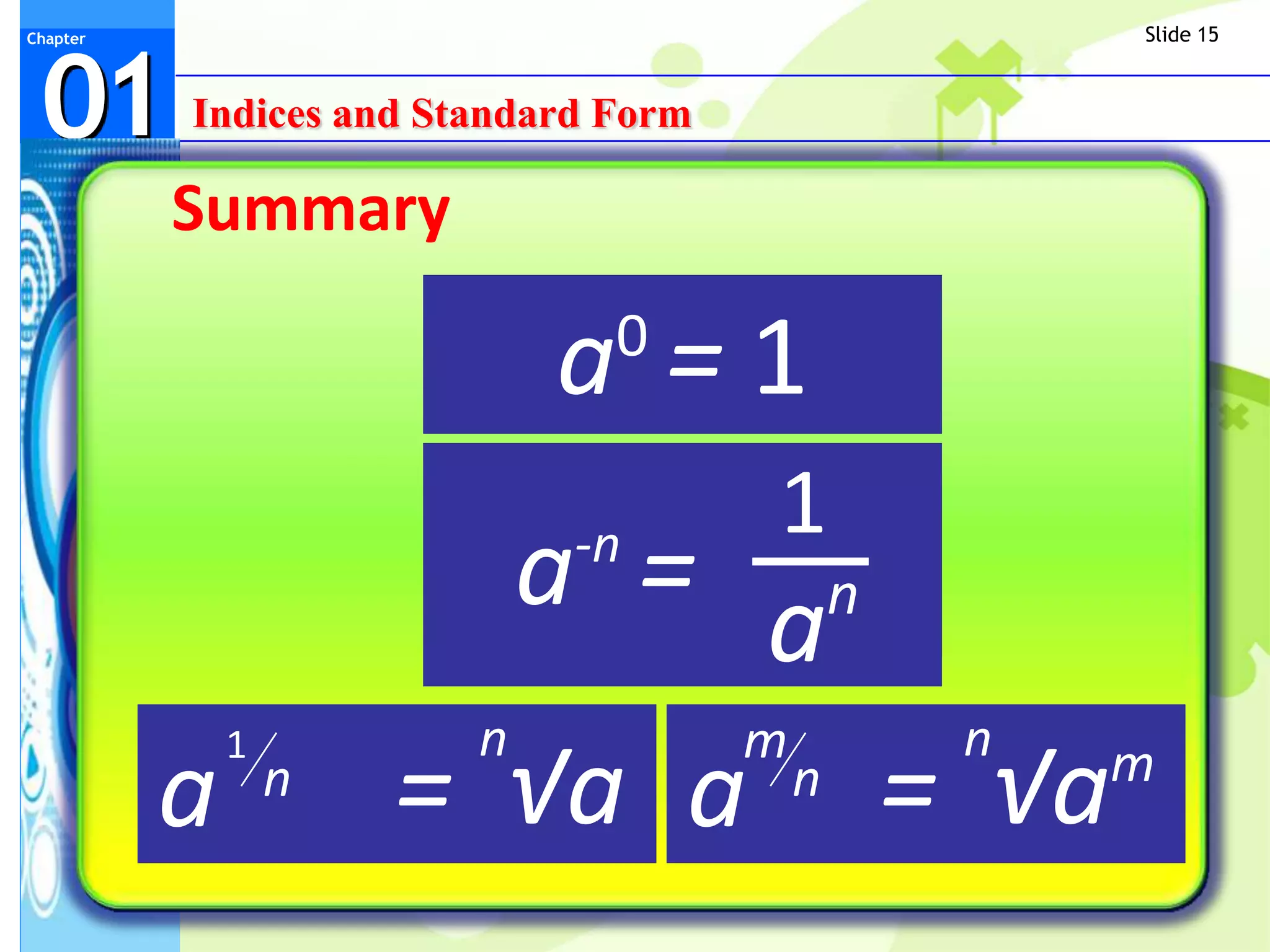
Summary
a =1
0
1
a = an
-n
1 n m n
a n = √a a n = √am
16.
Slide 16
01
Chapter
Indices and Standard Form
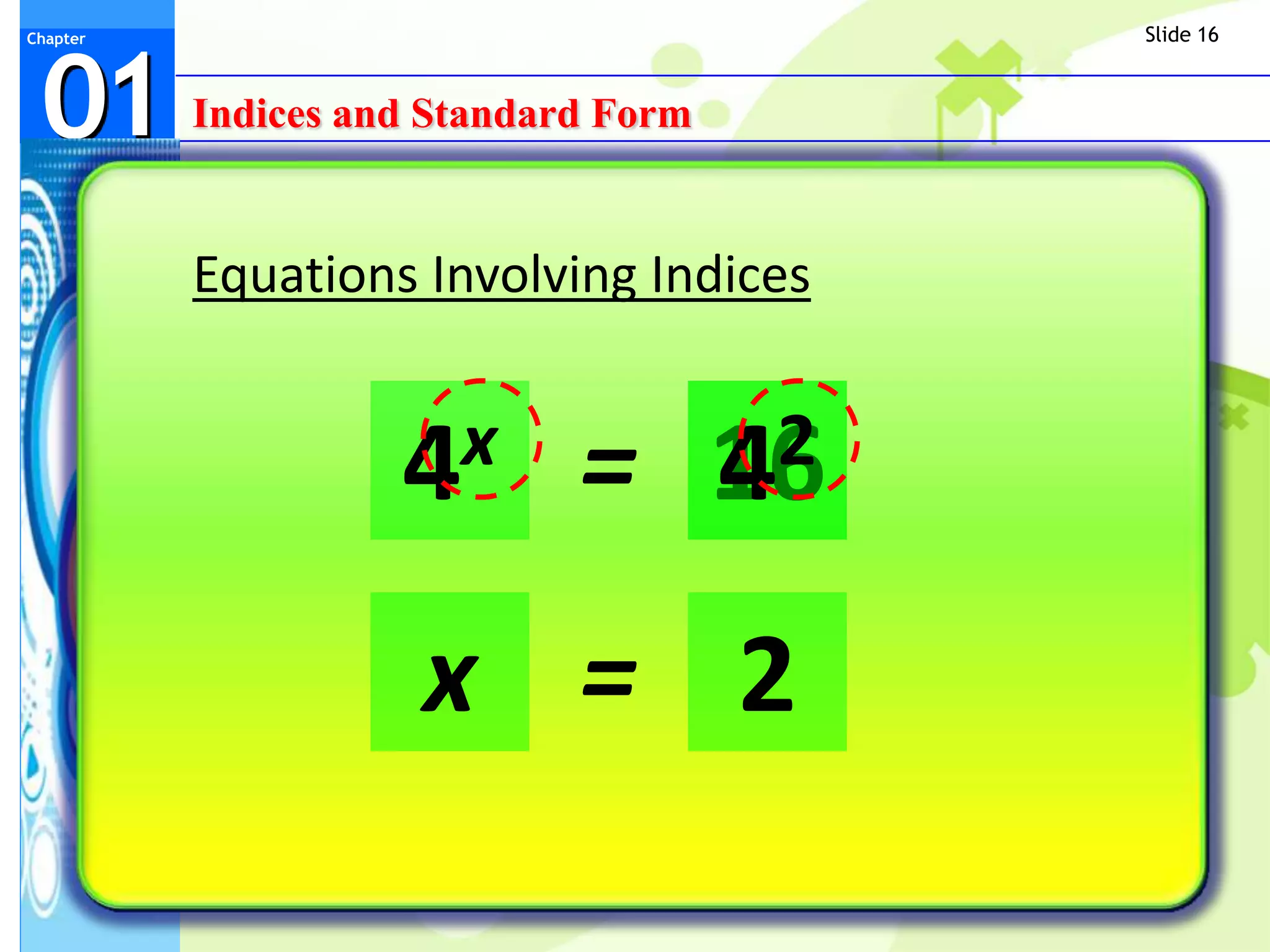
Equations Involving Indices
4 x = 16
4 2
x = 2
17.
Slide 17
01
Chapter
Indices and Standard Form
Index
Earth to Sun: (plural: indices)
8
1.440 00 x 10 km
Then what is this form of
expressing numbers known as?
1.440 00 x 108 — standard form of
144 000 000
A, where 1 ≤ A < 10 nn is an integer.
In general, A x 10
18.
Slide 18
01
Chapter
Indices and Standard Form
Standard form for very large numbers
144 000 000
8 6 3 Numbers larger than 1,
move to the left
Is 1 ≤ A < 10 now?
Yes! So, in standard form:
1.440 00 x 108
19.
Slide 19
01
Chapter
Indices and Standard Form
Standard form for very small numbers
Numbers smaller than 1,
move to the right.
0.000 000 144
3 6 7
Is 1 ≤ A < 10 now?
Yes! So, in standard form:
-7
1.440 00 x 10