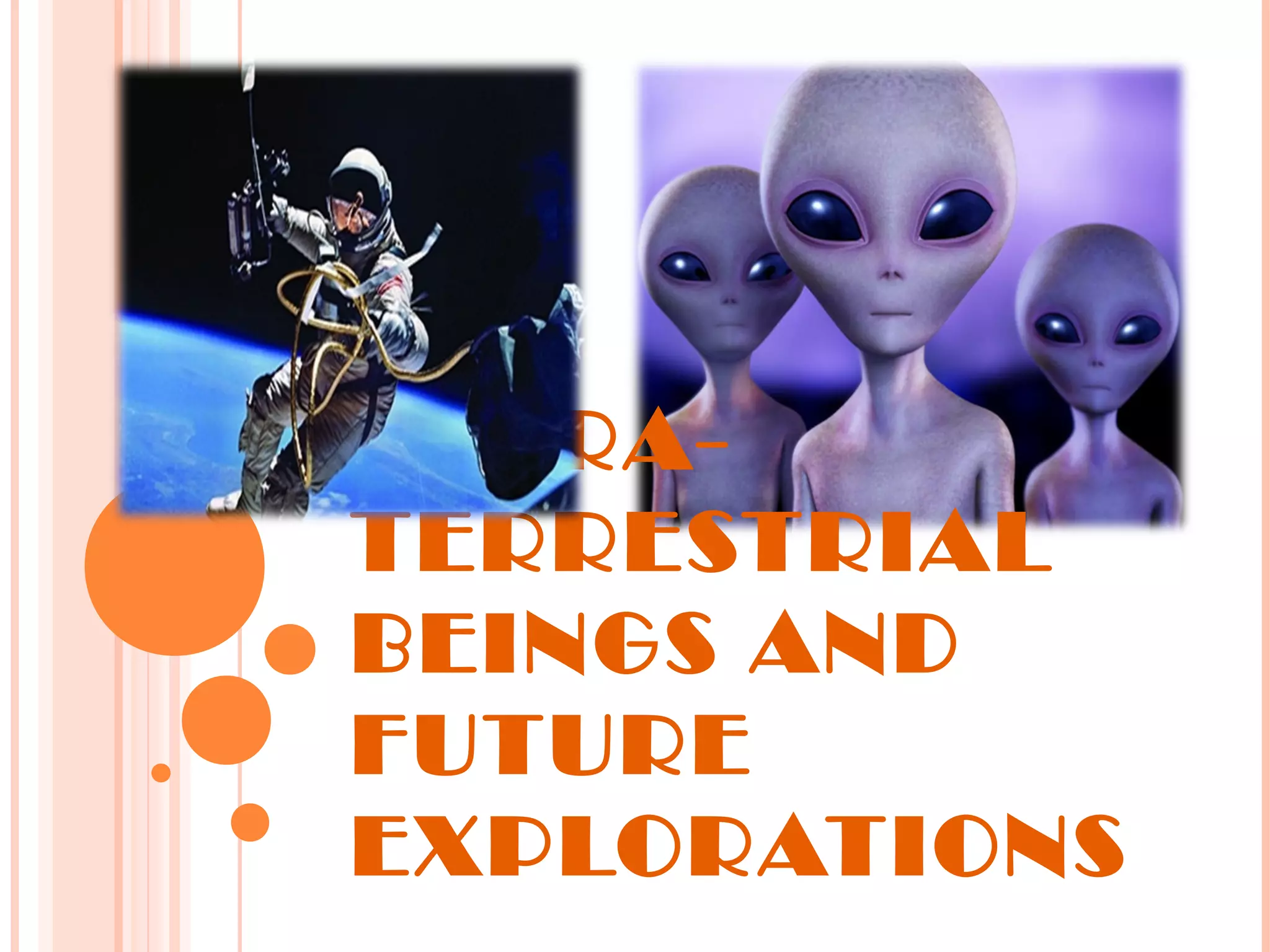
EXTRA-
TERRESTRIAL
BEINGS AND
FUTURE
EXPLORATIONS
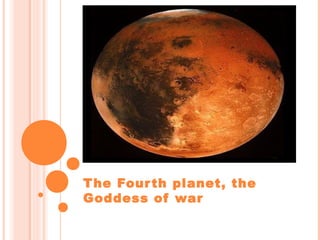
The Fourth planet, the
Goddess of war
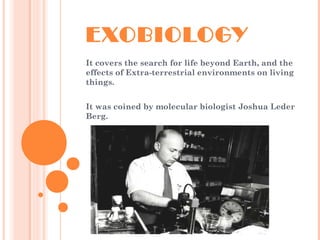
EXOBIOLOGY
It covers the search for life beyond Earth, and the
effects of Extra-terrestrial environments on living
things.
It was coined by molecular biologist Joshua Leder
Berg.
MARTIAN SPACE
PROBES
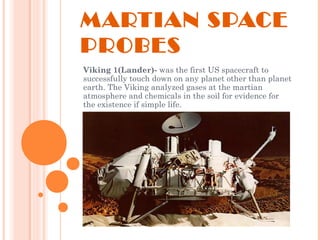
Viking 1(Lander)- was the first US spacecraft to
successfully touch down on any planet other than planet
earth. The Viking analyzed gases at the martian
atmosphere and chemicals in the soil for evidence for
the existence if simple life.
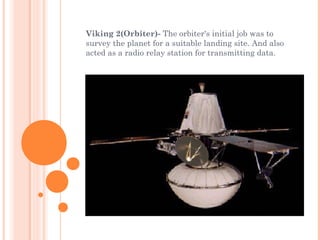
Viking 2(Orbiter)- The orbiter's initial job was to
survey the planet for a suitable landing site. And also
acted as a radio relay station for transmitting data. 
VIKING MISSION
TO MARS
NASA's Viking Mission to Mars was composed of two
spacecraft, Viking 1 and Viking 2, each consisting of an
orbiter and a lander. The primary mission objectives
were to obtain high resolution images of the Martian
surface, characterize the structure and composition of
the atmosphere and surface, and search for evidence of
life.
Both space craft where launch in 1976, the year in
which the united states celebrated its bicentennial.
PLANETARY
HABITABILITY
Is a measure of a planet or a natural satellites
potential to have habitable environments hospitable
to life. . Life may develop directly on a planet or
satellite or be transferred to it from another body, a
hypothetical process known as panspermia. As the
existence of life beyond Earth is unknown, planetary
habitability is largely an extrapolation of conditions
on Earth and the characteristics of
the Sun and Solar System which appear favorable to
life's flourishing—in particular those factors that
have sustained complex, multicellular organisms
and not just simpler, unicellular creatures. Research
and theory in this regard is a component
of planetary science and the emerging discipline
of astrobiology.
◘Space is the void that exists beyond any
celestial body, including the EARTH.
◘It is not completely empty, but consists of
hard vacuum containing a low density of
particles: predominantly radiation,
magnetic fields and neutrons.
◘ In the space between galaxies, matter
density can be low as a few atoms of
hydrogen per cubic meter.
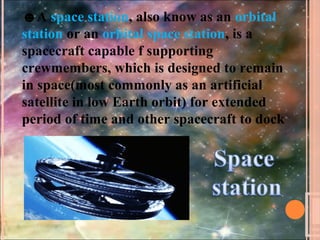
☻A space station, also know as an orbital
station or an orbital space station, is a
spacecraft capable f supporting
crewmembers, which is designed to remain
in space(most commonly as an artificial
satellite in low Earth orbit) for extended
period of time and other spacecraft to dock
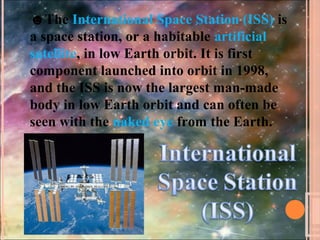
☻The International Space Station (ISS) is
a space station, or a habitable artificial
satellite, in low Earth orbit. It is first
component launched into orbit in 1998,
and the ISS is now the largest man-made
body in low Earth orbit and can often be
seen with the naked eye from the Earth.
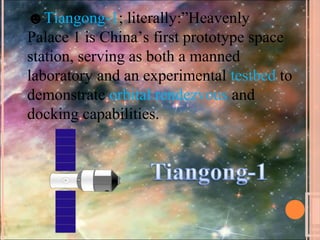
☻Tiangong-1; literally:”Heavenly
Palace 1 is China’s first prototype space
station, serving as both a manned
laboratory and an experimental testbed to
demonstrate orbital rendezvous and
docking capabilities.
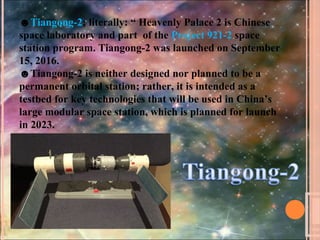
☻Tiangong-2; literally: “ Heavenly Palace 2 is Chinese
space laboratory and part of the Project 921-2 space
station program. Tiangong-2 was launched on September
15, 2016.
☻Tiangong-2 is neither designed nor planned to be a
permanent orbital station; rather, it is intended as a
testbed for key technologies that will be used in China’s
large modular space station, which is planned for launch
in 2023.
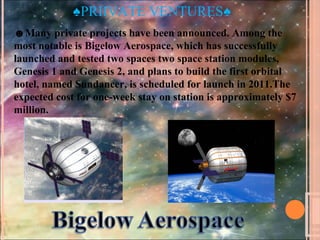
♠PRIIVATE VENTURES♠
☻Many private projects have been announced. Among the
most notable is Bigelow Aerospace, which has successfully
launched and tested two spaces two space station modules,
Genesis 1 and Genesis 2, and plans to build the first orbital
hotel, named Sundancer, is scheduled for launch in 2011.The
expected cost for one-week stay on station is approximately $7
million.
Group 11 extra terrestrial-beings-and future exploration

Group 11 extra terrestrial-beings-and future exploration

  • 1.
  • 2.
    The Fourth planet,the Goddess of war
  • 3.
    EXOBIOLOGY It covers thesearch for life beyond Earth, and the effects of Extra-terrestrial environments on living things. It was coined by molecular biologist Joshua Leder Berg.
  • 4.
    MARTIAN SPACE PROBES Viking 1(Lander)-was the first US spacecraft to successfully touch down on any planet other than planet earth. The Viking analyzed gases at the martian atmosphere and chemicals in the soil for evidence for the existence if simple life.
  • 5.
    Viking 2(Orbiter)- Theorbiter's initial job was to survey the planet for a suitable landing site. And also acted as a radio relay station for transmitting data. 
  • 6.
    VIKING MISSION TO MARS NASA'sViking Mission to Mars was composed of two spacecraft, Viking 1 and Viking 2, each consisting of an orbiter and a lander. The primary mission objectives were to obtain high resolution images of the Martian surface, characterize the structure and composition of the atmosphere and surface, and search for evidence of life. Both space craft where launch in 1976, the year in which the united states celebrated its bicentennial.
  • 7.
    PLANETARY HABITABILITY Is a measureof a planet or a natural satellites potential to have habitable environments hospitable to life. . Life may develop directly on a planet or satellite or be transferred to it from another body, a hypothetical process known as panspermia. As the existence of life beyond Earth is unknown, planetary habitability is largely an extrapolation of conditions on Earth and the characteristics of the Sun and Solar System which appear favorable to life's flourishing—in particular those factors that have sustained complex, multicellular organisms and not just simpler, unicellular creatures. Research and theory in this regard is a component of planetary science and the emerging discipline of astrobiology.
  • 10.
    ◘Space is thevoid that exists beyond any celestial body, including the EARTH. ◘It is not completely empty, but consists of hard vacuum containing a low density of particles: predominantly radiation, magnetic fields and neutrons. ◘ In the space between galaxies, matter density can be low as a few atoms of hydrogen per cubic meter.
  • 12.
    ☻A space station,also know as an orbital station or an orbital space station, is a spacecraft capable f supporting crewmembers, which is designed to remain in space(most commonly as an artificial satellite in low Earth orbit) for extended period of time and other spacecraft to dock
  • 13.
    ☻The International SpaceStation (ISS) is a space station, or a habitable artificial satellite, in low Earth orbit. It is first component launched into orbit in 1998, and the ISS is now the largest man-made body in low Earth orbit and can often be seen with the naked eye from the Earth.
  • 14.
    ☻Tiangong-1; literally:”Heavenly Palace 1is China’s first prototype space station, serving as both a manned laboratory and an experimental testbed to demonstrate orbital rendezvous and docking capabilities.
  • 15.
    ☻Tiangong-2; literally: “Heavenly Palace 2 is Chinese space laboratory and part of the Project 921-2 space station program. Tiangong-2 was launched on September 15, 2016. ☻Tiangong-2 is neither designed nor planned to be a permanent orbital station; rather, it is intended as a testbed for key technologies that will be used in China’s large modular space station, which is planned for launch in 2023.
  • 17.
    ♠PRIIVATE VENTURES♠ ☻Many privateprojects have been announced. Among the most notable is Bigelow Aerospace, which has successfully launched and tested two spaces two space station modules, Genesis 1 and Genesis 2, and plans to build the first orbital hotel, named Sundancer, is scheduled for launch in 2011.The expected cost for one-week stay on station is approximately $7 million.