Artificial Satellites
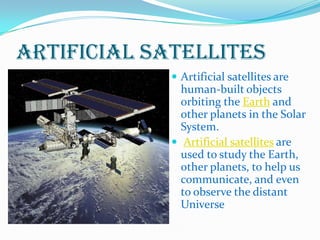
              Artificial satellites are
               human-built objects
               orbiting the Earth and
               other planets in the Solar
               System.
              Artificial satellites are
               used to study the Earth,
               other planets, to help us
               communicate, and even
               to observe the distant
               Universe
First Artificial Satellite in Space
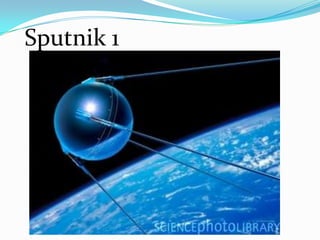
Sputnik 1 was the first artificial satellite to be put into Earth's
  orbit. It was launched into an elliptical low Earth orbit by
  the Soviet Union on 4 October 1957. It was launched during
  the International Geophysical Year from Site No.1/5, at the
  5thTyuratam range, in Kazakh SSR (now at the Baikonur
  Cosmodrome). The satellite travelled at 29,000 kilometers
  (18,000 mi) per hour, taking 96.2 minutes to complete an
  orbit, and emitted radio signals at 20.005 and
  40.002 MHz .The signals continued for 22 days until the
  transmitter batteries ran out on 26 October 1957.Sputnik
  1 burned up on 4 January 1958, as it fell from orbit upon
  reentering Earth's atmosphere, after travelling about 60
  million km (37 million miles) and spending 3 months in
  orbit.
Sputnik 1
Other Artificial Satellites
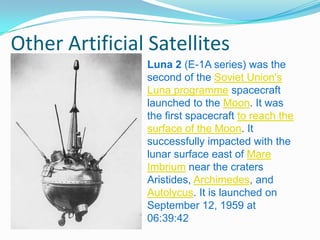
                Luna 2 (E-1A series) was the
                second of the Soviet Union's
                Luna programme spacecraft
                launched to the Moon. It was
                the first spacecraft to reach the
                surface of the Moon. It
                successfully impacted with the
                lunar surface east of Mare
                Imbrium near the craters
                Aristides, Archimedes, and
                Autolycus. It is launched on
                September 12, 1959 at
                06:39:42
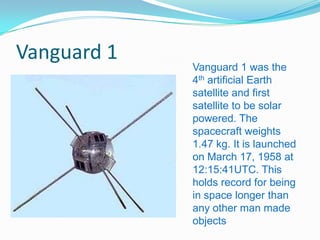
Vanguard 1
             Vanguard 1 was the
             4th artificial Earth
             satellite and first
             satellite to be solar
             powered. The
             spacecraft weights
             1.47 kg. It is launched
             on March 17, 1958 at
             12:15:41UTC. This
             holds record for being
             in space longer than
             any other man made
             objects
First Human in Space
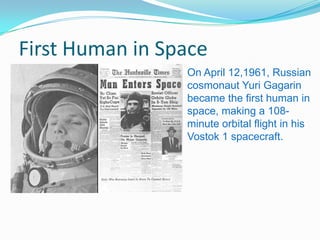
                 On April 12,1961, Russian
                 cosmonaut Yuri Gagarin
                 became the first human in
                 space, making a 108-
                 minute orbital flight in his
                 Vostok 1 spacecraft.
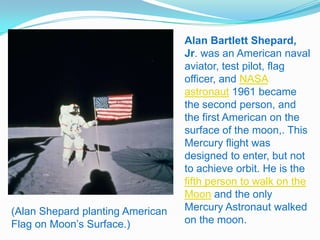
Alan Bartlett Shepard,
                                  Jr. was an American naval
                                  aviator, test pilot, flag
                                  officer, and NASA
                                  astronaut 1961 became
                                  the second person, and
                                  the first American on the
                                  surface of the moon,. This
                                  Mercury flight was
                                  designed to enter, but not
                                  to achieve orbit. He is the
                                  fifth person to walk on the
                                  Moon and the only
(Alan Shepard planting American   Mercury Astronaut walked
Flag on Moon’s Surface.)          on the moon.
Apollo 11
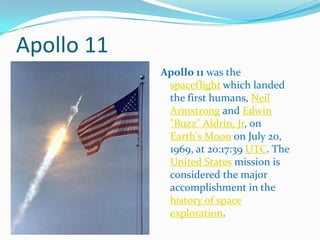
            Apollo 11 was the
             spaceflight which landed
             the first humans, Neil
             Armstrong and Edwin
             "Buzz" Aldrin, Jr, on
             Earth's Moon on July 20,
             1969, at 20:17:39 UTC. The
             United States mission is
             considered the major
             accomplishment in the
             history of space
             exploration.
Space Probes
A space probe is a scientific space exploration mission
  in which a spacecraft leaves Earth and explores space.
  It may approach the Moon, enter interplanetary, flyby
  or orbit other bodies, or approach interstellar space.
  Space probes are a form of robotic spacecraft .
Example of Space Probes
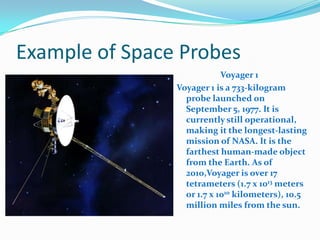
                            Voyager 1
                Voyager 1 is a 733-kilogram
                  probe launched on
                  September 5, 1977. It is
                  currently still operational,
                  making it the longest-lasting
                  mission of NASA. It is the
                  farthest human-made object
                  from the Earth. As of
                  2010,Voyager is over 17
                  tetrameters (1.7 x 10¹³ meters
                  or 1.7 x 10¹⁰ kilometers), 10.5
                  million miles from the sun.
Mars Exploration Rover
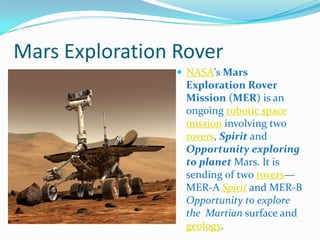
                  NASA's Mars
                  Exploration Rover
                  Mission (MER) is an
                  ongoing robotic space
                  mission involving two
                  rovers, Spirit and
                  Opportunity exploring
                  to planet Mars. It is
                  sending of two rovers—
                  MER-A Spirit and MER-B
                  Opportunity to explore
                  the Martian surface and
                  geology.
Skylab
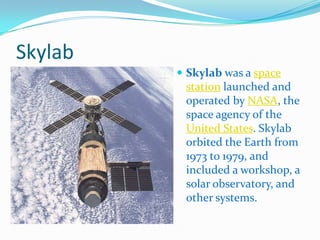
          Skylab was a space
          station launched and
          operated by NASA, the
          space agency of the
          United States. Skylab
          orbited the Earth from
          1973 to 1979, and
          included a workshop, a
          solar observatory, and
          other systems.
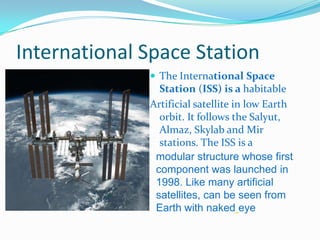
International Space Station
               The International Space
                Station (ISS) is a habitable
              Artificial satellite in low Earth
                orbit. It follows the Salyut,
                Almaz, Skylab and Mir
                stations. The ISS is a
               modular structure whose first
               component was launched in
               1998. Like many artificial
               satellites, can be seen from
               Earth with naked eye
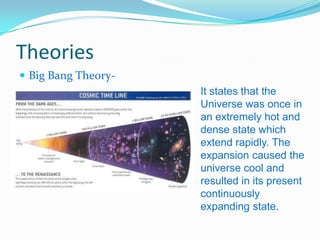
Theories
 Big Bang Theory-
                     It states that the
                     Universe was once in
                     an extremely hot and
                     dense state which
                     extend rapidly. The
                     expansion caused the
                     universe cool and
                     resulted in its present
                     continuously
                     expanding state.
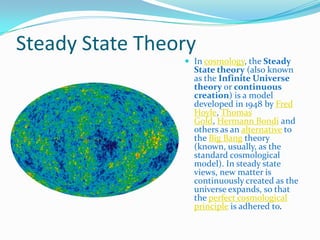
Steady State Theory
                  In cosmology, the Steady
                   State theory (also known
                   as the Infinite Universe
                   theory or continuous
                   creation) is a model
                   developed in 1948 by Fred
                   Hoyle, Thomas
                   Gold, Hermann Bondi and
                   others as an alternative to
                   the Big Bang theory
                   (known, usually, as the
                   standard cosmological
                   model). In steady state
                   views, new matter is
                   continuously created as the
                   universe expands, so that
                   the perfect cosmological
                   principle is adhered to.

Report in science( studying the universe )

  • 3.
    Artificial Satellites  Artificial satellites are human-built objects orbiting the Earth and other planets in the Solar System.  Artificial satellites are used to study the Earth, other planets, to help us communicate, and even to observe the distant Universe
  • 4.
    First Artificial Satellitein Space Sputnik 1 was the first artificial satellite to be put into Earth's orbit. It was launched into an elliptical low Earth orbit by the Soviet Union on 4 October 1957. It was launched during the International Geophysical Year from Site No.1/5, at the 5thTyuratam range, in Kazakh SSR (now at the Baikonur Cosmodrome). The satellite travelled at 29,000 kilometers (18,000 mi) per hour, taking 96.2 minutes to complete an orbit, and emitted radio signals at 20.005 and 40.002 MHz .The signals continued for 22 days until the transmitter batteries ran out on 26 October 1957.Sputnik 1 burned up on 4 January 1958, as it fell from orbit upon reentering Earth's atmosphere, after travelling about 60 million km (37 million miles) and spending 3 months in orbit.
  • 5.
  • 6.
    Other Artificial Satellites Luna 2 (E-1A series) was the second of the Soviet Union's Luna programme spacecraft launched to the Moon. It was the first spacecraft to reach the surface of the Moon. It successfully impacted with the lunar surface east of Mare Imbrium near the craters Aristides, Archimedes, and Autolycus. It is launched on September 12, 1959 at 06:39:42
  • 7.
    Vanguard 1 Vanguard 1 was the 4th artificial Earth satellite and first satellite to be solar powered. The spacecraft weights 1.47 kg. It is launched on March 17, 1958 at 12:15:41UTC. This holds record for being in space longer than any other man made objects
  • 8.
    First Human inSpace On April 12,1961, Russian cosmonaut Yuri Gagarin became the first human in space, making a 108- minute orbital flight in his Vostok 1 spacecraft.
  • 9.
    Alan Bartlett Shepard, Jr. was an American naval aviator, test pilot, flag officer, and NASA astronaut 1961 became the second person, and the first American on the surface of the moon,. This Mercury flight was designed to enter, but not to achieve orbit. He is the fifth person to walk on the Moon and the only (Alan Shepard planting American Mercury Astronaut walked Flag on Moon’s Surface.) on the moon.
  • 10.
    Apollo 11 Apollo 11 was the spaceflight which landed the first humans, Neil Armstrong and Edwin "Buzz" Aldrin, Jr, on Earth's Moon on July 20, 1969, at 20:17:39 UTC. The United States mission is considered the major accomplishment in the history of space exploration.
  • 11.
    Space Probes A spaceprobe is a scientific space exploration mission in which a spacecraft leaves Earth and explores space. It may approach the Moon, enter interplanetary, flyby or orbit other bodies, or approach interstellar space. Space probes are a form of robotic spacecraft .
  • 12.
    Example of SpaceProbes Voyager 1 Voyager 1 is a 733-kilogram probe launched on September 5, 1977. It is currently still operational, making it the longest-lasting mission of NASA. It is the farthest human-made object from the Earth. As of 2010,Voyager is over 17 tetrameters (1.7 x 10¹³ meters or 1.7 x 10¹⁰ kilometers), 10.5 million miles from the sun.
  • 13.
    Mars Exploration Rover  NASA's Mars Exploration Rover Mission (MER) is an ongoing robotic space mission involving two rovers, Spirit and Opportunity exploring to planet Mars. It is sending of two rovers— MER-A Spirit and MER-B Opportunity to explore the Martian surface and geology.
  • 14.
    Skylab  Skylab was a space station launched and operated by NASA, the space agency of the United States. Skylab orbited the Earth from 1973 to 1979, and included a workshop, a solar observatory, and other systems.
  • 15.
    International Space Station  The International Space Station (ISS) is a habitable Artificial satellite in low Earth orbit. It follows the Salyut, Almaz, Skylab and Mir stations. The ISS is a modular structure whose first component was launched in 1998. Like many artificial satellites, can be seen from Earth with naked eye
  • 16.
    Theories  Big BangTheory- It states that the Universe was once in an extremely hot and dense state which extend rapidly. The expansion caused the universe cool and resulted in its present continuously expanding state.
  • 17.
    Steady State Theory  In cosmology, the Steady State theory (also known as the Infinite Universe theory or continuous creation) is a model developed in 1948 by Fred Hoyle, Thomas Gold, Hermann Bondi and others as an alternative to the Big Bang theory (known, usually, as the standard cosmological model). In steady state views, new matter is continuously created as the universe expands, so that the perfect cosmological principle is adhered to.