The SunGroup 5
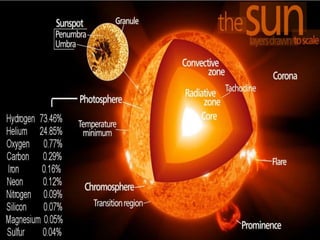
• The Sun is the star at the center of the Solar
System
• G-type main-sequence star
• Its diameter is about 109 times that of Earth,
and its mass is about 330,000 times that of
Earth, accounting for about 99.86% of the total
mass of the Solar System
• It formed approximately 4.6 billion years ago
from the gravitational collapse of matter within a
region of a large molecular cloud.
• The central mass became so hot and
dense that it eventually initiated nuclear
fusion in its core.
• The Sun is roughly middle-aged; it has not
changed dramatically for more than four
billion years, and will remain fairly stable
for more than another five billion years.
• VIDEOOOOOO
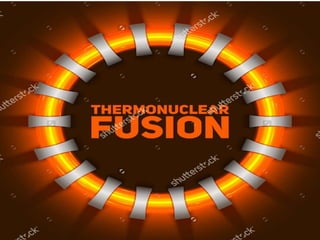
 Thermonuclear fusion is the process by which nuclei of low at
omic weight such as hydrogen combine to form nuclei of high
er atomic weight such as helium.
 Two isotopes of hydrogen, deuterium (composed of a hydrog
en nucleus containing one neutrons and one proton) tritium(
a hydrogen nucleus
containing two neutrons and oneproton), provide the most
energetically favorable fusion reactants.
SOLAR
RADIATION
• VIDEOOOOO
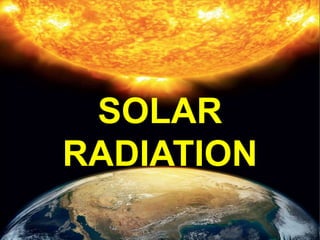
Solar radiation is the radiation, or energy we get
from the sun. It is also known as short-wave
radiation.
Solar radiation comes in many forms, such as
visible light, radio waves, heat (infrared), x-rays,
and ultraviolet rays.
Measurements for solar radiation are higher on
clear, sunny day and usually low on cloudy
days. When the sun is down, or there are heavy
clouds blocking the sun, solar radiation is
measured at zero.
SOLAR
PROMINENCE
• A solar prominence (also known as a
filament when viewed against the
solar disk) is a large, bright feature
extending outward from the Sun's
surface.
• Prominences are anchored to the
Sun's surface in the photosphere, and
extend outwards into the Sun's hot
outer atmosphere, called the corona.
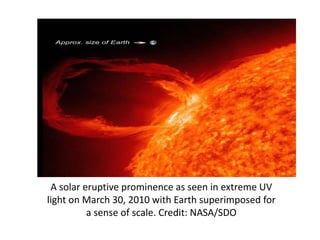
A solar eruptive prominence as seen in extreme UV
light on March 30, 2010 with Earth superimposed for
a sense of scale. Credit: NASA/SDO
• The red-glowing looped material is plasma, a
hot gas comprised of electrically charged
hydrogen and helium.
• The prominence plasma flows along a tangled
and twisted structure of magnetic fields
generated by the sun’s internal dynamo.
• An erupting prominence occurs when such a
structure becomes unstable and bursts
outward, releasing the plasma.
Sun Spots
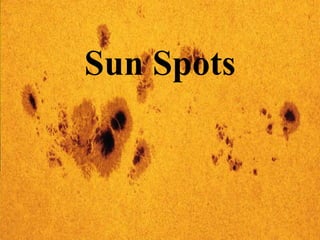
• Sunspots can be very large, up to 50,000
kilometers in diameter. They are caused by
interactions with the Sun's magnetic field.
• Sunspots occur over regions of intense
magnetic activity, and when that energy is
released, solar flares and big storms called
coronal mass ejections erupt from sunspots
Sunspot Cycle
• The number of sunspots seen on the "surface"
of the Sun changes from year to year. This rise
and fall in sunspot counts is a cycle. The length
of the cycle is about eleven years on
average. The Sunspot Cycle was discovered in
1843 by the amateur German astronomer
Samuel Heinrich Schwabe.
The picture on the left was taken near solar max in
March 2001. It shows many sunspots. The picture on the
right was taken near solar min in January 2005.
• The Sun is usually very active when sunspot
counts are high. Sunspots show us where
the Sun's magnetic field might be "twisted
up" enough to cause solar flares and coronal
mass ejections. The Sun gives off
more radiation than usual during solar max,
and this extra energy changes the uppermost
layers of Earth's atmosphere.

The sun

  • 1.
  • 2.
    • The Sunis the star at the center of the Solar System • G-type main-sequence star • Its diameter is about 109 times that of Earth, and its mass is about 330,000 times that of Earth, accounting for about 99.86% of the total mass of the Solar System • It formed approximately 4.6 billion years ago from the gravitational collapse of matter within a region of a large molecular cloud.
  • 4.
    • The centralmass became so hot and dense that it eventually initiated nuclear fusion in its core. • The Sun is roughly middle-aged; it has not changed dramatically for more than four billion years, and will remain fairly stable for more than another five billion years.
  • 6.
  • 7.
     Thermonuclear fusionis the process by which nuclei of low at omic weight such as hydrogen combine to form nuclei of high er atomic weight such as helium.  Two isotopes of hydrogen, deuterium (composed of a hydrog en nucleus containing one neutrons and one proton) tritium( a hydrogen nucleus containing two neutrons and oneproton), provide the most energetically favorable fusion reactants.
  • 8.
  • 9.
  • 10.
    Solar radiation isthe radiation, or energy we get from the sun. It is also known as short-wave radiation. Solar radiation comes in many forms, such as visible light, radio waves, heat (infrared), x-rays, and ultraviolet rays. Measurements for solar radiation are higher on clear, sunny day and usually low on cloudy days. When the sun is down, or there are heavy clouds blocking the sun, solar radiation is measured at zero.
  • 11.
  • 12.
    • A solarprominence (also known as a filament when viewed against the solar disk) is a large, bright feature extending outward from the Sun's surface. • Prominences are anchored to the Sun's surface in the photosphere, and extend outwards into the Sun's hot outer atmosphere, called the corona.
  • 13.
    A solar eruptiveprominence as seen in extreme UV light on March 30, 2010 with Earth superimposed for a sense of scale. Credit: NASA/SDO
  • 14.
    • The red-glowinglooped material is plasma, a hot gas comprised of electrically charged hydrogen and helium. • The prominence plasma flows along a tangled and twisted structure of magnetic fields generated by the sun’s internal dynamo. • An erupting prominence occurs when such a structure becomes unstable and bursts outward, releasing the plasma.
  • 16.
  • 18.
    • Sunspots canbe very large, up to 50,000 kilometers in diameter. They are caused by interactions with the Sun's magnetic field. • Sunspots occur over regions of intense magnetic activity, and when that energy is released, solar flares and big storms called coronal mass ejections erupt from sunspots
  • 20.
    Sunspot Cycle • Thenumber of sunspots seen on the "surface" of the Sun changes from year to year. This rise and fall in sunspot counts is a cycle. The length of the cycle is about eleven years on average. The Sunspot Cycle was discovered in 1843 by the amateur German astronomer Samuel Heinrich Schwabe.
  • 21.
    The picture onthe left was taken near solar max in March 2001. It shows many sunspots. The picture on the right was taken near solar min in January 2005.
  • 22.
    • The Sunis usually very active when sunspot counts are high. Sunspots show us where the Sun's magnetic field might be "twisted up" enough to cause solar flares and coronal mass ejections. The Sun gives off more radiation than usual during solar max, and this extra energy changes the uppermost layers of Earth's atmosphere.