The Colour
"The purest and most thoughtful
minds are those which love color the
most."
— John Ruskin
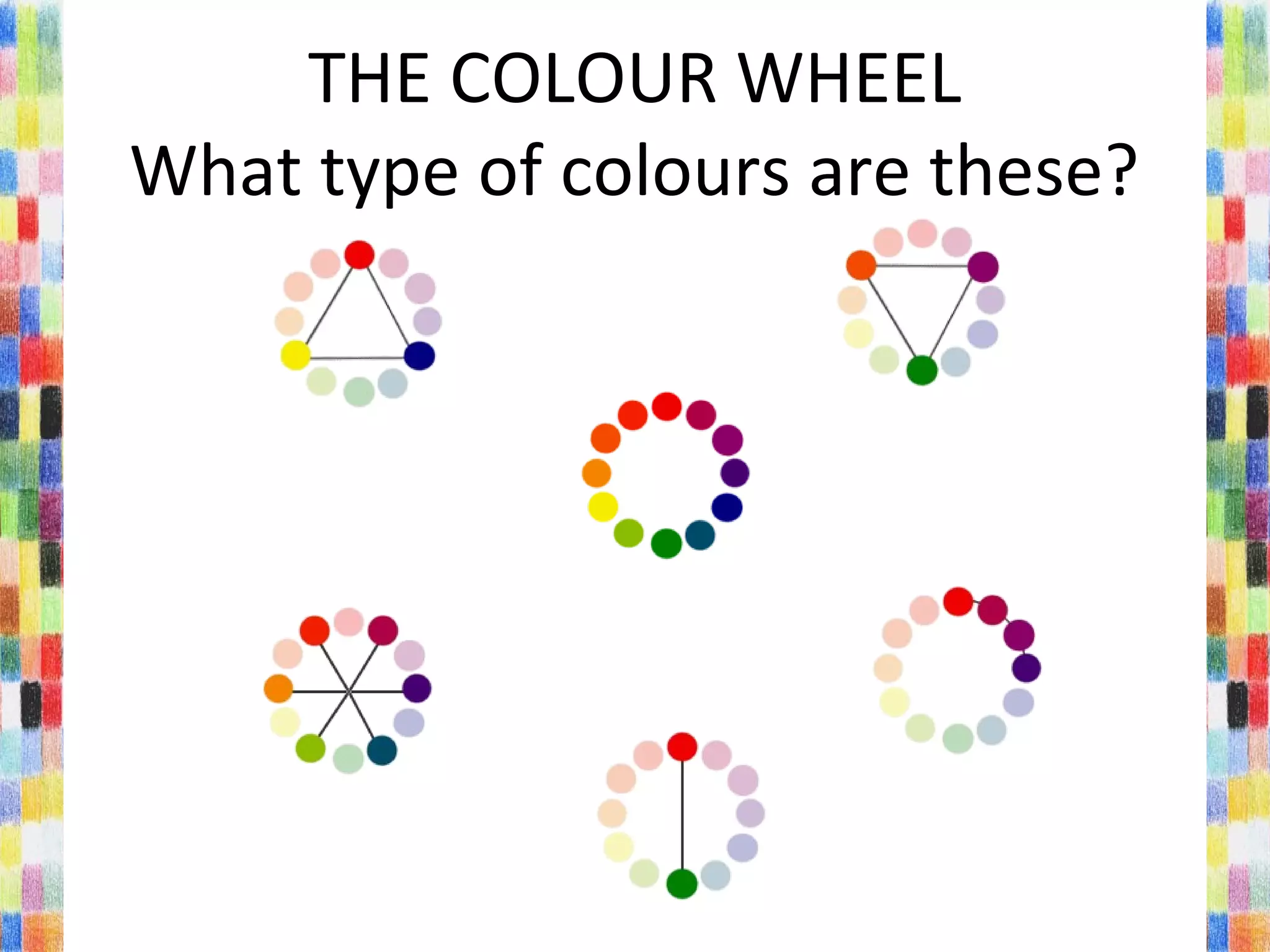
THE COLOUR WHEEL
What type of colours are these?
Primary Colours
Primary Colours
Primary Colours
•Cannot be made from any other colours
•All other colours are made from these
•Equal distance from each other on colour wheel
Secondary Colours
Secondary Colours
Secondary Colours
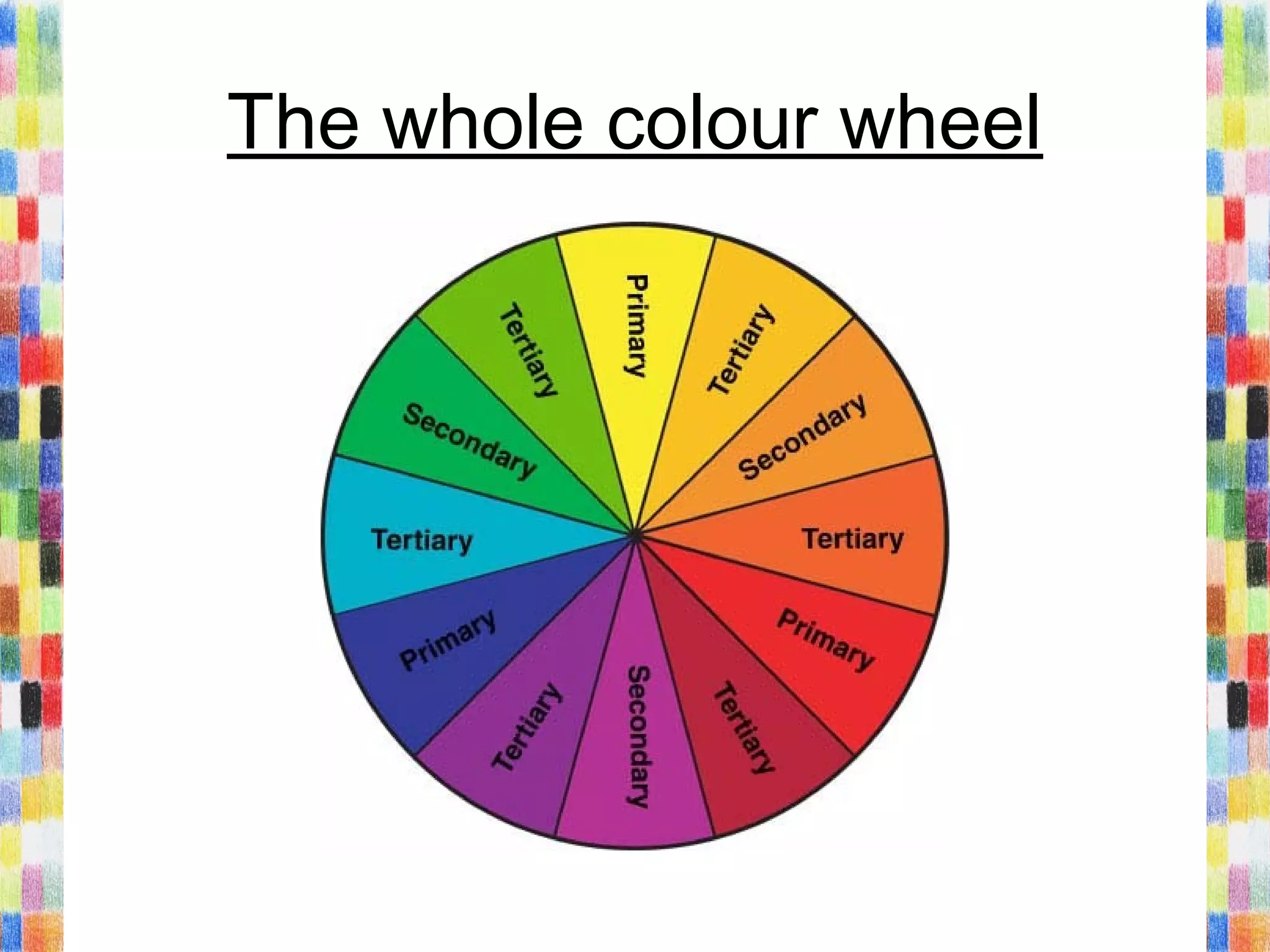
•Made by mixing equal amounts of 2 primary colours
•Found halfway between the primary colours on the wheel
Tertiary Colours
Made by mixing equal amounts of adjoining primary and secondary colours.
The whole colour wheel
Complementary Colours
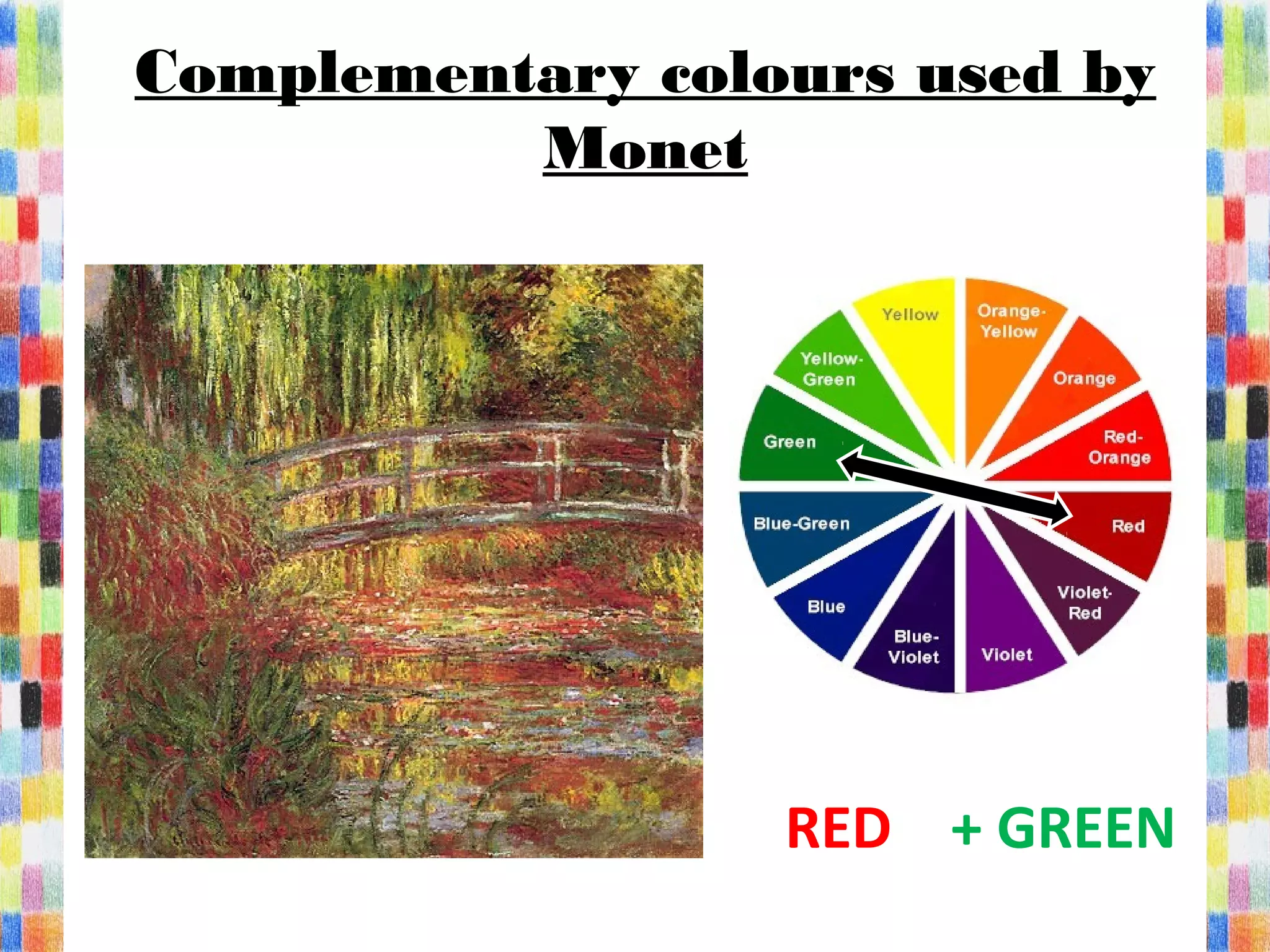
This colour scheme uses opposite
colours on the colour wheel. These
colours are across from each other on
the wheel and have great contrast.
"Complementary colors make a
strange pair. They are opposite, yet
they require each other. They incite
each other to maximum vividness
when together; and annihilate each
other when mixed.“
— Johannes Itten
Complementary colours used by
Van Gogh
BLUE + ORANGE
Complementary colours used by
Monet
RED + GREEN
COLOUR RELATIONSHIPS:
Color relationships may be displayed as a color wheel
or a color triangle.
The Painter's color triangle consists of
colors we would often use in art class—those
colors we learn about as children. The
primary hues are red, blue and yellow.
The Printers' color triangle is
the set of colors used in the
printing process. The primaries
are magenta, cyan, and yellow.
Nine-part harmonic triangle of Goethe begins
with the printer's primaries; the secondaries
formed are the painter's primaries; and the
resulting tertiaries formed are dark neutrals.
Describing colours:
hue, tint, shade and tone
 Hue as one of the twelve colors on the mixing wheel.
Every individual color on the Basic Colour Wheel can 
be altered in three ways by Tinting, Shading or
Toning. 
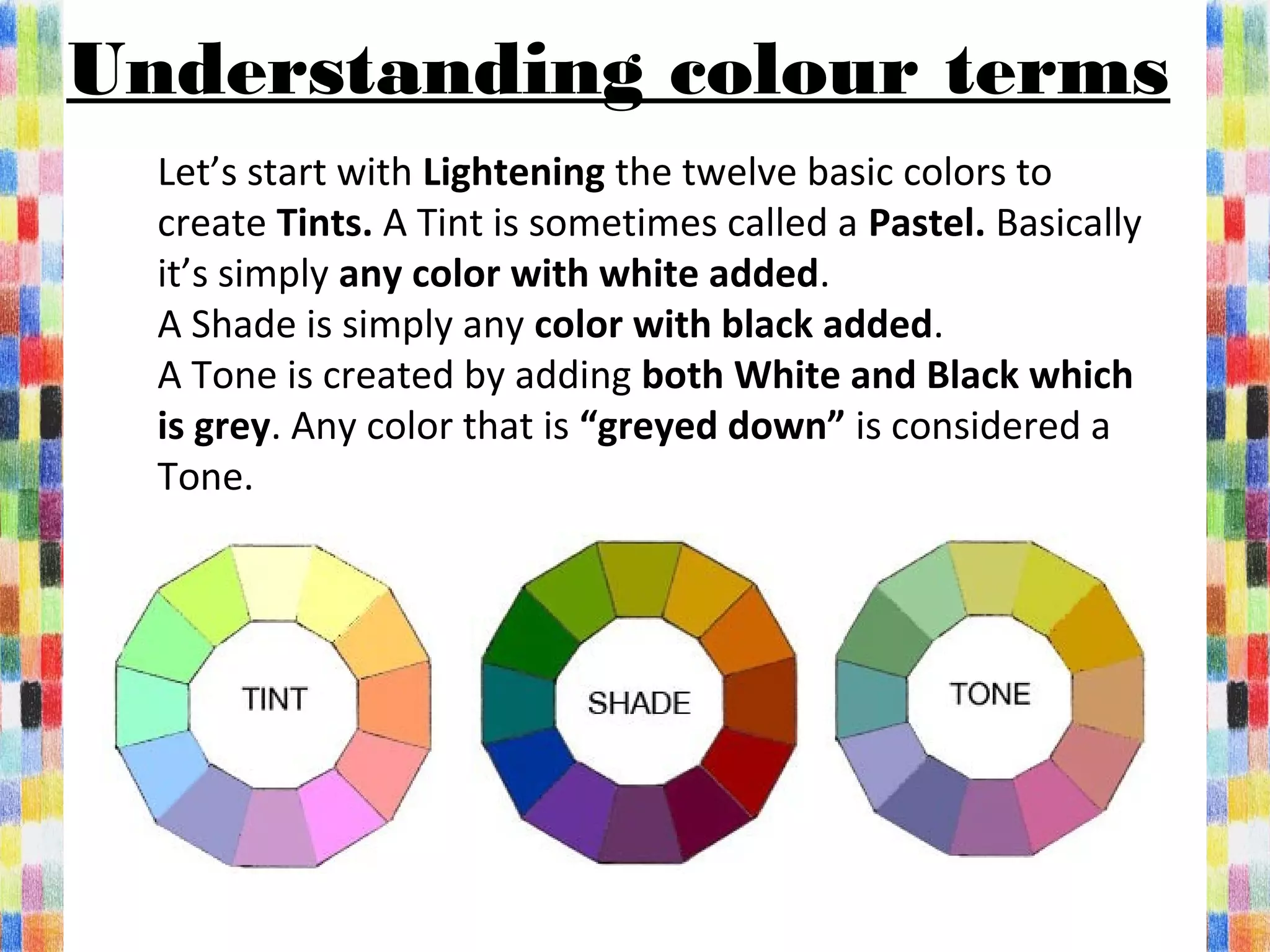
Understanding colour terms
Let’s start with Lightening the twelve basic colors to 
create Tints. A Tint is sometimes called a Pastel. Basically 
it’s simply any color with white added.
A Shade is simply any color with black added.
A Tone is created by adding both White and Black which
is grey. Any color that is “greyed down” is considered a 
Tone.
The Fauves 
With  respect  to  the  arts,  color  was  part  of  the  realistic,  visual 
representation  of  form,  but  one  group  of  painters  abandoned  the 
traditional practices regarding color in painting. This group of artists were 
influenced by Cezanne, Van Gogh, and Gauguin. Led by Henri Matisse, they 
were known as the Fauves, or "the wild beasts." Their exuberant use of
brilliant hues seem to disregard imitative color. Whereas other artists had 
used color as the description of an object, the Fauves let color become the
subject of their painting. A painting in the "Fauvist Manner" was one that 
related color shapes; rather than unifying a design with line, compositions 
sought an expressiveness within the relationships of the whole. This turn 
from tradition brought an integrity to color in that color was regarded on its 
own merit.
"Colors, like features, follow the changes of the emotions."
— Pablo Picasso
Read more about the Fauves at the National Gallery of Art
http://www.nga.gov/feature/artnation/fauve/index.htm
QUOTATIONS BY HENRI MATISSE
“When I put a green, it it not grass. When I put a blue, it is not the
sky.”
I do not literally paint that table, but the emotion it produces upon
me.
“Seek the strongest color effect possible... the content is of no
importance”.
Exactitude is not truth.
"Colour is life; for a world
without colours appears to
us as dead."—
Johannes Itten
Source : http://www.worqx.com/color/

Colour

  • 1.
    The Colour "The purestand most thoughtful minds are those which love color the most." — John Ruskin
  • 2.
    THE COLOUR WHEEL Whattype of colours are these?
  • 3.
  • 4.
  • 5.
    Primary Colours •Cannot bemade from any other colours •All other colours are made from these •Equal distance from each other on colour wheel
  • 6.
  • 7.
  • 8.
    Secondary Colours •Made bymixing equal amounts of 2 primary colours •Found halfway between the primary colours on the wheel
  • 9.
    Tertiary Colours Made bymixing equal amounts of adjoining primary and secondary colours.
  • 10.
  • 11.
    Complementary Colours This colourscheme uses opposite colours on the colour wheel. These colours are across from each other on the wheel and have great contrast.
  • 12.
    "Complementary colors makea strange pair. They are opposite, yet they require each other. They incite each other to maximum vividness when together; and annihilate each other when mixed.“ — Johannes Itten
  • 13.
    Complementary colours usedby Van Gogh BLUE + ORANGE
  • 14.
    Complementary colours usedby Monet RED + GREEN
  • 15.
    COLOUR RELATIONSHIPS: Color relationshipsmay be displayed as a color wheel or a color triangle. The Painter's color triangle consists of colors we would often use in art class—those colors we learn about as children. The primary hues are red, blue and yellow. The Printers' color triangle is the set of colors used in the printing process. The primaries are magenta, cyan, and yellow. Nine-part harmonic triangle of Goethe begins with the printer's primaries; the secondaries formed are the painter's primaries; and the resulting tertiaries formed are dark neutrals.
  • 16.
    Describing colours: hue, tint,shade and tone  Hue as one of the twelve colors on the mixing wheel. Every individual color on the Basic Colour Wheel can  be altered in three ways by Tinting, Shading or Toning. 
  • 17.
    Understanding colour terms Let’s start with Lightening the twelve basic colors to  create Tints.A Tint is sometimes called a Pastel. Basically  it’s simply any color with white added. A Shade is simply any color with black added. A Tone is created by adding both White and Black which is grey. Any color that is “greyed down” is considered a  Tone.
  • 18.
    The Fauves  With  respect  to the  arts,  color  was  part  of  the  realistic,  visual  representation  of  form,  but  one  group  of  painters  abandoned  the  traditional practices regarding color in painting. This group of artists were  influenced by Cezanne, Van Gogh, and Gauguin. Led by Henri Matisse, they  were known as the Fauves, or "the wild beasts." Their exuberant use of brilliant hues seem to disregard imitative color. Whereas other artists had  used color as the description of an object, the Fauves let color become the subject of their painting. A painting in the "Fauvist Manner" was one that  related color shapes; rather than unifying a design with line, compositions  sought an expressiveness within the relationships of the whole. This turn  from tradition brought an integrity to color in that color was regarded on its  own merit. "Colors, like features, follow the changes of the emotions." — Pablo Picasso Read more about the Fauves at the National Gallery of Art http://www.nga.gov/feature/artnation/fauve/index.htm
  • 19.
    QUOTATIONS BY HENRIMATISSE “When I put a green, it it not grass. When I put a blue, it is not the sky.” I do not literally paint that table, but the emotion it produces upon me. “Seek the strongest color effect possible... the content is of no importance”. Exactitude is not truth.
  • 20.
    "Colour is life;for a world without colours appears to us as dead."— Johannes Itten Source : http://www.worqx.com/color/