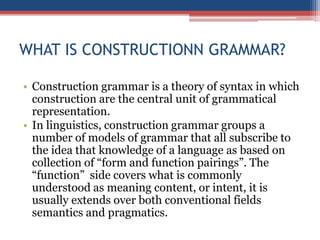
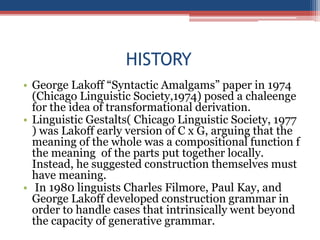
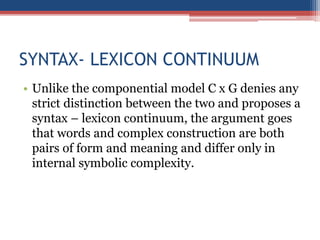
Construction grammar views grammatical constructions as the basic units of syntax, where a construction is a form-meaning pairing. It denies a strict distinction between lexicon and syntax, instead proposing a continuum. There are different models of how constructions are organized in the grammar, including a full entry model with minimal generalization, a usage-based model based on inductive learning, and models with varying degrees of inheritance. Construction grammar rejects derivation and adheres to no synonymy, viewing related constructions like active and passive as distinct. Various approaches within construction grammar emphasize different aspects, such as form (Berkeley construction grammar), psychological plausibility (Goldbergian construction grammar), or embodiment. The strength of construction grammar is its claim that many grammatical units