Downloaded 463 times


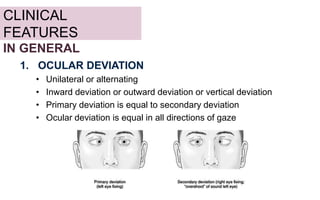






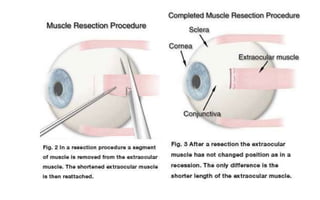


Concomitant strabismus is a type of manifest squint where the amount of deviation remains constant in all directions of gaze and there is no limitation of ocular movements. It can be caused by sensory obstacles like refractive errors, motor obstacles like abnormalities of extraocular muscles, or central obstacles like deficient development of fusion faculty. The main types are esotropia (inward deviation), exotropia (outward deviation), and hypertropia (vertical deviation). Treatment involves correcting refractive errors, amblyopia treatment, orthoptic exercises, and squint surgery to weaken strong muscles or strengthen weak muscles as needed.


