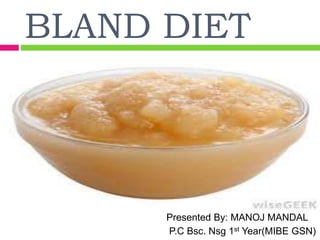

BLAND DIET
Presented By: MANOJ MANDAL
P.C Bsc. Nsg 1st Year(MIBE GSN)
WHAT IS A BLAND DIET?
Bland diets a diet consisting of foods that are generally soft,
low in dietary fiber, cooked rather than raw, and not spicy.
Fried and fatty foods, strong cheeses, whole grains (rich
in fiber), and the medications aspirin and ibuprofen are
also avoided while on this diet. Such a diet is
called bland because it is soothing to the digestive
tract (it minimizes irritation of tissues). It can also be
bland in the sense of "lacking flavor", but it does not
always have to be so; nonirritating food can be appetizing
food, depending on preparation and individual
preferences.
PURPOSE
 The foods included are limited to non-
stimulating, non-irritating and mildly seasoned
products.
 This diet should be individualized according to
your appetite and food tolerance. With time
and recovery, you may be able to expand this
diet to you tolerances.
 The bland or soft diet is designed to decrease
peristalsis and avoid irritation of the
gastrointestinal tract.
Nutrients Modified
 All nutrients are available on the Bland Diet.
Texture is modified by offering items that are
easily digested, moderately low in roughage
and very mildly seasoned products.
 Tender foods are used such as cooked
vegetables, canned fruits, and refined breads
and cereals.
 Fried foods and highly seasoned foods,
pepper, caffeinated beverages and alcohol
may cause distress and, therefore, are
eliminated.
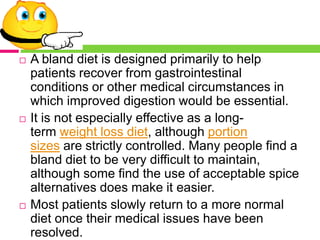
INDICATIONS
 Stomach or intestinal surgery
 Ulcers Diseases
 Heart burn
 Nausea and Vomiting
 GERD
 Gas and Flatulence
 Gastritis
 Dyspepsia
 Treatment of hiatus hernia
 A bland diet is designed primarily to help
patients recover from gastrointestinal
conditions or other medical circumstances in
which improved digestion would be essential.
 It is not especially effective as a long-
term weight loss diet, although portion
sizes are strictly controlled. Many people find a
bland diet to be very difficult to maintain,
although some find the use of acceptable spice
alternatives does make it easier.
 Most patients slowly return to a more normal
diet once their medical issues have been
resolved.
Dietary Guidelines and
Food List
 Eat three regular meals a day without snacks
since all food stimulates acid output.
 Eat foods slowly, chew well and avoid stomach
distention with large quantities of food.
 Use milk sparingly because it stimulates gastric
acid secretion.
 Use salt and very mild seasonings. Avoid
heavy spices such as chili peppers, black
pepper, chilis powder and highly seasoned
foods.
 Dietary fiber may be added since there is no
evidence that dietary is harmful.
 Choose whole grain, enriched, or refined
breads and cereals. Avoid large amounts of
unprocessed bran.
 Cook by baking, boiling, broiling, roasting,
stewing, microwaving or creaming. Avoid
frying.
 Avoid caffeinated beverages, coffee and tea
products because of the caffeine, theobromine,
and tannins.
 Citric acid juices may be irritating to some
individuals.
 Avoid aspirin, non steroidal anti-inflammatory
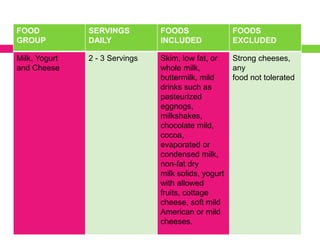
FOOD
GROUP
SERVINGS
DAILY
FOODS
INCLUDED
FOODS
EXCLUDED
Milk, Yogurt
and Cheese
2 - 3 Servings Skim, low fat, or
whole milk,
buttermilk, mild
drinks such as
pasteurized
eggnogs,
milkshakes,
chocolate mild,
cocoa,
evaporated or
condensed milk,
non-fat dry
milk solids, yogurt
with allowed
fruits, cottage
cheese, soft mild
American or mild
cheeses.
Strong cheeses,
any
food not tolerated
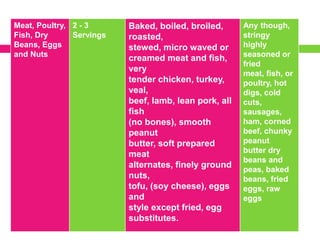
Meat, Poultry,
Fish, Dry
Beans, Eggs
and Nuts
2 - 3
Servings
Baked, boiled, broiled,
roasted,
stewed, micro waved or
creamed meat and fish,
very
tender chicken, turkey,
veal,
beef, lamb, lean pork, all
fish
(no bones), smooth
peanut
butter, soft prepared
meat
alternates, finely ground
nuts,
tofu, (soy cheese), eggs
and
style except fried, egg
substitutes.
Any though,
stringy
highly
seasoned or
fried
meat, fish, or
poultry, hot
digs, cold
cuts,
sausages,
ham, corned
beef, chunky
peanut
butter dry
beans and
peas, baked
beans, fried
eggs, raw
eggs
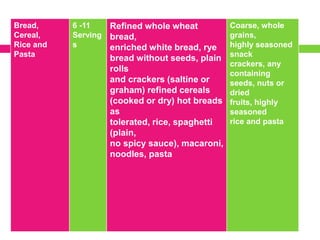
Bread,
Cereal,
Rice and
Pasta
6 -11
Serving
s
Refined whole wheat
bread,
enriched white bread, rye
bread without seeds, plain
rolls
and crackers (saltine or
graham) refined cereals
(cooked or dry) hot breads
as
tolerated, rice, spaghetti
(plain,
no spicy sauce), macaroni,
noodles, pasta
Coarse, whole
grains,
highly seasoned
snack
crackers, any
containing
seeds, nuts or
dried
fruits, highly
seasoned
rice and pasta
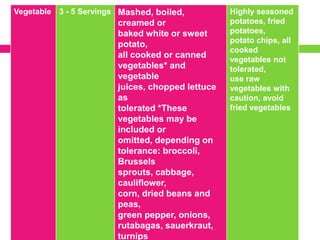
Vegetable 3 - 5 Servings Mashed, boiled,
creamed or
baked white or sweet
potato,
all cooked or canned
vegetables* and
vegetable
juices, chopped lettuce
as
tolerated *These
vegetables may be
included or
omitted, depending on
tolerance: broccoli,
Brussels
sprouts, cabbage,
cauliflower,
corn, dried beans and
peas,
green pepper, onions,
rutabagas, sauerkraut,
turnips
Highly seasoned
potatoes, fried
potatoes,
potato chips, all
cooked
vegetables not
tolerated,
use raw
vegetables with
caution, avoid
fried vegetables
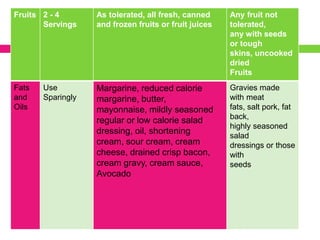
Fruits 2 - 4
Servings
As tolerated, all fresh, canned
and frozen fruits or fruit juices
Any fruit not
tolerated,
any with seeds
or tough
skins, uncooked
dried
Fruits
Fats
and
Oils
Use
Sparingly
Margarine, reduced calorie
margarine, butter,
mayonnaise, mildly seasoned
regular or low calorie salad
dressing, oil, shortening
cream, sour cream, cream
cheese, drained crisp bacon,
cream gravy, cream sauce,
Avocado
Gravies made
with meat
fats, salt pork, fat
back,
highly seasoned
salad
dressings or those
with
seeds
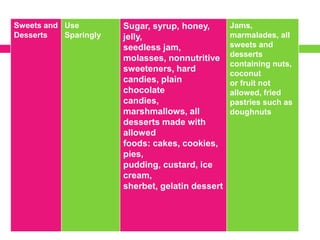
Sweets and
Desserts
Use
Sparingly
Sugar, syrup, honey,
jelly,
seedless jam,
molasses, nonnutritive
sweeteners, hard
candies, plain
chocolate
candies,
marshmallows, all
desserts made with
allowed
foods: cakes, cookies,
pies,
pudding, custard, ice
cream,
sherbet, gelatin dessert
Jams,
marmalades, all
sweets and
desserts
containing nuts,
coconut
or fruit not
allowed, fried
pastries such as
doughnuts
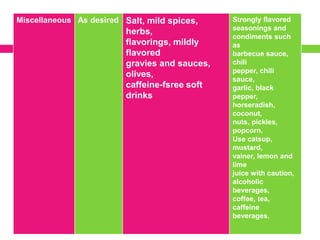
Miscellaneous As desired Salt, mild spices,
herbs,
flavorings, mildly
flavored
gravies and sauces,
olives,
caffeine-fsree soft
drinks
Strongly flavored
seasonings and
condiments such
as
barbecue sauce,
chili
pepper, chili
sauce,
garlic, black
pepper,
horseradish,
coconut,
nuts, pickles,
popcorn.
Use catsup,
mustard,
vainer, lemon and
lime
juice with caution,
alcoholic
beverages,
coffee, tea,
caffeine
beverages.
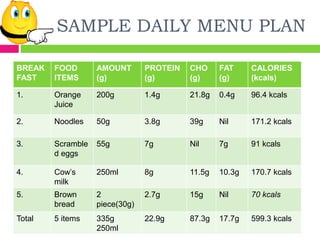
SAMPLE DAILY MENU PLAN
BREAK
FAST
FOOD
ITEMS
AMOUNT
(g)
PROTEIN
(g)
CHO
(g)
FAT
(g)
CALORIES
(kcals)
1. Orange
Juice
200g 1.4g 21.8g 0.4g 96.4 kcals
2. Noodles 50g 3.8g 39g Nil 171.2 kcals
3. Scramble
d eggs
55g 7g Nil 7g 91 kcals
4. Cow’s
milk
250ml 8g 11.5g 10.3g 170.7 kcals
5. Brown
bread
2
piece(30g)
2.7g 15g Nil 70 kcals
Total 5 items 335g
250ml
22.9g 87.3g 17.7g 599.3 kcals
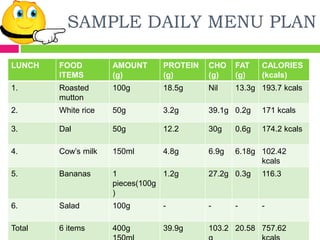
SAMPLE DAILY MENU PLAN
LUNCH FOOD
ITEMS
AMOUNT
(g)
PROTEIN
(g)
CHO
(g)
FAT
(g)
CALORIES
(kcals)
1. Roasted
mutton
100g 18.5g Nil 13.3g 193.7 kcals
2. White rice 50g 3.2g 39.1g 0.2g 171 kcals
3. Dal 50g 12.2 30g 0.6g 174.2 kcals
4. Cow’s milk 150ml 4.8g 6.9g 6.18g 102.42
kcals
5. Bananas 1
pieces(100g
)
1.2g 27.2g 0.3g 116.3
6. Salad 100g - - - -
Total 6 items 400g 39.9g 103.2 20.58 757.62
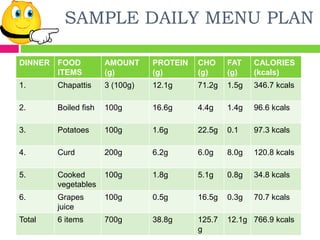
SAMPLE DAILY MENU PLAN
DINNER FOOD
ITEMS
AMOUNT
(g)
PROTEIN
(g)
CHO
(g)
FAT
(g)
CALORIES
(kcals)
1. Chapattis 3 (100g) 12.1g 71.2g 1.5g 346.7 kcals
2. Boiled fish 100g 16.6g 4.4g 1.4g 96.6 kcals
3. Potatoes 100g 1.6g 22.5g 0.1 97.3 kcals
4. Curd 200g 6.2g 6.0g 8.0g 120.8 kcals
5. Cooked
vegetables
100g 1.8g 5.1g 0.8g 34.8 kcals
6. Grapes
juice
100g 0.5g 16.5g 0.3g 70.7 kcals
Total 6 items 700g 38.8g 125.7
g
12.1g 766.9 kcals
SUMMARY
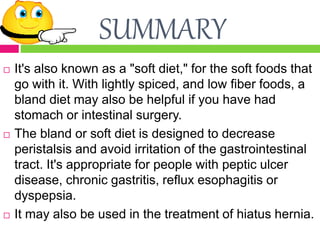
 It's also known as a "soft diet," for the soft foods that
go with it. With lightly spiced, and low fiber foods, a
bland diet may also be helpful if you have had
stomach or intestinal surgery.
 The bland or soft diet is designed to decrease
peristalsis and avoid irritation of the gastrointestinal
tract. It's appropriate for people with peptic ulcer
disease, chronic gastritis, reflux esophagitis or
dyspepsia.
 It may also be used in the treatment of hiatus hernia.
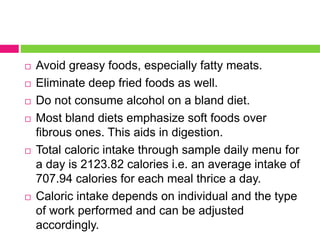
 Avoid greasy foods, especially fatty meats.
 Eliminate deep fried foods as well.
 Do not consume alcohol on a bland diet.
 Most bland diets emphasize soft foods over
fibrous ones. This aids in digestion.
 Total caloric intake through sample daily menu for
a day is 2123.82 calories i.e. an average intake of
707.94 calories for each meal thrice a day.
 Caloric intake depends on individual and the type
of work performed and can be adjusted
accordingly.
Bland diet

Bland diet

  • 1.
    BLAND DIET Presented By:MANOJ MANDAL P.C Bsc. Nsg 1st Year(MIBE GSN)
  • 2.
    WHAT IS ABLAND DIET? Bland diets a diet consisting of foods that are generally soft, low in dietary fiber, cooked rather than raw, and not spicy. Fried and fatty foods, strong cheeses, whole grains (rich in fiber), and the medications aspirin and ibuprofen are also avoided while on this diet. Such a diet is called bland because it is soothing to the digestive tract (it minimizes irritation of tissues). It can also be bland in the sense of "lacking flavor", but it does not always have to be so; nonirritating food can be appetizing food, depending on preparation and individual preferences.
  • 3.
    PURPOSE  The foodsincluded are limited to non- stimulating, non-irritating and mildly seasoned products.  This diet should be individualized according to your appetite and food tolerance. With time and recovery, you may be able to expand this diet to you tolerances.  The bland or soft diet is designed to decrease peristalsis and avoid irritation of the gastrointestinal tract.
  • 4.
    Nutrients Modified  Allnutrients are available on the Bland Diet. Texture is modified by offering items that are easily digested, moderately low in roughage and very mildly seasoned products.  Tender foods are used such as cooked vegetables, canned fruits, and refined breads and cereals.  Fried foods and highly seasoned foods, pepper, caffeinated beverages and alcohol may cause distress and, therefore, are eliminated.
  • 5.
    INDICATIONS  Stomach orintestinal surgery  Ulcers Diseases  Heart burn  Nausea and Vomiting  GERD  Gas and Flatulence  Gastritis  Dyspepsia  Treatment of hiatus hernia
  • 6.
     A blanddiet is designed primarily to help patients recover from gastrointestinal conditions or other medical circumstances in which improved digestion would be essential.  It is not especially effective as a long- term weight loss diet, although portion sizes are strictly controlled. Many people find a bland diet to be very difficult to maintain, although some find the use of acceptable spice alternatives does make it easier.  Most patients slowly return to a more normal diet once their medical issues have been resolved.
  • 7.
    Dietary Guidelines and FoodList  Eat three regular meals a day without snacks since all food stimulates acid output.  Eat foods slowly, chew well and avoid stomach distention with large quantities of food.  Use milk sparingly because it stimulates gastric acid secretion.  Use salt and very mild seasonings. Avoid heavy spices such as chili peppers, black pepper, chilis powder and highly seasoned foods.  Dietary fiber may be added since there is no evidence that dietary is harmful.
  • 8.
     Choose wholegrain, enriched, or refined breads and cereals. Avoid large amounts of unprocessed bran.  Cook by baking, boiling, broiling, roasting, stewing, microwaving or creaming. Avoid frying.  Avoid caffeinated beverages, coffee and tea products because of the caffeine, theobromine, and tannins.  Citric acid juices may be irritating to some individuals.  Avoid aspirin, non steroidal anti-inflammatory
  • 9.
    FOOD GROUP SERVINGS DAILY FOODS INCLUDED FOODS EXCLUDED Milk, Yogurt and Cheese 2- 3 Servings Skim, low fat, or whole milk, buttermilk, mild drinks such as pasteurized eggnogs, milkshakes, chocolate mild, cocoa, evaporated or condensed milk, non-fat dry milk solids, yogurt with allowed fruits, cottage cheese, soft mild American or mild cheeses. Strong cheeses, any food not tolerated
  • 10.
    Meat, Poultry, Fish, Dry Beans,Eggs and Nuts 2 - 3 Servings Baked, boiled, broiled, roasted, stewed, micro waved or creamed meat and fish, very tender chicken, turkey, veal, beef, lamb, lean pork, all fish (no bones), smooth peanut butter, soft prepared meat alternates, finely ground nuts, tofu, (soy cheese), eggs and style except fried, egg substitutes. Any though, stringy highly seasoned or fried meat, fish, or poultry, hot digs, cold cuts, sausages, ham, corned beef, chunky peanut butter dry beans and peas, baked beans, fried eggs, raw eggs
  • 11.
    Bread, Cereal, Rice and Pasta 6 -11 Serving s Refinedwhole wheat bread, enriched white bread, rye bread without seeds, plain rolls and crackers (saltine or graham) refined cereals (cooked or dry) hot breads as tolerated, rice, spaghetti (plain, no spicy sauce), macaroni, noodles, pasta Coarse, whole grains, highly seasoned snack crackers, any containing seeds, nuts or dried fruits, highly seasoned rice and pasta
  • 12.
    Vegetable 3 -5 Servings Mashed, boiled, creamed or baked white or sweet potato, all cooked or canned vegetables* and vegetable juices, chopped lettuce as tolerated *These vegetables may be included or omitted, depending on tolerance: broccoli, Brussels sprouts, cabbage, cauliflower, corn, dried beans and peas, green pepper, onions, rutabagas, sauerkraut, turnips Highly seasoned potatoes, fried potatoes, potato chips, all cooked vegetables not tolerated, use raw vegetables with caution, avoid fried vegetables
  • 13.
    Fruits 2 -4 Servings As tolerated, all fresh, canned and frozen fruits or fruit juices Any fruit not tolerated, any with seeds or tough skins, uncooked dried Fruits Fats and Oils Use Sparingly Margarine, reduced calorie margarine, butter, mayonnaise, mildly seasoned regular or low calorie salad dressing, oil, shortening cream, sour cream, cream cheese, drained crisp bacon, cream gravy, cream sauce, Avocado Gravies made with meat fats, salt pork, fat back, highly seasoned salad dressings or those with seeds
  • 14.
    Sweets and Desserts Use Sparingly Sugar, syrup,honey, jelly, seedless jam, molasses, nonnutritive sweeteners, hard candies, plain chocolate candies, marshmallows, all desserts made with allowed foods: cakes, cookies, pies, pudding, custard, ice cream, sherbet, gelatin dessert Jams, marmalades, all sweets and desserts containing nuts, coconut or fruit not allowed, fried pastries such as doughnuts
  • 15.
    Miscellaneous As desiredSalt, mild spices, herbs, flavorings, mildly flavored gravies and sauces, olives, caffeine-fsree soft drinks Strongly flavored seasonings and condiments such as barbecue sauce, chili pepper, chili sauce, garlic, black pepper, horseradish, coconut, nuts, pickles, popcorn. Use catsup, mustard, vainer, lemon and lime juice with caution, alcoholic beverages, coffee, tea, caffeine beverages.
  • 16.
    SAMPLE DAILY MENUPLAN BREAK FAST FOOD ITEMS AMOUNT (g) PROTEIN (g) CHO (g) FAT (g) CALORIES (kcals) 1. Orange Juice 200g 1.4g 21.8g 0.4g 96.4 kcals 2. Noodles 50g 3.8g 39g Nil 171.2 kcals 3. Scramble d eggs 55g 7g Nil 7g 91 kcals 4. Cow’s milk 250ml 8g 11.5g 10.3g 170.7 kcals 5. Brown bread 2 piece(30g) 2.7g 15g Nil 70 kcals Total 5 items 335g 250ml 22.9g 87.3g 17.7g 599.3 kcals
  • 17.
    SAMPLE DAILY MENUPLAN LUNCH FOOD ITEMS AMOUNT (g) PROTEIN (g) CHO (g) FAT (g) CALORIES (kcals) 1. Roasted mutton 100g 18.5g Nil 13.3g 193.7 kcals 2. White rice 50g 3.2g 39.1g 0.2g 171 kcals 3. Dal 50g 12.2 30g 0.6g 174.2 kcals 4. Cow’s milk 150ml 4.8g 6.9g 6.18g 102.42 kcals 5. Bananas 1 pieces(100g ) 1.2g 27.2g 0.3g 116.3 6. Salad 100g - - - - Total 6 items 400g 39.9g 103.2 20.58 757.62
  • 18.
    SAMPLE DAILY MENUPLAN DINNER FOOD ITEMS AMOUNT (g) PROTEIN (g) CHO (g) FAT (g) CALORIES (kcals) 1. Chapattis 3 (100g) 12.1g 71.2g 1.5g 346.7 kcals 2. Boiled fish 100g 16.6g 4.4g 1.4g 96.6 kcals 3. Potatoes 100g 1.6g 22.5g 0.1 97.3 kcals 4. Curd 200g 6.2g 6.0g 8.0g 120.8 kcals 5. Cooked vegetables 100g 1.8g 5.1g 0.8g 34.8 kcals 6. Grapes juice 100g 0.5g 16.5g 0.3g 70.7 kcals Total 6 items 700g 38.8g 125.7 g 12.1g 766.9 kcals
  • 19.
    SUMMARY  It's alsoknown as a "soft diet," for the soft foods that go with it. With lightly spiced, and low fiber foods, a bland diet may also be helpful if you have had stomach or intestinal surgery.  The bland or soft diet is designed to decrease peristalsis and avoid irritation of the gastrointestinal tract. It's appropriate for people with peptic ulcer disease, chronic gastritis, reflux esophagitis or dyspepsia.  It may also be used in the treatment of hiatus hernia.
  • 20.
     Avoid greasyfoods, especially fatty meats.  Eliminate deep fried foods as well.  Do not consume alcohol on a bland diet.  Most bland diets emphasize soft foods over fibrous ones. This aids in digestion.  Total caloric intake through sample daily menu for a day is 2123.82 calories i.e. an average intake of 707.94 calories for each meal thrice a day.  Caloric intake depends on individual and the type of work performed and can be adjusted accordingly.