Addition Reactions
•   Addition Reactions to Alkenes (Section 8.1)
•   Markovnikov’s Rule (Section 8.2)
•   Stereochemistry of Ionic Addition to Alkenes (Section 8.3)
•   H2SO4 Additions to Alkenes (Section 8.4)
•   H2O Additions to Alkenes (Section 8.5)
•   Oxymercuration/Demurcuration (Section 8.6)
•   Hydroboration/Oxidation (Section 8.7)
•   Addition of Br2 and Cl2 to Alkenes (Section 8.12)
•   Stereochemistry of Dihalide Additions (Section 8.13)
•   Halohydrin Formation [Net Addition of X-OH] (Section 8.14)
•   Divalent Carbon Compounds: Carbenes (Section 8.15)
•   Oxidations of Alkenes (Sections 8.16-8.17)
•   Additions to Alkynes (Sections 8.18-8.19)
•   Oxidative Cleavage of Alkynes (Section 8.20)
•   Applications in Synthesis (Section 8.21)
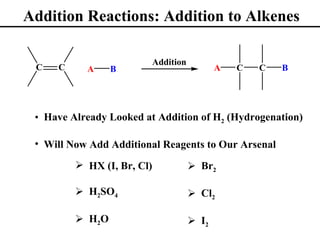
Addition Reactions: Addition to Alkenes

                            Addition
 C   C     A     B                            A   C   C   B


 • Have Already Looked at Addition of H2 (Hydrogenation)

 • Will Now Add Additional Reagents to Our Arsenal

          HX (I, Br, Cl)               Br2

          H2SO4                        Cl2

          H2O                          I2
Why Do Additions to Alkenes Work?

• Conversion of π Bond to 2 σ Bonds Typically Energy Favored

• Two σ Bonds Higher Energy than One π + One σ

• Overall Process is thus Typically Exothermic

• π Electrons are Exposed (ABOVE and BELOW sp2 Plane)

• π Bonds Good at Capturing Electrophiles (H+, Lewis Acids, X2)

• Metal Ions With Vacant Orbitals Also Good Electrophiles

• Let’s Look at the Addition Reaction of a Hydrogen Halide
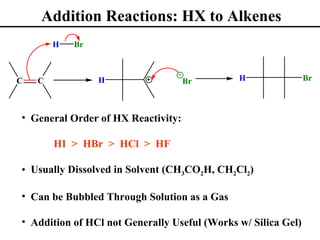
Addition Reactions: HX to Alkenes
        H   Br


C   C            H                  Br        H                Br


• General Order of HX Reactivity:

        HI > HBr > HCl > HF

• Usually Dissolved in Solvent (CH3CO2H, CH2Cl2)

• Can be Bubbled Through Solution as a Gas

• Addition of HCl not Generally Useful (Works w/ Silica Gel)
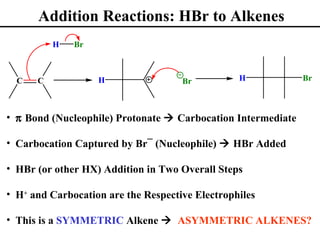
Addition Reactions: HBr to Alkenes
          H   Br


  C   C            H                 Br          H            Br


• π Bond (Nucleophile) Protonate  Carbocation Intermediate

• Carbocation Captured by Br¯ (Nucleophile)  HBr Added

• HBr (or other HX) Addition in Two Overall Steps

• H+ and Carbocation are the Respective Electrophiles

• This is a SYMMETRIC Alkene  ASYMMETRIC ALKENES?
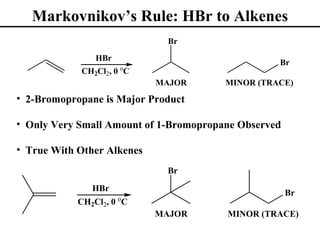
Markovnikov’s Rule: HBr to Alkenes
                              Br
               HBr
                                                  Br
                     o
            CH2Cl2, 0 C
                            MAJOR       MINOR (TRACE)
• 2-Bromopropane is Major Product

• Only Very Small Amount of 1-Bromopropane Observed

• True With Other Alkenes
                             Br
               HBr
                                                      Br
                     o
            CH2Cl2, 0 C
                            MAJOR       MINOR (TRACE)
Markovnikov’s Rule: Why?
                                  Br
                    HBr
                                                               Br
                          o
                 CH2Cl2, 0 C
                                MAJOR          MINOR (TRACE)

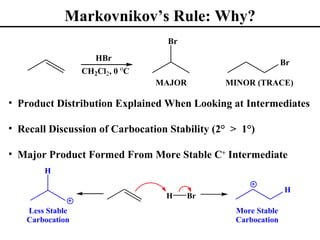
• Product Distribution Explained When Looking at Intermediates

• Recall Discussion of Carbocation Stability (2° > 1°)

• Major Product Formed From More Stable C+ Intermediate
       H

                                                               H
                                  H     Br
   Less Stable                                   More Stable
   Carbocation                                   Carbocation
Markovnikov’s Rule: C+ Stability
       H

                                                            H
                               H    Br
   Less Stable                                More Stable
   Carbocation                                Carbocation

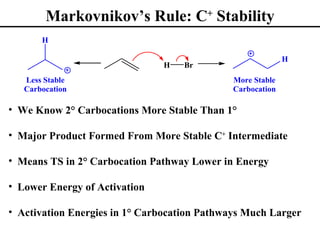
• We Know 2° Carbocations More Stable Than 1°

• Major Product Formed From More Stable C+ Intermediate

• Means TS in 2° Carbocation Pathway Lower in Energy

• Lower Energy of Activation

• Activation Energies in 1° Carbocation Pathways Much Larger
Markovnikov’s Rule: Summary
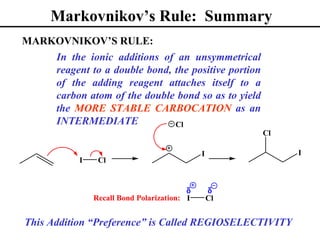
MARKOVNIKOV’S RULE:
    In the ionic additions of an unsymmetrical
    reagent to a double bond, the positive portion
    of the adding reagent attaches itself to a
    carbon atom of the double bond so as to yield
    the MORE STABLE CARBOCATION as an
    INTERMEDIATE              Cl
                                                       Cl

                                              I             I
            I    Cl


                                          δ       δ
                Recall Bond Polarization: I       Cl


This Addition “Preference” is Called REGIOSELECTIVITY
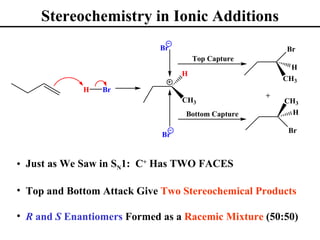
Stereochemistry in Ionic Additions
                             Br                         Br
                                      Top Capture
                                                         H
                                  H
                                                        CH3
             H   Br
                                                    +
                                  CH3                   CH3
                                  Bottom Capture          H

                                                         Br
                             Br


• Just as We Saw in SN1: C+ Has TWO FACES

• Top and Bottom Attack Give Two Stereochemical Products

• R and S Enantiomers Formed as a Racemic Mixture (50:50)
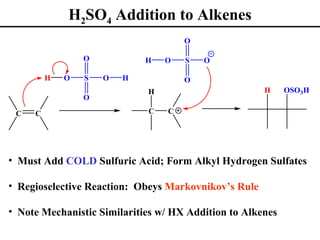
H2SO4 Addition to Alkenes
                                     O

                 O           H   O   S   O

         H   O   S   O   H           O
                             H                        H     OSO3H
                 O

 C   C                       C   C


• Must Add COLD Sulfuric Acid; Form Alkyl Hydrogen Sulfates

• Regioselective Reaction: Obeys Markovnikov’s Rule

• Note Mechanistic Similarities w/ HX Addition to Alkenes
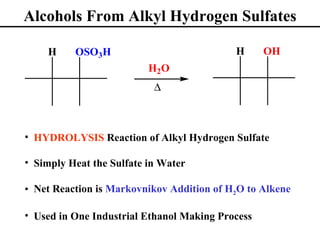
Alcohols From Alkyl Hydrogen Sulfates

    H     OSO3H                            H      OH
                          H2 O
                           ∆


• HYDROLYSIS Reaction of Alkyl Hydrogen Sulfate

• Simply Heat the Sulfate in Water

• Net Reaction is Markovnikov Addition of H2O to Alkene

• Used in One Industrial Ethanol Making Process
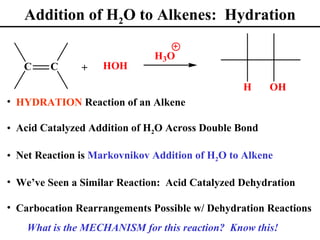
Addition of H2O to Alkenes: Hydration

                              H3 O
   C     C     +   HOH

                                                H     OH
• HYDRATION Reaction of an Alkene

• Acid Catalyzed Addition of H2O Across Double Bond

• Net Reaction is Markovnikov Addition of H2O to Alkene

• We’ve Seen a Similar Reaction: Acid Catalyzed Dehydration

• Carbocation Rearrangements Possible w/ Dehydration Reactions
    What is the MECHANISM for this reaction? Know this!
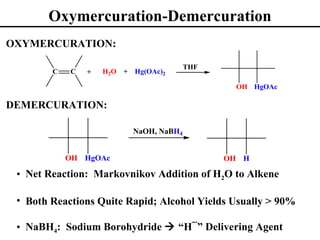
Oxymercuration-Demercuration
OXYMERCURATION:

                                            THF
        C   C   +   H2O   +   Hg(OAc)2

                                                   OH HgOAc

DEMERCURATION:

                              NaOH, NaBH4


            OH HgOAc                              OH H

 • Net Reaction: Markovnikov Addition of H2O to Alkene

 • Both Reactions Quite Rapid; Alcohol Yields Usually > 90%

 • NaBH4: Sodium Borohydride  “H¯” Delivering Agent
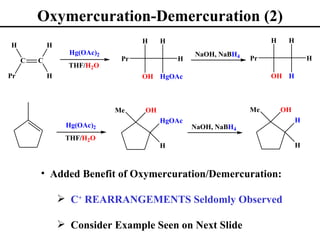
Oxymercuration-Demercuration (2)
                                    H    H                          H    H
H            H
                   Hg(OAc)2                      NaOH, NaBH4
     C   C                     Pr            H                 Pr                H
                   THF/H2O
Pr           H                      OH HgOAc                        OH H


                              Me    OH                         Me       OH
                                         HgOAc                               H
                  Hg(OAc)2                       NaOH, NaBH4
                  THF/H2O
                                         H                                   H


         • Added Benefit of Oxymercuration/Demercuration:

                  C+ REARRANGEMENTS Seldomly Observed

                  Consider Example Seen on Next Slide
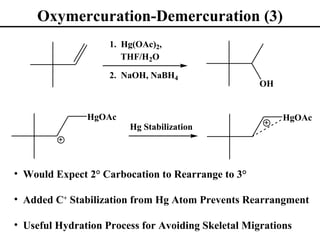
Oxymercuration-Demercuration (3)
                    1. Hg(OAc)2,
                       THF/H2O

                    2. NaOH, NaBH4
                                                    OH


               HgOAc                                     HgOAc
                        Hg Stabilization


• Would Expect 2° Carbocation to Rearrange to 3°

• Added C+ Stabilization from Hg Atom Prevents Rearrangment

• Useful Hydration Process for Avoiding Skeletal Migrations
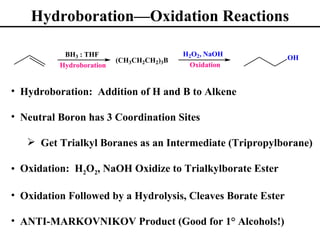
Hydroboration—Oxidation Reactions

           BH3 : THF                      H2O2, NaOH
                          (CH3CH2CH2)3B                      OH
          Hydroboration                    Oxidation


• Hydroboration: Addition of H and B to Alkene

• Neutral Boron has 3 Coordination Sites

    Get Trialkyl Boranes as an Intermediate (Tripropylborane)

• Oxidation: H2O2, NaOH Oxidize to Trialkylborate Ester

• Oxidation Followed by a Hydrolysis, Cleaves Borate Ester

• ANTI-MARKOVNIKOV Product (Good for 1° Alcohols!)
Hydroboration—Oxidation Reactions (2)

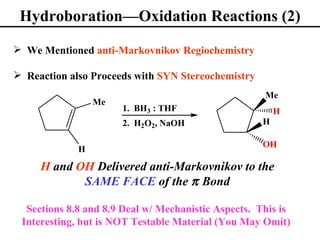
 We Mentioned anti-Markovnikov Regiochemistry

 Reaction also Proceeds with SYN Stereochemistry
                                                     Me
                 Me
                      1. BH3 : THF                       H
                      2. H2O2, NaOH                  H

                                                     OH
             H

     H and OH Delivered anti-Markovnikov to the
            SAME FACE of the π Bond

  Sections 8.8 and 8.9 Deal w/ Mechanistic Aspects. This is
 Interesting, but is NOT Testable Material (You May Omit)
Addition of Cl2 and Br2 to Alkenes
                            Cl2     H3CHC     CHCH3
         H3CHC    CHCH3
                            -9 oC
                                        Cl    Cl


                             Cl2    H3CH2CHC        CH2
         H3CH2CHC    CH2
                            -9 oC
                                             Cl     Cl

                                       Br
                    Br2                H          + Enantiomer
                    -5 oC              H
                                       Br

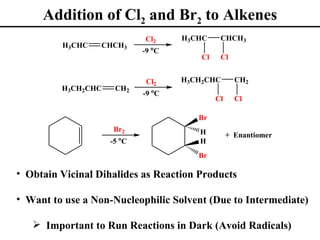
• Obtain Vicinal Dihalides as Reaction Products

• Want to use a Non-Nucleophilic Solvent (Due to Intermediate)

    Important to Run Reactions in Dark (Avoid Radicals)
General Mechanism of Dihalide Addition
      Br

      Br
                           Br
             -Br-                                   Br
  C    C
                                         Br

                    Br


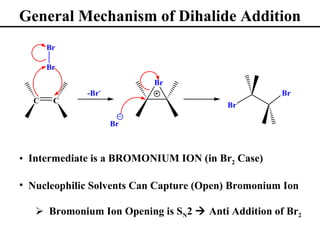
• Intermediate is a BROMONIUM ION (in Br2 Case)

• Nucleophilic Solvents Can Capture (Open) Bromonium Ion

    Bromonium Ion Opening is SN2  Anti Addition of Br2
Stereochemistry of Dihalide Additions

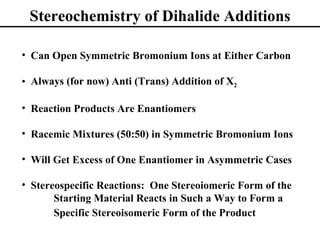
• Can Open Symmetric Bromonium Ions at Either Carbon

• Always (for now) Anti (Trans) Addition of X2

• Reaction Products Are Enantiomers

• Racemic Mixtures (50:50) in Symmetric Bromonium Ions

• Will Get Excess of One Enantiomer in Asymmetric Cases

• Stereospecific Reactions: One Stereoiomeric Form of the
       Starting Material Reacts in Such a Way to Form a
       Specific Stereoisomeric Form of the Product
Halohydrin Formation
         Br

         Br
                               Br
                 -Br-                  -H+                 Br
     C    C
                                              HO
                        H2O

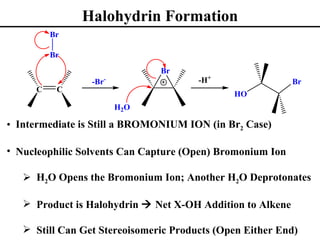
• Intermediate is Still a BROMONIUM ION (in Br2 Case)

• Nucleophilic Solvents Can Capture (Open) Bromonium Ion

    H2O Opens the Bromonium Ion; Another H2O Deprotonates

    Product is Halohydrin  Net X-OH Addition to Alkene

    Still Can Get Stereoisomeric Products (Open Either End)
Divalent Carbon Compounds: Carbenes

                    Heat or Light
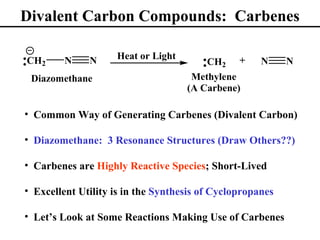
CH2      N    N                         CH2 +        N     N
 Diazomethane                        Methylene
                                    (A Carbene)

• Common Way of Generating Carbenes (Divalent Carbon)

• Diazomethane: 3 Resonance Structures (Draw Others??)

• Carbenes are Highly Reactive Species; Short-Lived

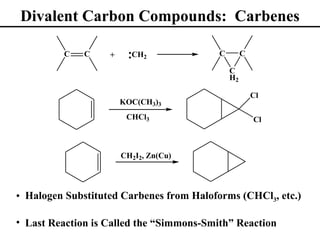
• Excellent Utility is in the Synthesis of Cyclopropanes

• Let’s Look at Some Reactions Making Use of Carbenes
Divalent Carbon Compounds: Carbenes

         C    C    +     CH2              C        C

                                              C
                                              H2

                                                       Cl
                       KOC(CH3)3
                        CHCl3                          Cl


                       CH2I2, Zn(Cu)


• Halogen Substituted Carbenes from Haloforms (CHCl3, etc.)

• Last Reaction is Called the “Simmons-Smith” Reaction
Oxidation: Syn Dihydroxylation
                                            OH
                   1. OsO4, pyridine
                                                      OH
                   2. Na2SO3/H2O
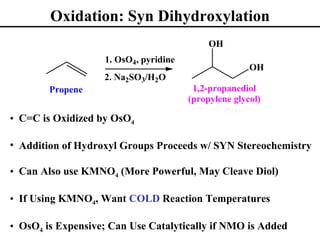
        Propene                         1,2-propanediol
                                       (propylene glycol)

• C=C is Oxidized by OsO4

• Addition of Hydroxyl Groups Proceeds w/ SYN Stereochemistry

• Can Also use KMNO4 (More Powerful, May Cleave Diol)

• If Using KMNO4, Want COLD Reaction Temperatures

• OsO4 is Expensive; Can Use Catalytically if NMO is Added
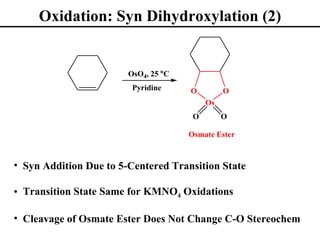
Oxidation: Syn Dihydroxylation (2)


                        OsO4, 25 oC
                         Pyridine     O         O
                                           Os
                                       O        O

                                      Osmate Ester


• Syn Addition Due to 5-Centered Transition State

• Transition State Same for KMNO4 Oxidations

• Cleavage of Osmate Ester Does Not Change C-O Stereochem
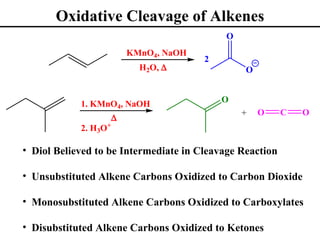
Oxidative Cleavage of Alkenes
                                            O
                          KMnO4, NaOH
                                        2
                            H2O, ∆              O


            1. KMnO4, NaOH                  O
                                                +   O     C   O
                      ∆
            2. H3O+

• Diol Believed to be Intermediate in Cleavage Reaction

• Unsubstituted Alkene Carbons Oxidized to Carbon Dioxide

• Monosubstituted Alkene Carbons Oxidized to Carboxylates

• Disubstituted Alkene Carbons Oxidized to Ketones
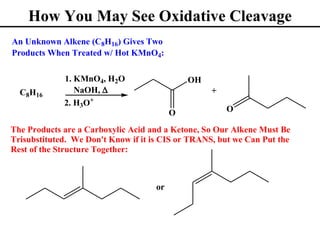
How You May See Oxidative Cleavage
An Unknown Alkene (C8H16) Gives Two
Products When Treated w/ Hot KMnO4:

             1. KMnO4, H2O                   OH
  C8H16         NaOH, ∆                           +
             2. H3O+
                                         O            O

The Products are a Carboxylic Acid and a Ketone, So Our Alkene Must Be
Trisubstituted. We Don't Know if it is CIS or TRANS, but we Can Put the
Rest of the Structure Together:


                                    or
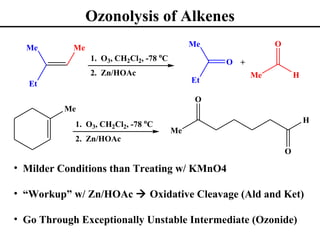
Ozonolysis of Alkenes
  Me        Me                                Me              O
                 1. O3, CH2Cl2, -78 oC             O +
                 2. Zn/HOAc                              Me           H
   Et                                         Et

                                               O
          Me
            1. O3, CH2Cl2, -78 oC                                         H
                                         Me
            2. Zn/HOAc
                                                                  O

• Milder Conditions than Treating w/ KMnO4

• “Workup” w/ Zn/HOAc  Oxidative Cleavage (Ald and Ket)

• Go Through Exceptionally Unstable Intermediate (Ozonide)
Dihalide Addition To Alkynes
                          Me        Br                Br   Br
                   Br2                    Br2
Me          Me                                  Me              Me
                  CCl4                   CCl4
                           Br      Me                 Br   Br


                          Me        Cl                Cl   Cl
                   Cl2                    Cl2
Me           Me                                 Me               Me
                  CCl4                   CCl4
                           Cl       Me                Cl   Cl


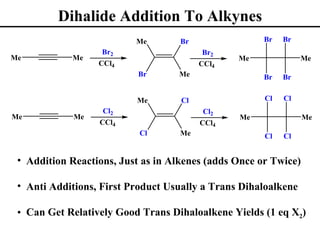
 • Addition Reactions, Just as in Alkenes (adds Once or Twice)

 • Anti Additions, First Product Usually a Trans Dihaloalkene

 • Can Get Relatively Good Trans Dihaloalkene Yields (1 eq X2)
Addition of HX to Alkynes

                            Me        Br                 H     Br

                      HBr                  HBr     Me               Me
Me              Me

                             H        Me                 H     Br
                                                   geminal dihaloalkane


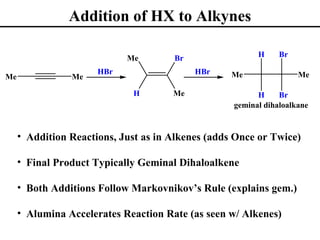
     • Addition Reactions, Just as in Alkenes (adds Once or Twice)

     • Final Product Typically Geminal Dihaloalkene

     • Both Additions Follow Markovnikov’s Rule (explains gem.)

     • Alumina Accelerates Reaction Rate (as seen w/ Alkenes)
Oxidative Cleavage of Alkynes
                                                 O                 O
                       1. O3, CH2Cl2,
Me              Et                                        +
                       2. Zn/HOAc
                                        Me           OH       Et       OH


                                                 O                 O
                       1. O3, CH2Cl2,
i
Pr              Ph                                        +
                       2. Zn/HOAc
                                        i
                                            Pr       OH       Ph       OH


                                                 O                 O
                     1. KMnO4, NaOH
Me              Et                                        +
                     2. HOAc
                                        Me           OH       Et       OH

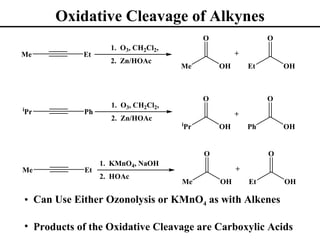
    • Can Use Either Ozonolysis or KMnO4 as with Alkenes

    • Products of the Oxidative Cleavage are Carboxylic Acids
Anti-Markovnikov HBr Addition
                         HBr                      Br
                       peroxides


                                       Me      Br
                             HBr
      Me               H
                           peroxides
                                        H      H


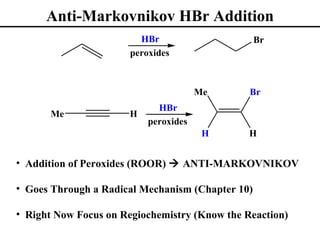
• Addition of Peroxides (ROOR)  ANTI-MARKOVNIKOV

• Goes Through a Radical Mechanism (Chapter 10)

• Right Now Focus on Regiochemistry (Know the Reaction)

Chemistry 343 chapter_8

  • 1.
    Addition Reactions • Addition Reactions to Alkenes (Section 8.1) • Markovnikov’s Rule (Section 8.2) • Stereochemistry of Ionic Addition to Alkenes (Section 8.3) • H2SO4 Additions to Alkenes (Section 8.4) • H2O Additions to Alkenes (Section 8.5) • Oxymercuration/Demurcuration (Section 8.6) • Hydroboration/Oxidation (Section 8.7) • Addition of Br2 and Cl2 to Alkenes (Section 8.12) • Stereochemistry of Dihalide Additions (Section 8.13) • Halohydrin Formation [Net Addition of X-OH] (Section 8.14) • Divalent Carbon Compounds: Carbenes (Section 8.15) • Oxidations of Alkenes (Sections 8.16-8.17) • Additions to Alkynes (Sections 8.18-8.19) • Oxidative Cleavage of Alkynes (Section 8.20) • Applications in Synthesis (Section 8.21)
  • 2.
    Addition Reactions: Additionto Alkenes Addition C C A B A C C B • Have Already Looked at Addition of H2 (Hydrogenation) • Will Now Add Additional Reagents to Our Arsenal  HX (I, Br, Cl)  Br2  H2SO4  Cl2  H2O  I2
  • 3.
    Why Do Additionsto Alkenes Work? • Conversion of π Bond to 2 σ Bonds Typically Energy Favored • Two σ Bonds Higher Energy than One π + One σ • Overall Process is thus Typically Exothermic • π Electrons are Exposed (ABOVE and BELOW sp2 Plane) • π Bonds Good at Capturing Electrophiles (H+, Lewis Acids, X2) • Metal Ions With Vacant Orbitals Also Good Electrophiles • Let’s Look at the Addition Reaction of a Hydrogen Halide
  • 4.
    Addition Reactions: HXto Alkenes H Br C C H Br H Br • General Order of HX Reactivity: HI > HBr > HCl > HF • Usually Dissolved in Solvent (CH3CO2H, CH2Cl2) • Can be Bubbled Through Solution as a Gas • Addition of HCl not Generally Useful (Works w/ Silica Gel)
  • 5.
    Addition Reactions: HBrto Alkenes H Br C C H Br H Br • π Bond (Nucleophile) Protonate  Carbocation Intermediate • Carbocation Captured by Br¯ (Nucleophile)  HBr Added • HBr (or other HX) Addition in Two Overall Steps • H+ and Carbocation are the Respective Electrophiles • This is a SYMMETRIC Alkene  ASYMMETRIC ALKENES?
  • 6.
    Markovnikov’s Rule: HBrto Alkenes Br HBr Br o CH2Cl2, 0 C MAJOR MINOR (TRACE) • 2-Bromopropane is Major Product • Only Very Small Amount of 1-Bromopropane Observed • True With Other Alkenes Br HBr Br o CH2Cl2, 0 C MAJOR MINOR (TRACE)
  • 7.
    Markovnikov’s Rule: Why? Br HBr Br o CH2Cl2, 0 C MAJOR MINOR (TRACE) • Product Distribution Explained When Looking at Intermediates • Recall Discussion of Carbocation Stability (2° > 1°) • Major Product Formed From More Stable C+ Intermediate H H H Br Less Stable More Stable Carbocation Carbocation
  • 8.
    Markovnikov’s Rule: C+Stability H H H Br Less Stable More Stable Carbocation Carbocation • We Know 2° Carbocations More Stable Than 1° • Major Product Formed From More Stable C+ Intermediate • Means TS in 2° Carbocation Pathway Lower in Energy • Lower Energy of Activation • Activation Energies in 1° Carbocation Pathways Much Larger
  • 9.
    Markovnikov’s Rule: Summary MARKOVNIKOV’SRULE: In the ionic additions of an unsymmetrical reagent to a double bond, the positive portion of the adding reagent attaches itself to a carbon atom of the double bond so as to yield the MORE STABLE CARBOCATION as an INTERMEDIATE Cl Cl I I I Cl δ δ Recall Bond Polarization: I Cl This Addition “Preference” is Called REGIOSELECTIVITY
  • 10.
    Stereochemistry in IonicAdditions Br Br Top Capture H H CH3 H Br + CH3 CH3 Bottom Capture H Br Br • Just as We Saw in SN1: C+ Has TWO FACES • Top and Bottom Attack Give Two Stereochemical Products • R and S Enantiomers Formed as a Racemic Mixture (50:50)
  • 11.
    H2SO4 Addition toAlkenes O O H O S O H O S O H O H H OSO3H O C C C C • Must Add COLD Sulfuric Acid; Form Alkyl Hydrogen Sulfates • Regioselective Reaction: Obeys Markovnikov’s Rule • Note Mechanistic Similarities w/ HX Addition to Alkenes
  • 12.
    Alcohols From AlkylHydrogen Sulfates H OSO3H H OH H2 O ∆ • HYDROLYSIS Reaction of Alkyl Hydrogen Sulfate • Simply Heat the Sulfate in Water • Net Reaction is Markovnikov Addition of H2O to Alkene • Used in One Industrial Ethanol Making Process
  • 13.
    Addition of H2Oto Alkenes: Hydration H3 O C C + HOH H OH • HYDRATION Reaction of an Alkene • Acid Catalyzed Addition of H2O Across Double Bond • Net Reaction is Markovnikov Addition of H2O to Alkene • We’ve Seen a Similar Reaction: Acid Catalyzed Dehydration • Carbocation Rearrangements Possible w/ Dehydration Reactions What is the MECHANISM for this reaction? Know this!
  • 14.
    Oxymercuration-Demercuration OXYMERCURATION: THF C C + H2O + Hg(OAc)2 OH HgOAc DEMERCURATION: NaOH, NaBH4 OH HgOAc OH H • Net Reaction: Markovnikov Addition of H2O to Alkene • Both Reactions Quite Rapid; Alcohol Yields Usually > 90% • NaBH4: Sodium Borohydride  “H¯” Delivering Agent
  • 15.
    Oxymercuration-Demercuration (2) H H H H H H Hg(OAc)2 NaOH, NaBH4 C C Pr H Pr H THF/H2O Pr H OH HgOAc OH H Me OH Me OH HgOAc H Hg(OAc)2 NaOH, NaBH4 THF/H2O H H • Added Benefit of Oxymercuration/Demercuration:  C+ REARRANGEMENTS Seldomly Observed  Consider Example Seen on Next Slide
  • 16.
    Oxymercuration-Demercuration (3) 1. Hg(OAc)2, THF/H2O 2. NaOH, NaBH4 OH HgOAc HgOAc Hg Stabilization • Would Expect 2° Carbocation to Rearrange to 3° • Added C+ Stabilization from Hg Atom Prevents Rearrangment • Useful Hydration Process for Avoiding Skeletal Migrations
  • 17.
    Hydroboration—Oxidation Reactions BH3 : THF H2O2, NaOH (CH3CH2CH2)3B OH Hydroboration Oxidation • Hydroboration: Addition of H and B to Alkene • Neutral Boron has 3 Coordination Sites  Get Trialkyl Boranes as an Intermediate (Tripropylborane) • Oxidation: H2O2, NaOH Oxidize to Trialkylborate Ester • Oxidation Followed by a Hydrolysis, Cleaves Borate Ester • ANTI-MARKOVNIKOV Product (Good for 1° Alcohols!)
  • 18.
    Hydroboration—Oxidation Reactions (2) We Mentioned anti-Markovnikov Regiochemistry  Reaction also Proceeds with SYN Stereochemistry Me Me 1. BH3 : THF H 2. H2O2, NaOH H OH H H and OH Delivered anti-Markovnikov to the SAME FACE of the π Bond Sections 8.8 and 8.9 Deal w/ Mechanistic Aspects. This is Interesting, but is NOT Testable Material (You May Omit)
  • 19.
    Addition of Cl2and Br2 to Alkenes Cl2 H3CHC CHCH3 H3CHC CHCH3 -9 oC Cl Cl Cl2 H3CH2CHC CH2 H3CH2CHC CH2 -9 oC Cl Cl Br Br2 H + Enantiomer -5 oC H Br • Obtain Vicinal Dihalides as Reaction Products • Want to use a Non-Nucleophilic Solvent (Due to Intermediate)  Important to Run Reactions in Dark (Avoid Radicals)
  • 20.
    General Mechanism ofDihalide Addition Br Br Br -Br- Br C C Br Br • Intermediate is a BROMONIUM ION (in Br2 Case) • Nucleophilic Solvents Can Capture (Open) Bromonium Ion  Bromonium Ion Opening is SN2  Anti Addition of Br2
  • 21.
    Stereochemistry of DihalideAdditions • Can Open Symmetric Bromonium Ions at Either Carbon • Always (for now) Anti (Trans) Addition of X2 • Reaction Products Are Enantiomers • Racemic Mixtures (50:50) in Symmetric Bromonium Ions • Will Get Excess of One Enantiomer in Asymmetric Cases • Stereospecific Reactions: One Stereoiomeric Form of the Starting Material Reacts in Such a Way to Form a Specific Stereoisomeric Form of the Product
  • 22.
    Halohydrin Formation Br Br Br -Br- -H+ Br C C HO H2O • Intermediate is Still a BROMONIUM ION (in Br2 Case) • Nucleophilic Solvents Can Capture (Open) Bromonium Ion  H2O Opens the Bromonium Ion; Another H2O Deprotonates  Product is Halohydrin  Net X-OH Addition to Alkene  Still Can Get Stereoisomeric Products (Open Either End)
  • 23.
    Divalent Carbon Compounds:Carbenes Heat or Light CH2 N N CH2 + N N Diazomethane Methylene (A Carbene) • Common Way of Generating Carbenes (Divalent Carbon) • Diazomethane: 3 Resonance Structures (Draw Others??) • Carbenes are Highly Reactive Species; Short-Lived • Excellent Utility is in the Synthesis of Cyclopropanes • Let’s Look at Some Reactions Making Use of Carbenes
  • 24.
    Divalent Carbon Compounds:Carbenes C C + CH2 C C C H2 Cl KOC(CH3)3 CHCl3 Cl CH2I2, Zn(Cu) • Halogen Substituted Carbenes from Haloforms (CHCl3, etc.) • Last Reaction is Called the “Simmons-Smith” Reaction
  • 25.
    Oxidation: Syn Dihydroxylation OH 1. OsO4, pyridine OH 2. Na2SO3/H2O Propene 1,2-propanediol (propylene glycol) • C=C is Oxidized by OsO4 • Addition of Hydroxyl Groups Proceeds w/ SYN Stereochemistry • Can Also use KMNO4 (More Powerful, May Cleave Diol) • If Using KMNO4, Want COLD Reaction Temperatures • OsO4 is Expensive; Can Use Catalytically if NMO is Added
  • 26.
    Oxidation: Syn Dihydroxylation(2) OsO4, 25 oC Pyridine O O Os O O Osmate Ester • Syn Addition Due to 5-Centered Transition State • Transition State Same for KMNO4 Oxidations • Cleavage of Osmate Ester Does Not Change C-O Stereochem
  • 27.
    Oxidative Cleavage ofAlkenes O KMnO4, NaOH 2 H2O, ∆ O 1. KMnO4, NaOH O + O C O ∆ 2. H3O+ • Diol Believed to be Intermediate in Cleavage Reaction • Unsubstituted Alkene Carbons Oxidized to Carbon Dioxide • Monosubstituted Alkene Carbons Oxidized to Carboxylates • Disubstituted Alkene Carbons Oxidized to Ketones
  • 28.
    How You MaySee Oxidative Cleavage An Unknown Alkene (C8H16) Gives Two Products When Treated w/ Hot KMnO4: 1. KMnO4, H2O OH C8H16 NaOH, ∆ + 2. H3O+ O O The Products are a Carboxylic Acid and a Ketone, So Our Alkene Must Be Trisubstituted. We Don't Know if it is CIS or TRANS, but we Can Put the Rest of the Structure Together: or
  • 29.
    Ozonolysis of Alkenes Me Me Me O 1. O3, CH2Cl2, -78 oC O + 2. Zn/HOAc Me H Et Et O Me 1. O3, CH2Cl2, -78 oC H Me 2. Zn/HOAc O • Milder Conditions than Treating w/ KMnO4 • “Workup” w/ Zn/HOAc  Oxidative Cleavage (Ald and Ket) • Go Through Exceptionally Unstable Intermediate (Ozonide)
  • 30.
    Dihalide Addition ToAlkynes Me Br Br Br Br2 Br2 Me Me Me Me CCl4 CCl4 Br Me Br Br Me Cl Cl Cl Cl2 Cl2 Me Me Me Me CCl4 CCl4 Cl Me Cl Cl • Addition Reactions, Just as in Alkenes (adds Once or Twice) • Anti Additions, First Product Usually a Trans Dihaloalkene • Can Get Relatively Good Trans Dihaloalkene Yields (1 eq X2)
  • 31.
    Addition of HXto Alkynes Me Br H Br HBr HBr Me Me Me Me H Me H Br geminal dihaloalkane • Addition Reactions, Just as in Alkenes (adds Once or Twice) • Final Product Typically Geminal Dihaloalkene • Both Additions Follow Markovnikov’s Rule (explains gem.) • Alumina Accelerates Reaction Rate (as seen w/ Alkenes)
  • 32.
    Oxidative Cleavage ofAlkynes O O 1. O3, CH2Cl2, Me Et + 2. Zn/HOAc Me OH Et OH O O 1. O3, CH2Cl2, i Pr Ph + 2. Zn/HOAc i Pr OH Ph OH O O 1. KMnO4, NaOH Me Et + 2. HOAc Me OH Et OH • Can Use Either Ozonolysis or KMnO4 as with Alkenes • Products of the Oxidative Cleavage are Carboxylic Acids
  • 33.
    Anti-Markovnikov HBr Addition HBr Br peroxides Me Br HBr Me H peroxides H H • Addition of Peroxides (ROOR)  ANTI-MARKOVNIKOV • Goes Through a Radical Mechanism (Chapter 10) • Right Now Focus on Regiochemistry (Know the Reaction)