Lecture Topic:
Lymphatic
system
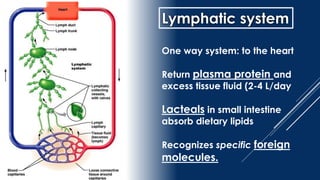
One way system: to the heart
Return plasma protein and
excess tissue fluid (2-4 L/day
Lacteals in small intestine
absorb dietary lipids
Recognizes specific foreign
molecules.
Lymphatic system
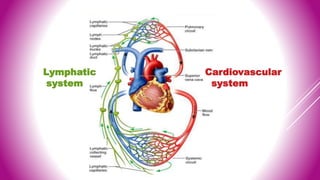
Lymphatic
system
Cardiovascular
system
Lymphatic system
Lymphatic
Vessels
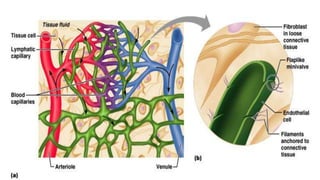
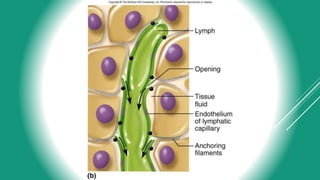
1).Lymph capillaries
 Have one way mini-valves allowing excess fluid to
enter but not leave
 Picks up bacteria and viruses as well as proteins,
electrolytes and fluid
 Absent in bones, bone marrow, teeth, CNS
2).Lymphatic collecting vessels
 Similar to blood vessels (3 layers), but thin &
delicate
 Superficial ones in skin travel with superficial veins.
 Deep ones ( in trunk and digestive viscera) travel
with deep arteries.
 Drain into superficial and deep lymph nodes.
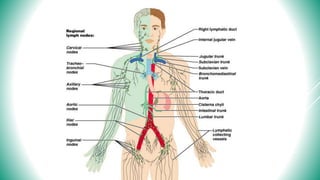
3).Lymphatic Trunks
 Lumbar
 Intestinal
Receives fatty lymph (chyle) absorbed
through lacteals of intestines
 Broncho-mediastinal
 Subclavian
 Jugular
(Paired, except intestinal)
Drain into cisterna chyli
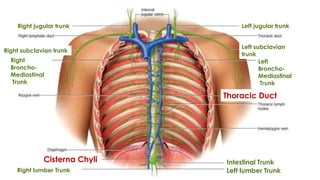
Lymphatic Trunks
Right
Broncho-
Mediastinal
Trunk
Right subclavian trunk
Left
Broncho-
Mediastinal
Trunk
Left subclavian
trunk
Right lumber Trunk Left lumber Trunk
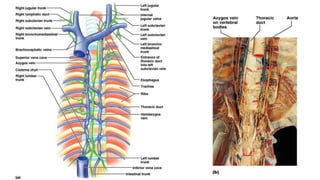
Thoracic Duct
Cisterna Chyli
Right jugular trunk Left jugular trunk
Intestinal Trunk
4).Lymphatic ducts:
 Thoracic duct (always present)
(drain into left subclavian vein)
 20% also have a right lymphatic duct
(drain into right subclavian vein)
Lymphoid
Organs
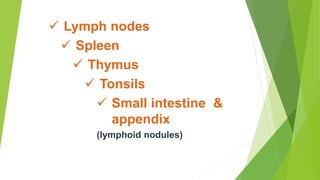
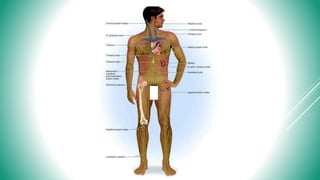
 Lymph nodes
 Spleen
 Thymus
 Tonsils
 Small intestine &
appendix
(lymphoid nodules)
Lymphatic system
L
Function of lymph nodes
FILTERING THEM FROM LYMPH TO INITIATE AN
IMMUNE RESPONSE.
DISTROY MOST PATHOGENS
BY
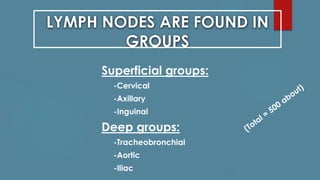
LYMPH NODES ARE FOUND IN
GROUPS
Superficial groups:
-Cervical
-Axillary
-Inguinal
Deep groups:
-Tracheobronchial
-Aortic
-Iliac
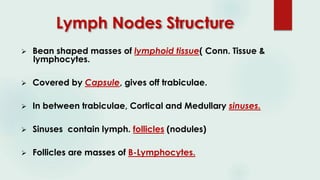
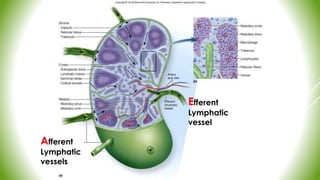
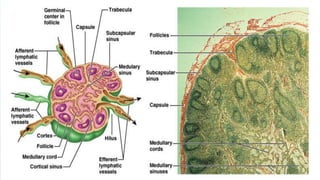
Lymph Nodes Structure
 Bean shaped masses of lymphoid tissue( Conn. Tissue &
lymphocytes.
 Covered by Capsule, gives off trabiculae.
 In between trabiculae, Cortical and Medullary sinuses.
 Sinuses contain lymph. follicles (nodules)
 Follicles are masses of B-Lymphocytes.
Afferent
Lymphatic
vessels
Efferent
Lymphatic
vessel
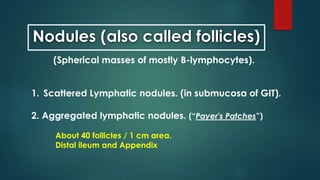
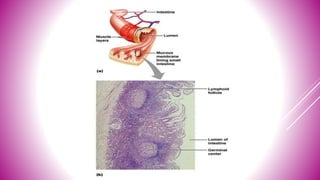
Nodules (also called follicles)
(Spherical masses of mostly B-lymphocytes).
1. Scattered Lymphatic nodules. (in submucosa of GIT).
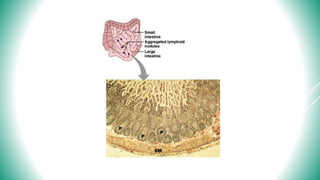
2. Aggregated lymphatic nodules. (“Payer's Patches”)
About 40 follicles / 1 cm area.
Distal ileum and Appendix
The thymus
Secrete hormones (thymopoietin, thymulin and
thymosin) for the development of T-lymphocytes
Thymus is the organ where T-cells become
mature and differentiate.
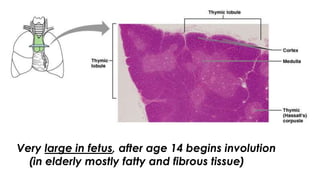
Very large in fetus, after age 14 begins involution
(in elderly mostly fatty and fibrous tissue)
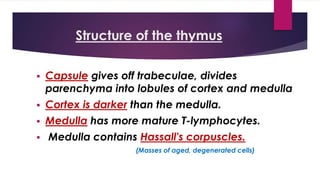
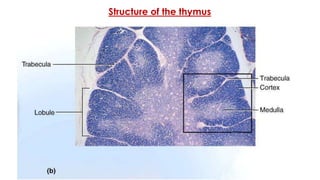
Structure of the thymus
 Capsule gives off trabeculae, divides
parenchyma into lobules of cortex and medulla
 Cortex is darker than the medulla.
 Medulla has more mature T-lymphocytes.
 Medulla contains Hassall's corpuscles.
(Masses of aged, degenerated cells)
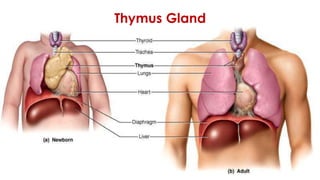
Thymus Gland
Structure of the thymus
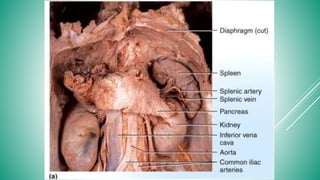
SPLEEN
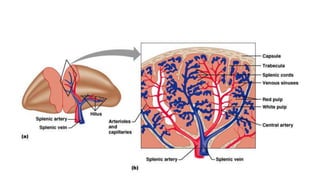
This is the largest lymphoid organ,
posterior to the stomach.
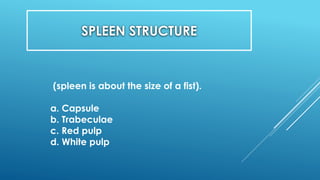
SPLEEN STRUCTURE
(spleen is about the size of a fist).
a. Capsule
b. Trabeculae
c. Red pulp
d. White pulp
RED PULP:
(made of sinuosoid capillaries)
WHITE PULP:
(made of masses of lymphocytes)
FUNCTIONS OF THE SPLEEN
 Phagocytizes bacteria and other foreign
materials : “white pulp”
 Removal & destruction of aged or defective
blood cells: “red pulp”
 Stores platelets
 In fetus: hematopoiesis
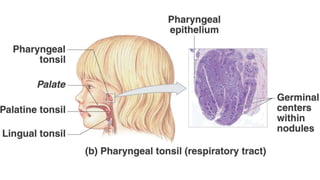
TONSILS. LOCATION
 Palatine tonsils:
 pair at posterior margin of oral cavity
 most often infected
 Lingual tonsils:
 pair at root of tongue
 Pharyngeal tonsil (adenoid):
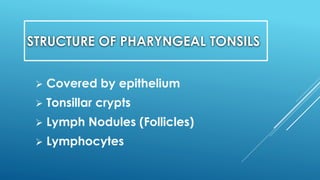
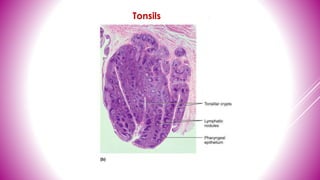
STRUCTURE OF PHARYNGEAL TONSILS
 Covered by epithelium
 Tonsillar crypts
 Lymph Nodules (Follicles)
 Lymphocytes
Tonsils
Hematopoiesis
thank you for attention.
THE END!

Lymphatic. anatomy

  • 1.
  • 2.
    One way system:to the heart Return plasma protein and excess tissue fluid (2-4 L/day Lacteals in small intestine absorb dietary lipids Recognizes specific foreign molecules. Lymphatic system
  • 3.
  • 4.
  • 5.
    1).Lymph capillaries  Haveone way mini-valves allowing excess fluid to enter but not leave  Picks up bacteria and viruses as well as proteins, electrolytes and fluid  Absent in bones, bone marrow, teeth, CNS
  • 8.
    2).Lymphatic collecting vessels Similar to blood vessels (3 layers), but thin & delicate  Superficial ones in skin travel with superficial veins.  Deep ones ( in trunk and digestive viscera) travel with deep arteries.  Drain into superficial and deep lymph nodes.
  • 9.
    3).Lymphatic Trunks  Lumbar Intestinal Receives fatty lymph (chyle) absorbed through lacteals of intestines  Broncho-mediastinal  Subclavian  Jugular (Paired, except intestinal) Drain into cisterna chyli
  • 10.
    Lymphatic Trunks Right Broncho- Mediastinal Trunk Right subclaviantrunk Left Broncho- Mediastinal Trunk Left subclavian trunk Right lumber Trunk Left lumber Trunk Thoracic Duct Cisterna Chyli Right jugular trunk Left jugular trunk Intestinal Trunk
  • 11.
    4).Lymphatic ducts:  Thoracicduct (always present) (drain into left subclavian vein)  20% also have a right lymphatic duct (drain into right subclavian vein)
  • 13.
  • 14.
     Lymph nodes Spleen  Thymus  Tonsils  Small intestine & appendix (lymphoid nodules)
  • 15.
  • 16.
    Function of lymphnodes FILTERING THEM FROM LYMPH TO INITIATE AN IMMUNE RESPONSE. DISTROY MOST PATHOGENS BY
  • 17.
    LYMPH NODES AREFOUND IN GROUPS Superficial groups: -Cervical -Axillary -Inguinal Deep groups: -Tracheobronchial -Aortic -Iliac
  • 19.
    Lymph Nodes Structure Bean shaped masses of lymphoid tissue( Conn. Tissue & lymphocytes.  Covered by Capsule, gives off trabiculae.  In between trabiculae, Cortical and Medullary sinuses.  Sinuses contain lymph. follicles (nodules)  Follicles are masses of B-Lymphocytes.
  • 20.
  • 22.
    Nodules (also calledfollicles) (Spherical masses of mostly B-lymphocytes). 1. Scattered Lymphatic nodules. (in submucosa of GIT). 2. Aggregated lymphatic nodules. (“Payer's Patches”) About 40 follicles / 1 cm area. Distal ileum and Appendix
  • 25.
    The thymus Secrete hormones(thymopoietin, thymulin and thymosin) for the development of T-lymphocytes Thymus is the organ where T-cells become mature and differentiate.
  • 26.
    Very large infetus, after age 14 begins involution (in elderly mostly fatty and fibrous tissue)
  • 27.
    Structure of thethymus  Capsule gives off trabeculae, divides parenchyma into lobules of cortex and medulla  Cortex is darker than the medulla.  Medulla has more mature T-lymphocytes.  Medulla contains Hassall's corpuscles. (Masses of aged, degenerated cells)
  • 28.
  • 29.
  • 30.
    SPLEEN This is thelargest lymphoid organ, posterior to the stomach.
  • 32.
    SPLEEN STRUCTURE (spleen isabout the size of a fist). a. Capsule b. Trabeculae c. Red pulp d. White pulp
  • 33.
    RED PULP: (made ofsinuosoid capillaries) WHITE PULP: (made of masses of lymphocytes)
  • 35.
    FUNCTIONS OF THESPLEEN  Phagocytizes bacteria and other foreign materials : “white pulp”  Removal & destruction of aged or defective blood cells: “red pulp”  Stores platelets  In fetus: hematopoiesis
  • 36.
    TONSILS. LOCATION  Palatinetonsils:  pair at posterior margin of oral cavity  most often infected  Lingual tonsils:  pair at root of tongue  Pharyngeal tonsil (adenoid):
  • 37.
    STRUCTURE OF PHARYNGEALTONSILS  Covered by epithelium  Tonsillar crypts  Lymph Nodules (Follicles)  Lymphocytes
  • 38.
  • 39.
  • 40.
    thank you forattention. THE END!