The document discusses various types of forces including contact forces, body forces, point forces, distributed forces, frictional forces, wind forces, and cohesive and adhesive forces. It also describes characteristics of forces such as magnitude, direction, and point of application. Additionally, it covers concepts like Newton's third law of motion, systems of forces, resolution of forces, and fundamental principles of mechanics including transmissibility, the parallelogram law of forces, gravitation, and superposition.
The presentation begins by introducing Lukhdhirji Engineering College in Morvi, followed by a list of enrolled students.
Definitions of force, its characteristics (magnitude, direction, nature, point of application) and its unit, Newton.
Overview of various types of forces including contact, body, point, distributed, external, internal, frictional, wind, hydrostatic, cohesive, and adhesive forces.
Explanation of contact forces (forces due to direct contact) and body forces (forces acting without contact).
Definitions of point forces (acting at a point) and distributed forces (spread over a large area).
Difference between external forces (acting on a body due to weight) and internal forces (resistance within a shape).
Explanation of action and reaction forces as per Newton’s third law.
Defining frictional forces, wind forces, and the concepts of cohesion (same material) and adhesion (different materials).
Definition of hydrostatic forces exerted by water on objects.
Overview of different systems of forces such as coplanar, concurrent, collinear, and their types.
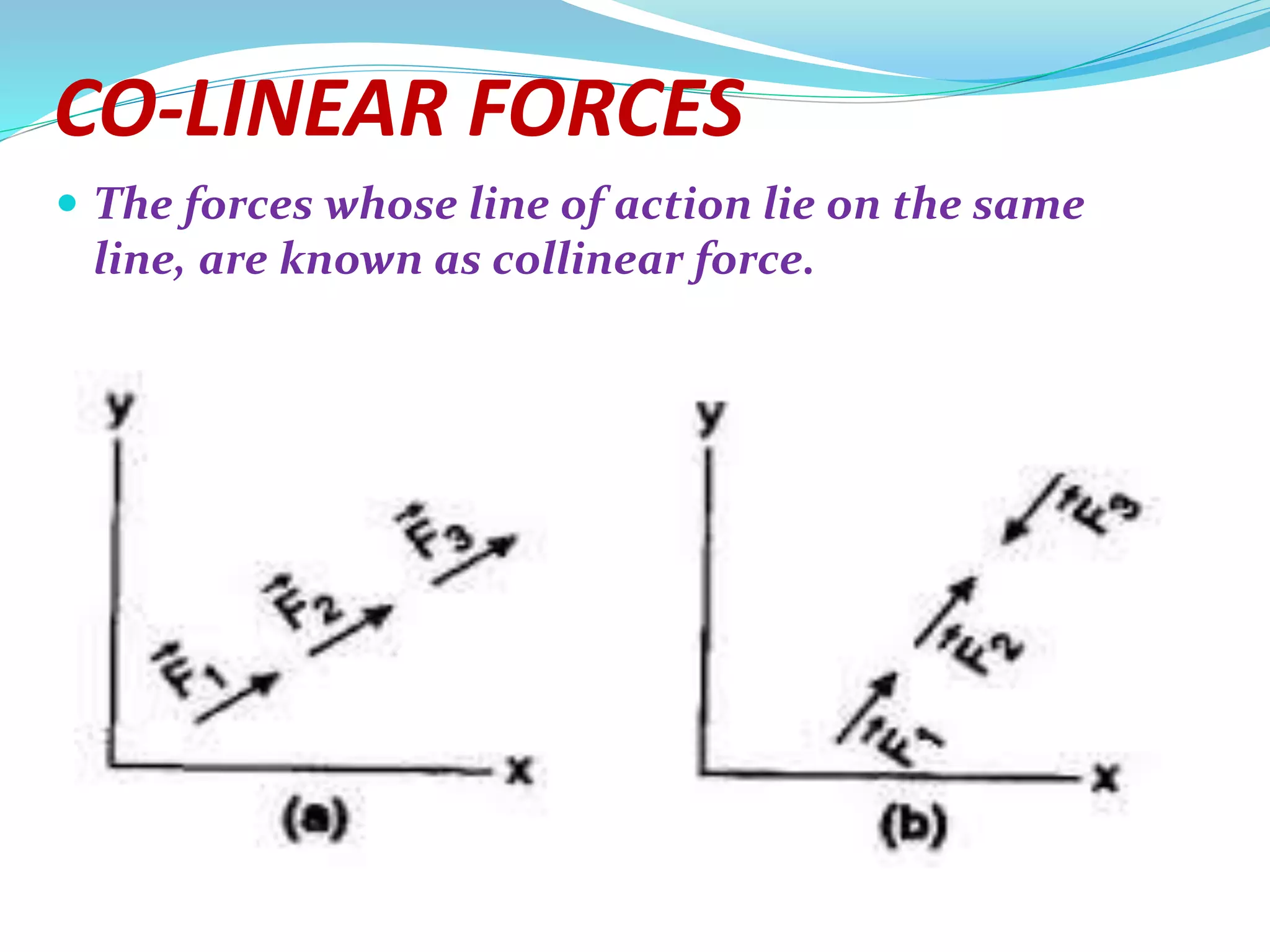
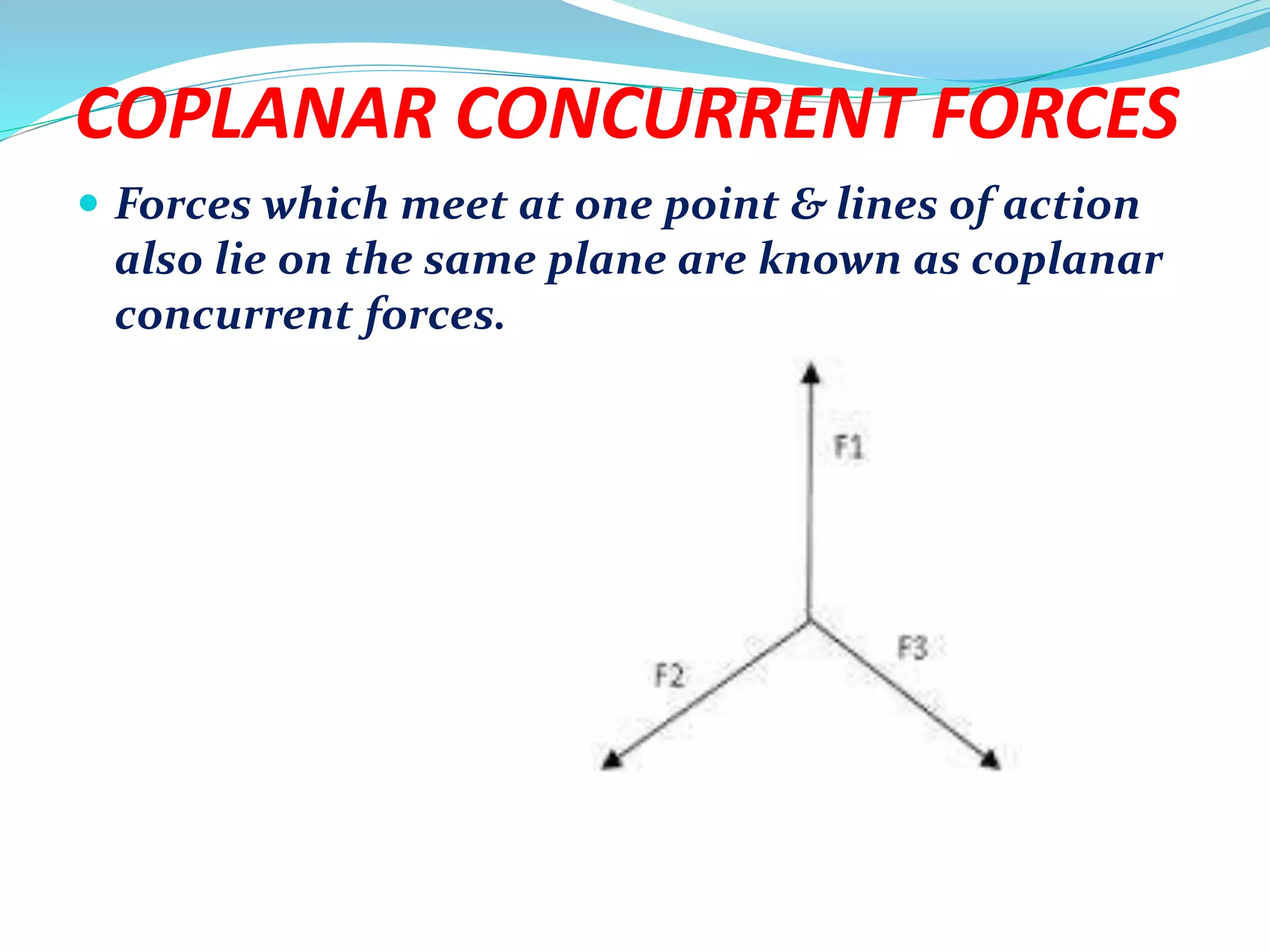
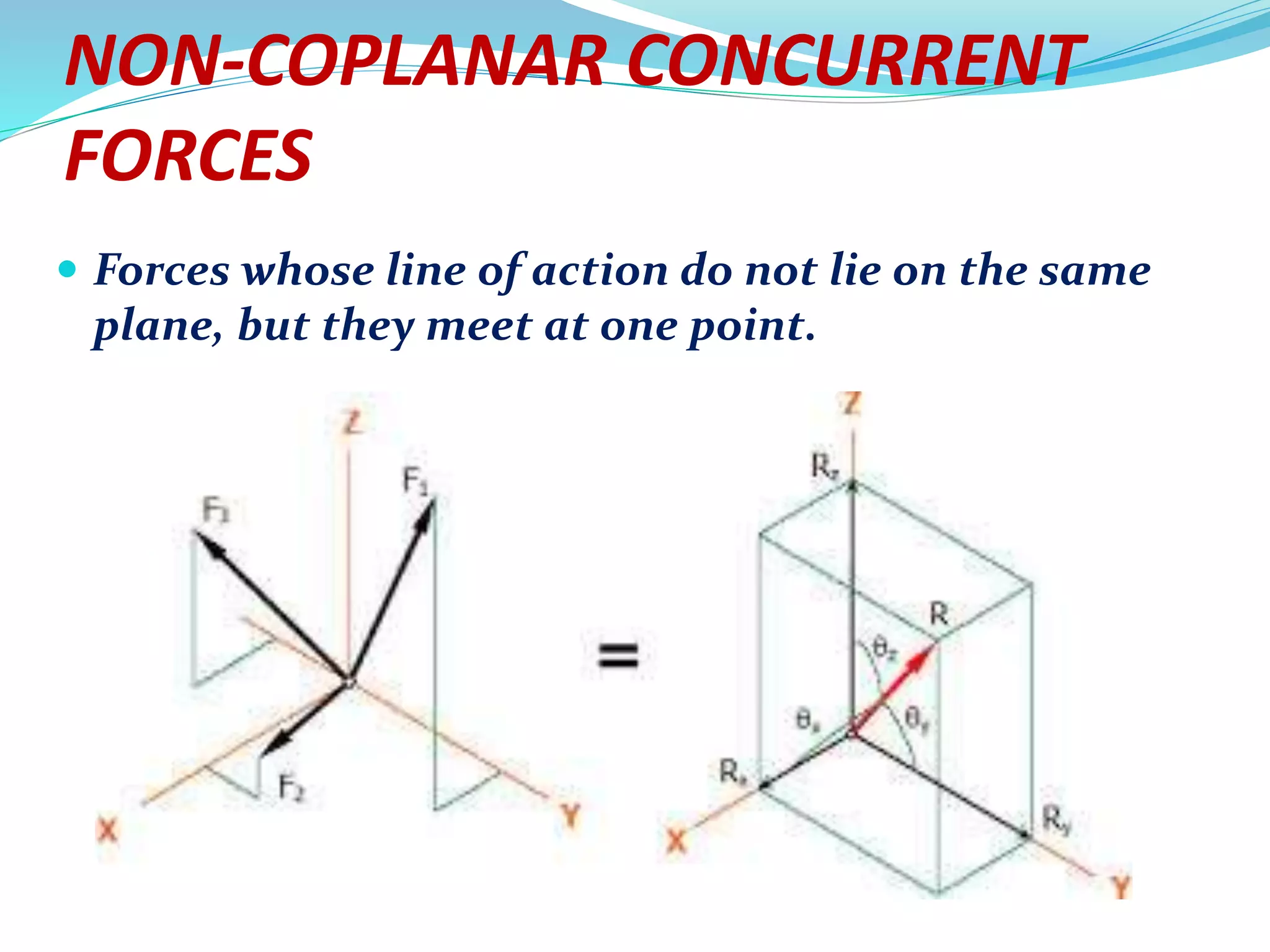
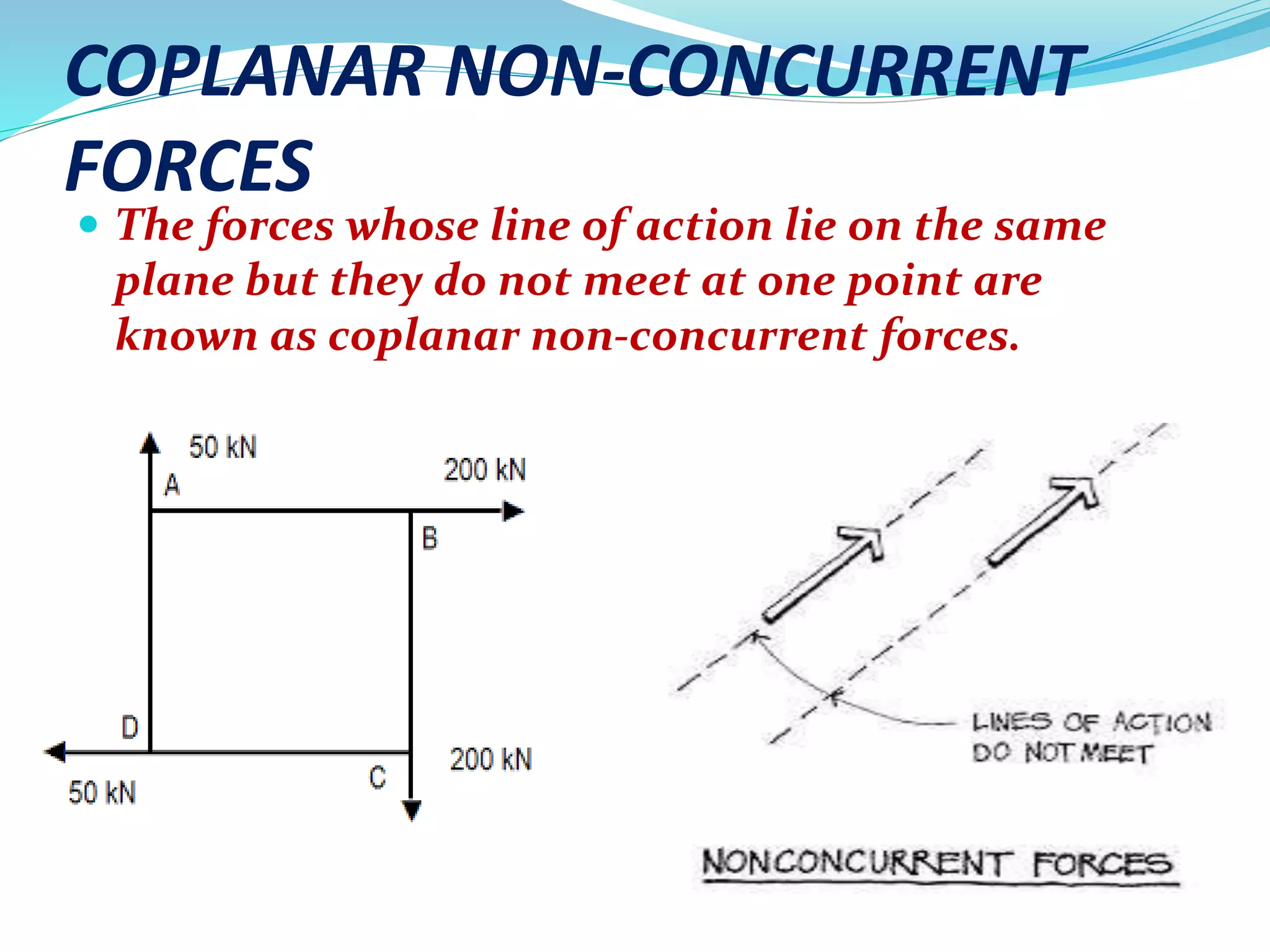
Definitions of coplanar forces, concurrent forces, collinear forces, along with non-coplanar forces and parallel forces.
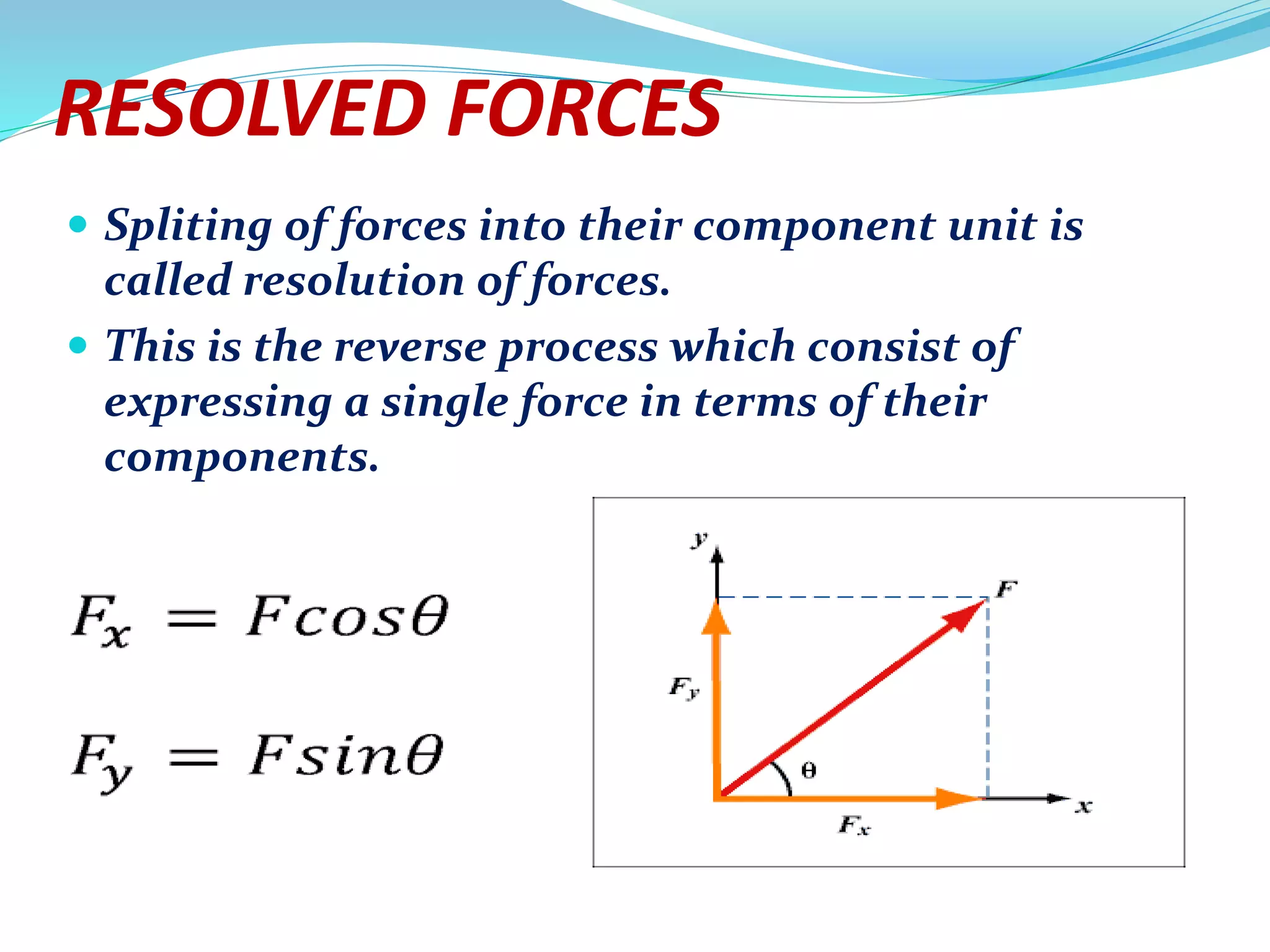
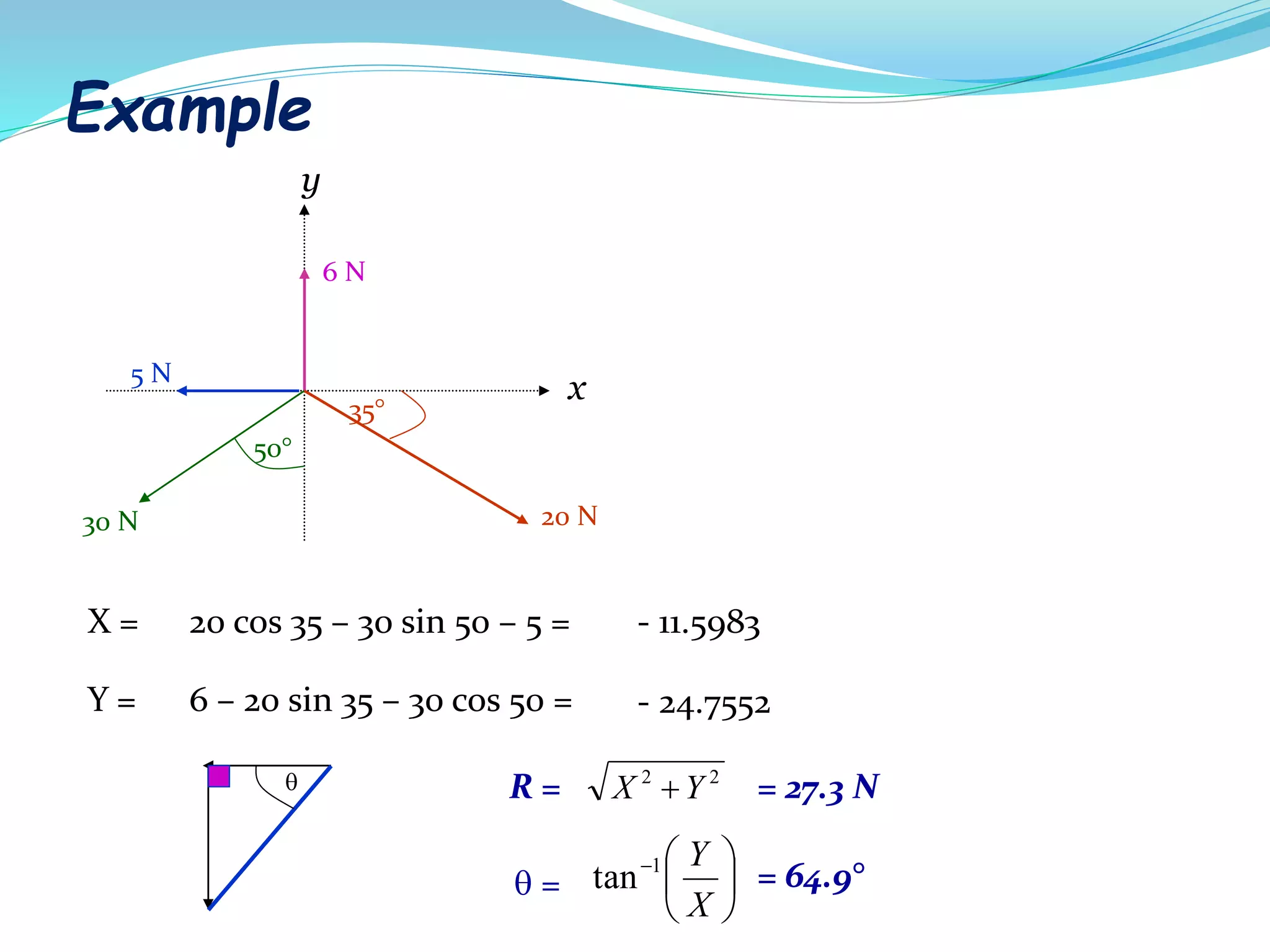
Discussion on the resolution of forces into components with an example calculation.
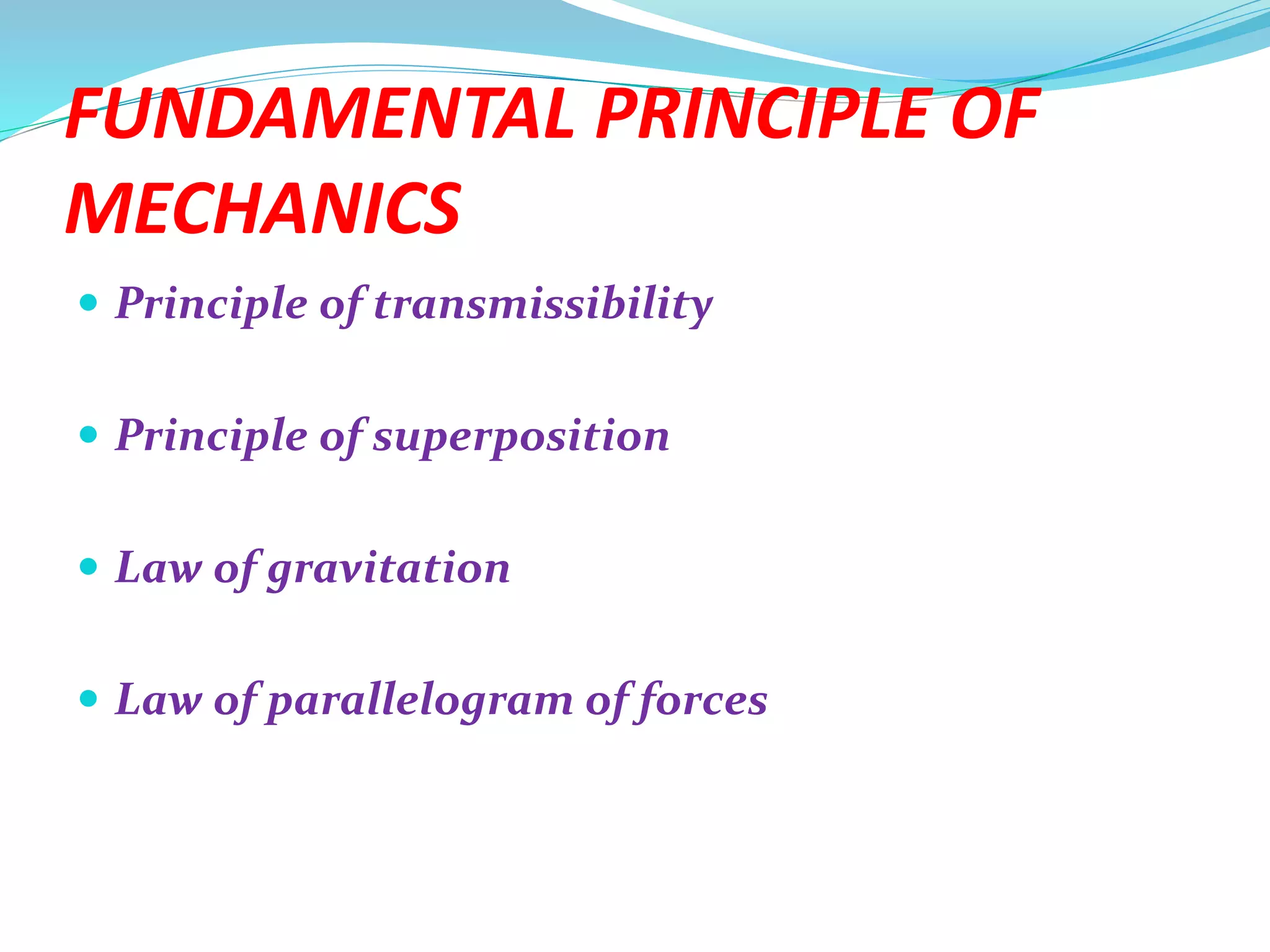
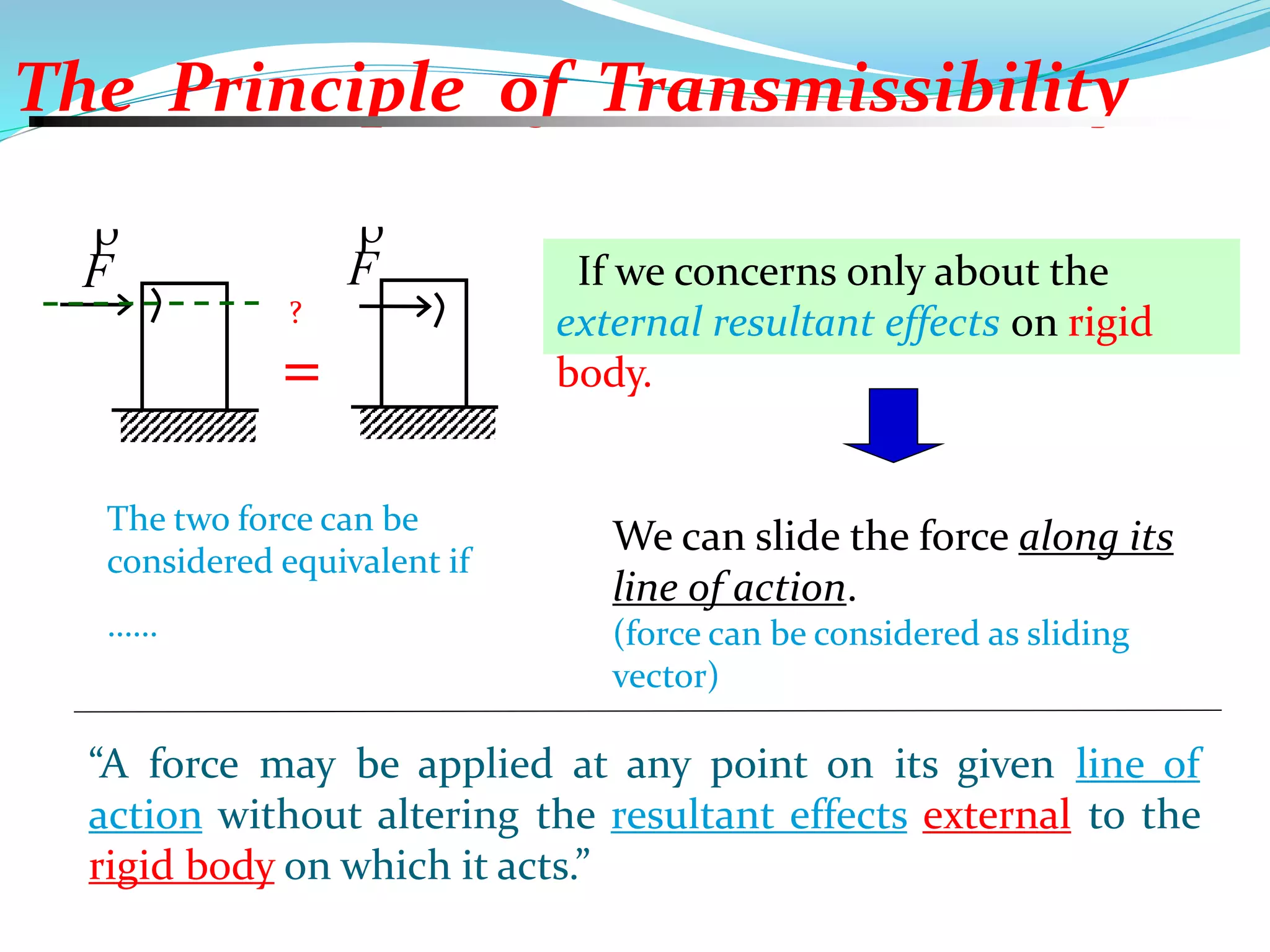
Explains principles like transmissibility, superposition, law of gravitation, and the parallelogram law of forces.
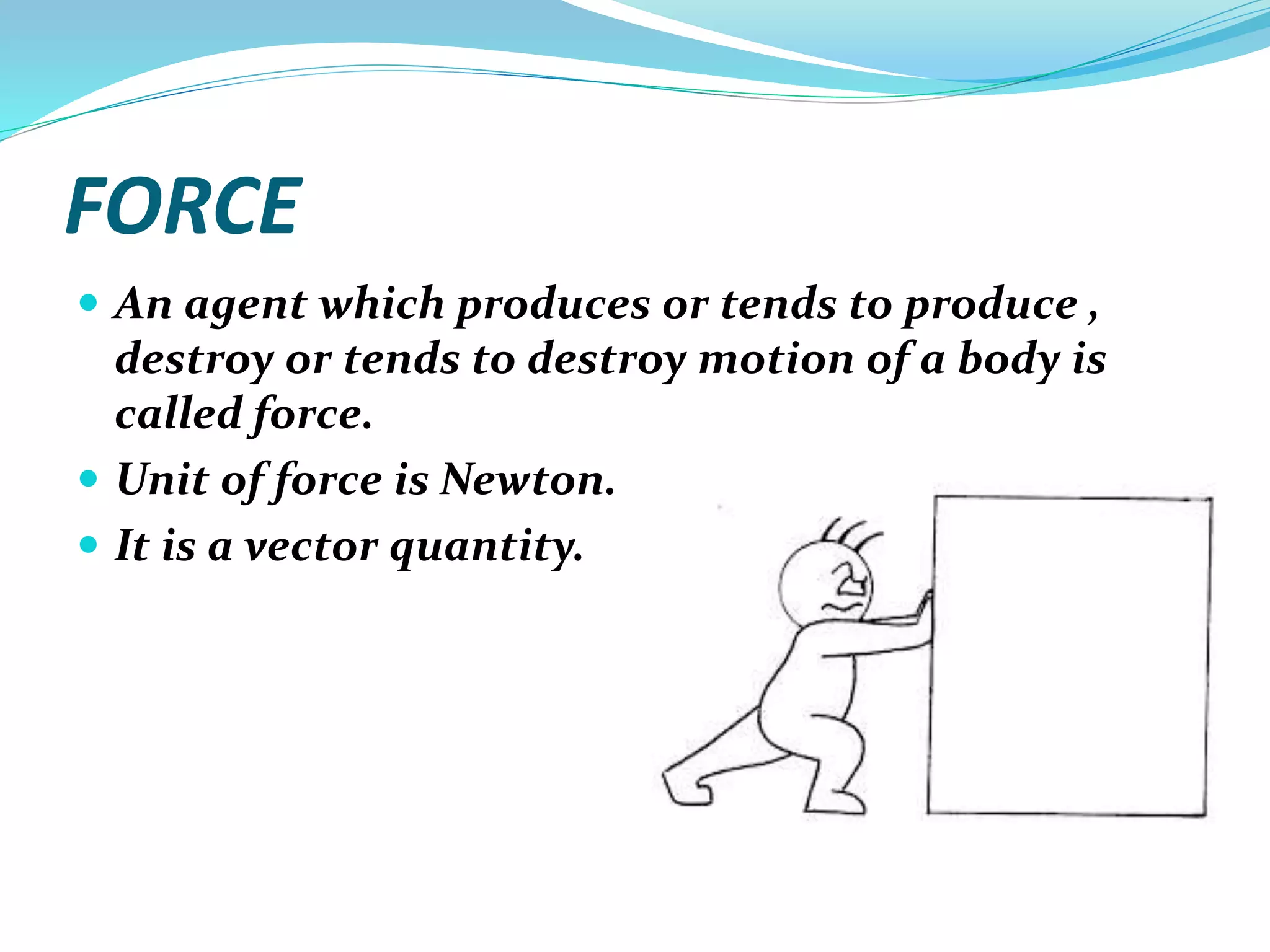
FORCE
An agentwhich produces or tends to produce ,
destroy or tends to destroy motion of a body is
called force.
Unit of force is Newton.
It is a vector quantity.
4.
CHARACHTERISTIC OF AFORCE
MAGNITUDE: Magnitude of force may be 10kn etc.
DIRECTION: It has certain fixed direction.
NATURE: It may be tensile or compressive.
POINT OF APPLICATION: Point at which force acts.
5.
TYPES OF FORCES
Contact Force
Body Force
Point Force
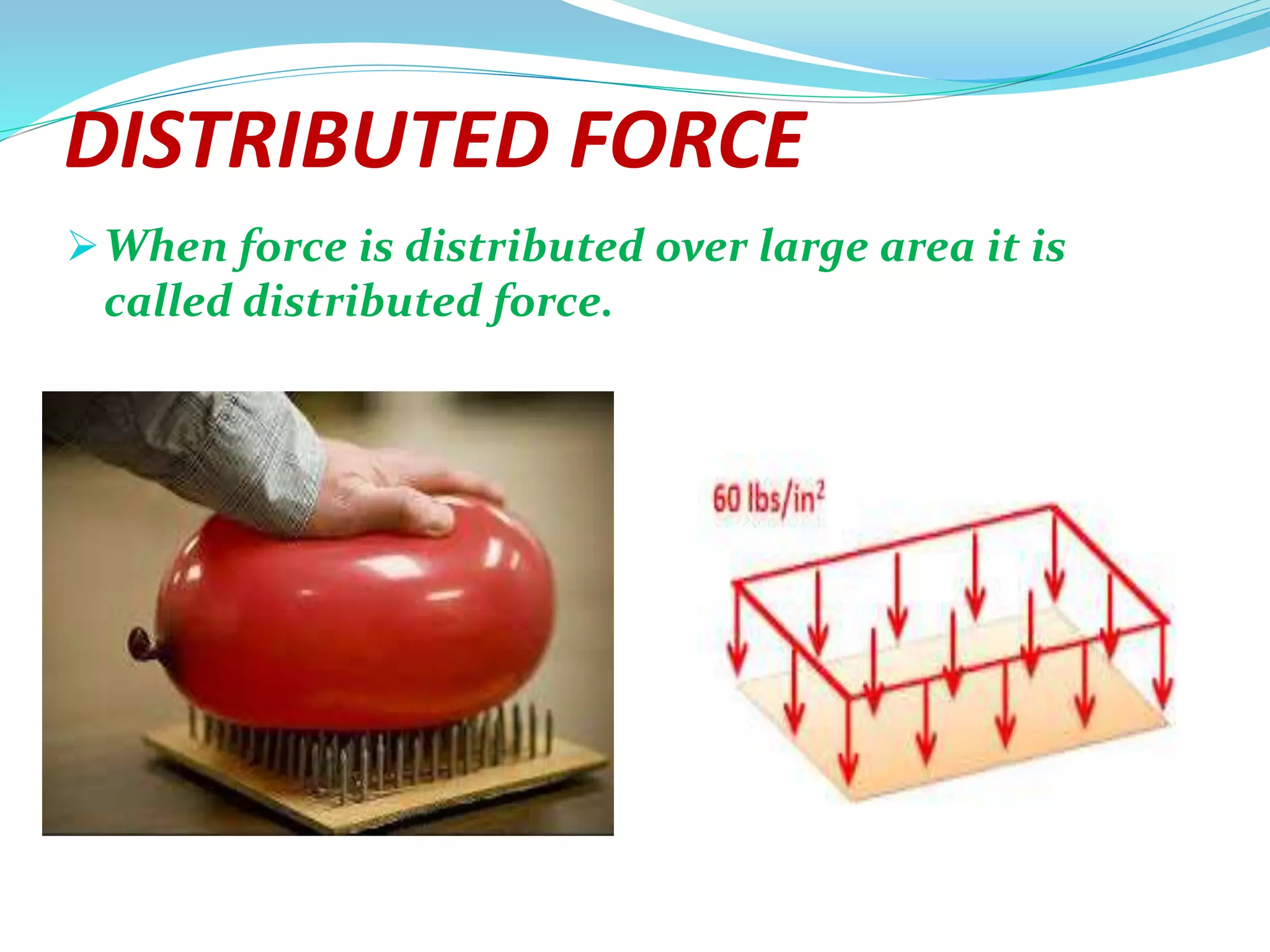
Distributed Force
External Force
Internal Force
Frictional Force
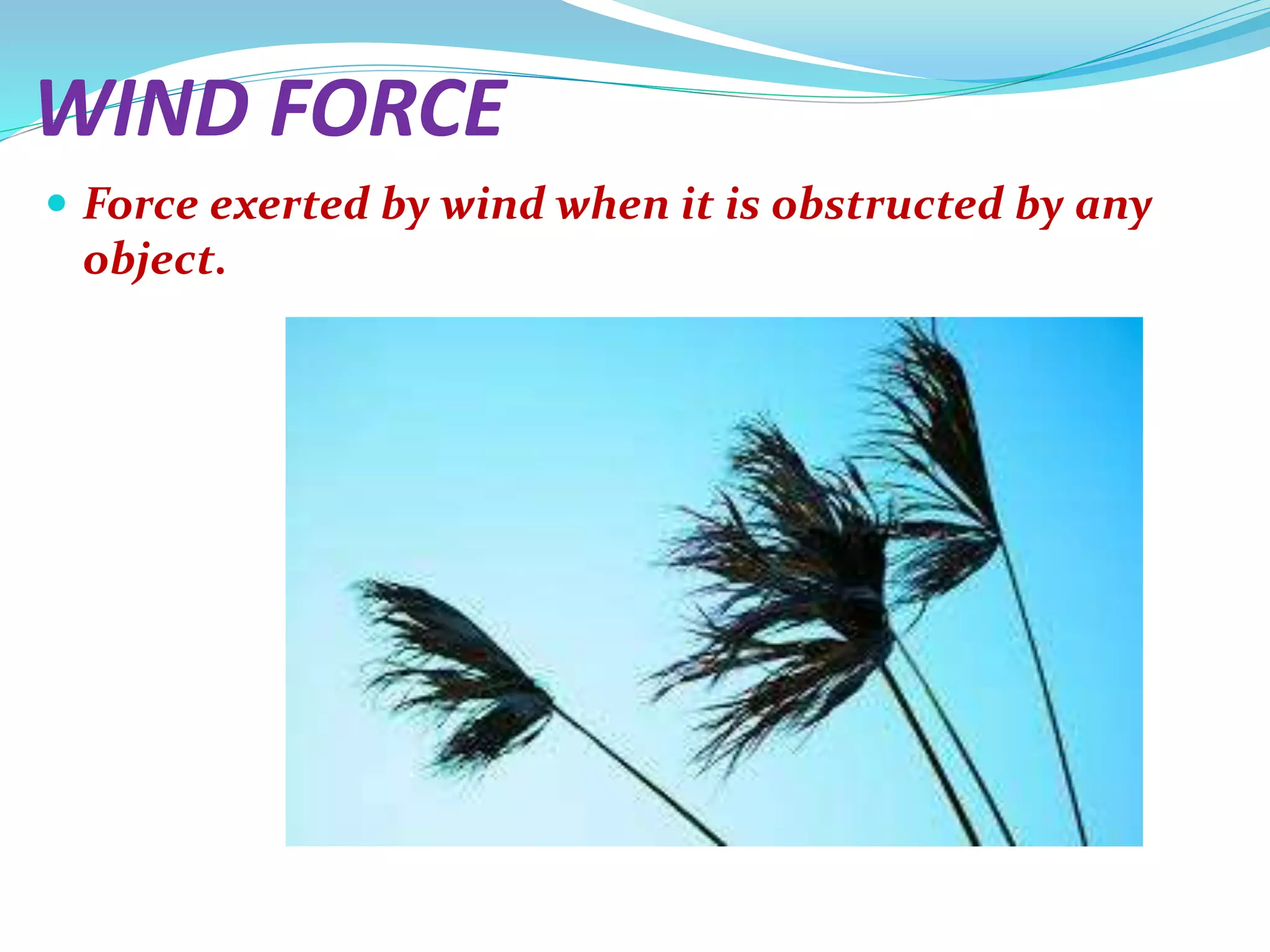
Wind Force
Hydrostatic Force
Cohesive & Adhesive Force etc.
6.
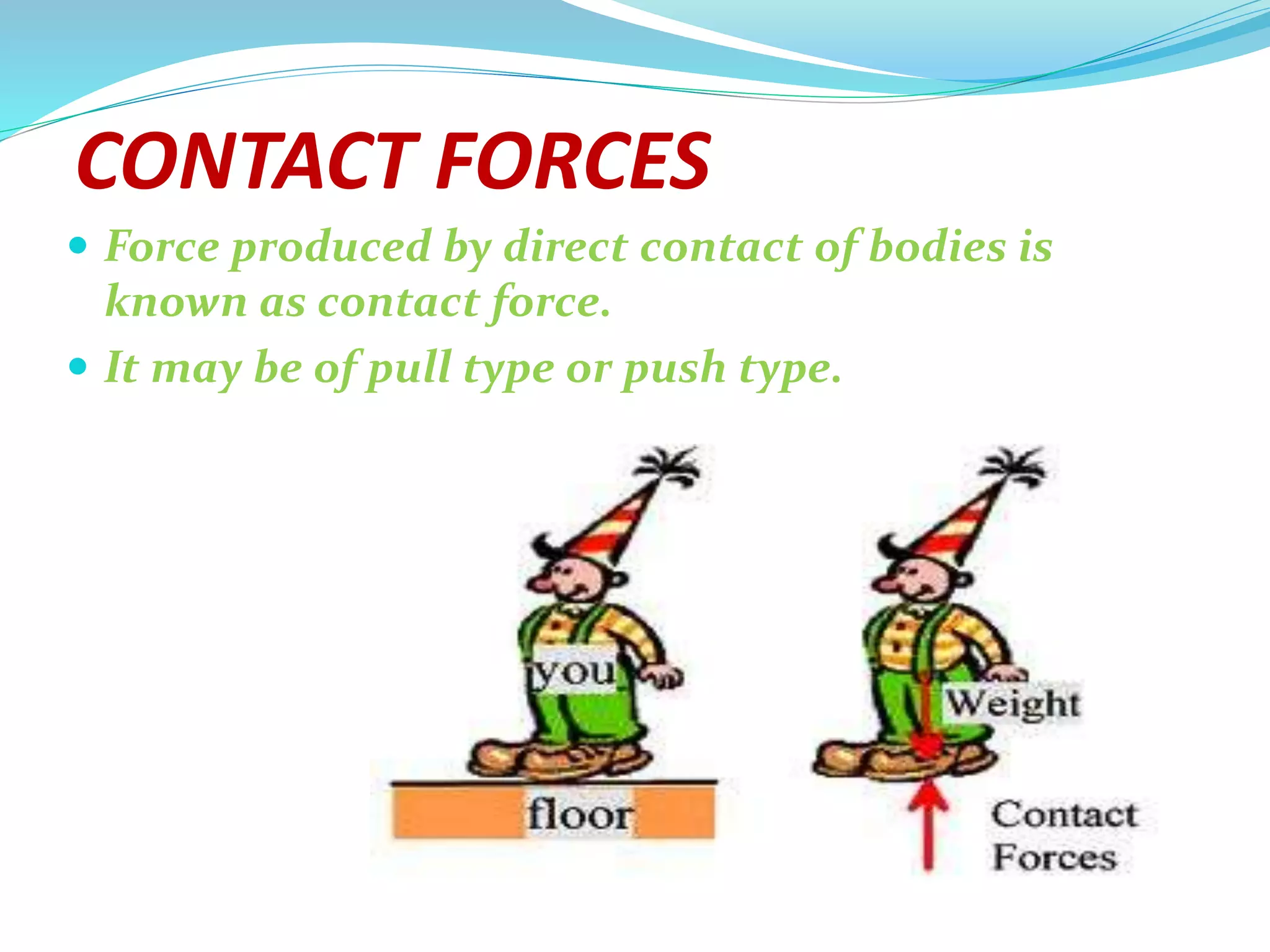
CONTACT FORCES
Forceproduced by direct contact of bodies is
known as contact force.
It may be of pull type or push type.
7.
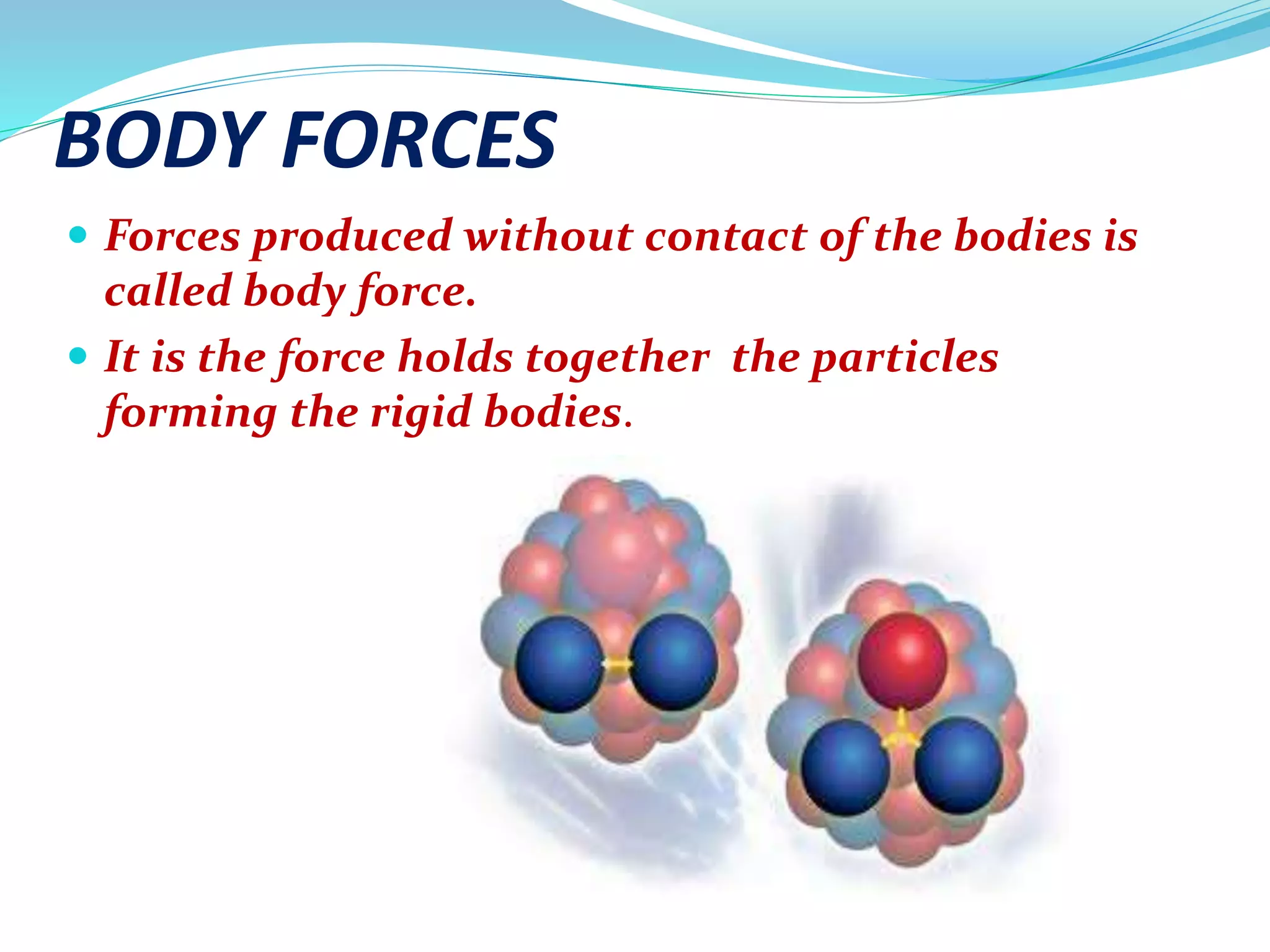
BODY FORCES
Forcesproduced without contact of the bodies is
called body force.
It is the force holds together the particles
forming the rigid bodies.
8.
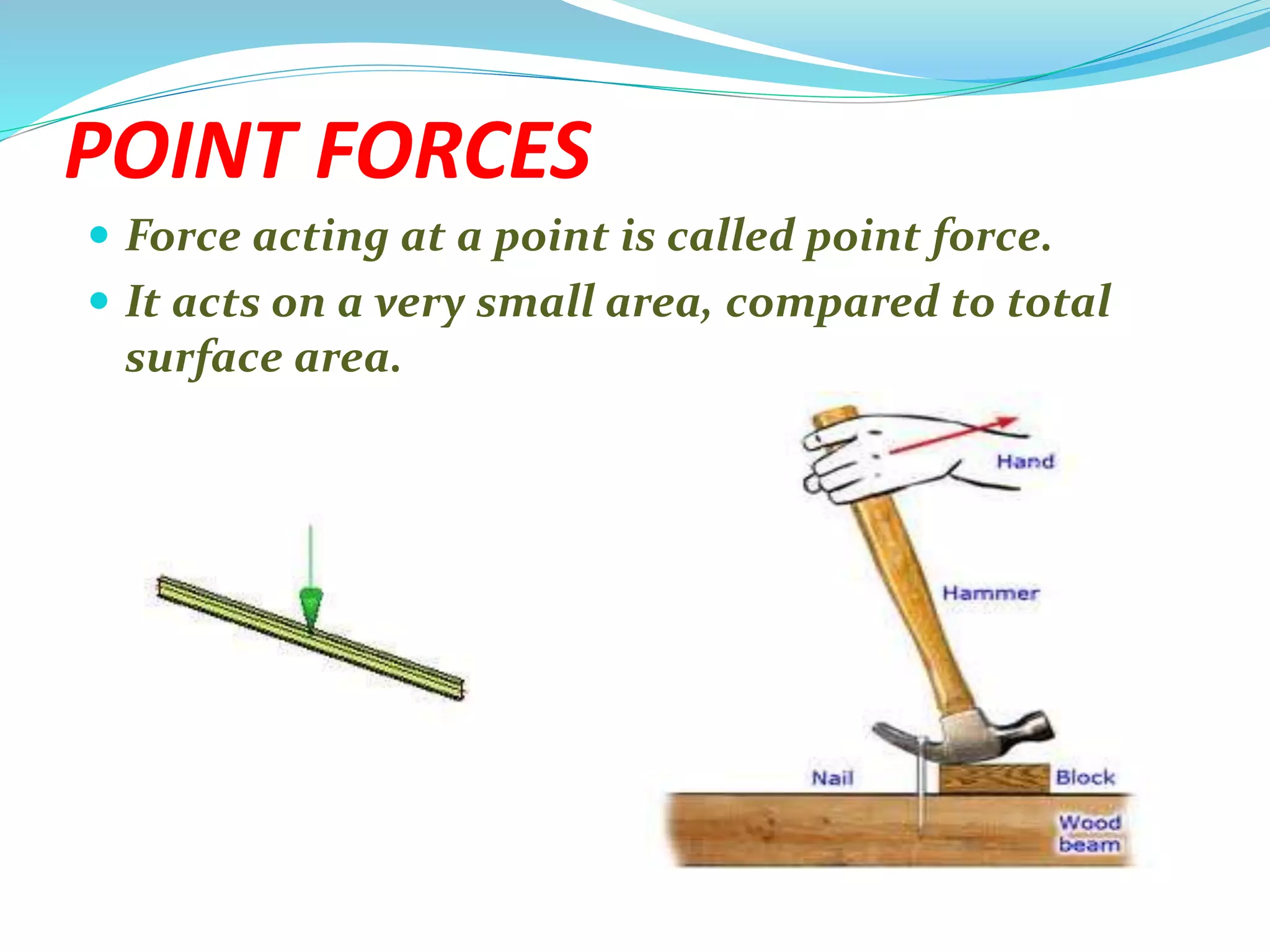
POINT FORCES
Forceacting at a point is called point force.
It acts on a very small area, compared to total
surface area.
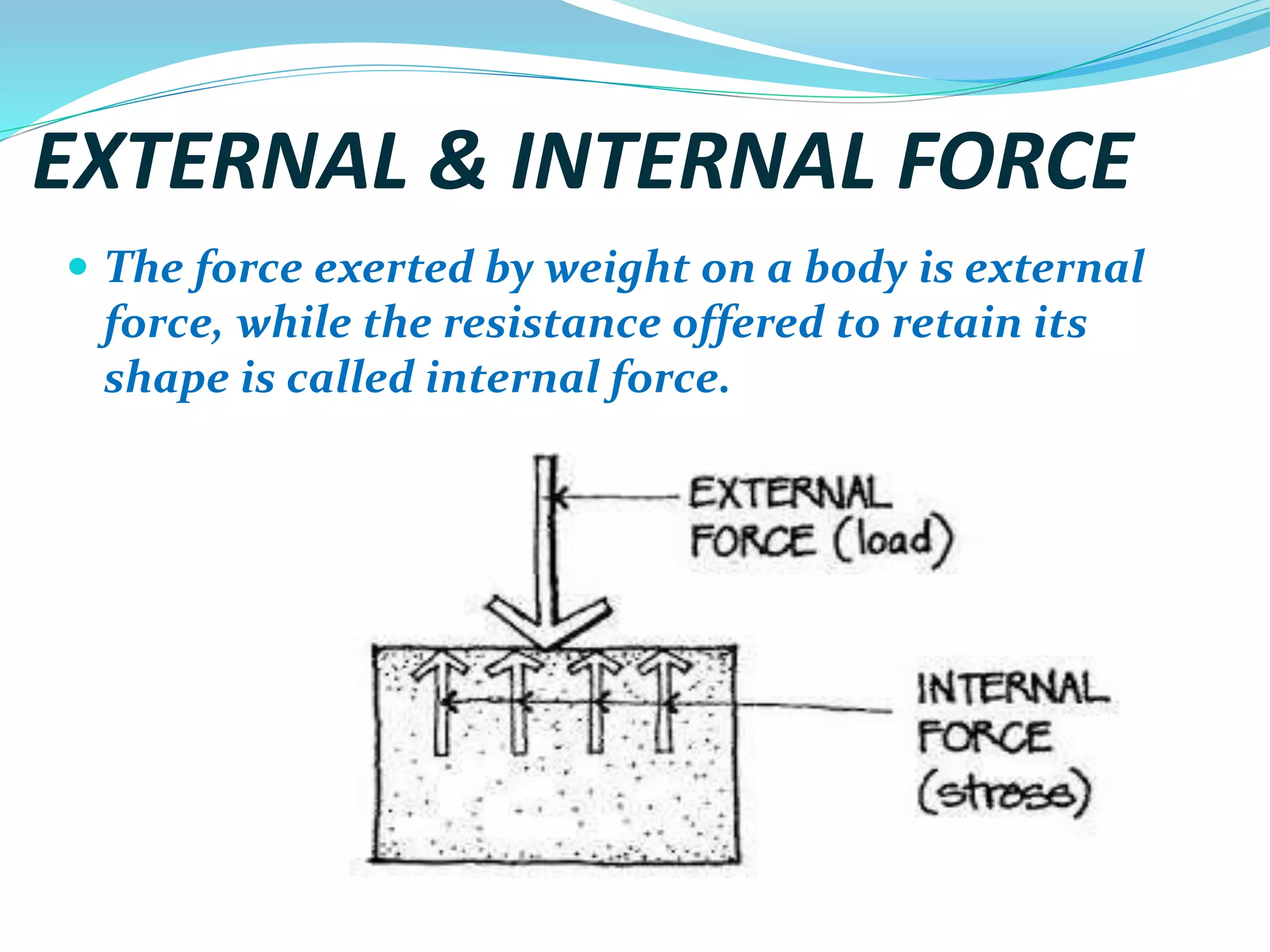
EXTERNAL & INTERNALFORCE
The force exerted by weight on a body is external
force, while the resistance offered to retain its
shape is called internal force.
11.
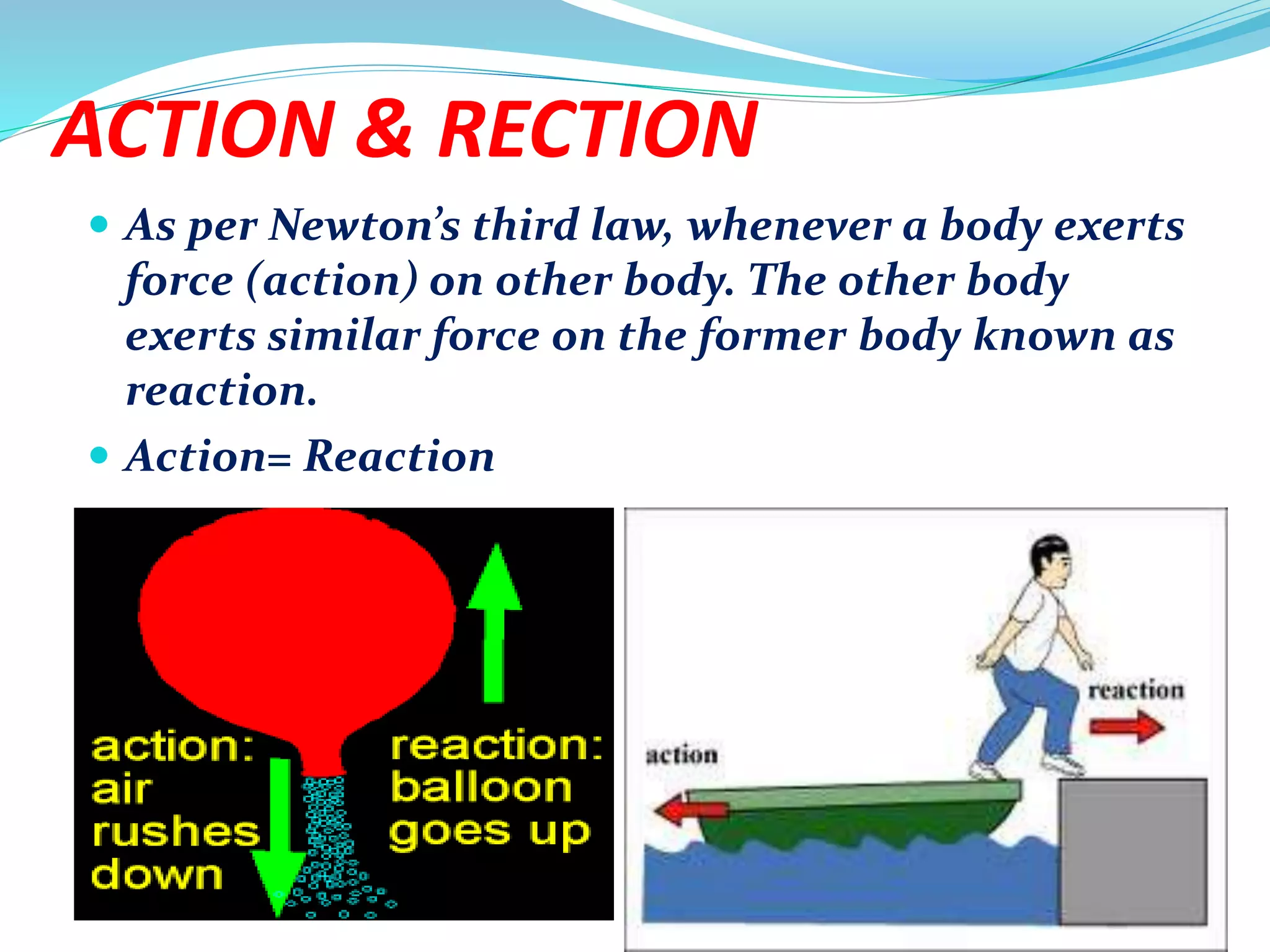
ACTION & RECTION
As per Newton’s third law, whenever a body exerts
force (action) on other body. The other body
exerts similar force on the former body known as
reaction.
Action= Reaction
12.
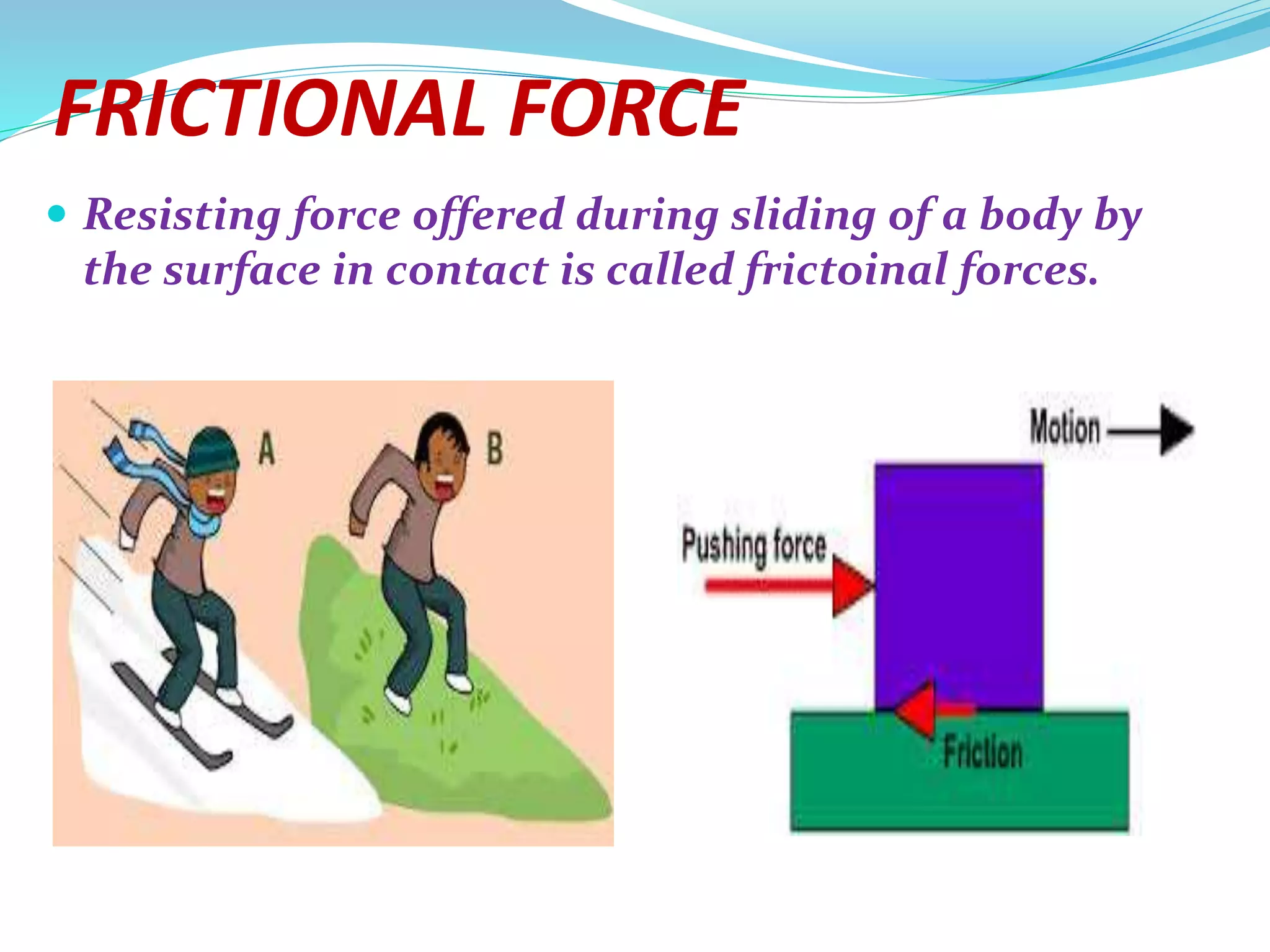
FRICTIONAL FORCE
Resistingforce offered during sliding of a body by
the surface in contact is called frictoinal forces.
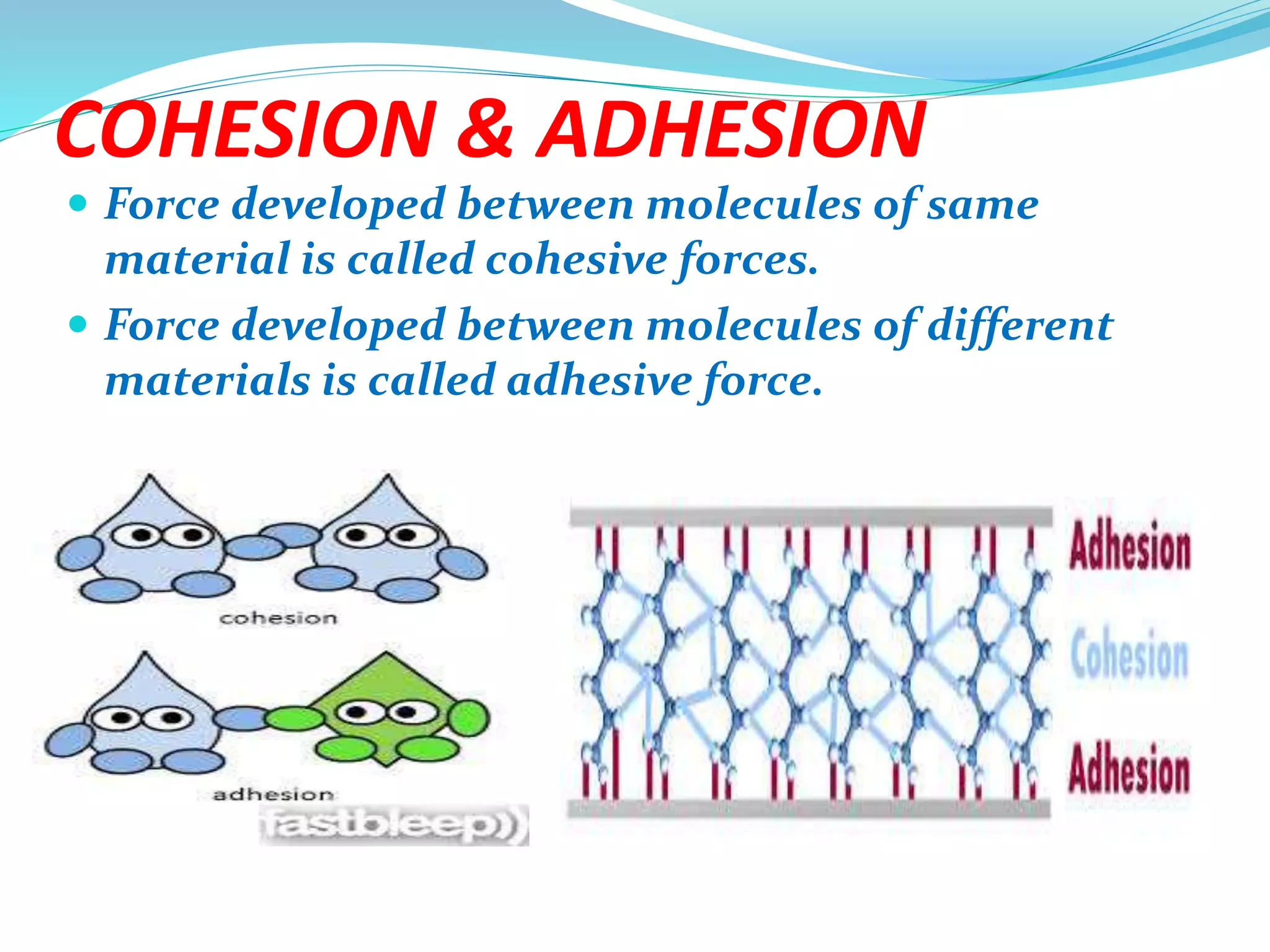
COHESION & ADHESION
Force developed between molecules of same
material is called cohesive forces.
Force developed between molecules of different
materials is called adhesive force.
SYSTEM OF FORCES
Whentwo or more forces act on a body, they are called
to form a system of forces.
Coplanar Forces
Concurrent Forces
Collinear Forces
Coplanar Concurrent Forces
Coplanar non Concurrent Forces
Non coplanar Concurrent Forces
Non coplanar Non concurrent Forces
Like parallel Forces
Unlike parallel Forces
Spatial Forces
17.
COPLANAR FORCES
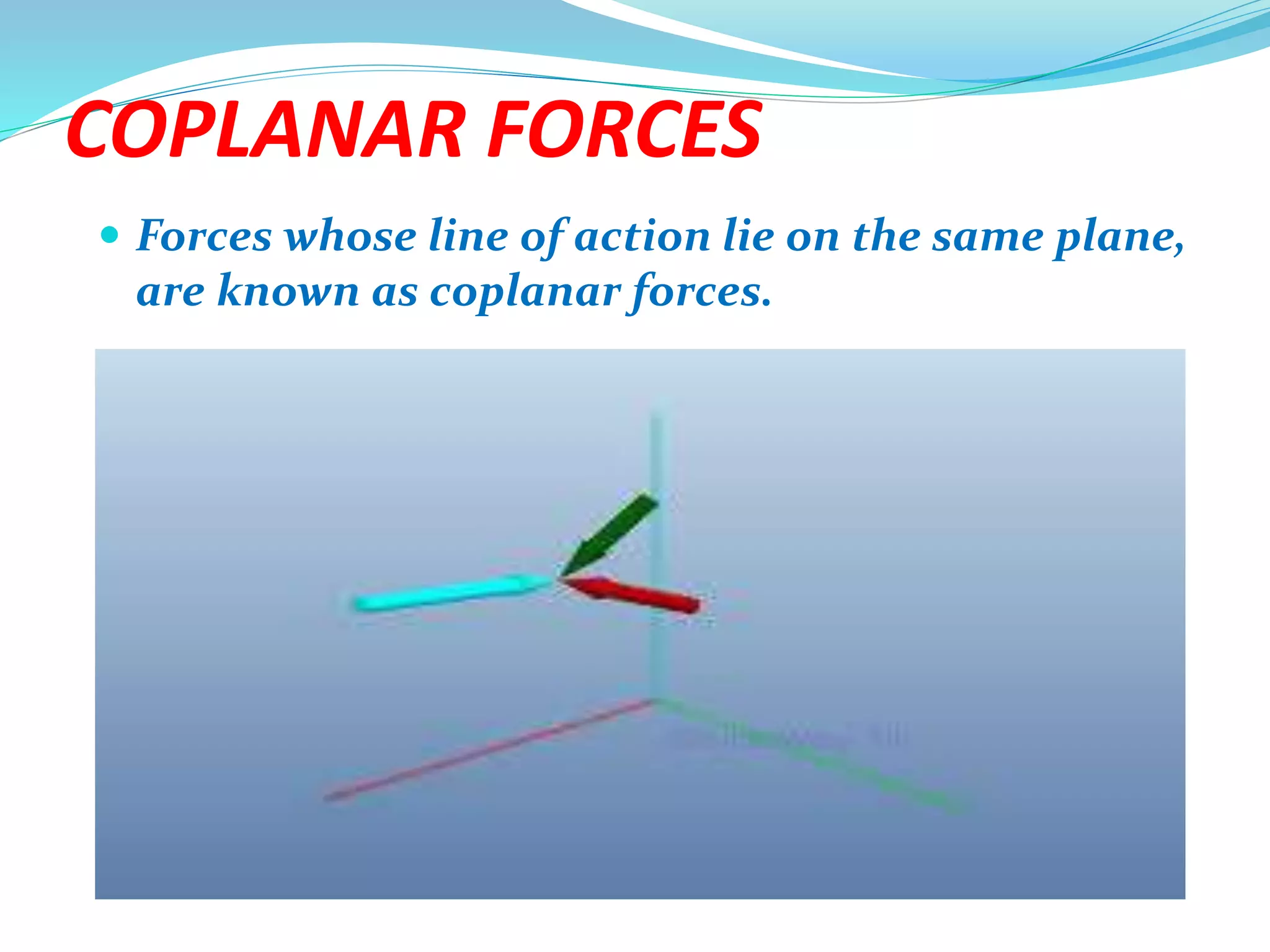
Forceswhose line of action lie on the same plane,
are known as coplanar forces.
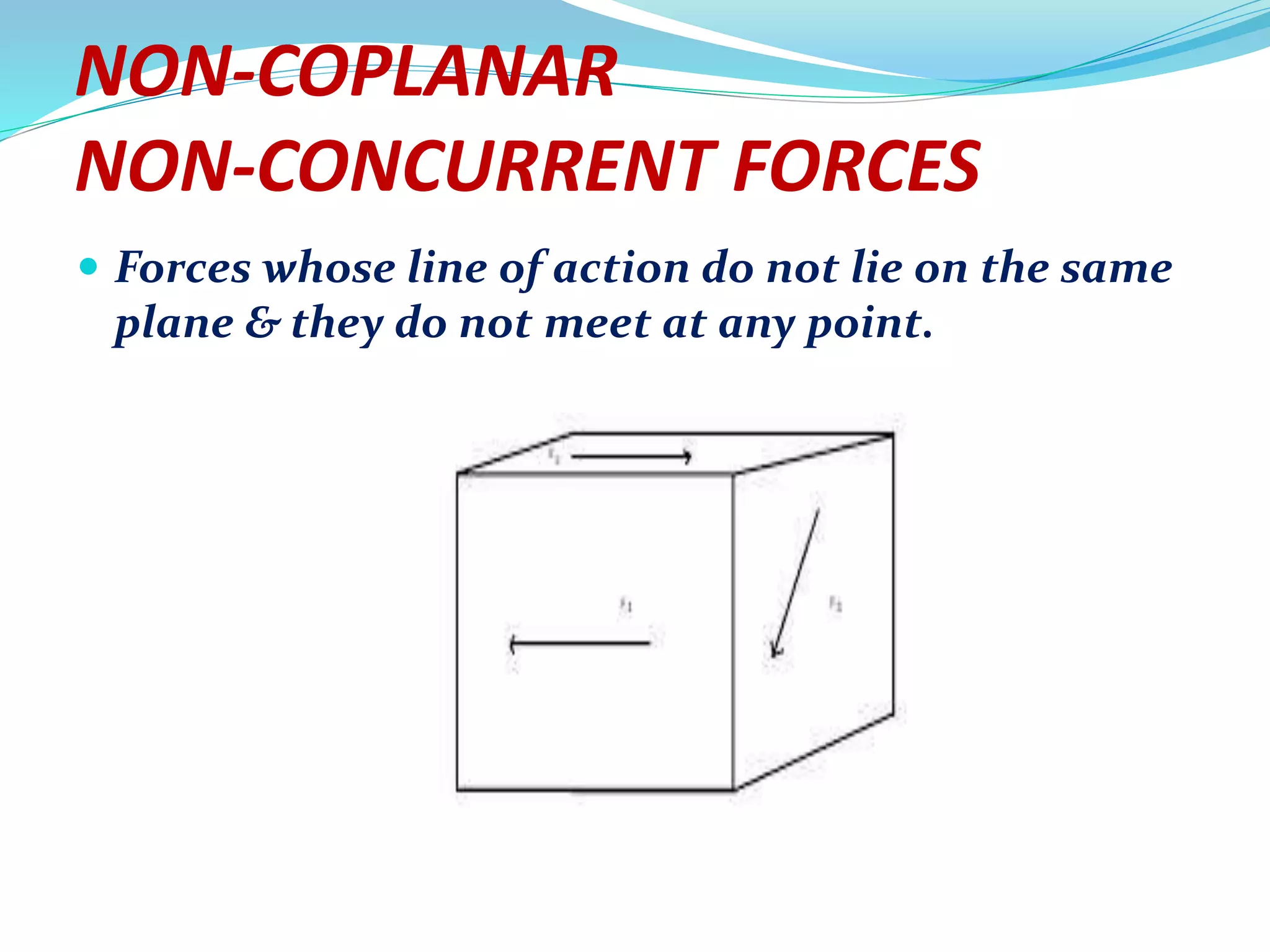
COPLANAR NON-CONCURRENT
FORCES
Theforces whose line of action lie on the same
plane but they do not meet at one point are
known as coplanar non-concurrent forces.
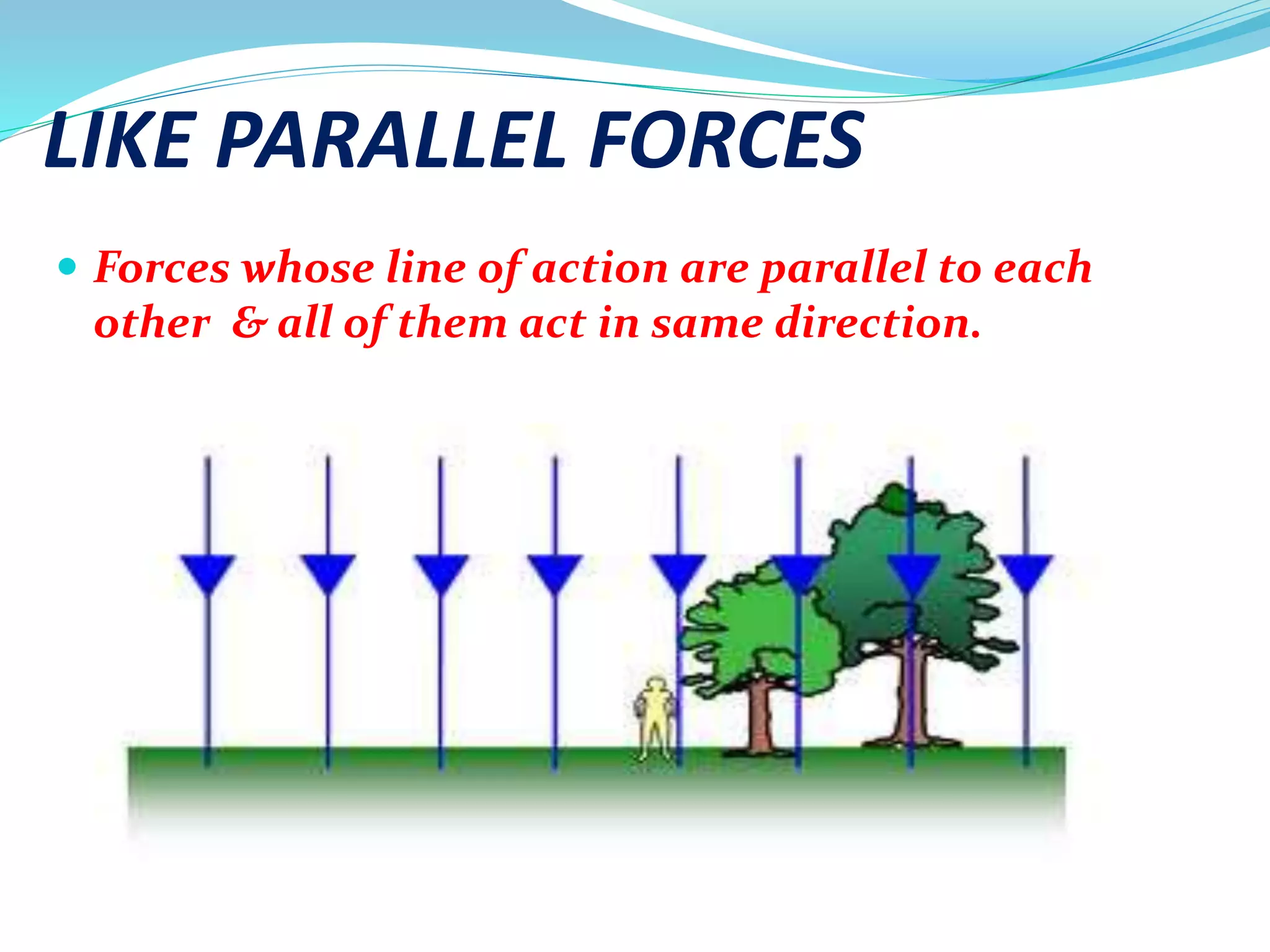
LIKE PARALLEL FORCES
Forces whose line of action are parallel to each
other & all of them act in same direction.
25.
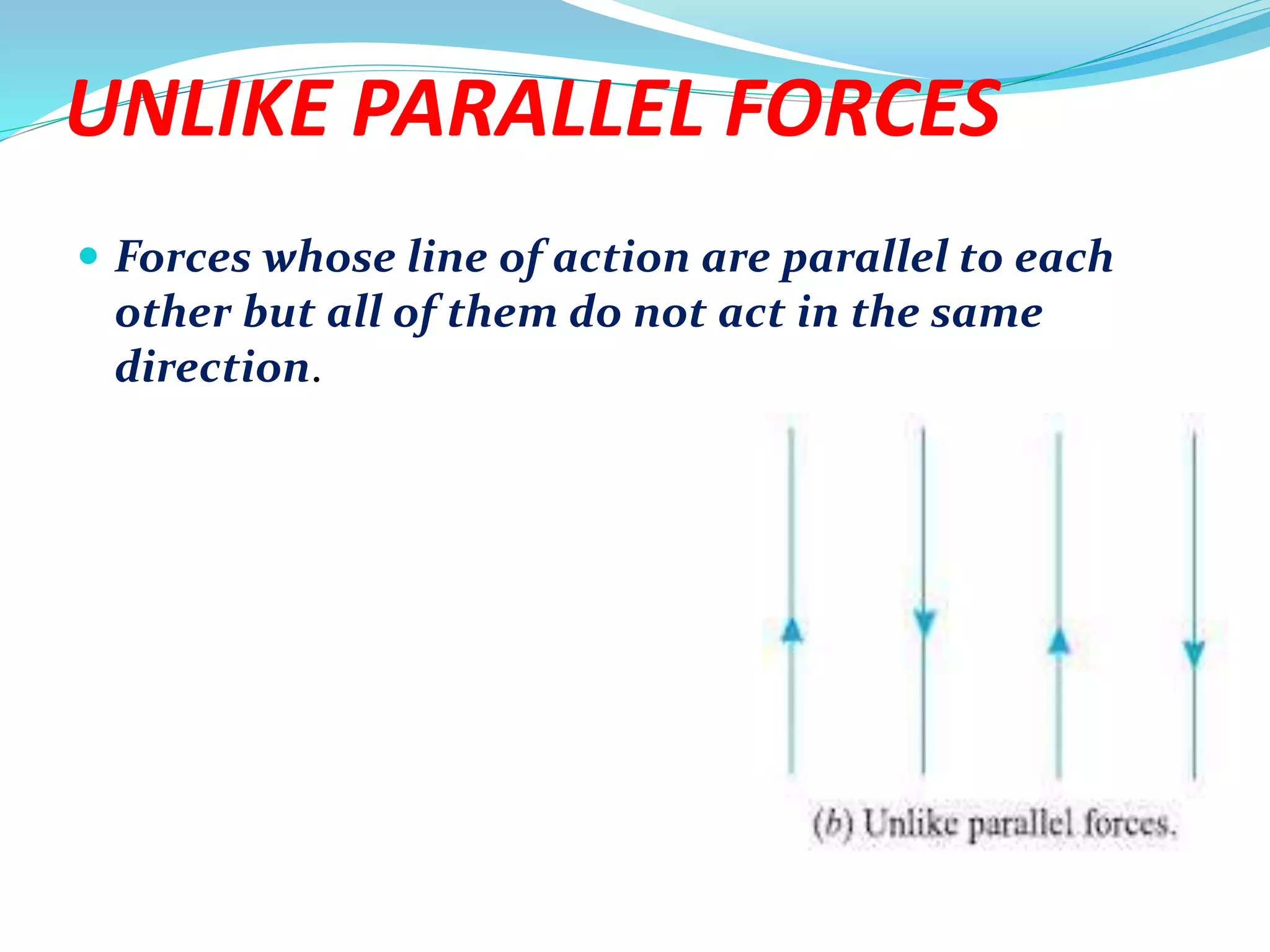
UNLIKE PARALLEL FORCES
Forces whose line of action are parallel to each
other but all of them do not act in the same
direction.
26.
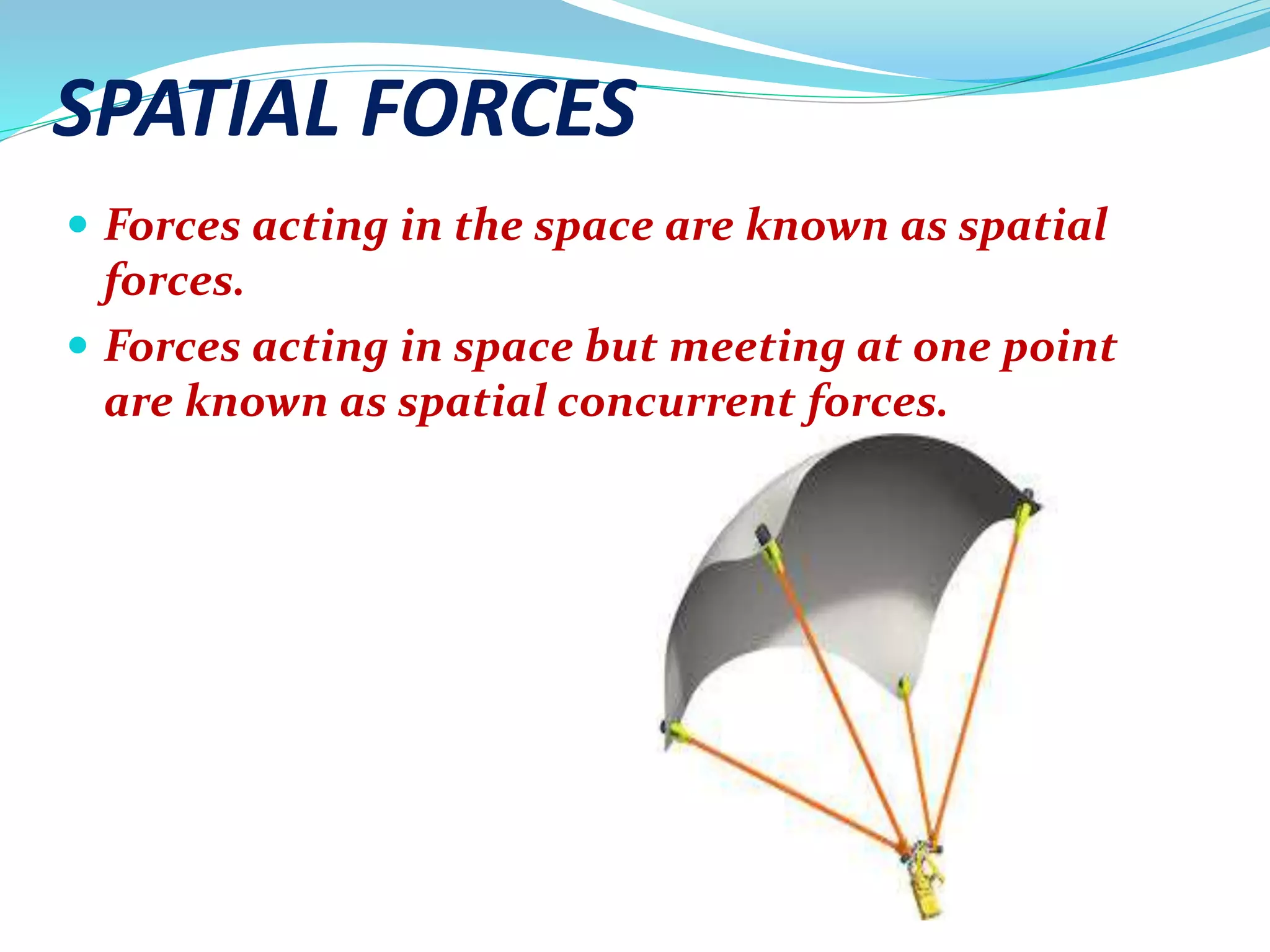
SPATIAL FORCES
Forcesacting in the space are known as spatial
forces.
Forces acting in space but meeting at one point
are known as spatial concurrent forces.
27.
RESOLVED FORCES
Splitingof forces into their component unit is
called resolution of forces.
This is the reverse process which consist of
expressing a single force in terms of their
components.
28.
Example
x
y
6 N
30 N
50°
20N
35°
5 N
X = 20 cos 35 – 30 sin 50 – 5 = - 11.5983
Y = 6 – 20 sin 35 – 30 cos 50 = - 24.7552
22
YX R = = 27.3 N
=
X
Y1
tan = 64.9°
29.
FUNDAMENTAL PRINCIPLE OF
MECHANICS
Principle of transmissibility
Principle of superposition
Law of gravitation
Law of parallelogram of forces
30.
The Principle ofTransmissibility
“A force may be applied at any point on its given line of
action without altering the resultant effects external to the
rigid body on which it acts.”
We can slide the force along its
line of action.
(force can be considered as sliding
vector)
F
F
=
?
The two force can be
considered equivalent if
……
If we concerns only about the
external resultant effects on rigid
body.
31.
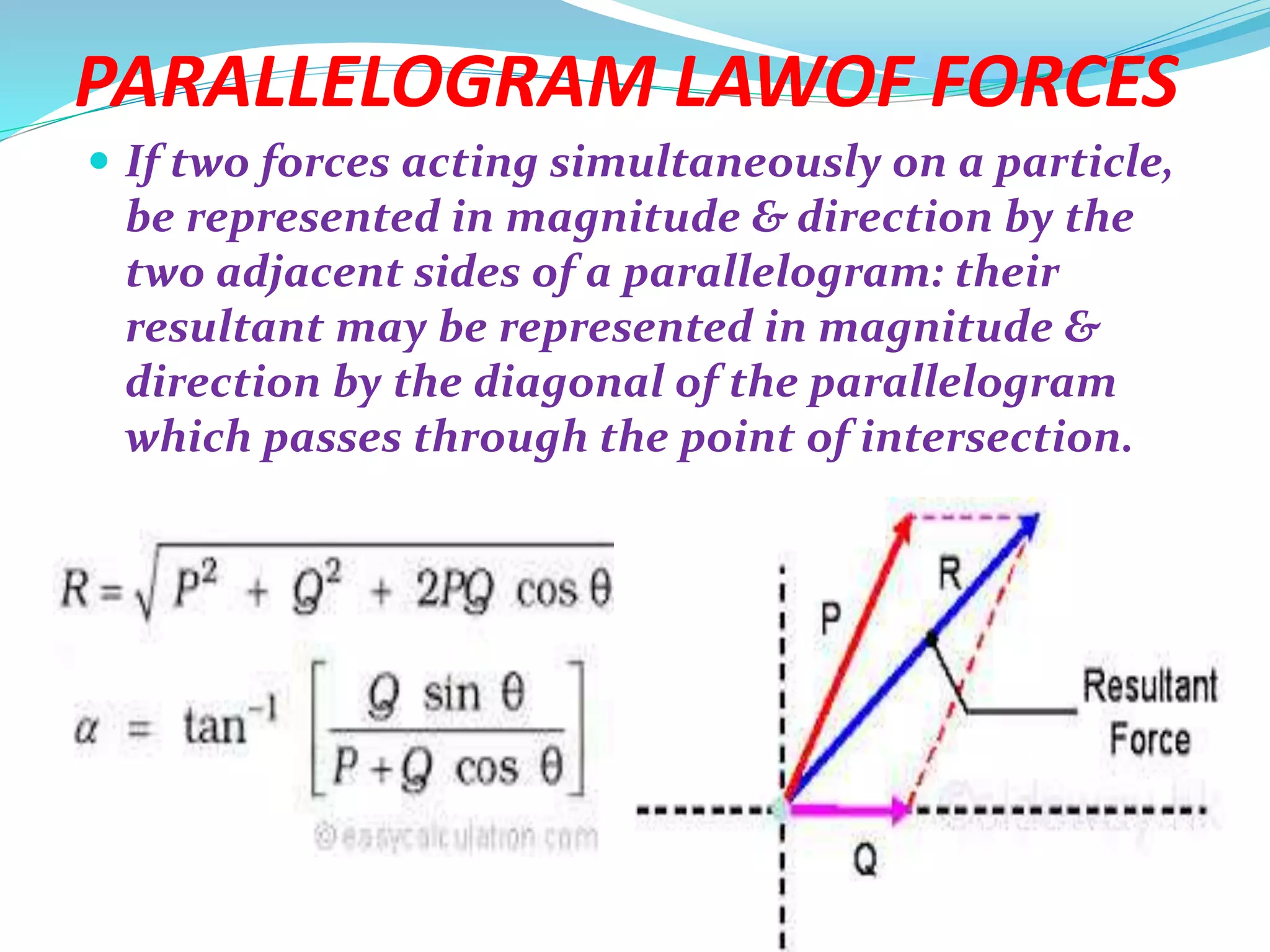
PARALLELOGRAM LAWOF FORCES
If two forces acting simultaneously on a particle,
be represented in magnitude & direction by the
two adjacent sides of a parallelogram: their
resultant may be represented in magnitude &
direction by the diagonal of the parallelogram
which passes through the point of intersection.
32.
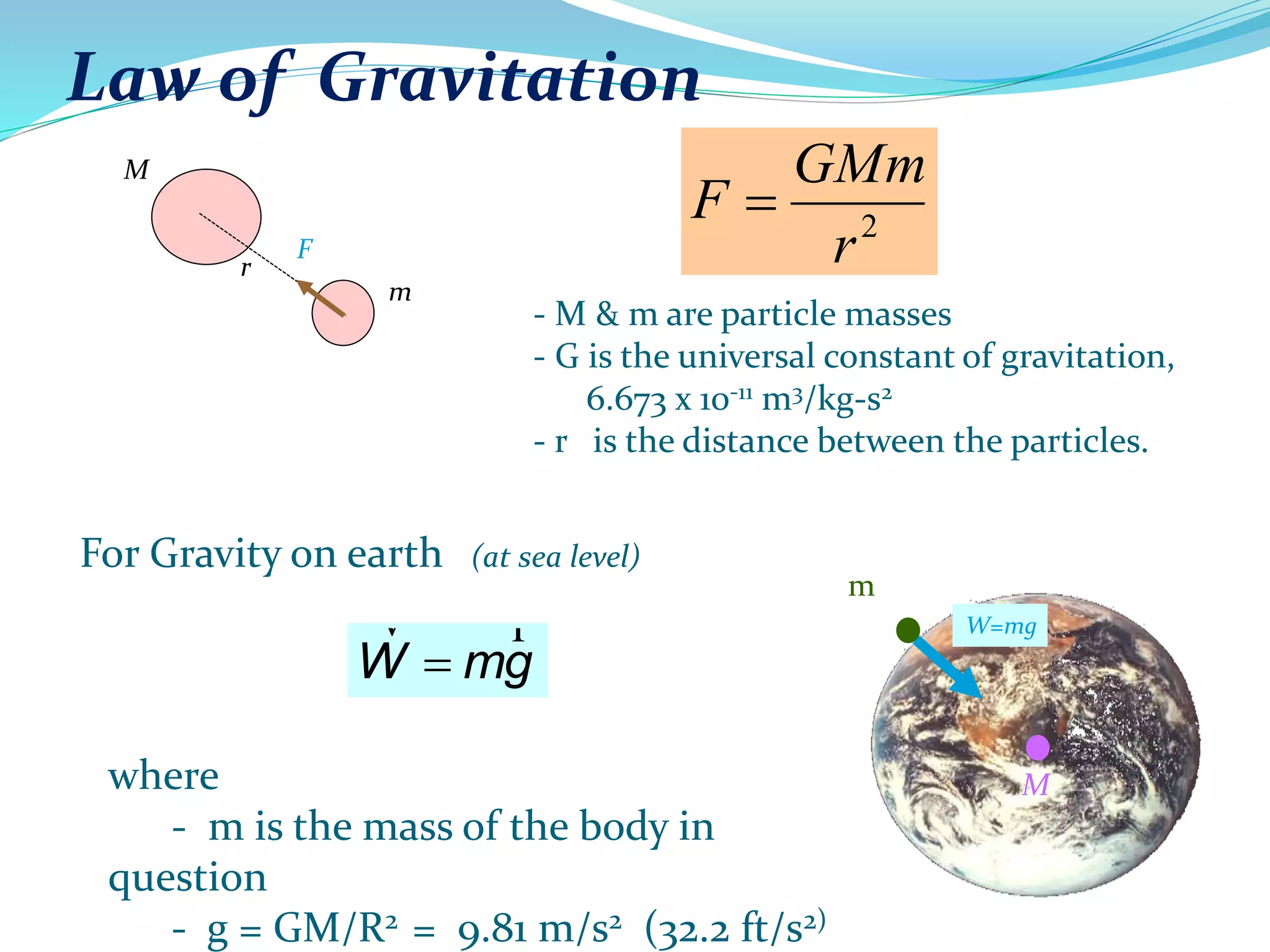
Law of Gravitation
2
r
GMm
F
- M & m are particle masses
- G is the universal constant of gravitation,
6.673 x 10⁻¹¹ m3/kg-s2
- r is the distance between the particles.
For Gravity on earth (at sea level)
where
- m is the mass of the body in
question
- g = GM/R2 = 9.81 m/s2 (32.2 ft/s2)
m
M
W=mg
v r
W mg
M
m
r
F
33.
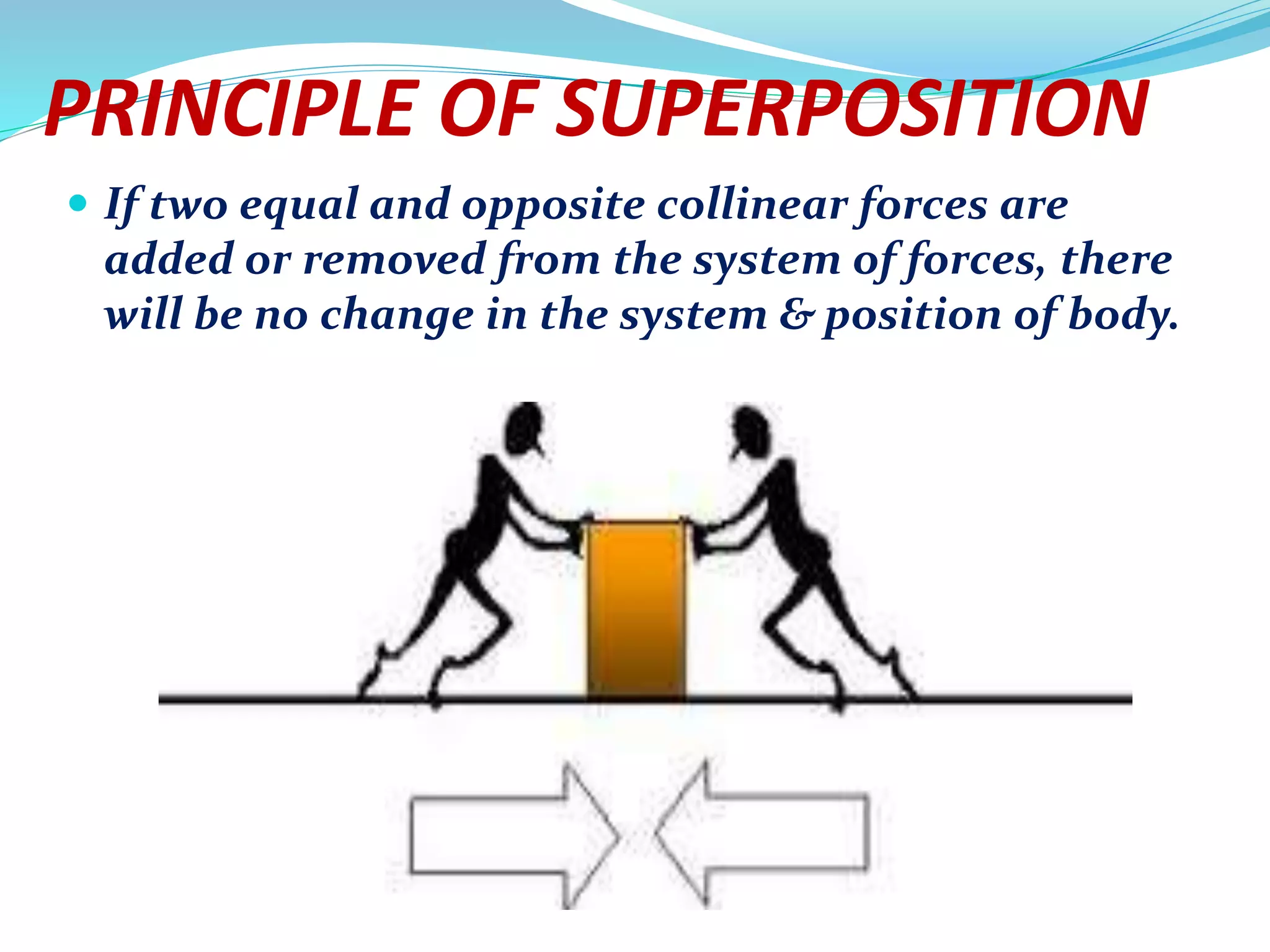
PRINCIPLE OF SUPERPOSITION
If two equal and opposite collinear forces are
added or removed from the system of forces, there
will be no change in the system & position of body.