Defining
Operationally
At the end of the session the participants are
expected to:
1. identify the different process skills in the
development of Science ideas particularly
defining operationally.
2. understand how we use the Science process
skills not only in teaching but in everyday life
3. appreciate the importance of process skills
by performing the activities correctly
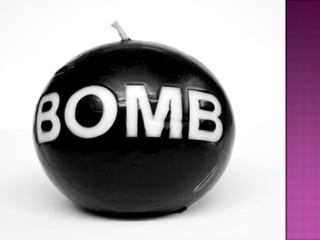
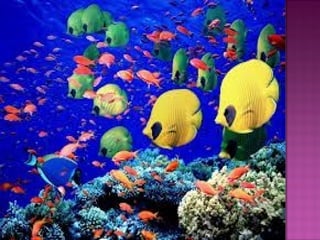
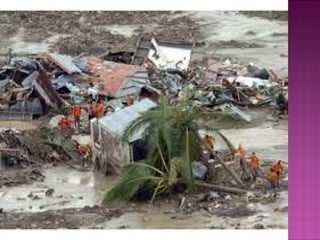
 Define the following
pictures in one word.
Materials:
yellow and green metacard, manila paper,
marker
Procedure:
1. Each group will be receiving white and red
metacards and words to be define in two
ways.
2. In your white metacards, write conceptual
definition or definitions coming from the
dictionary. Then write your own definition in the
red metacards.
Intelligence is the score obtained on a
specific IQ test 
Intelligence is the
capacity for learning, reasoning, understandi
ng, and similar formsof mental activity; 
aptitude in grasping truths, relationships,
facts, meanings.
-is forming a definition that is based on what you do or what
you observe..
-is a definition framed in terms
of students’ experiences.
it tells how something acts, not
what it is..
Example:
a pie-eating competition is
operationally defined as a
competition in which one eats pies.
 operational definition of the term weight of
an object, would be "weight is the numbers
that appear when that object is placed on a 
weighing scale".
According to it, the weight can be any of the
numbers shown on the scale after, including
the very moment the object is put on it.
- define variables or phenomena which can
not be measured directly
Example:
 Changes in temperature may not be
defined operationally because it can be
measured using thermometer but when we
discuss plants, we can define it operationally
through its colors, shapes and physical
characteristics
-states how to measure a variable in an experiment
Example:
The group of researchers did an investigation on
the effects of Vitamin E on the “endurance of a
person”
- The variable “endurance of a person” could be
defined operationally in many different ways.
- a. The number of hours a person could stay
awake.
- b. The distance a person could run without
stopping.
- c. The number of jumping jacks a person could do
before gets tired.
1. The need for operational definitions is
fundamental when collecting all types of
data.
For example, data collected will be
erroneous if those completing the checks
have different views of what constitutes a
fault at the end of a glass panel production
line.
1. Identify the characteristic of interest.
2. Select the measuring instrument.
3. Describe the test method.
4. State the decision criteria.
5. Document the operational definition
6. Test the operational definition.
 1. You may have experience landslide or seen in television. Write
a description of landslide based on your experience or based on
what you have seen.
 ________________________________________________________
________________________________________________________
 2. Find the meaning of landslide in a dictionary or a science
book. Record it below.
 ________________________________________________________
________________________________________________________
 3. How is your definition similar in the book?
 ________________________________________________________
________________________________________________________
4. How is your definition different from the book?
 ________________________________________________________
________________________________________________________
A primary school has a
program for increasing student’s
enjoyment of reading.
Think at least 4 ways that
”enjoyment of reading” could
be operationally defined.
 1.Amount of time students voluntarily
spend at the reading table.
 2.Number of references to books read
during sharing time.
 3.Number of voluntary book reports.
 4.Number of books taken home
An investigation is
underway to see how the intial
temperature of a liquid affects
the amount of evaporation.
Describe at least three
ways to see how the initial
temperature of a liquid affects
the amount of evaporation.
 Measure the depth of the liquid. Measure it
again twenty-four hours later.
 2.Pour a known quantity of liquid into an
open container.Measure its volume again
three hours later.
 3.Weigh the container of liquid. Twenty
minutes later, weight again. The difference
is the amount of evaporation
 You want to operationally define the
variable “size of a person” .
 Write at least 4 ways this variable could be
defined operationally
• 1.The reading in kilograms obtained when
a person steps on a scale.
• 2.The smallest number showing when a
person stands against a ruler which
extends from the floor up.
• 3.The amount of water that overflows
when a person is submerged in a full
bathtub.
• 4.The amount of tape required to encircle
the chest, waist and hips
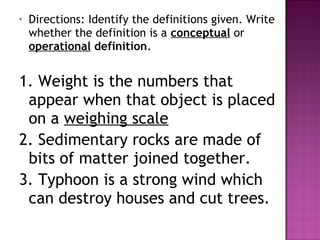
• Directions: Identify the definitions given. Write
whether the definition is a conceptual or
operational definition.
1. Weight is the numbers that
appear when that object is placed
on a weighing scale
2. Sedimentary rocks are made of
bits of matter joined together.
3. Typhoon is a strong wind which
can destroy houses and cut trees.
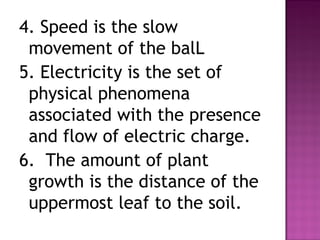
4. Speed is the slow
movement of the balL
5. Electricity is the set of
physical phenomena
associated with the presence
and flow of electric charge.
6. The amount of plant
growth is the distance of the
uppermost leaf to the soil.
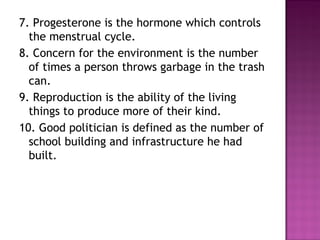
7. Progesterone is the hormone which controls
the menstrual cycle.
8. Concern for the environment is the number
of times a person throws garbage in the trash
can.
9. Reproduction is the ability of the living
things to produce more of their kind.
10. Good politician is defined as the number of
school building and infrastructure he had
built.
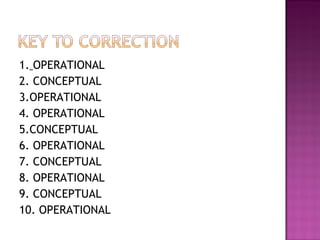
1. OPERATIONAL
2. CONCEPTUAL
3.OPERATIONAL
4. OPERATIONAL
5.CONCEPTUAL
6. OPERATIONAL
7. CONCEPTUAL
8. OPERATIONAL
9. CONCEPTUAL
10. OPERATIONAL
THANK YOU FOR LISTENING

Define operationally final

  • 2.
  • 3.
    At the endof the session the participants are expected to: 1. identify the different process skills in the development of Science ideas particularly defining operationally. 2. understand how we use the Science process skills not only in teaching but in everyday life 3. appreciate the importance of process skills by performing the activities correctly
  • 4.
     Define thefollowing pictures in one word.
  • 9.
    Materials: yellow and greenmetacard, manila paper, marker Procedure: 1. Each group will be receiving white and red metacards and words to be define in two ways. 2. In your white metacards, write conceptual definition or definitions coming from the dictionary. Then write your own definition in the red metacards.
  • 10.
    Intelligence is thescore obtained on a specific IQ test  Intelligence is the capacity for learning, reasoning, understandi ng, and similar formsof mental activity;  aptitude in grasping truths, relationships, facts, meanings.
  • 12.
    -is forming adefinition that is based on what you do or what you observe.. -is a definition framed in terms of students’ experiences.
  • 13.
    it tells howsomething acts, not what it is.. Example: a pie-eating competition is operationally defined as a competition in which one eats pies.
  • 14.
     operational definitionof the term weight of an object, would be "weight is the numbers that appear when that object is placed on a  weighing scale". According to it, the weight can be any of the numbers shown on the scale after, including the very moment the object is put on it.
  • 15.
    - define variablesor phenomena which can not be measured directly Example:  Changes in temperature may not be defined operationally because it can be measured using thermometer but when we discuss plants, we can define it operationally through its colors, shapes and physical characteristics
  • 16.
    -states how tomeasure a variable in an experiment Example: The group of researchers did an investigation on the effects of Vitamin E on the “endurance of a person” - The variable “endurance of a person” could be defined operationally in many different ways. - a. The number of hours a person could stay awake. - b. The distance a person could run without stopping. - c. The number of jumping jacks a person could do before gets tired.
  • 17.
    1. The needfor operational definitions is fundamental when collecting all types of data. For example, data collected will be erroneous if those completing the checks have different views of what constitutes a fault at the end of a glass panel production line.
  • 18.
    1. Identify thecharacteristic of interest. 2. Select the measuring instrument. 3. Describe the test method.
  • 19.
    4. State thedecision criteria. 5. Document the operational definition 6. Test the operational definition.
  • 20.
     1. Youmay have experience landslide or seen in television. Write a description of landslide based on your experience or based on what you have seen.  ________________________________________________________ ________________________________________________________  2. Find the meaning of landslide in a dictionary or a science book. Record it below.  ________________________________________________________ ________________________________________________________  3. How is your definition similar in the book?  ________________________________________________________ ________________________________________________________ 4. How is your definition different from the book?  ________________________________________________________ ________________________________________________________
  • 21.
    A primary schoolhas a program for increasing student’s enjoyment of reading. Think at least 4 ways that ”enjoyment of reading” could be operationally defined.
  • 22.
     1.Amount oftime students voluntarily spend at the reading table.  2.Number of references to books read during sharing time.  3.Number of voluntary book reports.  4.Number of books taken home
  • 23.
    An investigation is underwayto see how the intial temperature of a liquid affects the amount of evaporation. Describe at least three ways to see how the initial temperature of a liquid affects the amount of evaporation.
  • 24.
     Measure thedepth of the liquid. Measure it again twenty-four hours later.  2.Pour a known quantity of liquid into an open container.Measure its volume again three hours later.  3.Weigh the container of liquid. Twenty minutes later, weight again. The difference is the amount of evaporation
  • 25.
     You wantto operationally define the variable “size of a person” .  Write at least 4 ways this variable could be defined operationally
  • 26.
    • 1.The readingin kilograms obtained when a person steps on a scale. • 2.The smallest number showing when a person stands against a ruler which extends from the floor up. • 3.The amount of water that overflows when a person is submerged in a full bathtub. • 4.The amount of tape required to encircle the chest, waist and hips
  • 27.
    • Directions: Identifythe definitions given. Write whether the definition is a conceptual or operational definition. 1. Weight is the numbers that appear when that object is placed on a weighing scale 2. Sedimentary rocks are made of bits of matter joined together. 3. Typhoon is a strong wind which can destroy houses and cut trees.
  • 28.
    4. Speed isthe slow movement of the balL 5. Electricity is the set of physical phenomena associated with the presence and flow of electric charge. 6. The amount of plant growth is the distance of the uppermost leaf to the soil.
  • 29.
    7. Progesterone isthe hormone which controls the menstrual cycle. 8. Concern for the environment is the number of times a person throws garbage in the trash can. 9. Reproduction is the ability of the living things to produce more of their kind. 10. Good politician is defined as the number of school building and infrastructure he had built.
  • 30.
    1. OPERATIONAL 2. CONCEPTUAL 3.OPERATIONAL 4.OPERATIONAL 5.CONCEPTUAL 6. OPERATIONAL 7. CONCEPTUAL 8. OPERATIONAL 9. CONCEPTUAL 10. OPERATIONAL
  • 33.
    THANK YOU FORLISTENING