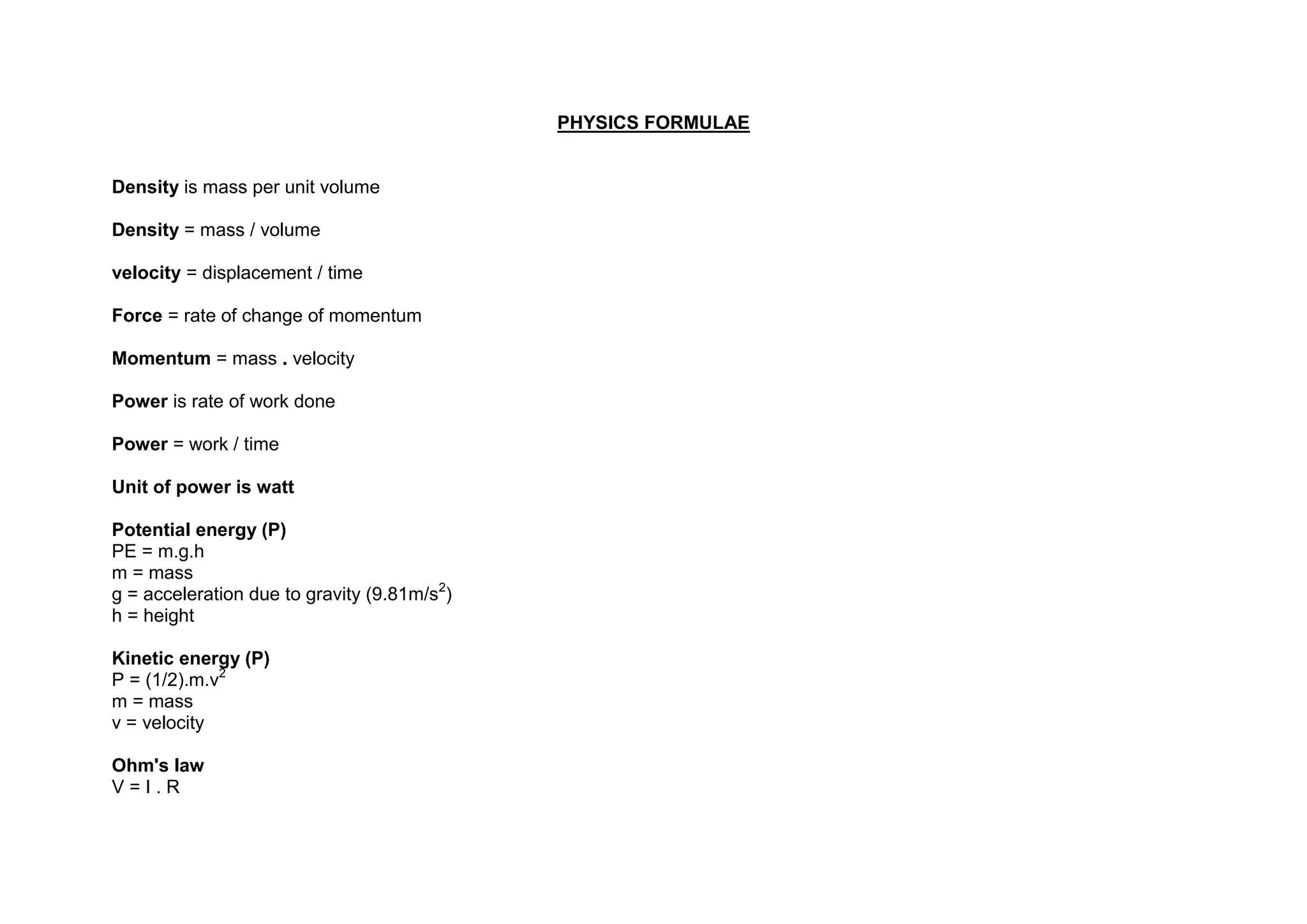
PHYSICS FORMULAE


Density is mass per unit volume

Density = mass / volume

velocity = displacement / time

Force = rate of change of momentum

Momentum = mass . velocity

Power is rate of work done

Power = work / time

Unit of power is watt

Potential energy (P)
PE = m.g.h
m = mass
g = acceleration due to gravity (9.81m/s2)
h = height

Kinetic energy (P)
P = (1/2).m.v2
m = mass
v = velocity

Ohm's law
V=I.R
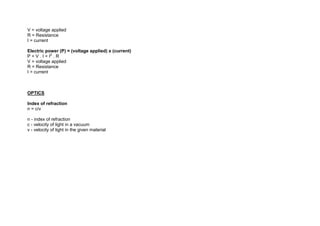
V = voltage applied
R = Resistance
I = current

Electric power (P) = (voltage applied) x (current)
P = V . I = I2 . R
V = voltage applied
R = Resistance
I = current


OPTICS

Index of refraction
n = c/v

n - index of refraction
c - velocity of light in a vacuum
v - velocity of light in the given material
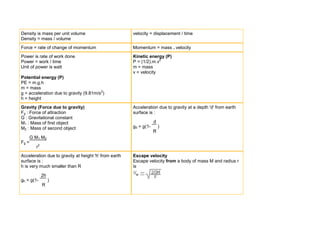
Density is mass per unit volume                        velocity = displacement / time
Density = mass / volume
Force = rate of change of momentum                     Momentum = mass . velocity
Power is rate of work done                             Kinetic energy (P)
Power = work / time                                    P = (1/2).m.v2
Unit of power is watt                                  m = mass
                                                       v = velocity
Potential energy (P)
PE = m.g.h
m = mass
g = acceleration due to gravity (9.81m/s2)
h = height
Gravity (Force due to gravity)                         Acceleration due to gravity at a depth 'd' from earth
Fg : Force of attraction                               surface is :
G : Gravitational constant
M1 : Mass of first object                                          d
M2 : Mass of second object                             gd = g(1-       )
                                                                   R
       G M1 M2
Fg =
         r2
Acceleration due to gravity at height 'h' from earth   Escape velocity
surface is :                                           Escape velocity from a body of mass M and radius r
h is very much smaller than R                          is

              2h
gh = g(1-          )
              R
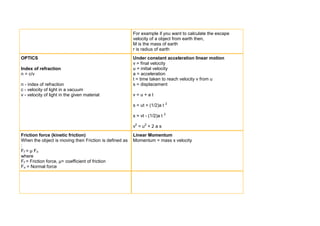
For example if you want to calculate the escape
                                                        velocity of a object from earth then,
                                                        M is the mass of earth
                                                        r is radius of earth
OPTICS                                                  Under constant acceleration linear motion
                                                        v = final velocity
Index of refraction                                     u = initial velocity
n = c/v                                                 a = acceleration
                                                        t = time taken to reach velocity v from u
n - index of refraction                                 s = displacement
c - velocity of light in a vacuum
v - velocity of light in the given material             v=u+at

                                                        s = ut + (1/2)a t 2

                                                        s = vt - (1/2)a t 2

                                                        v2 = u2 + 2 a s
Friction force (kinetic friction)                       Linear Momentum
When the object is moving then Friction is defined as   Momentum = mass x velocity
:
Ff = μ Fn
where
Ff = Friction force, μ= coefficient of friction
Fn = Normal force
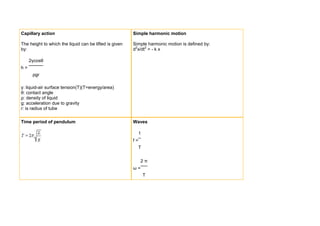
Capillary action                                        Simple harmonic motion

The height to which the liquid can be lifted is given   Simple harmonic motion is defined by:
by:                                                     d2x/dt2 = - k x

     2γcosθ
h=
      ρgr

γ: liquid-air surface tension(T)(T=energy/area)
θ: contact angle
ρ: density of liquid
g: acceleration due to gravity
r: is radius of tube

Time period of pendulum                                 Waves

                                                             1
                                                        f=
                                                          T


                                                             2π
                                                        ω=
                                                                 T
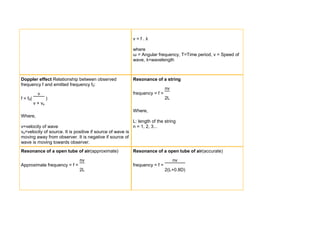
v=f.λ

                                                             where
                                                             ω = Angular frequency, T=Time period, v = Speed of
                                                             wave, λ=wavelength


Doppler effect Relationship between observed                 Resonance of a string
frequency f and emitted frequency f0:
                                                                               nv
            v                                                frequency = f =
f = f0(            )                                                           2L
          v + vs
                                                             Where,
Where,
                                                             L: length of the string
v=velocity of wave                                           n = 1, 2, 3...
vs=velocity of source. It is positive if source of wave is
moving away from observer. It is negative if source of
wave is moving towards observer.
Resonance of a open tube of air(approximate)                 Resonance of a open tube of air(accurate)

                               nv                                                   nv
Approximate frequency = f =                                  frequency = f =
                               2L                                              2(L+0.8D)
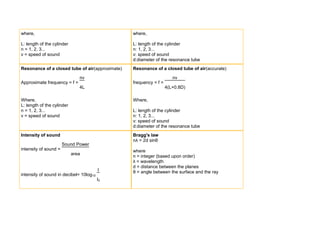
where,                                           where,

L: length of the cylinder                        L: length of the cylinder
n = 1, 2, 3...                                   n: 1, 2, 3...
v = speed of sound                               v: speed of sound
                                                 d:diameter of the resonance tube
Resonance of a closed tube of air(approximate)   Resonance of a closed tube of air(accurate)

                               nv                                     nv
Approximate frequency = f =                      frequency = f =
                               4L                                  4(L+0.8D)

Where,                                           Where,
L: length of the cylinder
n = 1, 2, 3...                                   L: length of the cylinder
v = speed of sound                               n: 1, 2, 3...
                                                 v: speed of sound
                                                 d:diameter of the resonance tube
Intensity of sound                               Bragg's law
                                                 nλ = 2d sinθ
                       Sound Power
intensity of sound =                             where
                            area
                                                 n = integer (based upon order)
                                                 λ = wavelength
                                                 d = distance between the planes
                                         I       θ = angle between the surface and the ray
intensity of sound in decibel= 10log10
                                         I0
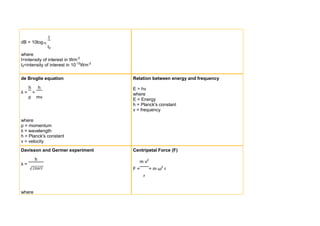
I
dB = 10log10
                  I0
where
I=intensity of interest in Wm-2
I0=intensity of interest in 10-12Wm-2

de Broglie equation                     Relation between energy and frequency

     h       h                          E = hν
λ=       =                              where
     p       mv                         E = Energy
                                        h = Planck's constant
                                        ν = frequency

where
p = momentum
λ = wavelength
h = Planck's constant
v = velocity
Davisson and Germer experiment          Centripetal Force (F)

         h                                 m v2
λ=
                                        F=        = m ω2 r
                                             r


where
e = charge of electron
m = mass of electron
V = potential difference between the plates thru which
the electron pass
λ = wavelength


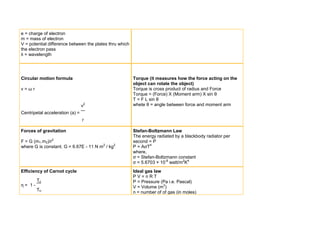
Circular motion formula                                  Torque (it measures how the force acting on the
                                                         object can rotate the object)
v=ωr                                                     Torque is cross product of radius and Force
                                                         Torque = (Force) X (Moment arm) X sin θ
                                                         T = F L sin θ
                                 v2                      whete θ = angle between force and moment arm
Centripetal acceleration (a) =
                                 r

Forces of gravitation                                    Stefan-Boltzmann Law
                                                         The energy radiated by a blackbody radiator per
F = G (m1.m2)/r2                                         second = P
where G is constant. G = 6.67E - 11 N m2 / kg2           P = AσT4
                                                         where,
                                                         σ = Stefan-Boltzmann constant
                                                         σ = 5.6703 × 10⁻⁸ watt/m2K4
Efficiency of Carnot cycle                               Ideal gas law
                                                         PV=nRT
        Tc                                               P = Pressure (Pa i.e. Pascal)
η= 1-                                                    V = Volume (m3)
        Th
                                                         n = number of of gas (in moles)
R = gas constant ( 8.314472 .m3.Pa.K-1mol-1] )
                                                    T = Temperature ( in Kelvin [K])


Boyles law (for ideal gas)                          Charles law (for ideal gas)
P1 V1 = P2V2
T (temperature is constant)                         V1 V2
                                                      =
                                                    T1 T2

                                                    P (pressure is constant)
Translational kinetic energy K per gas molecule     Internal energy of monatomic gas
(average molecular kinetic energy:)
                                                       3
   3                                                K= nRT
K= kT                                                  2
   2
                                                    n = number of of gas (in moles)
                   -23
k = 1.38066 x 10         J/K Boltzmann’s constant   R = gas constant ( 8.314472 .m3.Pa.K-1mol-1] )
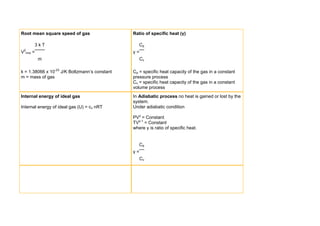
Root mean square speed of gas                  Ratio of specific heat (γ)

        3kT                                       Cp
V2rms   =                                      γ=
            m                                       Cv

k = 1.38066 x 10⁻²³ J/K Boltzmann’s constant   Cp = specific heat capacity of the gas in a constant
m = mass of gas                                pressure process
                                               Cv = specific heat capacity of the gas in a constant
                                               volume process
Internal energy of ideal gas                   In Adiabatic process no heat is gained or lost by the
                                               system.
Internal energy of ideal gas (U) = cv nRT      Under adiabatic condition

                                               PVγ = Constant
                                               TVγ-1 = Constant
                                               where γ is ratio of specific heat.


                                                  Cp
                                               γ=
                                                    Cv
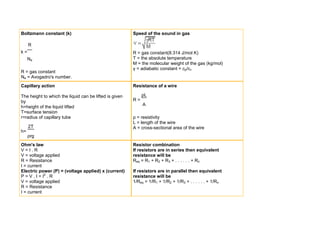
Boltzmann constant (k)                                  Speed of the sound in gas

     R
k=                                                      R = gas constant(8.314 J/mol K)
     Na                                                 T = the absolute temperature
                                                        M = the molecular weight of the gas (kg/mol)
                                                        γ = adiabatic constant = cp/cv
R = gas constant
Na = Avogadro's number.
Capillary action                                        Resistance of a wire

The height to which the liquid can be lifted is given        ρL
by                                                      R=
                                                             A
h=height of the liquid lifted
T=surface tension
r=radius of capillary tube                              ρ = resistivity
                                                        L = length of the wire
     2T                                                 A = cross-sectional area of the wire
h=
     ρrg
Ohm's law                                               Resistor combination
V=I.R                                                   If resistors are in series then equivalent
V = voltage applied                                     resistance will be
R = Resistance                                          Req = R1 + R2 + R3 + . . . . . . + Rn
I = current
Electric power (P) = (voltage applied) x (current)      If resistors are in parallel then equivalent
P = V . I = I2 . R                                      resistance will be
V = voltage applied                                     1/Req = 1/R1 + 1/R2 + 1/R3 + . . . . . . + 1/Rn
R = Resistance
I = current
In AC circuit average power is :                        In AC circuit Instantaneous power is :
Pavg = VrmsIrms cosυ                                    PInstantaneous = VmIm sinωt sin(ωt-υ)
where,                                                  where,
Pavg = Average Power                                    PInstantaneous = Instantaneous Power
Vrms = rms value of voltage                             Vm = Instantaneous voltage
Irms = rms value of current                             Im = Instantaneous current
Capacitors                                              Total capacitance (Ceq) for PARALLEL Capacitor
Q = C.V                                                 Combinations:
where                                                   Ceq = C1 + C2 + C3 + . . . . . . + Cn
Q = charge on the capacitor                             Total capacitance (Ceq) for SERIES Capacitor
C = capacitance of the capacitor                        Combinations:
V = voltage applied to the capacitor                    1/Ceq = 1/C1 + 1/C2 + 1/C3 + . . . . . . + 1/Cn
Parallel Plate Capacitor                                Cylindrical Capacitor

           A                                                           L
C = κ ε0                                                C = 2 π κ ε0
           d                                                        ln (b/a)
where                                                   where
C = [Farad (F)]                                         C = [Farad (F)]
κ = dielectric constant                                 κ = dielectric constant
A = Area of plate                                       L = length of cylinder [m]
d = distance between the plate                          a = outer radius of conductor [m]
ε0 = permittivity of free space (8.85 X 10⁻¹²C2/N m2)   b = inner radius of conductor [m]
                                                        ε0 = permittivity of free space (8.85 X 10⁻¹² C2/N m2)
Spherical Capacitor                                     Magnetic force acting on a charge q moving with
                                                        velocity v
               ab                                       F = q v B sin θ
                                                        where
C = 4 π κ ε0
                                                        F = force acting on charge q (Newton)
            b-a                                         q = charge (C)
where                                                   v = velocity (m/sec2)
C = [Farad (F)]                                         B = magnetic field
κ = dielectric constant                                 θ = angle between V (velocity) and B (magnetic field)
a = outer radius of conductor [m]
b = inner radius of conductor [m]
ε0 = permittivity of free space (8.85 X 10⁻¹²C2/N m2)


Force on a wire in magnetic field (B)                   In an RC circuit (Resistor-Capacitor), the time
F = B I l sin θ                                         constant (in seconds) is:
where                                                   τ = RC
F = force acting on wire (Newton)                       R = Resistance in Ω
I = Current (Ampere)                                    C = Capacitance in farads.
l = length of wire (m)
B = magnetic field
θ = angle between I (current) and B (magnetic field)
In an RL circuit (Resistor-inductor ), the time constant Self inductance of a solenoid = L = μn2LA
(in seconds) is:                                         n = number of turns per unit length
τ = L/R                                                  L = length of the solenoid.
R = Resistance in Ω
C = Inductance in henries
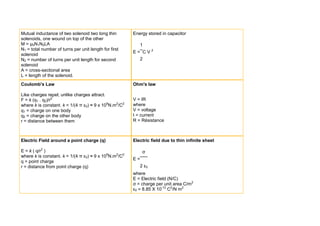
Mutual inductance of two solenoid two long thin        Energy stored in capacitor
solenoids, one wound on top of the other
M = μ0N1N2LA                                              1
N1 = total number of turns per unit length for first
                                                       E= CV2
solenoid
N2 = number of turns per unit length for second           2
solenoid
A = cross-sectional area
L = length of the solenoid.
Coulomb's Law                                          Ohm's law

Like charges repel, unlike charges attract.
F = k (q1 . q2)/r2                                     V = IR
where k is constant. k = 1/(4 π ε0) ≈ 9 x 10⁹N.m2/C2   where
q1 = charge on one body                                V = voltage
q2 = charge on the other body                          I = current
r = distance between them                              R = Résistance


Electric Field around a point charge (q)               Electric field due to thin infinite sheet

E = k ( q/r2 )                                              σ
where k is constant. k = 1/(4 π ε0) ≈ 9 x 10⁹N.m2/C2
                                                       E=
q = point charge
r = distance from point charge (q)                        2 ε0
                                                       where
                                                       E = Electric field (N/C)
                                                       σ = charge per unit area C/m2
                                                       ε0 = 8.85 X 10⁻¹² C2/N m2
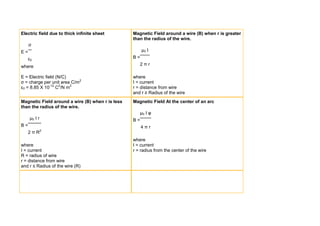
Electric field due to thick infinite sheet        Magnetic Field around a wire (B) when r is greater
                                                  than the radius of the wire.
     σ
E=                                                     μ0 I
   ε0                                             B=

where                                                2πr

E = Electric field (N/C)                          where
σ = charge per unit area C/m2                     I = current
ε0 = 8.85 X 10⁻¹² C2/N m2                         r = distance from wire
                                                  and r ≥ Radius of the wire
Magnetic Field around a wire (B) when r is less   Magnetic Field At the center of an arc
than the radius of the wire.
                                                     μ0 I υ
     μ0 I r                                       B=
B=                                                     4πr
              2
   2πR
                                                  where
where                                             I = current
I = current                                       r = radius from the center of the wire
R = radius of wire
r = distance from wire
and r ≤ Radius of the wire (R)
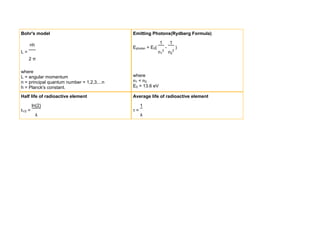
Bohr's model                                Emitting Photons(Rydberg Formula)

                                                            1       1
     nh
                                            Ephoton = E0(       -       )
L=                                                          n12 n22
     2π

where
L = angular momentum                        where
n = principal quantum number = 1,2,3,...n   n1 < n 2
h = Planck's constant.                      E0 = 13.6 eV

Half life of radioactive element            Average life of radioactive element

         ln(2)                                   1
t1/2 =                                      τ=
          λ                                      λ

Physics formulae

  • 1.
    PHYSICS FORMULAE Density ismass per unit volume Density = mass / volume velocity = displacement / time Force = rate of change of momentum Momentum = mass . velocity Power is rate of work done Power = work / time Unit of power is watt Potential energy (P) PE = m.g.h m = mass g = acceleration due to gravity (9.81m/s2) h = height Kinetic energy (P) P = (1/2).m.v2 m = mass v = velocity Ohm's law V=I.R
  • 2.
    V = voltageapplied R = Resistance I = current Electric power (P) = (voltage applied) x (current) P = V . I = I2 . R V = voltage applied R = Resistance I = current OPTICS Index of refraction n = c/v n - index of refraction c - velocity of light in a vacuum v - velocity of light in the given material
  • 3.
    Density is massper unit volume velocity = displacement / time Density = mass / volume Force = rate of change of momentum Momentum = mass . velocity Power is rate of work done Kinetic energy (P) Power = work / time P = (1/2).m.v2 Unit of power is watt m = mass v = velocity Potential energy (P) PE = m.g.h m = mass g = acceleration due to gravity (9.81m/s2) h = height Gravity (Force due to gravity) Acceleration due to gravity at a depth 'd' from earth Fg : Force of attraction surface is : G : Gravitational constant M1 : Mass of first object d M2 : Mass of second object gd = g(1- ) R G M1 M2 Fg = r2 Acceleration due to gravity at height 'h' from earth Escape velocity surface is : Escape velocity from a body of mass M and radius r h is very much smaller than R is 2h gh = g(1- ) R
  • 4.
    For example ifyou want to calculate the escape velocity of a object from earth then, M is the mass of earth r is radius of earth OPTICS Under constant acceleration linear motion v = final velocity Index of refraction u = initial velocity n = c/v a = acceleration t = time taken to reach velocity v from u n - index of refraction s = displacement c - velocity of light in a vacuum v - velocity of light in the given material v=u+at s = ut + (1/2)a t 2 s = vt - (1/2)a t 2 v2 = u2 + 2 a s Friction force (kinetic friction) Linear Momentum When the object is moving then Friction is defined as Momentum = mass x velocity : Ff = μ Fn where Ff = Friction force, μ= coefficient of friction Fn = Normal force
  • 5.
    Capillary action Simple harmonic motion The height to which the liquid can be lifted is given Simple harmonic motion is defined by: by: d2x/dt2 = - k x 2γcosθ h= ρgr γ: liquid-air surface tension(T)(T=energy/area) θ: contact angle ρ: density of liquid g: acceleration due to gravity r: is radius of tube Time period of pendulum Waves 1 f= T 2π ω= T
  • 6.
    v=f.λ where ω = Angular frequency, T=Time period, v = Speed of wave, λ=wavelength Doppler effect Relationship between observed Resonance of a string frequency f and emitted frequency f0: nv v frequency = f = f = f0( ) 2L v + vs Where, Where, L: length of the string v=velocity of wave n = 1, 2, 3... vs=velocity of source. It is positive if source of wave is moving away from observer. It is negative if source of wave is moving towards observer. Resonance of a open tube of air(approximate) Resonance of a open tube of air(accurate) nv nv Approximate frequency = f = frequency = f = 2L 2(L+0.8D)
  • 7.
    where, where, L: length of the cylinder L: length of the cylinder n = 1, 2, 3... n: 1, 2, 3... v = speed of sound v: speed of sound d:diameter of the resonance tube Resonance of a closed tube of air(approximate) Resonance of a closed tube of air(accurate) nv nv Approximate frequency = f = frequency = f = 4L 4(L+0.8D) Where, Where, L: length of the cylinder n = 1, 2, 3... L: length of the cylinder v = speed of sound n: 1, 2, 3... v: speed of sound d:diameter of the resonance tube Intensity of sound Bragg's law nλ = 2d sinθ Sound Power intensity of sound = where area n = integer (based upon order) λ = wavelength d = distance between the planes I θ = angle between the surface and the ray intensity of sound in decibel= 10log10 I0
  • 8.
    I dB = 10log10 I0 where I=intensity of interest in Wm-2 I0=intensity of interest in 10-12Wm-2 de Broglie equation Relation between energy and frequency h h E = hν λ= = where p mv E = Energy h = Planck's constant ν = frequency where p = momentum λ = wavelength h = Planck's constant v = velocity Davisson and Germer experiment Centripetal Force (F) h m v2 λ= F= = m ω2 r r where
  • 9.
    e = chargeof electron m = mass of electron V = potential difference between the plates thru which the electron pass λ = wavelength Circular motion formula Torque (it measures how the force acting on the object can rotate the object) v=ωr Torque is cross product of radius and Force Torque = (Force) X (Moment arm) X sin θ T = F L sin θ v2 whete θ = angle between force and moment arm Centripetal acceleration (a) = r Forces of gravitation Stefan-Boltzmann Law The energy radiated by a blackbody radiator per F = G (m1.m2)/r2 second = P where G is constant. G = 6.67E - 11 N m2 / kg2 P = AσT4 where, σ = Stefan-Boltzmann constant σ = 5.6703 × 10⁻⁸ watt/m2K4 Efficiency of Carnot cycle Ideal gas law PV=nRT Tc P = Pressure (Pa i.e. Pascal) η= 1- V = Volume (m3) Th n = number of of gas (in moles)
  • 10.
    R = gasconstant ( 8.314472 .m3.Pa.K-1mol-1] ) T = Temperature ( in Kelvin [K]) Boyles law (for ideal gas) Charles law (for ideal gas) P1 V1 = P2V2 T (temperature is constant) V1 V2 = T1 T2 P (pressure is constant) Translational kinetic energy K per gas molecule Internal energy of monatomic gas (average molecular kinetic energy:) 3 3 K= nRT K= kT 2 2 n = number of of gas (in moles) -23 k = 1.38066 x 10 J/K Boltzmann’s constant R = gas constant ( 8.314472 .m3.Pa.K-1mol-1] )
  • 11.
    Root mean squarespeed of gas Ratio of specific heat (γ) 3kT Cp V2rms = γ= m Cv k = 1.38066 x 10⁻²³ J/K Boltzmann’s constant Cp = specific heat capacity of the gas in a constant m = mass of gas pressure process Cv = specific heat capacity of the gas in a constant volume process Internal energy of ideal gas In Adiabatic process no heat is gained or lost by the system. Internal energy of ideal gas (U) = cv nRT Under adiabatic condition PVγ = Constant TVγ-1 = Constant where γ is ratio of specific heat. Cp γ= Cv
  • 12.
    Boltzmann constant (k) Speed of the sound in gas R k= R = gas constant(8.314 J/mol K) Na T = the absolute temperature M = the molecular weight of the gas (kg/mol) γ = adiabatic constant = cp/cv R = gas constant Na = Avogadro's number. Capillary action Resistance of a wire The height to which the liquid can be lifted is given ρL by R= A h=height of the liquid lifted T=surface tension r=radius of capillary tube ρ = resistivity L = length of the wire 2T A = cross-sectional area of the wire h= ρrg Ohm's law Resistor combination V=I.R If resistors are in series then equivalent V = voltage applied resistance will be R = Resistance Req = R1 + R2 + R3 + . . . . . . + Rn I = current Electric power (P) = (voltage applied) x (current) If resistors are in parallel then equivalent P = V . I = I2 . R resistance will be V = voltage applied 1/Req = 1/R1 + 1/R2 + 1/R3 + . . . . . . + 1/Rn R = Resistance I = current
  • 13.
    In AC circuitaverage power is : In AC circuit Instantaneous power is : Pavg = VrmsIrms cosυ PInstantaneous = VmIm sinωt sin(ωt-υ) where, where, Pavg = Average Power PInstantaneous = Instantaneous Power Vrms = rms value of voltage Vm = Instantaneous voltage Irms = rms value of current Im = Instantaneous current Capacitors Total capacitance (Ceq) for PARALLEL Capacitor Q = C.V Combinations: where Ceq = C1 + C2 + C3 + . . . . . . + Cn Q = charge on the capacitor Total capacitance (Ceq) for SERIES Capacitor C = capacitance of the capacitor Combinations: V = voltage applied to the capacitor 1/Ceq = 1/C1 + 1/C2 + 1/C3 + . . . . . . + 1/Cn Parallel Plate Capacitor Cylindrical Capacitor A L C = κ ε0 C = 2 π κ ε0 d ln (b/a) where where C = [Farad (F)] C = [Farad (F)] κ = dielectric constant κ = dielectric constant A = Area of plate L = length of cylinder [m] d = distance between the plate a = outer radius of conductor [m] ε0 = permittivity of free space (8.85 X 10⁻¹²C2/N m2) b = inner radius of conductor [m] ε0 = permittivity of free space (8.85 X 10⁻¹² C2/N m2)
  • 14.
    Spherical Capacitor Magnetic force acting on a charge q moving with velocity v ab F = q v B sin θ where C = 4 π κ ε0 F = force acting on charge q (Newton) b-a q = charge (C) where v = velocity (m/sec2) C = [Farad (F)] B = magnetic field κ = dielectric constant θ = angle between V (velocity) and B (magnetic field) a = outer radius of conductor [m] b = inner radius of conductor [m] ε0 = permittivity of free space (8.85 X 10⁻¹²C2/N m2) Force on a wire in magnetic field (B) In an RC circuit (Resistor-Capacitor), the time F = B I l sin θ constant (in seconds) is: where τ = RC F = force acting on wire (Newton) R = Resistance in Ω I = Current (Ampere) C = Capacitance in farads. l = length of wire (m) B = magnetic field θ = angle between I (current) and B (magnetic field) In an RL circuit (Resistor-inductor ), the time constant Self inductance of a solenoid = L = μn2LA (in seconds) is: n = number of turns per unit length τ = L/R L = length of the solenoid. R = Resistance in Ω C = Inductance in henries
  • 15.
    Mutual inductance oftwo solenoid two long thin Energy stored in capacitor solenoids, one wound on top of the other M = μ0N1N2LA 1 N1 = total number of turns per unit length for first E= CV2 solenoid N2 = number of turns per unit length for second 2 solenoid A = cross-sectional area L = length of the solenoid. Coulomb's Law Ohm's law Like charges repel, unlike charges attract. F = k (q1 . q2)/r2 V = IR where k is constant. k = 1/(4 π ε0) ≈ 9 x 10⁹N.m2/C2 where q1 = charge on one body V = voltage q2 = charge on the other body I = current r = distance between them R = Résistance Electric Field around a point charge (q) Electric field due to thin infinite sheet E = k ( q/r2 ) σ where k is constant. k = 1/(4 π ε0) ≈ 9 x 10⁹N.m2/C2 E= q = point charge r = distance from point charge (q) 2 ε0 where E = Electric field (N/C) σ = charge per unit area C/m2 ε0 = 8.85 X 10⁻¹² C2/N m2
  • 16.
    Electric field dueto thick infinite sheet Magnetic Field around a wire (B) when r is greater than the radius of the wire. σ E= μ0 I ε0 B= where 2πr E = Electric field (N/C) where σ = charge per unit area C/m2 I = current ε0 = 8.85 X 10⁻¹² C2/N m2 r = distance from wire and r ≥ Radius of the wire Magnetic Field around a wire (B) when r is less Magnetic Field At the center of an arc than the radius of the wire. μ0 I υ μ0 I r B= B= 4πr 2 2πR where where I = current I = current r = radius from the center of the wire R = radius of wire r = distance from wire and r ≤ Radius of the wire (R)
  • 17.
    Bohr's model Emitting Photons(Rydberg Formula) 1 1 nh Ephoton = E0( - ) L= n12 n22 2π where L = angular momentum where n = principal quantum number = 1,2,3,...n n1 < n 2 h = Planck's constant. E0 = 13.6 eV Half life of radioactive element Average life of radioactive element ln(2) 1 t1/2 = τ= λ λ