SLIT LAMP 
(METHODS OF ILLUMINATION) 
By: Maclester
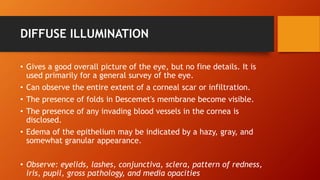
DIFFUSE ILLUMINATION 
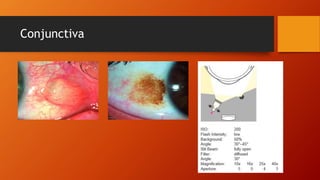
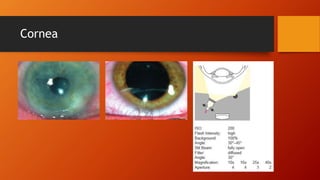
• Gives a good overall picture of the eye, but no fine details. It is 
used primarily for a general survey of the eye. 
• Can observe the entire extent of a corneal scar or infiltration. 
• The presence of folds in Descemet's membrane become visible. 
• The presence of any invading blood vessels in the cornea is 
disclosed. 
• Edema of the epithelium may be indicated by a hazy, gray, and 
somewhat granular appearance. 
• Observe: eyelids, lashes, conjunctiva, sclera, pattern of redness, 
iris, pupil, gross pathology, and media opacities
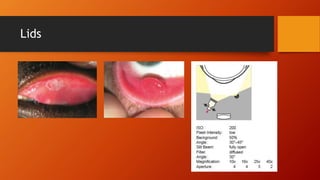
Lids
Conjunctiva
Cornea
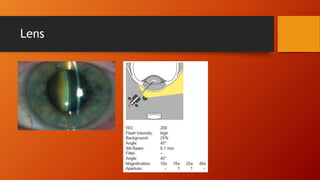
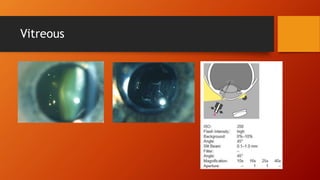
OPTIC SECTION 
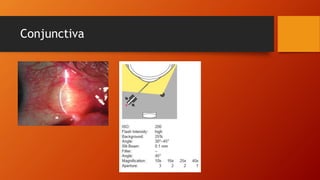
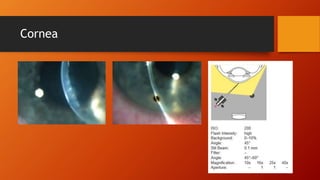
• To discover thickening, thinning, and distortions in the corneal 
contour. 
• To determine the depth of foreign bodies or opacities in the 
corneal substance. One way of describing depth is as a percentage 
of the total corneal thickness. 
• To see a wide slice of stroma. (The angle between the microscope 
and illuminating arm can be increased.) 
• To perceive the flare or relucency in normal aqueous. The 
luminous beam is directed so that the upper portion of the beam 
enters the lower part of the pupil. This permits dark areas 
immediately above to serve as a dark contrasting background. The 
presence of appreciable flare is indicative of a pathological state.
Conjunctiva
Cornea
Lens
Vitreous
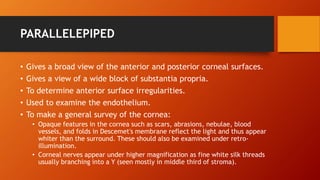
PARALLELEPIPED 
• Gives a broad view of the anterior and posterior corneal surfaces. 
• Gives a view of a wide block of substantia propria. 
• To determine anterior surface irregularities. 
• Used to examine the endothelium. 
• To make a general survey of the cornea: 
• Opaque features in the cornea such as scars, abrasions, nebulae, blood 
vessels, and folds in Descemet's membrane reflect the light and thus appear 
whiter than the surround. These should also be examined under retro-illumination. 
• Corneal nerves appear under higher magnification as fine white silk threads 
usually branching into a Y (seen mostly in middle third of stroma).
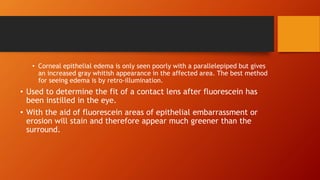
• Corneal epithelial edema is only seen poorly with a parallelepiped but gives 
an increased gray whitish appearance in the affected area. The best method 
for seeing edema is by retro-illumination. 
• Used to determine the fit of a contact lens after fluorescein has 
been instilled in the eye. 
• With the aid of fluorescein areas of epithelial embarrassment or 
erosion will stain and therefore appear much greener than the 
surround.
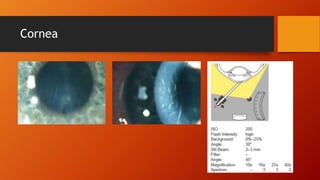
Cornea
RETRO-ILLUMINATION 
• Retroillumination is used to evaluate the optical qualities of a 
structure. 
• The light strikes the object of interest from a point behind the 
object and is then reflected back to the observer
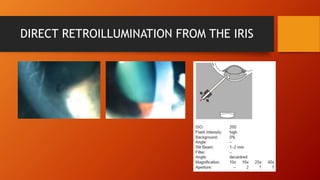
DIRECT RETROILLUMINATION FROM THE IRIS
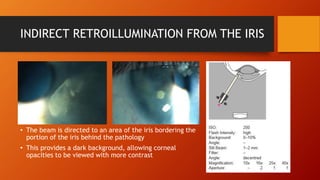
INDIRECT RETROILLUMINATION FROM THE IRIS 
• The beam is directed to an area of the iris bordering the 
portion of the iris behind the pathology 
• This provides a dark background, allowing corneal 
opacities to be viewed with more contrast
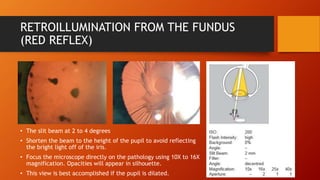
RETROILLUMINATION FROM THE FUNDUS 
(RED REFLEX) 
• The slit beam at 2 to 4 degrees 
• Shorten the beam to the height of the pupil to avoid reflecting 
the bright light off of the iris. 
• Focus the microscope directly on the pathology using 10X to 16X 
magnification. Opacities will appear in silhouette. 
• This view is best accomplished if the pupil is dilated.
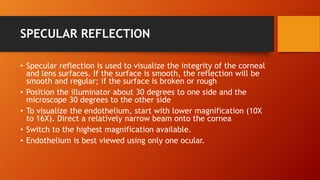
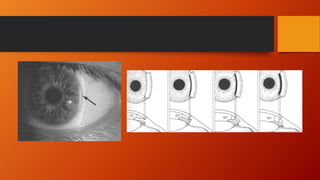
SPECULAR REFLECTION 
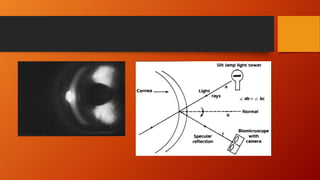
• Specular reflection is used to visualize the integrity of the corneal 
and lens surfaces. If the surface is smooth, the reflection will be 
smooth and regular; if the surface is broken or rough 
• Position the illuminator about 30 degrees to one side and the 
microscope 30 degrees to the other side 
• To visualize the endothelium, start with lower magnification (10X 
to 16X). Direct a relatively narrow beam onto the cornea 
• Switch to the highest magnification available. 
• Endothelium is best viewed using only one ocular.
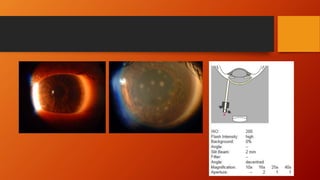
SCLEROTIC SCATTER 
• A tall, wide beam is directed onto the limbal area. 
• When the light is properly aligned with regard to the eye, a ring 
of light will appear around the cornea. 
• The light is absorbed and scattered through the cornea 
highlighting pathology. 
• Use 10X magnification, with the microscope directed straight 
ahead 
• Observe: general pattern of corneal opacities
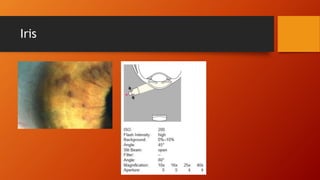
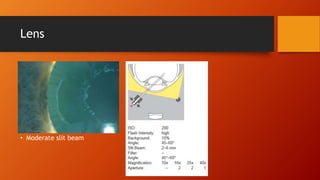
TANGENTIAL ILLUMINATION 
• This technique is used to observe surface texture. 
• Medium-wide beam of moderate height 
• Swing the slit lamp arm to the side at an oblique angle 
• Magnifications of 10X, 16X, or 25X are used 
• Observe: anterior and posterior cornea, iris, anterior lens 
(specially useful for viewing pseudoexfoliation)
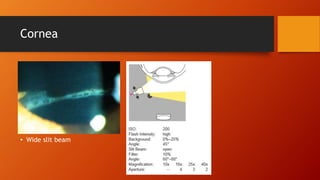
Cornea 
• Wide slit beam
Iris
Lens 
• Moderate slit beam
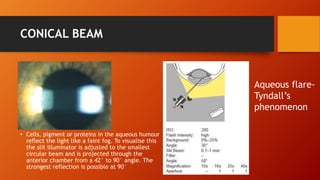
CONICAL BEAM 
• Cells, pigment or proteins in the aqueous humour 
reflect the light like a faint fog. To visualise this 
the slit illuminator is adjusted to the smallest 
circular beam and is projected through the 
anterior chamber from a 42° to 90° angle. The 
strongest reflection is possible at 90° 
Aqueous flare- 
Tyndall’s 
phenomenon
OSCILLATORY ILLUMINATION 
• A beam of light is rocked back and forth by moving the 
illuminating arm or rotating the prism or mirror. Occasional 
aqueous floaters are easier to observe. Can also be used to 
determine the extent of opacities in the crystalline lens.
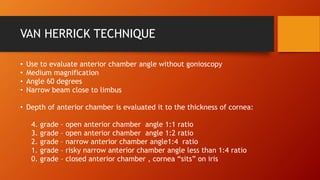
VAN HERRICK TECHNIQUE 
• Use to evaluate anterior chamber angle without gonioscopy 
• Medium magnification 
• Angle 60 degrees 
• Narrow beam close to limbus 
• Depth of anterior chamber is evaluated it to the thickness of cornea: 
4. grade – open anterior chamber angle 1:1 ratio 
3. grade – open anterior chamber angle 1:2 ratio 
2. grade – narrow anterior chamber angle1:4 ratio 
1. grade – risky narrow anterior chamber angle less than 1:4 ratio 
0. grade – closed anterior chamber , cornea “sits” on iris
Reference 
• Haag-streit slit lamp imaging guide 
• http://en.wikipedia.org/wiki/Slit_lamp 
• http://optometry.berkeley.edu/class/opt260a/labs_pp/labslitlam 
p.htm 
• http://cal.vet.upenn.edu/projects/ophthalmology/ophthalmo_fil 
es/Tools/BIOMICROSCOPY.pdf
•Thank you

Slit lamp (methods of illumination)

  • 1.
    SLIT LAMP (METHODSOF ILLUMINATION) By: Maclester
  • 2.
    DIFFUSE ILLUMINATION •Gives a good overall picture of the eye, but no fine details. It is used primarily for a general survey of the eye. • Can observe the entire extent of a corneal scar or infiltration. • The presence of folds in Descemet's membrane become visible. • The presence of any invading blood vessels in the cornea is disclosed. • Edema of the epithelium may be indicated by a hazy, gray, and somewhat granular appearance. • Observe: eyelids, lashes, conjunctiva, sclera, pattern of redness, iris, pupil, gross pathology, and media opacities
  • 3.
  • 4.
  • 5.
  • 6.
    OPTIC SECTION •To discover thickening, thinning, and distortions in the corneal contour. • To determine the depth of foreign bodies or opacities in the corneal substance. One way of describing depth is as a percentage of the total corneal thickness. • To see a wide slice of stroma. (The angle between the microscope and illuminating arm can be increased.) • To perceive the flare or relucency in normal aqueous. The luminous beam is directed so that the upper portion of the beam enters the lower part of the pupil. This permits dark areas immediately above to serve as a dark contrasting background. The presence of appreciable flare is indicative of a pathological state.
  • 7.
  • 8.
  • 9.
  • 10.
  • 11.
    PARALLELEPIPED • Givesa broad view of the anterior and posterior corneal surfaces. • Gives a view of a wide block of substantia propria. • To determine anterior surface irregularities. • Used to examine the endothelium. • To make a general survey of the cornea: • Opaque features in the cornea such as scars, abrasions, nebulae, blood vessels, and folds in Descemet's membrane reflect the light and thus appear whiter than the surround. These should also be examined under retro-illumination. • Corneal nerves appear under higher magnification as fine white silk threads usually branching into a Y (seen mostly in middle third of stroma).
  • 12.
    • Corneal epithelialedema is only seen poorly with a parallelepiped but gives an increased gray whitish appearance in the affected area. The best method for seeing edema is by retro-illumination. • Used to determine the fit of a contact lens after fluorescein has been instilled in the eye. • With the aid of fluorescein areas of epithelial embarrassment or erosion will stain and therefore appear much greener than the surround.
  • 13.
  • 14.
    RETRO-ILLUMINATION • Retroilluminationis used to evaluate the optical qualities of a structure. • The light strikes the object of interest from a point behind the object and is then reflected back to the observer
  • 15.
  • 16.
    INDIRECT RETROILLUMINATION FROMTHE IRIS • The beam is directed to an area of the iris bordering the portion of the iris behind the pathology • This provides a dark background, allowing corneal opacities to be viewed with more contrast
  • 17.
    RETROILLUMINATION FROM THEFUNDUS (RED REFLEX) • The slit beam at 2 to 4 degrees • Shorten the beam to the height of the pupil to avoid reflecting the bright light off of the iris. • Focus the microscope directly on the pathology using 10X to 16X magnification. Opacities will appear in silhouette. • This view is best accomplished if the pupil is dilated.
  • 18.
    SPECULAR REFLECTION •Specular reflection is used to visualize the integrity of the corneal and lens surfaces. If the surface is smooth, the reflection will be smooth and regular; if the surface is broken or rough • Position the illuminator about 30 degrees to one side and the microscope 30 degrees to the other side • To visualize the endothelium, start with lower magnification (10X to 16X). Direct a relatively narrow beam onto the cornea • Switch to the highest magnification available. • Endothelium is best viewed using only one ocular.
  • 20.
    SCLEROTIC SCATTER •A tall, wide beam is directed onto the limbal area. • When the light is properly aligned with regard to the eye, a ring of light will appear around the cornea. • The light is absorbed and scattered through the cornea highlighting pathology. • Use 10X magnification, with the microscope directed straight ahead • Observe: general pattern of corneal opacities
  • 22.
    TANGENTIAL ILLUMINATION •This technique is used to observe surface texture. • Medium-wide beam of moderate height • Swing the slit lamp arm to the side at an oblique angle • Magnifications of 10X, 16X, or 25X are used • Observe: anterior and posterior cornea, iris, anterior lens (specially useful for viewing pseudoexfoliation)
  • 23.
    Cornea • Wideslit beam
  • 24.
  • 25.
  • 26.
    CONICAL BEAM •Cells, pigment or proteins in the aqueous humour reflect the light like a faint fog. To visualise this the slit illuminator is adjusted to the smallest circular beam and is projected through the anterior chamber from a 42° to 90° angle. The strongest reflection is possible at 90° Aqueous flare- Tyndall’s phenomenon
  • 27.
    OSCILLATORY ILLUMINATION •A beam of light is rocked back and forth by moving the illuminating arm or rotating the prism or mirror. Occasional aqueous floaters are easier to observe. Can also be used to determine the extent of opacities in the crystalline lens.
  • 28.
    VAN HERRICK TECHNIQUE • Use to evaluate anterior chamber angle without gonioscopy • Medium magnification • Angle 60 degrees • Narrow beam close to limbus • Depth of anterior chamber is evaluated it to the thickness of cornea: 4. grade – open anterior chamber angle 1:1 ratio 3. grade – open anterior chamber angle 1:2 ratio 2. grade – narrow anterior chamber angle1:4 ratio 1. grade – risky narrow anterior chamber angle less than 1:4 ratio 0. grade – closed anterior chamber , cornea “sits” on iris
  • 30.
    Reference • Haag-streitslit lamp imaging guide • http://en.wikipedia.org/wiki/Slit_lamp • http://optometry.berkeley.edu/class/opt260a/labs_pp/labslitlam p.htm • http://cal.vet.upenn.edu/projects/ophthalmology/ophthalmo_fil es/Tools/BIOMICROSCOPY.pdf
  • 31.

Editor's Notes

  • #28 Small lateral or vertical movement are made with the beam so that the point under observation is alternately viewed by direct and indirect light.