PHILIPPINE ART
  HISTORY:       Term II, AY 2012-
                      2013


 VISUAL ARTS
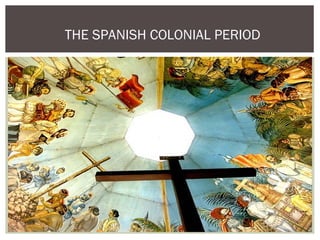
THE SPANISH COLONIAL PERIOD
SPANISH COLONIAL PERIOD

   When the Spaniards arrived in the
Philippines in 1521, the colonizers used art
as a tool to propagate the Catholic faith
through        beautiful   images.     With
communication as problem, the friars used
images to explain the concepts behind
Catholicism, and to tell the stories of
Christ’s life and passion.
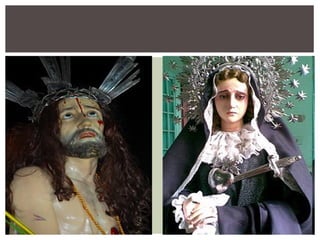
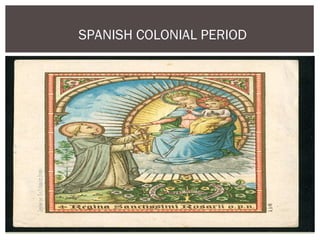
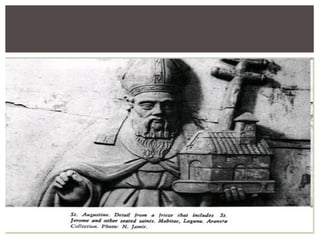
Images of the Holy Family and the
saints were introduced to the Filipino
psyche through carved santos, the
via crucis (Stations of the Cross),
engravings on estampitas, and
through paintings on church walls.
SPANISH COLONIAL PERIOD
Though the ethnic art forms such as pottery,
 weaving and metalwork were retained, the
 Spanish friars and the Chinese, the colony’s
 primary trading partner, were slowly introducing
 newer art forms. Icons brought by the friars were
 used as models for sculpture. Filipino artisans
 were taught the Chinese brushwork technique in
 painting. Engraving was also introduced.
The concept of patronage emerged.
 Artisans were commissioned and paid to
 carve, engrave, and paint. They replaced
 the arts that were once done in a
 communal spirit and community setting
 for rituals. The church, particularly the
 friars, became the new patron of the
 arts.
Since most art produced during the
 first two centuries of Spanish
 occupation were for the church, the
 friars enforced strict supervision over
 their production. Until the 19th
 century, art was only for the church
 and religious use.
Early in the 19th century, with the
 opening of the Suez canal in 1869
 and the development of the
 agricultural export economy, native
 indios acquired economic wealth and
 became what was to be called the
 "ilustrados," meaning enlightened and
 educated.
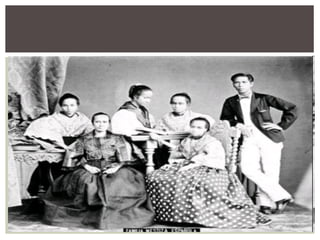
These developments paved the way for
 Filipinos ilustrados to send their children
 to universities in Europe. The rise of the
 "ilustrado" (Filipinos with money and
 education) class was inevitable. The
 ilustrados became the new patron of the
 arts. These events paved the way for the
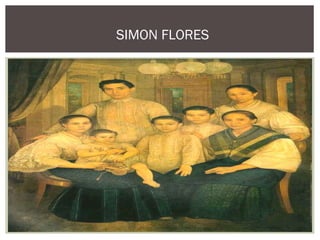
 secularization of art in the 19th century.
A. PAINTING

The Spanish friars introduced
 Western painting in the Philippines to
 artisans who learned to copy on two-
 dimensional form from the religious
 icons that the friars brought from
 Spain,. For the first centuries of
 Spanish colonization, painting was
 limited to religious icons.
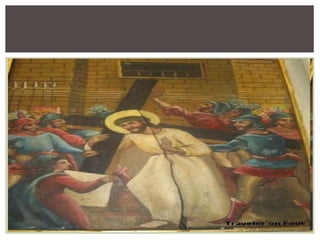
Portraits of saints and of the Holy
 Family became a familiar sight in
 churches. Other subject matters
 include the passion of Christ, the
 Via Crucis, the crucifixion, portrayal
 of heaven, purgatory and hell.
Painters from the Visayas
island of Bohol were noted for
their skillful manipulation of
the technique. Their paintings
of saints and religious scenes
show figures in frontal and
static positions.
For the Boholano painters, the more
 important persons would be depicted
 bigger than the rest of the figures.
 Christ normally dwarfs the Roman
 soldiers    in      these   paintings.
 Unfortunately, they did not sign their
 names on their works and no record of
 their names exists.
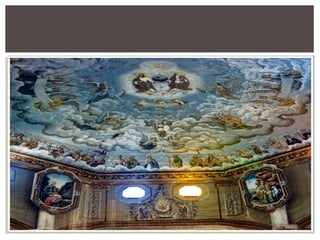
In the church in Paete, Laguna are two works by
 Josef Luciano Dans (1805- ca. 1870), probably
 one of the earliest recorded painters in Philippine
 art history. Langit, Lupa at Impierno ca. 1850
 (Heaven, Earth and Hell), a three-level painting
 which shows the Holy Trinity, Mary the Mother of
 Christ, saints, the Seven Blessed Sacraments
 and a macabre depiction of Hell.
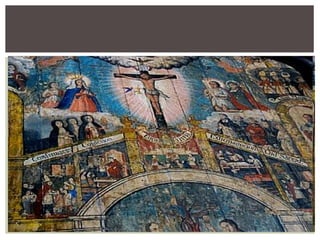
During the early part of the Spanish
 occupation, painting was exclusively
 for the churches and for religious
 purposes. Occasionally, it was also
 used for propaganda. Esteban
 Villanueva of Vigan, Ilocos Sur
 depicted the Ilocos revolt against the
 basi monopoly in a 1821.
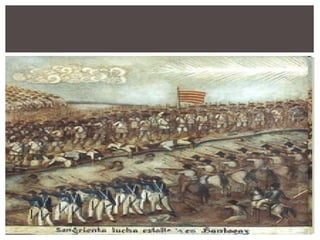
The         Spanish        government
 commissioned the work. The fourteen
 panels show the series of events that
 led to the crushing of the Ilocano basi
 workers revolt by Spanish forces. It
 also showed the appearance of
 Halley’s comet in the Philippines
 during that time.
Tagalog painters Jose Loden, Tomas
 Nazario and Miguel de los Reyes, did
 the first still life paintings in the
 country. They were commissioned in
 1786 by a Spanish botanist to paint
 the flora and fauna found in the
 country.
The     earliest  known      historical
 paintings in the Philippines was a
 mural at the Palacio Real (Royal
 Palace) in Intramuros entitled The
 Conquest of the Batanes done in
 1783. Unfortunately, it was destroyed
 during the 1863 earthquake.
Secular subject matter in painting
 only increased during the 19th
 century.    With    more    tourists,
 ilustrados and foreigners demanding
 souvenirs and decorations from the
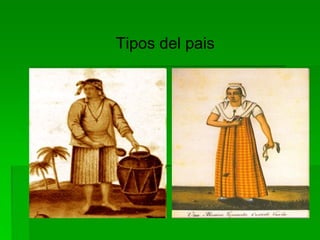
 country, tipos del pais developed in
 painting.
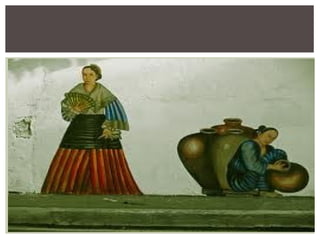
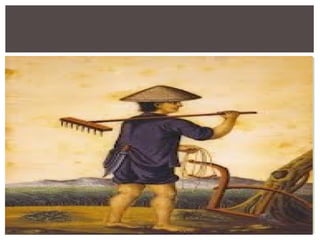
These watercolor paintings show the
 different types of inhabitants in the
 Philippines in their different native
 costumes that show their social status and
 occupation. It also became an album of
 different   native   costumes.     Damian
 Domingo y Gabor (ca. 1790-1832) was the
 most popular artist who worked in this
 style.
By: DARWIN I. RAMOS
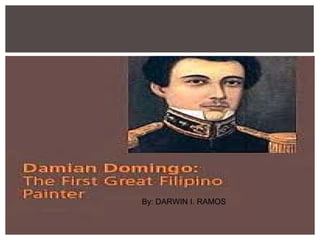
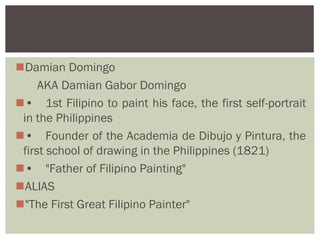
Damian Domingo
     AKA Damian Gabor Domingo
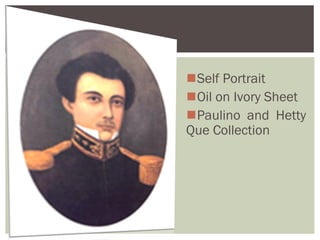
• 1st Filipino to paint his face, the first self-portrait
 in the Philippines
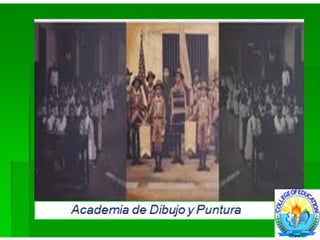
• Founder of the Academia de Dibujo y Pintura, the
 first school of drawing in the Philippines (1821)
• "Father of Filipino Painting"
ALIAS
"The First Great Filipino Painter"
DATE OF BIRTH
1796
BIRTHPLACE
Tondo, Manila, Philippines
WIFE: Lucia Casas
CHILDREN: Celedonia, Severo, Anastacio, Feliciana,
Agapita, Mariano, Jose, and Nicolasa YEAR OF DEATH
1834
PERSONAL BACKGROUND


Don Damian's father was
Spanish and his mother a
Manileña from Tondo. At an
early age he already showed a
mastery of the brush.
CAREER


Domingo is known for being among the first to



start painting secular subjects, a major
departure from the typical religious paintings of
the previous era. It was the period of the rising
middle class, and his tipos del pais or paintings
of native Filipinos in their costumes were in
demand as decorative items among the
ilustrados as well as among the tourists and
foreign residents.
Tipos del pais
He was skilled in executing miniature paintings,
which were then in vogue as objects to be given to
lovers and friends. According to his great grandson
Alfonso Ongpin, customs of the day did not allow
formal visits and suitors had to be content with
glimpses of their sweethearts from the street.
Domingo amazed his clients with his ability to
capture a perfect likeness of the lady in question
after a few brief sightings of her at her window.
It is told that his miniature portrait of Lucia
Casas so captivated the lady's father, the
wealthy colonel Don Ambrocio Casas, that
he invited the painter into his house. A
romance developed followed by a marriage
that produced eight children, including
Celedonia, Severo, Anastacio, Feliciana,
Agapita, Mariano, Jose, and Nicolasa. Two
of them, Severo and Jose, would follow in
the footsteps of their father.
THE FIRST FORMAL PHILIPPINE ART
             SCHOOL

Domingo became the painter of choice of
Manila's prominent class. He not only
developed genre painting but also portraiture.
His fame became so widespread that even
Governor-General Mariano Ricafort (1825-
1830) sat for him. Domingo realized the value
of formal art education, and moved his peers
and students to study art in a rigorous way
attuned to the Western world.
DAMIAN DOMINGO

The students were taught how to draw still
 life and the human form, the art of
 perspective, painting in oil and aquarelle,
 and the preparation of colors and surfaces.
 Painters of that epoch painted not only on
 canvas, but on wood and ivory, of copper,
 iron, silver, and sometimes gold.
He established the Academia de Dibujo y
 Pintura in 1821. Two years later another
 school was opened by the Sociedad
 Economica Filipina de Amigos del Pais. On
 13 June 1826 both schools were fused
 when Domingo was asked to teach at the
 latter academy. In 1828 he was made the
 director.
In his school he required that there be
 no discrimination of the races. The
 students were taught anatomy, still life
 painting, perspective drawing, the
 handling of oils and watercolors, and
 the preparation of colors and painting
 surfaces.
For his talent and civic work, Domingo
 was given the honorary title of
 lieutenant of the Spanish army. The
 French writer Jean Mallat observed
 that his miniatures displayed the mark
 of great talent.
LEGACY


Domingo died on July 26, 1834 after a long and
 progressive illness. The academy was officially
 closed on May 16, 1834 due to lack of funds.
Of his known surviving works, most are
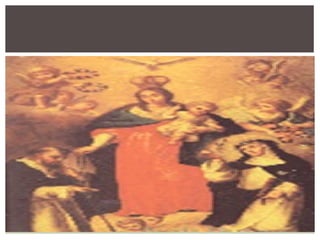
 watercolors. Among his oil paintings are the
 religious works The Apotheosis of St. Thomas
 Aquinas, Our Lady of the Most Holy Rosary, The
 Chair of St. Peter in Rome, and The Holy Family.
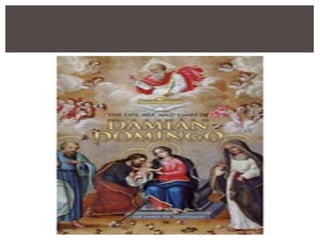
In 2007 Ayala Museum mounted the first major
 retrospective of the spectrum of his oeuvre,
 including religious images from the Ongpin
 Family collection, miniature portraits, and several
 versions of his Philippine costume albums. The
 exhibit was curated by a direct descendant of the
 painter, Lisa Ongpin-Periquet, along with Luciano
 Santiago and Deanna Ongpin-Recto.
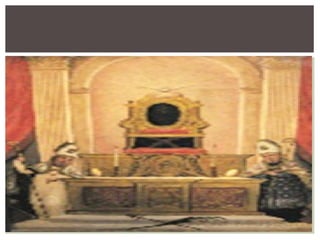
Damian Domingo continued to paint religious images.
He intended these for display in his personal shrine and
this exhibition marks the first time that the family, the
artist's descendants through the Alfonso Ongpin line,
have allowed their display in public. Fine details show
the artist's growing mastery of the miniaturismo style.
Domingo used a wide range of materials available to
artists like wood board, ivory, copper, iron, silver, and
gold.
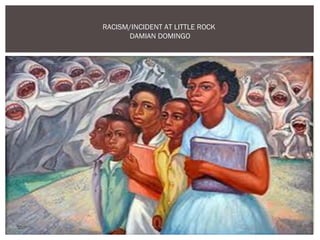
RACISM/INCIDENT AT LITTLE ROCK
      DAMIAN DOMINGO
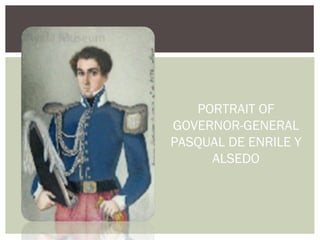
PORTRAIT OF
GOVERNOR-GENERAL
PASQUAL DE ENRILE Y
     ALSEDO
Self Portrait
Oil on Ivory Sheet
Paulino and Hetty
Que Collection
DAMIAN DOMINGO

He died about 1834, before reaching the
 age of 40. His death was a great loss not
 only to art but to the Filipino movement
 for racial equality that was to reach its
 apogee later in that century. To his family
 and motherland, he left a lasting legacy –
 the greatness of the Filipinos in painting.
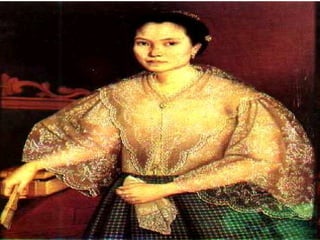
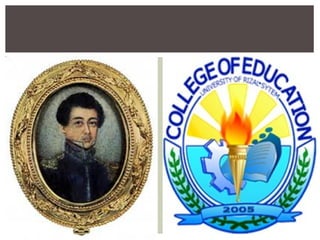
In the early 19th century, the rise of
 the ilustrados saw a rise in the art of
 portraiture. The need to adorn their
 newly constructed bahay-na-bato and
 the want to document their new found
 wealth and social status, the ilustrados
 commissioned painters to make
 portraits of themselves.
The works of painters like Simon Flores,
 Antonio Malantic and Justiniano Asuncion
 captured the intricately designed jewelry and
 fashion accessories, the minuet details of the
 embroidered clothes, and ornately designed
 domestic furniture of the patrons. The
 painstaking attention to minuet details
 characterized miniaturismo.
Thank you for
listening!!!
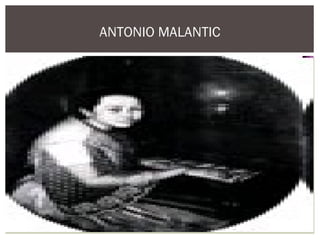
ANTONIO MALANTIC
SIMON FLORES
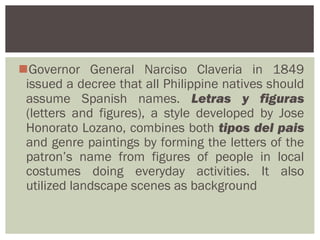
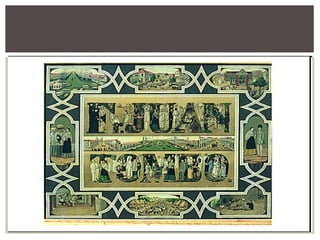
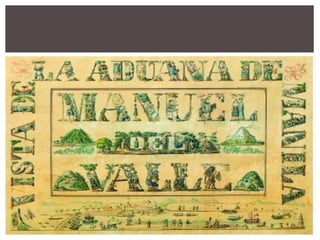
Governor General Narciso Claveria in 1849
 issued a decree that all Philippine natives should
 assume Spanish names. Letras y figuras
 (letters and figures), a style developed by Jose
 Honorato Lozano, combines both tipos del pais
 and genre paintings by forming the letters of the
 patron’s name from figures of people in local
 costumes doing everyday activities. It also
 utilized landscape scenes as background
Several Filipino painters had the
 chance to study and work abroad.
 Among them were Juan Novicio Luna
 and Felix Resureccion Hidalgo who
 became the first international Filipino
 artists when they won the gold and
 silver medals in the 1884 Madrid
 Exposition.

Philippine Art History

  • 1.
    PHILIPPINE ART HISTORY: Term II, AY 2012- 2013 VISUAL ARTS
  • 2.
  • 3.
    SPANISH COLONIAL PERIOD When the Spaniards arrived in the Philippines in 1521, the colonizers used art as a tool to propagate the Catholic faith through beautiful images. With communication as problem, the friars used images to explain the concepts behind Catholicism, and to tell the stories of Christ’s life and passion.
  • 5.
    Images of theHoly Family and the saints were introduced to the Filipino psyche through carved santos, the via crucis (Stations of the Cross), engravings on estampitas, and through paintings on church walls.
  • 6.
  • 9.
    Though the ethnicart forms such as pottery, weaving and metalwork were retained, the Spanish friars and the Chinese, the colony’s primary trading partner, were slowly introducing newer art forms. Icons brought by the friars were used as models for sculpture. Filipino artisans were taught the Chinese brushwork technique in painting. Engraving was also introduced.
  • 10.
    The concept ofpatronage emerged. Artisans were commissioned and paid to carve, engrave, and paint. They replaced the arts that were once done in a communal spirit and community setting for rituals. The church, particularly the friars, became the new patron of the arts.
  • 11.
    Since most artproduced during the first two centuries of Spanish occupation were for the church, the friars enforced strict supervision over their production. Until the 19th century, art was only for the church and religious use.
  • 12.
    Early in the19th century, with the opening of the Suez canal in 1869 and the development of the agricultural export economy, native indios acquired economic wealth and became what was to be called the "ilustrados," meaning enlightened and educated.
  • 13.
    These developments pavedthe way for Filipinos ilustrados to send their children to universities in Europe. The rise of the "ilustrado" (Filipinos with money and education) class was inevitable. The ilustrados became the new patron of the arts. These events paved the way for the secularization of art in the 19th century.
  • 15.
    A. PAINTING The Spanishfriars introduced Western painting in the Philippines to artisans who learned to copy on two- dimensional form from the religious icons that the friars brought from Spain,. For the first centuries of Spanish colonization, painting was limited to religious icons.
  • 16.
    Portraits of saintsand of the Holy Family became a familiar sight in churches. Other subject matters include the passion of Christ, the Via Crucis, the crucifixion, portrayal of heaven, purgatory and hell.
  • 17.
    Painters from theVisayas island of Bohol were noted for their skillful manipulation of the technique. Their paintings of saints and religious scenes show figures in frontal and static positions.
  • 18.
    For the Boholanopainters, the more important persons would be depicted bigger than the rest of the figures. Christ normally dwarfs the Roman soldiers in these paintings. Unfortunately, they did not sign their names on their works and no record of their names exists.
  • 20.
    In the churchin Paete, Laguna are two works by Josef Luciano Dans (1805- ca. 1870), probably one of the earliest recorded painters in Philippine art history. Langit, Lupa at Impierno ca. 1850 (Heaven, Earth and Hell), a three-level painting which shows the Holy Trinity, Mary the Mother of Christ, saints, the Seven Blessed Sacraments and a macabre depiction of Hell.
  • 22.
    During the earlypart of the Spanish occupation, painting was exclusively for the churches and for religious purposes. Occasionally, it was also used for propaganda. Esteban Villanueva of Vigan, Ilocos Sur depicted the Ilocos revolt against the basi monopoly in a 1821.
  • 23.
    The Spanish government commissioned the work. The fourteen panels show the series of events that led to the crushing of the Ilocano basi workers revolt by Spanish forces. It also showed the appearance of Halley’s comet in the Philippines during that time.
  • 25.
    Tagalog painters JoseLoden, Tomas Nazario and Miguel de los Reyes, did the first still life paintings in the country. They were commissioned in 1786 by a Spanish botanist to paint the flora and fauna found in the country.
  • 26.
    The earliest known historical paintings in the Philippines was a mural at the Palacio Real (Royal Palace) in Intramuros entitled The Conquest of the Batanes done in 1783. Unfortunately, it was destroyed during the 1863 earthquake.
  • 27.
    Secular subject matterin painting only increased during the 19th century. With more tourists, ilustrados and foreigners demanding souvenirs and decorations from the country, tipos del pais developed in painting.
  • 28.
    These watercolor paintingsshow the different types of inhabitants in the Philippines in their different native costumes that show their social status and occupation. It also became an album of different native costumes. Damian Domingo y Gabor (ca. 1790-1832) was the most popular artist who worked in this style.
  • 29.
  • 31.
    Damian Domingo AKA Damian Gabor Domingo • 1st Filipino to paint his face, the first self-portrait in the Philippines • Founder of the Academia de Dibujo y Pintura, the first school of drawing in the Philippines (1821) • "Father of Filipino Painting" ALIAS "The First Great Filipino Painter"
  • 32.
    DATE OF BIRTH 1796 BIRTHPLACE Tondo,Manila, Philippines WIFE: Lucia Casas CHILDREN: Celedonia, Severo, Anastacio, Feliciana, Agapita, Mariano, Jose, and Nicolasa YEAR OF DEATH 1834
  • 33.
    PERSONAL BACKGROUND Don Damian'sfather was Spanish and his mother a Manileña from Tondo. At an early age he already showed a mastery of the brush.
  • 34.
    CAREER Domingo is knownfor being among the first to  start painting secular subjects, a major departure from the typical religious paintings of the previous era. It was the period of the rising middle class, and his tipos del pais or paintings of native Filipinos in their costumes were in demand as decorative items among the ilustrados as well as among the tourists and foreign residents.
  • 35.
  • 36.
    He was skilledin executing miniature paintings, which were then in vogue as objects to be given to lovers and friends. According to his great grandson Alfonso Ongpin, customs of the day did not allow formal visits and suitors had to be content with glimpses of their sweethearts from the street. Domingo amazed his clients with his ability to capture a perfect likeness of the lady in question after a few brief sightings of her at her window.
  • 37.
    It is toldthat his miniature portrait of Lucia Casas so captivated the lady's father, the wealthy colonel Don Ambrocio Casas, that he invited the painter into his house. A romance developed followed by a marriage that produced eight children, including Celedonia, Severo, Anastacio, Feliciana, Agapita, Mariano, Jose, and Nicolasa. Two of them, Severo and Jose, would follow in the footsteps of their father.
  • 38.
    THE FIRST FORMALPHILIPPINE ART SCHOOL Domingo became the painter of choice of Manila's prominent class. He not only developed genre painting but also portraiture. His fame became so widespread that even Governor-General Mariano Ricafort (1825- 1830) sat for him. Domingo realized the value of formal art education, and moved his peers and students to study art in a rigorous way attuned to the Western world.
  • 40.
    DAMIAN DOMINGO The studentswere taught how to draw still life and the human form, the art of perspective, painting in oil and aquarelle, and the preparation of colors and surfaces. Painters of that epoch painted not only on canvas, but on wood and ivory, of copper, iron, silver, and sometimes gold.
  • 41.
    He established theAcademia de Dibujo y Pintura in 1821. Two years later another school was opened by the Sociedad Economica Filipina de Amigos del Pais. On 13 June 1826 both schools were fused when Domingo was asked to teach at the latter academy. In 1828 he was made the director.
  • 42.
    In his schoolhe required that there be no discrimination of the races. The students were taught anatomy, still life painting, perspective drawing, the handling of oils and watercolors, and the preparation of colors and painting surfaces.
  • 43.
    For his talentand civic work, Domingo was given the honorary title of lieutenant of the Spanish army. The French writer Jean Mallat observed that his miniatures displayed the mark of great talent.
  • 44.
    LEGACY Domingo died onJuly 26, 1834 after a long and progressive illness. The academy was officially closed on May 16, 1834 due to lack of funds. Of his known surviving works, most are watercolors. Among his oil paintings are the religious works The Apotheosis of St. Thomas Aquinas, Our Lady of the Most Holy Rosary, The Chair of St. Peter in Rome, and The Holy Family.
  • 45.
    In 2007 AyalaMuseum mounted the first major retrospective of the spectrum of his oeuvre, including religious images from the Ongpin Family collection, miniature portraits, and several versions of his Philippine costume albums. The exhibit was curated by a direct descendant of the painter, Lisa Ongpin-Periquet, along with Luciano Santiago and Deanna Ongpin-Recto.
  • 47.
    Damian Domingo continuedto paint religious images. He intended these for display in his personal shrine and this exhibition marks the first time that the family, the artist's descendants through the Alfonso Ongpin line, have allowed their display in public. Fine details show the artist's growing mastery of the miniaturismo style. Domingo used a wide range of materials available to artists like wood board, ivory, copper, iron, silver, and gold.
  • 48.
    RACISM/INCIDENT AT LITTLEROCK DAMIAN DOMINGO
  • 49.
  • 50.
    Self Portrait Oil onIvory Sheet Paulino and Hetty Que Collection
  • 57.
    DAMIAN DOMINGO He diedabout 1834, before reaching the age of 40. His death was a great loss not only to art but to the Filipino movement for racial equality that was to reach its apogee later in that century. To his family and motherland, he left a lasting legacy – the greatness of the Filipinos in painting.
  • 58.
    In the early19th century, the rise of the ilustrados saw a rise in the art of portraiture. The need to adorn their newly constructed bahay-na-bato and the want to document their new found wealth and social status, the ilustrados commissioned painters to make portraits of themselves.
  • 59.
    The works ofpainters like Simon Flores, Antonio Malantic and Justiniano Asuncion captured the intricately designed jewelry and fashion accessories, the minuet details of the embroidered clothes, and ornately designed domestic furniture of the patrons. The painstaking attention to minuet details characterized miniaturismo.
  • 61.
  • 62.
  • 63.
  • 64.
    Governor General NarcisoClaveria in 1849 issued a decree that all Philippine natives should assume Spanish names. Letras y figuras (letters and figures), a style developed by Jose Honorato Lozano, combines both tipos del pais and genre paintings by forming the letters of the patron’s name from figures of people in local costumes doing everyday activities. It also utilized landscape scenes as background
  • 68.
    Several Filipino paintershad the chance to study and work abroad. Among them were Juan Novicio Luna and Felix Resureccion Hidalgo who became the first international Filipino artists when they won the gold and silver medals in the 1884 Madrid Exposition.