DANCE
National Artist For
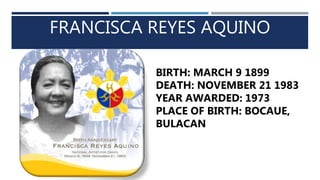
FRANCISCA REYES AQUINO
BIRTH: MARCH 9 1899
DEATH: NOVEMBER 21 1983
YEAR AWARDED: 1973
PLACE OF BIRTH: BOCAUE,
BULACAN
FRANCISCA REYES AQUINO
 Francisca Reyes Aquino is acknowledged as the Folk Dance Pioneer. She is
known as a dancer and researcher of Philippine folk dance. This Bulakeña began
her research on folk dances in the 1920’s making trips to remote barrios in
Central and Northern Luzon. Her research on the unrecorded forms of local
celebration, ritual and sport resulted into a 1926 thesis titled “Philippine Folk
Dances and Games,” and arranged specifically for use by teachers and
playground instructors in public and private schools.
 In the 1940’s, she served as supervisor of physical education at the Bureau of
Education that distributed her work and adapted the teaching of folk dancing as
a medium of making young Filipinos to be aware of their cultural heritage.
 She received the Republic Award of Merit in 1954, and the Ramon Magsaysay
Award in 1962 before being conferred to the Order of National Artists in 1973.
FRANCISCA REYES AQUINO
Major Works:
 Philippine National Dances (1946)
 Gymnastics for Girls (1947)
 Fundamental Dance Steps and Music (1948)
 Foreign Folk Dances (1949)
 Dances for all Occasion (1950)
 Playground Demonstration (1951)
 Philippine Folk Dances, Volumes I to VI.
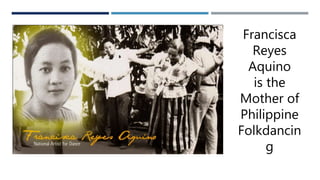
Francisca
Reyes
Aquino
is the
Mother of
Philippine
Folkdancin
g
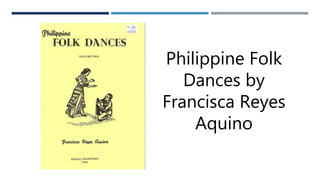
Philippine Folk
Dances by
Francisca Reyes
Aquino
TIKLOS By: Francisca Reyes Aquino
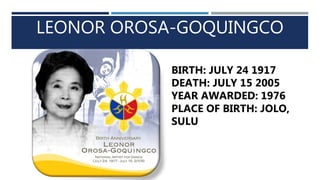
LEONOR OROSA-GOQUINGCO
BIRTH: JULY 24 1917
DEATH: JULY 15 2005
YEAR AWARDED: 1976
PLACE OF BIRTH: JOLO,
SULU
LEONOR OROSA-GOQUINGCO
 Before she was named as National Artist for Dance in 1976, Leonor
Orosa-Goquingco was known by many other names such as the
“Trailblazer”, “Mother of Philippine Theater Dance” and “Dean of Filipino
Performing Arts Critics”.
 She incorporated ballet with folk and Asian dance and such has been
able to create innovative and original choreographies. Throughout her
career, she has choreographed over 50 unique dances narrating stories
that she has penned. She was the Honorary Chair of the Association of
Ballet Academies of the Philippines (ABAP), and was a founding member
of the Philippine Ballet Theater.
 Her most elaborate project was The “Filipinescas: Philippine Life,
Legend, and Lore”. This performance brought traditional folk dance and
its evolution to the stage. This performance was toured around the world
from 1961 to 1970, introducing the world to Philippine Dance.
LEONOR OROSA-GOQUINGCO
Major Works:
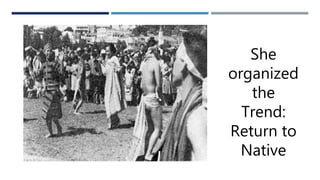
 TREND: Return to Native
 In a Javanese Garden
 Vinta!
 Filipinescas: Philippine Life, Legend, and Lore
 The Magic Garden
 Noli Dance Suite
She
organized
the
Trend:
Return to
Native
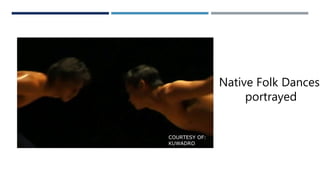
Native Folk Dances
portrayed
FILIPINESCAS By: Leonor Orosa Goquingco
LUCRECIA REYES-URTULA
BIRTH: JULY 29 1929
DEATH: AUGUST 24
1999
YEAR AWARDED: 1988
PLACE OF BIRTH: ILOILO
CITY, ILOILO
LUCRECIA REYES-URTULA
 Lucrecia Reyes-Urtula, choreographer, dance educator and researcher. She
spent almost four decades in the discovery and study of Philippine folk and
ethnic dances. She applied her findings to project a new example of an ethnic
dance culture that goes beyond simple preservation and into creative growth.
 Over a period of thirty years, she had choreographed suites of mountain
dances, Spanish-influenced dances, Muslim pageants and festivals, regional
variations and dances of the countryside for the Bayanihan Philippine Dance
Company of which she was the dance director. These dances have all earned
critical acclaims and rave reviews from audiences in their world tours in
Americas, Europe, Asia, Australia and Africa.
 She became the National Artist for Dance in 1988.
LUCRECIA REYES-URTULA
Major Works:
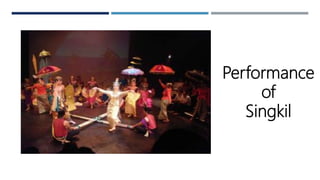
 Singkil (inspired by a Maranao poem)
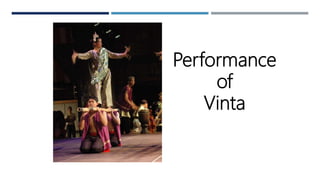
 Vinta (showcasing the Filipinos’ maritime skills)
 Tagabili (tale of tribal conflict)
 Pagdiwata (based on a four-day harvest festival)
 Salidsid (mountain wedding dance ritual)
Performance
of
Singkil
Performance
of
Vinta
SINGKIL By: Lucrecia Reyes Urtula
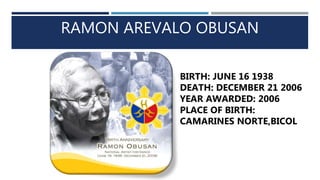
RAMON AREVALO OBUSAN
BIRTH: JUNE 16 1938
DEATH: DECEMBER 21 2006
YEAR AWARDED: 2006
PLACE OF BIRTH:
CAMARINES NORTE,BICOL
RAMON AREVALO OBUSAN
 Ramon Obusan was an accomplished dancer, choreographer, stage designer
and artistic director. He is recognized as a promoter of Philippine traditional
dance through his performances and cultural research. He achieved
phenomenal success in Philippine dance and cultural work. He was also
acknowledged as a researcher, archivist and documentary filmmaker who
broadened and deepened the Filipino understanding of his own cultural life
and expressions.
 Through the Ramon Obusan Folkloric Group (ROFG) which he founded in
1971. This group was acclaimed for its authentic and faithful recreation and
performance of Filipino folk dance. With his troupe, he helped deepen the
people’s appreciation of their cultural traditions and heritage of dance. He
also had effected cultural and diplomatic exchanges using the multifarious
aspects and dimensions of the art of dance.
RAMON AREVALO OBUSAN
Major Works:
 Vamos a Belen! Series (1998-2004) Philippine pastors tradition
 Noon Po sa Amin (tableaux of Philippine history in song, drama, and
dance)
 Obra Maestra (collection of Ramon Obusan’s dance masterpieces)
 Water, Fire, and Life (Philippine Dances and Music – A Celebration of Life)
 Glimpses of ASEAN (dance and music of the ASEAN member countries
 Saplot (Ramon Obusan Folkloric Group) Philippine costumes in dance
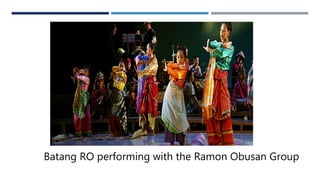
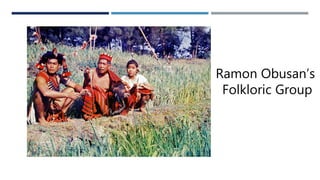
Ramon Obusan’s
Folkloric Group
Batang RO performing with the Ramon Obusan Group
ROFG By: Ramon Obusan

Dance

  • 1.
  • 2.
    FRANCISCA REYES AQUINO BIRTH:MARCH 9 1899 DEATH: NOVEMBER 21 1983 YEAR AWARDED: 1973 PLACE OF BIRTH: BOCAUE, BULACAN
  • 3.
    FRANCISCA REYES AQUINO Francisca Reyes Aquino is acknowledged as the Folk Dance Pioneer. She is known as a dancer and researcher of Philippine folk dance. This Bulakeña began her research on folk dances in the 1920’s making trips to remote barrios in Central and Northern Luzon. Her research on the unrecorded forms of local celebration, ritual and sport resulted into a 1926 thesis titled “Philippine Folk Dances and Games,” and arranged specifically for use by teachers and playground instructors in public and private schools.  In the 1940’s, she served as supervisor of physical education at the Bureau of Education that distributed her work and adapted the teaching of folk dancing as a medium of making young Filipinos to be aware of their cultural heritage.  She received the Republic Award of Merit in 1954, and the Ramon Magsaysay Award in 1962 before being conferred to the Order of National Artists in 1973.
  • 4.
    FRANCISCA REYES AQUINO MajorWorks:  Philippine National Dances (1946)  Gymnastics for Girls (1947)  Fundamental Dance Steps and Music (1948)  Foreign Folk Dances (1949)  Dances for all Occasion (1950)  Playground Demonstration (1951)  Philippine Folk Dances, Volumes I to VI.
  • 5.
  • 6.
  • 7.
  • 8.
    LEONOR OROSA-GOQUINGCO BIRTH: JULY24 1917 DEATH: JULY 15 2005 YEAR AWARDED: 1976 PLACE OF BIRTH: JOLO, SULU
  • 9.
    LEONOR OROSA-GOQUINGCO  Beforeshe was named as National Artist for Dance in 1976, Leonor Orosa-Goquingco was known by many other names such as the “Trailblazer”, “Mother of Philippine Theater Dance” and “Dean of Filipino Performing Arts Critics”.  She incorporated ballet with folk and Asian dance and such has been able to create innovative and original choreographies. Throughout her career, she has choreographed over 50 unique dances narrating stories that she has penned. She was the Honorary Chair of the Association of Ballet Academies of the Philippines (ABAP), and was a founding member of the Philippine Ballet Theater.  Her most elaborate project was The “Filipinescas: Philippine Life, Legend, and Lore”. This performance brought traditional folk dance and its evolution to the stage. This performance was toured around the world from 1961 to 1970, introducing the world to Philippine Dance.
  • 10.
    LEONOR OROSA-GOQUINGCO Major Works: TREND: Return to Native  In a Javanese Garden  Vinta!  Filipinescas: Philippine Life, Legend, and Lore  The Magic Garden  Noli Dance Suite
  • 11.
  • 12.
  • 13.
    FILIPINESCAS By: LeonorOrosa Goquingco
  • 14.
    LUCRECIA REYES-URTULA BIRTH: JULY29 1929 DEATH: AUGUST 24 1999 YEAR AWARDED: 1988 PLACE OF BIRTH: ILOILO CITY, ILOILO
  • 15.
    LUCRECIA REYES-URTULA  LucreciaReyes-Urtula, choreographer, dance educator and researcher. She spent almost four decades in the discovery and study of Philippine folk and ethnic dances. She applied her findings to project a new example of an ethnic dance culture that goes beyond simple preservation and into creative growth.  Over a period of thirty years, she had choreographed suites of mountain dances, Spanish-influenced dances, Muslim pageants and festivals, regional variations and dances of the countryside for the Bayanihan Philippine Dance Company of which she was the dance director. These dances have all earned critical acclaims and rave reviews from audiences in their world tours in Americas, Europe, Asia, Australia and Africa.  She became the National Artist for Dance in 1988.
  • 16.
    LUCRECIA REYES-URTULA Major Works: Singkil (inspired by a Maranao poem)  Vinta (showcasing the Filipinos’ maritime skills)  Tagabili (tale of tribal conflict)  Pagdiwata (based on a four-day harvest festival)  Salidsid (mountain wedding dance ritual)
  • 17.
  • 18.
  • 19.
  • 20.
    RAMON AREVALO OBUSAN BIRTH:JUNE 16 1938 DEATH: DECEMBER 21 2006 YEAR AWARDED: 2006 PLACE OF BIRTH: CAMARINES NORTE,BICOL
  • 21.
    RAMON AREVALO OBUSAN Ramon Obusan was an accomplished dancer, choreographer, stage designer and artistic director. He is recognized as a promoter of Philippine traditional dance through his performances and cultural research. He achieved phenomenal success in Philippine dance and cultural work. He was also acknowledged as a researcher, archivist and documentary filmmaker who broadened and deepened the Filipino understanding of his own cultural life and expressions.  Through the Ramon Obusan Folkloric Group (ROFG) which he founded in 1971. This group was acclaimed for its authentic and faithful recreation and performance of Filipino folk dance. With his troupe, he helped deepen the people’s appreciation of their cultural traditions and heritage of dance. He also had effected cultural and diplomatic exchanges using the multifarious aspects and dimensions of the art of dance.
  • 22.
    RAMON AREVALO OBUSAN MajorWorks:  Vamos a Belen! Series (1998-2004) Philippine pastors tradition  Noon Po sa Amin (tableaux of Philippine history in song, drama, and dance)  Obra Maestra (collection of Ramon Obusan’s dance masterpieces)  Water, Fire, and Life (Philippine Dances and Music – A Celebration of Life)  Glimpses of ASEAN (dance and music of the ASEAN member countries  Saplot (Ramon Obusan Folkloric Group) Philippine costumes in dance
  • 23.
  • 24.
    Batang RO performingwith the Ramon Obusan Group
  • 25.