HISTORICAL DEVELOPMENT
Western & Asian Arts in
Philippines
Asian Influences on
Philippine Art
THE PHILIPPINES, BEING AN ASIAN COUNTRY, IS INFLUENCED BY COUNTRIES ALL
AROUND ASIA
 Numerous Asian countries have influenced the
Philippines in our arts, culture, and tradition.
 Two Major influences:
 India
 China
Also Indonesia, Thailand, Japan, Malaysia, etc.
MALASIA
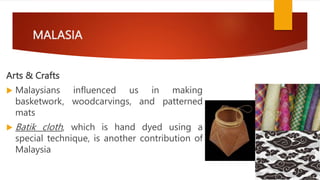
Arts & Crafts
 Malaysians influenced us in making
basketwork, woodcarvings, and patterned
mats
 Batik cloth, which is hand dyed using a
special technique, is another contribution of
Malaysia
CHINA
 Arts & Crafts
Woodblock Painting (ukiyo-e)- Originated in China
as a method of printing on textiles on paper
The excavations of Chinese pottery, ceramics, and
metal vessels for domestic purposes are proof of
the presence of the Chinese in Filipino art and
culture
JAPAN
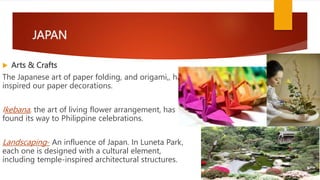
 Arts & Crafts
The Japanese art of paper folding, and origami,, has
inspired our paper decorations.
Ikebana, the art of living flower arrangement, has
found its way to Philippine celebrations.
Landscaping- An influence of Japan. In Luneta Park,
each one is designed with a cultural element,
including temple-inspired architectural structures.
ISLAM
 Arts & Crafts
Islam influences the art of Muslims in the
Philippines.
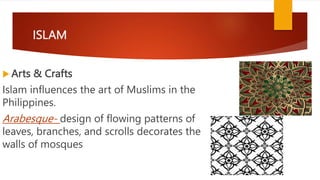
Arabesque- design of flowing patterns of
leaves, branches, and scrolls decorates the
walls of mosques
THAILAND
Art & Crafts
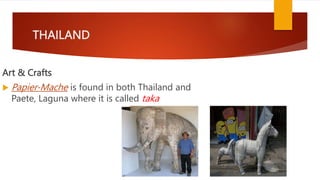
 Papier-Mache is found in both Thailand and
Paete, Laguna where it is called taka
WESTERN INFLUENCES ON
PHILIPPINE ART
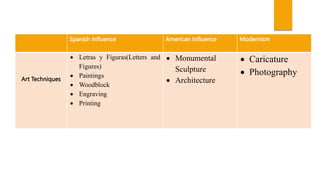
Spanish Influence American Influence Modernism
Subject of Art
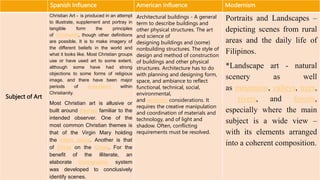
Christian Art - is produced in an attempt
to illustrate, supplement and portray in
tangible form the principles
of Christianity, though other definitions
are possible. It is to make imagery of
the different beliefs in the world and
what it looks like. Most Christian groups
use or have used art to some extent,
although some have had strong
objections to some forms of religious
image, and there have been major
periods of iconoclasm within
Christianity.
Most Christian art is allusive or
built around themes familiar to the
intended observer. One of the
most common Christian themes is
that of the Virgin Mary holding
the infant Jesus. Another is that
of Christ on the Cross. For the
benefit of the illiterate, an
elaborate iconographic system
was developed to conclusively
identify scenes.
Architectural buildings - A general
term to describe buildings and
other physical structures. The art
and science of
designing buildings and (some)
nonbuilding structures. The style of
design and method of construction
of buildings and other physical
structures. Architecture has to do
with planning and designing form,
space, and ambiance to reflect
functional, technical, social,
environmental,
and aesthetic considerations. It
requires the creative manipulation
and coordination of materials and
technology, and of light and
shadow. Often, conflicting
requirements must be resolved.
Portraits and Landscapes –
depicting scenes from rural
areas and the daily life of
Filipinos.
*Landscape art - natural
scenery as well
as mountains, valleys, trees,
rivers, and forests,
especially where the main
subject is a wide view –
with its elements arranged
into a coherent composition.
Spanish Influence American Influence Modernism
Art Techniques
 Letras y Figuras(Letters and
Figures)
 Paintings
 Woodblock
 Engraving
 Printing
 Monumental
Sculpture
 Architecture
 Caricature
 Photography
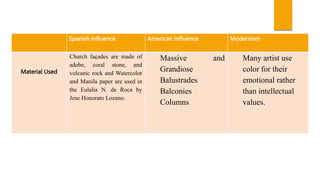
Spanish Influence American Influence Modernism
Material Used
Church façades are made of
adobe, coral stone, and
volcanic rock and Watercolor
and Manila paper are used in
the Eulalia N. de Roca by
Jose Honorato Lozano.
Massive and
Grandiose
Balustrades
Balconies
Columns
Many artist use
color for their
emotional rather
than intellectual
values.
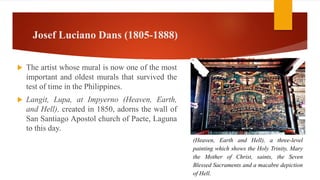
Josef Luciano Dans (1805-1888)
 The artist whose mural is now one of the most
important and oldest murals that survived the
test of time in the Philippines.
 Langit, Lupa, at Impyerno (Heaven, Earth,
and Hell), created in 1850, adorns the wall of
San Santiago Apostol church of Paete, Laguna
to this day.
(Heaven, Earth and Hell), a three-level
painting which shows the Holy Trinity, Mary
the Mother of Christ, saints, the Seven
Blessed Sacraments and a macabre depiction
of Hell.
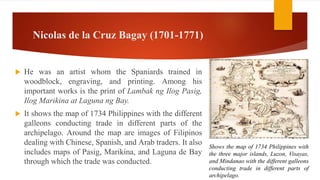
Nicolas de la Cruz Bagay (1701-1771)
 He was an artist whom the Spaniards trained in
woodblock, engraving, and printing. Among his
important works is the print of Lambak ng Ilog Pasig,
Ilog Marikina at Laguna ng Bay.
 It shows the map of 1734 Philippines with the different
galleons conducting trade in different parts of the
archipelago. Around the map are images of Filipinos
dealing with Chinese, Spanish, and Arab traders. It also
includes maps of Pasig, Marikina, and Laguna de Bay
through which the trade was conducted.
Shows the map of 1734 Philippines with
the three major islands, Luzon, Visayas,
and Mindanao with the different galleons
conducting trade in different parts of
archipelago.
Mariano Baldemor Madrinan
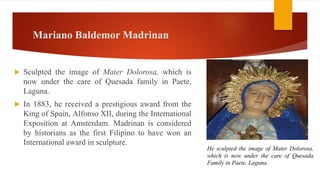
 Sculpted the image of Mater Dolorosa, which is
now under the care of Quesada family in Paete,
Laguna.
 In 1883, he received a prestigious award from the
King of Spain, Alfonso XII, during the International
Exposition at Amsterdam. Madrinan is considered
by historians as the first Filipino to have won an
International award in sculpture.
He sculpted the image of Mater Dolorosa,
which is now under the care of Quesada
Family in Paete, Laguna.
Jose Honorato Lozano
 Was born in Manila where he became the best painter in
the 1840s. His letras y figures artwork were much sought
after by patrons. He was also famous for his paintings
showing costumes of people of different social classes in
the Spanish period.
 He was also commissioned by the Spanish government to
paint scenes from the history of the colony, and his works
were exhibited during the Santa Cruz, Manila fiesta in
1848.
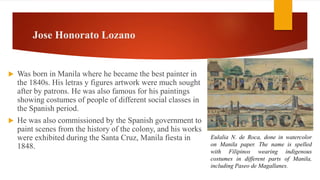
Eulalia N. de Roca, done in watercolor
on Manila paper. The name is spelled
with Filipinos wearing indigenous
costumes in different parts of Manila,
including Paseo de Magallanes.
Damian Domingo
 The director of the Academia de Dibujo y Pintura,
which were established in 1823. In the school of the
arts, he emphasized painting through brushwork.
 The students were Introduced to the single-point
perspective and painting of church icons. Employing
the miniaturismo technique of painting, his
brushstrokes were almost invisible in portraits,
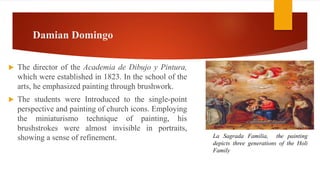
showing a sense of refinement. La Sagrada Familia, the painting
depicts three generations of the Holi
Family
Simon Flores(1839-1902)
 Grew up in Batangas and learned painting from his
family. His uncle, Pio dela Rosa was his art teacher
before he studied painting at the Academia de Dibujo
y Pintura.
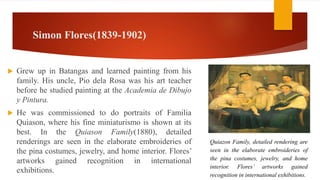
 He was commissioned to do portraits of Familia
Quiason, where his fine miniaturismo is shown at its
best. In the Quiason Family(1880), detailed
renderings are seen in the elaborate embroideries of
the pina costumes, jewelry, and home interior. Flores’
artworks gained recognition in international
exhibitions.
Quiazon Family, detailed rendering are
seen in the elaborate embroideries of
the pina costumes, jewelry, and home
interior. Flores’ artworks gained
recognition in international exhibitions.
Lorenzo Guerrero (1835-1904)
 A painter and a teacher. He is considered “the father of
Philippine genre” painting because he had thousands of
paintings depicting native Filipinos going about their daily
work set in Manila landscapes.
 His famous works include The Vendress, Young Lass
Beside a Brook, with its rich and cool greenery (De Leon,
1982), giant leaves forming a canopy over the girl who
elegantly balances a clay jar on her hand, and Dressing
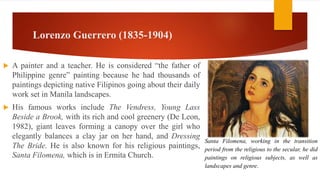
The Bride. He is also known for his religious paintings,
Santa Filomena, which is in Ermita Church.
Santa Filomena, working in the transition
period from the religious to the secular, he did
paintings on religious subjects, as well as
landscapes and genre.
Juan Luna
(October 23, 1857 – December 7, 1899)
 A Filipino painter, sculptor, and a political activist of
the Philippine Revolution during the late 19th century. He
became one of the first recognized Philippine artists.
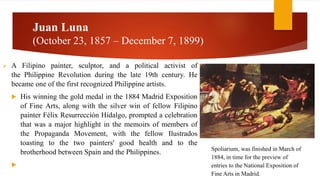
 His winning the gold medal in the 1884 Madrid Exposition
of Fine Arts, along with the silver win of fellow Filipino
painter Félix Resurrección Hidalgo, prompted a celebration
that was a major highlight in the memoirs of members of
the Propaganda Movement, with the fellow Ilustrados
toasting to the two painters' good health and to the
brotherhood between Spain and the Philippines.

Spoliarium, was finished in March of
1884, in time for the preview of
entries to the National Exposition of
Fine Arts in Madrid.
Felix Resurrecion Hidalgo
(February 21, 1855 – March 13, 1913)
 He is acknowledged as one of the great
Filipino painters of the late 19th
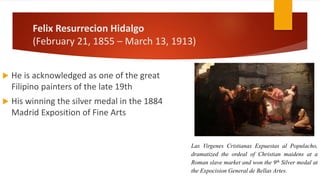
 His winning the silver medal in the 1884
Madrid Exposition of Fine Arts
Las Virgenes Cristianas Expuestas al Populacho,
dramatized the ordeal of Christian maidens at a
Roman slave market and won the 9th Silver medal at
the Expocision General de Bellas Artes.
Guillermo Tolentino
 A very talented artist who learned drawing under a
Thomasite teacher, Mrs. H.A. Bordner. His desire to learn
more about art are brought him to Washington, D.C., where
he worked in a café in Rock Creek Park. He caught the
attention of President Woodrow Wilson when he molded
Peace, a small statuette inspired by President Wilsons’s
stand on peace.
 Granted a scholarship by American millionaire Bernard
Bruch, he enrolled at the Beaux Arts School in New York
City for advance courses in sculpture. Two years later, he
went to Europe for further studies at the Royal Academy of
Fine Arts in Rome.
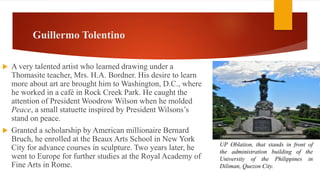
UP Oblation, that stands in front of
the administration building of the
University of the Philippines in
Diliman, Quezon City.
Juan Arellano and Antonio Toledo
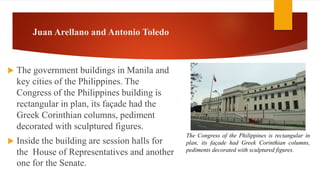
 The government buildings in Manila and
key cities of the Philippines. The
Congress of the Philippines building is
rectangular in plan, its façade had the
Greek Corinthian columns, pediment
decorated with sculptured figures.
 Inside the building are session halls for
the House of Representatives and another
one for the Senate.
The Congress of the Philippines is rectangular in
plan, its façade had Greek Corinthian columns,
pediments decorated with sculptured figures.
Fernando Amorsolo
 National Artist in 1972 for his great contribution to
the development of Philippine painting. He learned
painting from Fabian dela Rosa in the academic
conservative style of the School of Fine Arts.
 He also went to Spain to study at the Real Academia
de Bellas Artes de San Fernando, where he was
influenced by European masters like baroque painter
Diego Velasquez and impressionists Claude Monet
and Joaquin Sorolla
Fruit Pickers Harvesting Under the
Mango Tree, showing Filipino
women clothe in traditional
women’s wear baro at saya, resting
under a mango tree with mango
fruits on the ground.
Fabian dela Rosa (1869-1937)
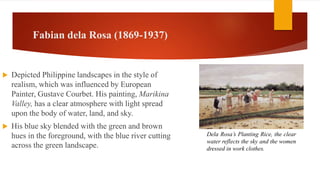
 Depicted Philippine landscapes in the style of
realism, which was influenced by European
Painter, Gustave Courbet. His painting, Marikina
Valley, has a clear atmosphere with light spread
upon the body of water, land, and sky.
 His blue sky blended with the green and brown
hues in the foreground, with the blue river cutting
across the green landscape.
Dela Rosa’s Planting Rice, the clear
water reflects the sky and the women
dressed in work clothes.
END OF PRESENTATION
THANK YOU!

Western & Asian Art.pptx

  • 1.
    HISTORICAL DEVELOPMENT Western &Asian Arts in Philippines
  • 2.
    Asian Influences on PhilippineArt THE PHILIPPINES, BEING AN ASIAN COUNTRY, IS INFLUENCED BY COUNTRIES ALL AROUND ASIA
  • 3.
     Numerous Asiancountries have influenced the Philippines in our arts, culture, and tradition.  Two Major influences:  India  China Also Indonesia, Thailand, Japan, Malaysia, etc.
  • 4.
    MALASIA Arts & Crafts Malaysians influenced us in making basketwork, woodcarvings, and patterned mats  Batik cloth, which is hand dyed using a special technique, is another contribution of Malaysia
  • 5.
    CHINA  Arts &Crafts Woodblock Painting (ukiyo-e)- Originated in China as a method of printing on textiles on paper The excavations of Chinese pottery, ceramics, and metal vessels for domestic purposes are proof of the presence of the Chinese in Filipino art and culture
  • 6.
    JAPAN  Arts &Crafts The Japanese art of paper folding, and origami,, has inspired our paper decorations. Ikebana, the art of living flower arrangement, has found its way to Philippine celebrations. Landscaping- An influence of Japan. In Luneta Park, each one is designed with a cultural element, including temple-inspired architectural structures.
  • 7.
    ISLAM  Arts &Crafts Islam influences the art of Muslims in the Philippines. Arabesque- design of flowing patterns of leaves, branches, and scrolls decorates the walls of mosques
  • 8.
    THAILAND Art & Crafts Papier-Mache is found in both Thailand and Paete, Laguna where it is called taka
  • 9.
  • 10.
    Spanish Influence AmericanInfluence Modernism Subject of Art Christian Art - is produced in an attempt to illustrate, supplement and portray in tangible form the principles of Christianity, though other definitions are possible. It is to make imagery of the different beliefs in the world and what it looks like. Most Christian groups use or have used art to some extent, although some have had strong objections to some forms of religious image, and there have been major periods of iconoclasm within Christianity. Most Christian art is allusive or built around themes familiar to the intended observer. One of the most common Christian themes is that of the Virgin Mary holding the infant Jesus. Another is that of Christ on the Cross. For the benefit of the illiterate, an elaborate iconographic system was developed to conclusively identify scenes. Architectural buildings - A general term to describe buildings and other physical structures. The art and science of designing buildings and (some) nonbuilding structures. The style of design and method of construction of buildings and other physical structures. Architecture has to do with planning and designing form, space, and ambiance to reflect functional, technical, social, environmental, and aesthetic considerations. It requires the creative manipulation and coordination of materials and technology, and of light and shadow. Often, conflicting requirements must be resolved. Portraits and Landscapes – depicting scenes from rural areas and the daily life of Filipinos. *Landscape art - natural scenery as well as mountains, valleys, trees, rivers, and forests, especially where the main subject is a wide view – with its elements arranged into a coherent composition.
  • 11.
    Spanish Influence AmericanInfluence Modernism Art Techniques  Letras y Figuras(Letters and Figures)  Paintings  Woodblock  Engraving  Printing  Monumental Sculpture  Architecture  Caricature  Photography
  • 12.
    Spanish Influence AmericanInfluence Modernism Material Used Church façades are made of adobe, coral stone, and volcanic rock and Watercolor and Manila paper are used in the Eulalia N. de Roca by Jose Honorato Lozano. Massive and Grandiose Balustrades Balconies Columns Many artist use color for their emotional rather than intellectual values.
  • 13.
    Josef Luciano Dans(1805-1888)  The artist whose mural is now one of the most important and oldest murals that survived the test of time in the Philippines.  Langit, Lupa, at Impyerno (Heaven, Earth, and Hell), created in 1850, adorns the wall of San Santiago Apostol church of Paete, Laguna to this day. (Heaven, Earth and Hell), a three-level painting which shows the Holy Trinity, Mary the Mother of Christ, saints, the Seven Blessed Sacraments and a macabre depiction of Hell.
  • 14.
    Nicolas de laCruz Bagay (1701-1771)  He was an artist whom the Spaniards trained in woodblock, engraving, and printing. Among his important works is the print of Lambak ng Ilog Pasig, Ilog Marikina at Laguna ng Bay.  It shows the map of 1734 Philippines with the different galleons conducting trade in different parts of the archipelago. Around the map are images of Filipinos dealing with Chinese, Spanish, and Arab traders. It also includes maps of Pasig, Marikina, and Laguna de Bay through which the trade was conducted. Shows the map of 1734 Philippines with the three major islands, Luzon, Visayas, and Mindanao with the different galleons conducting trade in different parts of archipelago.
  • 15.
    Mariano Baldemor Madrinan Sculpted the image of Mater Dolorosa, which is now under the care of Quesada family in Paete, Laguna.  In 1883, he received a prestigious award from the King of Spain, Alfonso XII, during the International Exposition at Amsterdam. Madrinan is considered by historians as the first Filipino to have won an International award in sculpture. He sculpted the image of Mater Dolorosa, which is now under the care of Quesada Family in Paete, Laguna.
  • 16.
    Jose Honorato Lozano Was born in Manila where he became the best painter in the 1840s. His letras y figures artwork were much sought after by patrons. He was also famous for his paintings showing costumes of people of different social classes in the Spanish period.  He was also commissioned by the Spanish government to paint scenes from the history of the colony, and his works were exhibited during the Santa Cruz, Manila fiesta in 1848. Eulalia N. de Roca, done in watercolor on Manila paper. The name is spelled with Filipinos wearing indigenous costumes in different parts of Manila, including Paseo de Magallanes.
  • 17.
    Damian Domingo  Thedirector of the Academia de Dibujo y Pintura, which were established in 1823. In the school of the arts, he emphasized painting through brushwork.  The students were Introduced to the single-point perspective and painting of church icons. Employing the miniaturismo technique of painting, his brushstrokes were almost invisible in portraits, showing a sense of refinement. La Sagrada Familia, the painting depicts three generations of the Holi Family
  • 18.
    Simon Flores(1839-1902)  Grewup in Batangas and learned painting from his family. His uncle, Pio dela Rosa was his art teacher before he studied painting at the Academia de Dibujo y Pintura.  He was commissioned to do portraits of Familia Quiason, where his fine miniaturismo is shown at its best. In the Quiason Family(1880), detailed renderings are seen in the elaborate embroideries of the pina costumes, jewelry, and home interior. Flores’ artworks gained recognition in international exhibitions. Quiazon Family, detailed rendering are seen in the elaborate embroideries of the pina costumes, jewelry, and home interior. Flores’ artworks gained recognition in international exhibitions.
  • 19.
    Lorenzo Guerrero (1835-1904) A painter and a teacher. He is considered “the father of Philippine genre” painting because he had thousands of paintings depicting native Filipinos going about their daily work set in Manila landscapes.  His famous works include The Vendress, Young Lass Beside a Brook, with its rich and cool greenery (De Leon, 1982), giant leaves forming a canopy over the girl who elegantly balances a clay jar on her hand, and Dressing The Bride. He is also known for his religious paintings, Santa Filomena, which is in Ermita Church. Santa Filomena, working in the transition period from the religious to the secular, he did paintings on religious subjects, as well as landscapes and genre.
  • 20.
    Juan Luna (October 23,1857 – December 7, 1899)  A Filipino painter, sculptor, and a political activist of the Philippine Revolution during the late 19th century. He became one of the first recognized Philippine artists.  His winning the gold medal in the 1884 Madrid Exposition of Fine Arts, along with the silver win of fellow Filipino painter Félix Resurrección Hidalgo, prompted a celebration that was a major highlight in the memoirs of members of the Propaganda Movement, with the fellow Ilustrados toasting to the two painters' good health and to the brotherhood between Spain and the Philippines.  Spoliarium, was finished in March of 1884, in time for the preview of entries to the National Exposition of Fine Arts in Madrid.
  • 21.
    Felix Resurrecion Hidalgo (February21, 1855 – March 13, 1913)  He is acknowledged as one of the great Filipino painters of the late 19th  His winning the silver medal in the 1884 Madrid Exposition of Fine Arts Las Virgenes Cristianas Expuestas al Populacho, dramatized the ordeal of Christian maidens at a Roman slave market and won the 9th Silver medal at the Expocision General de Bellas Artes.
  • 22.
    Guillermo Tolentino  Avery talented artist who learned drawing under a Thomasite teacher, Mrs. H.A. Bordner. His desire to learn more about art are brought him to Washington, D.C., where he worked in a café in Rock Creek Park. He caught the attention of President Woodrow Wilson when he molded Peace, a small statuette inspired by President Wilsons’s stand on peace.  Granted a scholarship by American millionaire Bernard Bruch, he enrolled at the Beaux Arts School in New York City for advance courses in sculpture. Two years later, he went to Europe for further studies at the Royal Academy of Fine Arts in Rome. UP Oblation, that stands in front of the administration building of the University of the Philippines in Diliman, Quezon City.
  • 23.
    Juan Arellano andAntonio Toledo  The government buildings in Manila and key cities of the Philippines. The Congress of the Philippines building is rectangular in plan, its façade had the Greek Corinthian columns, pediment decorated with sculptured figures.  Inside the building are session halls for the House of Representatives and another one for the Senate. The Congress of the Philippines is rectangular in plan, its façade had Greek Corinthian columns, pediments decorated with sculptured figures.
  • 24.
    Fernando Amorsolo  NationalArtist in 1972 for his great contribution to the development of Philippine painting. He learned painting from Fabian dela Rosa in the academic conservative style of the School of Fine Arts.  He also went to Spain to study at the Real Academia de Bellas Artes de San Fernando, where he was influenced by European masters like baroque painter Diego Velasquez and impressionists Claude Monet and Joaquin Sorolla Fruit Pickers Harvesting Under the Mango Tree, showing Filipino women clothe in traditional women’s wear baro at saya, resting under a mango tree with mango fruits on the ground.
  • 25.
    Fabian dela Rosa(1869-1937)  Depicted Philippine landscapes in the style of realism, which was influenced by European Painter, Gustave Courbet. His painting, Marikina Valley, has a clear atmosphere with light spread upon the body of water, land, and sky.  His blue sky blended with the green and brown hues in the foreground, with the blue river cutting across the green landscape. Dela Rosa’s Planting Rice, the clear water reflects the sky and the women dressed in work clothes.
  • 26.