NATURAL
APPROACH
NATURAL APPROACH
   History and Background

   Characteristics

   Roles of Teacher and Learner

   Strengths and Weaknesses

   Conclusion
I. HISTORY AND BACKGROUND


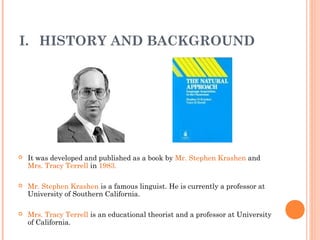
   It was developed and published as a book by Mr. Stephen Krashen and
    Mrs. Tracy Terrell in 1983.

   Mr. Stephen Krashen is a famous linguist. He is currently a professor at
    University of Southern California.

   Mrs. Tracy Terrell is an educational theorist and a professor at University
    of California.
HISTORY AND BACKGROUND


   Natural Approach believes that adults can still acquire second
    languages. The ability of language acquisition does not
    disappear as we grow up.
HISTORY AND BACKGROUND


   Adults have the LAD. Adults also acquire language by
    following the principles of Universal Grammar.

   The different between adult and children acquisition skill is
    that adults have two things to follow when they learn foreign
    language: Acquisition and learning. But, children only acquire
    the languages.
HISTORY AND BACKGROUND


   In the book, Mr. Krashen and Mrs. Terrell consider their
    approach as a traditional method.
OBJECTIVES
   To help adults in learning the foreign language
    naturally.

   The learner will be able to pick up the grammar
    by themselves when they are ready.
THEORIES


   The Acquisition-Learning hypothesis –
     The   most basic steps of all in the Krashen’s theory.
     It’s the most well known among linguists and
      language practitioners.
     The learner has two ways of learning the second
      language, which are the acquired system and the
      learned system.
   The monitor hypothesis
     When  the learner can check and correct language
      output.
THEORIES
   The Natural Order hypothesis
     When  people acquire language by using grammatical
      structures in a predictable order.
   The input hypothesis
     The acquisition of languages are in a predictable
      order. Everybody have the same steps of learning
      acquisition.
THEORIES
   The Affective Filter hypothesis
     When   the learner’s emotional state
      can act as a filter that can prevent
      input from reaching the learner’s
      language acquisition device.
     Filter is up = Negative emotional
      factors and they won’t acquire
      language.
     Filter is down = Learner will learn
      better.
II. CHARACTERISTICS
1. The goal of the approach is aimed at the goal of basic
   personal communication skills – “conversations,
   shopping, listening to the radio,” etc
2. Learners move through three stages: 1) the
   preproduction stage is the development of listening
   comprehension skills, 2) the early production stage,
   marked with errors, 3) the last stage extends the
   production into longer stretches of discourse.
3. The teacher needs to focus on meaning, not on form.
4. The teacher does not correct errors.
5. The most noteworthy characteristic is its advocacy of
   a “silent period,” where preproduction can begin.
6. The silent period encourages the delay of
oral production until speech “emerges.”
7. The Natural Approach encourages the
teacher not to insist that learners speak right
away.
8. The Natural Approach blends well with
things like TPR, which builds the learner’s
language “ego,” and does not force them into
risk-taking situations which could embarrass
them.
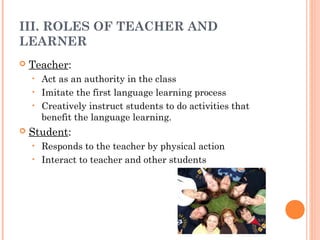
III. ROLES OF TEACHER AND
LEARNER
   Teacher:
    • Act as an authority in the class
    • Imitate the first language learning process
    • Creatively instruct students to do activities that
      benefit the language learning.
   Student:
    • Responds to the teacher by physical action
    • Interact to teacher and other students
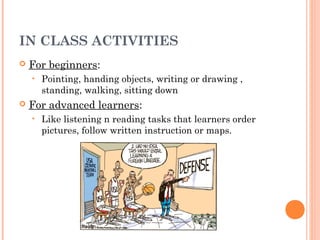
IN CLASS ACTIVITIES
   For beginners:
    •   Pointing, handing objects, writing or drawing ,
        standing, walking, sitting down
   For advanced learners:
    •   Like listening n reading tasks that learners order
        pictures, follow written instruction or maps.
IV. STRENGTHS & WEAKNESSES
   Strengths
    • This method is very easy.
    • Reliable as it’s widely used
    • There’s no grammar instruction in this method.


   Weaknesses
    • It takes long time and learner can do only elementary
      things.
    • It does not suit for those who do not have much time.
    • The method rarely concerns about correctness.
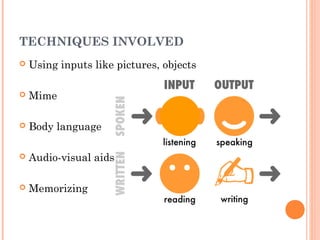
TECHNIQUES INVOLVED
   Using inputs like pictures, objects

   Mime

   Body language

   Audio-visual aids

   Memorizing
V. CONCLUSION
The Natural Approach has, like all other methods, certain
strengths and weaknesses. Its strengths seem to be the
avoidance of risk-taking activities that could damage a learner’s
language ego and develop negative mindsets toward the target
language. Therefore, the Natural Approach excels in building a
safe environment for the learner, which may be beneficial in the
end for ultimate language acquisition.

However, the Natural Approach has serious flaws. Because it
focuses on the “emergence” of language, which is a moment that
will differ for each learner, it may be difficult for the teacher to
manage an entire classroom. Furthermore, there is a question
about how exactly the learner will discern the grammatical
structures of the language without direct instruction. As one
critic wrote, “The decision of which structures to use appears to
be left to some mysterious sort of intuition.”
THANK YOU FOR YOUR
ATTENTION

Natural approach.pptx

  • 1.
  • 2.
    NATURAL APPROACH  History and Background  Characteristics  Roles of Teacher and Learner  Strengths and Weaknesses  Conclusion
  • 3.
    I. HISTORY ANDBACKGROUND  It was developed and published as a book by Mr. Stephen Krashen and Mrs. Tracy Terrell in 1983.  Mr. Stephen Krashen is a famous linguist. He is currently a professor at University of Southern California.  Mrs. Tracy Terrell is an educational theorist and a professor at University of California.
  • 4.
    HISTORY AND BACKGROUND  Natural Approach believes that adults can still acquire second languages. The ability of language acquisition does not disappear as we grow up.
  • 5.
    HISTORY AND BACKGROUND  Adults have the LAD. Adults also acquire language by following the principles of Universal Grammar.  The different between adult and children acquisition skill is that adults have two things to follow when they learn foreign language: Acquisition and learning. But, children only acquire the languages.
  • 6.
    HISTORY AND BACKGROUND  In the book, Mr. Krashen and Mrs. Terrell consider their approach as a traditional method.
  • 7.
    OBJECTIVES  To help adults in learning the foreign language naturally.  The learner will be able to pick up the grammar by themselves when they are ready.
  • 8.
    THEORIES  The Acquisition-Learning hypothesis –  The most basic steps of all in the Krashen’s theory.  It’s the most well known among linguists and language practitioners.  The learner has two ways of learning the second language, which are the acquired system and the learned system.  The monitor hypothesis  When the learner can check and correct language output.
  • 9.
    THEORIES  The Natural Order hypothesis  When people acquire language by using grammatical structures in a predictable order.  The input hypothesis  The acquisition of languages are in a predictable order. Everybody have the same steps of learning acquisition.
  • 10.
    THEORIES  The Affective Filter hypothesis  When the learner’s emotional state can act as a filter that can prevent input from reaching the learner’s language acquisition device.  Filter is up = Negative emotional factors and they won’t acquire language.  Filter is down = Learner will learn better.
  • 11.
    II. CHARACTERISTICS 1. Thegoal of the approach is aimed at the goal of basic personal communication skills – “conversations, shopping, listening to the radio,” etc 2. Learners move through three stages: 1) the preproduction stage is the development of listening comprehension skills, 2) the early production stage, marked with errors, 3) the last stage extends the production into longer stretches of discourse. 3. The teacher needs to focus on meaning, not on form. 4. The teacher does not correct errors. 5. The most noteworthy characteristic is its advocacy of a “silent period,” where preproduction can begin.
  • 12.
    6. The silentperiod encourages the delay of oral production until speech “emerges.” 7. The Natural Approach encourages the teacher not to insist that learners speak right away. 8. The Natural Approach blends well with things like TPR, which builds the learner’s language “ego,” and does not force them into risk-taking situations which could embarrass them.
  • 13.
    III. ROLES OFTEACHER AND LEARNER  Teacher: • Act as an authority in the class • Imitate the first language learning process • Creatively instruct students to do activities that benefit the language learning.  Student: • Responds to the teacher by physical action • Interact to teacher and other students
  • 14.
    IN CLASS ACTIVITIES  For beginners: • Pointing, handing objects, writing or drawing , standing, walking, sitting down  For advanced learners: • Like listening n reading tasks that learners order pictures, follow written instruction or maps.
  • 15.
    IV. STRENGTHS &WEAKNESSES  Strengths • This method is very easy. • Reliable as it’s widely used • There’s no grammar instruction in this method.  Weaknesses • It takes long time and learner can do only elementary things. • It does not suit for those who do not have much time. • The method rarely concerns about correctness.
  • 16.
    TECHNIQUES INVOLVED  Using inputs like pictures, objects  Mime  Body language  Audio-visual aids  Memorizing
  • 17.
    V. CONCLUSION The NaturalApproach has, like all other methods, certain strengths and weaknesses. Its strengths seem to be the avoidance of risk-taking activities that could damage a learner’s language ego and develop negative mindsets toward the target language. Therefore, the Natural Approach excels in building a safe environment for the learner, which may be beneficial in the end for ultimate language acquisition. However, the Natural Approach has serious flaws. Because it focuses on the “emergence” of language, which is a moment that will differ for each learner, it may be difficult for the teacher to manage an entire classroom. Furthermore, there is a question about how exactly the learner will discern the grammatical structures of the language without direct instruction. As one critic wrote, “The decision of which structures to use appears to be left to some mysterious sort of intuition.”
  • 18.
    THANK YOU FORYOUR ATTENTION