
UNDERSTANDING THE FREIGHT RATE SHEET
Deciphering freight rate sheets can be a daunting
task for those with little or no experience in the
shipping industry. However, it is crucial that
shipping customers understand the information
they contain, especially when they will benchmark
their ocean freight prices. Therefore, we have
compiled a list of common terms and
abbreviations that may be found on a freight rate
sheet.
Accessorial Charges - Charges that are applied to
the base tariff rate or base contract rate, e.g.,
bunkers, container, currency, destination/delivery.
Aden War Risk Surcharge - A surcharge on goods
transiting the Gulf of Aden used to
compensate shippers for additional costs including
crew risk compensation, cancellation of
economical speed, and redeployment of vessels.
Ad Valorem - A term from Latin meaning,
“according to value.” An import duty applied as a
percentage of the cargo’s dutiable value.
AI - Abbreviation for “All Inclusive.” The total price
to move cargo from origin to destination, inclusive
of all charges (limited to transportation costs).
Arrival Notice - A notification by carrier of ship’s
arrival to the consignee, the “Notify Party,” and –
when applicable – the “Also Notify Party.”
BAF - Abbreviation for “Bunker Adjustment
Factor.” Used to compensate steamship lines for
fluctuating fuel costs. Sometimes called “Fuel
Adjustment Factor” or FAF.
Base Rate - The cost of shipping a container from
one point to another. Rates fluctuate frequently
based on a number of different factors.
BL Fee - “Bill of Lading Fee.” A fee charged by the
shipping line for the processing of the bill of lading
on behalf of the client.
Base Rate - The cost of shipping a container from
one point to another. Rates fluctuate frequently
based on a number of different factors.
BL Fee - “Bill of Lading Fee.” A fee charged by the
shipping line for the processing of the bill of lading
on behalf of the client.
BUC - Abbreviation for “Bunker Charge.” An extra
charge sometimes added to steamship freight rates;
justified by higher fuel costs. Also known as Fuel
Adjustment Factor or FAF.
CAF - Abbreviation for “Currency Adjustment
Factor.” A charge expressed as a percentage of a
base rate that is applied to compensate ocean
carriers of currency fluctuations.
Cargo Data Declaration Fee - A surcharge assessed for
the additional costs of declaring cargo information in
advance to the European Union authorities as required
for authorities to evaluate any potential security and
safety threats.
Carrier - Any person or entity who, in a contract of
carriage, undertakes to perform or to procure the perfor-
mance of carriage by rail, road, sea, air, inland waterway
or by a combination of such modes.
CBM (CM) - Abbreviation for “Cubic Meter.”
CFS - Abbreviation for “Container Freight Station.” A
shipping dock where cargo is loaded (“stuffed”) into or
unloaded (“stripped”) from containers. Generally, this
involves less than container load shipments, although
small shipments destined to the same consignee are
often consolidated. Container reloading from/to rail or
motor carrier equipment is a typical activity. These
facilities can be located in container yards or off dock.
Chassis Utilization Surcharge - A fee imposed for the
use of a chassis in conjunction with the shipping
container to facilitate overland transportation.
CL - Abbreviation for “Container load”.
COD - Abbreviation for “Collect (cash) on Delivery.”
Congestion - The term used for situations where ships
have to queue up and wait for a spot so they can load or
offload.
Container Yard (CY) - A materials–handling/storage
facility used for completely unitized loads in containers
and/or empty containers. Commonly referred to as CY.
CSF - Abbreviation for “Carrier Security Fee.” Charges for
the security of cargo during the shipment.
Customs - A government agency charged with enforcing
the rules passed to protect the country’s import and ex-
port revenues.
Customs Filing Fee - A fee paid to the customs broker
for arranging your customs clearance.
Customs Formalities - Requirements referring to
customs regulations including documentation, security,
information and physical inspection responsibilities.
CYRC - Abbreviation for “Container Yard Receiving
Charge.”
DDC - Abbreviation for “Destination Delivery Charge.” A
charge, based on container size, that is applied to many
tariffs to cargo. This charge is considered accessorial and
is added to the base ocean freight. This charge covers
crane lifts off the vessel, drayage of the container within
the terminal and gate fees at the terminal operation.
Demurrage - A penalty charge against shippers
or consignees for delaying the carrier’s equipment or
vessel beyond the allowed free time. Demurrage applies
to cargo; detention applies to equipment. If you store a
container at the port beyond free days, then demurrage
and detention apply. If you keep a container for too long
on any other premise (not on the port’s premises), then
only detention applies.
Destination – The place to which a shipment
is consigned or the place where the carrier actually turns
over cargo to the consignee or his agent.
Detention - A penalty charge against shippers
or consignees for delaying carrier’s equipment beyond
allowed time. Demurrage applies to cargo; detention
applies to equipment. If you store a container at the port
beyond free days, then demurrage and detention apply. If
you keep a container for too long on any other premise
(not on the port’s premises), then only detention applies
DTHC - Abbreviation for “Destination Terminal
Handling Charge.”
Dutiable Value - The amount on which an Ad Valorem
or customs duty is calculated.
EBS - Abbreviation for “Emergency Bunker Surcharge.” A
surcharge added to the cost of freight to cover fuel costs.
EIS - Abbreviation for “Equipment Imbalance
Surcharge.” A surcharge on an ocean freight rate,
imposed by shipping lines, to recover costs related to
removing large quantities of empty containers from a
country or countries where there is no export use for
those containers that had been previously imported into
those places. The charge is usually a flat rate per
container, and it is not necessarily applied in all trades or
at all times, rather it is only applied when such trade
imbalances necessitate large expenditure on shifting
empty containers from one place to another.
ENS - Abbreviation for “Entry Summary Declaration.” An
ENS is an electronic declaration of goods being carried
into the customs territory of the community.
Environment Fee Destination - Environmental
surcharges imposed by the destination port. Covers
various contingencies such as hydrocarbon spill cleanup
costs and other mandated fees.
ERR - Abbreviation for “Emergency Rate Restoration.” A
surcharge added to the cost of freight to cover increases
in shipping costs.
ERS - Abbreviation for “Equipment Repositioning
Surcharge.” A fee imposed when a shipper requests that
the carrier makes empty containers available that must
be moved from one location to another
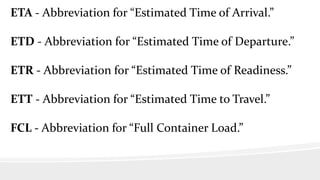
ETA - Abbreviation for “Estimated Time of Arrival.”
ETD - Abbreviation for “Estimated Time of Departure.”
ETR - Abbreviation for “Estimated Time of Readiness.”
ETT - Abbreviation for “Estimated Time to Travel.”
FCL - Abbreviation for “Full Container Load.”
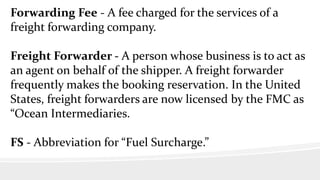
Forwarding Fee - A fee charged for the services of a
freight forwarding company.
Freight Forwarder - A person whose business is to act as
an agent on behalf of the shipper. A freight forwarder
frequently makes the booking reservation. In the United
States, freight forwarders are now licensed by the FMC as
“Ocean Intermediaries.
FS - Abbreviation for “Fuel Surcharge.”
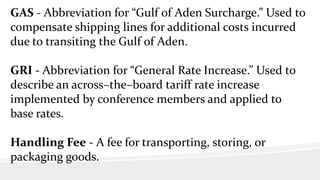
GAS - Abbreviation for “Gulf of Aden Surcharge.” Used to
compensate shipping lines for additional costs incurred
due to transiting the Gulf of Aden.
GRI - Abbreviation for “General Rate Increase.” Used to
describe an across–the–board tariff rate increase
implemented by conference members and applied to
base rates.
Handling Fee - A fee for transporting, storing, or
packaging goods.
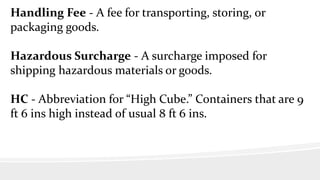
Handling Fee - A fee for transporting, storing, or
packaging goods.
Hazardous Surcharge - A surcharge imposed for
shipping hazardous materials or goods.
HC - Abbreviation for “High Cube.” Containers that are 9
ft 6 ins high instead of usual 8 ft 6 ins.
ISF - Abbreviation for “Importer Security Filing.” A US
Customs and Border Protection (CBP) regulation
requiring importers and vessel carriers to provide data
electronically to CBP for inbound ocean shipments. Also
known as 10+2.
ISPS - Abbreviation for “International Ship and Port
Security Code.” It is an amendment to the Safety of Life at
Sea (SOLAS) Convention (1974/1988) on minimum
security arrangements for ships, ports and government
agencies. Having come into force in 2004, it prescribes
responsibilities to governments, shipping companies,
shipboard personnel, and port/facility personnel to
“detect security threats and take preventative measures
against security incidents affecting ships or port facilities
used in international trade.”
LCL (LTL) - Abbreviation for “Less than Container Load”
or “Less than Truck Load.” The quantity of freight which
is less than that required for the application of a
container load rate.
MT - Abbreviation for “Metric Ton.”
NBC - Abbreviation for “New Bunker Charge.”
NOx - Abbreviation for “Nitrogen Oxides.” Refers to the
gasses NO and NO2 produced from the reaction of
nitrogen and oxygen gasses in the air during combustion.
Ocean Rate - See Base Rate
Origin - Location where shipment begins its movement.
OWS - Abbreviation for “Over Weight Surcharge.”
Piracy Surcharge - A charge assessed to compensate
shipping companies for increased costs associated with
avoiding piracy and hijacking.
POD - Abbreviation for “Port of Destination.”
POL - Abbreviation for “Port of Loading.”
Port Dues - Fees charged by the harbor authority on
ships using the port`s facilities.
Port of Entry - Port where cargo is unloaded and enters
a country.
Port of Exit - Place where cargo is loaded and leaves a
country.
PSS - Abbreviation for “Peak Season Surcharge.”
Release Fee - A fee charged by the destination port to
release cargo for further movement or action.
SCS - Abbreviation for “Suez Canal Surcharge.” Used to
compensate shipping companies for additional costs
incurred due to transiting the Suez Canal.
Sea Freight Rate - See Base Rate
SES - Abbreviation for “Special Equipment Surcharge.”
Shipper - The person or company who is usually the
supplier or owner of commodities shipped. Also called
Consignor.
Surcharge - An extra or additional charge.
Surtax - An extra or additional tax.
TAD - Abbreviation for “Transit Accompanying
Document.” A document accompanying uncleared goods
during transit from one authorized location to another.
THC - Abbreviation for “Terminal Handling Charge.”
Sometimes referred to as Capatazia, in particular in
Brazil.
THC Destination - Terminal Handling Charges
incurred at the destination port.
THC Origin - Terminal Handling Charges incurred at
the port of origin.
Terminal Charge - A charge made for a service
performed in a carrier’s terminal area.
Terror - The threat of terrorist acts against the shipping
and port industry.
TEU - Abbreviation for “Twenty-foot Equivalent Unit.”
Wharfage - A Charge assessed by a pier or dock owner
against freight handled over the pier or dock or against a
steamship company using the pier or dock.
3PL - Abbreviation for “Third Party Logistics.” A
company that provides logistics services to other
companies for some or all of their logistics needs. It
typically includes warehousing and transportation
services. Most 3PL’s also have freight forwarding licenses.
Did we miss any or was anything unclear? Let us know!
Want to know how Logical Maritime Services can
help you discover savings in your ocean freight?
Contact us on +233 24 302 6201.

UNDERSTANDING THE FREIGHT RATE SHEET

  • 1.
  • 2.
    Deciphering freight ratesheets can be a daunting task for those with little or no experience in the shipping industry. However, it is crucial that shipping customers understand the information they contain, especially when they will benchmark their ocean freight prices. Therefore, we have compiled a list of common terms and abbreviations that may be found on a freight rate sheet.
  • 3.
    Accessorial Charges -Charges that are applied to the base tariff rate or base contract rate, e.g., bunkers, container, currency, destination/delivery. Aden War Risk Surcharge - A surcharge on goods transiting the Gulf of Aden used to compensate shippers for additional costs including crew risk compensation, cancellation of economical speed, and redeployment of vessels.
  • 4.
    Ad Valorem -A term from Latin meaning, “according to value.” An import duty applied as a percentage of the cargo’s dutiable value. AI - Abbreviation for “All Inclusive.” The total price to move cargo from origin to destination, inclusive of all charges (limited to transportation costs).
  • 5.
    Arrival Notice -A notification by carrier of ship’s arrival to the consignee, the “Notify Party,” and – when applicable – the “Also Notify Party.” BAF - Abbreviation for “Bunker Adjustment Factor.” Used to compensate steamship lines for fluctuating fuel costs. Sometimes called “Fuel Adjustment Factor” or FAF.
  • 6.
    Base Rate -The cost of shipping a container from one point to another. Rates fluctuate frequently based on a number of different factors. BL Fee - “Bill of Lading Fee.” A fee charged by the shipping line for the processing of the bill of lading on behalf of the client.
  • 7.
    Base Rate -The cost of shipping a container from one point to another. Rates fluctuate frequently based on a number of different factors. BL Fee - “Bill of Lading Fee.” A fee charged by the shipping line for the processing of the bill of lading on behalf of the client.
  • 8.
    BUC - Abbreviationfor “Bunker Charge.” An extra charge sometimes added to steamship freight rates; justified by higher fuel costs. Also known as Fuel Adjustment Factor or FAF. CAF - Abbreviation for “Currency Adjustment Factor.” A charge expressed as a percentage of a base rate that is applied to compensate ocean carriers of currency fluctuations.
  • 9.
    Cargo Data DeclarationFee - A surcharge assessed for the additional costs of declaring cargo information in advance to the European Union authorities as required for authorities to evaluate any potential security and safety threats. Carrier - Any person or entity who, in a contract of carriage, undertakes to perform or to procure the perfor- mance of carriage by rail, road, sea, air, inland waterway or by a combination of such modes.
  • 10.
    CBM (CM) -Abbreviation for “Cubic Meter.” CFS - Abbreviation for “Container Freight Station.” A shipping dock where cargo is loaded (“stuffed”) into or unloaded (“stripped”) from containers. Generally, this involves less than container load shipments, although small shipments destined to the same consignee are often consolidated. Container reloading from/to rail or motor carrier equipment is a typical activity. These facilities can be located in container yards or off dock.
  • 11.
    Chassis Utilization Surcharge- A fee imposed for the use of a chassis in conjunction with the shipping container to facilitate overland transportation. CL - Abbreviation for “Container load”. COD - Abbreviation for “Collect (cash) on Delivery.” Congestion - The term used for situations where ships have to queue up and wait for a spot so they can load or offload.
  • 12.
    Container Yard (CY)- A materials–handling/storage facility used for completely unitized loads in containers and/or empty containers. Commonly referred to as CY. CSF - Abbreviation for “Carrier Security Fee.” Charges for the security of cargo during the shipment. Customs - A government agency charged with enforcing the rules passed to protect the country’s import and ex- port revenues.
  • 13.
    Customs Filing Fee- A fee paid to the customs broker for arranging your customs clearance. Customs Formalities - Requirements referring to customs regulations including documentation, security, information and physical inspection responsibilities. CYRC - Abbreviation for “Container Yard Receiving Charge.”
  • 14.
    DDC - Abbreviationfor “Destination Delivery Charge.” A charge, based on container size, that is applied to many tariffs to cargo. This charge is considered accessorial and is added to the base ocean freight. This charge covers crane lifts off the vessel, drayage of the container within the terminal and gate fees at the terminal operation.
  • 15.
    Demurrage - Apenalty charge against shippers or consignees for delaying the carrier’s equipment or vessel beyond the allowed free time. Demurrage applies to cargo; detention applies to equipment. If you store a container at the port beyond free days, then demurrage and detention apply. If you keep a container for too long on any other premise (not on the port’s premises), then only detention applies.
  • 16.
    Destination – Theplace to which a shipment is consigned or the place where the carrier actually turns over cargo to the consignee or his agent. Detention - A penalty charge against shippers or consignees for delaying carrier’s equipment beyond allowed time. Demurrage applies to cargo; detention applies to equipment. If you store a container at the port beyond free days, then demurrage and detention apply. If you keep a container for too long on any other premise (not on the port’s premises), then only detention applies
  • 17.
    DTHC - Abbreviationfor “Destination Terminal Handling Charge.” Dutiable Value - The amount on which an Ad Valorem or customs duty is calculated. EBS - Abbreviation for “Emergency Bunker Surcharge.” A surcharge added to the cost of freight to cover fuel costs.
  • 18.
    EIS - Abbreviationfor “Equipment Imbalance Surcharge.” A surcharge on an ocean freight rate, imposed by shipping lines, to recover costs related to removing large quantities of empty containers from a country or countries where there is no export use for those containers that had been previously imported into those places. The charge is usually a flat rate per container, and it is not necessarily applied in all trades or at all times, rather it is only applied when such trade imbalances necessitate large expenditure on shifting empty containers from one place to another.
  • 19.
    ENS - Abbreviationfor “Entry Summary Declaration.” An ENS is an electronic declaration of goods being carried into the customs territory of the community. Environment Fee Destination - Environmental surcharges imposed by the destination port. Covers various contingencies such as hydrocarbon spill cleanup costs and other mandated fees.
  • 20.
    ERR - Abbreviationfor “Emergency Rate Restoration.” A surcharge added to the cost of freight to cover increases in shipping costs. ERS - Abbreviation for “Equipment Repositioning Surcharge.” A fee imposed when a shipper requests that the carrier makes empty containers available that must be moved from one location to another
  • 21.
    ETA - Abbreviationfor “Estimated Time of Arrival.” ETD - Abbreviation for “Estimated Time of Departure.” ETR - Abbreviation for “Estimated Time of Readiness.” ETT - Abbreviation for “Estimated Time to Travel.” FCL - Abbreviation for “Full Container Load.”
  • 22.
    Forwarding Fee -A fee charged for the services of a freight forwarding company. Freight Forwarder - A person whose business is to act as an agent on behalf of the shipper. A freight forwarder frequently makes the booking reservation. In the United States, freight forwarders are now licensed by the FMC as “Ocean Intermediaries. FS - Abbreviation for “Fuel Surcharge.”
  • 23.
    GAS - Abbreviationfor “Gulf of Aden Surcharge.” Used to compensate shipping lines for additional costs incurred due to transiting the Gulf of Aden. GRI - Abbreviation for “General Rate Increase.” Used to describe an across–the–board tariff rate increase implemented by conference members and applied to base rates. Handling Fee - A fee for transporting, storing, or packaging goods.
  • 24.
    Handling Fee -A fee for transporting, storing, or packaging goods. Hazardous Surcharge - A surcharge imposed for shipping hazardous materials or goods. HC - Abbreviation for “High Cube.” Containers that are 9 ft 6 ins high instead of usual 8 ft 6 ins.
  • 25.
    ISF - Abbreviationfor “Importer Security Filing.” A US Customs and Border Protection (CBP) regulation requiring importers and vessel carriers to provide data electronically to CBP for inbound ocean shipments. Also known as 10+2.
  • 26.
    ISPS - Abbreviationfor “International Ship and Port Security Code.” It is an amendment to the Safety of Life at Sea (SOLAS) Convention (1974/1988) on minimum security arrangements for ships, ports and government agencies. Having come into force in 2004, it prescribes responsibilities to governments, shipping companies, shipboard personnel, and port/facility personnel to “detect security threats and take preventative measures against security incidents affecting ships or port facilities used in international trade.”
  • 27.
    LCL (LTL) -Abbreviation for “Less than Container Load” or “Less than Truck Load.” The quantity of freight which is less than that required for the application of a container load rate. MT - Abbreviation for “Metric Ton.” NBC - Abbreviation for “New Bunker Charge.”
  • 28.
    NOx - Abbreviationfor “Nitrogen Oxides.” Refers to the gasses NO and NO2 produced from the reaction of nitrogen and oxygen gasses in the air during combustion. Ocean Rate - See Base Rate Origin - Location where shipment begins its movement. OWS - Abbreviation for “Over Weight Surcharge.”
  • 29.
    Piracy Surcharge -A charge assessed to compensate shipping companies for increased costs associated with avoiding piracy and hijacking. POD - Abbreviation for “Port of Destination.” POL - Abbreviation for “Port of Loading.” Port Dues - Fees charged by the harbor authority on ships using the port`s facilities.
  • 30.
    Port of Entry- Port where cargo is unloaded and enters a country. Port of Exit - Place where cargo is loaded and leaves a country. PSS - Abbreviation for “Peak Season Surcharge.” Release Fee - A fee charged by the destination port to release cargo for further movement or action.
  • 31.
    SCS - Abbreviationfor “Suez Canal Surcharge.” Used to compensate shipping companies for additional costs incurred due to transiting the Suez Canal. Sea Freight Rate - See Base Rate SES - Abbreviation for “Special Equipment Surcharge.” Shipper - The person or company who is usually the supplier or owner of commodities shipped. Also called Consignor.
  • 32.
    Surcharge - Anextra or additional charge. Surtax - An extra or additional tax. TAD - Abbreviation for “Transit Accompanying Document.” A document accompanying uncleared goods during transit from one authorized location to another. THC - Abbreviation for “Terminal Handling Charge.” Sometimes referred to as Capatazia, in particular in Brazil.
  • 33.
    THC Destination -Terminal Handling Charges incurred at the destination port. THC Origin - Terminal Handling Charges incurred at the port of origin. Terminal Charge - A charge made for a service performed in a carrier’s terminal area. Terror - The threat of terrorist acts against the shipping and port industry.
  • 34.
    TEU - Abbreviationfor “Twenty-foot Equivalent Unit.” Wharfage - A Charge assessed by a pier or dock owner against freight handled over the pier or dock or against a steamship company using the pier or dock. 3PL - Abbreviation for “Third Party Logistics.” A company that provides logistics services to other companies for some or all of their logistics needs. It typically includes warehousing and transportation services. Most 3PL’s also have freight forwarding licenses.
  • 35.
    Did we missany or was anything unclear? Let us know! Want to know how Logical Maritime Services can help you discover savings in your ocean freight? Contact us on +233 24 302 6201.