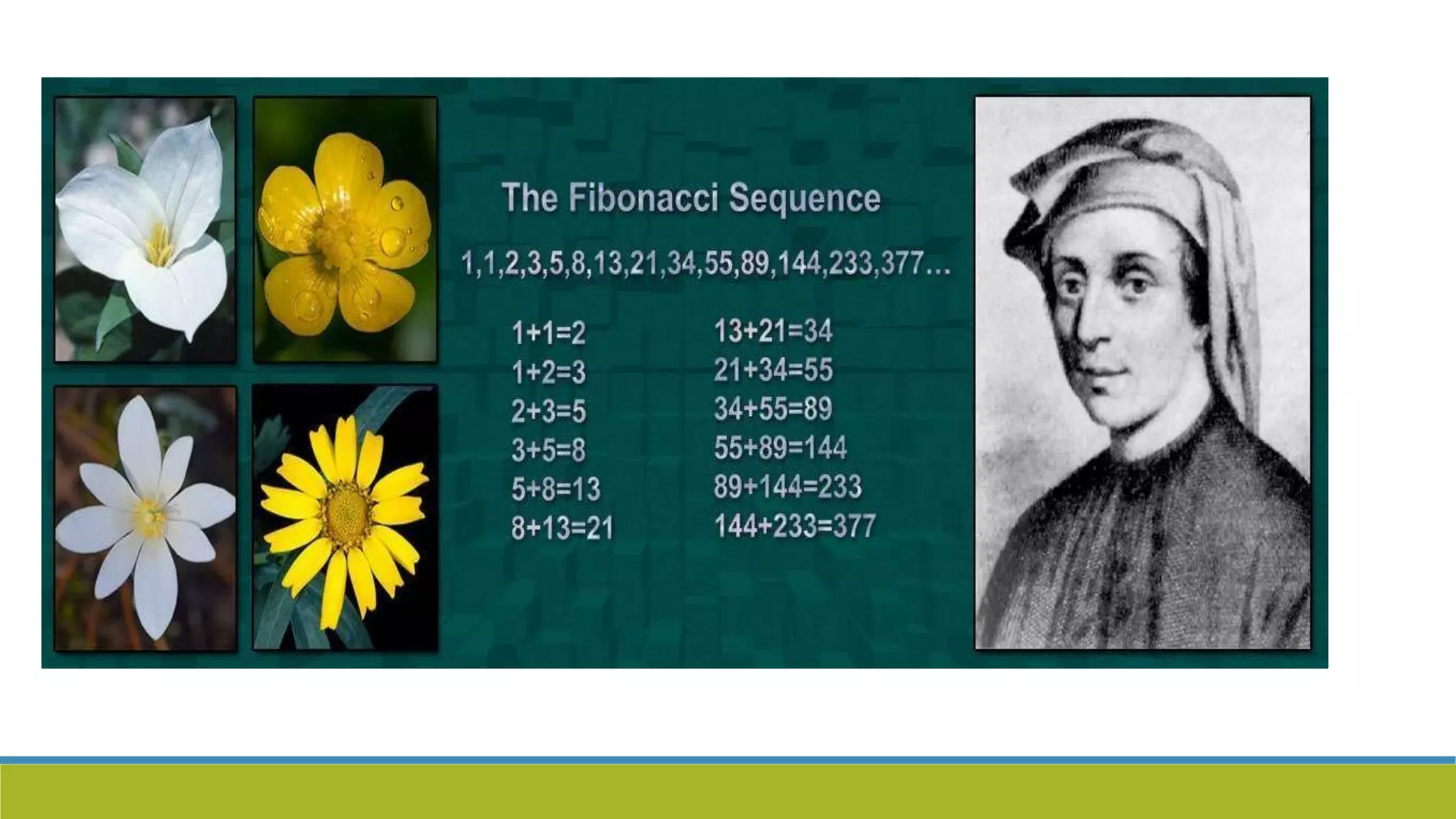
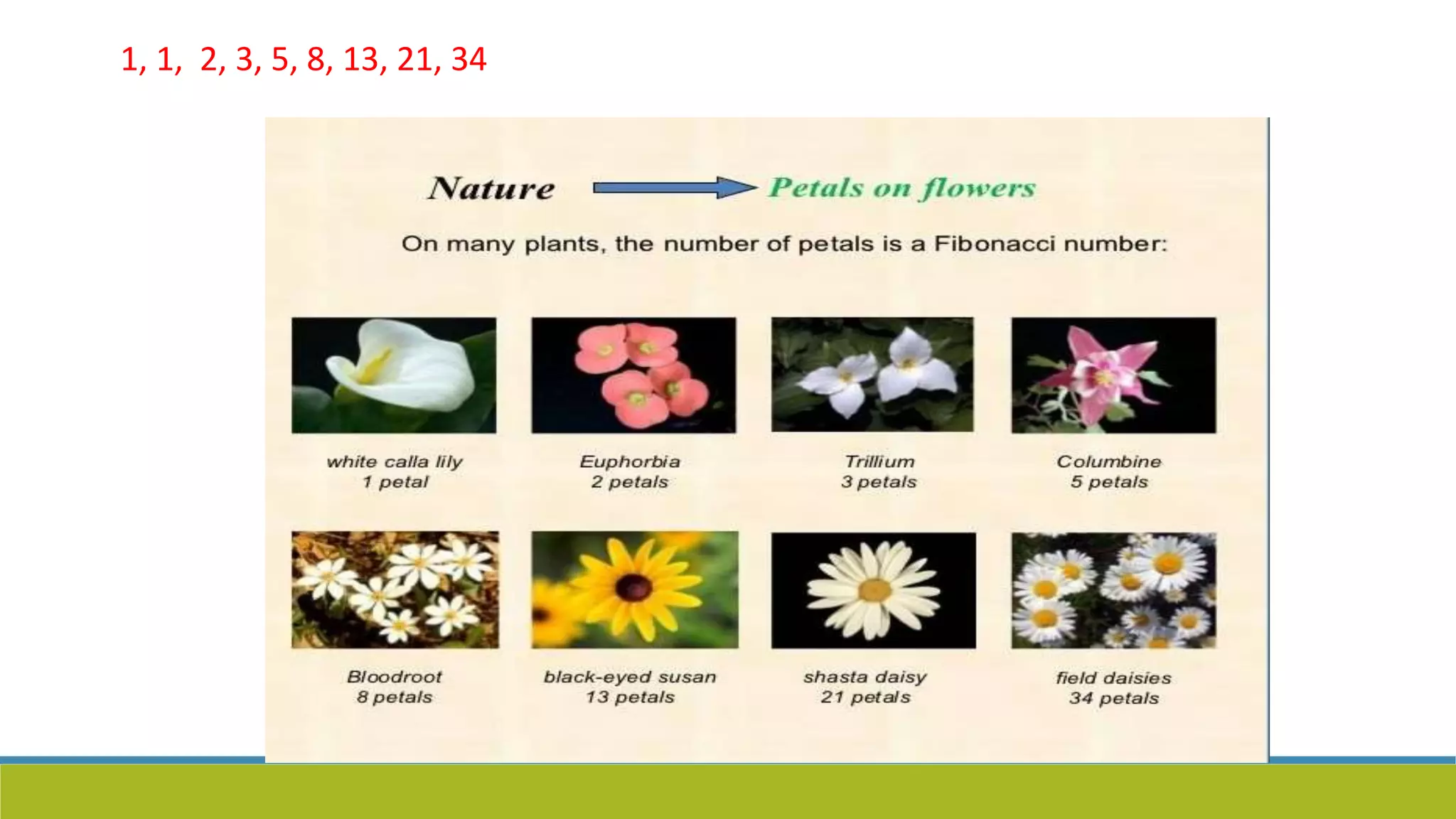
1, 1, 2, 3, 5, 8, 13, 21, 34
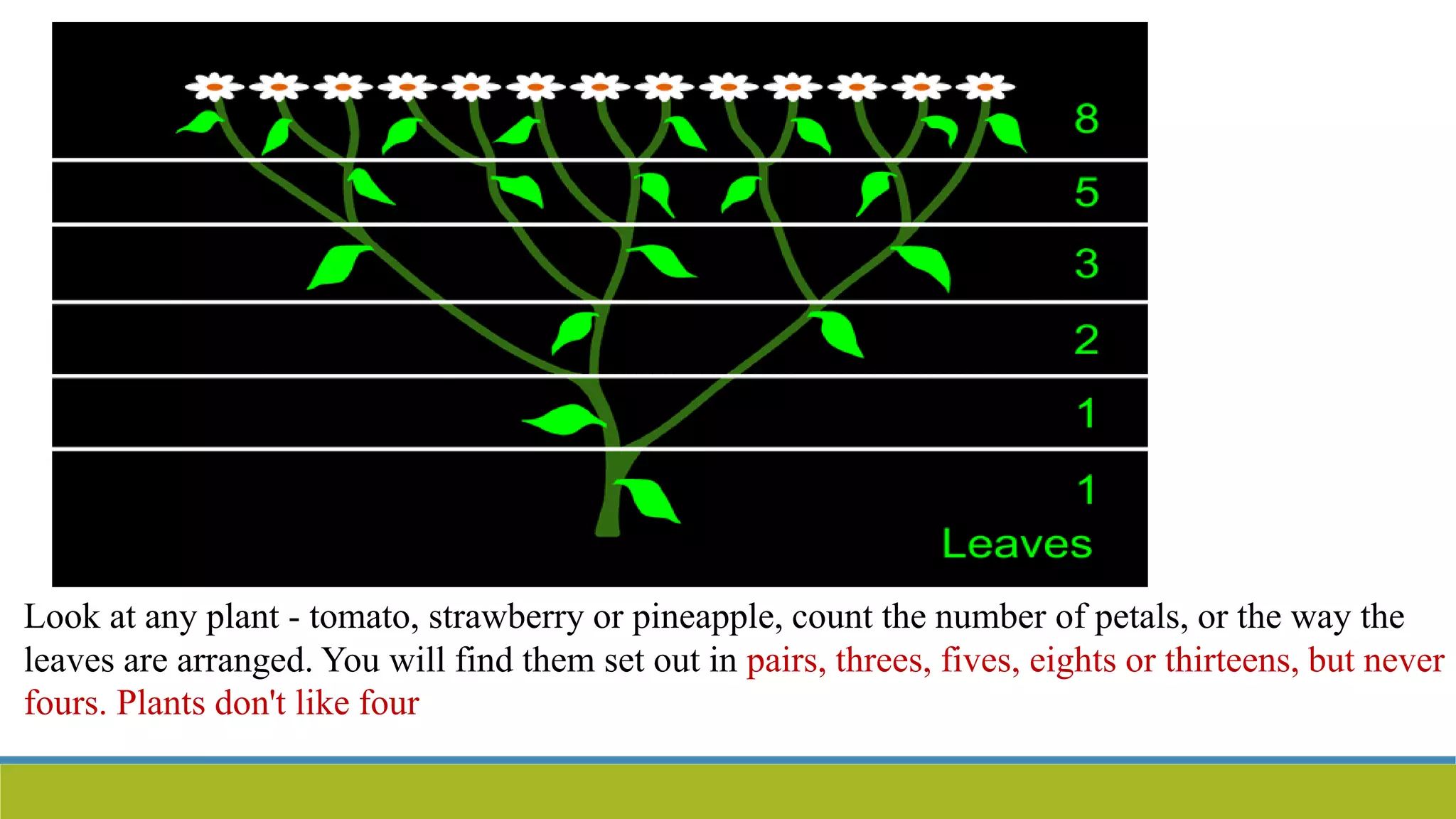
Look at any plant - tomato, strawberry or pineapple, count the number of petals, or the way the
leaves are arranged. You will find them set out in pairs, threes, fives, eights or thirteens, but never
fours. Plants don't like four
Fibonacci Sequence
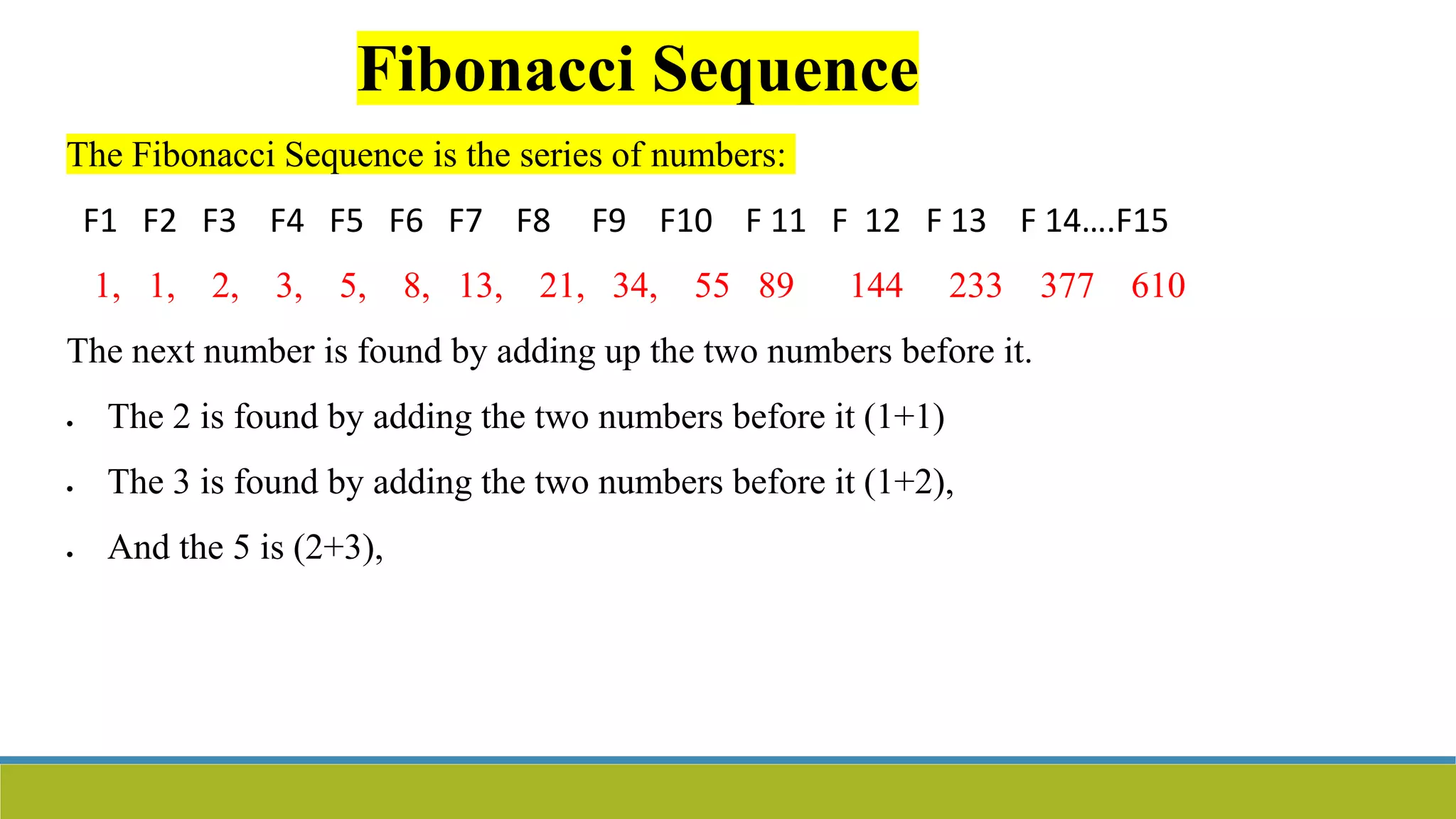
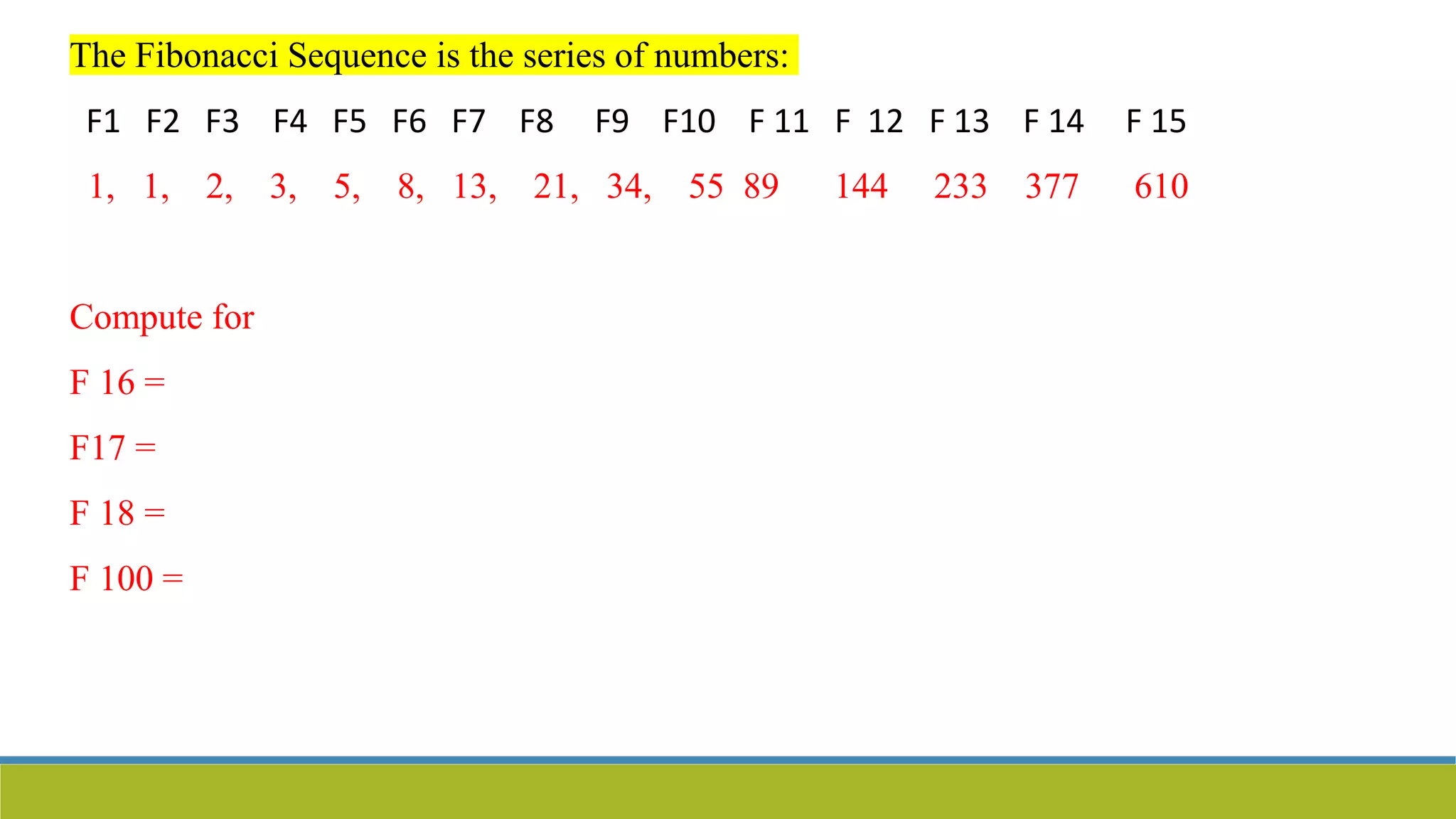
The Fibonacci Sequence is the series of numbers:
F1 F2 F3 F4 F5 F6 F7 F8 F9 F10 F 11 F 12 F 13 F 14….F15
1, 1, 2, 3, 5, 8, 13, 21, 34, 55 89 144 233 377 610
The next number is found by adding up the two numbers before it.
 The 2 is found by adding the two numbers before it (1+1)
 The 3 is found by adding the two numbers before it (1+2),
 And the 5 is (2+3),
Example: the 8th term is
the 7th term plus the 6th term:
x8 = x7 + x6
F1 F2 F3 F4 F5 F6 F7 F8 F9 F10 F 11 F 12 F 13 F 14….F15
1, 1, 2, 3, 5, 8, 13, 21, 34, 55 89 144 233 377 610
The Fibonacci Sequence is the series of numbers:
F1 F2 F3 F4 F5 F6 F7 F8 F9 F10 F 11 F 12 F 13 F 14 F 15
1, 1, 2, 3, 5, 8, 13, 21, 34, 55 89 144 233 377 610
Compute for
F 16 =
F17 =
F 18 =
F 100 =
Binet's Formula
Binet's formula is an explicit formula used to find the nth term
of the Fibonacci sequence.
It is so named because it was derived by mathematician
Jacques Philippe Marie Binet
F n = 1 + √ 5 n
2
√ 5
Using scientific calculator
Press the following keys 1 + √ 5 = / 2 = ^ 17 = / √ 5 =
• Use the appropriate key for division
• F 17 = ?
• F 17 = 1596.99 or 1597
• F 20 = ?
• F 20 = 6765 1 + √ 5 = / 2 = ^ 20 / √ 5 =
1.345678 x 10 ^ 10
1.3457 x 10 ^ 10
2.3942468 E – 8
2.3942 x 10 ^ 8
F153 = 4.2230 x 10 ^ 31
F 260 = 9.7118 x 10 ^ 53
F162 = 3.2101 x 10 ^ 33
F33 = 3,524,578
F 79 = 1.4472 x 10 ^ 16
F 143 = 3.4336 x 10 ^ 29

Fibonacci-Sequence

  • 3.
    1, 1, 2,3, 5, 8, 13, 21, 34
  • 4.
    Look at anyplant - tomato, strawberry or pineapple, count the number of petals, or the way the leaves are arranged. You will find them set out in pairs, threes, fives, eights or thirteens, but never fours. Plants don't like four
  • 5.
    Fibonacci Sequence The FibonacciSequence is the series of numbers: F1 F2 F3 F4 F5 F6 F7 F8 F9 F10 F 11 F 12 F 13 F 14….F15 1, 1, 2, 3, 5, 8, 13, 21, 34, 55 89 144 233 377 610 The next number is found by adding up the two numbers before it.  The 2 is found by adding the two numbers before it (1+1)  The 3 is found by adding the two numbers before it (1+2),  And the 5 is (2+3),
  • 6.
    Example: the 8thterm is the 7th term plus the 6th term: x8 = x7 + x6 F1 F2 F3 F4 F5 F6 F7 F8 F9 F10 F 11 F 12 F 13 F 14….F15 1, 1, 2, 3, 5, 8, 13, 21, 34, 55 89 144 233 377 610
  • 7.
    The Fibonacci Sequenceis the series of numbers: F1 F2 F3 F4 F5 F6 F7 F8 F9 F10 F 11 F 12 F 13 F 14 F 15 1, 1, 2, 3, 5, 8, 13, 21, 34, 55 89 144 233 377 610 Compute for F 16 = F17 = F 18 = F 100 =
  • 8.
    Binet's Formula Binet's formulais an explicit formula used to find the nth term of the Fibonacci sequence. It is so named because it was derived by mathematician Jacques Philippe Marie Binet
  • 9.
    F n =1 + √ 5 n 2 √ 5 Using scientific calculator Press the following keys 1 + √ 5 = / 2 = ^ 17 = / √ 5 = • Use the appropriate key for division • F 17 = ? • F 17 = 1596.99 or 1597 • F 20 = ? • F 20 = 6765 1 + √ 5 = / 2 = ^ 20 / √ 5 =
  • 10.
    1.345678 x 10^ 10 1.3457 x 10 ^ 10 2.3942468 E – 8 2.3942 x 10 ^ 8 F153 = 4.2230 x 10 ^ 31 F 260 = 9.7118 x 10 ^ 53 F162 = 3.2101 x 10 ^ 33 F33 = 3,524,578 F 79 = 1.4472 x 10 ^ 16 F 143 = 3.4336 x 10 ^ 29