The University of Sydney Page 1
Practice-based research
methods: Challenges
and potentials
Seminar and MasterClass
Lina Markauskaitė
11 December 2018 @University of
Southern Denmark, Kolding
The University of Sydney Page 2
Background
The University of Sydney Page 3
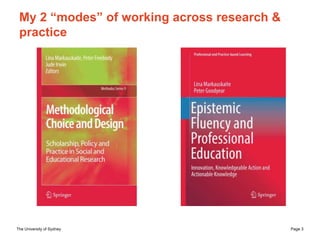
My 2 “modes” of working across research &
practice
The University of Sydney Page 4
Main points
1. Research useful for teaching and learning (T&L)
changes together with T&L practices
2. Our challenge is to create enduring dynamic
connections between ways of engaging in T&L practices
and in research practices
3. Practice-based research is epistemic craftsmanship
4. We need Basic and Use-inspired basic research of T&L
practice
Note: When I say ‘practice’ I mean ‘T&L practice’. In fact, I
will talk about two practices: ‘T&L practice’ and ‘Research
practice’.
The University of Sydney Page 5
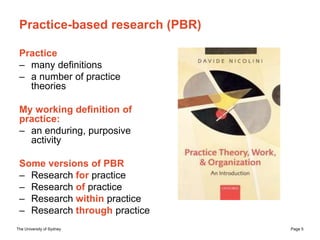
Practice-based research (PBR)
Practice
– many definitions
– a number of practice
theories
My working definition of
practice:
– an enduring, purposive
activity
Some versions of PBR
– Research for practice
– Research of practice
– Research within practice
– Research through practice
The University of Sydney Page 6
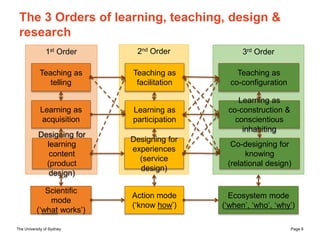
3rd Order2nd Order1st Order
The 3 Orders of learning, teaching, design &
research
Teaching as
telling
Learning as
acquisition
Designing for
learning
content
(product
design)
Teaching as
facilitation
Learning as
participation
Designing for
experiences
(service
design)
Teaching as
co-configuration
Learning as
co-construction &
conscientious
inhabiting
Co-designing for
knowing
(relational design)
Scientific
mode
(‘what works’)
Action mode
(‘know how’)
Ecosystem mode
(‘when’, ‘who’, ‘why’)
The University of Sydney Page 7
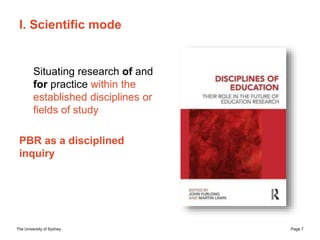
I. Scientific mode
Situating research of and
for practice within the
established disciplines or
fields of study
PBR as a disciplined
inquiry
The University of Sydney Page 8
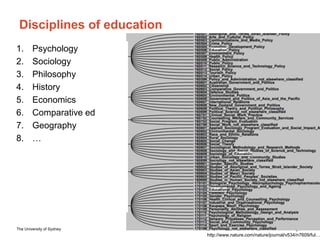
Disciplines of education
1. Psychology
2. Sociology
3. Philosophy
4. History
5. Economics
6. Comparative ed
7. Geography
8. …
http://www.nature.com/nature/journal/v534/n7609/ful…
The University of Sydney Page 9
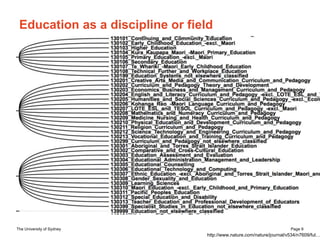
Education as a discipline or field
http://www.nature.com/nature/journal/v534/n7609/ful…
The University of Sydney Page 10
Discipline as…
…a set of shared
dispositions about:
a) Objects
b) Evidence
c) Methods
d) Expertise
Benefits
– Gives intellectual “home”
– Enables production of
cumulative knowledge
– Values intellectual agency
But
– Imposes constrains on
knowledge development
– External usefulness is rarely the
main concern
https://images.pexels.com
The University of Sydney Page 11
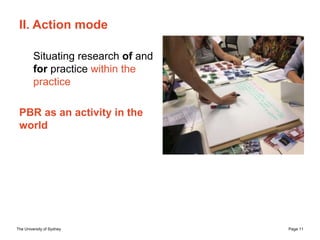
II. Action mode
Situating research of and
for practice within the
practice
PBR as an activity in the
world
The University of Sydney Page 12
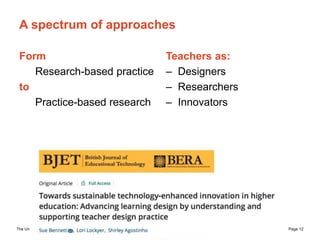
A spectrum of approaches
Form
Research-based practice
to
Practice-based research
Teachers as:
– Designers
– Researchers
– Innovators
The University of Sydney Page 13
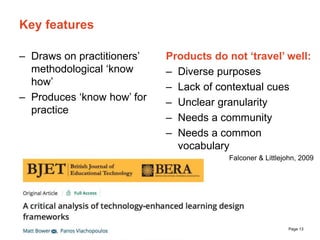
Key features
– Draws on practitioners’
methodological ‘know
how’
– Produces ‘know how’ for
practice
Products do not ‘travel’ well:
– Diverse purposes
– Lack of contextual cues
– Unclear granularity
– Needs a community
– Needs a common
vocabulary
Falconer & Littlejohn, 2009
The University of Sydney Page 14
III. Ecosystem mode
Situating research for and
of practice within a self-
improving ecosystem
PBR as a principled-
reflexive action within a
multilayered, dynamic
ecosystem
Source: Senge, 2000
The University of Sydney Page 15
PBR as an ecosystem on its own
Models for linking research
to practice
1. Research Development &
Diffusion
2. Evidence-Based Practice
3. Boundary-Crossing
Practices
4. Knowledge Communities
A combination of all 4
modes is necessary
Based on Broekkamp & van Hout-Wolters, 2007
From Goodyear, 2011
Requires epistemic fluency
& craftsmanship
– Different disciplines
– Different inquiry traditions
– Different perspectives
The University of Sydney Page 16
EXAMPLE 1:
‘Easy’ way for doing PBR
Following a tradition
https://images.pexels.com
The University of Sydney Page 17
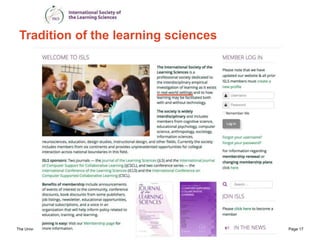
From ISLS Vision 2009
Tradition of the learning sciences
The University of Sydney Page 18
Tradition of the learning sciences
“Learning Sciences (ISLS)… seek to
advance the sciences and practices of
learning, broadly speaking, with special
attention to how they may be augmented
by technology.”
“ISLS is committed to application in
context (not only in laboratories), to
rigorous empirical research (not simply
philosophy), and to design and
application (not only theory)”
From ISLS Vision 2009
The University of Sydney Page 19
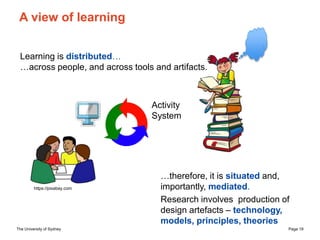
A view of learning
Learning is distributed…
…across people, and across tools and artifacts.
Activity
System
…therefore, it is situated and,
importantly, mediated.
Research involves production of
design artefacts – technology,
models, principles, theories
https://pixabay.com
The University of Sydney Page 20
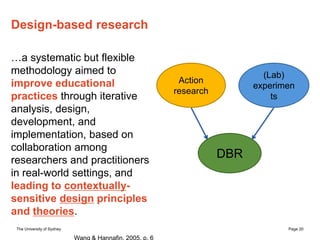
Design-based research
…a systematic but flexible
methodology aimed to
improve educational
practices through iterative
analysis, design,
development, and
implementation, based on
collaboration among
researchers and practitioners
in real-world settings, and
leading to contextually-
sensitive design principles
and theories.
Action
research
(Lab)
experimen
ts
DBR
The University of Sydney Page 21
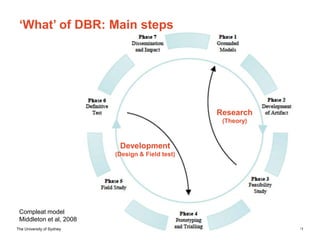
‘What’ of DBR: Main steps
Compleat model
Middleton et al, 2008
Research
(Theory)
Development
(Design & Field test)
The University of Sydney Page 22
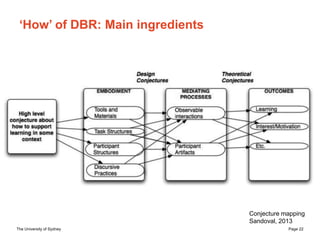
‘How’ of DBR: Main ingredients
Conjecture mapping
Sandoval, 2013
Research
(Theory)
Development &
Implementation
(Design)
The University of Sydney Page 23
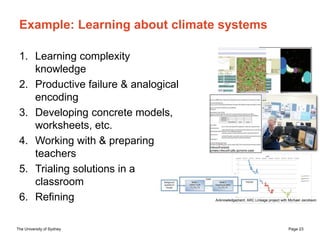
Example: Learning about climate systems
1. Learning complexity
knowledge
2. Productive failure & analogical
encoding
3. Developing concrete models,
worksheets, etc.
4. Working with & preparing
teachers
5. Trialing solutions in a
classroom
6. Refining Acknowledgement: ARC Linkage project with Michael Jacobson
The University of Sydney Page 25
DBR: Some challenges
1. Researcher-participant relationship and roles
2. Hawthorne effect
3. Reliability and validity
4. Capturing context and process
5. Integrating and analyzing various, often ‘rich’, data formats
6. Producing knowledge needed for design (when, why)
The University of Sydney Page 26
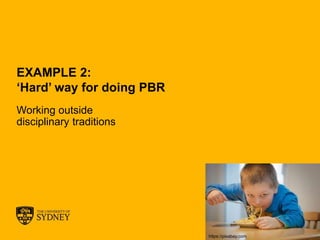
EXAMPLE 2:
‘Hard’ way for doing PBR
Working outside
disciplinary traditions
https://pixabay.com
The University of Sydney Page 27
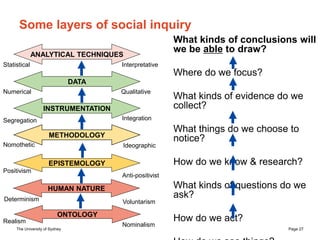
Some layers of social inquiry
What kinds of conclusions will
we be able to draw?
Where do we focus?
What kinds of evidence do we
collect?
What things do we choose to
notice?
How do we know & research?
What kinds of questions do we
ask?
How do we act?ONTOLOGY
EPISTEMOLOGY
METHODOLOGY
INSTRUMENTATION
DATA
ANALYTICAL TECHNIQUES
Realism
Positivism
Nomothetic
Segregation
Numerical
Statistical
Nominalism
Anti-positivist
Ideographic
Integration
Qualitative
Interpretative
HUMAN NATURE
Determinism Voluntarism
The University of Sydney Page 28
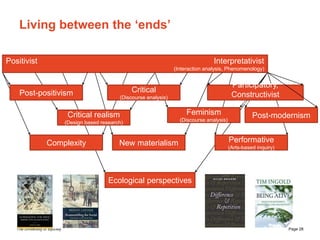
Living between the ‘ends’
Post-positivism Critical
(Discourse analysis)
Participatory,
Constructivist
(Action research)
Post-modernism
New materialism
Ecological perspectives
Performative
(Arts-based inquiry)
Complexity
Positivist Interpretativist
(Interaction analysis, Phenomenology)
Critical realism
(Design based research)
Feminism
(Discourse analysis)
The University of Sydney Page 29
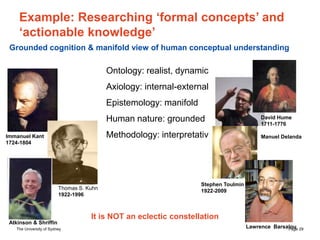
Example: Researching ‘formal concepts’ and
‘actionable knowledge’
Ontology: realist, dynamic
Axiology: internal-external
Epistemology: manifold
Human nature: grounded
Methodology: interpretativeImmanuel Kant
1724-1804
Thomas S. Kuhn
1922-1996
David Hume
1711-1776
Manuel Delanda
Lawrence Barsalou
Stephen Toulmin
1922-2009
Atkinson & Shriffin
Grounded cognition & manifold view of human conceptual understanding
It is NOT an eclectic constellation
The University of Sydney Page 30
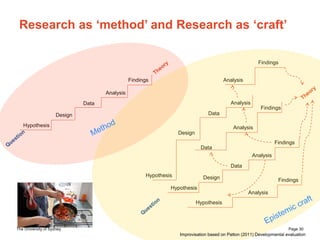
Research as ‘method’ and Research as ‘craft’
Design
Data
Analysis
Findings
Hypothesis
Design
Data
Analysis
Findings
Hypothesis
Design
Data
Analysis
Hypothesis
Data
Analysis
Analysis
Analysis
Hypothesis
Findings
Findings
Findings
Improvisation based on Patton (2011) Developmental evaluation
The University of Sydney Page 31
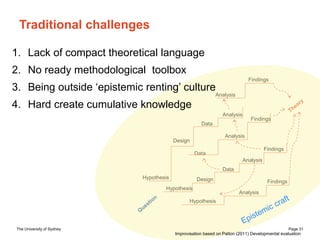
Traditional challenges
Design
Data
Analysis
Findings
Hypothesis
Design
Data
Analysis
Hypothesis
Data
Analysis
Analysis
Analysis
Hypothesis
Findings
Findings
Findings
Improvisation based on Patton (2011) Developmental evaluation
1. Lack of compact theoretical language
2. No ready methodological toolbox
3. Being outside ‘epistemic renting’ culture
4. Hard create cumulative knowledge
The University of Sydney Page 32
Some final notes
Where we are and what's
next
https://pixabay.com
The University of Sydney Page 33
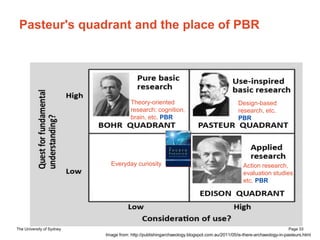
Pasteur's quadrant and the place of PBR
Everyday curiosity
Image from: http://publishingarchaeology.blogspot.com.au/2011/05/is-there-archaeology-in-pasteurs.html
Design-based
research, etc.
PBR
Action research,
evaluation studies
etc. PBR
Theory-oriented
research: cognition,
brain, etc. PBR
The University of Sydney Page 34
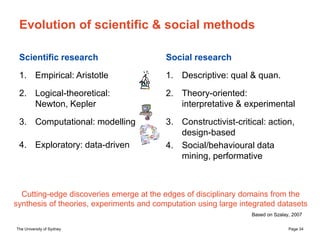
Evolution of scientific & social methods
Scientific research
1. Empirical: Aristotle
2. Logical-theoretical:
Newton, Kepler
3. Computational: modelling
4. Exploratory: data-driven
Social research
1. Descriptive: qual & quan.
2. Theory-oriented:
interpretative & experimental
3. Constructivist-critical: action,
design-based
4. Social/behavioural data
mining, performative
Cutting-edge discoveries emerge at the edges of disciplinary domains from the
synthesis of theories, experiments and computation using large integrated datasets
Based on Szalay, 2007
The University of Sydney Page 35
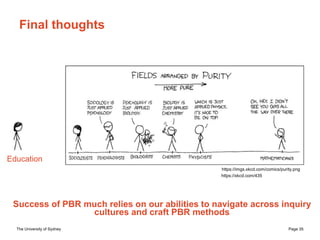
Final thoughts
Success of PBR much relies on our abilities to navigate across inquiry
cultures and craft PBR methods
Education
https://imgs.xkcd.com/comics/purity.png
https://xkcd.com/435
The University of Sydney Page 36
Main points
1. Research useful for teaching and learning (T&L)
changes together with T&L practices
2. Our challenge is to create enduring dynamic
connections between ways of engaging in T&L practices
and in research practices
3. Practice-based research is epistemic craftsmanship
4. We need Basic and Use-inspired basic research of T&L
practice
The University of Sydney Page 37
Email:
Lina.Marakauskaite@sydney.edu.au
Thank you
Your questions, comments, reflections…

Practice-based research methods: Challenges and potentials

  • 1.
    The University ofSydney Page 1 Practice-based research methods: Challenges and potentials Seminar and MasterClass Lina Markauskaitė 11 December 2018 @University of Southern Denmark, Kolding
  • 2.
    The University ofSydney Page 2 Background
  • 3.
    The University ofSydney Page 3 My 2 “modes” of working across research & practice
  • 4.
    The University ofSydney Page 4 Main points 1. Research useful for teaching and learning (T&L) changes together with T&L practices 2. Our challenge is to create enduring dynamic connections between ways of engaging in T&L practices and in research practices 3. Practice-based research is epistemic craftsmanship 4. We need Basic and Use-inspired basic research of T&L practice Note: When I say ‘practice’ I mean ‘T&L practice’. In fact, I will talk about two practices: ‘T&L practice’ and ‘Research practice’.
  • 5.
    The University ofSydney Page 5 Practice-based research (PBR) Practice – many definitions – a number of practice theories My working definition of practice: – an enduring, purposive activity Some versions of PBR – Research for practice – Research of practice – Research within practice – Research through practice
  • 6.
    The University ofSydney Page 6 3rd Order2nd Order1st Order The 3 Orders of learning, teaching, design & research Teaching as telling Learning as acquisition Designing for learning content (product design) Teaching as facilitation Learning as participation Designing for experiences (service design) Teaching as co-configuration Learning as co-construction & conscientious inhabiting Co-designing for knowing (relational design) Scientific mode (‘what works’) Action mode (‘know how’) Ecosystem mode (‘when’, ‘who’, ‘why’)
  • 7.
    The University ofSydney Page 7 I. Scientific mode Situating research of and for practice within the established disciplines or fields of study PBR as a disciplined inquiry
  • 8.
    The University ofSydney Page 8 Disciplines of education 1. Psychology 2. Sociology 3. Philosophy 4. History 5. Economics 6. Comparative ed 7. Geography 8. … http://www.nature.com/nature/journal/v534/n7609/ful…
  • 9.
    The University ofSydney Page 9 Education as a discipline or field http://www.nature.com/nature/journal/v534/n7609/ful…
  • 10.
    The University ofSydney Page 10 Discipline as… …a set of shared dispositions about: a) Objects b) Evidence c) Methods d) Expertise Benefits – Gives intellectual “home” – Enables production of cumulative knowledge – Values intellectual agency But – Imposes constrains on knowledge development – External usefulness is rarely the main concern https://images.pexels.com
  • 11.
    The University ofSydney Page 11 II. Action mode Situating research of and for practice within the practice PBR as an activity in the world
  • 12.
    The University ofSydney Page 12 A spectrum of approaches Form Research-based practice to Practice-based research Teachers as: – Designers – Researchers – Innovators
  • 13.
    The University ofSydney Page 13 Key features – Draws on practitioners’ methodological ‘know how’ – Produces ‘know how’ for practice Products do not ‘travel’ well: – Diverse purposes – Lack of contextual cues – Unclear granularity – Needs a community – Needs a common vocabulary Falconer & Littlejohn, 2009
  • 14.
    The University ofSydney Page 14 III. Ecosystem mode Situating research for and of practice within a self- improving ecosystem PBR as a principled- reflexive action within a multilayered, dynamic ecosystem Source: Senge, 2000
  • 15.
    The University ofSydney Page 15 PBR as an ecosystem on its own Models for linking research to practice 1. Research Development & Diffusion 2. Evidence-Based Practice 3. Boundary-Crossing Practices 4. Knowledge Communities A combination of all 4 modes is necessary Based on Broekkamp & van Hout-Wolters, 2007 From Goodyear, 2011 Requires epistemic fluency & craftsmanship – Different disciplines – Different inquiry traditions – Different perspectives
  • 16.
    The University ofSydney Page 16 EXAMPLE 1: ‘Easy’ way for doing PBR Following a tradition https://images.pexels.com
  • 17.
    The University ofSydney Page 17 From ISLS Vision 2009 Tradition of the learning sciences
  • 18.
    The University ofSydney Page 18 Tradition of the learning sciences “Learning Sciences (ISLS)… seek to advance the sciences and practices of learning, broadly speaking, with special attention to how they may be augmented by technology.” “ISLS is committed to application in context (not only in laboratories), to rigorous empirical research (not simply philosophy), and to design and application (not only theory)” From ISLS Vision 2009
  • 19.
    The University ofSydney Page 19 A view of learning Learning is distributed… …across people, and across tools and artifacts. Activity System …therefore, it is situated and, importantly, mediated. Research involves production of design artefacts – technology, models, principles, theories https://pixabay.com
  • 20.
    The University ofSydney Page 20 Design-based research …a systematic but flexible methodology aimed to improve educational practices through iterative analysis, design, development, and implementation, based on collaboration among researchers and practitioners in real-world settings, and leading to contextually- sensitive design principles and theories. Action research (Lab) experimen ts DBR
  • 21.
    The University ofSydney Page 21 ‘What’ of DBR: Main steps Compleat model Middleton et al, 2008 Research (Theory) Development (Design & Field test)
  • 22.
    The University ofSydney Page 22 ‘How’ of DBR: Main ingredients Conjecture mapping Sandoval, 2013 Research (Theory) Development & Implementation (Design)
  • 23.
    The University ofSydney Page 23 Example: Learning about climate systems 1. Learning complexity knowledge 2. Productive failure & analogical encoding 3. Developing concrete models, worksheets, etc. 4. Working with & preparing teachers 5. Trialing solutions in a classroom 6. Refining Acknowledgement: ARC Linkage project with Michael Jacobson
  • 24.
    The University ofSydney Page 25 DBR: Some challenges 1. Researcher-participant relationship and roles 2. Hawthorne effect 3. Reliability and validity 4. Capturing context and process 5. Integrating and analyzing various, often ‘rich’, data formats 6. Producing knowledge needed for design (when, why)
  • 25.
    The University ofSydney Page 26 EXAMPLE 2: ‘Hard’ way for doing PBR Working outside disciplinary traditions https://pixabay.com
  • 26.
    The University ofSydney Page 27 Some layers of social inquiry What kinds of conclusions will we be able to draw? Where do we focus? What kinds of evidence do we collect? What things do we choose to notice? How do we know & research? What kinds of questions do we ask? How do we act?ONTOLOGY EPISTEMOLOGY METHODOLOGY INSTRUMENTATION DATA ANALYTICAL TECHNIQUES Realism Positivism Nomothetic Segregation Numerical Statistical Nominalism Anti-positivist Ideographic Integration Qualitative Interpretative HUMAN NATURE Determinism Voluntarism
  • 27.
    The University ofSydney Page 28 Living between the ‘ends’ Post-positivism Critical (Discourse analysis) Participatory, Constructivist (Action research) Post-modernism New materialism Ecological perspectives Performative (Arts-based inquiry) Complexity Positivist Interpretativist (Interaction analysis, Phenomenology) Critical realism (Design based research) Feminism (Discourse analysis)
  • 28.
    The University ofSydney Page 29 Example: Researching ‘formal concepts’ and ‘actionable knowledge’ Ontology: realist, dynamic Axiology: internal-external Epistemology: manifold Human nature: grounded Methodology: interpretativeImmanuel Kant 1724-1804 Thomas S. Kuhn 1922-1996 David Hume 1711-1776 Manuel Delanda Lawrence Barsalou Stephen Toulmin 1922-2009 Atkinson & Shriffin Grounded cognition & manifold view of human conceptual understanding It is NOT an eclectic constellation
  • 29.
    The University ofSydney Page 30 Research as ‘method’ and Research as ‘craft’ Design Data Analysis Findings Hypothesis Design Data Analysis Findings Hypothesis Design Data Analysis Hypothesis Data Analysis Analysis Analysis Hypothesis Findings Findings Findings Improvisation based on Patton (2011) Developmental evaluation
  • 30.
    The University ofSydney Page 31 Traditional challenges Design Data Analysis Findings Hypothesis Design Data Analysis Hypothesis Data Analysis Analysis Analysis Hypothesis Findings Findings Findings Improvisation based on Patton (2011) Developmental evaluation 1. Lack of compact theoretical language 2. No ready methodological toolbox 3. Being outside ‘epistemic renting’ culture 4. Hard create cumulative knowledge
  • 31.
    The University ofSydney Page 32 Some final notes Where we are and what's next https://pixabay.com
  • 32.
    The University ofSydney Page 33 Pasteur's quadrant and the place of PBR Everyday curiosity Image from: http://publishingarchaeology.blogspot.com.au/2011/05/is-there-archaeology-in-pasteurs.html Design-based research, etc. PBR Action research, evaluation studies etc. PBR Theory-oriented research: cognition, brain, etc. PBR
  • 33.
    The University ofSydney Page 34 Evolution of scientific & social methods Scientific research 1. Empirical: Aristotle 2. Logical-theoretical: Newton, Kepler 3. Computational: modelling 4. Exploratory: data-driven Social research 1. Descriptive: qual & quan. 2. Theory-oriented: interpretative & experimental 3. Constructivist-critical: action, design-based 4. Social/behavioural data mining, performative Cutting-edge discoveries emerge at the edges of disciplinary domains from the synthesis of theories, experiments and computation using large integrated datasets Based on Szalay, 2007
  • 34.
    The University ofSydney Page 35 Final thoughts Success of PBR much relies on our abilities to navigate across inquiry cultures and craft PBR methods Education https://imgs.xkcd.com/comics/purity.png https://xkcd.com/435
  • 35.
    The University ofSydney Page 36 Main points 1. Research useful for teaching and learning (T&L) changes together with T&L practices 2. Our challenge is to create enduring dynamic connections between ways of engaging in T&L practices and in research practices 3. Practice-based research is epistemic craftsmanship 4. We need Basic and Use-inspired basic research of T&L practice
  • 36.
    The University ofSydney Page 37 Email: Lina.Marakauskaite@sydney.edu.au Thank you Your questions, comments, reflections…