Russell F. Doolittle The Step-by-Step Evolution of Vertebrate Blood Coagulation UC San Diego
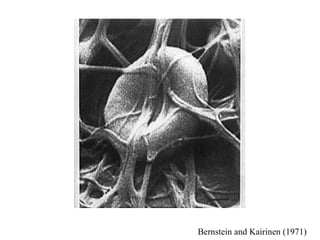
Bernstein and Kairinen (1971)
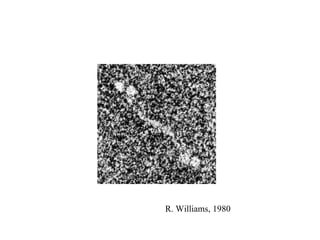
R. Williams, 1980
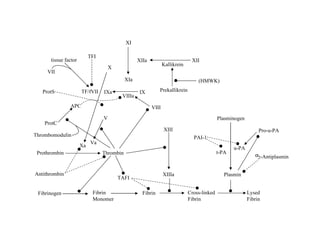
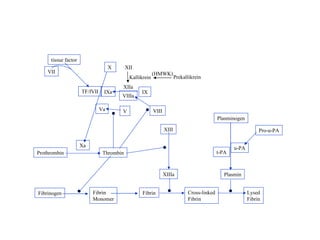
Blood clotting in humans is very complex. It involves  more than two dozen genetically encoded proteins.
Fibrinogen Fibrin Monomer Fibrin Cross-linked Fibrin Lysed Fibrin Thrombin Antithrombin Thrombomodulin Prothrombin Xa TAFI XIIIa XIII Plasmin Plasminogen u-PA t-PA PAI-1 VIIIa XIa IXa XI X Va ProtC VIII V TF/fVII VII tissue factor TFI APC ProtS Pro-u-PA -Antiplasmin  2 IX XIIa Kallikrein XII Prekallikrein (HMWK)
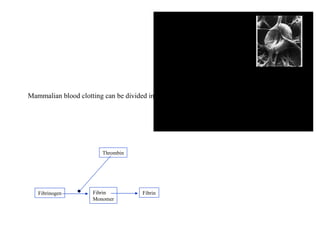
Mammalian blood clotting can be divided into sets of reactions . Fibrinogen Fibrin Monomer Fibrin Thrombin
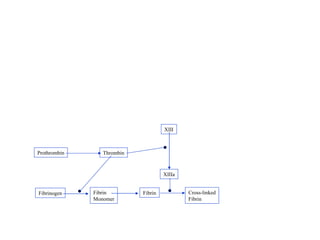
Fibrinogen Fibrin Monomer Fibrin Cross-linked Fibrin Thrombin Prothrombin XIIIa XIII
Fibrinogen Fibrin Monomer Fibrin Cross-linked Fibrin Thrombin Prothrombin Xa XIIIa XIII VIIIa IXa X Va VIII V TF/fVII VII tissue factor IX Lysed Fibrin Plasmin Plasminogen u-PA t-PA Pro-u-PA XIIa Kallikrein XII Prekallikrein (HMWK)
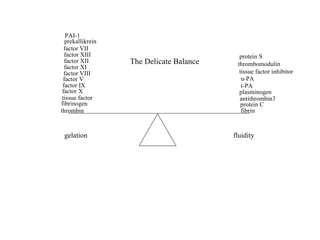
The Delicate Balance thrombin fibrinogen factor VII factor X factor IX factor V factor VIII factor XI factor XII factor XIII prekallikrein PAI-1 tissue factor plasminogen fibrin protein C antithrombin3 gelation fluidity tissue factor inhibitor t-PA u-PA thrombomodulin protein S
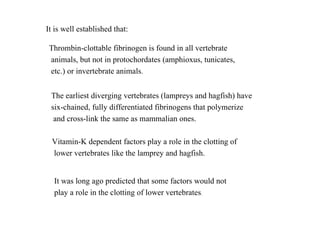
Thrombin-clottable fibrinogen is found in all vertebrate animals, but not in protochordates (amphioxus, tunicates, etc.) or invertebrate animals . The earliest diverging vertebrates (lampreys and hagfish) have six-chained, fully differentiated fibrinogens that polymerize and cross-link the same as mammalian ones. It is well established that: Vitamin-K dependent factors play a role in the clotting of lower vertebrates like the lamprey and hagfish.   It was long ago predicted that some factors would not play a role in the clotting of lower vertebrates .
Doolittle R. F. (1993) Thromb Haemost.  70:24-28.   The evolution of vertebrate blood coagulation: a case of Yin and Yang
 
How did blood clotting become so complex? Why is it so complex? How can we find out? We can start to answer these questions by examining clotting in more primitive creatures.
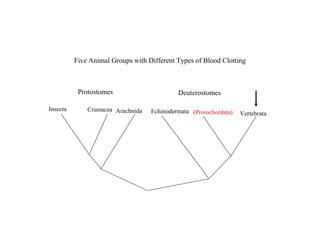
Protostomes Deuterostomes Crustacea Echinodermata Arachnida Insecta (Protochordata) Vertebrata Five Animal Groups with Different Types of Blood Clotting
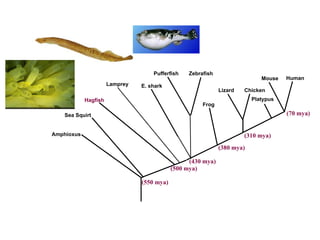
Hagfish Lamprey E. shark Pufferfish Zebrafish Frog Lizard Chicken Mouse Human (70 mya) (310 mya) (430 mya) (500 mya) (550 mya) Sea Squirt Amphioxus (380 mya) Platypus
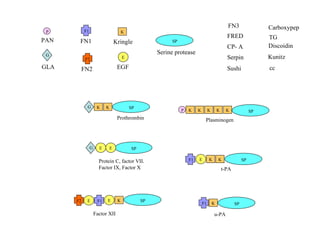
Many   of the clotting proteins are multi-domained and involve various combinations of common domains.
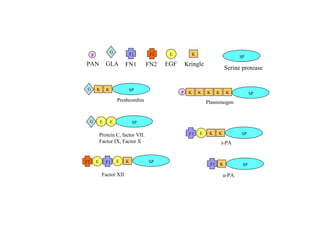
EGF FN2 FN1 Prothrombin K K SP G Protein C, factor VII. Factor IX, Factor X SP G K u-PA SP F1 F1 t-PA E K K SP F1 E F2 K E E Factor XII SP F1 F2 Plasminogen P K K K K K SP K Kringle SP Serine protease P G GLA PAN FN3 FRED CP- A Serpin Kunitz Carboxypep TG Discoidin Sushi cc E E
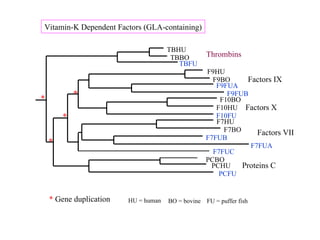
TBHU TBBO F9HU F9BO F9FUA F9FUB F10BO F10HU F10FU F7HU F7BO F7FUB F7FUA F7FUC PCBO PCHU PCFU TBFU Vitamin-K Dependent Factors (GLA-containing) Thrombins Factors IX Factors X Factors VII Proteins C * * * * *  Gene duplication HU = human BO = bovine FU = puffer fish
Today it is possible to find out what clotting factors a creature has by computer searching of whole genome databases. But not the hagfish. Whole genome databases are available for many vertebrates, including human, other mammals, opossum, platypus, chicken Lizard, frog, and several fish. A draft genome is available for lamprey. My students and I have been scouring the lamprey data base, as well as those other vertebrates listed above.
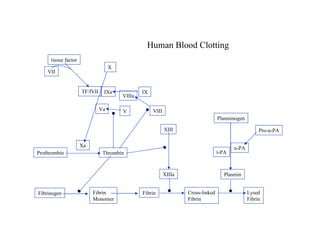
Fibrinogen Fibrin Monomer Fibrin Cross-linked Fibrin Lysed Fibrin Thrombin Prothrombin Xa XIIIa XIII Plasmin Plasminogen u-PA t-PA VIIIa IXa X Va VIII V TF/fVII VII tissue factor Pro-u-PA IX Human Blood Clotting
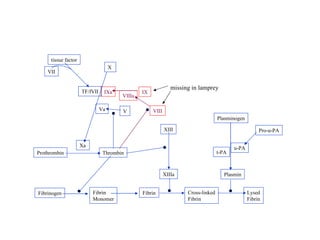
Fibrinogen Fibrin Monomer Fibrin Cross-linked Fibrin Lysed Fibrin Thrombin Prothrombin Xa XIIIa XIII Plasmin Plasminogen u-PA t-PA VIIIa IXa X Va VIII V TF/fVII VII tissue factor Pro-u-PA IX missing in lamprey
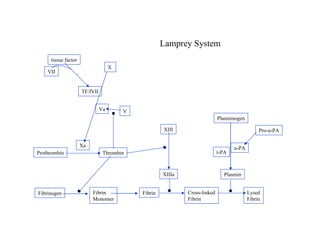
Fibrinogen Fibrin Monomer Fibrin Cross-linked Fibrin Lysed Fibrin Thrombin Prothrombin Xa XIIIa XIII Plasmin Plasminogen u-PA t-PA X Va V TF/fVII VII tissue factor Pro-u-PA Lamprey System
Lampreys have a simpler clotting system than other vertebrates. (We’re anxious to find out what the hagfish has!)
All  fish have a simpler clotting system than tetrapods.   In particular, they lack the “contact phase” factors.
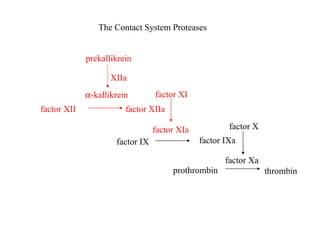
factor XII factor XIIa factor XI factor XIa factor IX factor IXa factor X factor Xa prekallikrein  -kallikrein XIIa prothrombin thrombin The Contact System Proteases
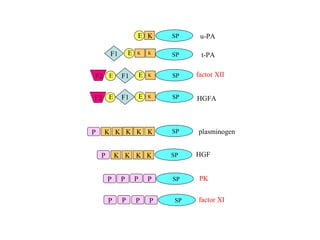
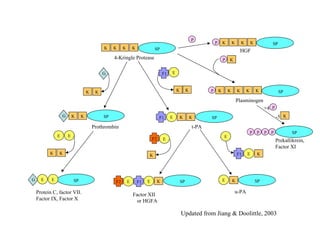
HGFA SP E E K F1 F2 factor XII SP E E K F1 F2 K SP SP SP K K P plasminogen SP P HGF SP P P P P factor XI P P P P SP PK K K t-PA F1 u-PA E E K K K K K K K
Without exception, all of the proteins involved in mammalian blood clotting are descended from other protein families that are not involved in clotting. The backbone of clotting, like many other extracellular processes, is limited proteolysis, especially employing serine proteases. Hundreds of serine proteases--all evolutionarily related--are found in animals. There is also a full complement of serine protease inhibitors, members of a widely spread family called “serpins.” Factor V (or factor 5) and factor VIII (factor 8) are descended from ferroxidase enzymes that can be traced back to bacteria. Fibrinogen is a multi-domain protein, the globular portions of which have numerous relatives throughout the animal kingdom.
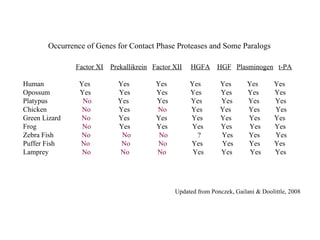
Occurrence of Genes for Contact Phase Proteases and Some Paralogs Factor XI   Prekallikrein   Factor XII   HGFA   HGF   Plasminogen   t-PA Human  Yes  Yes  Yes  Yes  Yes  Yes  Yes Opossum  Yes  Yes  Yes  Yes  Yes  Yes  Yes Platypus  No   Yes  Yes  Yes  Yes  Yes  Yes Chicken  No   Yes  No   Yes  Yes  Yes  Yes  Green Lizard  No   Yes  Yes  Yes  Yes  Yes  Yes  Frog  No   Yes  Yes  Yes  Yes  Yes  Yes Zebra Fish  No   No   No   ?  Yes  Yes  Yes Puffer Fish  No   No  No   Yes  Yes  Yes  Yes Lamprey  No   No   No   Yes  Yes  Yes  Yes Updated from Ponczek, Gailani & Doolittle, 2008
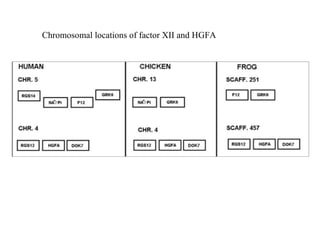
Chromosomal locations of factor XII and HGFA
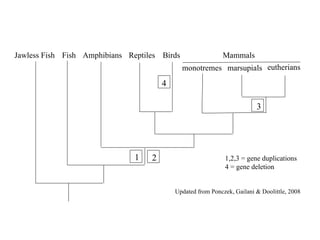
3 Jawless Fish Fish Amphibians Reptiles Birds monotremes marsupials eutherians Mammals 1 2 4 Updated from Ponczek, Gailani & Doolittle, 2008 1,2,3 = gene duplications  4 = gene deletion
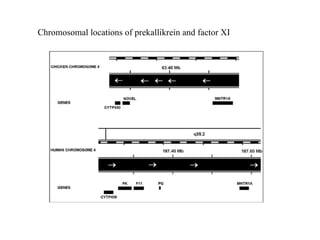
Chromosomal locations of prekallikrein and factor XI
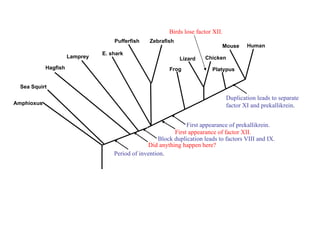
Duplication leads to separate factor XI and prekallikrein . Sea Squirt Hagfish Lamprey E. shark Pufferfish Zebrafish Frog Lizard Chicken Mouse Human Period of invention . Amphioxus Block duplication leads to factors VIII and IX. First appearance of factor XII. First appearance of prekallikrein. Birds lose factor XII. Did anything happen here? Platypus
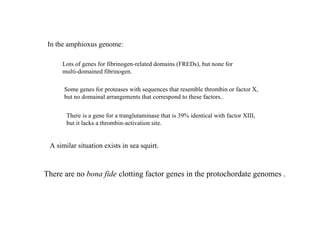
In the amphioxus genome: Lots of genes for fibrinogen-related domains (FREDs), but none for  multi-domained fibrinogen. Some genes for proteases with sequences that resemble thrombin or factor X, but no domainal arrangements that correspond to these factors.. There is a gene for a tranglutaminase that is 39% identical with factor XIII, but it lacks a thrombin-activation site. A similar situation exists in sea squirt. There are no  bona fide  clotting factor genes in the protochordate genomes .
4-Kringle Protease u-PA Factor XII or HGFA HGF Updated from Jiang & Doolittle, 2003 Prekallikrein,  Factor XI +4 -5 E E K K K K K Protein C, factor VII. Factor IX, Factor X K K K K SP Prothrombin K K SP G G SP G K SP t-PA E K K SP F1 E F1 E F2 K E E SP F1 F2 K K K F1 E Plasminogen P K K K K K SP P K E E E E P P K K K K SP P P SP P P P K
Summary Genomic sequence data are making it possible to reconstruct the individual events that have led to the complex system of blood clotting observed in mammals. The raw material for all the many proteins involved in blood clotting was available in the form of domains in the common ancestor of vertebrates and protochordates. The number of components increases as one moves up the evolutionary scale from the jawless fish to mammals. Even among mammals some recently evolved features are apparent.  Reasonable scenarios can be presented that show a step-by-step development of the process. Whole genome duplications may have played a role in expanding the inventory of similar proteins.
Acknowledgements Yong Jiang Michel Ponczek Justin Nand Sung Hong Da-Fei Feng David Gailani (Vanderbilt)
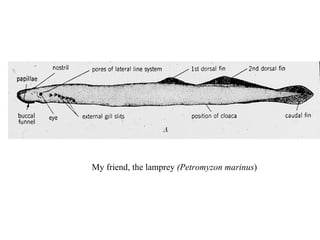
My friend, the lamprey  (Petromyzon marinus )
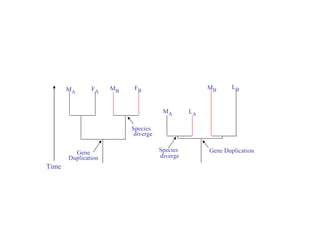
Gene Time Duplication Gene Duplication M A F A M B F B Species  diverge M B L B M A L A diverge Species
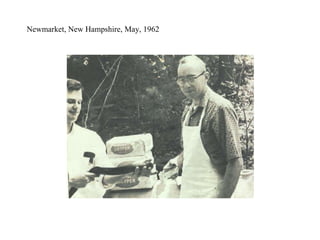
Newmarket, New Hampshire, May, 1962
K u-PA SP F1 K E E Factor XII SP F1 F2 Prothrombin K K SP G Plasminogen P K K K K K SP K Kringle SP Serine protease G GLA P PAN F2 FN2 F1 FN1 Protein C, factor VII. Factor IX, Factor X SP G t-PA E K K SP F1 E E EGF E
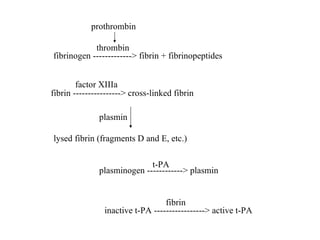
fibrinogen -------------> fibrin + fibrinopeptides thrombin fibrin ----------------> cross-linked fibrin factor XIIIa plasmin lysed fibrin (fragments D and E, etc.) plasminogen ------------> plasmin t-PA prothrombin fibrin inactive t-PA -----------------> active t-PA
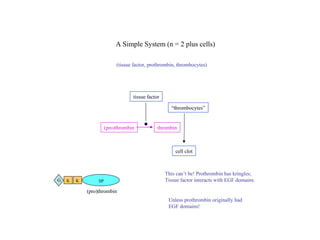
“ thrombocytes” cell clot (pro)thrombin tissue factor A Simple System (n = 2 plus cells) (tissue factor, prothrombin, thrombocytes) thrombin This can’t be! Prothrombin has kringles; Tissue factor interacts with EGF domains. Unless prothrombin originally had EGF domains! (pro)thrombin K K SP G
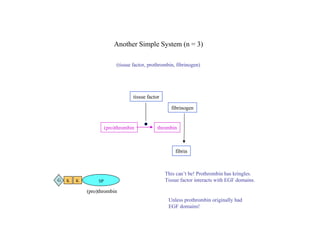
fibrinogen fibrin (pro)thrombin tissue factor Another Simple System (n = 3) (tissue factor, prothrombin, fibrinogen) thrombin (pro)thrombin This can’t be! Prothrombin has kringles. Tissue factor interacts with EGF domains. Unless prothrombin originally had EGF domains! K K SP G
 
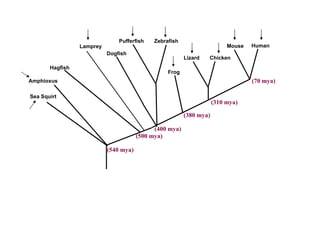
Hagfish Lamprey Dogfish Pufferfish Zebrafish Frog Lizard Chicken Mouse Human (70 mya) (310 mya) (400 mya) (500 mya) (540 mya) Sea Squirt Amphioxus (380 mya)
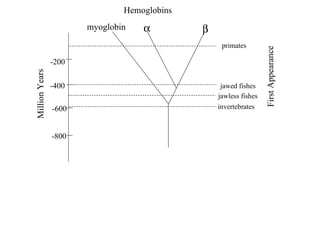
invertebrates jawless fishes jawed fishes primates   myoglobin First Appearance Million Years Hemoglobins -200 -400 -600 -800
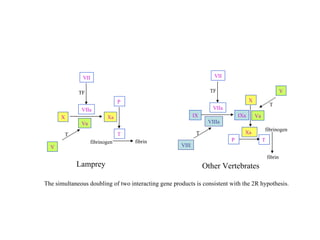
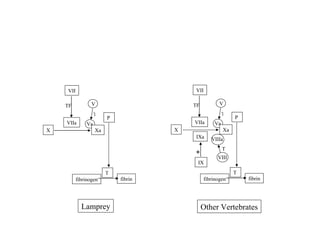
X VII P V Xa VIIa TF T T Va fibrinogen fibrin Lamprey IX VII X IXa VIIa TF T VIIIa fibrinogen fibrin P T Xa Va V T Other Vertebrates VIII The simultaneous doubling of two interacting gene products is consistent with the 2R hypothesis.
Other Vertebrates Lamprey X VII P VIIa TF Va T Xa IX IXa T VIIIa X VII P VIIa TF Va T Xa * T fibrinogen fibrin V T fibrinogen fibrin V VIII

Step‐by‐Step 
Evolution 
of
 Vertebrate 
Blood
 Coagulation


  • 1.
    Russell F. DoolittleThe Step-by-Step Evolution of Vertebrate Blood Coagulation UC San Diego
  • 2.
  • 3.
  • 4.
    Blood clotting inhumans is very complex. It involves more than two dozen genetically encoded proteins.
  • 5.
    Fibrinogen Fibrin MonomerFibrin Cross-linked Fibrin Lysed Fibrin Thrombin Antithrombin Thrombomodulin Prothrombin Xa TAFI XIIIa XIII Plasmin Plasminogen u-PA t-PA PAI-1 VIIIa XIa IXa XI X Va ProtC VIII V TF/fVII VII tissue factor TFI APC ProtS Pro-u-PA -Antiplasmin  2 IX XIIa Kallikrein XII Prekallikrein (HMWK)
  • 6.
    Mammalian blood clottingcan be divided into sets of reactions . Fibrinogen Fibrin Monomer Fibrin Thrombin
  • 7.
    Fibrinogen Fibrin MonomerFibrin Cross-linked Fibrin Thrombin Prothrombin XIIIa XIII
  • 8.
    Fibrinogen Fibrin MonomerFibrin Cross-linked Fibrin Thrombin Prothrombin Xa XIIIa XIII VIIIa IXa X Va VIII V TF/fVII VII tissue factor IX Lysed Fibrin Plasmin Plasminogen u-PA t-PA Pro-u-PA XIIa Kallikrein XII Prekallikrein (HMWK)
  • 9.
    The Delicate Balancethrombin fibrinogen factor VII factor X factor IX factor V factor VIII factor XI factor XII factor XIII prekallikrein PAI-1 tissue factor plasminogen fibrin protein C antithrombin3 gelation fluidity tissue factor inhibitor t-PA u-PA thrombomodulin protein S
  • 10.
    Thrombin-clottable fibrinogen isfound in all vertebrate animals, but not in protochordates (amphioxus, tunicates, etc.) or invertebrate animals . The earliest diverging vertebrates (lampreys and hagfish) have six-chained, fully differentiated fibrinogens that polymerize and cross-link the same as mammalian ones. It is well established that: Vitamin-K dependent factors play a role in the clotting of lower vertebrates like the lamprey and hagfish. It was long ago predicted that some factors would not play a role in the clotting of lower vertebrates .
  • 11.
    Doolittle R. F.(1993) Thromb Haemost. 70:24-28. The evolution of vertebrate blood coagulation: a case of Yin and Yang
  • 12.
  • 13.
    How did bloodclotting become so complex? Why is it so complex? How can we find out? We can start to answer these questions by examining clotting in more primitive creatures.
  • 14.
    Protostomes Deuterostomes CrustaceaEchinodermata Arachnida Insecta (Protochordata) Vertebrata Five Animal Groups with Different Types of Blood Clotting
  • 15.
    Hagfish Lamprey E.shark Pufferfish Zebrafish Frog Lizard Chicken Mouse Human (70 mya) (310 mya) (430 mya) (500 mya) (550 mya) Sea Squirt Amphioxus (380 mya) Platypus
  • 16.
    Many of the clotting proteins are multi-domained and involve various combinations of common domains.
  • 17.
    EGF FN2 FN1Prothrombin K K SP G Protein C, factor VII. Factor IX, Factor X SP G K u-PA SP F1 F1 t-PA E K K SP F1 E F2 K E E Factor XII SP F1 F2 Plasminogen P K K K K K SP K Kringle SP Serine protease P G GLA PAN FN3 FRED CP- A Serpin Kunitz Carboxypep TG Discoidin Sushi cc E E
  • 18.
    TBHU TBBO F9HUF9BO F9FUA F9FUB F10BO F10HU F10FU F7HU F7BO F7FUB F7FUA F7FUC PCBO PCHU PCFU TBFU Vitamin-K Dependent Factors (GLA-containing) Thrombins Factors IX Factors X Factors VII Proteins C * * * * * Gene duplication HU = human BO = bovine FU = puffer fish
  • 19.
    Today it ispossible to find out what clotting factors a creature has by computer searching of whole genome databases. But not the hagfish. Whole genome databases are available for many vertebrates, including human, other mammals, opossum, platypus, chicken Lizard, frog, and several fish. A draft genome is available for lamprey. My students and I have been scouring the lamprey data base, as well as those other vertebrates listed above.
  • 20.
    Fibrinogen Fibrin MonomerFibrin Cross-linked Fibrin Lysed Fibrin Thrombin Prothrombin Xa XIIIa XIII Plasmin Plasminogen u-PA t-PA VIIIa IXa X Va VIII V TF/fVII VII tissue factor Pro-u-PA IX Human Blood Clotting
  • 21.
    Fibrinogen Fibrin MonomerFibrin Cross-linked Fibrin Lysed Fibrin Thrombin Prothrombin Xa XIIIa XIII Plasmin Plasminogen u-PA t-PA VIIIa IXa X Va VIII V TF/fVII VII tissue factor Pro-u-PA IX missing in lamprey
  • 22.
    Fibrinogen Fibrin MonomerFibrin Cross-linked Fibrin Lysed Fibrin Thrombin Prothrombin Xa XIIIa XIII Plasmin Plasminogen u-PA t-PA X Va V TF/fVII VII tissue factor Pro-u-PA Lamprey System
  • 23.
    Lampreys have asimpler clotting system than other vertebrates. (We’re anxious to find out what the hagfish has!)
  • 24.
    All fishhave a simpler clotting system than tetrapods. In particular, they lack the “contact phase” factors.
  • 25.
    factor XII factorXIIa factor XI factor XIa factor IX factor IXa factor X factor Xa prekallikrein  -kallikrein XIIa prothrombin thrombin The Contact System Proteases
  • 26.
    HGFA SP EE K F1 F2 factor XII SP E E K F1 F2 K SP SP SP K K P plasminogen SP P HGF SP P P P P factor XI P P P P SP PK K K t-PA F1 u-PA E E K K K K K K K
  • 27.
    Without exception, allof the proteins involved in mammalian blood clotting are descended from other protein families that are not involved in clotting. The backbone of clotting, like many other extracellular processes, is limited proteolysis, especially employing serine proteases. Hundreds of serine proteases--all evolutionarily related--are found in animals. There is also a full complement of serine protease inhibitors, members of a widely spread family called “serpins.” Factor V (or factor 5) and factor VIII (factor 8) are descended from ferroxidase enzymes that can be traced back to bacteria. Fibrinogen is a multi-domain protein, the globular portions of which have numerous relatives throughout the animal kingdom.
  • 28.
    Occurrence of Genesfor Contact Phase Proteases and Some Paralogs Factor XI Prekallikrein Factor XII HGFA HGF Plasminogen t-PA Human Yes Yes Yes Yes Yes Yes Yes Opossum Yes Yes Yes Yes Yes Yes Yes Platypus No Yes Yes Yes Yes Yes Yes Chicken No Yes No Yes Yes Yes Yes Green Lizard No Yes Yes Yes Yes Yes Yes Frog No Yes Yes Yes Yes Yes Yes Zebra Fish No No No ? Yes Yes Yes Puffer Fish No No No Yes Yes Yes Yes Lamprey No No No Yes Yes Yes Yes Updated from Ponczek, Gailani & Doolittle, 2008
  • 29.
    Chromosomal locations offactor XII and HGFA
  • 30.
    3 Jawless FishFish Amphibians Reptiles Birds monotremes marsupials eutherians Mammals 1 2 4 Updated from Ponczek, Gailani & Doolittle, 2008 1,2,3 = gene duplications 4 = gene deletion
  • 31.
    Chromosomal locations ofprekallikrein and factor XI
  • 32.
    Duplication leads toseparate factor XI and prekallikrein . Sea Squirt Hagfish Lamprey E. shark Pufferfish Zebrafish Frog Lizard Chicken Mouse Human Period of invention . Amphioxus Block duplication leads to factors VIII and IX. First appearance of factor XII. First appearance of prekallikrein. Birds lose factor XII. Did anything happen here? Platypus
  • 33.
    In the amphioxusgenome: Lots of genes for fibrinogen-related domains (FREDs), but none for multi-domained fibrinogen. Some genes for proteases with sequences that resemble thrombin or factor X, but no domainal arrangements that correspond to these factors.. There is a gene for a tranglutaminase that is 39% identical with factor XIII, but it lacks a thrombin-activation site. A similar situation exists in sea squirt. There are no bona fide clotting factor genes in the protochordate genomes .
  • 34.
    4-Kringle Protease u-PAFactor XII or HGFA HGF Updated from Jiang & Doolittle, 2003 Prekallikrein, Factor XI +4 -5 E E K K K K K Protein C, factor VII. Factor IX, Factor X K K K K SP Prothrombin K K SP G G SP G K SP t-PA E K K SP F1 E F1 E F2 K E E SP F1 F2 K K K F1 E Plasminogen P K K K K K SP P K E E E E P P K K K K SP P P SP P P P K
  • 35.
    Summary Genomic sequencedata are making it possible to reconstruct the individual events that have led to the complex system of blood clotting observed in mammals. The raw material for all the many proteins involved in blood clotting was available in the form of domains in the common ancestor of vertebrates and protochordates. The number of components increases as one moves up the evolutionary scale from the jawless fish to mammals. Even among mammals some recently evolved features are apparent. Reasonable scenarios can be presented that show a step-by-step development of the process. Whole genome duplications may have played a role in expanding the inventory of similar proteins.
  • 36.
    Acknowledgements Yong JiangMichel Ponczek Justin Nand Sung Hong Da-Fei Feng David Gailani (Vanderbilt)
  • 37.
    My friend, thelamprey (Petromyzon marinus )
  • 38.
    Gene Time DuplicationGene Duplication M A F A M B F B Species diverge M B L B M A L A diverge Species
  • 39.
  • 40.
    K u-PA SPF1 K E E Factor XII SP F1 F2 Prothrombin K K SP G Plasminogen P K K K K K SP K Kringle SP Serine protease G GLA P PAN F2 FN2 F1 FN1 Protein C, factor VII. Factor IX, Factor X SP G t-PA E K K SP F1 E E EGF E
  • 41.
    fibrinogen -------------> fibrin+ fibrinopeptides thrombin fibrin ----------------> cross-linked fibrin factor XIIIa plasmin lysed fibrin (fragments D and E, etc.) plasminogen ------------> plasmin t-PA prothrombin fibrin inactive t-PA -----------------> active t-PA
  • 42.
    “ thrombocytes” cellclot (pro)thrombin tissue factor A Simple System (n = 2 plus cells) (tissue factor, prothrombin, thrombocytes) thrombin This can’t be! Prothrombin has kringles; Tissue factor interacts with EGF domains. Unless prothrombin originally had EGF domains! (pro)thrombin K K SP G
  • 43.
    fibrinogen fibrin (pro)thrombintissue factor Another Simple System (n = 3) (tissue factor, prothrombin, fibrinogen) thrombin (pro)thrombin This can’t be! Prothrombin has kringles. Tissue factor interacts with EGF domains. Unless prothrombin originally had EGF domains! K K SP G
  • 44.
  • 45.
    Hagfish Lamprey DogfishPufferfish Zebrafish Frog Lizard Chicken Mouse Human (70 mya) (310 mya) (400 mya) (500 mya) (540 mya) Sea Squirt Amphioxus (380 mya)
  • 46.
    invertebrates jawless fishesjawed fishes primates   myoglobin First Appearance Million Years Hemoglobins -200 -400 -600 -800
  • 47.
    X VII PV Xa VIIa TF T T Va fibrinogen fibrin Lamprey IX VII X IXa VIIa TF T VIIIa fibrinogen fibrin P T Xa Va V T Other Vertebrates VIII The simultaneous doubling of two interacting gene products is consistent with the 2R hypothesis.
  • 48.
    Other Vertebrates LampreyX VII P VIIa TF Va T Xa IX IXa T VIIIa X VII P VIIa TF Va T Xa * T fibrinogen fibrin V T fibrinogen fibrin V VIII