DRUGS ACTING ON THE BLOOD
AND BLOOD-FORMING
ORGANS
Saurabh Bhope
M Pharm 2nd Sem (Pharmacology)
Department Of Pharmaceutical Sciences,
R T M Nagpur University
BLOOD COAGULATION
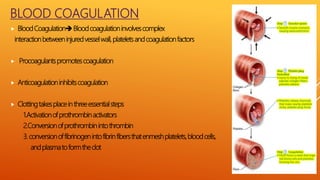
 BloodCoagulationBloodcoagulationinvolvescomplex
interactionbetweeninjuredvesselwall,plateletsandcoagulationfactors
 Procoagulantspromotescoagulation
 Anticoagulationinhibitscoagulation
 Clottingtakesplaceinthreeessentialsteps
1.Activationofprothrombinactivators
2.Conversionofprothrombinintothrombin
3.conversionoffibrinogenintofibrinfibersthatenmeshplatelets,bloodcells,
andplasmatoformtheclot
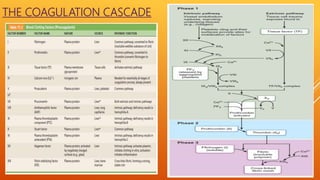
THE COAGULATION CASCADE
COAGULANTS
 1. Vitamin K
K1 (from plants, : Phytonadione (Phylloquinone)
fat soluble)
K2 (produced by : Menaquinones
bacteria)
K3 (synthetic) —Fat soluble : Menadione, Acetomenaphthone
—Water soluble : Menadione sod. bisulfite,
Menadione sod. diphosphate
 2. Miscellaneous : Fibrinogen (human)
: Antihaemophilic factor
: Adrenochrome monosemicarbazone
: Rutin, Ethamsylate
VITAMIN K
Action acts as a cofactor at a late stage in the synthesis by liver of
coagulation proteins-prothrombin, factors VII, IX and X
 The vit K dependent change confers on them the capacity to bind Ca2 and to get
bound to phospholipid surfaces-properties essential for participation in the
coagulation cascade
Deficiency liver disease, obstructive jaundice, malabsorption, long-term
antimicrobial therapy which alters intestinal flora
Use (a) Dietary deficiency
(b) Prolonged antimicrobial therapy
(c) Obstructive jaundice or malabsorption syndromes
(d) Liver disease (cirrhosis, viral hepatitis)
(f) Overdose of oral anticoagulants
MISCELLANEOUS
Fibrinogen Control bleeding in haemophilia, antihaemophilic globulin (AHG)
deficiency and acute afibrinogenemic states
Antihaemophilic factor Indicated (along with human fibrinogen) in
haemophilia and AHG deficiency ,highly effective in controlling bleeding episodes, but
action is short-lasting (1 to 2 days)
Desmopressin Releases factor VIII and von Willebrand's factor from vascular
endothelium and checks bleeding in haemophilia and von Willebrand's disease
Adrenochrome monosemicarbazone Reduces capillary fragility, control
oozing from raw surfaces & prevent microvessel bleeding, e.g. epistaxis, haematuria,
retinal haemorrhage, secondary haemorrhage from wounds
Rutin Reduces capillary bleeding
Ethamsylate Reduces capillary bleeding when platelets are adequate
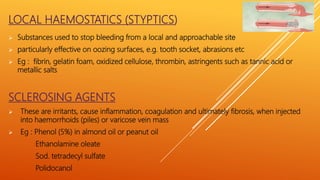
LOCAL HAEMOSTATICS (STYPTICS)
 Substances used to stop bleeding from a local and approachable site
 particularly effective on oozing surfaces, e.g. tooth socket, abrasions etc
 Eg : fibrin, gelatin foam, oxidized cellulose, thrombin, astringents such as tannic acid or
metallic salts
SCLEROSING AGENTS
 These are irritants, cause inflammation, coagulation and ultimately fibrosis, when injected
into haemorrhoids (piles) or varicose vein mass
 Eg : Phenol (5%) in almond oil or peanut oil
Ethanolamine oleate
Sod. tetradecyl sulfate
Polidocanol
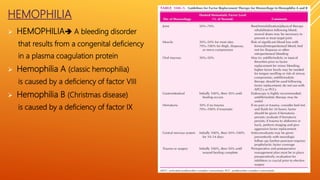
HEMOPHILIA
 HEMOPHILIA A bleeding disorder
that results from a congenital deficiency
in a plasma coagulation protein
 Hemophilia A (classic hemophilia)
is caused by a deficiency of factor VIII
 Hemophilia B (Christmas disease)
is caused by a deficiency of factor IX
ANTICOAGULANTS
1. Used in vivo
A. Parenteral anticoagulants
Heparin, Low molecular weight heparin
Heparinoids–Heparan sulfate, Danaparoid, Lepirudin, Ancrod
B. Oral anticoagulants
(i) Coumarin derivatives: Bishydroxycoumarin (Dicumarol),
Warfarin sod., Acenocoumarol (Nicoumalone),
Ethylbiscoumacetate
(ii) Indandione derivative: Phenindione
2. Used in vitro
A. Heparin
B. Calcium complexing agents: Sodium citrate, Sodium oxalate, Sodium
edetate
HEPARIN
Action Acts indirectly by activating plasma antithrombin III (AT III, a serine
proteinase inhibitor) and may be other similar cofactors
 The heparin-AT III complex then binds to clotting factors of the intrinsic and common
pathways (Xa, lla, IXa, Xla, Xlla and XIIIa) and inactivates them but not factor VIla
operative in the extrinsic pathway
 At low concentrations of heparin, factor Xa mediated conversion of prothrombin to
thrombin is selectively affected
 The anticoagulant action is exerted mainly by inhibition of factor Xa as well as thrombin
(IIa) mediated conversion of fibrinogen to fibrin
 Low concentrations of heparin prolong aPTT without significantly prolonging PT, High
concentrations prolong both
ADVERSE EFFECT
 Bleeding due to overdose
 Thrombocytopenia
 Transient and reversible alopecia
 Osteoporosis
 Hypersensitivity reactions
ORAL ANTICOAGULANTS
Warfarin Act indirectly by interfering with the synthesis of vit K dependent
clotting factors in liver
 Behave as competitive antagonists of vit K and reduce the plasma levels of
function of clotting factors in a dose-dependent manner
 Interfere with regeneration of the active hydroquinone form of vit K which carries
out the final step of ϒ carboxylation glutamate residues of prothrombin and
factors VII, IX and X
 This carboxylation is essential for the ability of the clotting factors to bind Ca and
to get bound to phospholipid surfaces, necessary for coagulation sequence to
proceed
CONTRAINDICATIONS
 Pregnancy Birth defects, skeletal abnormalities
 Foetal warfarin syndrome-hypoplasia of nose, eye socket, hand bones, and growth retardation
 Later in pregnancy, it can cause CNS defects, foetal haemorrhage, foetal death and accentuates
neonatal hypoprothrombinemia
DRUG INTERACTIONS
 1. Broad-spectrum antibiotics, inhibit gut flora and reduce vit K production
 2. Newer cephalosporins (cefamandole, moxalactam, cefoperazone) cause
hypoprothrombinaemia by the same mechanism as warfarin-additive action
 3. Aspirin: inhibits platelet aggregation and causes g.i. bleeding
 4. Long acting sulfonamides, indomethacin, phenytoin and probenecid: displace warfarin
from plasma protein binding
 5. Tolbutamide and phenytoin: inhibit warfarin metabolism and vice versa
 6. Oral contraceptives: increase blood levels of clotting factors
USES OF ANTICOAGULANTS
 1. Deep vein thrombosis and pulmonary embolism
 2. Myocardial infarction (MI)
 3. Unstable angina
 4. Rheumatic heart disease; Atrial fibrillation(AF)
 5. Cerebrovascular disease
 6. Vascular surgery, prosthetic heart valves,retinal vessel thrombosis,
extracorporeal circulation, haemodialysis
 7. Defibrination syndrome
FIBRINOLYTIC (THROMBOLYTICS)
 These are drugs used to lyse thrombi/ clot to recanalize occluded blood vessels
 Haemostatic plug of platelets formed at the site of injury to blood vessels is reinforced by fibrin
deposition to form a thrombus
 The fibrinolytic system is activated to remove fibrin
 Serine protease Plasmin enzyme generated from plasminogen by tissue plasminogen activator (t-
PA), produced by vascular endothelium digest fibrin
 The t-PA selectively activates fibrin bound plasminogen within the thrombus, and any plasmin that
leaks is inactivated by circulating antiplasmins
 Fibrin bound plasmin is not inactivated by antiplasmins because of common binding site for both
fibrin and antiplasmin
 When excessive amounts of plasminogen are activated (by administered fibrinolytics), the a2
antiplasmin is exhausted and active plasmin persists in plasma
 Plasmin is a rather nonspecific protease: degrades coagulation factors (including fibrinogen) and
some other plasma proteins as well
 Thus, activation of circulating plasminogen induces a lytic state whose major complication is
haemorrhage
1. STREPTOKINASE
 Combines with circulating plasminogen to form an activator complex which then causes
limited proteolysis of other plasminogen molecules to plasmin
2. Urokinase
 Activates plasminogen directly
3. Alteplase (recombinant tissue plasminogen activator
(rt-PA)
4. Reteplase
5. Tenecteplase
USES OF FIBRINOLYTICS
1 . Acute myocardial infarction
2 . Deep vein thrombosis
3. Pulmonary embolism
4. Peripheral arterial occlusion
5. Stroke
ANTIFIBRINOLYTICS
1. Epsilon amino-caproic acid (EACA)
 Analogue of the amino add lysine: combines withthe lysine binding sites of plasminogen and
plasmin so that the latter is not able to bind to fibrin and lyse it
2. Tranexaemic acid
 It binds to the lysine binding site on plasminogen and prevents its combination with fibrin
3. Aprotinin
 Has polyvalent serine protease inhibitory activity
Drugs acting on the blood and blood forming organs