Biology Futures The revolution in personalized genomics and synthetic biology:  technological status and ethical issues Melanie Swan MS Futures Group +1-650-681-9482 [email_address] www.melanieswan.com June 14, 2008 Slides: http//www.melanieswan.com/presentations/biology_futures.ppt
Broad biology problem space: increasing worldwide demand for natural resources and healthcare services Traditional approaches stalled: soaring costs, slow innovation, static rate of annual drug discovery  Conceptual and practical transformation Art to digitized information science to engineering problem Trial and error tools replaced by direct design  Summary June 14, 2008
Agenda Genomics tools: sequencing and synthesizing Personal genomics revolution (sequencing) Synthethic biology revolution (synthesizing) Biofuels, biofood Ethics Other areas Advances in brain research Long-term biology futures June 14, 2008
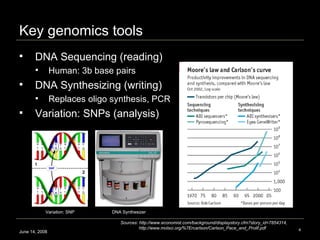
Key genomics tools June 14, 2008 DNA Sequencing (reading) Human: 3b base pairs DNA Synthesizing (writing)  Replaces oligo synthesis, PCR  Variation: SNPs (analysis) Sources: http://www.economist.com/background/displaystory.cfm?story_id=7854314,  http://www.molsci.org/%7Ercarlson/Carlson_Pace_and_Prolif.pdf  DNA Synthesizer Variation: SNP
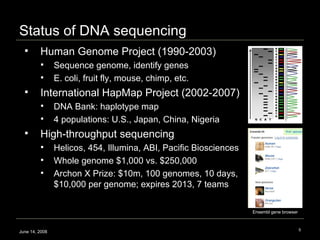
Status of DNA sequencing June 14, 2008 Human Genome Project (1990-2003) Sequence genome, identify genes E. coli, fruit fly, mouse, chimp, etc. International HapMap Project (2002-2007)  DNA Bank: haplotype map 4 populations: U.S., Japan, China, Nigeria High-throughput sequencing Helicos, 454, Illumina, ABI, Pacific Biosciences Whole genome $1,000 vs. $250,000 Archon X Prize: $10m, 100 genomes, 10 days, $10,000 per genome; expires 2013, 7 teams Ensembl gene browser
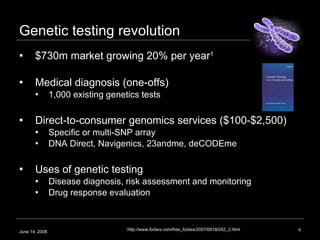
Genetic testing revolution $730m market growing 20% per year 1 Medical diagnosis (one-offs) 1,000 existing genetics tests Direct-to-consumer genomics services ($100-$2,500) Specific or multi-SNP array DNA Direct, Navigenics, 23andme, deCODEme Uses of genetic testing Disease diagnosis, risk assessment and monitoring  Drug response evaluation June 14, 2008 1 http://www.forbes.com/free_forbes/2007/0618/052_2.html
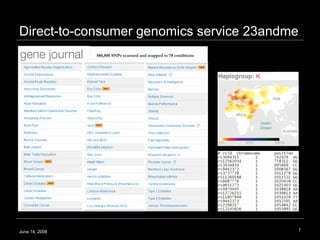
Direct-to-consumer genomics service 23andme June 14, 2008 580,000 SNPs scanned and mapped to 78 conditions
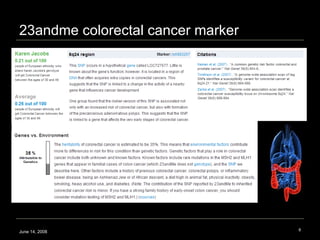
23andme colorectal cancer marker   June 14, 2008
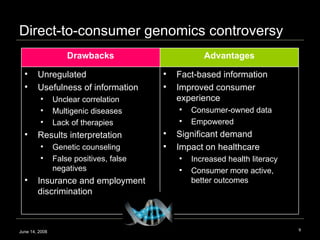
Direct-to-consumer genomics controversy June 14, 2008 Drawbacks Advantages Unregulated  Usefulness of information Unclear correlation Multigenic diseases Lack of therapies Results interpretation Genetic counseling False positives, false negatives Insurance and employment discrimination Fact-based information Improved consumer experience Consumer-owned data Empowered Significant demand  Impact on healthcare Increased health literacy  Consumer more active, better outcomes
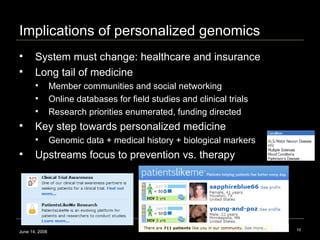
Implications of personalized genomics June 14, 2008 System must change: healthcare and insurance Long tail of medicine  Member communities and social networking Online databases for field studies and clinical trials  Research priorities enumerated, funding directed Key step towards personalized medicine Genomic data + medical history + biological markers Upstreams focus to prevention vs. therapy
Synthetic biology revolution Vision Understand and harness biological design rules  Definition Using engineering to redesign existing and construct new biological parts, devices and systems  Wide-ranging applications Energy, nutrients/food, pharmaceuticals, structural materials, chemicals, environment   Result  Encoded DNA executed by a cellular chassis  Directed design vs. trial and error  June 14, 2008
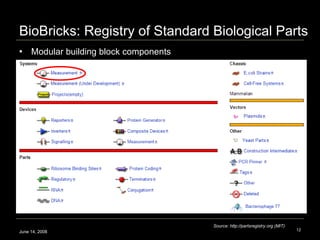
BioBricks: Registry of Standard Biological Parts Modular building block components June 14, 2008 Source: http://partsregistry.org (MIT)
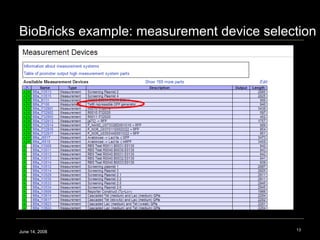
BioBricks example: measurement device selection June 14, 2008
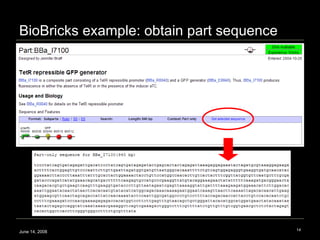
BioBricks example: obtain part sequence June 14, 2008
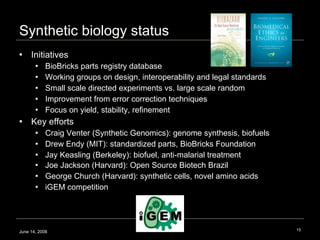
Synthetic biology status Initiatives BioBricks parts registry database Working groups on design, interoperability and legal standards Small scale directed experiments vs. large scale random  Improvement from error correction techniques Focus on yield, stability, refinement Key efforts Craig Venter (Synthetic Genomics): genome synthesis, biofuels Drew Endy (MIT): standardized parts, BioBricks Foundation Jay Keasling (Berkeley): biofuel, anti-malarial treatment Joe Jackson (Harvard): Open Source Biotech Brazil  George Church (Harvard): synthetic cells, novel amino acids iGEM competition June 14, 2008
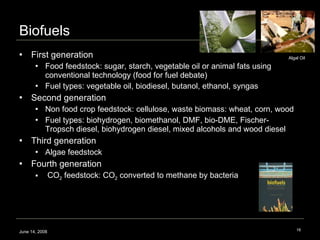
Biofuels First generation Food feedstock: sugar, starch, vegetable oil or animal fats using conventional technology (food for fuel debate) Fuel types: vegetable oil, biodiesel, butanol, ethanol, syngas Second generation  Non food crop feedstock: cellulose, waste biomass: wheat, corn, wood  Fuel types: biohydrogen, biomethanol, DMF, bio-DME, Fischer-Tropsch diesel, biohydrogen diesel, mixed alcohols and wood diesel  Third generation Algae feedstock  Fourth generation CO 2  feedstock: CO 2  converted to methane by bacteria June 14, 2008 Algal Oil
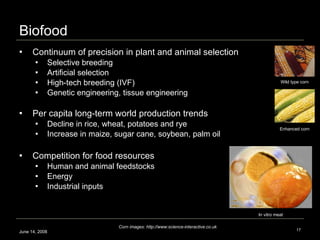
Biofood Continuum of precision in plant and animal selection Selective breeding  Artificial selection  High-tech breeding (IVF)  Genetic engineering, tissue engineering Per capita long-term world production trends Decline in rice, wheat, potatoes and rye Increase in maize, sugar cane, soybean, palm oil  Competition for food resources Human and animal feedstocks Energy Industrial inputs  June 14, 2008 In vitro meat Corn images: http://www:science-interactive.co.uk Wild type corn Enhanced corn
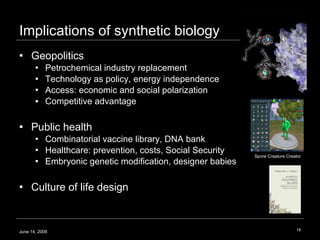
Implications of synthetic biology Geopolitics Petrochemical industry replacement Technology as policy, energy independence  Access: economic and social polarization Competitive advantage Public health Combinatorial vaccine library, DNA bank Healthcare: prevention, costs, Social Security Embryonic genetic modification, designer babies Culture of life design June 14, 2008 Spore Creature Creator
Bioethics and society Fundamental setting for bioethics: humanity Legislative status UN Convention on Human Rights and Biomedicine U.S. Presidential Council on Bioethics (est. 2001) U.S. genetic nondiscrimination Federal: Genetic Information Nondiscrimination Act, May 2008  State: genetic non-discrimination legislation in 40 states  Heterogeneous cultural response to technology Paternity testing (Europe), stem cell research (U.S.) June 14, 2008
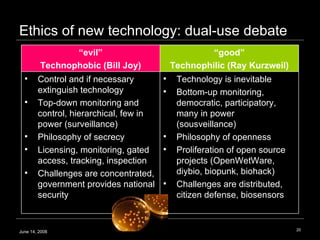
Ethics of new technology: dual-use debate  June 14, 2008 “ evil” Technophobic (Bill Joy) “ good” Technophilic (Ray Kurzweil) Control and if necessary extinguish technology Top-down monitoring and control, hierarchical, few in power (surveillance) Philosophy of secrecy Licensing, monitoring, gated access, tracking, inspection Challenges are concentrated, government provides national security Technology is inevitable Bottom-up monitoring, democratic, participatory, many in power (sousveillance) Philosophy of openness Proliferation of open source projects (OpenWetWare, diybio, biopunk, biohack)  Challenges are distributed, citizen defense, biosensors
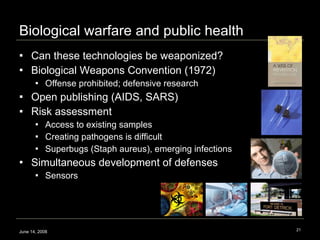
Biological warfare and public health Can these technologies be weaponized? Biological Weapons Convention (1972) Offense prohibited; defensive research Open publishing (AIDS, SARS) Risk assessment Access to existing samples Creating pathogens is difficult Superbugs (Staph aureus), emerging infections Simultaneous development of defenses Sensors June 14, 2008
Ethics: practitioner standards  Hippocratic oath principles: autonomy, privacy, beneficence Research Ethics Recommendations for Whole-Genome Research: Consensus Statement 1  March 25, 2008 Consent Withdrawal from research Return of results Public data release  Synthetic biology biosafety  Reviews: external pre-experimental and ongoing Responsibility-taking: signature, documentation Safe design: non-reproductive, activation-based, suicide gene Safeguards for unintended consequences  June 14, 2008 1 http://biology.plosjournals.org/perlserv/?request=get-document&doi=10.1371/journal.pbio.0060073
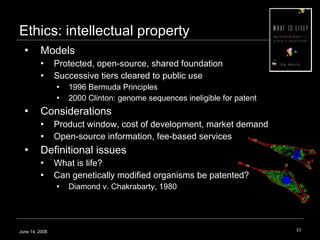
Models Protected, open-source, shared foundation Successive tiers cleared to public use  1996 Bermuda Principles 2000 Clinton: genome sequences ineligible for patent Considerations Product window, cost of development, market demand Open-source information, fee-based services Definitional issues What is life? Can genetically modified organisms be patented?  Diamond v. Chakrabarty, 1980  Ethics: intellectual property June 14, 2008
Pedagogy and scientific method High dynamism in the field of biology Mathematical biology (SMB), computational biology 21c skillsets: the new literacy June 14, 2008 1 http://en.wikipedia.org/wiki/Synthetic_biology The educated person of today must be able to express thoughts in a variety of technology-based media   Evolution of the scientific method Combinatorial era focuses on empiricism and simulation “ From this combination of passion and inventiveness I sense that students are reinventing literacy. Literacy has been boiled down to reading and writing, but the means have changed since the Renaissance. In a very real sense post-digital literacy now includes 3D machining and microcontroller programming.” – Neil Gershenfeld, MIT 1
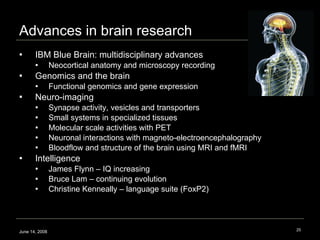
Advances in brain research  IBM Blue Brain: multidisciplinary advances Neocortical anatomy and microscopy recording Genomics and the brain Functional genomics and gene expression  Neuro-imaging Synapse activity, vesicles and transporters  Small systems in specialized tissues  Molecular scale activities with PET  Neuronal interactions with magneto-electroencephalography Bloodflow and structure of the brain using MRI and fMRI Intelligence  James Flynn – IQ increasing Bruce Lam – continuing evolution Christine Kenneally – language suite (FoxP2) June 14, 2008
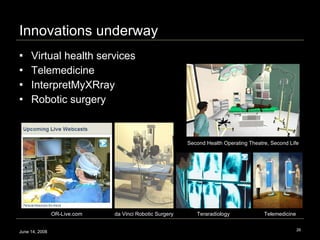
Innovations underway Virtual health services Telemedicine InterpretMyXRray Robotic surgery June 14, 2008 Second Health Operating Theatre, Second Life Teraradiology Telemedicine da Vinci Robotic Surgery OR-Live.com
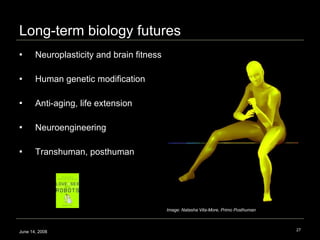
Long-term biology futures Neuroplasticity and brain fitness Human genetic modification Anti-aging, life extension Neuroengineering Transhuman, posthuman June 14, 2008 Image: Natasha Vita-More, Primo Posthuman
Broad biology problem space: increasing worldwide demand for natural resources and healthcare services Traditional approaches stalled: soaring costs, slow innovation, static rate of annual drug discovery  Conceptual and practical transformation Art to digitized information science to engineering problem Trial and error tools replaced by direct design  Summary June 14, 2008
Resources Ethics and biotechnology industry watch groups http://www.bioethics.net/ (American Journal of Bioethics) http://www.etcgroup.org/ News, blogs, advocacy groups, etc. http://www.eyeonDNA.com/ http://phylogenomics.blogspot.com/ http://www.personalizedmedicinecoalition.org/ Podcasts and video  http://www.cbc.ca/ideas/features/science/  http://www.onemedplace.com/ http://or-live.com/ Synthetic biology http://partsregistry.org/ http://igem.org/ http://openwetware.org/ http://www.synbiosafe.eu/forum/ June 14, 2008
Thank you Melanie Swan MS Futures Group +1-650-681-9482  [email_address] www.melanieswan.com Slides: http//www.melanieswan.com/presentations/biology_futures.ppt Provided under an open source  Creative Commons 3.0 license

Biology Futures

  • 1.
    BiologyFutures The revolution in personalized genomics and synthetic biology: technological status and ethical issues Melanie Swan MS Futures Group +1-650-681-9482 [email_address] www.melanieswan.com June 14, 2008 Slides: http//www.melanieswan.com/presentations/biology_futures.ppt
  • 2.
    Broad biology problemspace: increasing worldwide demand for natural resources and healthcare services Traditional approaches stalled: soaring costs, slow innovation, static rate of annual drug discovery Conceptual and practical transformation Art to digitized information science to engineering problem Trial and error tools replaced by direct design Summary June 14, 2008
  • 3.
    Agenda Genomics tools:sequencing and synthesizing Personal genomics revolution (sequencing) Synthethic biology revolution (synthesizing) Biofuels, biofood Ethics Other areas Advances in brain research Long-term biology futures June 14, 2008
  • 4.
    Key genomics toolsJune 14, 2008 DNA Sequencing (reading) Human: 3b base pairs DNA Synthesizing (writing) Replaces oligo synthesis, PCR Variation: SNPs (analysis) Sources: http://www.economist.com/background/displaystory.cfm?story_id=7854314, http://www.molsci.org/%7Ercarlson/Carlson_Pace_and_Prolif.pdf DNA Synthesizer Variation: SNP
  • 5.
    Status of DNAsequencing June 14, 2008 Human Genome Project (1990-2003) Sequence genome, identify genes E. coli, fruit fly, mouse, chimp, etc. International HapMap Project (2002-2007) DNA Bank: haplotype map 4 populations: U.S., Japan, China, Nigeria High-throughput sequencing Helicos, 454, Illumina, ABI, Pacific Biosciences Whole genome $1,000 vs. $250,000 Archon X Prize: $10m, 100 genomes, 10 days, $10,000 per genome; expires 2013, 7 teams Ensembl gene browser
  • 6.
    Genetic testing revolution$730m market growing 20% per year 1 Medical diagnosis (one-offs) 1,000 existing genetics tests Direct-to-consumer genomics services ($100-$2,500) Specific or multi-SNP array DNA Direct, Navigenics, 23andme, deCODEme Uses of genetic testing Disease diagnosis, risk assessment and monitoring Drug response evaluation June 14, 2008 1 http://www.forbes.com/free_forbes/2007/0618/052_2.html
  • 7.
    Direct-to-consumer genomics service23andme June 14, 2008 580,000 SNPs scanned and mapped to 78 conditions
  • 8.
    23andme colorectal cancermarker June 14, 2008
  • 9.
    Direct-to-consumer genomics controversyJune 14, 2008 Drawbacks Advantages Unregulated Usefulness of information Unclear correlation Multigenic diseases Lack of therapies Results interpretation Genetic counseling False positives, false negatives Insurance and employment discrimination Fact-based information Improved consumer experience Consumer-owned data Empowered Significant demand Impact on healthcare Increased health literacy Consumer more active, better outcomes
  • 10.
    Implications of personalizedgenomics June 14, 2008 System must change: healthcare and insurance Long tail of medicine Member communities and social networking Online databases for field studies and clinical trials Research priorities enumerated, funding directed Key step towards personalized medicine Genomic data + medical history + biological markers Upstreams focus to prevention vs. therapy
  • 11.
    Synthetic biology revolutionVision Understand and harness biological design rules Definition Using engineering to redesign existing and construct new biological parts, devices and systems Wide-ranging applications Energy, nutrients/food, pharmaceuticals, structural materials, chemicals, environment Result Encoded DNA executed by a cellular chassis Directed design vs. trial and error June 14, 2008
  • 12.
    BioBricks: Registry ofStandard Biological Parts Modular building block components June 14, 2008 Source: http://partsregistry.org (MIT)
  • 13.
    BioBricks example: measurementdevice selection June 14, 2008
  • 14.
    BioBricks example: obtainpart sequence June 14, 2008
  • 15.
    Synthetic biology statusInitiatives BioBricks parts registry database Working groups on design, interoperability and legal standards Small scale directed experiments vs. large scale random Improvement from error correction techniques Focus on yield, stability, refinement Key efforts Craig Venter (Synthetic Genomics): genome synthesis, biofuels Drew Endy (MIT): standardized parts, BioBricks Foundation Jay Keasling (Berkeley): biofuel, anti-malarial treatment Joe Jackson (Harvard): Open Source Biotech Brazil George Church (Harvard): synthetic cells, novel amino acids iGEM competition June 14, 2008
  • 16.
    Biofuels First generationFood feedstock: sugar, starch, vegetable oil or animal fats using conventional technology (food for fuel debate) Fuel types: vegetable oil, biodiesel, butanol, ethanol, syngas Second generation Non food crop feedstock: cellulose, waste biomass: wheat, corn, wood Fuel types: biohydrogen, biomethanol, DMF, bio-DME, Fischer-Tropsch diesel, biohydrogen diesel, mixed alcohols and wood diesel Third generation Algae feedstock Fourth generation CO 2 feedstock: CO 2 converted to methane by bacteria June 14, 2008 Algal Oil
  • 17.
    Biofood Continuum ofprecision in plant and animal selection Selective breeding Artificial selection High-tech breeding (IVF) Genetic engineering, tissue engineering Per capita long-term world production trends Decline in rice, wheat, potatoes and rye Increase in maize, sugar cane, soybean, palm oil Competition for food resources Human and animal feedstocks Energy Industrial inputs June 14, 2008 In vitro meat Corn images: http://www:science-interactive.co.uk Wild type corn Enhanced corn
  • 18.
    Implications of syntheticbiology Geopolitics Petrochemical industry replacement Technology as policy, energy independence Access: economic and social polarization Competitive advantage Public health Combinatorial vaccine library, DNA bank Healthcare: prevention, costs, Social Security Embryonic genetic modification, designer babies Culture of life design June 14, 2008 Spore Creature Creator
  • 19.
    Bioethics and societyFundamental setting for bioethics: humanity Legislative status UN Convention on Human Rights and Biomedicine U.S. Presidential Council on Bioethics (est. 2001) U.S. genetic nondiscrimination Federal: Genetic Information Nondiscrimination Act, May 2008 State: genetic non-discrimination legislation in 40 states Heterogeneous cultural response to technology Paternity testing (Europe), stem cell research (U.S.) June 14, 2008
  • 20.
    Ethics of newtechnology: dual-use debate June 14, 2008 “ evil” Technophobic (Bill Joy) “ good” Technophilic (Ray Kurzweil) Control and if necessary extinguish technology Top-down monitoring and control, hierarchical, few in power (surveillance) Philosophy of secrecy Licensing, monitoring, gated access, tracking, inspection Challenges are concentrated, government provides national security Technology is inevitable Bottom-up monitoring, democratic, participatory, many in power (sousveillance) Philosophy of openness Proliferation of open source projects (OpenWetWare, diybio, biopunk, biohack) Challenges are distributed, citizen defense, biosensors
  • 21.
    Biological warfare andpublic health Can these technologies be weaponized? Biological Weapons Convention (1972) Offense prohibited; defensive research Open publishing (AIDS, SARS) Risk assessment Access to existing samples Creating pathogens is difficult Superbugs (Staph aureus), emerging infections Simultaneous development of defenses Sensors June 14, 2008
  • 22.
    Ethics: practitioner standards Hippocratic oath principles: autonomy, privacy, beneficence Research Ethics Recommendations for Whole-Genome Research: Consensus Statement 1 March 25, 2008 Consent Withdrawal from research Return of results Public data release Synthetic biology biosafety Reviews: external pre-experimental and ongoing Responsibility-taking: signature, documentation Safe design: non-reproductive, activation-based, suicide gene Safeguards for unintended consequences June 14, 2008 1 http://biology.plosjournals.org/perlserv/?request=get-document&doi=10.1371/journal.pbio.0060073
  • 23.
    Models Protected, open-source,shared foundation Successive tiers cleared to public use 1996 Bermuda Principles 2000 Clinton: genome sequences ineligible for patent Considerations Product window, cost of development, market demand Open-source information, fee-based services Definitional issues What is life? Can genetically modified organisms be patented? Diamond v. Chakrabarty, 1980 Ethics: intellectual property June 14, 2008
  • 24.
    Pedagogy and scientificmethod High dynamism in the field of biology Mathematical biology (SMB), computational biology 21c skillsets: the new literacy June 14, 2008 1 http://en.wikipedia.org/wiki/Synthetic_biology The educated person of today must be able to express thoughts in a variety of technology-based media Evolution of the scientific method Combinatorial era focuses on empiricism and simulation “ From this combination of passion and inventiveness I sense that students are reinventing literacy. Literacy has been boiled down to reading and writing, but the means have changed since the Renaissance. In a very real sense post-digital literacy now includes 3D machining and microcontroller programming.” – Neil Gershenfeld, MIT 1
  • 25.
    Advances in brainresearch IBM Blue Brain: multidisciplinary advances Neocortical anatomy and microscopy recording Genomics and the brain Functional genomics and gene expression Neuro-imaging Synapse activity, vesicles and transporters Small systems in specialized tissues Molecular scale activities with PET Neuronal interactions with magneto-electroencephalography Bloodflow and structure of the brain using MRI and fMRI Intelligence James Flynn – IQ increasing Bruce Lam – continuing evolution Christine Kenneally – language suite (FoxP2) June 14, 2008
  • 26.
    Innovations underway Virtualhealth services Telemedicine InterpretMyXRray Robotic surgery June 14, 2008 Second Health Operating Theatre, Second Life Teraradiology Telemedicine da Vinci Robotic Surgery OR-Live.com
  • 27.
    Long-term biology futuresNeuroplasticity and brain fitness Human genetic modification Anti-aging, life extension Neuroengineering Transhuman, posthuman June 14, 2008 Image: Natasha Vita-More, Primo Posthuman
  • 28.
    Broad biology problemspace: increasing worldwide demand for natural resources and healthcare services Traditional approaches stalled: soaring costs, slow innovation, static rate of annual drug discovery Conceptual and practical transformation Art to digitized information science to engineering problem Trial and error tools replaced by direct design Summary June 14, 2008
  • 29.
    Resources Ethics andbiotechnology industry watch groups http://www.bioethics.net/ (American Journal of Bioethics) http://www.etcgroup.org/ News, blogs, advocacy groups, etc. http://www.eyeonDNA.com/ http://phylogenomics.blogspot.com/ http://www.personalizedmedicinecoalition.org/ Podcasts and video http://www.cbc.ca/ideas/features/science/ http://www.onemedplace.com/ http://or-live.com/ Synthetic biology http://partsregistry.org/ http://igem.org/ http://openwetware.org/ http://www.synbiosafe.eu/forum/ June 14, 2008
  • 30.
    Thank you MelanieSwan MS Futures Group +1-650-681-9482 [email_address] www.melanieswan.com Slides: http//www.melanieswan.com/presentations/biology_futures.ppt Provided under an open source Creative Commons 3.0 license